Top 100 Decision Models for Strategic Thinking
One hundred ways to think before you choose
One hundred decision models, from the Eisenhower Matrix to the Decision Journal: what each one is, how it works, a worked example, where it misleads and a two-minute exercise. 100 chapters in 10 parts, one detailed diagram and one short film per model.
Preface
How to read this one.
One hundred decision models, from the Eisenhower Matrix to the Decision Journal: what each one is, how it works, a worked example, where it misleads and a two-minute exercise. 100 chapters in 10 parts, one detailed diagram and one short film per model.
- ↓ Scroll vertically for the 100-chapter journey.
- → Swipe horizontally on any chapter for its plate + details.
- ✦ Random Chapter and Random Book pinned to the footer.
Contents
tap a chapter to jump
100 chapters.
The Eisenhower Matrix
Top 100 Decision Models for Strategic Thinking — One hundred ways to think before you choose
The Eisenhower Matrix sorts work by two qualities that people habitually blur: how much a task matters and how soon it demands attention. It takes its name from Dwight Eisenhower, who in a 1954 speech drew a line between urgent and important problems and remarked how rarely the two coincide. The four-box grid came later; Stephen Covey made it famous in The 7 Habits of Highly Effective People in 1989, and it has lived on whiteboards ever since.
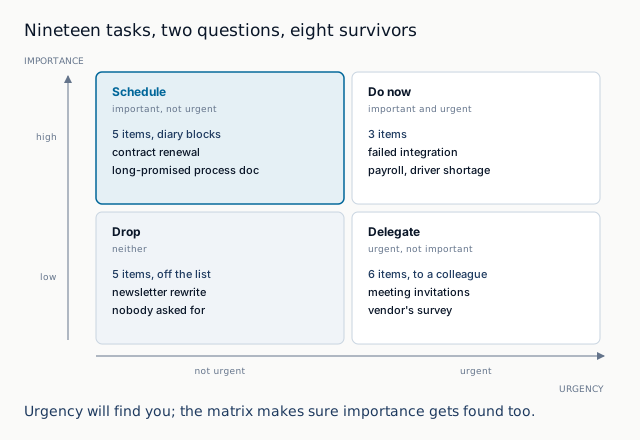
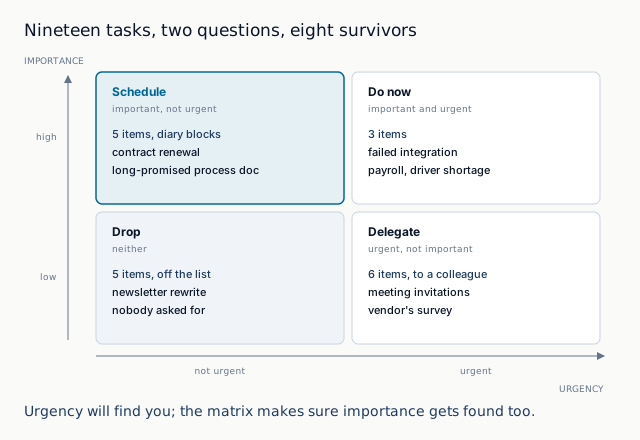
The grid puts importance on the vertical axis and urgency on the horizontal. Top right, important and urgent, is Do now : the burst pipe, the investor call moved to this afternoon. Top left, important but not urgent, is Schedule : the hiring plan, the pricing review, the conversation with a struggling colleague. Bottom right, urgent but not important, is Delegate : requests that are noisy and time-bound but would be handled perfectly well by someone else. Bottom left, neither, is Drop , and it is usually fuller than anyone admits.
The real payoff is the top-left box. Work that matters but has no deadline is exactly the work that gets displaced, because urgency is loud and importance is quiet. Left alone, today's unscheduled important task becomes next month's crisis, and the Do now box fills with problems that could have been prevented.
Consider the operations lead at a twelve-person logistics start-up on a Monday morning with nineteen items on her list. Sorting them takes ten minutes. Three are genuinely urgent and important: a failed customer integration, payroll sign-off and a driver shortage for Wednesday. Five, including a supplier contract renewal due in six weeks and a long-promised process document, are important but not urgent, so they get blocks in the diary this week. Six are urgent mainly for someone else, such as meeting invitations and a vendor's survey, and go to a colleague or get a two-line reply. The last five, among them a newsletter rewrite nobody asked for, simply leave the list. She ends the morning with eight items rather than nineteen, and two of them are the ones that would have bitten in a month.
The matrix misleads when urgency is treated as a fixed property rather than something often manufactured by other people's poor planning. It also assumes importance is obvious, when deciding what matters is frequently the hard part; the grid organises that judgement but cannot make it. And it says nothing about effort, so a vital two-minute task and a vital two-month project land in the same box. Used as a quick sort rather than a philosophy, though, it is hard to beat.
Urgency will always find you; the matrix exists so that importance gets found too.
Top 100 Decision Models for Strategic Thinking — One hundred ways to think before you choose
Ready when you are.
Tap below to open the full chapter in the book reader. Anchored books jump to this chapter automatically.
The Pareto Principle
Top 100 Decision Models for Strategic Thinking — One hundred ways to think before you choose
The Pareto Principle is the observation that outcomes are rarely spread evenly across their causes: a minority of inputs tends to produce a majority of results. The name honours Vilfredo Pareto, the Italian economist who noticed in the 1890s that a small share of the population held most of the land. The quality pioneer Joseph Juran later generalised the pattern to defects and their causes, calling them the vital few and the trivial many , and attached Pareto's name to it. The famous 80/20 split is shorthand, not law; real data might come out at 70/30 or 95/5, and the two numbers need not add up to 100 at all, since they measure different things.
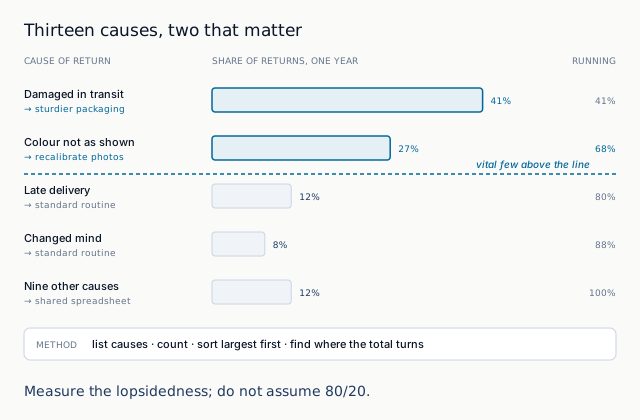
The working method is simple. List the causes of an outcome you care about, count how often each occurs or how much each costs, sort them from largest to smallest, and see where the running total crosses most of the effect. The few causes above that line are where attention pays. Everything below it can wait or be handled by a standard routine.
Take a small online furniture shop whose returns are eating its margin. The founder pulls a year of return reasons and finds thirteen different causes. Sorted, the picture is stark: damage in transit accounts for 41 per cent of returns, colours that look different from the photos for 27 per cent, late delivery for 12 per cent and customers changing their minds for 8 per cent, with nine other causes sharing the last 12 per cent between them. Two causes out of thirteen drive more than two-thirds of the problem. Sturdier packaging for the most fragile products and recalibrated product photography become the quarter's priorities; the long tail gets a shared spreadsheet and no meetings.
The principle misleads in three common ways. First, people assume the ratio instead of measuring it, announcing that a fifth of customers bring four-fifths of revenue without checking. Second, the tail is not always trivial: a rare cause can be catastrophic, and a single safety failure outweighs a hundred cosmetic ones. Third, cutting the trivial many can backfire when they are cheap to serve and quietly form the base the vital few grow from. Counting frequency is not the same as counting consequence, so the sort should use whichever measure actually matters.
Most problems are lopsided; the skill lies in measuring the lopsidedness rather than assuming it.
Top 100 Decision Models for Strategic Thinking — One hundred ways to think before you choose
Ready when you are.
Tap below to open the full chapter in the book reader. Anchored books jump to this chapter automatically.
Opportunity Cost
Top 100 Decision Models for Strategic Thinking — One hundred ways to think before you choose
Opportunity cost is the value of the best alternative you give up when you choose something. Every yes spends time, money or attention that could have gone elsewhere, and the true cost of a choice is not just what it consumes but what that resource would otherwise have done. Economists had circled the idea for a long time before the Austrian economist Friedrich von Wieser gave it its name in the early twentieth century. It is now among the first ideas taught in any economics course, and among the first forgotten in any planning meeting.
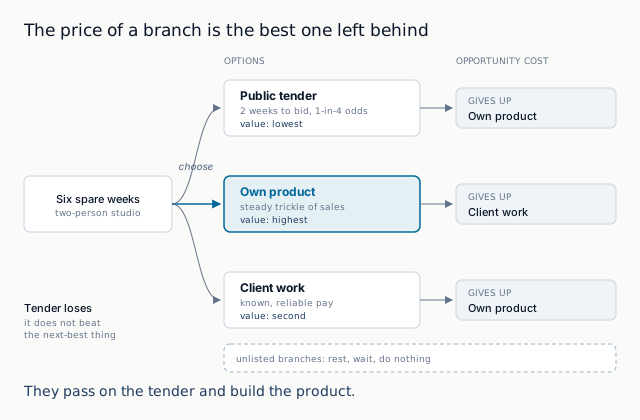
The mechanics are straightforward. Lay out the realistic options for a scarce resource, estimate what each would return, and pick one. The opportunity cost of your pick is the return of the best option you rejected: not the average of the others, and certainly not the worst. If the option you chose returns less than its opportunity cost, you have made a loss, even if the accounts show a profit.
Picture a two-person design studio with roughly six spare weeks. Option one is bidding for a large public tender: plenty of work if they win, but the bid alone eats two weeks and their odds are perhaps one in four. Option two is finishing their own template product, which they expect to bring in a modest, steady trickle of sales for years. Option three is filling the gap with routine client work they know will pay. On a rough expected-value basis the product comes out on top, the client work a close second and the tender last. So the opportunity cost of chasing the tender is the product, and the opportunity cost of building the product is the client work. Framed that way, the founders stop debating whether the tender is good and ask whether it beats the next-best thing. It does not, so they pass, and build the product.
The concept is easiest to misuse by ignoring it. Free things are the classic trap: a "free" conference costs two days, and an unpaid pilot costs the deal you would have chased instead. It also misleads when the alternatives are imagined too narrowly, since the best forgone option is often one nobody bothered to list, such as resting, waiting or doing nothing at all. And estimates of what you gave up are guesses by definition. You never see the road not taken, which makes opportunity cost easy to argue about and impossible to audit.
Nothing is free; it is merely priced in a currency you were not watching.
Top 100 Decision Models for Strategic Thinking — One hundred ways to think before you choose
Ready when you are.
Tap below to open the full chapter in the book reader. Anchored books jump to this chapter automatically.
The 5/25 Rule
Top 100 Decision Models for Strategic Thinking — One hundred ways to think before you choose
The 5/25 Rule is a blunt method for choosing a small number of goals and protecting them from a large number of decent ones. It comes from a widely retold story in which Warren Buffett advises his personal pilot to write down his top 25 career goals, circle the five that matter most, and then treat the remaining twenty not as a backlog but as a list to avoid at all costs. The anecdote is popular and probably embellished, and its details have never been firmly confirmed, so it is best read as a parable rather than history. The idea stands on its own regardless.
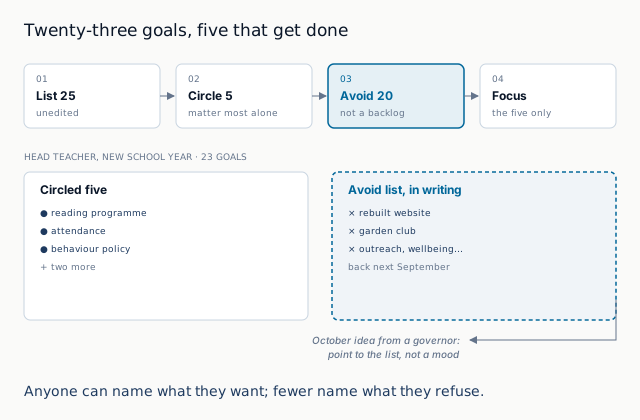
The method has four moves. First, list up to 25 things you want to achieve over a set period, without editing. Second, circle the five that would matter most if they were the only ones completed. Third, and this is the hard part, label the other twenty an avoid list: these are not things to get to later, they are the most dangerous distractions you have, precisely because they are attractive. Fourth, put your time into the five and nothing else until they are done or deliberately revised.
Imagine a head teacher at a primary school at the start of a new academic year. Her honest list runs to 23 goals: a reading programme, a new behaviour policy, a garden club, a rebuilt website, an outreach scheme for parents, a staff wellbeing review and more. She circles five, including reading, attendance and the behaviour policy. The rebuilt website and the garden club are both good ideas with enthusiastic champions, which is exactly why they go on the avoid list in writing, with a note that they return to the table next September. When a governor proposes a fresh initiative in October, she can point to a list rather than defend a mood.
The rule's weaknesses are real. Twenty-five and five are arbitrary numbers; a team of fifty can carry more than five priorities, while one person may only manage two. Goals are not independent either. Sometimes one of the twenty is a prerequisite for one of the five, and banning it stalls the work that matters. The avoid list can also become a graveyard for things that were merely uncomfortable rather than unimportant. The rule works best as a periodic forcing exercise, revisited every few months, not as a vow.
The second list is the useful one: anyone can name what they want, but fewer can name what they will refuse.
Top 100 Decision Models for Strategic Thinking — One hundred ways to think before you choose
Ready when you are.
Tap below to open the full chapter in the book reader. Anchored books jump to this chapter automatically.
The Value vs Effort Matrix
Top 100 Decision Models for Strategic Thinking — One hundred ways to think before you choose
The Value vs Effort Matrix is the simplest way to compare a pile of ideas that all sound worthwhile. It has no single inventor. It grew out of lean, agile and product-management practice, where teams needed a quick, visual way to triage backlogs, and it travels under several names, including the impact–effort grid and the action priority matrix.
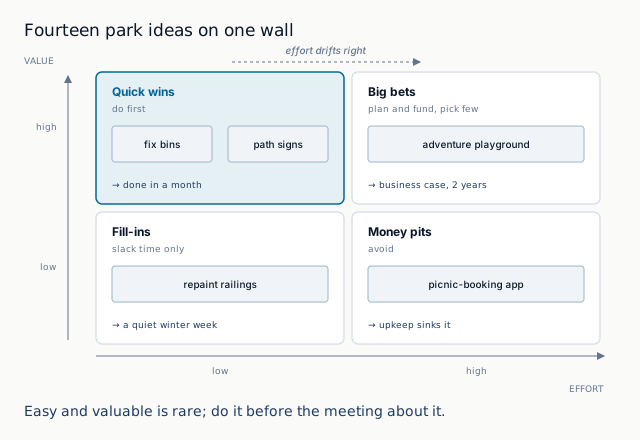
Each idea is placed on two axes. Effort runs left to right, from low to high; value runs from bottom to top. The four quadrants that result have conventional names. Top left, high value for low effort, is Quick wins : do these first. Top right, high value for high effort, is Big bets : worth doing, but they need planning, money and patience, so pick few. Bottom left, low value for low effort, is Fill-ins : fine for a slack afternoon, harmful as a strategy. Bottom right, low value for high effort, is Money pits , sometimes politely called thankless tasks: avoid them, and be wary of anyone who champions one passionately.
The model's strength is relative placement. Nobody needs precise numbers; the team only needs to agree that idea A is worth more than idea B and costs less. That is usually quick, and the disagreements that surface along the way are often the most useful part of the exercise.
Picture the parks team of a mid-sized town council with fourteen improvement ideas and a limited budget. They put sticky notes on a wall-sized grid. Fixing broken bins and adding signs to the busiest footpath land in Quick wins and are done within a month. A new adventure playground is a Big bet: high value and a great deal of work, so it gets a proper business case and a two-year timeline. Repainting railings nobody has complained about is a Fill-in, kept for a quiet winter week. An app for booking picnic spots, championed loudly at a public meeting, lands squarely in the Money pit once the team estimates the upkeep, and is politely shelved.
The matrix misleads in predictable ways. Estimates of effort are almost always optimistic, so quick wins drift to the right once work begins. Value is often judged from one viewpoint only, usually that of whoever holds the marker pen. And a team that only ever takes quick wins will look busy for a year while avoiding every big bet that would change its position. The grid is a first cut, not a final ranking; follow it with a closer look at the top few.
Easy and valuable is rare; when you find it, do it before someone schedules a meeting about it.
Top 100 Decision Models for Strategic Thinking — One hundred ways to think before you choose
Ready when you are.
Tap below to open the full chapter in the book reader. Anchored books jump to this chapter automatically.
MoSCoW Prioritisation
Top 100 Decision Models for Strategic Thinking — One hundred ways to think before you choose
MoSCoW is a way of agreeing what a project will and will not deliver when time or money is fixed. Dai Clegg devised it in 1994 while working at Oracle, and it was soon adopted by the Dynamic Systems Development Method, one of the early agile frameworks. The capital letters spell four categories; the lower-case o's are there only to make the word pronounceable.
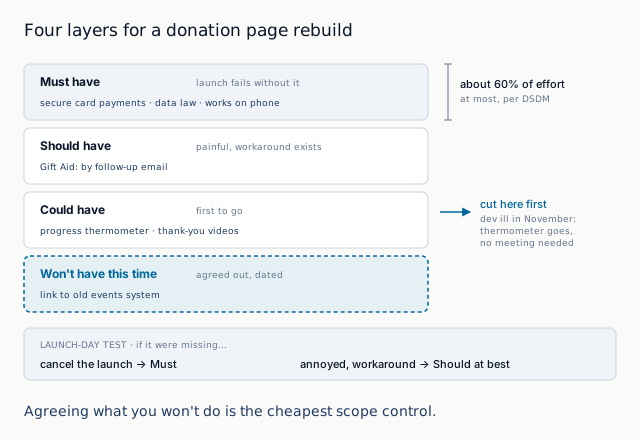
The four categories form layers. Must have covers requirements without which the delivery is pointless, unlawful or unsafe; if any Must is missing, the release has failed. Should have items are important and painful to leave out, but a workaround exists. Could have items are desirable and the first to go when time runs short. Won't have this time is the most valuable category, because it records, explicitly and in advance, what everyone has agreed not to do in this round. DSDM guidance suggests that Musts should take up no more than about 60 per cent of the effort, so that the lower layers act as contingency.
The discipline lies in the definitions. A Must is not merely something important; it is something whose absence breaks the whole. The test is to ask what would happen if the item were missing on launch day. If the honest answer is that the launch should be cancelled, it is a Must. If people would be annoyed and use a workaround, it is a Should at best.
Consider a small charity rebuilding its online donation page before a winter appeal. The wish list runs to twenty items. Taking card payments securely, complying with data-protection law and working properly on a phone are Musts. Gift Aid declarations are a Should, because they can be collected by follow-up email for a few weeks. A progress thermometer and personalised thank-you videos are Coulds. Integration with the old events system, which the trustees keep raising, is a Won't, written down and dated. When the developer falls ill for a week in November, the team drops the thermometer without a meeting, because that decision was taken months earlier.
MoSCoW fails when everything becomes a Must, which happens whenever stakeholders suspect that Should is a polite word for never. It offers no ranking within a category, so twelve Musts give no hint about which to build first. And Won't lists are often quietly ignored, which defeats their purpose. The method works when someone with authority enforces the definitions and revisits the Won'ts at the start of the next round.
Agreeing what you will not do is the cheapest scope control there is.
Top 100 Decision Models for Strategic Thinking — One hundred ways to think before you choose
Ready when you are.
Tap below to open the full chapter in the book reader. Anchored books jump to this chapter automatically.
RICE Scoring
Top 100 Decision Models for Strategic Thinking — One hundred ways to think before you choose
RICE scoring turns a debate about which feature to build next into an arithmetic problem with its assumptions on display. The product team at Intercom, the customer-messaging company, published it around 2016 after finding that existing scoring methods left too much room for pet projects. The acronym names the four factors in the formula.
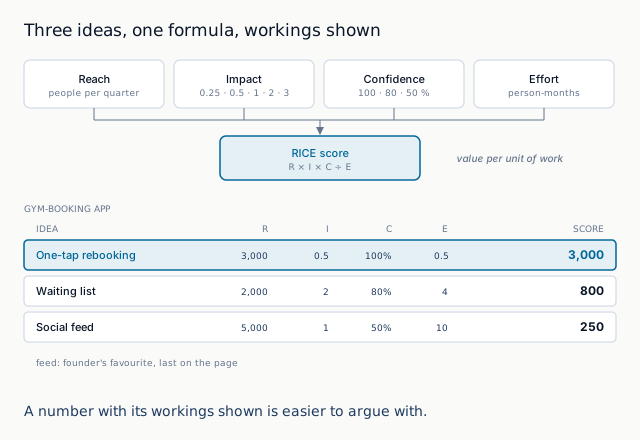
Reach is how many people the idea will affect in a set period, such as customers per quarter, counted rather than felt. Impact is how much it will move the goal for each of them, on a deliberately coarse scale; Intercom's version runs from 0.25 for minimal, through 0.5, 1 and 2, to 3 for massive. Confidence is a percentage reflecting how much evidence supports the other estimates, typically 100 for high, 80 for medium and 50 for low. Effort is the total work required, in person-months. The score is reach times impact times confidence, divided by effort: value delivered per unit of work.
Confidence is the factor that does the quiet work. It forces a team to discount exciting ideas that rest on a hunch, and to admit out loud when it does not really know.
Picture a four-person product team at a gym-booking app weighing three ideas. A waiting-list feature would reach about 2,000 members a quarter, with an impact of 2, confidence of 80 per cent drawn from support tickets, and four person-months of effort: 2,000 × 2 × 0.8 ÷ 4 gives 800. A social feed for sharing workouts would reach more people, perhaps 5,000, but its impact is a guess at 1, confidence is 50 per cent and the effort is ten person-months, which gives 250. A one-tap rebooking button reaches 3,000 members with an impact of 0.5, full confidence and half a person-month of work, scoring 3,000. The modest button wins comfortably, followed by the waiting list. The social feed, which the founder loved, comes last, and the reasons are on the page rather than in anyone's head.
RICE misleads when its inputs are reverse-engineered to justify a decision already made, which is easy because every factor is an estimate. Its tidy output also hides the fact that impact and confidence are subjective, and that one optimistic number multiplies through the whole score. It favours small, measurable improvements and can starve strategic bets whose reach only appears years later. The score should start a conversation, not end one.
A number with its workings shown is easier to argue with, which is exactly the point.
Top 100 Decision Models for Strategic Thinking — One hundred ways to think before you choose
Ready when you are.
Tap below to open the full chapter in the book reader. Anchored books jump to this chapter automatically.
The Kano Model
Top 100 Decision Models for Strategic Thinking — One hundred ways to think before you choose
The Kano Model explains why adding features does not always make customers happier, and why removing one can make them furious. It was developed by the Japanese quality researcher Noriaki Kano and his colleagues, who published it in 1984. Its central insight is that satisfaction does not rise in a straight line with what you provide; different kinds of feature behave in different ways.
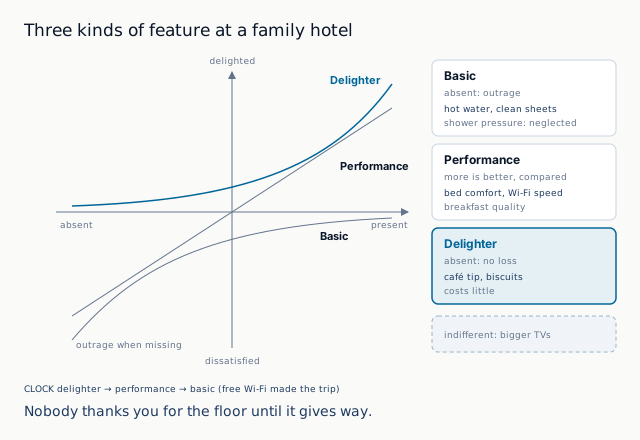
Kano sorts features by how their presence and their absence feel to a customer. Basic needs, sometimes called must-be qualities, are simply expected: having them earns no credit, but lacking them causes outrage. Performance needs are proportional: the more you deliver, the happier people are, and they will readily compare you with rivals on them. Delighters , or attractive qualities, are unexpected: nobody complains when they are missing, but their presence produces a disproportionate lift. Two further categories complete the picture: indifferent features that nobody cares about either way, and reverse features that some customers actively dislike. Teams usually classify features with a short survey that asks how a customer would feel if a feature were present, and how they would feel if it were absent.
Take a family-run hotel reviewing its rooms. Clean sheets, hot water and working Wi-Fi are Basics; guests never praise them, but one cold shower produces a scathing review. Wi-Fi speed, bed comfort and breakfast quality are Performance needs, and guests compare them directly with the place down the road. A handwritten note recommending a hidden local café, or a jar of homemade biscuits, is a Delighter that costs little and turns up in review after review. The owners realise they had been spending on bigger televisions, which their survey shows guests are indifferent to, while the shower pressure, a Basic, had been neglected for two years.
The model has a built-in clock. Delighters decay into Performance needs and then into Basics as customers grow used to them and competitors copy them; free hotel Wi-Fi made exactly that journey. A Kano analysis is therefore a snapshot and needs repeating. It also varies by segment, since one guest's delighter is another's indifference, and survey answers about hypothetical features can differ from real behaviour. Finally, it says nothing about cost, so it is best paired with a method that does.
Customers never thank you for the floor, but they certainly notice when it gives way.
Top 100 Decision Models for Strategic Thinking — One hundred ways to think before you choose
Ready when you are.
Tap below to open the full chapter in the book reader. Anchored books jump to this chapter automatically.
The Theory of Constraints
Top 100 Decision Models for Strategic Thinking — One hundred ways to think before you choose
The Theory of Constraints holds that the output of any system is limited by one bottleneck at a time, and that improving anything other than that bottleneck is largely wasted effort. The Israeli physicist turned management thinker Eliyahu Goldratt set it out in The Goal , a 1984 business novel about a struggling factory, and refined it over the following years. The idea applies to any chain of dependent steps: a kitchen, a hiring pipeline, a software release, an emergency department.
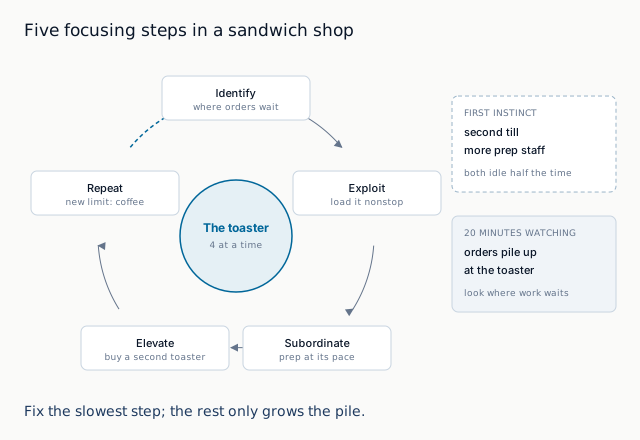
Goldratt's method has five focusing steps that loop. Identify the constraint: the step where work piles up waiting. Exploit it: get the most out of the constraint as it stands, so that it never sits idle and never works on anything defective. Subordinate everything else to it: other steps should run at the constraint's pace, even if that means they sometimes stand still. Elevate it: only now spend money or effort on increasing its capacity. Then repeat , because once that constraint is broken another step becomes the limit, and yesterday's rules must not become tomorrow's bottleneck.
The counterintuitive part is the third step. Keeping every station busy feels efficient, but when an upstream step outpaces the constraint, it simply builds a pile of half-finished work in front of it.
Consider a busy sandwich shop that cannot clear its lunchtime queue. The owner had been weighing a second till and more prep staff. Twenty minutes of watching shows that orders wait at the toaster, which handles four sandwiches at a time, while the tills and the prep counter are idle half the time. Exploiting the constraint means one person loads the toaster continuously rather than between other jobs. Subordinating means prep pauses rather than stacking cold sandwiches, and the tills group hot orders together. Only when that is not enough does the owner elevate by buying a second toaster. The queue then moves to the coffee machine, and the loop begins again.
The theory misleads when people assume they know where the constraint is rather than looking at where work waits. In knowledge work the bottleneck can be one person's approval, a policy or the market itself, none of which shows up on a process map. It can also encourage endless polishing of a step that limits output today but has stopped mattering to the strategy. And when demand varies, the constraint moves, so it is worth watching regularly rather than once.
Improving everything at once mostly improves the size of the pile in front of the slowest step.
Top 100 Decision Models for Strategic Thinking — One hundred ways to think before you choose
Ready when you are.
Tap below to open the full chapter in the book reader. Anchored books jump to this chapter automatically.
The Weighted Decision Matrix
Top 100 Decision Models for Strategic Thinking — One hundred ways to think before you choose
The Weighted Decision Matrix compares a handful of options against several criteria at once, each criterion carrying a weight that reflects how much it matters. It belongs to the family of methods known as multi-criteria decision analysis and is a close relative of the concept-selection matrix popularised by the engineer Stuart Pugh. It is common in engineering, procurement and public bodies, where decisions need to be explained as well as made.
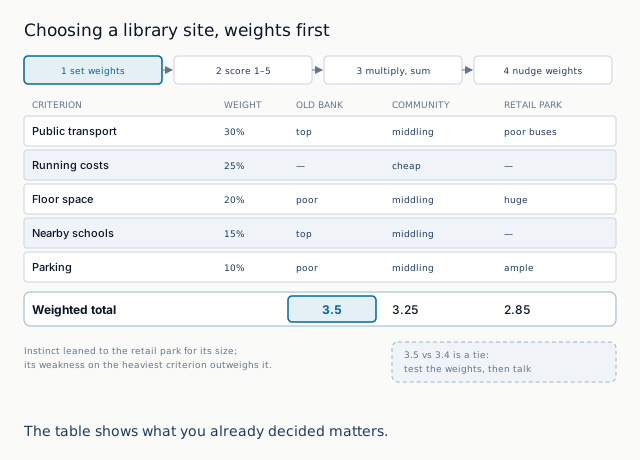
The structure is a simple table, built in four steps. First, agree the criteria and give each a weight, as percentages that sum to 100, before anyone looks closely at the options. Second, score every option against every criterion on a fixed scale, say 1 to 5. Third, multiply each score by its weight and add up each option's total; the highest is the provisional winner. Fourth, test the result by nudging the weights to see whether the winner holds. The order matters: weights first, scores second, because setting weights after seeing the options is the easiest way to rig the outcome.
Consider a county library service choosing between three sites for a new branch. The panel agrees five criteria and weights: access by public transport 30 per cent, running costs 25, floor space 20, nearby schools 15 and parking 10. The old bank on the high street scores top marks on transport and schools but poorly on space and parking. The retail park unit is huge, with ample parking, but badly served by buses. The community centre annexe is cheap to run and middling elsewhere. On the 1–5 scale the weighted totals come out at 3.5 for the old bank, 3.25 for the community centre and 2.85 for the retail park. The panel's instinct had leaned towards the retail park because of its size; the matrix shows that its weakness on the most heavily weighted criterion outweighs its strengths.
The matrix misleads by producing false precision. A total of 3.5 against 3.4 is a tie dressed up as a decision, and scores on a five-point scale are judgements, not measurements. Criteria can overlap and count the same virtue twice, and a fatal flaw can be averaged away unless some criteria are treated as pass-or-fail before scoring begins. Testing sensitivity is the remedy: if a small shift in the weights changes the winner, the decision is closer than the table makes it look, and deserves a conversation rather than a calculation.
The table does not decide for you; it shows you what you have already decided matters.
Top 100 Decision Models for Strategic Thinking — One hundred ways to think before you choose
Ready when you are.
Tap below to open the full chapter in the book reader. Anchored books jump to this chapter automatically.
The Decision Tree
Top 100 Decision Models for Strategic Thinking — One hundred ways to think before you choose
A decision tree is a drawing of a choice and everything that might follow from it. It grew out of the decision analysis developed in the 1960s, most closely associated with Howard Raiffa at Harvard, who turned the arithmetic of probability into something a manager could sketch on a whiteboard. The ambition is modest: put your options and your uncertainties on paper in the order they happen, and let the structure do some of the thinking that anxiety usually does badly.
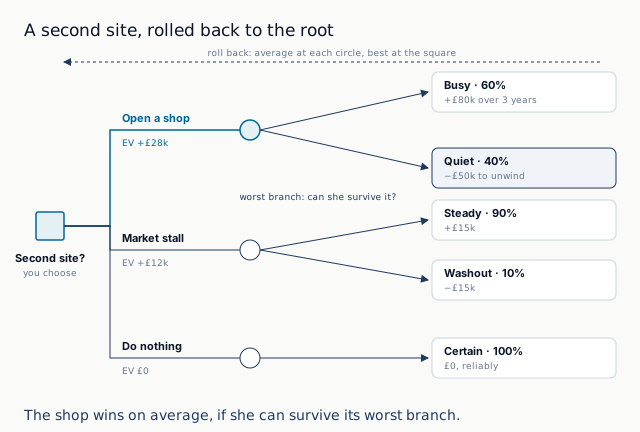
The tree has two kinds of fork. A square marks a decision node , where you choose. A circle marks a chance node , where the world chooses for you, and each branch out of it carries a probability; the branches leaving one circle must add up to 100 per cent. At the tip of every branch sits a payoff. You then work backwards from the tips. At each circle, multiply each payoff by its probability and add them up; at each square, keep the branch with the best result. Whatever survives at the root is the option the numbers favour, with a figure attached.
Take a baker with one successful shop who is weighing a second site. Opening another shop, she reckons, has a 60 per cent chance of being busy enough to add £80,000 over three years and a 40 per cent chance of being quiet and costing £50,000 to unwind. A weekend market stall is humbler: a 90 per cent chance of a steady £15,000 and a 10 per cent chance of a washout that costs £15,000. Doing nothing is worth nothing, reliably. Rolled back, the shop is worth about £28,000 and the stall about £12,000. The tree says shop. It also shows her, on a single branch, the £50,000 loss she would have to survive to get there, which is a different question from which branch is biggest.
That is the tree's real gift. It separates what you control from what you don't, and it forces every vague "it might go wrong" into a branch with a number on it, however rough. Often the most valuable branch is one you add halfway through drawing, such as running a pop-up for a month before signing a lease, because it buys information before the expensive commitment.
The weaknesses are just as visible. Probabilities invented to make the arithmetic work give a precise-looking answer built on guesswork. Trees sprawl: three options with three outcomes each, followed by another round of choices, soon become a hedge nobody can read, so prune to the branches that could actually change the decision. And the rollback assumes you care only about averages, when a single bad branch might be fatal.
A tree will not tell you the future, but it will show you exactly which guess your decision rests on.
Top 100 Decision Models for Strategic Thinking — One hundred ways to think before you choose
Ready when you are.
Tap below to open the full chapter in the book reader. Anchored books jump to this chapter automatically.
Expected Value
Top 100 Decision Models for Strategic Thinking — One hundred ways to think before you choose
Expected value is the average result of a choice if you could make it many times over. The idea comes from a 1654 exchange of letters between Blaise Pascal and Pierre de Fermat about how to split the stakes of an unfinished game of chance, and Christiaan Huygens set it out in print a few years later. Nearly four centuries on, it remains the backbone of insurance, betting and every spreadsheet that claims to weigh risk.
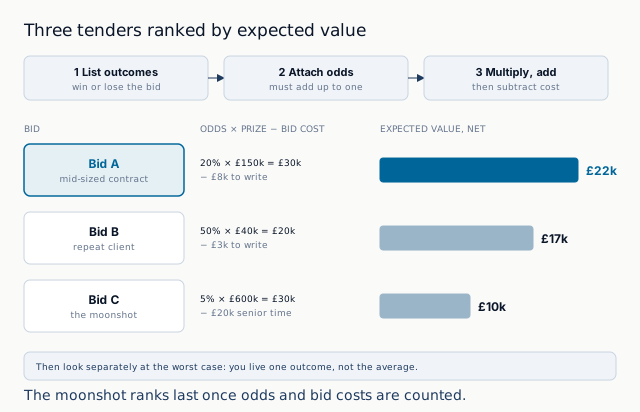
The method has three moves. List the outcomes that could follow a choice. Attach a probability to each, making sure they add up to one. Multiply each outcome by its probability and add the results together. The sum is the expected value: not what will happen, but what each attempt is worth on average. Comparing the expected values of your options, after subtracting what it costs to take part, gives you a fair way to rank them.
Consider a small consultancy with time to prepare only one tender this month. Bid A is a mid-sized contract: a 20 per cent chance of winning £150,000 of work, for about £8,000 of effort to write the bid, which nets an expected £22,000. Bid B comes from a repeat client: a 50 per cent chance at £40,000, costing £3,000 to prepare, so £17,000. Bid C is the moonshot everyone is excited about: a 5 per cent chance at £600,000, but £20,000 of senior time to chase it, so £10,000. The glamorous option comes last, and the dull repeat client sits far closer to the top than anyone in the room expected.
The discipline lies less in the multiplication than in the conversation it forces. Saying "20 per cent" out loud invites someone to ask why not 10, and that argument is usually more useful than the final figure. Expected value also cures a common habit: judging a decision by its outcome. A sound bid that loses was still a sound bid; a reckless one that wins was still reckless.
Its blind spot is that you live through one outcome, not the average. A choice with a handsome expected value and a small chance of ruin is a bad choice if ruin means you never get to play again; the average only arrives for those who survive long enough to collect it. Probabilities for rare events are also notoriously soft, so a large payoff multiplied by a made-up small number can justify almost anything. Use expected value to rank the options, then look separately and honestly at the worst case.
The average is a fine guide to the long run; it is not a promise about next Tuesday.
Top 100 Decision Models for Strategic Thinking — One hundred ways to think before you choose
Ready when you are.
Tap below to open the full chapter in the book reader. Anchored books jump to this chapter automatically.
The Rumsfeld Matrix
Top 100 Decision Models for Strategic Thinking — One hundred ways to think before you choose
In February 2002, at a Pentagon press briefing about the evidence on Iraq, the US Defense Secretary Donald Rumsfeld distinguished between known knowns, known unknowns and unknown unknowns. The line was widely mocked at the time and has since been quietly adopted by project managers, engineers and risk officers, because it names something real. The underlying idea is older: the Johari window, devised by the psychologists Joseph Luft and Harrington Ingham in 1955, crosses what you know about yourself with what others know in a similar grid. The Rumsfeld Matrix is what planners call the version that crosses knowledge with awareness.
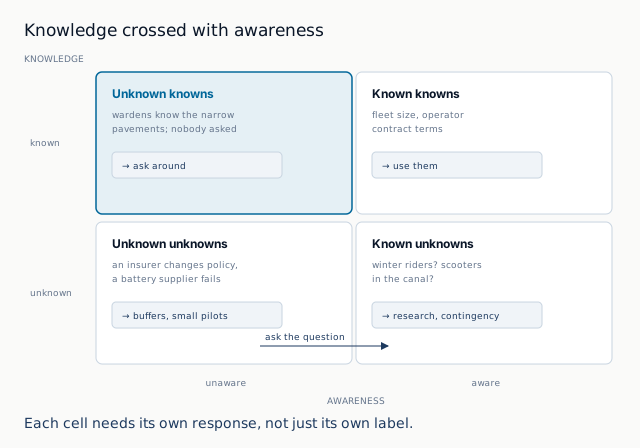
The grid asks two questions. Do we know the answer? And are we aware that the question exists? Known knowns are facts you have and know you have. Known unknowns are questions you have identified but not yet answered; they are what a good risk register is made of. Unknown unknowns are the questions nobody has thought to ask, the source of genuine surprise. The fourth cell, usually left out of the quotation, is unknown knowns : things someone in the organisation knows that never reach the decision, or assumptions held so deeply that nobody examines them.
Picture a city council preparing a rental e-scooter scheme. Its known knowns include the fleet size and the terms of the operator contract. Its known unknowns: how many people will ride in winter, and how many scooters will end up in the canal. Its unknown knowns: the parking wardens already know which pavements are too narrow for a docking bay, but nobody has asked them. Its unknown unknowns are, by definition, impossible to list in advance; perhaps an insurer changes its policy, or a battery supplier quietly goes under.
The matrix earns its place because each cell asks for a different response. Known unknowns call for research, forecasts and contingency budgets. Unknown knowns call for asking around: interviewing the wardens, reading the complaints inbox, inviting the sceptic to the meeting. Unknown unknowns cannot be researched, so the response is structural: buffers, reversible steps and a pilot small enough to survive a surprise.
The misuse is to treat "unknown unknowns" as an alibi, a way to describe a foreseeable failure as an act of fate. Many so-called surprises turn out to have been unknown knowns sitting in someone's inbox. The grid is also static while knowledge moves: today's unknown unknown becomes tomorrow's known unknown the moment someone asks the right question, so the useful work is moving items between cells, not admiring the categories.
The cheapest surprises to remove are the ones somebody already saw coming.
Top 100 Decision Models for Strategic Thinking — One hundred ways to think before you choose
Ready when you are.
Tap below to open the full chapter in the book reader. Anchored books jump to this chapter automatically.
The Cynefin Framework
Top 100 Decision Models for Strategic Thinking — One hundred ways to think before you choose
The Cynefin framework (pronounced roughly kuh-NEV-in , a Welsh word for habitat or a place of belonging) was developed by Dave Snowden from 1999, initially while he worked at IBM. It starts from an observation that sounds obvious and is routinely ignored: different situations need different ways of deciding, and the most common mistake is reaching for the method that suited the last situation. Snowden has renamed the domains more than once over the years; the labels used here are the current ones.
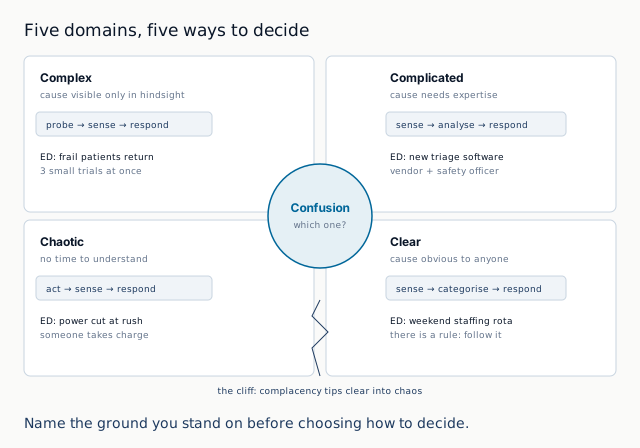
There are four main domains and one in the middle. In clear situations, cause and effect are obvious to anyone, so you sense, categorise and respond with established practice. In complicated situations, cause and effect exist but take expertise to uncover, so you sense, analyse and respond, often by calling in a specialist. In complex situations, cause and effect can only be understood in hindsight, so you probe with small, safe-to-fail experiments, sense what happens and amplify what works. In chaotic situations there is no time to understand anything, so you act to stabilise, then sense, then respond. At the centre sits confusion : not knowing which domain you are in, which is where most arguments about method really begin.
Consider a hospital emergency department on a single Monday. The weekend staffing rota is clear: there is a rule, so follow it. Introducing new triage software is complicated: the vendor's engineers and the clinical safety officer can work out the right configuration if they are given time. Working out why frail patients keep returning within a week is complex: dozens of factors interact, so the team runs three small trials at once, a follow-up phone call, a pharmacist review and a link with a local care home, and keeps whichever moves the numbers. A power cut during the evening rush is chaotic: someone takes charge and acts first.
The framework's practical value is a shared vocabulary for "we are using the wrong tool". Commissioning a six-month analysis of a complex problem wastes the six months; running experiments on something with a known answer wastes everyone's patience. Snowden also warns about the edge between clear and chaotic: complacency in a routine system is how it falls off a cliff.
The usual misuse is to treat Cynefin as a two-by-two grid and drop every problem neatly into a box. Real situations straddle domains and drift between them, and a single project can have clear, complicated and complex parts at the same time. Nor is it a ranking: complex is not better or worse than clear, only different.
Choose the method only after you have named the ground you are standing on.
Top 100 Decision Models for Strategic Thinking — One hundred ways to think before you choose
Ready when you are.
Tap below to open the full chapter in the book reader. Anchored books jump to this chapter automatically.
One-Way and Two-Way Doors
Top 100 Decision Models for Strategic Thinking — One hundred ways to think before you choose
In his letter to Amazon shareholders published in 2016, Jeff Bezos divided decisions into two types. Type 1 decisions are consequential and irreversible, or nearly so: walk through the door and you cannot get back. Type 2 decisions are changeable: if you dislike what you find on the other side, you can step back through. The image of one-way and two-way doors stuck because it turns an abstract property, reversibility, into something you can picture yourself standing in front of.
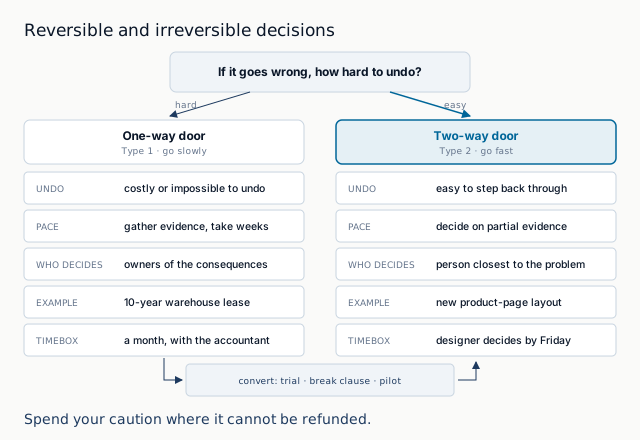
The model asks one question before any other: if this goes wrong, how hard is it to undo? One-way doors deserve slowness. Gather evidence, consult widely, involve whoever owns the consequences and accept that the decision may take weeks. Two-way doors deserve speed. Decide with incomplete information, let the person closest to the problem make the call and treat the outcome as an experiment. Bezos's argument was that large organisations tend to apply the heavy one-way process to everything, and so grow slow and timid on choices that should take an afternoon.
Picture a small online homeware shop with eight staff. This month it faces two decisions: a new layout for its product pages, and a ten-year lease on a warehouse twice the size of the current one. The layout is a two-way door: show it to half the visitors, watch sales for a fortnight, roll it back if it disappoints. The lease is a one-way door: breaking it would cost more than a year's profit. The sensible split is to let the web designer decide the first by Friday and to spend a month on the second, with the founders, their accountant and a long look at worst-case volumes.
The real skill lies in noticing which kind of door you face, because many feel more permanent than they are. A hire looks irreversible but can usually be undone, at a cost. A price change feels risky but can often be reversed next month. Conversely, some small-looking choices quietly lock you in, such as building the whole product on one supplier's proprietary system. A useful habit is to ask whether a one-way door can be turned into a two-way one, with a trial period, a break clause or a pilot in a single region.
The model misleads when reversibility is assumed rather than checked. Some things are technically undoable but not in practice: a broken promise to customers, a public announcement, a key employee who leaves in protest. Treating such choices as two-way doors because the paperwork can be reversed is how teams talk themselves into a speed they cannot afford.
Spend your caution where it cannot be refunded.
Top 100 Decision Models for Strategic Thinking — One hundred ways to think before you choose
Ready when you are.
Tap below to open the full chapter in the book reader. Anchored books jump to this chapter automatically.
The Pre-Mortem
Top 100 Decision Models for Strategic Thinking — One hundred ways to think before you choose
A post-mortem tells you why a patient died, which helps the next patient but not this one. The pre-mortem , described by the psychologist Gary Klein in a short Harvard Business Review article in 2007, moves the exercise to the moment it can still help: before the project starts. It draws on research into what psychologists call prospective hindsight , the finding that people come up with explanations more readily for an event imagined as having already happened than for one framed as merely possible.
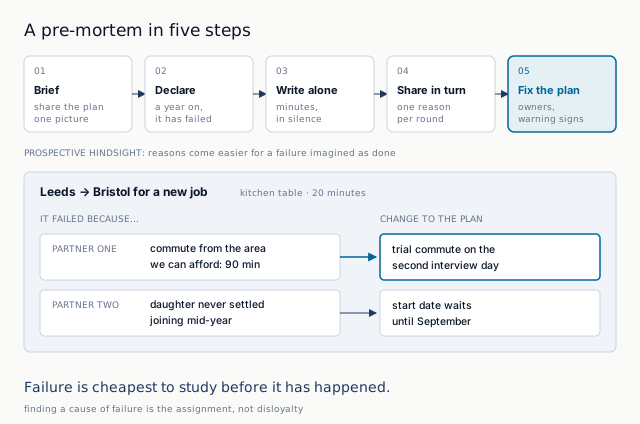
The sequence is simple and works best in a fixed order. First, the team is briefed on the plan, so everyone is imagining the same thing. Second, the facilitator announces that it is a year later and the project has failed, clearly and without hedging. Third, everyone spends a few minutes writing down, alone and in silence, every reason they can think of for the failure. Fourth, the reasons are read out one per person per round, so the loudest voice does not set the agenda. Fifth, the group picks the most plausible and damaging causes and changes the plan to prevent them, or agrees how it will spot them early.
Imagine a couple deciding whether to move from Leeds to Bristol for a new job. In a twenty-minute pre-mortem at the kitchen table, they imagine that it is next summer and the move has been a mistake. Their lists overlap less than either expected. One writes that the commute from the only area they could afford turned out to take ninety minutes. The other writes that their daughter never settled at a school she joined halfway through the year. Neither had said these things aloud, because saying them felt like doubting the plan. The fixes are modest: a trial commute on the day of the second interview, and a start date that waits until September.
The technique works because it changes what counts as loyalty. In an ordinary planning meeting, raising a risk can look like a lack of commitment; in a pre-mortem, finding a convincing cause of failure is the assignment. It is a socially safe way to surface concerns that a hierarchy would otherwise filter out, and it often hands the quietest person in the room the most useful line of the meeting.
It can go wrong in two directions. Run as a box-ticking ritual after the plan has already been approved, it produces a list nobody acts on. Run without a firm facilitator, it can turn into a gloomy free-for-all that sinks a perfectly good project. The output must be changes to the plan, with owners and early warning signs, not a mood.
Failure is cheapest to study before it has happened.
Top 100 Decision Models for Strategic Thinking — One hundred ways to think before you choose
Ready when you are.
Tap below to open the full chapter in the book reader. Anchored books jump to this chapter automatically.
Bayesian Updating
Top 100 Decision Models for Strategic Thinking — One hundred ways to think before you choose
Bayesian updating is the habit of treating beliefs as estimates that move with evidence, by the amount the evidence deserves. It takes its name from Thomas Bayes, an English minister whose essay on probability was published after his death, in 1763, by his friend Richard Price; Pierre-Simon Laplace developed the same idea more fully a few years later. The mathematics can become elaborate, but the core move fits on a napkin.
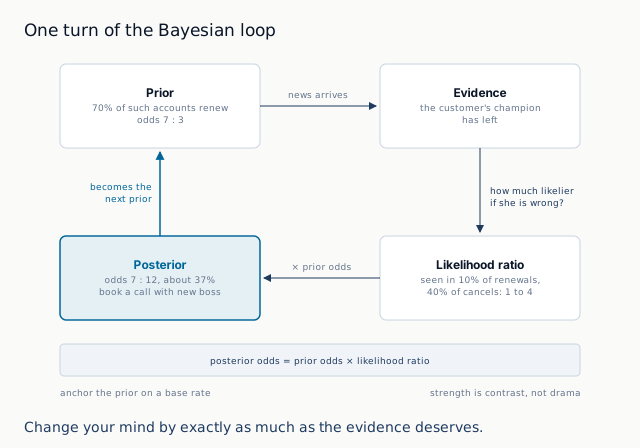
The loop has four stations. You begin with a prior : how likely you think something is before the new information, ideally anchored on a base rate. Then evidence arrives. You ask the crucial question: how much more likely is this evidence if my belief is true than if it is false? That ratio, the likelihood ratio , is the strength of the evidence. Multiply your prior odds by it and you get the posterior , your updated belief. The posterior then becomes the prior for the next piece of evidence, and the loop goes round again.
A software founder has a large customer coming up for renewal. Across her client base, about 70 per cent of accounts like this one renew, so her prior is 70 per cent, or odds of 7 to 3. Then she hears that the customer's internal champion has left. Looking back, she reckons champions leave in about 10 per cent of accounts that go on to renew, but in around 40 per cent of accounts that end up cancelling. The evidence is four times as likely if the customer is leaving, so her odds shift from 7:3 to 7:12, and her belief falls to roughly 37 per cent. Not doomed, but a different week: she books a call with the new decision-maker.
Two things in that sum carry the lesson. The starting point matters: the same news about a customer with a 95 per cent prior would leave her far less worried. And the strength of evidence lies in the contrast, not the drama. Something that happens almost as often when you are wrong as when you are right should barely move you, however vivid it feels. Much poor judgement is evidence overweighted because it is memorable, or a base rate ignored because it is boring.
The model fails mostly through false precision. Priors and likelihoods in everyday decisions are judgement calls, and dressing them in decimals can make a hunch look like a calculation. It can also be gamed: a prior chosen to be extreme will resist almost any evidence. The value lies less in the exact posterior than in the direction and size of the move, and in the willingness to keep moving.
Strong opinions are fine; the skill is knowing how fast to change them.
Top 100 Decision Models for Strategic Thinking — One hundred ways to think before you choose
Ready when you are.
Tap below to open the full chapter in the book reader. Anchored books jump to this chapter automatically.
Margin of Safety
Top 100 Decision Models for Strategic Thinking — One hundred ways to think before you choose
The phrase margin of safety belongs to the investor Benjamin Graham, who used it in Security Analysis , written with David Dodd in 1934, and later made it the subject of the final chapter of The Intelligent Investor (1949). Engineers had the same instinct long before: a bridge expected to carry ten tonnes is built to carry several times that, because loads, materials and calculations all contain error. The principle in both cases is to leave room for being wrong.
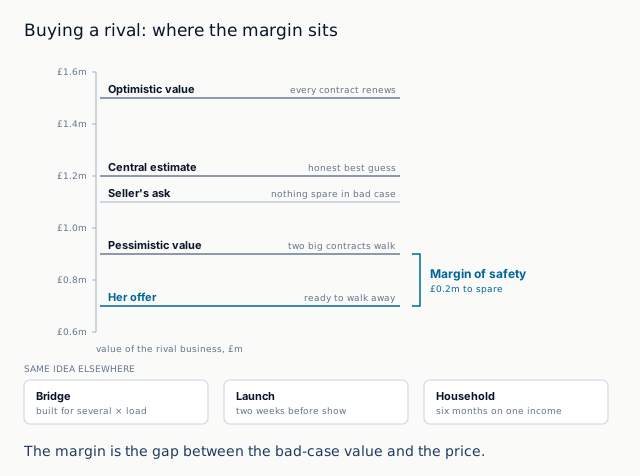
The model rests on four reference points, read from top to bottom. There is the optimistic value of what you are buying or building, the number you would show an investor. There is your central estimate, your honest best guess. There is the pessimistic value, what it is worth if several things go against you. And there is the price you pay, or the load you commit to. The margin of safety is the gap between the pessimistic value and the price: if you only proceed when the price sits comfortably below the pessimistic case, you can be wrong in several directions and still come out whole.
The founder of a cleaning company is offered the chance to buy a smaller local rival. Her optimistic valuation, assuming every contract renews and the new staff stay, is £1.5 million. Her central estimate is £1.2 million. If the two biggest contracts walk and integration drags on for a year, it is worth perhaps £900,000. The seller wants £1.1 million. On her central estimate that looks like a bargain, but it leaves nothing to spare in the bad case. She offers £700,000 and is ready to walk away; at that price, the deal survives the pessimistic version of the story with £200,000 to spare.
The idea travels well beyond investing. A project plan with a launch date two weeks before the trade show has a margin of safety; one timed to finish the night before does not. A household that could still pay the mortgage if one income vanished for six months has one; a household stretched to the limit by the best case does not. In each case the margin is not pessimism, merely an admission that forecasts are made by people.
The misuse runs both ways. A margin that is too wide means never acting: a buyer who demands a huge discount on everything will rarely buy anything. And a margin calculated on the wrong number gives false comfort: if the pessimistic case is really just a slightly less optimistic one, the buffer is decorative. The test is whether your pessimistic case would make you wince.
The margin is what lets a good decision survive bad luck.
Top 100 Decision Models for Strategic Thinking — One hundred ways to think before you choose
Ready when you are.
Tap below to open the full chapter in the book reader. Anchored books jump to this chapter automatically.
The Barbell Strategy
Top 100 Decision Models for Strategic Thinking — One hundred ways to think before you choose
The barbell strategy was popularised by the essayist and former options trader Nassim Nicholas Taleb in The Black Swan (2007) and Antifragile (2012), though bond investors had long used the word for a portfolio split between very short and very long maturities. Taleb's version is broader: put most of your resources somewhere boringly safe, a small part somewhere aggressively speculative, and nothing in the comfortable middle.
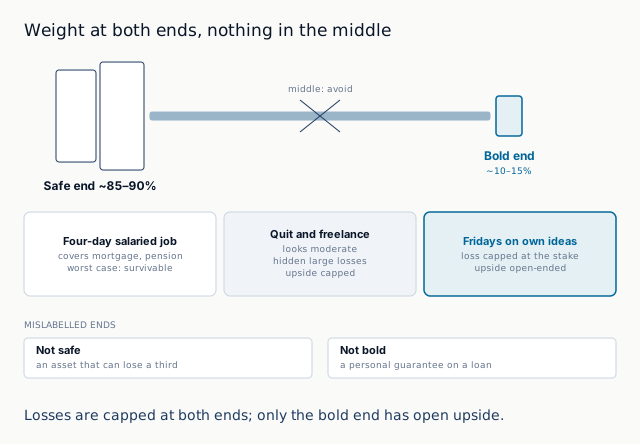
The shape gives the model its name: weight at both ends of the bar and nothing in between. The safe end, perhaps 85 to 90 per cent, is protected from ruin: cash, a stable job, a core product that pays the bills. The bold end, the remaining 10 to 15 per cent, goes on bets with limited downside and open-ended upside: small experiments, side projects, early ideas where you can lose only what you put in but might gain many times over. The middle, where risks look moderate, is what the strategy avoids, because moderate-looking risks can hide large losses while their upside stays capped.
Consider a product designer in her thirties who wants to start something of her own but has a mortgage. The middle path would be to quit and freelance while building her product, a choice that looks balanced but exposes her to losing income and focus at the same time. Her barbell is different. She negotiates a four-day week with her employer, which covers the mortgage and her pension, and spends the fifth day building small things quickly and in public. If none of them works, she has lost some Fridays. If one takes off, she has a business with paying customers before she has resigned.
The logic concerns the shape of outcomes rather than their average. On the safe end, the worst case is known and survivable. On the bold end, losses are capped at the stake, but gains are not. A team can apply the same structure to its roadmap, keeping most of its capacity on reliable improvements and a fixed slice on wild experiments, and an organisation can do the same with its budget.
The barbell misleads when either end is mislabelled. A "safe" asset that can quietly lose a third of its value is not the safe end, and a speculative bet with open-ended losses, such as a personal guarantee on a loan, does not belong on the bold end at all. It is also easy to drift back to the middle, as the fifth day slowly grows into a half-hearted second job. The structure only works when both ends are protected deliberately.
Be cautious with most of what you have, so you can afford to be adventurous with the rest.
Top 100 Decision Models for Strategic Thinking — One hundred ways to think before you choose
Ready when you are.
Tap below to open the full chapter in the book reader. Anchored books jump to this chapter automatically.
Real Options
Top 100 Decision Models for Strategic Thinking — One hundred ways to think before you choose
Real options apply a piece of financial thinking to physical decisions: factories, leases, product lines, research. The term was coined by the MIT finance professor Stewart Myers in 1977, a few years after Fischer Black, Myron Scholes and Robert Merton had shown how to value financial options. The insight that carried across is simple: the right, but not the obligation, to do something later has value, and sometimes it is worth paying for.
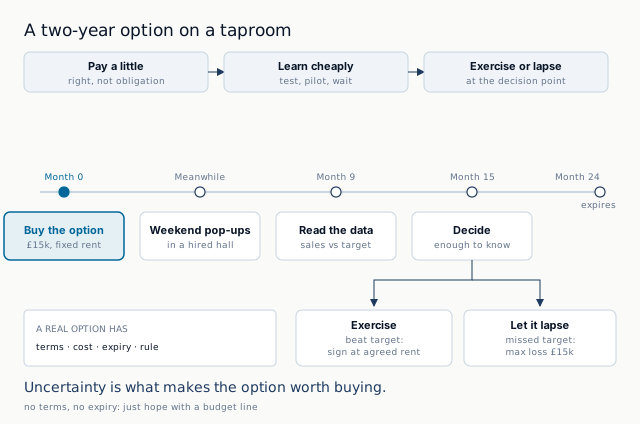
An option has a recognisable life cycle. You pay a small, fixed amount now to secure the right to act later on known terms. You use the time it buys to learn cheaply, through a test, a pilot or simply by waiting for information to arrive. Then, at a decision point, you either exercise the option, committing fully because the evidence supports it, or let it lapse , in which case your loss is the fee and nothing more. Uncertainty, which normally argues for doing nothing, becomes the source of the option's value: the more uncertain the future, the more it is worth keeping a door open cheaply.
A regional brewery wants to open a taproom in a neighbouring town but has no idea whether locals will come. Signing a lease outright is a big bet. Instead it pays the landlord £15,000 for a two-year option on a unit at a fixed rent. In the meantime it runs weekend pop-ups in a hired hall. By month nine it has sales data; by month fifteen it knows enough to decide. If the pop-ups have beaten their target, it exercises the option and signs the lease at the agreed rent. If not, it lets the option lapse. The worst case is the £15,000, a fraction of what a failed taproom would have cost.
Thinking in real options changes how you read plans. A building designed to take an extra floor, a contract with a break clause, a pilot in one city, a prototype before tooling, a second supplier kept warm: each buys flexibility. It also changes how you value projects that look unprofitable on their own, because a small first product may be worth more for the doors it opens than for its own cash.
The concept is abused when every vague possibility is called an option to justify spending. A real option has defined terms, a cost, an expiry date and a rule for exercising it; without those it is just hope with a budget line. Options also decay: keeping too many open drains money and attention, and an option nobody is prepared either to exercise or to abandon is merely procrastination with paperwork.
When you cannot know, pay a little to find out before you pay a lot to commit.
Top 100 Decision Models for Strategic Thinking — One hundred ways to think before you choose
Ready when you are.
Tap below to open the full chapter in the book reader. Anchored books jump to this chapter automatically.
First Principles
Top 100 Decision Models for Strategic Thinking — One hundred ways to think before you choose
A first principle is a claim that cannot be broken down any further: a fact of physics, a law, a basic human need, a hard constraint. Aristotle used the term for the foundational propositions from which knowledge is built, and engineers have long worked this way. The idea has lately become fashionable in startup circles, mostly as a stick with which to beat reasoning by analogy , which is what most of us do most of the time: doing something because that is how similar things are done.
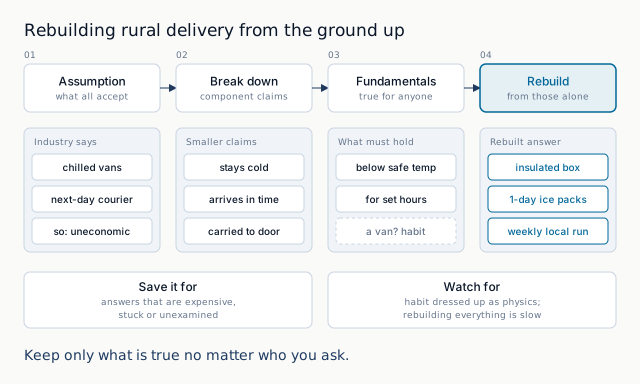
Analogy is efficient and usually fine. The trouble starts when an inherited answer carries hidden costs that nobody has questioned. First-principles thinking runs in four moves. Write down the assumption everyone accepts. Break it down into its component claims. Keep only the fundamentals , the pieces that are true no matter who you ask. Then rebuild a solution from those pieces alone, ignoring how it has been done before.
Take a founder starting a meal-kit business for small villages. The industry assumption is that fresh ingredients need refrigerated vans and next-day courier networks, which makes rural delivery uneconomic. Broken down, the claim becomes several smaller ones: the food must stay cold, it must arrive before it spoils, and someone must carry it the last mile. The fundamentals turn out to be narrower than the assumption. The food needs to stay below a safe temperature for a set number of hours; it does not need a van to do so. Rebuilt from there, the answer looks different: insulated boxes with ice packs rated for a full day, delivered once a week on a fixed route by a local driver who already passes every village. Nothing about it is clever. It simply was not visible from inside the analogy.
The model has costs of its own. Rebuilding from scratch is slow, and doing it for every decision would be exhausting as well as arrogant; most conventions exist because someone already did the thinking. It also tempts people to mistake their own assumptions for fundamentals, so that "customers only care about price" gets treated as a law of nature. And the fundamentals of a physical problem are easier to agree on than those of a human one, where regulation, trust and habit are real constraints even when they look like mere convention. The sensible discipline is to save the method for the few problems where the standard answer is expensive, stuck or suspiciously unexamined.
The aim is not to be original; it is to know which parts of the answer are load-bearing.
Top 100 Decision Models for Strategic Thinking — One hundred ways to think before you choose
Ready when you are.
Tap below to open the full chapter in the book reader. Anchored books jump to this chapter automatically.
Inversion
Top 100 Decision Models for Strategic Thinking — One hundred ways to think before you choose
Most planning runs forwards: here is the goal, so what must we do to reach it? Inversion turns the question round: what would guarantee that we miss it? The mathematician Carl Jacobi is said to have urged his students to "invert, always invert", meaning that many hard problems become easier when restated backwards. The investor Charlie Munger made the habit famous well beyond mathematics, arguing that consistently avoiding stupidity tends to beat trying to be brilliant.
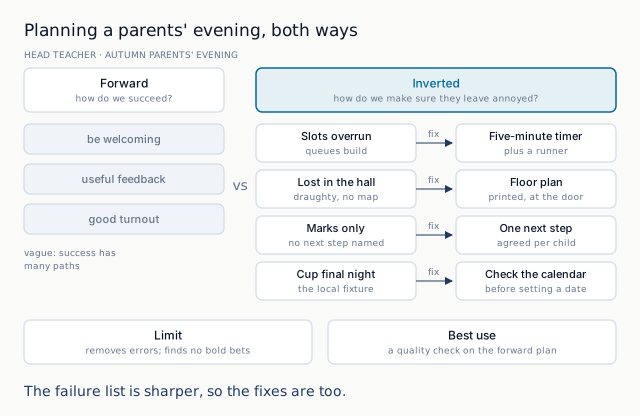
The method has two columns. On the left, the forward question produces the usual aspirations, which tend to be vague because success has many paths. On the right, the inverted question produces a list of specific failure modes, because failure is usually concrete: a missed handover, a meeting nobody wanted, a tired person making a big call at the end of the day. Each failure is then turned into a rule that prevents it, and the prevention list is often shorter, sharper and cheaper than the aspiration list.
A head teacher planning the autumn parents' evening tried both. Forwards, the staff produced the expected answers: make it welcoming, give useful feedback, get a good turnout. Inverted, the question became how to make sure parents leave annoyed and none the wiser. The answers came quickly and were embarrassingly familiar. Let appointments overrun so the queues build; seat parents in a draughty hall with no idea where each teacher is; let teachers talk about marks without naming one thing the child should do next; hold it on the night of the local cup final. Each became a fix: a five-minute timer and a runner to keep slots moving, a printed floor plan at the door, one agreed next step per child, and a glance at the local calendar before setting the date. None of these had appeared on the forward list.
Inversion has limits. It is a tool for removing avoidable errors, not for finding bold opportunities; an organisation that only avoids mistakes may still never do anything worth doing. Failure lists can also balloon into a catalogue of fears that justifies inaction, especially in cautious institutions. And some failures are visible only to people who have lived through them, so an inverted brainstorm among novices may simply recycle the forward list with the word "not" added. The technique works best alongside a forward plan, as a quality check rather than a replacement.
Success has many routes; failure tends to leave a clear set of fingerprints.
Top 100 Decision Models for Strategic Thinking — One hundred ways to think before you choose
Ready when you are.
Tap below to open the full chapter in the book reader. Anchored books jump to this chapter automatically.
Second-Order Thinking
Top 100 Decision Models for Strategic Thinking — One hundred ways to think before you choose
Every decision has an immediate effect, the one it was designed to produce. Second-order thinking asks what happens next: how people, markets and systems respond to that first effect, and what their responses cause in turn. The idea is old, since economists have warned about unintended consequences for centuries, but the investor Howard Marks gave it its current label, contrasting first-level thinkers, who stop at the obvious, with second-level thinkers who keep asking and then what?
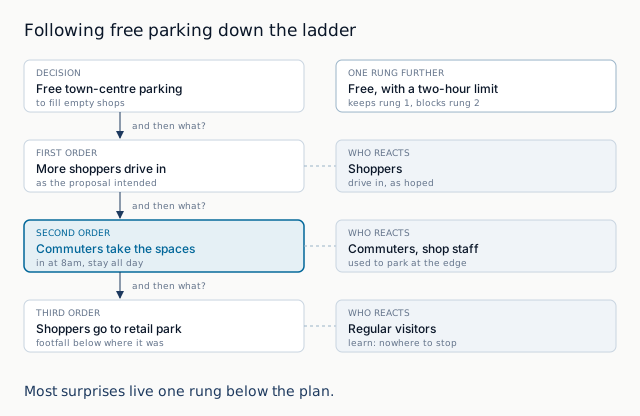
The structure is a ladder of consequences. At the top sits the decision . Below it comes the first-order effect , usually the one written in the proposal. Below that are the second-order effects : the reactions of everyone affected, including people who were never in the room. Further down sit the third-order effects , where those reactions settle into new habits, prices or norms. Most of the trouble, and most of the opportunity, lives on the second rung, because that is where other people's incentives enter.
Consider a market-town council worried about empty shops. The proposal is to make town-centre parking free. First order: more shoppers drive in, as intended. Second order: commuters and shop staff, who used to park at the edge of town to avoid the fees, now take the central spaces at eight in the morning and stay all day. By ten there is nowhere left for a shopper to stop. Third order: regular visitors learn that the town is impossible to park in and head for the retail park instead, so footfall ends up lower than before the change. A council that had thought one rung further might have chosen free parking with a two-hour limit, keeping the first-order benefit while blocking the second-order behaviour.
The method is easy to overdo. Consequences branch, and beyond the second or third rung forecasts become guesses; spending a week mapping the fifth-order effects of a minor decision is a form of avoidance in its own right. It can also become a reason never to act, since almost any change has a downside somewhere down the chain. The more useful habit is narrower: identify who will change their behaviour because of the decision, and ask what they will do. That single question catches most of the damage, and it often shows that the best option is a small tweak to the original idea rather than a different idea altogether.
The first effect is the one you planned; the second is the one you will be remembered for.
Top 100 Decision Models for Strategic Thinking — One hundred ways to think before you choose
Ready when you are.
Tap below to open the full chapter in the book reader. Anchored books jump to this chapter automatically.
Occam's Razor
Top 100 Decision Models for Strategic Thinking — One hundred ways to think before you choose
Occam's razor is the principle that, among explanations that fit the facts equally well, the one requiring the fewest assumptions should be tried first. It is named after William of Ockham, a fourteenth-century English friar and logician, although the familiar wording and the name "razor" came later, and versions of the idea go back to Aristotle. The razor shaves away explanations that need more moving parts than the evidence demands.
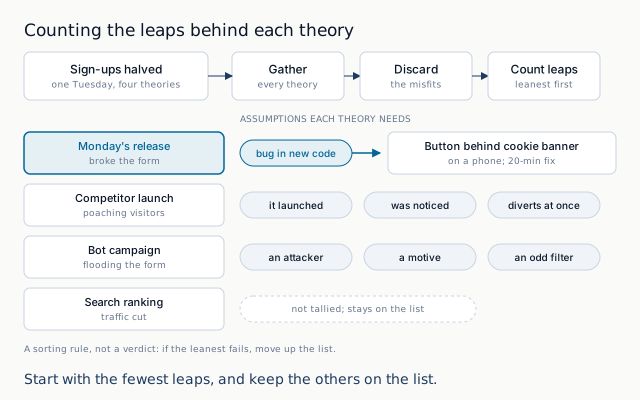
Applying it takes three steps. Gather every explanation anyone has proposed. Discard those that do not fit the facts you actually have. Then, among the survivors, count the assumptions each one needs in order to be true, and investigate the leanest first. The razor does not say that the simplest explanation is true. It says it is the cheapest place to start looking, because it has fewer ways of being wrong.
A small software company noticed one Tuesday that sign-ups had fallen by roughly half. Within an hour the team had four theories. A competitor had launched a rival product that morning and was poaching visitors. A change in a search engine's ranking had cut traffic. A bot campaign was flooding the form so that the system was rejecting real users. Or Monday evening's release had broken something in the sign-up page. Counting assumptions changed the conversation. The competitor theory needed the launch to have happened, to have been noticed and to divert people instantly. The bot theory needed an attacker, a motive and a filter behaving oddly. The release theory needed only one thing: a bug in code that had changed the day before. Someone opened the form on a phone and found the submit button hidden behind a cookie banner. The fix took twenty minutes.
The razor misleads when it is treated as a verdict rather than a sorting rule. Reality is not obliged to be simple; medicine, ecology and economics are full of cases where the true cause has several interacting parts, and doctors are taught that a patient can have more than one illness at once. Simplicity is also in the eye of the beholder: an explanation feels simple when it matches a familiar story, which can turn the razor into a cover for bias. The honest use is procedural. Rank the candidates by their assumptions, test the leanest first, and move up the list without embarrassment when it fails.
Start with the fewest leaps, and keep the others on the list.
Top 100 Decision Models for Strategic Thinking — One hundred ways to think before you choose
Ready when you are.
Tap below to open the full chapter in the book reader. Anchored books jump to this chapter automatically.
Hanlon's Razor
Top 100 Decision Models for Strategic Thinking — One hundred ways to think before you choose
Hanlon's razor says: never attribute to malice what can be adequately explained by stupidity. The line is usually credited to Robert J. Hanlon, who submitted it to a 1980 collection of jokes in the spirit of Murphy's law, though similar sentiments appear much earlier in literature. The blunt wording is part of its charm and part of its problem. A kinder and more useful version swaps stupidity for the ordinary causes of other people's irritating behaviour: error, haste, overload and not knowing what you know.
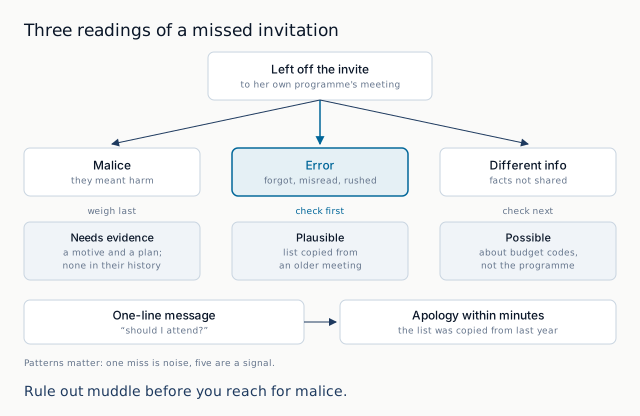
The model works like a short decision tree. Something has gone wrong and it affects you. Before reacting, sort the possible causes into three branches. Malice : they meant to harm you, which is possible but needs evidence. Error : they forgot, misread or rushed, by far the most common branch. Different information : they acted sensibly on facts you did not know they had, or lacked facts you assumed they shared. Only when the second and third branches have been ruled out does the first deserve serious weight.
A project manager at a housing association discovered she had been left off the invitation to a meeting about a programme she ran. Her first reading was political: a colleague in finance was trying to sideline her. Before replying, she ran the tree. Malice would need a motive and a plan, and nothing else in their dealings suggested either. Error was plausible, since the invitation might have been copied from an older meeting that predated her role. Different information was possible too: the meeting might concern budget codes rather than the programme itself. She sent a one-line message asking whether she should attend. The answer came back within minutes, with an apology and a corrected invitation. The list had indeed been copied from last year.
The razor is a default, not a law. Some people do act in bad faith, and a policy of always assuming innocence can be exploited, particularly by those who learn that "sorry, my mistake" works every time. Patterns matter: one missed invitation is noise, five are a signal. It also helps to notice which way the razor usually cuts. People readily excuse their own lapses as accidents while reading intent into identical lapses by others, a tendency social psychologists have studied for decades. Used well, the razor saves relationships, time and the energy that grudges consume, and it still leaves room to act firmly once the evidence genuinely points to intent.
Assume the muddle first; it is usually right, and it is always cheaper.
Top 100 Decision Models for Strategic Thinking — One hundred ways to think before you choose
Ready when you are.
Tap below to open the full chapter in the book reader. Anchored books jump to this chapter automatically.
The Circle of Competence
Top 100 Decision Models for Strategic Thinking — One hundred ways to think before you choose
The circle of competence is the area in which your judgement is reliably good, because you have seen enough cases, made enough mistakes and received enough feedback to know how things usually go. Warren Buffett described the idea in his 1996 letter to shareholders, adding that the size of the circle matters far less than knowing where its boundary lies. His partner Charlie Munger made the same point in talks for years. The model is less about expertise than about self-knowledge.
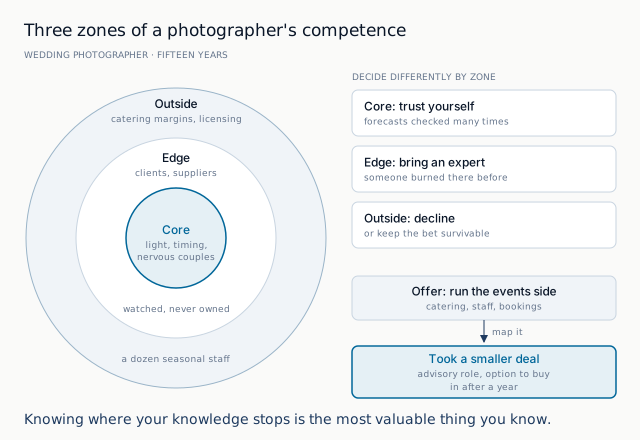
It helps to picture three zones. At the core is what you know you know: tested knowledge, where your forecasts have been checked against reality many times. Around it lies the edge , familiar ground where you understand the vocabulary but have had little direct feedback. Outside is everything else, where your views are borrowed and your confidence is no guide to your accuracy. Each zone calls for a different way of deciding: trust your own judgement at the core, recruit someone who has been burned before at the edge, and outside, either decline or keep the bet small enough to survive being wrong.
A wedding photographer with fifteen years of work behind her had a superb feel for light, timing and nervous couples. A venue where she often worked offered her the chance to take over its whole events business: catering contracts, staffing, licensing and bookings. It felt like a natural step, since she had been to hundreds of weddings there. Mapping the circle made the picture clearer. Photography and the flow of the day were core. Client management and supplier relationships were the edge; she had watched them closely but never owned them. Catering margins, alcohol licensing and employing a dozen seasonal staff sat outside. She took a smaller deal: a paid advisory role on the guest experience, with an option to buy in after a year, once she had seen the books.
The model has blind spots. People rarely know where their circle actually ends, because competence in one field produces a confidence that travels happily into the next, which is how good surgeons become poor investors and good investors become poor pundits. A circle that never grows also becomes a cage; the point is to widen it deliberately, through small bets with fast feedback, rather than to hide inside it. And organisations have circles too, often smaller than their leaders believe, especially once the person who really understood a product has left.
Knowing where your knowledge stops is the most valuable thing you know.
Top 100 Decision Models for Strategic Thinking — One hundred ways to think before you choose
Ready when you are.
Tap below to open the full chapter in the book reader. Anchored books jump to this chapter automatically.
The Map Is Not the Territory
Top 100 Decision Models for Strategic Thinking — One hundred ways to think before you choose
The phrase the map is not the territory comes from Alfred Korzybski, a Polish-American scholar who used it in a 1931 paper on language and meaning. His point was that every representation, whether a word, a model or a spreadsheet, is a simplification of something richer. A map is useful precisely because it leaves things out. The danger comes when we forget that it does, and start managing the map instead of the ground it describes.
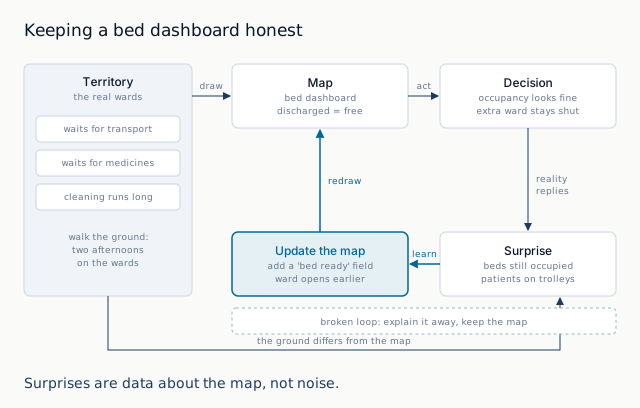
The model is a loop. There is the territory : the messy, changing reality. Someone draws a map of it, choosing what to measure and what to ignore. Decisions are taken from the map. Reality then produces surprises , the gaps between what the map predicted and what actually happened, and a healthy organisation uses those surprises to update the map. The failure is a broken loop, in which surprises are explained away so that the map can stay as it is.
A hospital trust used a bed-occupancy dashboard to decide when to open extra winter capacity. The dashboard counted a bed as free as soon as a patient was discharged on the system. On paper, occupancy hovered at a manageable level, so the extra ward stayed shut. On the wards, nurses described a different place: discharged patients often remained in their beds for hours, waiting for transport or medicines, and cleaning took longer than the system assumed. The map was not exactly wrong; it measured administrative discharge, which is a real thing. It simply was not the thing that mattered to a patient waiting on a trolley. After a manager spent two afternoons walking the wards, the trust added a field recording that a bed was physically ready, and the trigger for opening the extra ward moved earlier.
Treating the idea as a licence to distrust all maps would be a mistake. Without simplification nothing can be managed at scale, and stories from the ground have their own distortions: the loudest anecdote is not always the typical one. The model asks for a habit rather than a rejection. Know what each measure leaves out, keep a regular route back to the territory, and treat persistent disagreement between the numbers and the people doing the work as information about the map. The best map-makers are the ones who check it most often.
A map earns its keep only as long as someone keeps walking the ground.
Top 100 Decision Models for Strategic Thinking — One hundred ways to think before you choose
Ready when you are.
Tap below to open the full chapter in the book reader. Anchored books jump to this chapter automatically.
Chesterton's Fence
Top 100 Decision Models for Strategic Thinking — One hundred ways to think before you choose
Chesterton's fence comes from a 1929 essay by the writer G. K. Chesterton. He imagined a reformer who comes across a fence built across a road and, seeing no use for it, wants it cleared away. The wiser reformer, Chesterton argued, would say: go and find out why it was put there, and once you can tell me, I may let you remove it. The principle is not a defence of everything old. It is a rule about the order of operations: understand first, change second.
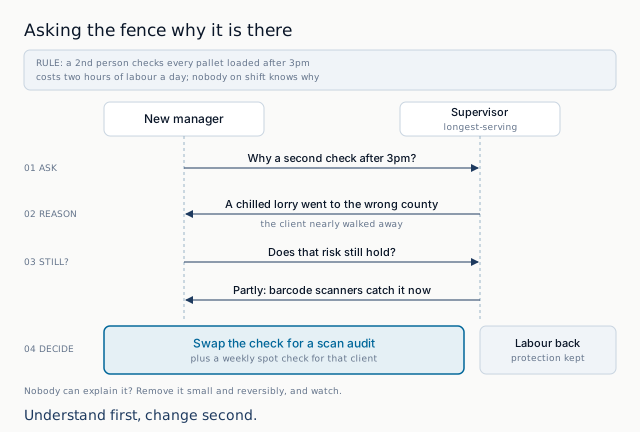
In practice it is a conversation in four turns. The newcomer asks why the thing exists. Someone who remembers, or a document, or the data, supplies the reason . The newcomer then asks whether that reason still holds today. Only after that answer comes the decision : keep the fence, replace it with something cheaper that does the same job, or take it down knowing what is being given up. When nobody can explain the fence at all, that is itself a finding, and it argues for a small, reversible removal rather than a bulldozer.
A new operations manager at a regional distribution warehouse found a rule that every outbound pallet loaded after three in the afternoon had to be checked by a second person. It cost two hours of labour a day, and nobody on the current shift knew why. Instead of scrapping it, she asked the longest-serving supervisor. The rule dated from a year when a late-shift error had sent a lorry of chilled goods to the wrong county, and the client had nearly walked away. The reason was real. Did it still hold? Only partly: the client remained, but the warehouse now had barcode scanning at the loading doors, which caught the same mistake automatically. She replaced the second check with a scan audit and kept a weekly spot check for that client. The labour came back; the protection stayed.
The fence can be overused. Some organisations hide behind it, treating every legacy rule as sacred and every question about one as disrespect, so that nothing ever changes. Investigation has a cost as well, and for small, easily reversed changes it can be cheaper to remove the fence and watch what happens, provided someone is actually watching. The model earns its keep when the damage from removal could be large, hard to undo or likely to surface long after the person who removed the fence has moved on.
Every fence was once somebody's solution; find out to what before calling it a problem.
Top 100 Decision Models for Strategic Thinking — One hundred ways to think before you choose
Ready when you are.
Tap below to open the full chapter in the book reader. Anchored books jump to this chapter automatically.
The Ladder of Inference
Top 100 Decision Models for Strategic Thinking — One hundred ways to think before you choose
The ladder of inference describes how people get from what they see to what they do, often in seconds and without noticing the steps. It was developed by the organisational theorist Chris Argyris and reached a wide audience through Peter Senge's work on learning organisations in the 1990s. Its value lies in making a fast, invisible process slow and visible, so that two people who disagree can find the rung where they parted company.
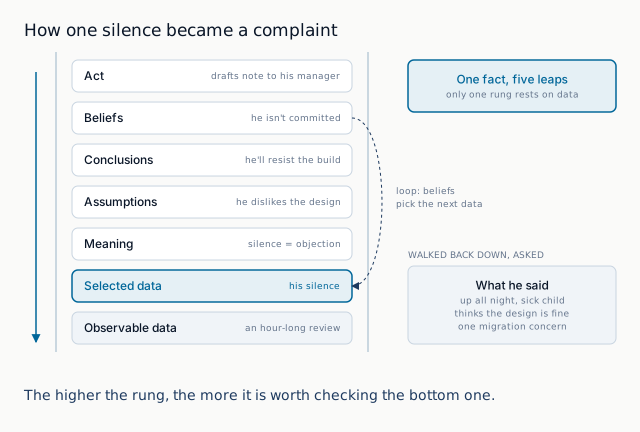
Read the ladder from the bottom. At ground level lies all the observable data , far more than anyone can take in. On the first rung we select some of it. Then we add meaning , interpreting what we picked through our own culture and history. From meanings we make assumptions , draw conclusions , adopt beliefs , and finally act . The trap is a reflexive loop: our beliefs shape which data we select next time, so the ladder turns into a lift that carries us straight to the top.
A product manager ran a design review in which one senior engineer said almost nothing. She selected that silence from an hour of conversation. She added meaning: engineers on this team speak up when they care. She assumed he disliked the design, concluded that he would quietly resist the build, came to believe he was not committed to the roadmap, and acted by drafting a message to his manager. Before sending it, she walked herself back down the ladder and found that the only rung resting on data was the first. So she asked him directly. He had been up most of the night with a sick child, thought the design was fine, and had one concern about a database migration that he had been planning to write up. Her conclusion had used one fact and five inferences.
The ladder is a diagnostic, not a cure. Knowing about it does not stop anyone climbing; climbing is how people make sense of a busy world, and many quick inferences turn out right. It can also be turned into a weapon in an argument, as in you're up your ladder again , which dismisses someone rather than understanding them. The useful move is curious and specific: share the data you selected, say what you made of it, and invite the other person to show theirs. Many disagreements turn out to be about which rung each person is standing on.
The higher the rung, the more it is worth checking the bottom one.
Top 100 Decision Models for Strategic Thinking — One hundred ways to think before you choose
Ready when you are.
Tap below to open the full chapter in the book reader. Anchored books jump to this chapter automatically.
Steelmanning
Top 100 Decision Models for Strategic Thinking — One hundred ways to think before you choose
A straw man is a weak caricature of an opposing view, built to be knocked down. Steelmanning is the reverse: before arguing against a position, you construct its strongest possible version, stronger if you can manage it than the way its holder put it. The term spread through online debating and rationalist circles in the 2010s, but the idea is older. The philosopher Daniel Dennett popularised a set of rules he credited to the game theorist Anatol Rapoport, the first of which is to restate your opponent's position so clearly that they wish they had put it that way.
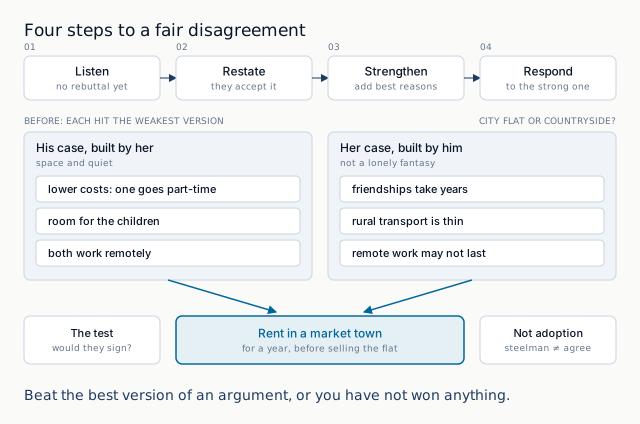
The method runs as a short sequence. First, listen to the view as stated, without composing a reply. Second, restate it in your own words and check that the other person accepts your summary. Third, strengthen it: find the best evidence and the most sympathetic reasons for holding it, including ones they did not mention. Only then, fourth, respond , to the strong version rather than the one that was easiest to dismiss. The fourth step tends to be shorter than people expect, because a good steelman often changes what you wanted to say.
A couple living in a city flat were stuck on whether to move to the countryside. He wanted space and quiet; she thought it was a fantasy that would leave them isolated. Their arguments had settled into a loop in which each attacked the weakest version of the other's case: he heard her as afraid of change, and she heard him as romanticising mud. They agreed to try steelmanning. She restated his position, then improved it: lower housing costs would let one of them go part-time, the children would have room to roam, and both now worked remotely most of the week. He did the same for hers: friendships take years to build, rural transport is thin, and remote working might not survive a change of employer. With both cases at full strength, the decision became practical rather than personal: rent in a market town for a year before selling the flat.
Steelmanning can go wrong. Strengthening a view is not the same as adopting it, and some positions do not deserve an elaborate defence; there is no duty to dignify claims that are dishonest or harmful. Done as a performance, it becomes a preamble to the same old rebuttal, which the other person spots instantly. It is also possible to build a version so polished that its real holders no longer recognise it. The test is simple: would the person you disagree with sign your summary?
Beat the best version of an argument, or you have not really won anything.
Top 100 Decision Models for Strategic Thinking — One hundred ways to think before you choose
Ready when you are.
Tap below to open the full chapter in the book reader. Anchored books jump to this chapter automatically.
SWOT Analysis
Top 100 Decision Models for Strategic Thinking — One hundred ways to think before you choose
SWOT analysis sorts what you know about an organisation into four boxes: strengths, weaknesses, opportunities and threats. Its origins are hazy. It is often credited to work at the Stanford Research Institute in the 1960s, sometimes to Albert Humphrey in particular, but the record is thin and several business schools taught similar grids at the time. What is not in doubt is its reach: few strategy tools are drawn on more whiteboards.
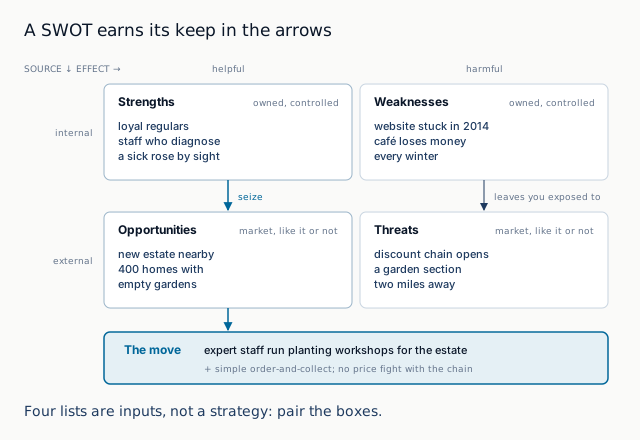
The grid rests on two questions. The first is where does this come from? Strengths and weaknesses are internal, things the organisation owns or controls. Opportunities and threats are external, things happening in the market whether you like it or not. The second question is does it help or hurt? Strengths and opportunities help; weaknesses and threats hurt. Cross the two and you get the four cells in the figure. The useful discipline is refusing to let an item drift into the wrong box. "A new competitor" is a threat, not a weakness; "we are slow to answer the phone" is a weakness, not a threat.
Take a family-run garden centre on the edge of a market town. Its strengths are loyal regulars and staff who can diagnose a sick rose by sight. Its weaknesses are a website stuck in 2014 and a café that loses money every winter. The opportunity is a new housing estate of four hundred homes with empty gardens. The threat is a discount chain opening a garden section two miles away. Laid out like that, the obvious move appears: point the expert staff at the new estate with planting workshops and a simple online order-and-collect service, rather than fight the chain on price.
That last step is where SWOT earns its keep and where most teams stop short. The four lists are inputs, not a strategy. The real work is pairing them: which strength seizes which opportunity, which weakness leaves you exposed to which threat. Without that pairing, a SWOT becomes a comforting inventory that changes nothing.
It misleads in other ways too. Teams flatter themselves, so the strengths box swells with things every competitor also has. Items are vague ("good culture") and unweighted, so a minor irritation sits beside an existential risk. And it is a snapshot; a threat today can be an opportunity next year. Treat each entry as a claim that needs evidence, keep each box to three or four lines, and date the page.
A SWOT is only as good as the arrows you draw between its boxes.
Top 100 Decision Models for Strategic Thinking — One hundred ways to think before you choose
Ready when you are.
Tap below to open the full chapter in the book reader. Anchored books jump to this chapter automatically.
Porter's Five Forces
Top 100 Decision Models for Strategic Thinking — One hundred ways to think before you choose
Porter's Five Forces explains why profit pools differ so much between industries. Michael Porter, an economist at Harvard Business School, set it out in a 1979 Harvard Business Review article and expanded it in his 1980 book Competitive Strategy . His point was that the intensity of competition is shaped by more than the firms you think of as rivals.
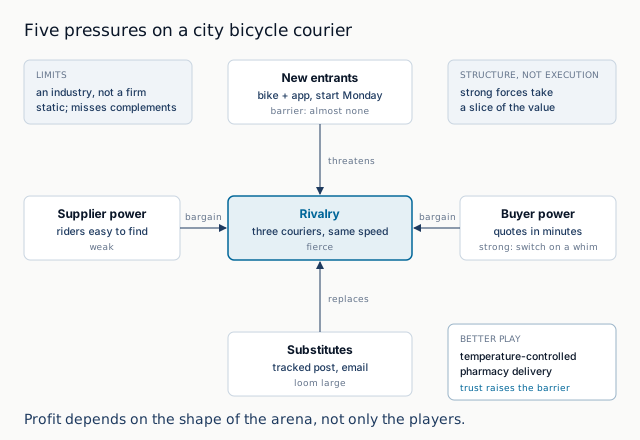
At the centre sits rivalry among existing competitors: how many there are, how fast the market grows, how similar the offers look. Around it press four other forces. The threat of new entrants depends on barriers such as capital, regulation, brand or network effects. The bargaining power of suppliers rises when inputs are scarce or concentrated. The bargaining power of buyers rises when customers are few, large or can switch cheaply. The threat of substitutes comes from different products that do the same job. Each force, if strong, takes a slice of the value the industry creates. Five weak forces leave plenty on the table; five strong ones leave crumbs.
Picture a founder weighing a same-day bicycle courier service in a mid-sized city. Rivalry is fierce: three couriers already compete on speed. New entrants face almost no barrier, since anyone with a bike and an app can start on Monday. Suppliers are weak, because bikes and riders are easy to find. Buyers are strong: local businesses can compare quotes in minutes and switch on a whim. Substitutes loom large, from post-office tracked delivery to email replacing paper altogether. Mapped like this, the founder sees that the problem is not execution but structure. The better play may be a niche where forces are weaker, such as temperature-controlled delivery for pharmacies, where trust and compliance raise the barrier.
The model has limits worth knowing. It describes an industry, not a company, so it says little about why one firm beats another inside the same market. It is a static picture, and fast-moving sectors can shift forces within a year. It underplays complements , the products that make yours more valuable, and it can make every relationship look adversarial when partnerships with suppliers or buyers are often the smarter move. Defining the industry too broadly or too narrowly will also give you nonsense.
Used well, it turns a vague sense that "it's tough out there" into five specific pressures you can measure, avoid or soften.
Profit is decided as much by the shape of the arena as by the skill of the players.
Top 100 Decision Models for Strategic Thinking — One hundred ways to think before you choose
Ready when you are.
Tap below to open the full chapter in the book reader. Anchored books jump to this chapter automatically.
PESTLE Analysis
Top 100 Decision Models for Strategic Thinking — One hundred ways to think before you choose
PESTLE analysis is a structured scan of the forces outside an organisation that it cannot control but must live with: political, economic, social, technological, legal and environmental. The idea is usually traced to Francis Aguilar of Harvard, who in 1967 described scanning the business environment under four headings he labelled ETPS. Later writers rearranged the letters into PEST, then added legal and environmental factors to make PESTLE. Variants such as STEEPLE add ethics, but the purpose is the same.
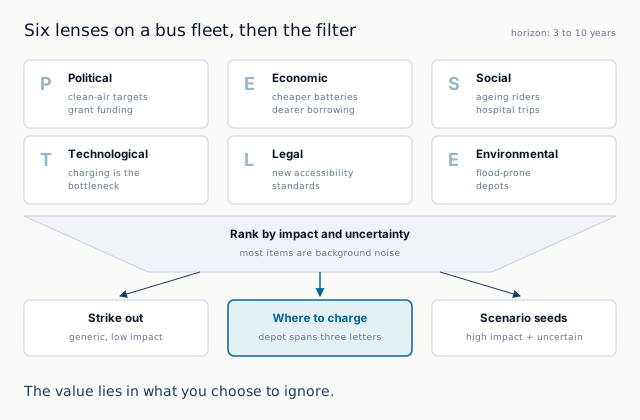
The method is simple. Go through each letter in turn and list the trends that could plausibly affect you over the planning horizon, typically three to ten years. Political covers government priorities, funding and stability. Economic covers growth, interest rates, labour markets and costs. Social covers demographics, habits and attitudes. Technological covers new tools and the speed of adoption. Legal covers regulation, standards and liability. Environmental covers climate, resources and physical risk. Then, crucially, filter: most items will be background noise, and only a handful will genuinely shape your choices.
Consider a regional transport authority planning to replace its diesel bus fleet. Politically, national clean-air targets and the prospect of grant funding push towards electric. Economically, battery costs have been falling but borrowing is dearer than it was. Socially, an ageing population means more passengers who rely on buses for hospital trips. Technologically, charging infrastructure is the bottleneck, not the vehicles. Legally, new accessibility standards will apply to any fleet bought this decade. Environmentally, depots in flood-prone areas need rethinking. Laid side by side, the authority sees that the critical issue is not which bus to buy but where and how to charge it, and that depot location sits at the junction of three letters at once.
The danger with PESTLE is that it is too easy. A team can fill six boxes with plausible trends in an hour and feel thorough, while nothing connects back to a decision. Lists become generic ("technology is changing fast"), the letters encourage false neatness when real forces cut across categories, and the result is often filed and forgotten. Better practice is to rank each factor by likely impact and by uncertainty, and to treat the high-impact, high-uncertainty ones as the seeds of scenarios rather than as facts.
The value of the scan lies not in what you write down but in what you choose to ignore.
Top 100 Decision Models for Strategic Thinking — One hundred ways to think before you choose
Ready when you are.
Tap below to open the full chapter in the book reader. Anchored books jump to this chapter automatically.
The Ansoff Matrix
Top 100 Decision Models for Strategic Thinking — One hundred ways to think before you choose
The Ansoff Matrix maps the ways a business can grow by asking two questions: are we selling existing or new products, and to existing or new markets? Igor Ansoff, a mathematician turned strategist, published it in a 1957 Harvard Business Review article on diversification. Its staying power comes from how quickly it makes the risk of each growth route visible.
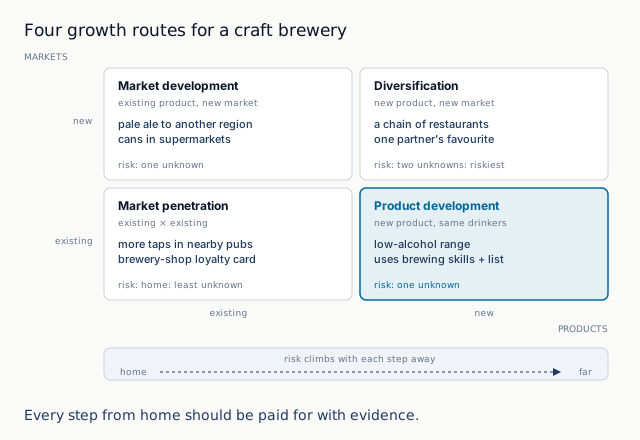
The four cells follow from the two axes. Market penetration means selling more of what you already make to the customers you already serve, through better pricing, distribution or promotion. Product development means new products for existing customers, building on what you know about them. Market development means taking existing products to new customers, regions or segments. Diversification means new products for new markets at once. Risk climbs as you move away from the bottom-left corner, because each step away from home means knowing less about either the customer or the product. Diversification doubles the unknowns.
Take a craft brewery whose pale ale sells well in its home county's pubs. Penetration would mean more taps in nearby pubs and a loyalty scheme for the brewery shop. Product development would mean a low-alcohol range for the same drinkers, who keep asking for one. Market development would mean exporting the pale ale to cities in another region, or selling cans through supermarkets for the first time. Diversification might mean opening a chain of restaurants. Mapped out, the founders see that low-alcohol beer uses their brewing skills and their existing customer list, so it carries far less risk than the restaurants that one partner keeps championing.
The matrix is a map, not a verdict. Penetration can be the riskiest move of all in a saturated market where every extra sale is snatched from a stronger rival. The categories also blur: is a supermarket can a new market or a new product? And "diversification" covers everything from a sensible adjacent step to a wild leap, so it pays to ask how related the new business is to what you already do well. Finally, the matrix says nothing about whether a cell is attractive, only how far it is from home; pair it with a look at the market itself.
Its best use is as a conversation tool. Plot every growth idea on the board, and the team quickly sees whether it is betting on several modest steps or one long jump.
Growth is easiest close to home, and every step away should be paid for with evidence.
Top 100 Decision Models for Strategic Thinking — One hundred ways to think before you choose
Ready when you are.
Tap below to open the full chapter in the book reader. Anchored books jump to this chapter automatically.
The BCG Growth-Share Matrix
Top 100 Decision Models for Strategic Thinking — One hundred ways to think before you choose
The BCG growth-share matrix helps a company with several products or business units decide where to put its money. Bruce Henderson, founder of the Boston Consulting Group, introduced it around 1970. Its memorable labels have outlived much of the theory behind them, which is both its success and its risk.
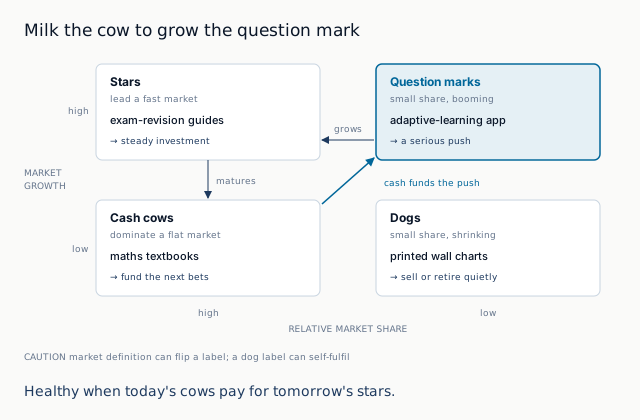
Each unit is placed on two axes. The horizontal axis is relative market share , the unit's share compared with its largest competitor. The vertical axis is market growth , how fast the whole market is expanding. Four cells result. Stars have high share in fast-growing markets; they are leaders but need heavy investment to keep up. Cash cows have high share in slow markets; they generate more cash than they need. Question marks have low share in fast markets; they consume cash and could go either way. Dogs have low share in slow markets and tend to tie up resources for little return. The classic logic is to milk the cows to fund the most promising question marks, turning them into stars that later mature into the next generation of cows.
Consider a mid-sized educational publisher. Its secondary-school maths textbooks dominate a flat market: a cash cow. Its new adaptive-learning app is growing quickly in a booming market, but share is small: a question mark. Its exam-revision guides lead a fast-growing segment: a star. A line of printed wall charts holds a small share of a shrinking market: a dog. The board's decision becomes sharper. Textbook profits should fund a serious push on the app, the revision guides deserve steady investment, and the wall charts are a candidate for sale or quiet retirement.
The matrix simplifies brutally, and that is where it misleads. Market share does not always bring cost advantage, which was the original assumption. Defining the market changes everything: the same unit can be a dog in one definition and a star in another. Labels become self-fulfilling, as a unit branded a dog is starved of attention and declines on cue. Dogs can be profitable, and some exist to support stars, such as a niche product that keeps a key customer loyal. And the matrix ignores links between units, treating a portfolio as independent bets.
Used as a first sort rather than a sentence, it still asks the right question: where is the cash coming from, and where should it go next?
A portfolio is healthy when today's cows are paying for tomorrow's stars.
Top 100 Decision Models for Strategic Thinking — One hundred ways to think before you choose
Ready when you are.
Tap below to open the full chapter in the book reader. Anchored books jump to this chapter automatically.
Blue Ocean Strategy
Top 100 Decision Models for Strategic Thinking — One hundred ways to think before you choose
Blue Ocean Strategy contrasts two kinds of market. In a red ocean , rivals fight over the same customers with the same offer, and the water turns red with price cuts. In a blue ocean , a company creates uncontested space by offering something different enough that comparison stops making sense. W. Chan Kim and Renée Mauborgne of INSEAD popularised the idea in their 2005 book of the same name, building on research they had published through the 1990s.
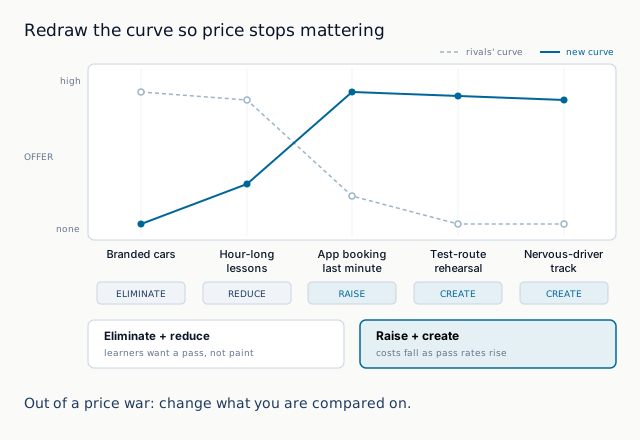
At its heart is value innovation : raising value for buyers while lowering cost, rather than trading one off against the other. The main practical tool is the ERRC grid , four questions asked of every factor the industry competes on. Which factors should be eliminated because the industry takes them for granted? Which should be reduced well below the standard? Which should be raised well above it? And which should be created that the industry has never offered? The answers draw a new value curve, a profile of the offer that looks distinctly unlike anyone else's.
Take a driving school in a crowded suburb where every competitor advertises cheaper hourly lessons. The owner runs the grid. Eliminate: the expensive branded cars, since learners care about passing, not paintwork. Reduce: generic hour-long lessons that repeat the same roundabouts. Raise: lesson flexibility, with short sessions booked by app at the last minute. Create: a test-route package that rehearses the actual local test routes at the real test times, plus a nervous-driver track with a calm instructor. The school stops being compared on hourly rate, because nobody else offers the same thing, and its costs fall even as pass rates rise.
The idea has drawn fair criticism. Many celebrated blue oceans turn red quickly once rivals copy what works, so the advantage is often temporary unless something makes it hard to imitate. Success stories are chosen after the fact, which flatters the method. And "create uncontested space" can become an excuse to chase novelty instead of fixing a weak core offer. Some markets are red for a reason: the factors everyone competes on are the ones customers truly care about.
Its lasting value is the discipline of questioning every industry assumption, one factor at a time, instead of simply trying to be a bit better at everything.
The way out of a price war is to change what you are being compared on.
Top 100 Decision Models for Strategic Thinking — One hundred ways to think before you choose
Ready when you are.
Tap below to open the full chapter in the book reader. Anchored books jump to this chapter automatically.
The Value Chain
Top 100 Decision Models for Strategic Thinking — One hundred ways to think before you choose
The value chain breaks a business into the activities it performs to deliver a product, so you can see which ones create value, which ones cost too much and where competitive advantage really lives. Michael Porter introduced it in his 1985 book Competitive Advantage . The idea is that a firm is not one thing but a sequence of discrete activities, and advantage comes from performing some of them better or more cheaply than rivals.
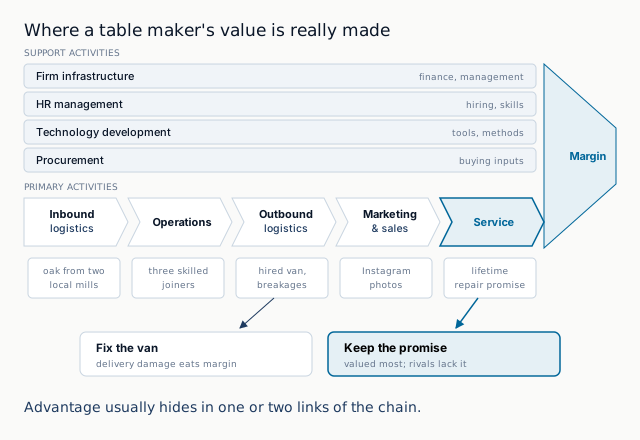
Porter split activities into two groups. The primary activities follow the product's journey: inbound logistics (receiving and storing inputs), operations (turning inputs into the product), outbound logistics (getting it to customers), marketing and sales (persuading them to buy) and service (supporting them afterwards). The support activities run across all of them: firm infrastructure such as finance and management, human resource management, technology development and procurement. Margin is what remains when the value customers pay for exceeds the cost of all these activities. The analysis asks, activity by activity, what it costs, what it contributes and how it compares with competitors.
Consider a small furniture maker selling solid oak tables. Mapped along the chain, inbound logistics means sourcing timber from two local mills. Operations is the workshop, where three skilled joiners do the real craft. Outbound logistics is a hired van and a lot of breakages. Marketing relies on a well-photographed Instagram account. Service is a lifetime repair promise that customers mention in nearly every review. The picture is revealing. The owner had been thinking of cutting the repair promise to save money, but it is the activity customers value most and rivals do not offer. Meanwhile delivery damage quietly eats margin. The decision flips: keep the promise, fix the van.
The model was built for manufacturing, and it can feel awkward for services, software or platforms, where value is created by networks rather than by moving goods along a line. Drawing the chain can become an end in itself, a diagram that lists every department without saying anything about advantage. And it looks inward; the most important links are often those with suppliers' and customers' own chains, which Porter called the value system.
Its strength is forcing precision. "We are good at quality" becomes a specific claim about a specific activity, which can be costed, protected or improved.
Advantage is rarely spread evenly; it usually hides in one or two links of the chain.
Top 100 Decision Models for Strategic Thinking — One hundred ways to think before you choose
Ready when you are.
Tap below to open the full chapter in the book reader. Anchored books jump to this chapter automatically.
VRIO
Top 100 Decision Models for Strategic Thinking — One hundred ways to think before you choose
VRIO is a test for whether a resource or capability can give an organisation a lasting competitive advantage. It comes from the resource-based view of the firm, and especially from the work of Jay Barney, who in a 1991 paper argued that sustained advantage comes from resources that are valuable, rare, inimitable and non-substitutable. Barney later reshaped the test into VRIO, replacing non-substitutability with a question about organisation.
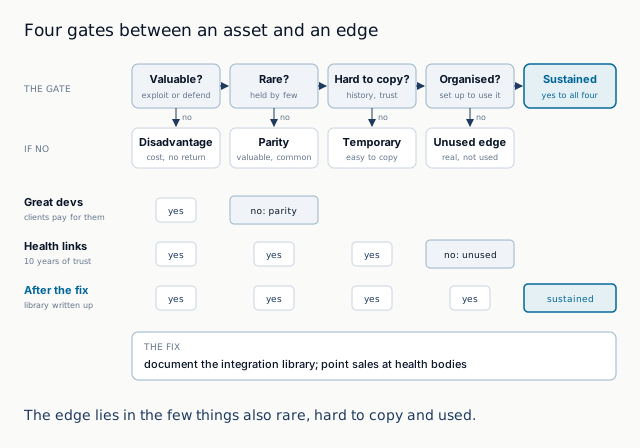
The four questions are asked in order, and each one is a gate. Is the resource valuable , letting you exploit an opportunity or neutralise a threat? If not, it is a disadvantage, a cost with no return. Is it rare , held by few competitors? If valuable but common, it only brings parity. Is it costly to imitate , because of history, complexity or relationships that cannot simply be bought? If valuable and rare but easy to copy, the advantage is temporary. Finally, is the organisation organised to capture its value, with the processes, incentives and structure to use it? If the answer is no, the advantage is real but unused. Only a yes to all four gives sustained advantage.
Consider a twenty-person software consultancy that believes its edge is "great developers". Valuable? Yes, clients pay for quality. Rare? Not really; good developers are available to anyone with a budget. So that is parity, not an edge. Then the partners try a second candidate: a decade-long relationship with the regional health service, plus a library of tested integrations with its old records systems. Valuable, rare, and very hard to copy because it took ten years of trust to build. But is the firm organised to exploit it? Sales still chases any project going, and the integration library lives in one person's head. The diagnosis is clear: a real advantage, unused. The fix is to document the library and point sales at other health bodies.
VRIO is easy to answer optimistically, especially on imitation, where every team believes its culture cannot be copied. Its answers are judgements rather than measurements, so evidence matters: how long would a well-funded rival take to replicate this, and what would it cost them? The test also deals with one resource at a time, while real advantage often comes from a bundle working together. And it is static, saying little about how quickly today's rare capability becomes tomorrow's industry standard.
Plenty of things are valuable; the edge lies in the few that are also rare, hard to copy and actually used.
Top 100 Decision Models for Strategic Thinking — One hundred ways to think before you choose
Ready when you are.
Tap below to open the full chapter in the book reader. Anchored books jump to this chapter automatically.
The Three Horizons
Top 100 Decision Models for Strategic Thinking — One hundred ways to think before you choose
The Three Horizons model is a way of managing growth across different timescales at once. It was set out by Mehrdad Baghai, Stephen Coley and David White, then at McKinsey, in their 1999 book The Alchemy of Growth . Its core observation is that organisations fail not because they lack ideas but because the urgent demands of today's business starve the future of attention and money.
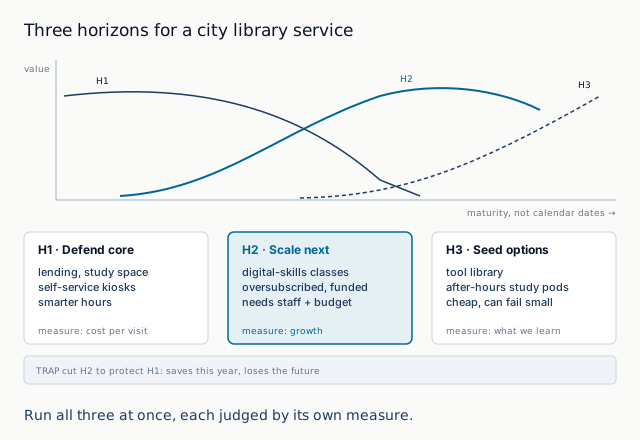
The model sorts activity into three horizons. Horizon 1 is the core business that generates most of today's revenue and profit; the job is to defend and extend it. Horizon 2 is emerging business that is already gaining traction and could become a future core; the job is to scale it. Horizon 3 is a set of options, small experiments and research projects that may become businesses in the more distant future; the job is to explore cheaply and learn. The horizons describe the maturity of each activity rather than strict calendar dates. The point is to run all three simultaneously, each with its own measures, because judging a Horizon 3 experiment by Horizon 1 profit targets will kill it every time.
Picture a city library service under pressure to cut costs. Horizon 1 is book lending and study space: still the heart of the service, to be run efficiently with self-service kiosks and smarter opening hours. Horizon 2 is a digital-skills programme helping older residents with online forms, which is already oversubscribed and attracting funding from the council's health team; it needs dedicated staff and a proper budget line. Horizon 3 includes a tool library lending drills and sewing machines, and a pilot of after-hours study pods; each costs little and is judged on what it teaches, not on numbers. Seen together, the head of service can argue that cutting Horizon 2 to protect Horizon 1 would save money this year and lose the library its future relevance.
The model is sometimes misread as a strict timeline or a fixed budget split. Ratios such as 70/20/10 are often quoted as a rule of thumb, but they are a starting point for discussion, not part of the original model. It also says little about how to pick Horizon 3 bets, and in fast-moving fields the horizons can collapse into one another. Most importantly, labelling a project Horizon 3 does not protect it: it needs a sponsor, a separate measure of success and permission to fail small.
Today's business will always shout loudest, so tomorrow's needs a protected voice.
Top 100 Decision Models for Strategic Thinking — One hundred ways to think before you choose
Ready when you are.
Tap below to open the full chapter in the book reader. Anchored books jump to this chapter automatically.
The Prisoner's Dilemma
Top 100 Decision Models for Strategic Thinking — One hundred ways to think before you choose
The Prisoner's Dilemma is the best-known puzzle in game theory: a situation in which two parties each act in their own interest and end up worse off than if they had cooperated. Merrill Flood and Melvin Dresher devised the game at the RAND Corporation in 1950, and the mathematician Albert Tucker gave it the story of two prisoners that made it famous.
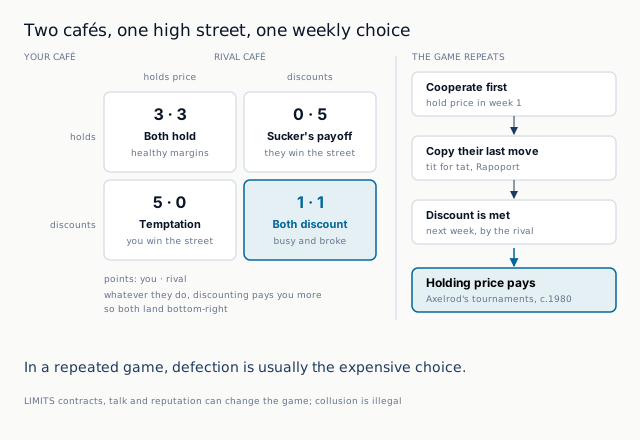
The structure is a two-by-two table of choices. Each player can cooperate or defect . If both cooperate, both do reasonably well. If both defect, both do poorly. If one cooperates while the other defects, the defector does best of all and the cooperator does worst, collecting what game theorists call the sucker's payoff. The trap is that, whatever the other side does, defecting pays more for you. So two rational players both defect and land in the bottom-right corner, even though both would prefer the top-left. Individual logic and collective outcome point in opposite directions.
Imagine two independent cafés facing each other across a high street. Each week they decide whether to hold prices or run a discount. Score the outcomes in points. Both hold: three each, healthy margins. One discounts while the other holds: the discounter wins the street's customers and scores five, the other scores nothing. Both discount: one each, busy and broke. Each owner, reasoning alone, discounts. A month later both are working harder for less. What breaks the trap is that the game repeats. In computer tournaments run by the political scientist Robert Axelrod around 1980, a simple strategy called tit for tat , submitted by Anatol Rapoport, did strikingly well: cooperate first, then copy whatever the other player did last. The cafés need not collude, which would be illegal; it is enough that each knows a discount will be met with one next week.
The model is easily stretched too far. Many real situations are not true dilemmas: payoffs may favour cooperation outright, or one side may be able to change the rules, sign a contract or simply talk. Labelling every negotiation a prisoner's dilemma can make defection feel inevitable when it is not. And real players are not perfectly rational; reputation, fairness and habit matter a great deal.
Its lasting lesson is about structure: when an outcome depends on the other side, think about the game you are in, and about the next round, not just this one.
In a one-off game defection looks clever; in a repeated one, it is usually the expensive choice.
Top 100 Decision Models for Strategic Thinking — One hundred ways to think before you choose
Ready when you are.
Tap below to open the full chapter in the book reader. Anchored books jump to this chapter automatically.
The Business Model Canvas
Top 100 Decision Models for Strategic Thinking — One hundred ways to think before you choose
The Business Model Canvas is a single sheet divided into nine boxes, each holding one part of how an organisation creates, delivers and captures value. It grew out of Alexander Osterwalder's doctoral work in the mid-2000s and became widely used after Business Model Generation , written with Yves Pigneur and published in 2010. Its appeal is that it replaces a forty-page plan with something a team can argue over around a table.
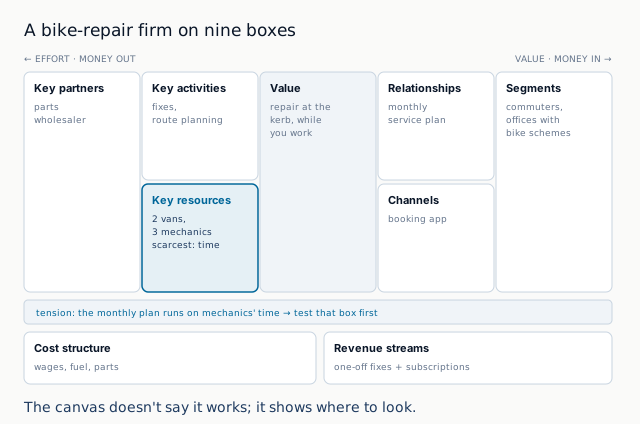
At the centre sits the value proposition : why anyone would choose you. To its right are the customer-facing boxes: customer segments, the channels that reach them, the relationships you keep with them and the revenue streams they pay into. To its left are the operational boxes: key activities, key resources and key partners. Along the bottom, cost structure faces revenue. The right side is about value and money coming in; the left side is about effort and money going out. A good canvas reads as one story, not nine unrelated answers.
Take a two-van mobile bike-repair business in Leeds. Its segments are commuters and offices with bike-to-work schemes. The value proposition is a repair done at the kerb while the owner is at their desk. Bookings arrive through an app, relationships are kept through a monthly service plan, and revenue comes from one-off fixes plus subscriptions. Behind that sit two vans and three mechanics, a parts wholesaler as a key partner, and costs dominated by wages, fuel and parts. Drawn out, one tension becomes obvious: the subscription promise depends on mechanics' time, the scarcest resource on the sheet. That is the box to test first.
The canvas misleads when it is treated as a poster rather than a set of guesses. Every sticky note is a hypothesis about customers or costs, and a canvas filled in once and framed on the wall says nothing about which guesses have been checked. It also has blind spots: competitors, timing and the team itself have no box of their own, so they have to be brought in deliberately. And because the format is tidy, a weak business can look complete simply because every box has something in it.
Used well, it is a thinking surface: change one box and watch what the others now have to do. Sketch two or three alternative canvases for the same idea and the choices become visible in a way a spreadsheet hides.
The canvas does not tell you whether the business works; it shows you where to look.
Top 100 Decision Models for Strategic Thinking — One hundred ways to think before you choose
Ready when you are.
Tap below to open the full chapter in the book reader. Anchored books jump to this chapter automatically.
Jobs to Be Done
Top 100 Decision Models for Strategic Thinking — One hundred ways to think before you choose
Jobs to Be Done starts from a simple shift in question. Instead of asking who the customer is, it asks what progress they are trying to make, in a particular situation, and what they "hire" to make it. The idea has several parents: Theodore Levitt's often-quoted line about people wanting the hole rather than the drill is usually cited as an ancestor, Tony Ulwick built a formal method around customer outcomes in the 1990s, and Clayton Christensen popularised the language of hiring and firing products in the 2000s.
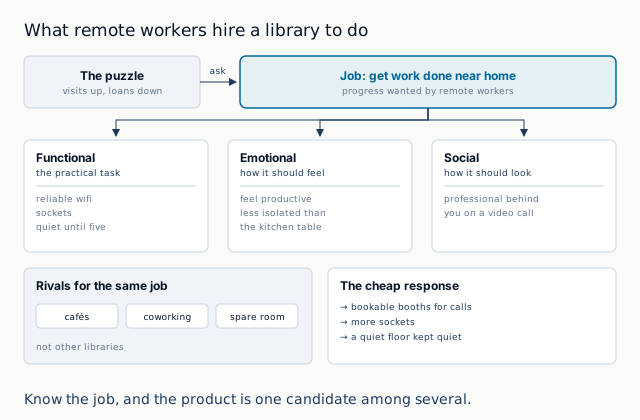
A job has more than one dimension. The functional side is the practical task. The emotional side is how the person wants to feel while doing it. The social side is how they want to be seen. Products that win usually serve all three, and rivals are defined by the job rather than the category: anything else the person could hire for the same progress is competition, including doing nothing.
Consider a town-centre public library that noticed weekday visits rising while book loans fell. Interviews revealed that many visitors were remote workers. Functionally, they were hiring the library for reliable wifi, sockets and quiet until five. Emotionally, they wanted to feel productive and less isolated than at the kitchen table. Socially, they wanted somewhere that looked professional behind them on a video call. Seen this way, the library's competitors were cafés, coworking spaces and spare bedrooms, not other libraries. The response was modest and cheap: bookable booths for calls, more sockets, and a quiet floor kept genuinely quiet. Visits held up, and the library had a clearer argument for its budget.
The model misleads when jobs are pitched too high or too low. "Live a fulfilling life" is a job, technically, but it guides nothing; "click the export button" is a task, not a job. It is also easy to retrofit: a team can invent a job that happens to justify the feature it already wanted to build. The best evidence comes from real switching stories, asking people to recall the moment they stopped using one thing and started using another, because what people say they value and what makes them change are often different.
When it works, Jobs to Be Done widens the view of competition and narrows the view of what matters, which is a useful combination.
Know the job, and the product becomes one candidate among several rather than the centre of the universe.
Top 100 Decision Models for Strategic Thinking — One hundred ways to think before you choose
Ready when you are.
Tap below to open the full chapter in the book reader. Anchored books jump to this chapter automatically.
Crossing the Chasm
Top 100 Decision Models for Strategic Thinking — One hundred ways to think before you choose
Crossing the Chasm describes a dangerous gap in the life of a new technology product. It comes from Geoffrey Moore's 1991 book of the same name, which built on Everett Rogers' Diffusion of Innovations . Rogers sorted adopters into five groups along a bell curve: innovators, early adopters, the early majority, the late majority and laggards. Moore's insight was that the groups are not a smooth continuum. Between early adopters and the early majority lies a chasm , where many products stall.
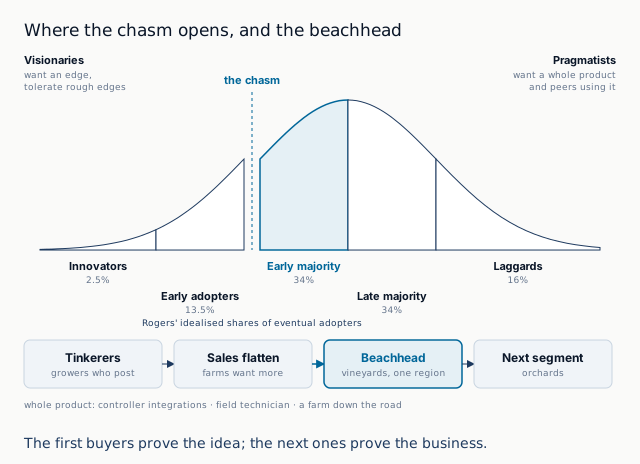
The reason is that the two groups buy for different reasons. Early adopters are visionaries: they want an edge, tolerate rough edges and will stitch together missing pieces themselves. The early majority are pragmatists: they want a complete, working solution, they want to see people like them already using it, and they treat the visionaries' enthusiasm as a warning rather than a reference. A product can therefore sell well to the first sixteen per cent of the market and then hit a wall.
Moore's prescription is to stop chasing everyone and pick a beachhead : one narrow segment of pragmatists whose problem you can solve completely, including service, integration and training, the "whole product". Win that segment decisively, and its members become the references that let you move into neighbouring segments.
Picture a start-up selling soil-moisture sensors. Its first customers were tech-minded growers who enjoyed tinkering and posted about it online. Sales then flattened. Conversations with mainstream farms revealed they wanted sensors that worked with their existing irrigation controllers, a local engineer who would turn up, and proof from a farm down the road. The founders narrowed their focus to vineyards in one region, built the controller integrations, hired a field technician, and signed a dozen estates. Those estates, not the early enthusiasts, opened the door to orchards next.
The model has limits. Rogers' percentages describe an idealised curve, not a law, and many products never face a sharp break between groups. Consumer products spread by fashion or network effects can jump straight to the majority. The chasm can also become an alibi, used to explain away a product that simply does not solve a painful enough problem. And picking a beachhead takes nerve, since it means deliberately saying no to revenue elsewhere.
The first buyers prove the idea; the next ones prove the business.
Top 100 Decision Models for Strategic Thinking — One hundred ways to think before you choose
Ready when you are.
Tap below to open the full chapter in the book reader. Anchored books jump to this chapter automatically.
The Product Life Cycle
Top 100 Decision Models for Strategic Thinking — One hundred ways to think before you choose
The Product Life Cycle treats a product like an organism with a lifespan. Sales start slowly, accelerate, level off and eventually decline. The idea circulated in marketing thinking through the 1950s and was popularised by Theodore Levitt's 1965 Harvard Business Review article urging managers to exploit it. Its value is less as a forecast than as a reminder that the right strategy at launch is the wrong one later.
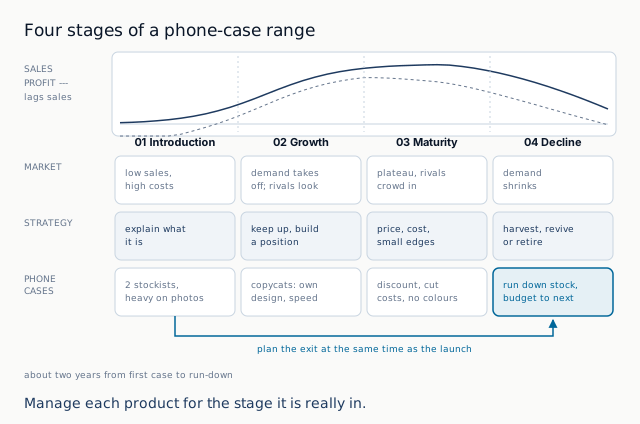
There are four stages. In introduction , sales are low, costs are high and most effort goes into explaining what the product is. In growth , demand takes off, competitors notice, and the job becomes keeping up with orders while building a position. In maturity , sales plateau, rivals crowd in, and competition shifts to price, efficiency and small differences. In decline , demand shrinks, and the choice is between harvesting the remaining profit, reviving the product, or retiring it cleanly. Profit typically lags sales: losses at launch, the best margins in late growth and early maturity.
A small company that makes protective cases for one particular phone model lives through the whole cycle in about two years. At introduction it ships to two specialist stockists and spends heavily on product photos. In growth, demand surges as the handset sells, but copycat cases appear within months, so the founders invest in a recognisable design and faster delivery. At maturity, the cases are discounted across marketplaces and the sensible move is to cut costs and stop new colours. When the manufacturer announces the next model, the firm runs down stock and moves its design budget to the new handset. Knowing the shape in advance lets them plan the exit at the same time as the launch.
The model misleads in a few ways. Stage boundaries are only obvious in hindsight, and durations vary from weeks to decades. Categories, brands and individual products follow different curves, so confusing them leads to bad calls. Most dangerously, the model can be self-fulfilling: declare a product mature, starve it of investment, and it duly declines. Some products that looked finished have been relaunched into fresh growth with a new use or audience.
Every product is somewhere on the curve; the mistake is managing it as if it were somewhere else.
Top 100 Decision Models for Strategic Thinking — One hundred ways to think before you choose
Ready when you are.
Tap below to open the full chapter in the book reader. Anchored books jump to this chapter automatically.
The Hype Cycle
Top 100 Decision Models for Strategic Thinking — One hundred ways to think before you choose
The Hype Cycle is a sketch of how expectations about a new technology rise and fall over time. It was introduced by the research firm Gartner in 1995, with analyst Jackie Fenn usually credited, and Gartner still publishes annual charts placing technologies along it. The shape is easy to remember: a sharp peak, a deep dip, and a long, gentle climb.
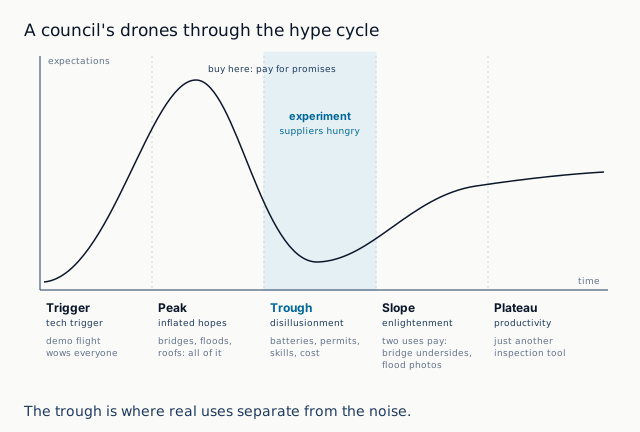
It has five phases. A technology trigger — a breakthrough, a demo, a launch — starts the conversation. Attention snowballs into the peak of inflated expectations , where success stories are loud and limits are ignored. Then real deployments meet real constraints and interest collapses into the trough of disillusionment . Those who persist enter the slope of enlightenment , where it becomes clear which uses genuinely work. Finally comes the plateau of productivity , where the technology is unremarkable and quietly valuable.
Consider a county council exploring drones for inspecting bridges. The trigger is a supplier's demonstration flight, which impresses everyone. Within months there are plans to survey every bridge, monitor flooding and check roofs. Then the trough arrives: battery life is short, flight permissions take time, image analysis needs skills the council lacks, and the bill is larger than forecast. Several projects are quietly dropped. A small team keeps going and finds two uses that pay off: inspecting the undersides of high bridges without closing roads, and photographing flood damage quickly. Those become routine. Years later, drones are just another inspection tool, and nobody holds a meeting about them.
The practical lesson is about timing. Buying at the peak means paying for promises; the trough is often the best time to experiment, because suppliers are hungry and the useful applications are starting to separate from the noise. The cycle also explains why sceptics and enthusiasts can both be right at different moments.
It is a heuristic, not a measurement. Many technologies never reach the plateau; some skip the trough; others repeat the cycle more than once. Placing a technology on the curve is a judgement, and nobody can say with confidence how long each phase will last. Treat it as a way to read the mood around a technology, not as a timetable.
Hype is a weather report on expectations, not a forecast of usefulness.
Top 100 Decision Models for Strategic Thinking — One hundred ways to think before you choose
Ready when you are.
Tap below to open the full chapter in the book reader. Anchored books jump to this chapter automatically.
Pirate Metrics (AARRR)
Top 100 Decision Models for Strategic Thinking — One hundred ways to think before you choose
Pirate Metrics is a framework for tracking a customer's journey through a product in five stages whose initials spell AARRR, hence the pirate. It was set out by investor Dave McClure in a 2007 talk aimed at start-ups that were measuring plenty but learning little. The point is to replace one vague growth number with a chain of specific ones, so a team can see exactly where people drop away.
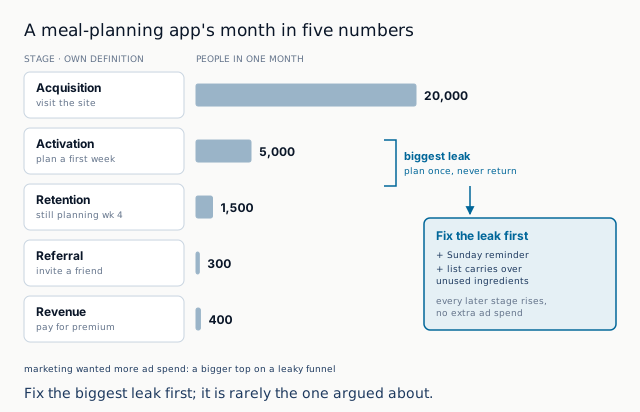
The stages run in sequence. Acquisition : people arrive, from search, ads, word of mouth. Activation : they have a first experience good enough to matter, the moment the product proves itself. Retention : they come back. Referral : they bring others. Revenue : they pay. The order of the last two is sometimes swapped, and each team must define each stage for its own product, which is where most of the value lies. "Activation" for a banking app is not the same as for a game.
Take a meal-planning app. In one month, twenty thousand people visit the site. Five thousand sign up and plan their first week of meals, which the team defines as activation. Fifteen hundred are still planning in week four. Three hundred invite a friend, and four hundred pay for premium. Laid out like this, the conversation changes. The marketing team had wanted more spending on ads, but the figures show the bigger leak sits between activation and retention: most people plan one week and never return. The team adds a Sunday reminder and a shopping list that carries over unused ingredients. Retention rises, and every later stage rises with it, without an extra pound of acquisition spend.
The framework misleads when its numbers become vanity metrics, counted because they are easy rather than because they predict anything. Pouring more people into the top of a leaky funnel feels like progress while money drains out. It can also tempt teams to optimise each stage separately, nudging referral with tricks that annoy users and hurt retention. And the funnel shape hides the fact that real customers loop, pause and return; it is a model of the journey, not the journey itself.
Fix the biggest leak first; it is rarely the stage everyone is arguing about.
Top 100 Decision Models for Strategic Thinking — One hundred ways to think before you choose
Ready when you are.
Tap below to open the full chapter in the book reader. Anchored books jump to this chapter automatically.
The Flywheel
Top 100 Decision Models for Strategic Thinking — One hundred ways to think before you choose
The Flywheel describes growth as a heavy wheel that is hard to start and hard to stop. Each push adds a little speed, and once it is turning, every further push counts for more. Jim Collins used the image in Good to Great in 2001 to argue that lasting success rarely comes from a single dramatic move but from consistent effort in one direction. Amazon's leadership became known for sketching their business as a flywheel, and the term spread through the technology industry.
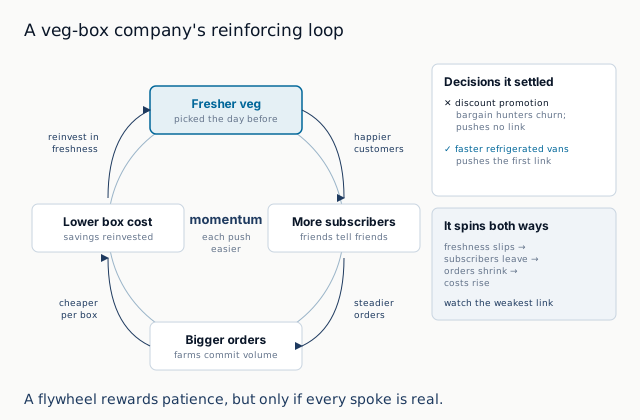
As a model, a flywheel is a reinforcing loop : a short chain of causes in which the last link feeds the first. The discipline lies in getting each arrow right. Every step must genuinely cause the next, and the loop must close; otherwise it is just a list of good things drawn in a circle.
Consider a regional vegetable-box company. Its loop runs like this. Fresher produce, picked the day before delivery, leads to happier customers who tell their friends, so subscribers grow. More subscribers mean bigger, steadier orders, so local farms commit volume and offer better prices and first pick. Larger orders lower the cost of each box, and the company reinvests those savings in freshness rather than taking them as profit. That makes the produce better still, and the wheel turns again. Once the founders drew this, several decisions became easier: a discount promotion that would attract bargain hunters with poor retention was dropped, because it did not push any part of the wheel, while paying for faster refrigerated vans was approved, because it pushed the first link.
The flywheel misleads in three main ways. Teams draw arrows that are hopes rather than causes, and the loop looks convincing on a whiteboard while one link quietly fails. Momentum takes time, so impatient owners may give up just before it builds, or worse, mistake a lucky spurt for a working loop. And reinforcing loops run in both directions: if freshness slips, subscribers leave, orders shrink, costs rise, and the same wheel spins downward. A flywheel worth having is one whose weakest link you know and watch.
A flywheel rewards patience, but only if every spoke is real.
Top 100 Decision Models for Strategic Thinking — One hundred ways to think before you choose
Ready when you are.
Tap below to open the full chapter in the book reader. Anchored books jump to this chapter automatically.
Network Effects
Top 100 Decision Models for Strategic Thinking — One hundred ways to think before you choose
A network effect exists when each extra user makes a product more valuable to the others. A telephone is useless if you own the only one, and early telephone companies understood that their networks became more attractive as they grew. The idea was later linked to Robert Metcalfe, whose name was attached in the 1990s to the observation that the number of possible connections grows much faster than the number of users. With ten users there are forty-five possible pairs; with a hundred, nearly five thousand.
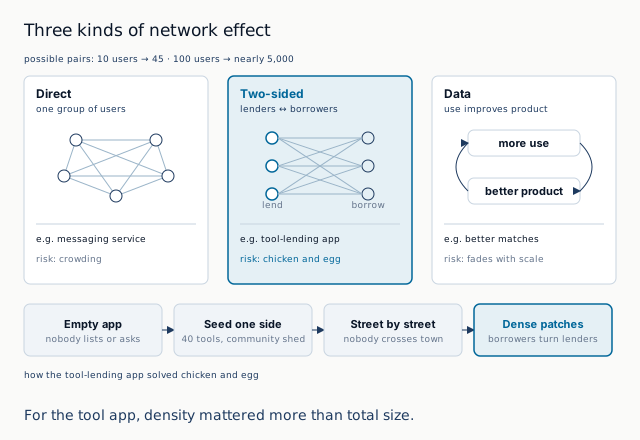
Network effects come in a few varieties. Direct effects work within one group: each new member of a messaging service is someone more to talk to. Indirect or two-sided effects work across groups: more buyers attract more sellers, which attracts more buyers. Some argue for data effects too, where usage improves the product, though these tend to weaken as scale grows. Each kind has its own failure mode: crowding, the chicken-and-egg problem, and diminishing returns.
Consider a neighbourhood tool-lending app. It is two-sided: lenders list their ladders and hedge trimmers, borrowers request them. At launch it has the classic chicken-and-egg problem: no borrower opens an app with three tools, and no lender bothers listing for an empty audience. The organisers solved it by seeding one side themselves, buying forty common tools for a community shed and listing them, and by launching street by street rather than across the whole city, since nobody will cross town to borrow a drill. Once a few streets had dense supply, borrowers came, and some became lenders. The network effect was real, but it was local: density mattered more than total size.
The idea is misused constantly. Almost every pitch deck claims network effects, yet many products simply have many users, each of whom gains nothing from the others. Network effects can also turn negative, as crowding, spam or poor matches drive people away. Where users can easily use several rival networks at once, the advantage weakens. And quality counts: a thousand engaged members can beat a million idle ones.
Network effects are powerful once they exist; getting the first dense patch is the real work.
Top 100 Decision Models for Strategic Thinking — One hundred ways to think before you choose
Ready when you are.
Tap below to open the full chapter in the book reader. Anchored books jump to this chapter automatically.
Disruptive Innovation
Top 100 Decision Models for Strategic Thinking — One hundred ways to think before you choose
Disruptive innovation names a particular way that newcomers overtake established firms. It was set out by Joseph Bower and Clayton Christensen in a 1995 article and developed in Christensen's 1997 book The Innovator's Dilemma . The word has since been stretched to mean any exciting change, but the original theory is narrower and more useful.
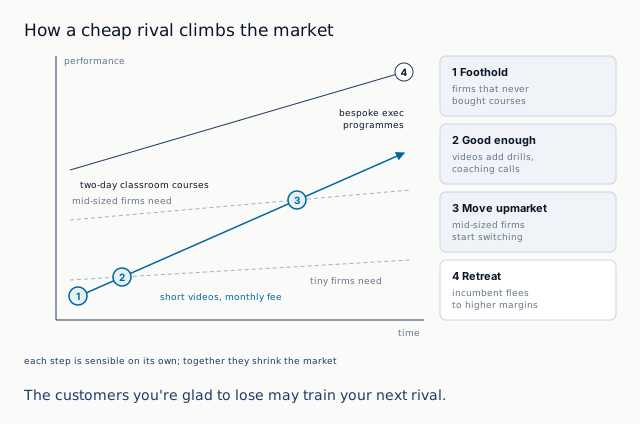
It begins with a pattern of incumbents improving their products for their best, most demanding customers, often beyond what many customers need. That leaves room at the bottom. A disrupter enters with something simpler, cheaper or more convenient, aimed either at the least demanding customers or at people who previously bought nothing at all. Incumbents see small margins and ignore it, which is rational. The entrant improves, becomes good enough for mainstream customers, and moves upmarket. By the time the incumbent responds, it has retreated to a shrinking, high-end corner.
Imagine a training company that sells two-day classroom courses on management skills at a high price to large firms. A newcomer offers short video courses for a small monthly fee. At first its customers are tiny businesses that never bought training at all; the incumbent does not lose a single client and dismisses the product as superficial. Each year the videos improve, add practice exercises and coaching calls, and mid-sized firms start switching. The incumbent responds by moving further upmarket into bespoke executive programmes, where margins are higher. Each step is sensible on its own. Taken together, they shrink its market year by year.
The theory is often misapplied. Not every successful newcomer is a disrupter; one that beats incumbents at the high end with a better product is a sustaining innovator. Christensen and colleagues argued in 2015 that some celebrated examples did not fit the definition. The theory's predictive power has also been contested, notably by historians who found that some supposedly doomed incumbents survived well. And the label can be used defensively, letting a struggling firm blame disruption for ordinary mistakes.
Its real value is as a warning about your own rational choices: the customers you are happiest to lose may be where the next competitor learns its trade.
Disruption rarely looks threatening at the start; that is precisely why it works.
Top 100 Decision Models for Strategic Thinking — One hundred ways to think before you choose
Ready when you are.
Tap below to open the full chapter in the book reader. Anchored books jump to this chapter automatically.
The Long Tail
Top 100 Decision Models for Strategic Thinking — One hundred ways to think before you choose
The Long Tail describes what happens to demand when the cost of offering one more product falls close to zero. Chris Anderson, then editor of Wired , set out the idea in a 2004 article and a 2006 book. Plot sales against rank and you get a tall head of a few bestsellers, followed by a long, thin tail of items that each sell rarely. In a physical shop, the tail is cut off because shelf space is expensive. Online, it can be kept, and its many small sales can add up to a large share of the total.
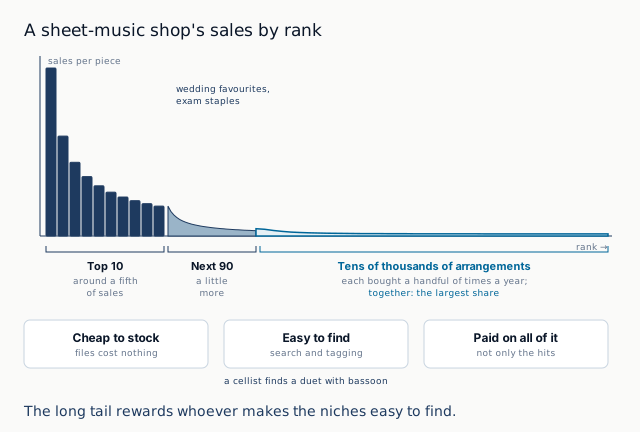
Three things have to be true for the tail to pay. Storage and distribution must be cheap, so that carrying an obscure item costs almost nothing. Customers must be able to find what they want, through search, recommendations or community. And the business must make money across the whole curve rather than only on the hits. When these hold, variety becomes an advantage rather than a cost.
Picture an independent online sheet-music shop that sells digital downloads. Its ten most popular pieces, wedding favourites and exam staples, might make up around a fifth of sales. The next ninety add a little more. But beyond them sits a catalogue of tens of thousands of arrangements for unusual instrument combinations, each bought a handful of times a year, and together they bring in the largest share of revenue. Because the files cost nothing to store, the owner keeps adding arrangements and invests mainly in search and tagging, so a cellist looking for a duet with bassoon can find one. A general retailer cannot compete on that range, and the bestsellers alone would not sustain the shop.
The model misleads when its promise is taken too broadly. In many markets the hits still take most of the money, and later research on media sales suggested the tail can be flatter and thinner than the original optimism implied. Tail items can carry hidden costs in cataloguing, support and quality control. Discovery is the real bottleneck: an item nobody can find might as well not exist. And for most small businesses, the tail is better as an aggregator's game than as a seller's, because aggregators capture the sum while each niche producer sells little.
The long tail rewards whoever makes the niches easy to find.
Top 100 Decision Models for Strategic Thinking — One hundred ways to think before you choose
Ready when you are.
Tap below to open the full chapter in the book reader. Anchored books jump to this chapter automatically.
Feedback Loops
Top 100 Decision Models for Strategic Thinking — One hundred ways to think before you choose
A feedback loop exists whenever the result of an action circles back to shape the next action. The idea comes from engineering and was given its general form by Norbert Wiener's cybernetics in the late 1940s; Jay Forrester's system dynamics work at MIT in the 1950s then carried it into business and policy. The insight is simple and permanently useful: most of what puzzles us about organisations, markets and habits is a loop we have not drawn yet.
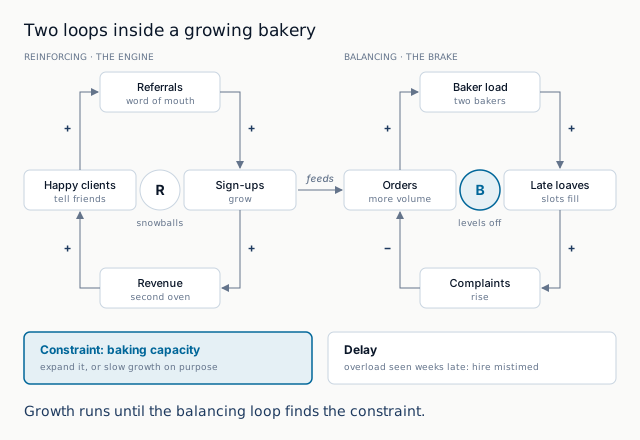
There are only two kinds. A reinforcing loop feeds on itself: more produces more, or less produces less. Word of mouth, compound interest and a team losing confidence after each missed deadline are all reinforcing. A balancing loop pushes back towards a target: a thermostat, a price that falls when stock piles up, a manager who tightens control when quality slips. Reinforcing loops explain growth and collapse; balancing loops explain stability, resistance and the frustrating sense that nothing you change stays changed. Real systems wire several of each together, and the behaviour you see depends on which loop is dominant at the moment.
Take a small subscription bakery. Happy customers tell friends, sign-ups grow, more revenue buys a second oven, and the loop spins faster. That is reinforcing. But each new order adds pressure on two bakers, delivery slots fill, loaves arrive late, and complaints rise until sign-ups flatten. That is balancing, and it was always there, quietly waiting for volume. The founder who blames the marketing for the plateau is looking at the wrong loop. The useful move is to name the constraint that the balancing loop is protecting, here baking capacity, and decide whether to expand it or to slow growth deliberately.
The model misleads when every problem is forced into a tidy circle. Loops also have delays , and a delay between action and signal is where most mistakes happen: the bakery hires a third baker just as demand dips, because the evidence of overload arrived weeks late. People also confuse correlation with a loop, drawing arrows between things that merely move together. And a diagram is a hypothesis, not a fact; it needs checking against what actually happens when a lever is pulled.
Once you can tell an engine from a brake, most strange behaviour stops being strange.
Top 100 Decision Models for Strategic Thinking — One hundred ways to think before you choose
Ready when you are.
Tap below to open the full chapter in the book reader. Anchored books jump to this chapter automatically.
Stocks and Flows
Top 100 Decision Models for Strategic Thinking — One hundred ways to think before you choose
Every system holds things that accumulate. Money in an account, people on a team, trust between partners, bugs in a codebase, carbon in the air. Each of these is a stock , and it can change only through its flows : what comes in and what goes out. The language comes from Jay Forrester's system dynamics, developed at MIT from the late 1950s, and it reached a wide audience through Donella Meadows' Thinking in Systems . The familiar picture is a bathtub, a tap filling it and a plughole draining it.
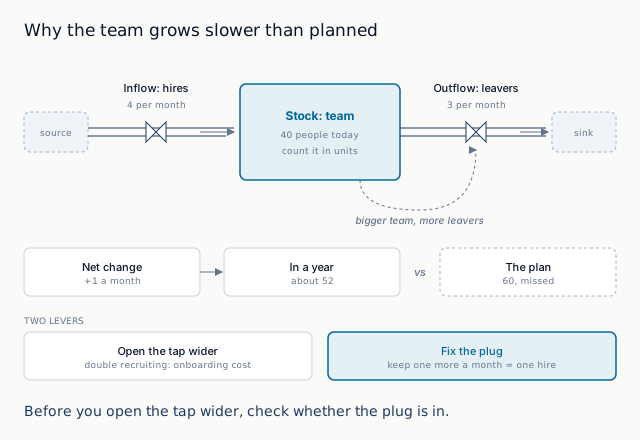
The model works by forcing three questions. What is the stock, measured in units you could count? What is the inflow per period? What is the outflow per period? The stock rises only while inflow beats outflow, and it falls only while outflow wins. That sounds trivial, yet it explains why stocks change slowly even when flows change fast, why they act as buffers, and why cutting the inflow does not empty anything until the outflow catches up.
Consider a software team of forty. The head of engineering wants sixty by next year and pushes recruiters hard. They hire four people a month. Meanwhile three people a month leave, a figure nobody had written down. Net growth is one person a month, so the team reaches roughly fifty-two in a year, not sixty. Doubling the recruiting budget treats the inflow; the cheaper lever might be the outflow, since keeping one more person a month is worth as much as hiring one, without the onboarding cost. The same arithmetic applies to customer churn, a backlog of support tickets or the stock of goodwill in a marriage.
The model misleads when stocks and flows are confused. A company's profit is a flow; its cash is a stock; panicking about a bad month of profit with a deep cash buffer is a category error, and so is relaxing about a good month while the buffer is nearly gone. Some stocks are hard to measure, such as morale or reputation, and it is tempting to treat them as fixed when they are quietly draining. Flows also depend on the stocks themselves: a bigger team generates more leavers, so the arithmetic is rarely as linear as the first sketch.
Before you open the tap wider, check whether the plug is in.
Top 100 Decision Models for Strategic Thinking — One hundred ways to think before you choose
Ready when you are.
Tap below to open the full chapter in the book reader. Anchored books jump to this chapter automatically.
The Iceberg Model
Top 100 Decision Models for Strategic Thinking — One hundred ways to think before you choose
The Iceberg Model is a way of looking below a single event to the forces that keep producing it. It circulates widely in systems-thinking teaching, and is often linked to the circle around Peter Senge and Daniel Kim in the 1990s, though no single inventor is clearly established. The metaphor does the work: what you see above the water is a small part of what is there, and the part you cannot see is what sinks ships.
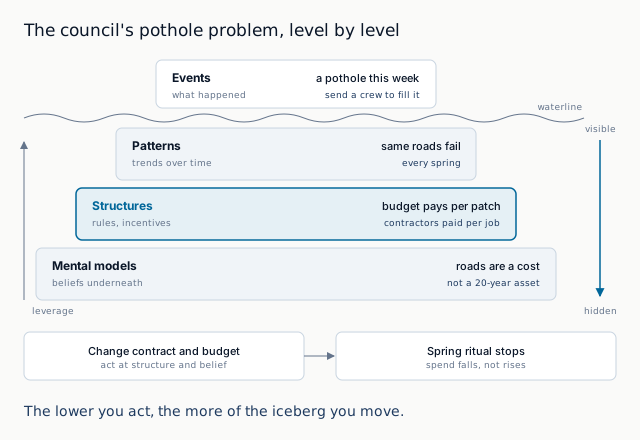
The model has four levels. At the top are events , the things that happened: an outage, a resignation, a missed target. Beneath them are patterns , the trends you notice when you line events up over time. Beneath those are structures , the rules, incentives, processes, physical layouts and feedback loops that generate the patterns. At the bottom sit mental models , the beliefs and assumptions that people hold and that shaped the structures in the first place. Each level down is less visible, and each level down offers more leverage, because a change there alters everything above it.
Imagine a local council that keeps getting complaints about potholes on one estate. Event thinking sends a crew to fill this week's hole. Looking for patterns shows the holes reappear every spring on the same roads. Looking at structure reveals that the repair budget pays for patching per hole, not for resurfacing, and that contractors are paid by the job, so cheap patches that fail are rewarded. Underneath that sits a mental model: roads are a cost to be minimised this year rather than an asset to be maintained over twenty. A council that only reacts at the tip spends more every year; one that changes the contract and the budgeting assumption can stop the spring ritual.
The model is easily misused as a ritual of its own, with workshops producing tidy four-layer posters and no changed rule. The levels also blur: is a performance review a structure or the expression of a belief? It does not matter much, provided the discussion reaches something that can be changed. And not every event is the tip of an iceberg. Some things are genuinely one-off, and digging for deep causes in a random failure wastes the time it was meant to save.
Fixing events keeps you busy. Changing structures and beliefs keeps you from having to.
Top 100 Decision Models for Strategic Thinking — One hundred ways to think before you choose
Ready when you are.
Tap below to open the full chapter in the book reader. Anchored books jump to this chapter automatically.
Leverage Points
Top 100 Decision Models for Strategic Thinking — One hundred ways to think before you choose
Leverage points are the places in a system where a small shift produces a large change in behaviour. The idea was set out by the environmental scientist Donella Meadows in her 1997 essay Places to Intervene in a System , which ranked twelve kinds of intervention from least to most powerful. Her list is less a formula than a warning: the places people instinctively push are usually the weakest.
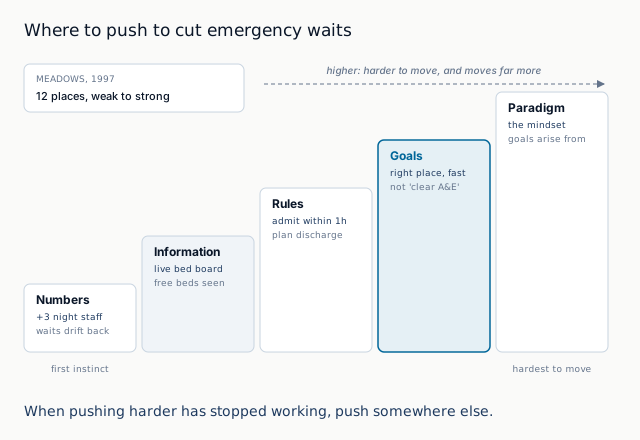
At the bottom of the ladder sit numbers and parameters : budgets, prices, targets, headcounts. They are easy to argue about and change, and they rarely change what a system does. Higher up are the sizes of buffers, the structure of flows and the length of delays. Above those are the feedback loops themselves and the flow of information, meaning who gets to see what and when. Higher again are the rules of the system, its incentives and constraints. Near the top are its goals , and at the very top the paradigm , the shared mindset from which goals and rules arise, along with the ability to step outside any paradigm at all. Meadows also noted, wryly, that people often find a leverage point and then push it in the wrong direction.
Picture a hospital trust trying to cut waiting times in its emergency department. The first instinct is a parameter: add three more staff to night shifts. Waits improve briefly, then drift back. A step up is information: a live screen showing every ward's free beds, so patients are not stuck in corridors while beds sit empty upstairs. Higher still is a rule: wards must accept admissions within an hour, with discharge planning starting at admission rather than on the final morning. At goal level the question changes from "how fast do we clear the department?" to "how fast does a patient get to the right place?", which makes the whole building responsible for flow.
The model misleads when it is read as a strict ranking, as if paradigms always beat parameters. Sometimes a number is exactly what needs to change, and a sudden price change can rewire behaviour across a market. High leverage points are also the hardest to move and the most politically charged; trying to shift a paradigm from a junior post can simply burn credibility. And leverage cuts both ways: a well-placed change with a wrong assumption fails dramatically.
When pushing harder has stopped working, push somewhere else.
Top 100 Decision Models for Strategic Thinking — One hundred ways to think before you choose
Ready when you are.
Tap below to open the full chapter in the book reader. Anchored books jump to this chapter automatically.
The Five Whys
Top 100 Decision Models for Strategic Thinking — One hundred ways to think before you choose
The Five Whys is the simplest root-cause method there is: state the problem, ask why it happened, then ask why that happened, and keep going until you reach a cause that, if fixed, would stop the whole chain from recurring. It is credited to Sakichi Toyoda, founder of the Toyota group, and was made central to the Toyota Production System by Taiichi Ohno, who described it as the basis of Toyota's scientific approach. Five is a rule of thumb, not a law. Sometimes three questions get there; sometimes seven are needed.
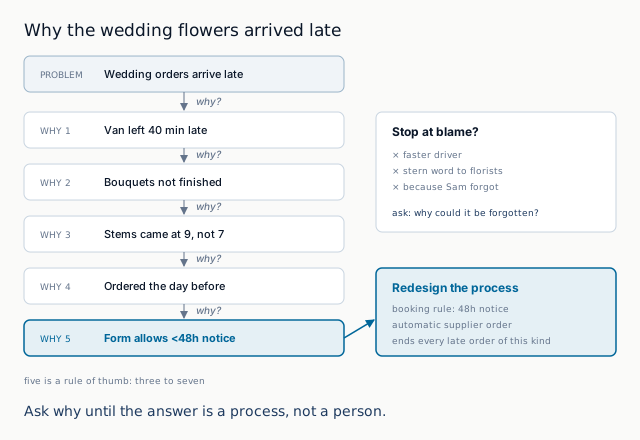
The method works by refusing the first answer. Each why moves one step down a causal chain: the visible symptom, the immediate cause, the condition that allowed it, the process that created the condition, and finally the gap in the process. A good chain ends at something a team controls and can change, usually a missing standard, check or design choice, rather than at a human failing or an act of nature.
A florist that delivers across a city notices that wedding orders keep arriving late. Why? The van left forty minutes behind schedule. Why? The arrangements were not finished at loading time. Why? The stems arrived from the wholesaler at nine rather than seven. Why? The order was placed the afternoon before instead of two days ahead. Why? The booking form lets couples confirm a wedding with less than forty-eight hours' notice, and nobody had linked that form to the supplier's cut-off. The fix is not a faster driver or a stern word with the florists. It is a booking rule and an automatic supplier order, which ends every late wedding delivery of that kind at once.
The method misleads in three ways. First, real failures usually have several contributing causes, and a single chain picks one path through a branching tree; teams should be willing to fork the chain. Second, the answers depend entirely on who is in the room, so a chain built without the people who do the work drifts towards guesswork. Third, it is easy to stop at blame: "because Sam forgot" is an answer that ends the conversation without fixing anything. The next why, "why was it possible to forget?", is where the useful answer lives.
Stop asking only when the answer is something you can redesign.
Top 100 Decision Models for Strategic Thinking — One hundred ways to think before you choose
Ready when you are.
Tap below to open the full chapter in the book reader. Anchored books jump to this chapter automatically.
The Fishbone Diagram
Top 100 Decision Models for Strategic Thinking — One hundred ways to think before you choose
The Fishbone Diagram , also called the Ishikawa or cause-and-effect diagram, maps the possible causes of a problem in one picture. It is associated with Kaoru Ishikawa, a leading figure in Japan's post-war quality movement, who popularised it in the 1960s. The name comes from its shape: the problem sits at the head of the fish, a spine runs back from it, and the main categories of cause branch off like bones, each carrying smaller bones of specific causes.
The method is deliberately broad before it is deep. The team writes the effect clearly at the head, as a measurable problem rather than a solution in disguise. It then draws the major bones. In manufacturing these are often the classic six: methods , machines , people , materials , measurement and environment . Service teams frequently swap in categories such as policies, systems or suppliers. Under each bone the group brainstorms specific causes, asking why for each until it reaches something concrete. Only after the picture is full does the team vote on, or better, test, the most likely candidates.
Take a coffee roaster whose wholesale customers complain that the espresso blend tastes inconsistent. Under machines: the roaster's temperature probe drifts. Under materials: the Brazilian component changed farm in March. Under methods: two roast profiles are in use and the labels are ambiguous. Under people: the new roaster learnt the job from notes, not from a colleague. Under measurement: nobody cups a sample from every batch. Under environment: the warehouse heats up in the afternoon and beans rest longer in summer. The team's hunch was the new green beans. The diagram shows five other candidates, and cupping two weeks of batches against the roast logs points to the profile mix-up as the main culprit.
The diagram misleads when it is treated as an answer rather than a list of hypotheses. A packed fishbone looks rigorous, yet every bone was produced by brainstorming and needs evidence before anyone acts. It also flattens interactions: a drifting probe matters more in a hot warehouse, and the separate bones hide that. Categories can become a tick-box exercise, with teams inventing a cause for every bone so the drawing looks balanced. Used well, it is a disciplined way to slow a group down for twenty minutes so it does not spend twenty weeks fixing the wrong thing.
Draw the whole skeleton before you pick a bone.
Top 100 Decision Models for Strategic Thinking — One hundred ways to think before you choose
Ready when you are.
Tap below to open the full chapter in the book reader. Anchored books jump to this chapter automatically.
The OODA Loop
Top 100 Decision Models for Strategic Thinking — One hundred ways to think before you choose
The OODA Loop stands for observe, orient, decide, act. It was developed by John Boyd, a US Air Force fighter pilot and military strategist, through briefings he gave in the 1970s and 1980s. Boyd's starting point was air combat, but his argument was general: in any contest, the side that cycles through the loop faster and more accurately can disorient its opponent, who ends up reacting to a situation that has already changed.
The four stages are easy to state. Observe means taking in information from the environment, including the effects of your own last action. Orient means making sense of it, filtering what you see through experience, culture, prior models and fresh analysis. Decide means choosing a course of action, best understood as a hypothesis. Act means testing that hypothesis in the world, which produces new information to observe. Boyd stressed that orientation is the heart of the loop: it shapes what you notice, what options you can imagine and how quickly you can drop a stale picture. Skilled operators often skip from orientation straight to action, because experience has turned the decision into instinct.
Picture a small online retailer of camping gear when a larger rival suddenly undercuts its best-selling tent by a fifth. A slow loop looks like this: the drop is noticed in the monthly report, a pricing meeting is scheduled, and a matched price goes live five weeks later, by which time the rival has moved on to bundles. A fast loop looks different. The founder watches daily sales and competitor prices, so the drop is seen within a day. Orientation asks what the rival is actually doing, clearing old stock rather than starting a price war, which suggests not matching at all. The decision is to promote a waterproofing kit with the tent instead, and the result is visible in two days, ready for the next turn of the loop.
The model is often misread as a call for raw speed. Boyd's point was tempo combined with good orientation; a fast loop with a distorted picture just makes mistakes more quickly. It is also less useful where there is no adversary or where decisions are slow by nature, such as building a hospital. And in organisations the bottleneck is rarely observation; it is the long, political orient and decide stages, which no dashboard can fix on its own.
Speed matters, but only after you have learnt to see straight.
Top 100 Decision Models for Strategic Thinking — One hundred ways to think before you choose
Ready when you are.
Tap below to open the full chapter in the book reader. Anchored books jump to this chapter automatically.
Plan–Do–Check–Act
Top 100 Decision Models for Strategic Thinking — One hundred ways to think before you choose
Plan–Do–Check–Act , often shortened to PDCA, is a four-step cycle for improving a process through small, deliberate experiments. Its roots lie in the work of the statistician Walter Shewhart at Bell Labs in the 1930s, and it was carried to Japanese industry and then the wider world by W. Edwards Deming, who later preferred "Plan–Do–Study–Act" to stress learning over inspection. It underpins much of lean thinking and the Japanese practice of kaizen , continuous improvement.
The cycle runs like this. Plan : define the problem, set a measurable goal and predict what a specific change will do. Do : try the change on a small scale, ideally in one place or for a short period. Check : compare what happened with what you predicted, using data rather than impressions. Act : if the change worked, standardise it so the gain sticks; if it did not, keep what you learnt and start a new plan. Then the cycle turns again. The prediction in the planning stage is what separates PDCA from mere tinkering: without it there is nothing to check against, and every result can be read as success.
A GP surgery wants to reduce missed appointments, which run at about one in ten. The plan: text patients a reminder two days ahead, with a link to cancel, and predict that no-shows will fall to one in fifteen. The team does it for one doctor's list for a month. The check shows no-shows fell to one in fourteen, close to the prediction, but also that most cancellations came in the final evening, too late to rebook. The act stage adopts the reminder for every list and sets up the next cycle: try a second reminder the morning before, with a small waiting list ready to take freed slots.
PDCA fails when one of the four letters is skipped. Many teams plan and do, then move on without checking, so the loop never closes. Others check carefully and never act, writing a report that changes nothing. The cycle is also slow by design and is a poor fit for a crisis that demands a decision in hours. And small-scale tests can mislead when the conditions in the pilot, enthusiastic staff and a quiet month, differ from the conditions everywhere else.
Progress is a habit of small, honest experiments.
Top 100 Decision Models for Strategic Thinking — One hundred ways to think before you choose
Ready when you are.
Tap below to open the full chapter in the book reader. Anchored books jump to this chapter automatically.
Goodhart's Law
Top 100 Decision Models for Strategic Thinking — One hundred ways to think before you choose
Goodhart's Law warns that a measure stops being reliable once it becomes a target. The economist Charles Goodhart made the original point in 1975, about monetary statistics: when a central bank leans on a particular indicator to steer policy, the relationship that made that indicator useful tends to break down. The crisp version most people quote, "when a measure becomes a target, it ceases to be a good measure", is the anthropologist Marilyn Strathern's later paraphrase.
The mechanism has a few steps. A number starts out as a decent proxy for something you care about but cannot see directly, such as quality, learning or customer satisfaction. Someone then sets a target on that number and attaches rewards, rankings or blame. People respond rationally by finding the cheapest way to move the number, and the cheapest way is often not the way that moves the underlying goal. Over time the proxy and the goal drift apart, while the dashboard keeps reporting success.
A broadband company's support centre is judged on calls handled per agent per hour. The measure was sensible: busy agents with short queues meant customers got help quickly. Once bonuses are linked to it, call lengths fall, and so does the share of problems actually fixed. Agents transfer awkward calls, promise call-backs that never come, or end calls once the customer is told to restart the router. The figure goes up every month. Repeat calls, cancellations and complaints go up too, but they sit on another team's dashboard. Management has bought a better number and a worse service.
The law does not mean measuring is pointless; it means a single measure under pressure is fragile. Sensible responses include pairing each target with a counterweight (calls handled alongside problems resolved on first contact), rotating or blending indicators, keeping some measures for learning rather than reward, and, above all, going to look at the work. The law is also misused as an excuse to avoid any accountability, which is its own failure. Measures are still the best way to see at scale; they just need to be held lightly.
Watch what the number is for, not just where it is.
Top 100 Decision Models for Strategic Thinking — One hundred ways to think before you choose
Ready when you are.
Tap below to open the full chapter in the book reader. Anchored books jump to this chapter automatically.
The Tragedy of the Commons
Top 100 Decision Models for Strategic Thinking — One hundred ways to think before you choose
The Tragedy of the Commons describes how a shared resource can be ruined by people who each act reasonably. The idea was sketched in 1833 by the economist William Forster Lloyd, using the example of cattle on common pasture, and made famous by the ecologist Garrett Hardin in a 1968 essay in Science . Each herder gains the full benefit of adding one more animal but bears only a fraction of the damage, which is shared with everyone. So each adds another, and the pasture fails.
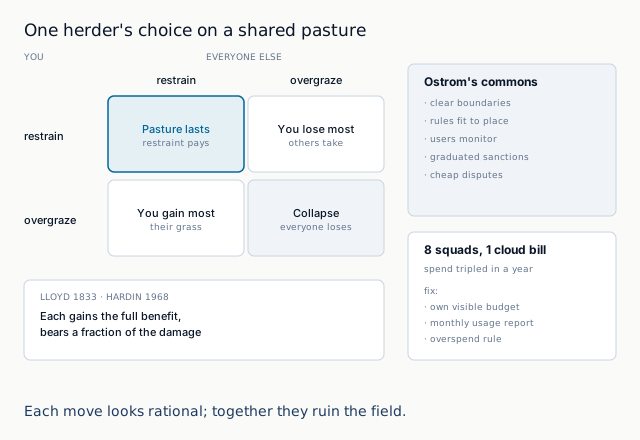
The logic is easiest to see as a payoff grid. If you restrain while others restrain, the resource lasts. If you overuse while others restrain, you gain the most. If you restrain while others overuse, you lose the most. If everyone overuses, the resource collapses and everyone loses. Without some way to coordinate, overusing looks like the safer choice for each individual, which is why the collapse can happen even when every user can see it coming.
Modern commons are everywhere. An office kitchen fridge becomes a science experiment because nobody owns the clean-up. Shared cloud budgets in a company get eaten by teams who each spin up a few more servers, since the bill lands centrally. Picture a start-up with eight squads and one cloud account: within a year spending has tripled, and every squad can justify its own share. The fix is not a plea for virtue. It is giving each squad its own visible budget, a monthly report of who used what, and a simple rule for what happens when a team overspends.
Hardin's version misleads when read as proof that shared resources must be either privatised or controlled by the state. The political economist Elinor Ostrom, who won the Nobel prize in economics in 2009, documented many communities, from Swiss alpine pastures to irrigation systems, that managed commons sustainably for centuries. Their common features included clear boundaries, rules matched to local conditions, monitoring by the users themselves, graduated sanctions and cheap ways to resolve disputes. The tragedy is a risk, not a destiny. It is most likely when users are anonymous, numerous and unable to talk to each other.
Shared things last when their users can see each other and agree the rules.
Top 100 Decision Models for Strategic Thinking — One hundred ways to think before you choose
Ready when you are.
Tap below to open the full chapter in the book reader. Anchored books jump to this chapter automatically.
The Johari Window
Top 100 Decision Models for Strategic Thinking — One hundred ways to think before you choose
In 1955 two American psychologists, Joseph Luft and Harrington Ingham, sketched a simple grid for a workshop on group dynamics and named it after their own first names: the Johari Window . It has outlived most management tools of its era because it asks an awkward question with unusual politeness. What do you know about yourself, what do others know about you, and where do those two pictures disagree?
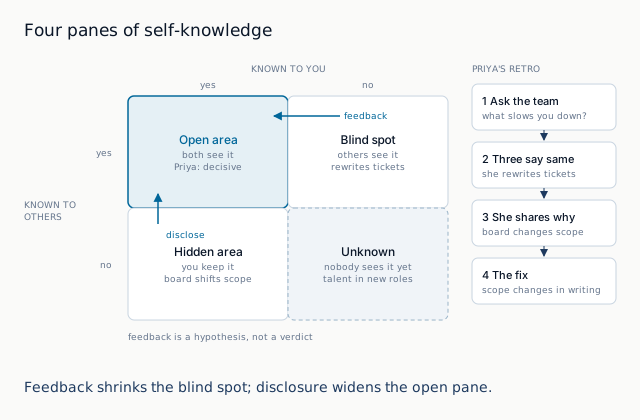
The window has four panes. Put known to you and not known to you along one edge, known to others and not known to others along the other. The open area holds what both sides see: your role, your habits, the fact that you talk fast when nervous. The blind spot holds what others see and you do not, such as the way you interrupt when a meeting runs late. The hidden area is what you know and keep back: a worry, a preference, a mistake not yet confessed. The unknown holds what nobody has noticed yet, including talents that only appear under new conditions. The panes are not fixed in size. Asking for feedback shrinks the blind spot; choosing to disclose shrinks the hidden area; together they widen the open area, which is where trust and quick decisions live.
Consider a five-person product team whose lead, Priya, prides herself on being decisive. In a retrospective she asks each person for one thing she does that slows them down. Three of them, separately, name the same habit: she rewrites tickets after they have been estimated. That is a blind spot moving into the open. In return she shares something from her hidden pane: she rewrites because the board keeps changing scope on her, and she has been absorbing it quietly. Within ten minutes the team has a better diagnosis than months of grumbling produced, and a fix: scope changes now come to the whole team, in writing.
The model misleads when it becomes a demand for total transparency. Not everything in the hidden pane belongs in the open; discretion is not dishonesty, and a workplace that pressures people to disclose is running a surveillance exercise with a friendly name. Feedback also has a quality problem. Others see your behaviour, not your reasons, so their view of your blind spot can be confidently wrong. Treat what lands in that pane as a hypothesis to test, not a verdict. And the unknown area is unknown for a reason: no workshop exercise will map it, though new roles and honest experiments sometimes do.
The window is a mirror with two sides, and you only ever hold one of them.
Top 100 Decision Models for Strategic Thinking — One hundred ways to think before you choose
Ready when you are.
Tap below to open the full chapter in the book reader. Anchored books jump to this chapter automatically.
Maslow's Hierarchy of Needs
Top 100 Decision Models for Strategic Thinking — One hundred ways to think before you choose
In 1943 the American psychologist Abraham Maslow published a paper titled A Theory of Human Motivation . Its central idea, now known as Maslow's hierarchy of needs , is that human needs come in an order of urgency, and that a higher need tends to grip us only once the ones below are reasonably met. The famous pyramid is not Maslow's own drawing; others added it later, and it made the theory both more memorable and more rigid than he intended.
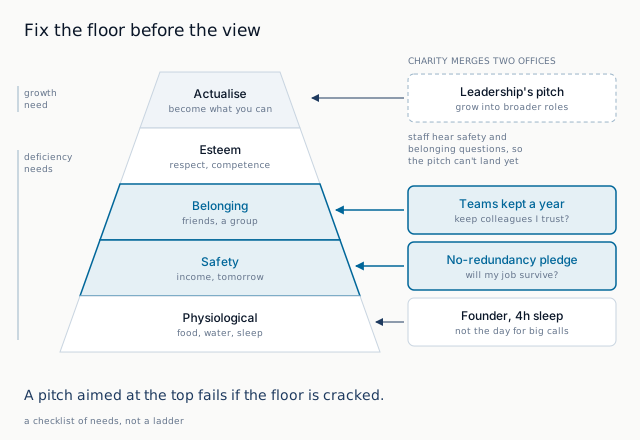
Read the pyramid from the bottom. Physiological needs come first: food, water, sleep, warmth. Then safety : physical security, health, a stable income, a predictable tomorrow. Then belonging : friendship, family, being part of a group. Then esteem : respect from others and for yourself, the sense of being competent and recognised. At the top sits self-actualisation , Maslow's term for becoming what one is capable of becoming. He called the lower levels deficiency needs, felt mainly when missing, and the top a growth need, which keeps expanding the more it is fed.
For decision-makers the useful move is diagnostic. When a team rejects a perfectly good plan, ask which level the plan threatens. Take a regional charity merging two offices. Leadership presents the merger as a chance for staff to grow into broader roles, a pitch aimed squarely at the top of the pyramid. Staff hear something else: will my job survive, will my commute double, will I lose the colleagues I trust? Those are safety and belonging questions, and no amount of talk about growth reaches people standing on a cracked floor. When the charity publishes a no-redundancy pledge and keeps existing teams intact for a year, the same growth pitch suddenly gets a hearing.
The hierarchy applies to the decider too. A founder running on four hours' sleep, with a bank balance measured in weeks, is not well placed at that moment to make a brilliant call about brand purpose. Noticing which level is shouting is often enough to postpone a decision that does not need making today.
The model's limits are well known. The strict ordering does not hold up reliably in research: people go hungry for causes, artists trade safety for meaning, and many cultures rank belonging above individual esteem. Maslow himself described the levels as overlapping rather than as a staircase. Use the pyramid as a checklist of needs, not as a ladder people must climb one rung at a time.
Fix the floor first, and the view from the top tends to improve.
Top 100 Decision Models for Strategic Thinking — One hundred ways to think before you choose
Ready when you are.
Tap below to open the full chapter in the book reader. Anchored books jump to this chapter automatically.
The Flow Channel
Top 100 Decision Models for Strategic Thinking — One hundred ways to think before you choose
The Hungarian-American psychologist Mihaly Csikszentmihalyi spent years asking climbers, surgeons, chess players and factory workers when they felt most alive. Their answers converged on a state he called flow : total absorption, a sense that time had bent, action and awareness merging. From the mid-1970s he described the conditions that make it likely, and the most practical of them fits on one chart. Put skill on one axis and challenge on the other. Flow lives in a diagonal band, the flow channel , where the two rise together.
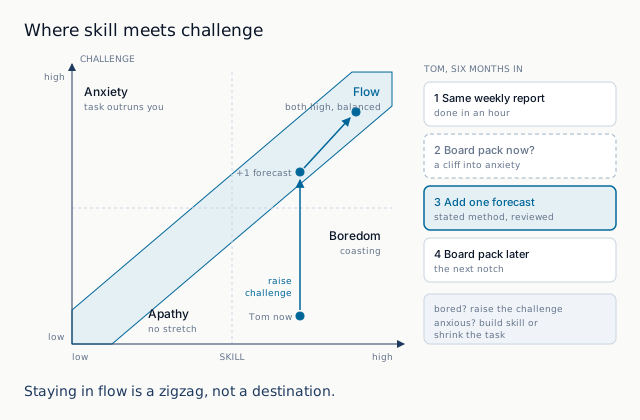
Divide the chart into four and the territory becomes easy to read. High challenge with low skill produces anxiety : the task outruns you. Low challenge with high skill produces boredom : you are coasting and attention drifts. Low on both is apathy , the slow afternoon of tasks that neither stretch nor reward. High on both, roughly in balance, is flow . Later researchers, among them Fausto Massimini and Massimo Carli, carved the chart into eight finer regions, but the four-way version does most of the work.
The channel is a moving target. Every time you master a level, your skill rises and the old challenge slides you towards boredom; the cure is to raise the challenge. Every time you take on something new, you start in anxiety; the cure is to build skill or shrink the task. Staying in flow is a zigzag, not a destination.
Take a junior analyst, Tom, six months into a job. His manager has given him the same weekly sales report since he started. He now finishes it in an hour and spends the rest of the day refreshing his inbox. That is boredom, not laziness. The manager's instinct is to hand him the board pack, which would fling him straight into anxiety. The channel suggests a middle step: keep the weekly report but ask Tom to add one forecast with a stated method, reviewed by a senior colleague. Challenge rises a notch, skill grows to meet it, and three months later the board pack becomes the next notch rather than a cliff edge.
The model has limits. Flow feels good, but feeling good is not proof of value; people can slip into flow while gaming, scrolling or polishing a slide nobody needs. Some essential work, such as compliance checks, will never be flow-friendly and needs other kinds of design. And the chart says nothing about meaning. A person in perfect flow on the wrong task is efficiently lost.
Good work lives where the task is just big enough to need all of you.
Top 100 Decision Models for Strategic Thinking — One hundred ways to think before you choose
Ready when you are.
Tap below to open the full chapter in the book reader. Anchored books jump to this chapter automatically.
Ikigai
Top 100 Decision Models for Strategic Thinking — One hundred ways to think before you choose
Ikigai is a Japanese word that roughly means a reason for being, or what makes life worth living. In Japan it is used modestly: an ikigai can be a grandchild, a garden, an early walk to the fish market. The diagram that made the word famous abroad is a much later Western remix. In 2014 the British blogger Marc Winn placed the word at the centre of an existing four-circle Venn diagram about purpose, and the image spread through careers advice. It is worth knowing both versions, because they answer different questions.
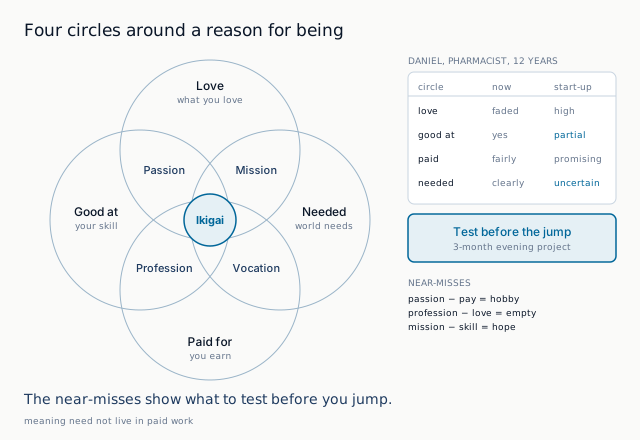
The Western diagram has four circles: what you love , what you are good at , what the world needs and what you can be paid for . Each neighbouring overlap has a name. Love plus skill is passion . Skill plus pay is profession . Pay plus need is vocation . Need plus love is mission . Ikigai, in this version, sits where all four meet. The value of the picture lies in the near-misses it exposes. Passion without pay is a hobby that may never fund itself; profession without love is a comfortable emptiness; mission without skill is good intentions that cannot deliver.
Imagine a hospital pharmacist, Daniel, considering a move into health-tech product work. He scores his current role: good at it, paid fairly, clearly needed, but the love has faded after twelve years. The new role scores high on love and promising on pay, while skill is partial and need is uncertain, since the start-up has not yet proved anyone will buy. The diagram does not make the decision for him. It tells him what to test: a three-month evening project with the start-up would show whether the skill gap can be closed and whether the market need is real, before he gives up a role that already sits in three circles.
The four-circle version misleads in two ways. First, it implies that a full life must be found in paid work, which is precisely what the original Japanese idea does not claim; many people keep their ikigai outside their job and are wise to do so. Second, it treats the circles as fixed. Skill grows with practice, love often follows competence, and what the world pays for shifts with every technology cycle. A person who waits for all four circles to align before acting may wait for ever.
Use the circles to see the gaps, and the original word to remember that meaning does not need a business model.
Top 100 Decision Models for Strategic Thinking — One hundred ways to think before you choose
Ready when you are.
Tap below to open the full chapter in the book reader. Anchored books jump to this chapter automatically.
The Circle of Control
Top 100 Decision Models for Strategic Thinking — One hundred ways to think before you choose
Nearly two thousand years ago the Stoic teacher Epictetus opened his Handbook with a distinction: some things are up to us and some are not. In 1989 Stephen Covey gave the idea a modern diagram in The 7 Habits of Highly Effective People , contrasting a large circle of concern with a smaller circle of influence inside it. Many trainers now draw three rings, with a tight circle of control at the centre, and that is the version most people mean by the name.
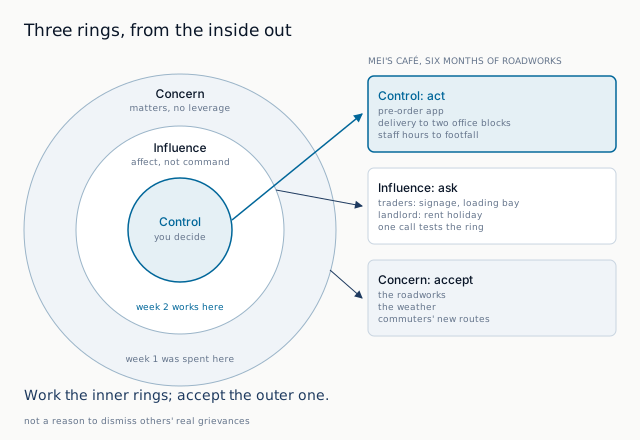
Work from the inside out. The circle of control holds what you directly decide: your actions, your words, your effort, how you prepare and how you respond. The circle of influence holds what you can affect but not command: a colleague's opinion, a supplier's priorities, a council decision you can lobby on. The circle of concern holds everything else that matters to you but where your leverage is negligible: interest rates, the weather, a competitor's funding round. Covey's observation was that proactive people spend their energy in the inner circles, and that doing so tends to make their influence grow. Reactive people spend it on concern, and their influence shrinks while their worry expands.
Take Mei, who runs a small café on a high street where the council has announced six months of roadworks. Her first week goes on concern: furious emails, late-night forecasts, refreshing the council's website. Sorting the problem into rings changes the second week. Control: she can move to a pre-order app, offer delivery to the two office blocks behind the shop and fit staff hours to the new footfall. Influence: she can join other traders to ask the council for clear signage and a loading bay, and ask her landlord for a temporary rent holiday. Concern: the roadworks themselves, the weather, whether commuters change route for good. She accepts the outer ring, works the inner two, and the café comes out of the summer smaller but intact.
The model has two misuses. One is quiet surrender: labelling something as outside your control because acting on it would be uncomfortable. Many things that feel like concern turn out to be influence once someone makes a phone call. The other is the reverse: telling people with real grievances that their distress is a failure of focus. The rings are a tool for allocating your own effort, not for dismissing other people's problems.
Worry is energy with nowhere to go; the rings give it an address.
Top 100 Decision Models for Strategic Thinking — One hundred ways to think before you choose
Ready when you are.
Tap below to open the full chapter in the book reader. Anchored books jump to this chapter automatically.
Fixed and Growth Mindsets
Top 100 Decision Models for Strategic Thinking — One hundred ways to think before you choose
The Stanford psychologist Carol Dweck spent decades studying how people, especially students, respond to failure. Her work, popularised in the 2006 book Mindset , distinguishes two beliefs about ability. In a fixed mindset , intelligence and talent are largely set, and each task is a test of how much you have. In a growth mindset , ability can be developed through effort, good strategies and help from others, and each task is a chance to get better. Most people hold a mix, and the mix shifts by domain. Someone can be growth-minded about cooking and fixed-minded about maths.
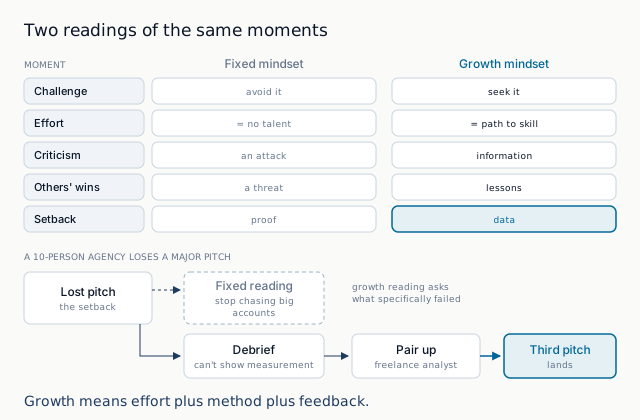
The two mindsets play out across a predictable set of moments. Faced with a challenge, the fixed view avoids it, because failing would expose a limit; the growth view seeks it, because stretching is how limits move. Effort, to the fixed view, is a sign you lack talent; to the growth view, it is the path to mastery. Criticism feels like an attack in one and like useful information in the other. Other people's success is a threat in one and a source of lessons in the other. And a setback, the moment that matters most, is read either as proof or as data.
Picture a ten-person marketing agency that loses a major pitch. The founder's first instinct is fixed: we are not good at big accounts, so let us stop chasing them. A growth reading asks what specifically failed. The debrief shows the creative work scored well, but the agency could not explain how it would measure results. That is a skill gap, not a destiny. The founder pairs with a freelance analyst for the next two pitches and builds a simple measurement section into the template. The third big pitch lands. Nothing about the agency's talent changed; its response to failure did.
The model needs care. Large later studies have found that brief mindset interventions in schools produce modest average effects, larger for some groups and close to nothing for others, so it is no magic switch. Dweck herself has warned against a false growth mindset : praising effort that is not working, or telling people to try harder when what they need is a different strategy, better teaching or more resources. Growth is not just grit; it is effort plus method plus feedback. And mindset talk can become a way for organisations to blame individuals for structural problems.
Ability is a verb more often than people assume.
Top 100 Decision Models for Strategic Thinking — One hundred ways to think before you choose
Ready when you are.
Tap below to open the full chapter in the book reader. Anchored books jump to this chapter automatically.
The Dunning–Kruger Effect
Top 100 Decision Models for Strategic Thinking — One hundred ways to think before you choose
In 1999 two Cornell psychologists, Justin Kruger and David Dunning, published a paper with a memorable title: Unskilled and Unaware of It . Across tests of logical reasoning, grammar and humour, the participants who scored lowest tended to overestimate their performance by a wide margin. In the paper's own summary, those in the bottom quarter scored around the 12th percentile but placed themselves around the 62nd. The pattern became known as the Dunning–Kruger effect .
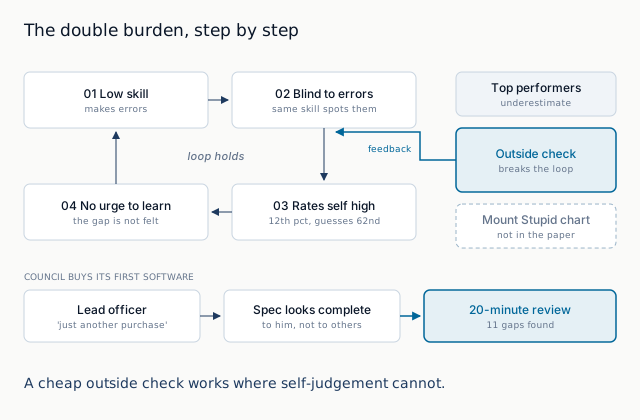
The paper's explanation is a chain, and it is more interesting than the popular meme. Low skill in a domain means you make errors. But the knowledge needed to spot those errors is the same knowledge you lack, so you cannot see them. Kruger and Dunning called this a double burden . Not seeing the errors, you rate yourself well. And without a felt gap between how good you think you are and how good you are, there is no reason to learn, so the loop holds until outside feedback breaks it. The authors also found a quieter mirror image: top performers tended to underestimate themselves, partly because they assumed that tasks easy for them were easy for everyone.
Imagine a council procurement team taking on its first software contract. The lead officer has bought furniture and vehicles for years and is sure software is just another purchase: list requirements, compare quotes, pick the cheapest compliant bid. He does not know what he does not know about data migration, licensing terms or exit clauses, so his specification looks complete to him. A twenty-minute review by a colleague who has bought software before turns up eleven gaps. The fix was not more confidence or less; it was a cheap outside check at the very point where his own judgement had no way of working.
The effect is often misused. The internet's favourite chart, a peak of confidence nicknamed Mount Stupid followed by a valley of despair, does not come from the paper. The research does not claim that novices are more confident than experts, only that they are less accurate about themselves. Some researchers also argue that part of the pattern is a statistical artefact of how self-ratings and scores relate, which is a reason to hold the finding a little more loosely than the meme does. And the label is far easier to pin on others than on yourself, which rather proves the point.
The least visible gaps are in the instrument you use to look for gaps.
Top 100 Decision Models for Strategic Thinking — One hundred ways to think before you choose
Ready when you are.
Tap below to open the full chapter in the book reader. Anchored books jump to this chapter automatically.
System 1 and System 2
Top 100 Decision Models for Strategic Thinking — One hundred ways to think before you choose
Psychologists have long described two modes of thinking. In 2000 Keith Stanovich and Richard West gave them neutral labels, and in 2011 Daniel Kahneman made those labels famous in Thinking, Fast and Slow . System 1 is fast, automatic and effortless. It reads faces, finishes sentences, senses danger and produces impressions without being asked. System 2 is slow, deliberate and effortful. It does long division, compares contracts and follows rules it has to hold in mind. Kahneman stressed that the two systems are useful fictions, characters in a story about the mind rather than places in the brain.
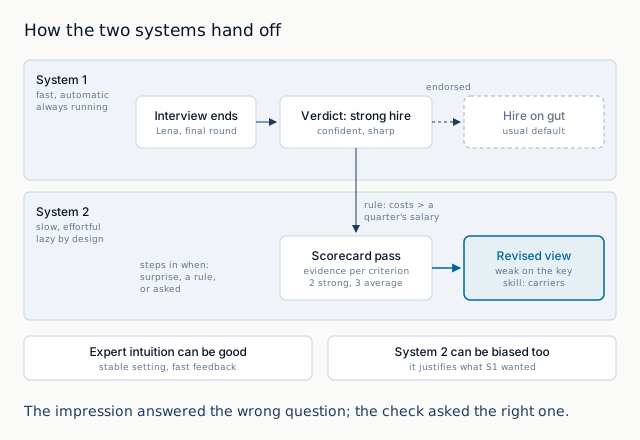
The interesting part is how they hand off. System 1 runs all the time and sends up a stream of impressions and verdicts. System 2 is lazy by design: most of the time it endorses those verdicts with little or no checking, which is efficient, because most impressions are good enough. It steps in when something surprises it, when a rule is plainly at stake, or when we deliberately call on it. When it does check, the answer may change, and the revised view feeds the next intuition.
Take Lena, a hiring manager at a logistics firm, finishing a final interview. Within minutes System 1 has delivered a verdict: strong hire, confident, sharp, reminds her of herself at that age. On an ordinary day System 2 would approve the verdict and move on. But she has a rule: any decision that costs more than a quarter's salary gets a slow pass. She opens the scorecard agreed before the interviews and scores each criterion with evidence. The candidate is strong on two, average on three, and weak on the one that matters most for the role, managing difficult carriers. The impression was not wrong about the person; it was answering the wrong question.
The model is easy to misuse. It is tempting to cast System 1 as the villain and System 2 as the hero, but expert intuition in stable settings with fast feedback, such as a nurse spotting a deteriorating patient or a chess master seeing a move, is often excellent. System 2 can be biased too, building elaborate justifications for what System 1 already wanted. Some research cited in the book, notably on priming, has since failed to replicate, so lean on the framework rather than on every finding hung from it. And nobody can run System 2 all day; effort is finite.
Trust intuition where it has earned the right, and audit it everywhere else.
Top 100 Decision Models for Strategic Thinking — One hundred ways to think before you choose
Ready when you are.
Tap below to open the full chapter in the book reader. Anchored books jump to this chapter automatically.
The Sunk Cost Trap
Top 100 Decision Models for Strategic Thinking — One hundred ways to think before you choose
Economists call costs that have already been paid and cannot be recovered sunk costs . Textbook logic says they should play no part in deciding what to do next: the money is gone whichever path you choose, so only future costs and future benefits differ between the options. People find this remarkably hard to apply. In a well-known set of studies published in 1985, Hal Arkes and Catherine Blumer showed that people who had paid more for something were more likely to keep using it, even when it no longer served them. The tendency is known as the sunk cost fallacy , or the sunk cost trap.
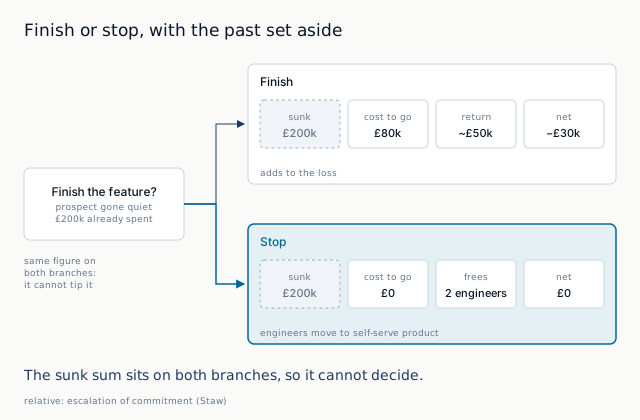
The cure is a decision tree that deletes the past. Draw the choice as it stands today. Each branch carries only what is still to come: the money and time still required, the value it will return, and what else those resources could do. The sunk amount goes on every branch as the same figure, which is the honest way of saying it cannot tip the scales.
Consider a software start-up that has spent £200,000 building an enterprise feature for one large prospect. The prospect has gone quiet. Finishing the feature would cost another £80,000 in engineering, and the realistic return, now that the anchor customer is wavering, looks like £50,000 over the next year. The founders' instinct is to finish: walking away seems to waste the £200,000. The tree tells a different story. Finishing nets minus £30,000; stopping nets zero and frees two engineers for the self-serve product customers are already asking for. The £200,000 is spent on both branches. Stopping does not waste it; finishing would add to the loss.
The trap has relatives. Escalation of commitment , studied by Barry Staw, describes managers pouring more into failing projects they personally launched, often to justify the original call. Public bodies face an extra twist: abandoning a half-built project can look like admitting waste, so reputational cost leaks into what should be a forward-looking sum. And not every past investment is truly sunk. Skills learned, data gathered and relationships built can carry value forward, and they belong on the future branches, not in the discarded pile. The test is not whether money was spent but whether it can still earn.
Yesterday's spending is a lesson, not a vote.
Top 100 Decision Models for Strategic Thinking — One hundred ways to think before you choose
Ready when you are.
Tap below to open the full chapter in the book reader. Anchored books jump to this chapter automatically.
The 10/10/10 Rule
Top 100 Decision Models for Strategic Thinking — One hundred ways to think before you choose
The writer and former Harvard Business Review editor Suzy Welch developed the 10/10/10 rule as a personal habit and set it out in her 2009 book 10-10-10 . The method is almost embarrassingly simple. Before deciding, ask how you will feel about each option in ten minutes, in ten months and in ten years. The numbers are not magic; they are a device for dragging attention away from the present moment, where emotion tends to dominate, towards the stretches of time where most consequences live.
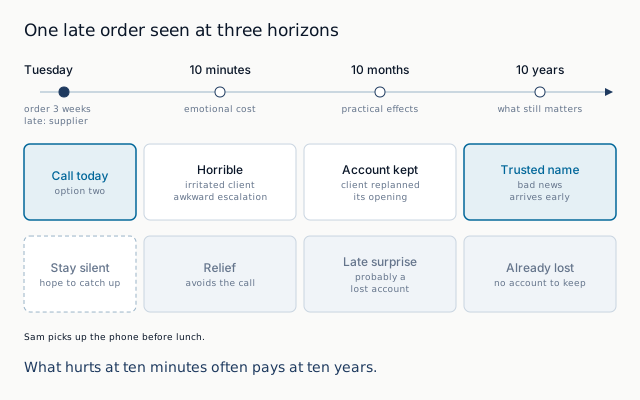
The rule works by giving each horizon a different job. Ten minutes surfaces the immediate emotional cost: the awkwardness of a hard conversation, the relief of avoiding it. Ten months brings in the practical consequences: what happens to the project, the relationship, the money. Ten years asks what will still matter at all, and what kind of person, team or company the choice makes you. A good decision often looks worst at ten minutes and best at ten years, which is exactly why short-term feelings make it so hard.
Take Sam, operations lead at a furniture maker, who learns on a Tuesday that a large order for a hotel client will ship three weeks late because a supplier has failed. Option one is to say nothing yet and hope to claw back time. Option two is to call the client today. At ten minutes, calling is horrible: an irritated customer and an awkward escalation. At ten months the picture flips: the client has had time to replan its opening and the relationship has survived, whereas silence would have meant a late surprise and probably a lost account. At ten years, Sam's firm is the kind of supplier people recommend because bad news arrives early. Sam picks up the phone before lunch.
The rule has limits. It assumes you can forecast your future feelings, and people are notoriously poor at that; we tend to overestimate how long both good and bad feelings will last. It suits personal and relational choices better than complex analytical ones, where the numbers need a spreadsheet rather than a mood check. And used carelessly, the ten-year horizon can justify anything: almost every short-term pain looks small from a decade away, including some that should simply be avoided.
The moment of choosing is the shortest part of living with a choice.
Top 100 Decision Models for Strategic Thinking — One hundred ways to think before you choose
Ready when you are.
Tap below to open the full chapter in the book reader. Anchored books jump to this chapter automatically.
Tuckman's Team Stages
Top 100 Decision Models for Strategic Thinking — One hundred ways to think before you choose
In 1965 the psychologist Bruce Tuckman reviewed dozens of studies of small groups and noticed that they tended to pass through the same sequence on the way to doing useful work. He gave the stages rhyming names that have outlived almost everything else written about teams that decade: forming, storming, norming and performing. In 1977, with Mary Ann Jensen, he added a fifth, adjourning, for the moment a group disbands.
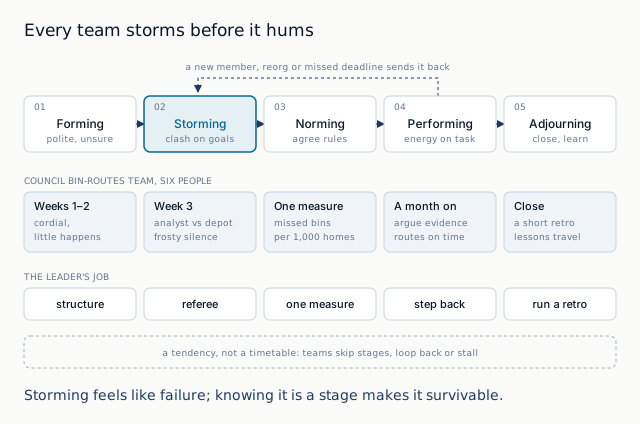
The sequence runs left to right. In forming , people are polite, cautious and slightly lost; they look to whoever seems to be in charge and keep their real views to themselves. Storming follows once the work gets real: disagreements surface about goals, roles and who gets heard, and the team often feels worse than when it started. If those arguments are worked through rather than buried, the group reaches norming , where it settles how it does things, from how decisions get made to who owns the spreadsheet. Only then does performing become possible: energy goes into the task rather than into the group itself, and the leader can step back. Adjourning is the ending, which deserves more care than it usually gets.
Picture a council setting up a six-person team to redesign its bin collection routes. In the first fortnight everyone is cordial and nothing much happens. In week three the data analyst and the depot manager clash over whether residents' complaints or lorry mileage should drive the design, and two meetings end in frosty silence. The team lead resists the urge to smooth it over. Instead she gets both to agree on a single measure, missed collections per thousand homes, and a rule that whoever owns a route's data has the final say on it. Within a month the meetings are shorter, the arguments are about evidence rather than turf, and the new routes go live on time. When the project closes, she runs a short retrospective so the lessons travel with the people.
The value of the model is mostly emotional. Storming feels like failure, and leaders who don't expect it tend either to crush the conflict or to break up the team. Knowing it is a stage makes it survivable, and shows how the leader's job changes as the team moves: structure early, refereeing in the storm, then getting out of the way.
The caution is that the stages are a tendency, not a timetable. Tuckman's original review drew largely on therapy and laboratory groups, and real teams loop back: a new member, a reorganisation or a missed deadline can send a performing team straight back into the storm. Some teams skip a stage; some never leave one. Treat the labels as a diagnosis to test, not a progress bar to fill.
A team that has never stormed has usually not started the real work.
Top 100 Decision Models for Strategic Thinking — One hundred ways to think before you choose
Ready when you are.
Tap below to open the full chapter in the book reader. Anchored books jump to this chapter automatically.
Situational Leadership
Top 100 Decision Models for Strategic Thinking — One hundred ways to think before you choose
Situational Leadership grew out of work by Paul Hersey and Ken Blanchard in the late 1960s, first published as the life cycle theory of leadership. The two later developed rival versions, Blanchard's known as SLII, which is why the labels vary depending on which training course you sat through. The core idea survives both: the right way to lead depends less on the leader's personality than on the follower's readiness for a particular task.
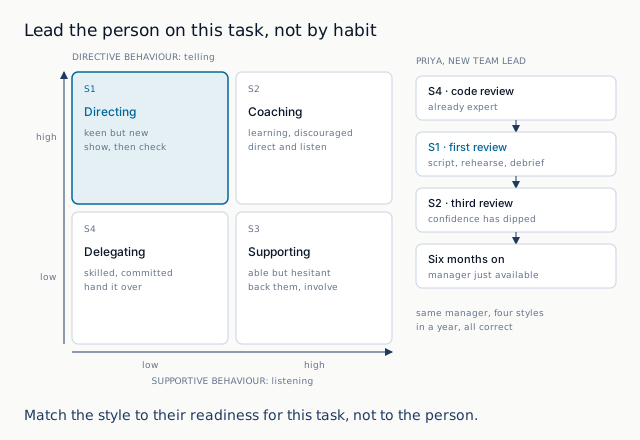
The model crosses two kinds of behaviour. Directive behaviour is telling: setting goals, showing how, checking closely. Supportive behaviour is listening: encouraging, asking, involving people in decisions. High direction with low support is directing , right for someone keen but new to the task. High on both is coaching , for someone who has learned enough to be discouraged by how much is left. Low direction with high support is supporting , for the capable but hesitant. Low on both is delegating , for someone skilled and committed. The leader's job is to read the person's development level on this task, then pick the matching quadrant.
The phrase on this task does most of the work. Take a small engineering firm promoting its best developer, Priya, to lead a team. On code review she needs delegation; interfering would insult her. On running her first performance review she is a beginner, enthusiastic and slightly overconfident, so her manager directs: a script, a rehearsal, a debrief. By her third review she has seen one go badly and her confidence has dipped, so he shifts to coaching, still giving direction but spending more time on her reasoning and doubts. Six months later he is merely available. Same manager, same report, four styles in a year, all of them correct.
The model's strength is that it turns a leader's style into a choice rather than a habit. Most managers have a default, usually the one their own best boss used, and apply it to everyone. Mapping each person, task by task, exposes where that default is starving someone of guidance or smothering someone who no longer needs it.
Its weaknesses are real. Academic tests of the model have produced mixed support, and the neat path from novice to expert is an idealisation; people do not always move through the quadrants in order. Diagnosing development level is also a judgement that can quietly harden into labelling. The best protection is to say it out loud: tell people which style you are using and why, and ask whether it fits.
Good leaders are not consistent in style; they are consistent in paying attention.
Top 100 Decision Models for Strategic Thinking — One hundred ways to think before you choose
Ready when you are.
Tap below to open the full chapter in the book reader. Anchored books jump to this chapter automatically.
The RACI Matrix
Top 100 Decision Models for Strategic Thinking — One hundred ways to think before you choose
The RACI matrix has no famous inventor. It emerged from project and organisational design practice in the second half of the twentieth century, sometimes under the drier name of responsibility assignment matrix, and spread because it solves a problem every organisation has: work that falls between chairs. The grid lists tasks down one side and people or teams across the top, and each cell gets one of four letters.
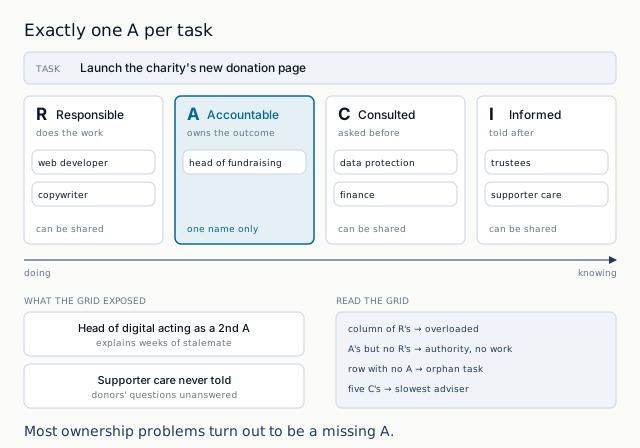
Responsible marks whoever does the work; there can be several. Accountable marks the single person who owns the outcome, signs it off and answers for it if it goes wrong. The golden rule is exactly one A per task. Consulted marks people whose input is sought before the work is done, a two-way conversation. Informed marks those told afterwards, a one-way update. The separation is the point: doing, owning, advising and knowing are four different jobs, and most muddles come from blending them.
Consider a mid-sized charity launching a new donation page. The first attempt stalled for weeks because the digital team thought fundraising owned it and fundraising thought digital did. A one-hour session produced a grid. For the launch, the web developer and a copywriter are Responsible, the head of fundraising is Accountable, the data-protection officer and finance are Consulted because the page handles money and personal details, and trustees and the supporter-care team are Informed. Two things fell out immediately. The head of digital had been acting as a second A, which explained the stalemate, and supporter care had never been told the page existed, which explained why nobody could answer donors' questions. Neither problem needed a reorganisation; both needed a letter in a box.
The grid is also a diagnostic. A column full of R's suggests someone overloaded; a column of A's with no R's suggests someone holding authority without doing work. A row with no A is an orphan task. A row with five C's is a task that will move at the speed of its slowest adviser.
Where it misleads is in its tidiness. A RACI chart records an agreement; it does not create one. If the head of digital never accepted giving up the A, the grid simply becomes a document to argue about. Overuse is the other trap: charting every minor task produces a spreadsheet nobody reads, and generous C's quietly turn consultation into a veto. Variants such as RASCI add a Supporting role, which helps on large programmes and complicates everything else.
Most ownership problems turn out to be a missing A.
Top 100 Decision Models for Strategic Thinking — One hundred ways to think before you choose
Ready when you are.
Tap below to open the full chapter in the book reader. Anchored books jump to this chapter automatically.
The Thomas–Kilmann Conflict Modes
Top 100 Decision Models for Strategic Thinking — One hundred ways to think before you choose
In 1974 Kenneth Thomas and Ralph Kilmann published a questionnaire, now known as the Thomas–Kilmann Conflict Mode Instrument , building on an earlier grid by Robert Blake and Jane Mouton. Its claim is modest and useful: when people disagree, each of them behaves along two independent dimensions, and the combinations produce five recognisable modes.
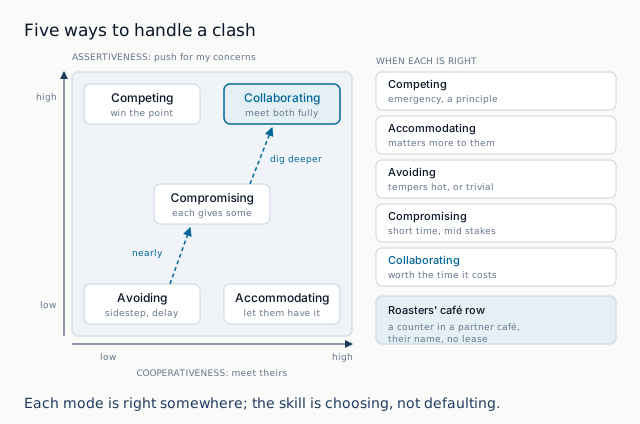
The first dimension is assertiveness , how hard you push for your own concerns. The second is cooperativeness , how much you try to satisfy the other person's. High assertiveness with low cooperation is competing : winning the point. High cooperation with low assertiveness is accommodating : letting the other side have it. Low on both is avoiding : postponing or sidestepping. High on both is collaborating : digging until you find an answer that fully meets both sets of concerns. In the middle sits compromising : each side gives something up to settle quickly. The instrument is meant to show which modes you overuse and which you neglect, not to grade you.
Take the two co-founders of a coffee-roasting business arguing about whether to open a café. One wants the margin and the visibility; the other fears the cash it will swallow. For months they avoid the subject, which is itself a choice, and the tension leaks into everything else. When they finally meet, they almost compromise on a pop-up stall that satisfies neither. Instead they collaborate, asking what each is really protecting. It turns out to be brand presence on one side and runway on the other, and they land on a partnership with an existing café that gives them a counter and their name on the menu with no lease. That answer was only reachable because both stayed assertive and cooperative at once, which is tiring and slow.
That cost is the point the model makes well. Collaborating is not always best. Competing is right in an emergency or when a principle is at stake; accommodating is right when the issue matters far more to the other person; avoiding is right when tempers are hot or the issue is trivial; compromising is right when time is short and the stakes are moderate. Skill lies in choosing, rather than falling into the mode your temperament prefers.
The weakness is that the model describes behaviour in a single conflict between equals. It says little about power, about culture, or about repeated disputes where today's accommodation sets tomorrow's expectations. People also rate their own modes more flatteringly than colleagues would, so asking someone who has argued with you is more accurate than any questionnaire.
The aim is not to find your style but to stop having only one.
Top 100 Decision Models for Strategic Thinking — One hundred ways to think before you choose
Ready when you are.
Tap below to open the full chapter in the book reader. Anchored books jump to this chapter automatically.
Cialdini's Principles of Influence
Top 100 Decision Models for Strategic Thinking — One hundred ways to think before you choose
Robert Cialdini, a social psychologist, spent part of his research years observing sales trainings, fundraising operations and advertising firms from the inside, watching what reliably got people to agree. His 1984 book Influence distilled it into six principles of influence , and in 2016 he added a seventh. Each is a mental shortcut that usually serves people well, which is precisely why it can be exploited.
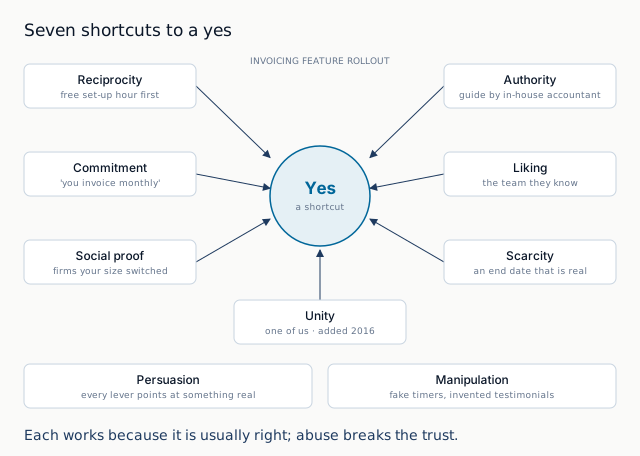
Reciprocity : people feel obliged to return favours, so giving first creates a pull. Commitment and consistency : once people take a small, public position, they tend to act in line with it. Social proof : under uncertainty, people copy what others like them are doing. Authority : people defer to credible expertise. Liking : people say yes more readily to those they like, who resemble them or who pay them genuine attention. Scarcity : things seem more valuable when they are rare or about to disappear. Unity , the late addition, is the pull of shared identity, of being one of us rather than merely similar.
A small software company trying to move customers onto its new invoicing feature shows how they combine honestly. It offers existing users a free hour of set-up help before asking for anything. The in-app prompt asks a tiny question, whether they invoice monthly, and later reminds them they said so. The landing page shows that most accounting firms of their size have switched, which is true and specific. The guide is written by the company's in-house chartered accountant and says so. The support team is the same friendly people customers already email. The early-adopter offer ends on a stated date that really is the date. Uptake rises, and nobody feels tricked, because every lever points at something real.
The line between persuasion and manipulation runs exactly there. Fake countdown timers, invented testimonials and borrowed lab coats use the same principles against the person's interest, and regulators increasingly treat many of them as dark patterns. They also tend to work once: discovered manipulation destroys liking and authority together. Cialdini himself presented the principles as something to use ethically and to defend against.
There are limits beyond ethics. The principles were mostly studied in particular cultures and settings, effects vary in size, and some of the underlying studies have not replicated as cleanly as popular retellings suggest. Stacking all seven on one page is noisy and faintly desperate. The more reliable use is defensive: when you feel a sudden urge to say yes, ask which principle is pulling, and whether the thing would still look good without it.
Influence works best when there is nothing to hide.
Top 100 Decision Models for Strategic Thinking — One hundred ways to think before you choose
Ready when you are.
Tap below to open the full chapter in the book reader. Anchored books jump to this chapter automatically.
The Five Dysfunctions of a Team
Top 100 Decision Models for Strategic Thinking — One hundred ways to think before you choose
Patrick Lencioni, a management consultant, set out the five dysfunctions of a team in a 2002 book written mostly as a fable about a struggling technology company and its new chief executive. The model is a pyramid, and the order matters: each dysfunction makes the one above it likely, so fixing the top while ignoring the bottom rarely works.
At the base is an absence of trust , specifically what Lencioni calls vulnerability-based trust: being able to say I was wrong or I need help without fear. Without it comes fear of conflict : people avoid open argument about ideas, so meetings are pleasant and pointless while the real debate happens in corridors. Without honest debate there is a lack of commitment , because people who never voiced their view never really sign up to the decision; they nod and drift. Without commitment comes avoidance of accountability : nobody can hold a peer to a plan they never truly agreed. At the top sits inattention to results , where individual status, budgets or departmental wins take priority over what the team as a whole set out to achieve.
Imagine the five-person leadership team of a regional housing association. On paper it is fine: targets set, meetings held. In practice repair times keep slipping. Working down the pyramid explains why. The repairs director misses deadlines, but peers never challenge her because nobody wants a row. The operations head privately disagrees with the repairs target but never said so in the meeting that set it. And that silence traces back to a chief executive who treats any admission of a mistake as weakness. So the fix starts at the base. The chief executive opens the next away-day by describing a decision of hers that went badly. Over the following months meetings get noisier, the repairs target is argued about and reset, and when it slips again a colleague raises it, unprompted, within a week.
The pyramid is useful precisely because it redirects attention from symptoms to causes. Missed results invite more reporting and tighter targets, which treat the top of the pyramid and leave the foundations untouched.
The caveats are worth stating. The model comes from consulting experience and a fable, not from controlled research, and its neat chain of causes is a simplification; trust and conflict feed each other in both directions. It fits small senior teams far better than large groups. And trust built through staged confessions at off-sites can feel performative; it is earned in ordinary behaviour, week after week.
Results sit at the top, but they are paid for at the bottom.
Top 100 Decision Models for Strategic Thinking — One hundred ways to think before you choose
Ready when you are.
Tap below to open the full chapter in the book reader. Anchored books jump to this chapter automatically.
The Stakeholder Map
Top 100 Decision Models for Strategic Thinking — One hundred ways to think before you choose
Stakeholder thinking was put on the management map by R. Edward Freeman in 1984, who argued that a firm answers to everyone who can affect it or is affected by it, not just to shareholders. The practical tool that grew up around the idea is the stakeholder map , and its most common form is the power–interest grid usually credited to Aubrey Mendelow. It turns a long, anxious list of people who might object into four piles with four different treatments.
The horizontal axis is interest : how much a person or group cares about, or is affected by, the decision. The vertical axis is power : how much they can help or block it. High power and high interest marks the key players: manage closely , involve them early and treat their concerns as design input. High power but low interest: keep satisfied , giving them enough to stay comfortable without burying them in detail, and watching for anything that might wake them up. Low power but high interest: keep informed ; these people often know the ground best and can become allies or loud critics. Low on both: monitor , with minimal effort.
Suppose a secondary school's head teacher wants to move to a later start time. She lists everyone affected and places them. The governing body and the local bus operator, which would have to change its routes, land in the top right, so she meets them before announcing anything. The local authority has power but little interest, and a short briefing note keeps it comfortable. Parents and students sit bottom right, intensely interested but without a veto, so they get a clear explanation, a consultation and regular updates. Nearby shops, mildly affected, are simply monitored. The exercise produces one surprise: the bus operator, which she had nearly forgotten, is the only party that can make the plan impossible, so it gets the first meeting.
The map's real use is in how it changes. People move between boxes, and the most dangerous move is from bottom right to top right: interested parents who organise, find a sympathetic councillor or reach the local paper suddenly have power. A good map is redrawn as the project goes on.
Its limits come from its simplicity. Power is not one number; there is formal authority, the ability to delay, and influence through others. The grid also encourages treating low-power groups as things to be handled rather than people with legitimate claims, which is ethically shaky and tends to backfire. And placing people is guesswork until you have talked to them, so treat the first draft as a hypothesis.
The people who can stop you are rarely the ones making the most noise.
Top 100 Decision Models for Strategic Thinking — One hundred ways to think before you choose
Ready when you are.
Tap below to open the full chapter in the book reader. Anchored books jump to this chapter automatically.
Autonomy, Mastery, Purpose
Top 100 Decision Models for Strategic Thinking — One hundred ways to think before you choose
Daniel Pink's 2009 book Drive popularised a three-part account of what motivates people doing complex, creative work: autonomy, mastery and purpose . Pink did not invent the underlying science; it rests largely on decades of research by the psychologists Edward Deci and Richard Ryan into intrinsic motivation, later formalised as self-determination theory. His contribution was packaging it for managers, with a pointed message: for many kinds of work, carrots and sticks do less than we assume, and sometimes do harm.
The model starts from a precondition. Pay must be fair and adequate, enough to take money off the table as a distraction. Above that line, three drivers matter. Autonomy is control over one's own work, which Pink breaks down into task, time, technique and team: what you do, when, how and with whom. Mastery is the urge to get better at something that matters, which needs work pitched just beyond current ability and feedback that makes progress visible. Purpose is the sense that the work serves something larger than oneself or the quarterly number. The three reinforce each other: autonomy without mastery is anxiety, and mastery without purpose is a hobby.
A family-run bakery chain with six shops and high staff turnover offers a concrete case. Its first response, a bonus for shops that hit sales targets, produced creative waste logs and little else. The owners then tried the other route. Shop teams were given control of their own rota and two shelf slots each for bakes of their own devising. Bakers who wanted to learn laminated pastry got a monthly session with the head baker and a clear ladder of skills to climb. And the chain began giving its end-of-day bread to local food banks, with each shop choosing its partner. Turnover fell over the following year, and two of the shop-designed bakes became bestsellers across the chain.
The model is at its strongest as a check on lazy incentive design. Before adding another bonus, ask whether the problem is that people lack control, lack a way to improve, or cannot see why the work matters. Those are cheaper to fix and harder to game.
It is weaker on routine, rule-following work, where Pink himself acknowledges that conventional rewards can work well, and it can be misused as cover for low pay dressed up as meaningful work. Autonomy also needs guardrails: total freedom for a team that lacks skill or shared direction is not empowerment but abandonment. The precondition is not optional.
Pay gets people through the door; these three keep them caring once inside.
Top 100 Decision Models for Strategic Thinking — One hundred ways to think before you choose
Ready when you are.
Tap below to open the full chapter in the book reader. Anchored books jump to this chapter automatically.
Radical Candour
Top 100 Decision Models for Strategic Thinking — One hundred ways to think before you choose
Radical candour comes from Kim Scott, who drew on her management experience at Google and Apple in a 2017 book, spelled Radical Candor in the American original. Its premise is that good feedback requires two things at once, and that most people instinctively trade one off against the other.
The model is a two-by-two. One axis is care personally : showing that you see the other person as a human being and want them to succeed. The other is challenge directly : saying clearly what is not working, even when it is uncomfortable. High on both is radical candour: honest, specific and plainly on the person's side. High care with low challenge is ruinous empathy , the most common failure: being so nice that people are never told what is holding them back. High challenge with low care is obnoxious aggression : accurate criticism delivered as an attack, which people hear as hostility and discount. Low on both is manipulative insincerity : vague praise to someone's face and real views behind their back, usually chosen to protect oneself.
Picture the editor of a small news website with a talented new reporter whose stories keep running long and burying the point. For weeks the editor softens it: great work, maybe tighten a little. That is ruinous empathy, and the next pieces are no better. A colleague's instinct is to rewrite them with a sarcastic note, which would be obnoxious aggression. The editor instead sits down, says she hired the reporter for her nose for a story and wants to see her on the front page, then puts two versions side by side: the reporter's opening and a rewrite that leads with the news. She asks what made the reporter hold it back. Within a month the openings sharpen, and the reporter starts asking for this kind of critique before filing.
Scott stresses that the quadrants describe a piece of feedback, not a person's character; everyone lands in every quadrant on some days. She also recommends asking for criticism before giving it, so that challenge flows both ways, and praising as specifically as you criticise.
The familiar misuse sits in the word radical . People quote it to license bluntness, taking the challenge and skipping the care, which is just obnoxious aggression with a slogan. Care cannot be asserted in the moment; it is built in the relationship beforehand, which is why the same words land differently from different people. Norms about directness also vary widely between cultures, and what reads as candour in one office reads as rudeness in another.
Kindness that withholds the truth does not stay kind for long.
Top 100 Decision Models for Strategic Thinking — One hundred ways to think before you choose
Ready when you are.
Tap below to open the full chapter in the book reader. Anchored books jump to this chapter automatically.
BATNA
Top 100 Decision Models for Strategic Thinking — One hundred ways to think before you choose
BATNA stands for best alternative to a negotiated agreement, a term coined by Roger Fisher and William Ury of the Harvard Negotiation Project in their 1981 book Getting to Yes . The idea sounds obvious and is ignored constantly: before you negotiate, work out exactly what you will do if no deal is reached. That alternative, not your hopes or the other side's opening, is the yardstick for every offer on the table.
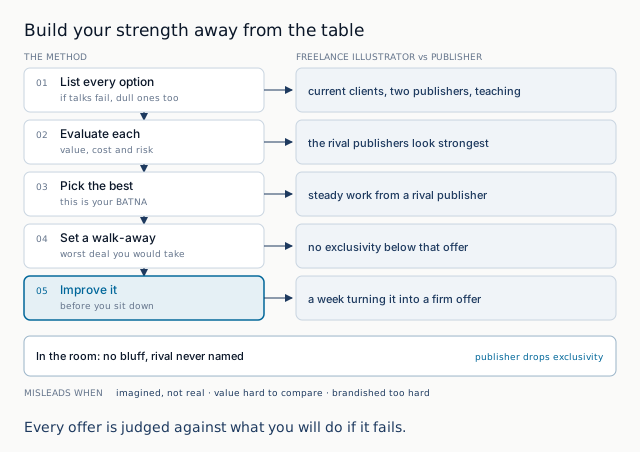
The process runs in steps. First, list every realistic course of action open to you if talks fail, including the dull ones. Second, evaluate them: what would each actually deliver, at what cost and risk? Third, pick the best; that is your BATNA. Fourth, turn it into a walk-away point , the least favourable deal you would accept, since any agreement worse than your BATNA is worse than leaving. Fifth, and most often skipped, improve it before you sit down: a stronger alternative is the most reliable source of negotiating power there is. The same analysis applied to the other party suggests where their walk-away lies, and so where the room for agreement sits between the two.
Consider a freelance illustrator negotiating a year-long contract with a publisher that wants exclusivity and a lower day rate. Her options if it falls through: carry on with her current mix of clients, pitch to two other publishers who have shown interest, or take a part-time teaching post. She finds the second strongest, so she spends a week making it real, getting one of those publishers to a firm offer of steady work. Her walk-away is now concrete: she will not accept exclusivity on terms that pay less than that offer would. In the meeting she does not need to bluff or even mention the rival; she calmly declines the first proposal, and the publisher, which has its own deadline, drops exclusivity.
BATNA thinking works because it replaces a feeling with a comparison. Without it, negotiators either cling to poor deals out of fear of having nothing, or reject good ones out of pride. With it, the question becomes simple: better or worse than the alternative?
It can mislead in three ways. An imagined BATNA is not a BATNA, and overrating your alternatives leads to walking away from deals you needed. Many things do not compare cleanly, such as relationships and reputation, so the comparison needs judgement as well as numbers. And in long relationships, brandishing the alternative can win the round and sour everything after it.
The strongest position at the table is usually built away from it.
Top 100 Decision Models for Strategic Thinking — One hundred ways to think before you choose
Ready when you are.
Tap below to open the full chapter in the book reader. Anchored books jump to this chapter automatically.
Six Thinking Hats
Top 100 Decision Models for Strategic Thinking — One hundred ways to think before you choose
Most meetings do not fail for lack of brains. They fail because everyone is thinking in a different mode at once: one person lists risks, another pitches ideas, a third is quietly annoyed and a fourth wants the numbers. Six Thinking Hats , set out by Edward de Bono in his 1985 book of the same name, fixes this with one rule: the whole group wears the same hat at the same time. He called it parallel thinking . Instead of arguing across the table, everyone looks in the same direction, then turns together.
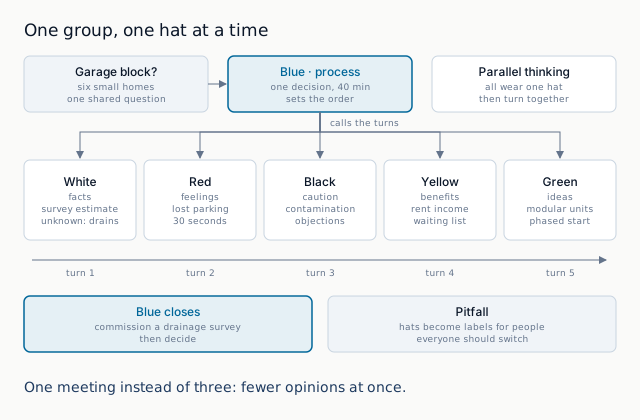
Each hat is a colour and a mode. White asks for facts and figures, including what nobody knows yet. Red permits feelings and hunches with no justification required. Black is caution: risks, weak points, reasons it could fail. Yellow is its optimistic twin, hunting for value and benefits. Green is for new ideas, alternatives and deliberate provocations. Blue sits above the rest and manages the thinking itself: it sets the agenda, picks the order of hats, keeps time and draws the conclusion. In practice a facilitator holds the blue hat and calls the sequence, often giving each colour only a few minutes.
Picture a housing association board deciding whether to turn a disused garage block into six small homes. Blue opens: one decision, forty minutes. White gathers what is known (planning status, a surveyor's rough estimate) and flags what is not: the drainage. Red goes round the table, and two members admit they dislike tenants losing parking. Said in thirty seconds, that feeling no longer leaks into every later point. Black lists contamination and neighbour objections. Yellow names rent income and a long waiting list. Green suggests modular units, or a phased start. Blue closes the loop: commission a drainage survey, then decide. One meeting instead of three.
The model goes wrong when the hats become labels for people. Calling a colleague "a black-hat person" defeats the point, which is that everyone switches. Teams also tend to skip the hat they are worst at: enthusiastic start-ups rush past black, cautious institutions never really leave it. Some groups find the colours theatrical and keep only the sequence, which works fine. And treat the method as meeting discipline rather than a theory of the mind; de Bono's broader claims about how thinking works are not well supported by evidence.
Good meetings do not need fewer opinions, only fewer opinions at once.
Top 100 Decision Models for Strategic Thinking — One hundred ways to think before you choose
Ready when you are.
Tap below to open the full chapter in the book reader. Anchored books jump to this chapter automatically.
SCAMPER
Top 100 Decision Models for Strategic Thinking — One hundred ways to think before you choose
Blank-page brainstorming is overrated. Most useful ideas are rearrangements of something that already exists, and SCAMPER turns that observation into a checklist. Bob Eberle assembled it in the early 1970s, building on a list of idea-spurring questions from Alex Osborn, the advertising executive who also popularised brainstorming. The acronym gives seven prompts to apply, one at a time, to an existing product, service or process.
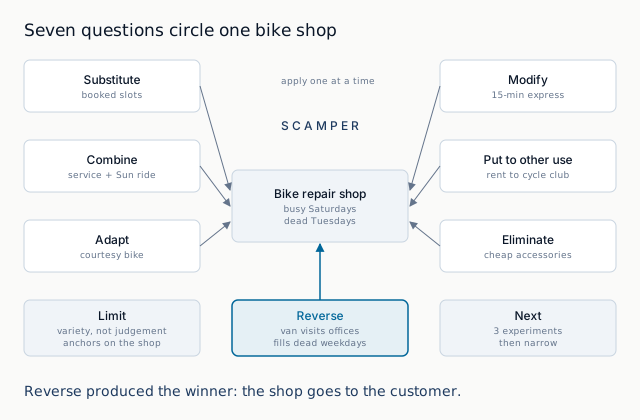
The letters stand for Substitute, Combine, Adapt, Modify, Put to another use, Eliminate and Reverse. Substitute asks what part, material or person could be swapped. Combine asks what could be bundled or merged. Adapt asks what idea from elsewhere could be borrowed. Modify (sometimes Magnify or Minify) asks what could be bigger, smaller or changed in shape or frequency. Put to another use asks who else could use it, or for what. Eliminate asks what could be removed entirely. Reverse (or Rearrange) asks what happens if the order, the roles or the direction flips. The object stays in the middle; the seven questions circle it like inspectors.
Take a two-person bicycle repair shop in a market town, busy on Saturdays and dead on Tuesdays. Substitute: swap the walk-in queue for booked slots. Combine: pair a service with a guided Sunday ride. Adapt: borrow the car-dealer idea of a courtesy bike. Modify: offer a fifteen-minute express check. Put to another use: rent the workshop to a cycling club on quiet evenings. Eliminate: drop the low-margin sale of cheap accessories that clutters the counter. Reverse: instead of customers bringing bikes in, a van visits office car parks. Seven prompts, twenty minutes, and the owners have three experiments worth running, the most promising being the office visits, which fill exactly the dead weekdays.
The weakness of SCAMPER is that it generates variety, not judgement. It will happily produce forty ideas, most of them poor, and it says nothing about which one deserves money. It also anchors you to the thing you started with: a checklist that circles the existing bicycle shop will never suggest that the real opportunity is something other than repairs. Use it to widen options, then switch to a model that narrows them, and occasionally step right back and ask whether the object in the middle is the right one at all.
Originality is usually just an old thing asked a better question.
Top 100 Decision Models for Strategic Thinking — One hundred ways to think before you choose
Ready when you are.
Tap below to open the full chapter in the book reader. Anchored books jump to this chapter automatically.
The Double Diamond
Top 100 Decision Models for Strategic Thinking — One hundred ways to think before you choose
Teams love solutions. Put a vague complaint in front of capable people and within ten minutes someone is sketching an app. The Double Diamond , published by the UK Design Council in 2005 after studying how design teams at large companies actually worked, is a simple drawing that slows the rush. It shows two diamonds side by side, each one a widening then a narrowing: first around the problem, then around the solution.
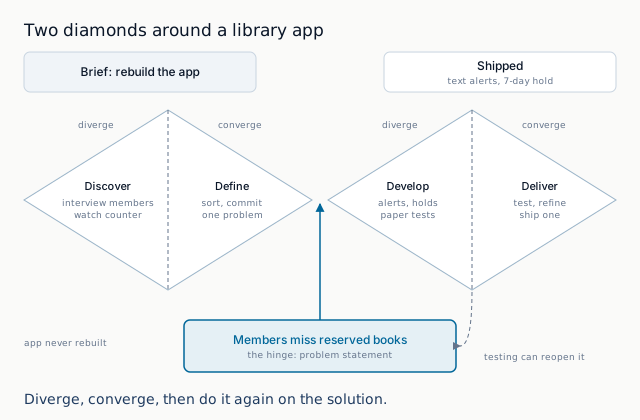
The four phases are usually named Discover, Define, Develop and Deliver. Discover opens out: talk to users, watch behaviour, gather data and resist conclusions. Define closes in: sort what was found and commit to a sharp problem statement. That statement is the hinge between the two diamonds. Develop opens out again: generate many possible answers to the defined problem, prototype cheaply, compare. Deliver closes: test, refine and ship the one that works. The shape makes a point that is easy to forget: you need divergent thinking twice , and convergence twice, and the order matters.
Consider a county council whose library app has dismal ratings. The obvious brief is "rebuild the app". In Discover, a small team spends two weeks interviewing members and watching people at the counter. They learn that most complaints are about one thing: reserving a book and then missing the collection window. Define turns that into a problem statement: members do not know when a reserved book is waiting. Develop produces options (text alerts, a longer hold period, lockers at the supermarket) and tests paper versions with a dozen members. Deliver ships text alerts and a seven-day hold. The app was never rebuilt; ratings and collections both improved, at a fraction of the planned cost.
The diamond misleads when drawn as a neat one-way sequence. Real projects loop back: testing in Deliver often reveals the problem was defined wrongly, and that is a success of the method, not a failure. Teams also inflate Discover into months of research that never converges, or skip it and "define" a problem they already assumed. Critics note that the original model said little about systems, organisations or what happens after launch; the Design Council has since published broader versions. Treat it as a reminder of shape, not a project plan.
Most wasted builds were excellent answers to a question nobody checked.
Top 100 Decision Models for Strategic Thinking — One hundred ways to think before you choose
Ready when you are.
Tap below to open the full chapter in the book reader. Anchored books jump to this chapter automatically.
The Morphological Box
Top 100 Decision Models for Strategic Thinking — One hundred ways to think before you choose
When people look for a new idea they tend to search for one complete answer. The morphological box works the other way round: it breaks a problem into its independent parameters, lists the options for each, and then treats every combination as a candidate. It comes from Fritz Zwicky, the Swiss astrophysicist at Caltech, who developed morphological analysis from the 1940s onwards and applied it to everything from jet engines to telescopes. The box is the grid at its heart.
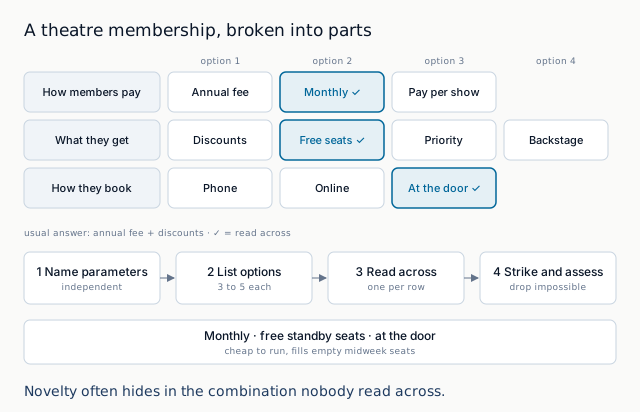
Building one takes four moves. First, name the parameters: the few dimensions on which any solution must make a choice, chosen so that they are genuinely independent of each other. Second, list three to five realistic options for each parameter, written as columns. Third, read across: pick one option from each column to form a configuration, and do this many times, including combinations that seem odd. Fourth, strike out the impossible or contradictory ones and assess the rest. Even a small box multiplies fast. Three parameters with four options each give sixty-four configurations, which is the point: you see far more designs than anyone would have proposed in a meeting.
A regional theatre wants a membership scheme to fill midweek seats. The team picks three parameters: how members pay, what they get and how they book. Payment could be annual, monthly or pay-per-show. The perk could be discounted tickets, free tickets, priority booking or backstage events. Booking could be by phone, online or by turning up for unsold seats. The usual answer, an annual fee for discounted tickets, sits in the top row. Reading across differently produces a monthly subscription that gives free standby seats for midweek shows, collected at the door. It costs almost nothing to run, uses seats that would otherwise be empty and appeals to younger audiences who dislike annual commitments. Nobody had suggested it until the box laid the options side by side.
The method has limits. Choosing parameters is the real skill, and a badly chosen set either hides the interesting dimension or creates parameters that secretly depend on each other. Large boxes become unmanageable, so cut ruthlessly or use simple filters before scoring. And the box finds combinations of what you already listed: it cannot invent an option nobody wrote down. Use it after some research, not instead of it.
Novelty often hides in the combination nobody bothered to read across.
Top 100 Decision Models for Strategic Thinking — One hundred ways to think before you choose
Ready when you are.
Tap below to open the full chapter in the book reader. Anchored books jump to this chapter automatically.
SMART Goals
Top 100 Decision Models for Strategic Thinking — One hundred ways to think before you choose
"Improve customer service" is a wish, not a goal. Nobody can tell whether it has been achieved, so nobody can be held to it, including the person who wrote it. SMART goals are a test for that kind of vagueness. The acronym is usually traced to George T. Doran, a consultant who described it in the journal Management Review in 1981, and it has since become one of the most quoted checklists in management.
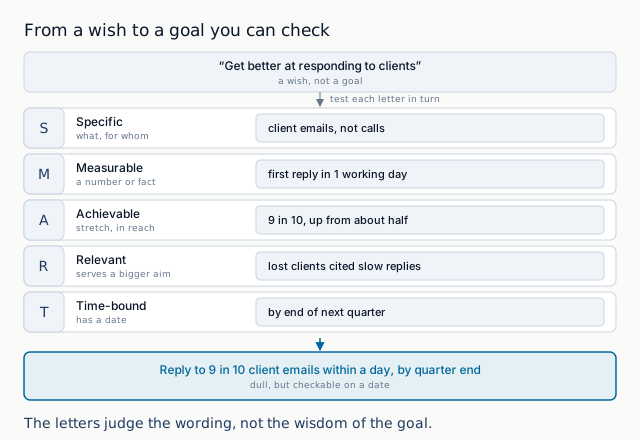
A goal passes if it is Specific, Measurable, Achievable, Relevant and Time-bound. Specific means it names exactly what will change and for whom. Measurable means there is a number or an observable fact that shows whether it happened. Achievable means it is stretching but within reach given the people and money available. Relevant means it actually serves a bigger aim rather than being easy to count. Time-bound means it has a date. Doran's own wording differed slightly (he used Assignable for the A and Realistic for the R), and many variations exist; what matters is the spirit of each letter, applied from top to bottom.
A three-person accountancy practice wants to "get better at responding to clients". Run through the letters. Specific: reply to client emails, not phone calls or post. Measurable: a first reply, even a holding one, within one working day, tracked in the shared inbox. Achievable: they currently manage it about half the time by their own rough count, so all the time is unrealistic; nine in ten is a stretch but plausible with a rota. Relevant: their last two lost clients both cited slow replies, so this touches revenue. Time-bound: by the end of the next quarter. The result is "Reply to nine in ten client emails within one working day by the end of the quarter." Dull, but checkable, and that is the point.
SMART is a quality check, not a source of ambition. It is perfectly possible to write a SMART goal that is trivial or points in the wrong direction; the letters judge the wording, not the wisdom. The Measurable letter tempts people towards whatever is easy to count, which can distort behaviour once the number becomes the target. And for exploratory work, where nobody yet knows what success looks like, forcing precision too early can kill good ideas. Use SMART to tighten goals you have already chosen well.
A goal you cannot check is a goal you cannot miss, which is exactly the problem.
Top 100 Decision Models for Strategic Thinking — One hundred ways to think before you choose
Ready when you are.
Tap below to open the full chapter in the book reader. Anchored books jump to this chapter automatically.
OKRs
Top 100 Decision Models for Strategic Thinking — One hundred ways to think before you choose
Many organisations have goals; fewer can say, three months later, whether they moved. OKRs , short for Objectives and Key Results, pair a qualitative direction with a handful of numbers that prove progress. The method was developed by Andy Grove at Intel in the 1970s, building on Peter Drucker's management by objectives. John Doerr, who learned it at Intel, introduced it to Google in 1999 and later wrote a popular book about it, which is why it spread so widely through technology firms.
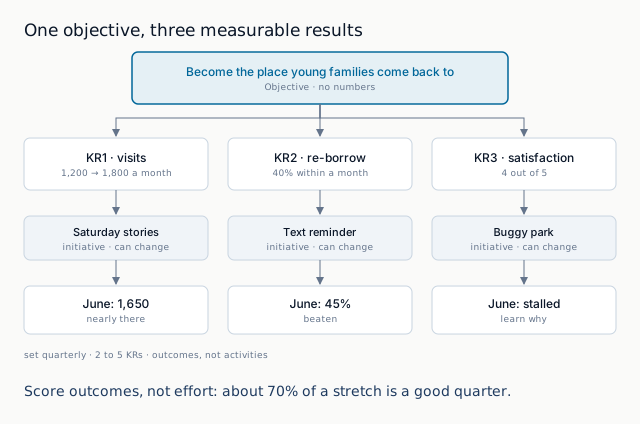
The structure is a small tree. At the top sits the Objective : a short, motivating statement of what you want to achieve, with no numbers in it. Beneath it hang two to five Key Results : measurable outcomes that would show the objective has been met. Key results describe outcomes, not activities; "launch a newsletter" is a task, "500 people renew by email" is a result. Underneath the key results, teams list the initiatives they will try, which are allowed to change. OKRs are typically set quarterly, scored at the end, and in Grove's and Doerr's telling are meant to be ambitious enough that hitting around 70 per cent is a good outcome.
A city library service sets an objective for the spring: "Become the place young families come back to." Key result one: monthly visits by children's card holders rise from 1,200 to 1,800. Key result two: 40 per cent of new junior members borrow again within a month. Key result three: parent satisfaction in the termly survey reaches 4 out of 5. Initiatives sit under each: Saturday story sessions, a text reminder when a first loan is due, a buggy park by the door. By June the first result reaches 1,650, the second 45 per cent, the third stalls. That pattern tells the team far more than "we ran lots of events".
OKRs go wrong in predictable ways. Organisations write too many, and twenty objectives means no priority at all. Key results quietly turn into to-do lists, measuring effort rather than outcome. Linking OKRs directly to bonuses encourages people to set safe targets, undermining the stretch the method depends on. And cascading every objective mechanically down the hierarchy produces a paperwork exercise rather than focus. The method works best with few objectives, honest scoring and a willingness to learn from a missed number.
An objective tells you where to look; key results tell you whether you got there.
Top 100 Decision Models for Strategic Thinking — One hundred ways to think before you choose
Ready when you are.
Tap below to open the full chapter in the book reader. Anchored books jump to this chapter automatically.
Kanban
Top 100 Decision Models for Strategic Thinking — One hundred ways to think before you choose
A team can be busy all day and still finish almost nothing. The usual cause is not laziness but too many things started at once. Kanban treats that as a flow problem. The word is Japanese for a signboard or card, and the system grew up at Toyota from the late 1940s, where cards signalled when a process upstream should produce more parts. In the 2000s David J. Anderson and others adapted it for software and office work, and the board of columns and cards became familiar far beyond factories.
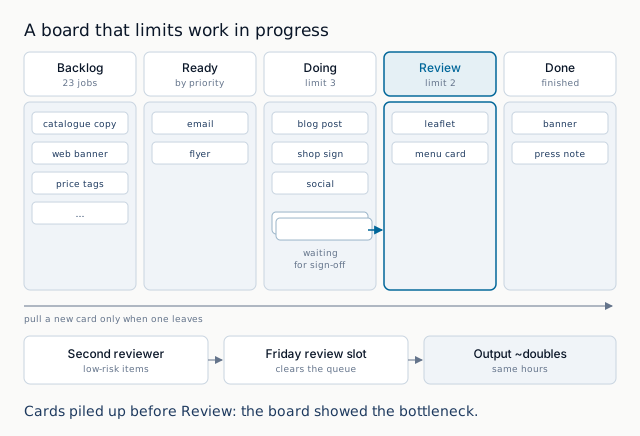
The model rests on two moves. First, make the work visible: a board with columns for each stage, such as Backlog, Ready, Doing, Review and Done, and one card per piece of work. Second, and more important, set a work-in-progress limit for the active columns. If Doing has a limit of three, a fourth card cannot enter until one leaves. That limit turns the board from a pretty picture into a system: it forces people to finish before starting, and it exposes bottlenecks, because cards pile up visibly in front of the slow stage. Work is pulled into the next column when there is room, not pushed in when someone upstream is done.
A four-person marketing team at a furniture retailer has twenty-three jobs "in progress", from catalogue copy to a website banner. Everything is late, and everyone feels behind. They put every job on a board and agree a limit of three cards in Doing and two in Review. Within a week the board shows the real problem: cards wait for days in Review because only the head of marketing signs off copy. They add a second reviewer for low-risk items and make Friday morning a review slot. Over the following month the number of jobs finished each week roughly doubles, though nobody is working longer hours. What changed was how much they were juggling.
Kanban is often adopted as a board without the limits, which delivers transparency but little else. Limits set too high change nothing; set too low they leave people idle, so they need adjusting as the team learns. The method also says little about what to work on next: it optimises flow, not priority, so pair it with a way of ordering the backlog. And a board is only as honest as its cards; work that never appears on it still eats the week.
Top 100 Decision Models for Strategic Thinking — One hundred ways to think before you choose
Ready when you are.
Tap below to open the full chapter in the book reader. Anchored books jump to this chapter automatically.
Build–Measure–Learn
Top 100 Decision Models for Strategic Thinking — One hundred ways to think before you choose
New ventures rarely die because they failed to build what they planned. They die because they built it well, and nobody wanted it. Build–Measure–Learn is the feedback loop at the centre of Eric Ries's 2011 book The Lean Startup , which drew on Steve Blank's customer development work and on lean manufacturing. Its claim is simple: the job of an early team is not to execute a plan but to find out, as quickly and cheaply as possible, which parts of the plan are true.
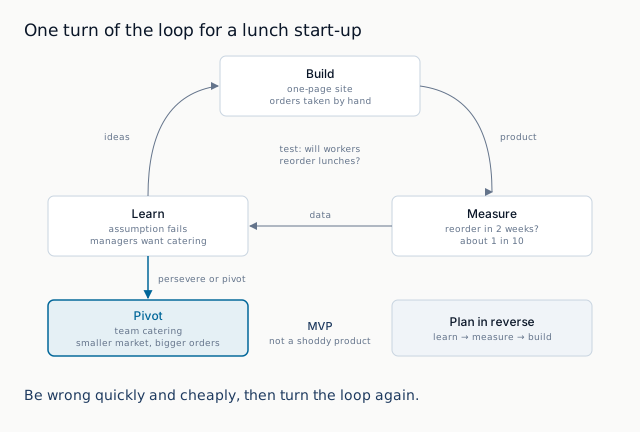
The loop has three stages. Build means making the smallest thing that can test an important assumption: a minimum viable product , which might be a landing page, a manual service behind a simple front end or a single feature. Measure means watching what real people actually do with it, using numbers that reflect behaviour rather than flattering totals. Learn means deciding what those numbers say about the assumption, then choosing to persevere or to pivot , changing a fundamental part of the strategy. Ries stressed that although you build first, you plan in reverse: decide what you need to learn, then what to measure, then what to build.
A founder believes office workers will pay for healthy lunches delivered from local cafés. Instead of building an app, she makes a one-page site with a menu and a form, and takes orders herself by hand for two office buildings. The assumption under test is that people will reorder, not that they will try it once. She measures the share of first-time customers who order again within two weeks. After three weeks the answer is about one in ten, far below what the business needs. The comments, though, point somewhere else: office managers keep asking for catered team lunches. She pivots to catering for meetings, a smaller market with bigger orders, and repeats the loop.
The model is misused when "MVP" becomes an excuse for shipping something shoddy, which tests only whether people tolerate poor quality. It is also misused when teams measure vanity metrics , such as total sign-ups, that rise regardless of whether the product works. The loop suits uncertainty about customers; it fits less well where failure is dangerous or expensive, such as medical devices or bridges. And speed matters only if each turn of the loop actually teaches something: a team that ships weekly but never changes its mind is just busy.
The goal is not to be right first, but to be wrong quickly and cheaply.
Top 100 Decision Models for Strategic Thinking — One hundred ways to think before you choose
Ready when you are.
Tap below to open the full chapter in the book reader. Anchored books jump to this chapter automatically.
The After-Action Review
Top 100 Decision Models for Strategic Thinking — One hundred ways to think before you choose
Most teams finish a piece of work and move straight to the next one. Whatever they learned stays in individual heads, if it stays anywhere. The After-Action Review is a short, structured conversation that captures it while it is still fresh. It was developed by the US Army in the 1970s for training exercises, where units would gather immediately afterwards to understand what had happened, and it has since been adopted by hospitals, fire services and many businesses.
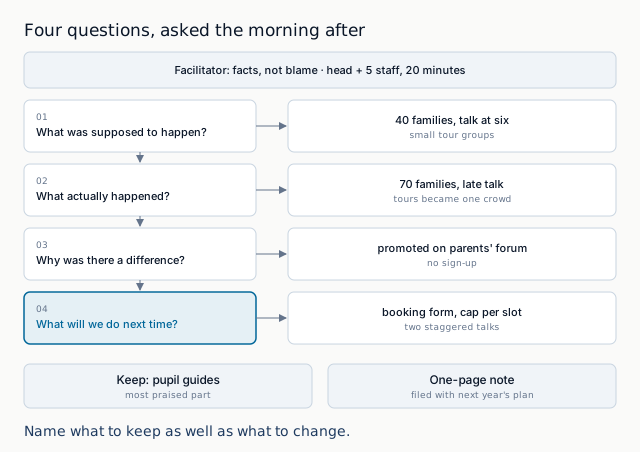
The heart of the review is four questions, asked in order. What was supposed to happen? This reconstructs the intent and the plan, which people often remember differently. What actually happened? This establishes the facts, ideally from several viewpoints, before anyone explains them. Why was there a difference? This is where causes are explored, both for what went wrong and for what went unexpectedly well. What will we do next time? This turns the analysis into a small number of things to keep and things to change. A facilitator keeps time and keeps the tone factual: the review examines events, not people, and what is said in the room is not used for blame.
A primary school runs its first evening open day for prospective parents. The next morning, the head and five staff spend twenty minutes on a review. Supposed to happen: forty families, a talk at six and tours in small groups. Actually happened: seventy families arrived, the talk started late, and tours became one large crowd. Why the gap: the event was promoted on a local parents' forum nobody had counted on, and there was no sign-up. What next time: a free booking form with a cap per slot, and two staggered talks. They also noted what worked, as the pupil guides were the most praised part of the evening. The lessons went into a one-page note filed with next year's plan.
The review fails when it becomes a hunt for culprits, because people quickly stop saying what really happened. It also fails when held weeks later, when memories have been tidied, or when it produces a long list of lessons that nobody owns. The most common failure is simply not doing it after things go well, which is when people are least defensive. Keep it short, keep it regular and assign each action to a named person.
Experience is only a teacher if someone asks it questions.
Top 100 Decision Models for Strategic Thinking — One hundred ways to think before you choose
Ready when you are.
Tap below to open the full chapter in the book reader. Anchored books jump to this chapter automatically.
Double-Loop Learning
Top 100 Decision Models for Strategic Thinking — One hundred ways to think before you choose
When results disappoint, most organisations change what they do and try again. Sometimes that is enough. Sometimes the problem returns, because the rules that produced the action were never examined. Double-loop learning , developed by the organisational theorists Chris Argyris and Donald Schön in the 1970s, names the difference. Argyris liked the analogy of a thermostat: one that turns the heating on when the room drops below its setting is learning in a single loop; one that asks whether the setting itself is right would be learning in two.
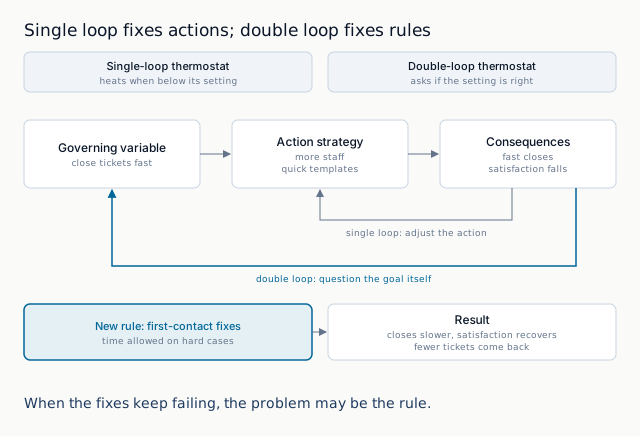
The model has three elements. Governing variables are the goals, values and assumptions a person or organisation is trying to keep within range, often unspoken. Action strategies are the plans and behaviours used to achieve them. Consequences are what actually happens. In single-loop learning, a mismatch between intended and actual consequences sends you back to adjust the action strategy. In double-loop learning, the mismatch also sends you back to the governing variables: is the goal right, is the assumption true, are we measuring the wrong thing? Argyris argued that people and organisations are often skilled at avoiding this second loop, because it is uncomfortable and can be embarrassing.
A software company's support team is judged on how quickly it closes tickets. Customer satisfaction keeps falling, so managers adjust actions: more staff, faster templates, tighter targets. Closing time improves; satisfaction does not. A double-loop review asks a different question: why is speed of closing the governing variable at all? Looking at reopened tickets, they find agents closing cases quickly with answers that do not fix the problem, exactly as the target rewards. They change the measure to issues resolved on first contact and give agents permission to spend longer on hard cases. Closing times rise, satisfaction recovers and the number of tickets falls, because fewer problems come back.
The model is easier to admire than to practise. Questioning governing variables can feel like an attack on the people who set them, which is why it often happens only after a crisis. Done constantly, it becomes paralysis: some rules should simply be followed while the action is fixed. The distinction between loops also blurs in real life, and the label alone changes nothing. Its real value is as a prompt, to be used when a problem keeps returning despite good fixes.
When the fixes keep failing, the problem may be the rule, not the effort.
Top 100 Decision Models for Strategic Thinking — One hundred ways to think before you choose
Ready when you are.
Tap below to open the full chapter in the book reader. Anchored books jump to this chapter automatically.
Explore vs Exploit
Top 100 Decision Models for Strategic Thinking — One hundred ways to think before you choose
The explore–exploit trade-off is the tension between gathering new information and using the information you already have. Statisticians formalised it as the multi-armed bandit problem, named after a gambler facing a row of slot machines with unknown payouts, and the organisational theorist James March made it a staple of management thinking in 1991, warning that firms drift towards exploiting what works until they forget how to find what might work better.
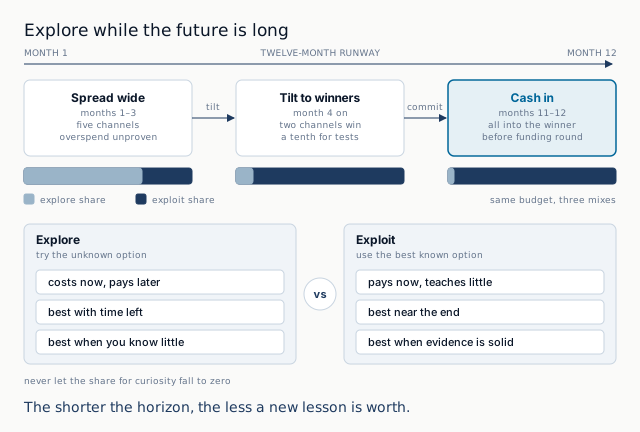
The model turns on one variable that most people ignore: how much time is left. Exploring costs something now and pays later, because anything you learn can be used again and again. Exploiting pays now but teaches you little. The figure sets the two side by side. Early in a horizon, with many decisions still ahead, exploration is cheap insurance against settling too soon. Late in a horizon, with few decisions left, there is little time to use any new discovery, so the sensible move is to cash in the best option you know. Uncertainty pushes the same way: the less you know about an option, the more a single try is worth.
Consider a founder running paid acquisition for a meal-kit start-up with a twelve-month runway. In month one she splits her budget across five channels, deliberately overspending on the unproven ones. By month four two channels clearly convert better, so she moves most of the money there while keeping a small slice, perhaps a tenth, for testing newcomers. In the last two months before a funding round she stops experimenting almost entirely and pours everything into the winner, because a lesson learned in month eleven arrives too late to pay for itself. Same budget, three different mixes, each right for its moment.
The model misleads when the horizon is misjudged. Organisations routinely act as if the game ends next quarter, exploiting relentlessly and starving research, then discover the world has moved on. Individuals often do the reverse, sampling endlessly because committing feels like a loss. The model also assumes the options stay still; when a market shifts, yesterday's winner can quietly become a loser, and a team that stopped exploring will be the last to notice. And exploration only pays if someone records and uses what was learned. A test nobody reads is just an expense.
Explore while the future is long, exploit as it shortens, and never let the share for curiosity fall to zero.
Top 100 Decision Models for Strategic Thinking — One hundred ways to think before you choose
Ready when you are.
Tap below to open the full chapter in the book reader. Anchored books jump to this chapter automatically.
Scenario Planning
Top 100 Decision Models for Strategic Thinking — One hundred ways to think before you choose
Scenario planning replaces the single forecast with a small set of plausible, internally consistent futures, then asks which decisions hold up across all of them. Its roots lie in Herman Kahn's work on military futures at the RAND Corporation in the 1950s. It went corporate at Royal Dutch Shell, whose planners in the early 1970s explored a world of oil supply shocks before the 1973 crisis made one real. The story is often retold with some polish, but the core lesson is sound: an organisation that has already imagined a future reacts faster when it arrives.
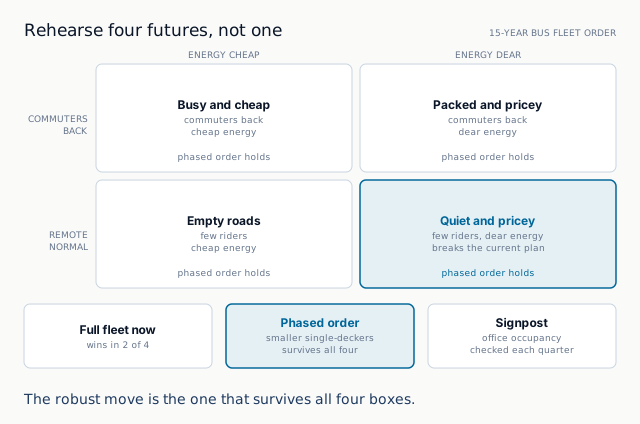
The common method, and the one in the figure, starts by listing the forces that will shape the decision, then sorting them into those that are fairly predictable and those that are both highly uncertain and highly consequential. Pick the two most important uncertainties, draw them as axes, and you get four quadrants. Each becomes a scenario with a memorable name and a short narrative: what happened, what it felt like, who won. The point is not to guess which one will happen. It is to test the strategy against each, looking for moves that work everywhere, moves that pay off hugely in one world, and signposts that would tell you early which world you are entering.
Take a regional bus operator deciding whether to order a fleet of electric double-deckers that will run for fifteen years. The two big uncertainties are how normal remote working becomes and how dear energy turns out to be. Commuters back and energy cheap gives Busy and cheap ; commuters back and energy dear gives Packed and pricey ; remote work normal and energy cheap gives Empty roads ; remote work normal and energy dear gives Quiet and pricey , the world that breaks the current plan. Walking through all four, the team sees that buying the full fleet up front wins in only two quadrants, while a phased order with smaller single-deckers on flexible routes survives in all of them. They also agree to watch office occupancy figures each quarter as an early signpost.
Scenarios fail in predictable ways. Teams pick axes that are easy rather than important, or quietly label one quadrant the "base case" and treat the others as decoration. Narratives can become so vivid that people mistake them for forecasts. And the exercise is wasted if it ends in a report rather than a changed decision; scenario planning earns its keep only when someone moves money or timing because of it.
The aim is not to predict the future but to stop being ambushed by it.
Top 100 Decision Models for Strategic Thinking — One hundred ways to think before you choose
Ready when you are.
Tap below to open the full chapter in the book reader. Anchored books jump to this chapter automatically.
Wardley Mapping
Top 100 Decision Models for Strategic Thinking — One hundred ways to think before you choose
A Wardley map is a picture of a business that shows two things at once: what a user needs and the chain of components that delivers it, and how evolved each of those components is. Simon Wardley developed the technique in the mid-2000s while running a software company, frustrated that strategy documents were full of words and almost empty of position. A map, unlike a list, lets you see where things are and which way they are moving.
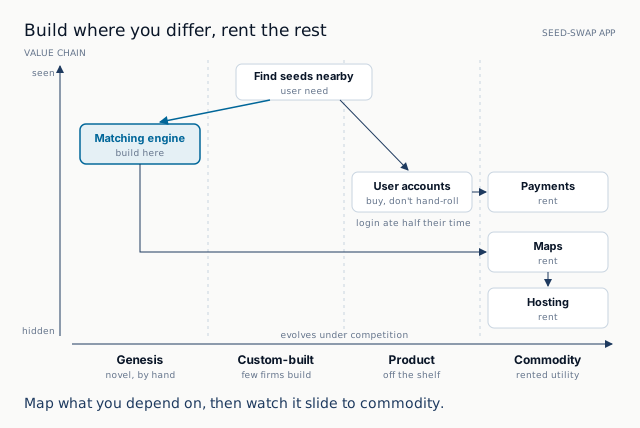
The vertical axis is the value chain. At the top sits a user and their need; beneath come the components that serve it, ordered by how visible they are to the user, down to the plumbing nobody sees. The horizontal axis is evolution, and it is the clever part. Wardley argues that components, driven by competition, tend to travel through the four stages shown in the figure: genesis , where something is novel, uncertain and built by hand; custom-built , where a few firms make their own versions; product , where it is bought off the shelf with features to compare; and commodity , where it is standardised, cheap and often sold as a utility. Each stage calls for different methods. Experimentation suits genesis; strict cost control suits commodity. Applying one to the other is a common and expensive error.
Picture a small team building an app that helps allotment holders swap seeds. Mapping it, they put "find seeds nearby" at the top, then the listings feature, a matching engine, user accounts, payments, hosting and maps beneath. Placing each on the evolution axis is revealing: hosting, payments and maps are commodities they can rent; user accounts are a product; only the matching engine, which suggests swaps based on local growing conditions, is genuinely novel. Yet they had been spending half their time on a hand-rolled login system. The map moves that effort to the matching engine and rents the rest.
Maps are only as good as the judgement behind them. Placing a component on the axis is a reasoned guess, and two people can honestly disagree. Maps can also become elaborate artworks that nobody updates; since movement is the point, a map drawn once and filed is a photograph of a river. And the evolution path describes a tendency under competition, not a law with a timetable.
Build where you differ, rent where everyone is the same, and keep redrawing the map.
Top 100 Decision Models for Strategic Thinking — One hundred ways to think before you choose
Ready when you are.
Tap below to open the full chapter in the book reader. Anchored books jump to this chapter automatically.
Black Swans
Top 100 Decision Models for Strategic Thinking — One hundred ways to think before you choose
A black swan , in Nassim Nicholas Taleb's sense, is an event with three properties: it lies outside regular expectations, it carries an extreme impact, and afterwards people construct a story that makes it look predictable. The phrase borrows an old philosophical example. Europeans long treated "all swans are white" as settled, until black swans were found in Australia; no number of white sightings had ever proved the rule. Taleb's 2007 book turned the image into a warning about how organisations and markets misread risk.
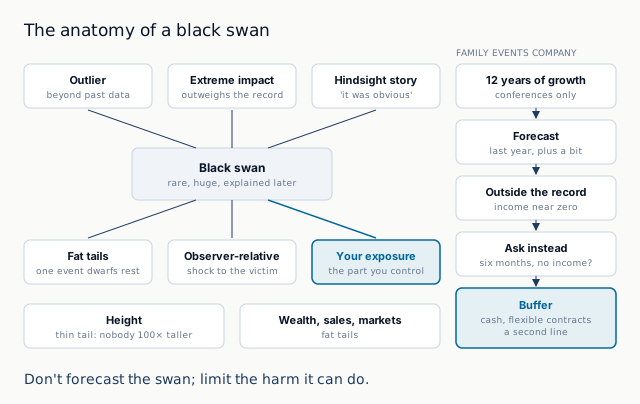
The figure lays out the anatomy. The outlier sits beyond the range of past data, so models calibrated on that data give it close to zero probability. The extreme impact means it can outweigh everything else in the record, because some domains, such as wealth, book sales, epidemics and markets, have fat tails , where a single observation can dwarf the rest combined. Height does not work like this; no adult is a hundred times taller than another. Retrospective predictability is the trap that keeps the cycle going: once the shock has happened, everyone sees the signs, and the lesson drawn is "watch for that particular sign" rather than "expect what you cannot list". Taleb also stresses that a black swan is relative to the observer; a shock to the victim is rarely a surprise to whoever planned it. The one part fully under your control is your exposure.
Consider a family-run events company that has grown steadily for twelve years, with nearly all its income from large in-person conferences. Every forecast it makes is built from those twelve years, and every one says next year will look like the last, plus a bit. Then something outside the record arrives, say a long ban on gatherings or the sudden collapse of its main venue's owner, and income falls to almost nothing for months. The wiser move was never to predict that event, which nobody could. It was to ask what would happen if income stopped for six months, and to hold enough cash, flexible contracts and a second line of business to get through it.
The idea is misused in two directions. Some label every bad surprise a black swan, which conveniently excuses poor preparation for risks that were well known, such as a recession or a river that floods every few years. Others become so taken with the unknowable that they stop planning at all. The useful stance lies between: do not try to forecast the rare event; reduce your exposure to its harm and keep some exposure to its upside.
You cannot see the swan coming, but you can decide now how badly it is allowed to hurt.
Top 100 Decision Models for Strategic Thinking — One hundred ways to think before you choose
Ready when you are.
Tap below to open the full chapter in the book reader. Anchored books jump to this chapter automatically.
Antifragility
Top 100 Decision Models for Strategic Thinking — One hundred ways to think before you choose
Antifragility is Nassim Nicholas Taleb's word, from his 2012 book of that name, for things that gain from disorder. He coined it because the language lacked a true opposite of fragile : we say robust or resilient, but those describe things that merely withstand shocks. Something antifragile improves because of them, within limits. Muscles strengthen under load, immune systems learn from exposure, and an industry in which small firms fail often can get collectively better at what it does.
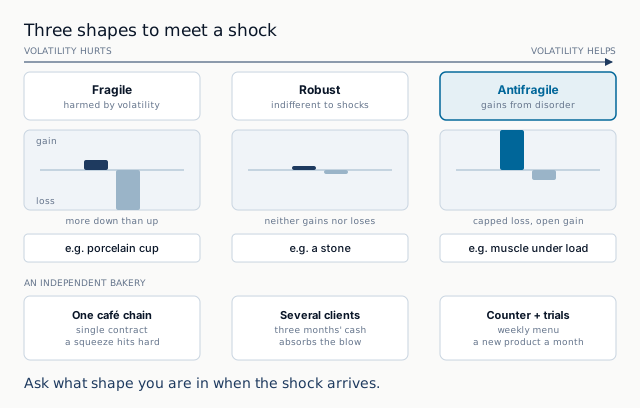
The figure sets out the triad. The fragile thing has more downside than upside from variation: a porcelain cup gains nothing from being shaken and can lose everything. The robust thing is indifferent; a stone does not care. The antifragile thing has more upside than downside, so volatility, errors and stressors work in its favour. The practical question therefore shifts from "how do we predict shocks?" to "what shape are we in when they come?" Taleb's recipes follow from that: avoid large irreversible exposures, add redundancy even when it looks inefficient, take many small bets with capped losses and open-ended gains, and let small failures happen so that large ones don't.
Imagine an independent bakery that sells almost entirely to one café chain under a single contract. It is fragile: a price squeeze or a lost contract hits it hard, and no amount of good news can help as much. Making it robust means spreading sales across several wholesale clients and keeping three months of cash in the bank. Making it antifragile means arranging things so that disruption becomes a source of gain: a counter for walk-in trade, a menu that changes weekly so the bakery learns quickly what sells, and a habit of trialling one new product a month in small batches. When a rival closes or tastes shift, the bakery is placed to pick up the business, and each small flop costs a tray of buns rather than the company.
The concept is easily stretched too far. Not every stressor helps; past a threshold, load tears muscle too, and the dose matters. "Antifragile" is also used as a fashionable synonym for resilient, which loses the point that the aim is to benefit, not merely to survive. And the strategy of many small bets requires that the bets really are small and the losses truly capped; a portfolio of hidden large risks with a cheerful label is just fragility in disguise.
The goal is not to avoid shocks but to be shaped so that they leave you stronger.
Top 100 Decision Models for Strategic Thinking — One hundred ways to think before you choose
Ready when you are.
Tap below to open the full chapter in the book reader. Anchored books jump to this chapter automatically.
The Lindy Effect
Top 100 Decision Models for Strategic Thinking — One hundred ways to think before you choose
The Lindy effect holds that for things that do not age biologically, such as ideas, books, technologies and institutions, every extra period of survival raises the expected remaining lifespan. The name comes from Lindy's, a New York delicatessen where, according to a 1964 article by the writer Albert Goldman, comedians joked that a show's future run was proportional to how long it had already been running. The mathematician Benoît Mandelbrot later gave the idea a more formal treatment, and Nassim Nicholas Taleb popularised it in the form most people now use.
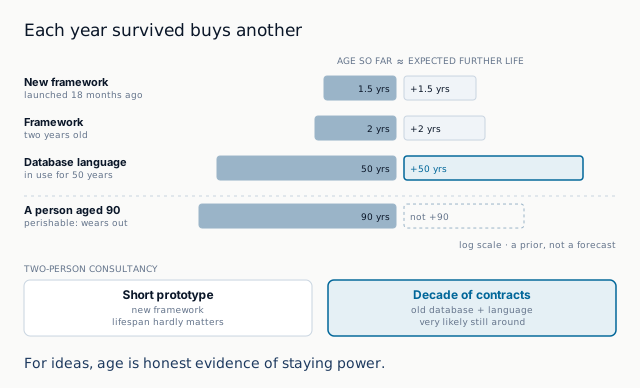
The rough rule, which the figure shows, is that a non-perishable thing can be expected to last about as long again as it has already lasted. A software framework released two years ago might be expected to last another two; a database language that has been in use for fifty years might plausibly last another fifty. This is the opposite of how we think about people or machines, which wear out, so that age shortens life expectancy. For ideas, age is evidence: each year survived is a year in which the thing beat competitors, changing tastes and the attention of critics. It is a rule of thumb about the shape of survival, not a precise forecast for any one item.
Think of a two-person consultancy choosing the technology for client systems it will have to maintain for a decade. One option is a framework launched eighteen months ago, slick and fashionable; the other is a relational database and a programming language each in wide use for decades. Lindy suggests the newer framework has a real chance of being abandoned within a few years, leaving the consultancy supporting a dead tool, while the old pair will very probably still be around. So the partners use the new framework for a short prototype, where its lifespan hardly matters, and the old stack for the long contracts.
Lindy misleads when applied to perishable things: a ninety-year-old person does not have ninety years ahead. It also breaks when the environment changes abruptly; a long survival record in old conditions says little about survival in new ones, which is how long-lived industries can collapse within a decade. And it says nothing about quality. Plenty of old things survive by inertia, and some new things are simply better. Treat it as a prior, a starting estimate, to be updated by everything else you know.
Age is not proof of worth, but for ideas it is honest evidence of staying power.
Top 100 Decision Models for Strategic Thinking — One hundred ways to think before you choose
Ready when you are.
Tap below to open the full chapter in the book reader. Anchored books jump to this chapter automatically.
The Kelly Criterion
Top 100 Decision Models for Strategic Thinking — One hundred ways to think before you choose
The Kelly criterion is a formula for how much of your capital to stake on a favourable, repeatable bet. John L. Kelly Jr, a researcher at Bell Labs, published it in 1956 in a paper about transmitting information over noisy channels; gamblers and investors, notably the mathematician Edward Thorp, soon saw that it answered a practical question. If you have an edge, how big should each bet be so that your wealth grows as fast as possible over the long run without ever being wiped out?
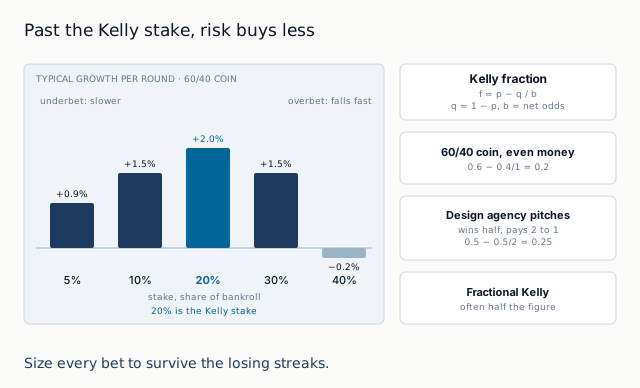
For a simple bet the answer is the edge divided by the odds. With a probability p of winning, a probability q = 1 − p of losing, and net odds b (what you win per pound staked), the Kelly fraction is p − q / b . The figure shows what that means in practice. On a coin that lands in your favour 60 per cent of the time at even money, Kelly says stake 20 per cent of your bankroll each round. Bet less and you still grow, but more slowly. Bet more and growth falls away faster than intuition suggests; at 40 per cent the typical outcome is decline, even though every single bet still has a positive expected value. The curve is lopsided: overbetting is punished far more than underbetting.
A small design agency could apply the same logic to a choice that has nothing to do with gambling. Suppose it wins roughly half the competitive pitches it enters, and a win returns about three times the staff time and money a pitch consumes, so the net odds are about two to one. Kelly suggests committing roughly a quarter of its spare capacity to pitching at any one time: 0.5 − 0.5/2 = 0.25. Pitching at twice that rate would feel ambitious and, after an ordinary run of losses, would leave the agency short of the cash and people needed for the work it already has.
The formula's weakness is its inputs. Real edges are estimated, not known, and an overestimated edge produces a stake that is far too large. That is why most practitioners use fractional Kelly , often half the computed figure, which gives up a little growth for much smoother results. Kelly also assumes bets can be repeated many times and that the goal is long-run growth; for a once-in-a-lifetime decision, or for anyone who cannot stomach deep drawdowns, it is a ceiling, not a target.
Size every bet to survive the losing streaks, and let the edge do the rest.
Top 100 Decision Models for Strategic Thinking — One hundred ways to think before you choose
Ready when you are.
Tap below to open the full chapter in the book reader. Anchored books jump to this chapter automatically.
Ergodicity
Top 100 Decision Models for Strategic Thinking — One hundred ways to think before you choose
A process is ergodic when the average across many parallel versions of it equals the average that one version experiences over time. The term comes from statistical physics, where Ludwig Boltzmann used the idea in the nineteenth century for systems that, given long enough, pass through all their possible states. Since the 2010s the physicist Ole Peters and his collaborators have argued that much of economics quietly assumes ergodicity where it does not hold, and that this explains a good deal of apparently irrational caution.
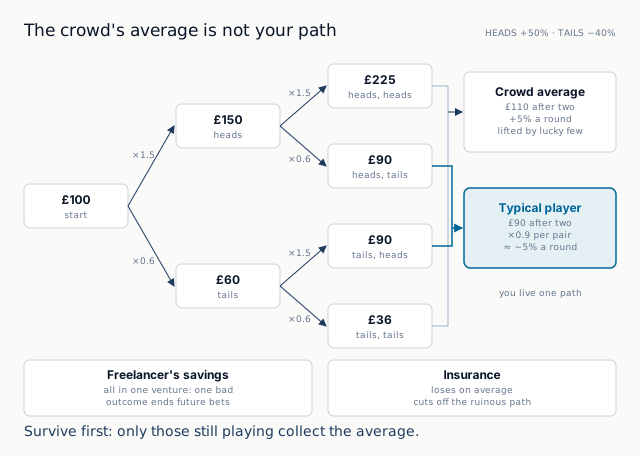
The standard illustration is a coin game, and the figure follows it. Start with £100. Heads, your wealth rises by half; tails, it falls by 40 per cent. Each toss has a positive expected value: averaged across a crowd of players, wealth grows 5 per cent per round. Now follow a single player through time. One heads and one tails takes £100 to £150 and then to £90, or to £60 and then £90; either way the pair multiplies wealth by 0.9. Over many rounds the typical player shrinks by about 5 per cent a round and heads towards zero, while the crowd average is propped up by a tiny number of spectacularly lucky players. The ensemble average and the time average point in opposite directions.
What matters for one person or one firm is the time average, because you live a single path, in sequence, and losses compound. A freelance designer invited to put her whole savings into a friend's venture with a good expected return faces exactly this. Viewed as one of a hundred similar investors, the bet looks attractive. Viewed as her own path, a single bad outcome removes her ability to take any future bets at all. Risking a small fraction keeps her in the game long enough for the average to matter, the same intuition that sits behind the Kelly criterion. Insurance is the textbook case on this view: it loses money on average for the policyholder, yet can raise long-run growth by cutting off the ruinous path.
The approach has critics. Many economists point out that expected-utility theory, with a suitable curve, already captures much of this, and they dispute how much ergodicity economics adds. The idea can also be stretched to justify any caution at all. Its lasting value is a question to put to every appealing average: is this the average of many people once, or of me many times?
Survive first, because only those still playing ever collect the average.
Top 100 Decision Models for Strategic Thinking — One hundred ways to think before you choose
Ready when you are.
Tap below to open the full chapter in the book reader. Anchored books jump to this chapter automatically.
The Centaur Decision
Top 100 Decision Models for Strategic Thinking — One hundred ways to think before you choose
The centaur model of decision-making pairs a human with a machine, each doing what it does best, on the bet that the combination beats either alone. The image comes from chess. After losing to IBM's Deep Blue in 1997, Garry Kasparov promoted advanced chess , first played in 1998, in which players consulted computers during the game. In freestyle tournaments in the mid-2000s, teams of modest human players using several programs sometimes beat both grandmasters and stronger engines, a result Kasparov has often cited. As engines grew far stronger, the human contribution in chess itself shrank, which is a useful caution, but the pattern has travelled into medicine, law, finance and now everyday work with AI assistants.
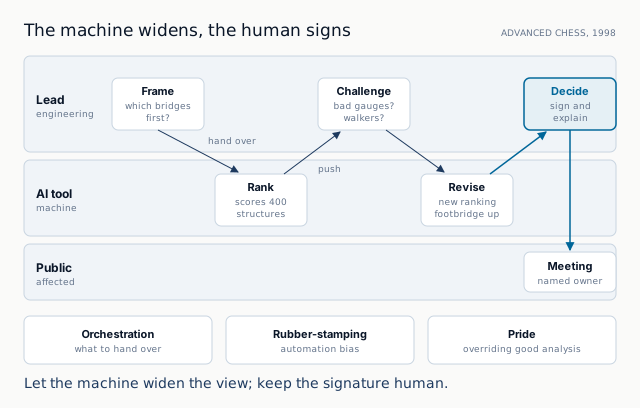
The figure shows the exchange as a sequence, because the division of labour matters more than the tools. The human frames the question: what decision, for whom, judged by what. The machine generates options, evidence and probabilities at a breadth no person can match. The human challenges that output, asking what it missed, where its data are thin and what it was never told. The machine revises. Then the human decides, explains the decision to the people affected and owns the consequences. The skill being exercised is not calculation but orchestration : knowing which questions to hand over, when to trust the answer and when to push back.
Consider a county council deciding which bridges to inspect first after a winter of floods. An analysis tool can score all four hundred structures on age, traffic, flood exposure and past defects in minutes, producing a ranked list. The engineering lead uses it, but asks the tool what would change if the readings from two river gauges were unreliable, and notices that a footbridge near a primary school ranks low only because pedestrian traffic is not counted. She moves it up. The final list is better than either the model's ranking or the engineers' instinct, and it is signed by a named person who can explain it at a public meeting.
The centaur fails when the human side collapses into rubber-stamping, a well-documented tendency known as automation bias , in which people accept machine output because it looks authoritative. It fails in reverse when people override good analysis out of pride. And the pairing assumes the human adds something; where the machine is reliably better and the stakes are low, a centaur may just be a slower machine.
Let the machine widen what you can see; keep the judgement, and the signature, human.
Top 100 Decision Models for Strategic Thinking — One hundred ways to think before you choose
Ready when you are.
Tap below to open the full chapter in the book reader. Anchored books jump to this chapter automatically.
The Decision Journal
Top 100 Decision Models for Strategic Thinking — One hundred ways to think before you choose
A decision journal is a written record made at the moment of choosing: what you decided, why, what you expected and how you felt. It grew up in investment firms, where the gap between good decisions and good outcomes is painfully visible, and it has been advocated by writers such as the investment strategist Michael Mauboussin; researchers who study judgement have long recommended something similar. It is the last chapter in this book for a reason: every other model here gets sharper once you can check how you actually used it.
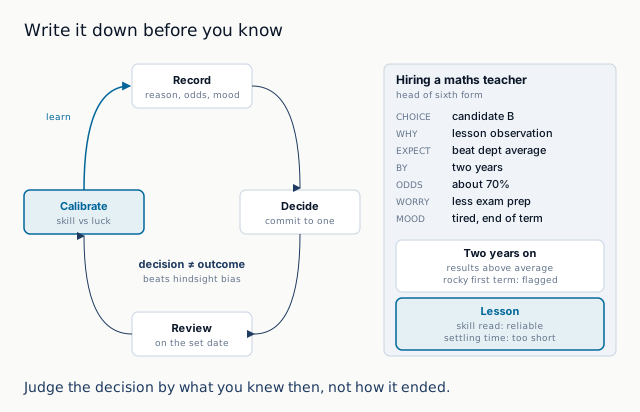
The journal exists to defeat hindsight bias , the tendency to remember our past beliefs as closer to what happened than they really were. Without a record, a lucky call becomes proof of skill and an unlucky one proof of stupidity, and neither teaches anything. The figure shows the loop. Before deciding, record the situation, the options considered, the one chosen and why, what you expect to happen with a rough probability, and your mood and energy. Decide. Set a review date. When it arrives, compare what happened with what you wrote, and separate the quality of the decision from the quality of the luck. Over time the entries reveal patterns: areas where you are overconfident, moods in which you decide badly, kinds of evidence you keep ignoring.
Picture the head of sixth form at a small secondary school, choosing which of two applicants to hire as a maths teacher. She writes half a page: candidate B, because the lesson observation showed real skill with pupils who were struggling; expected outcome, results in her classes match or beat the department average within two years, about 70 per cent confident; worry, B has less experience of exam preparation; mood, tired, end of term. Two years later the review shows results above average but a rocky first term, which the note had flagged. The lesson she draws is specific: her read of teaching skill is reliable, and her estimate of how long new staff take to settle is consistently too short.
A journal is easy to start and easy to abandon. Entries written after the fact defeat the purpose, since memory has already begun editing. Long entries become a chore; the useful ones take five minutes. And a journal reviewed only after failures teaches a lopsided lesson. Successes need the same scrutiny, because some of them were luck too.
Outcomes are noisy teachers; a written record is how you hear the lesson underneath.
Top 100 Decision Models for Strategic Thinking — One hundred ways to think before you choose
Ready when you are.
Tap below to open the full chapter in the book reader. Anchored books jump to this chapter automatically.