The Vegetable Kingdom
100 chapters on the green world that feeds us
The book edition of The Visual Encyclopaedia of plants: what a plant is, how plants evolved from algae to orchids, how they are built, how they turn light into life and reproduce, the forests, deserts and islands they fill, the crops we domesticated, the medicines and materials we take from them, and the threats and future of the green kingdom. 100 chapters in 10 parts, a detailed plate for every chapter.
Preface
How to read this one.
The book edition of The Visual Encyclopaedia of plants: what a plant is, how plants evolved from algae to orchids, how they are built, how they turn light into life and reproduce, the forests, deserts and islands they fill, the crops we domesticated, the medicines and materials we take from them, and the threats and future of the green kingdom. 100 chapters in 10 parts, a detailed plate for every chapter.
- ↓ Scroll vertically for the 100-chapter journey.
- → Swipe horizontally on any chapter for its plate + details.
- ✦ Random Chapter and Random Book pinned to the footer.
Contents
tap a chapter to jump
100 chapters.
What Is a Plant?
The Vegetable Kingdom — 100 chapters on the green world that feeds us
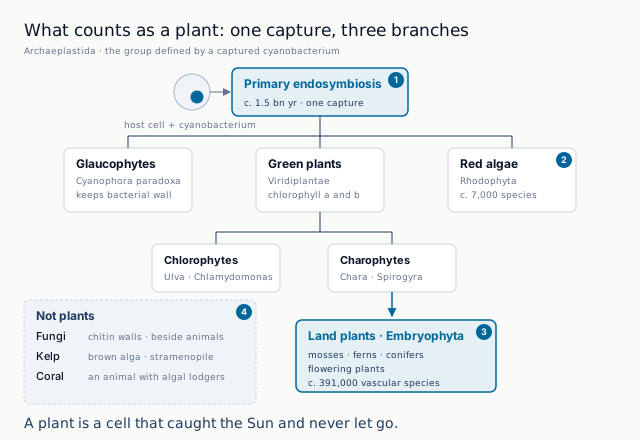
Ask a child to draw a plant and you get a stem, two leaves and a flower. A botanist needs longer, because the word has to stretch from a moss the size of a fingernail to a giant sequoia and still exclude mushrooms, seaweed and coral. The modern definition rests on a single ancient event. Around 1.5 billion years ago (botanists debate the date) a single-celled organism engulfed a cyanobacterium and, instead of digesting it, kept it. That captive became the chloroplast , and every descendant of that cell belongs to the group now called Archaeplastida : the glaucophytes, the red algae and the green lineage that runs from pond scum to oak.
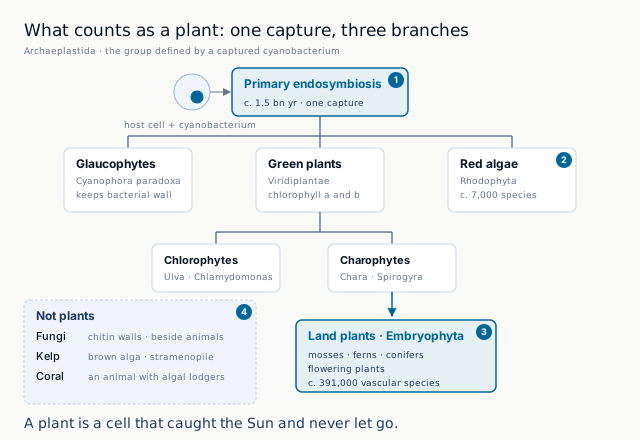
Within that green lineage sit the land plants , or Embryophyta, named because they shelter the embryo inside the parent's tissues. They share a toolkit: cells walled with cellulose , a stiff polymer of glucose; a large water-filled vacuole that keeps the cell firm; a life cycle that alternates between two generations; and a pigment set built around chlorophyll a and b. By that definition the kingdom holds mosses, liverworts, hornworts, ferns, conifers and flowering plants. Kew's State of the World's Plants report counted about 391,000 named vascular species in 2016, and the number climbs by roughly 2,000 a year.
How we know is written in the cell. Under the electron microscope a chloroplast shows two membranes, the inner one still built like a bacterial envelope, and inside sits a small circular genome whose genes read like those of living cyanobacteria. In 1905 the Russian botanist Konstantin Mereschkowski guessed that chloroplasts had once been free-living; DNA sequencing in the 1970s proved him right. The glaucophyte Cyanophora paradoxa , a freshwater alga, even keeps a thin bacterial cell wall around its chloroplasts, a relic of the original capture.
The borders of the kingdom are not where most people think. Fungi are not plants: their walls are chitin, the material of insect shells, they feed by absorption, and on the tree of life they sit beside animals. The brown kelp of a Californian forest, Macrocystis pyrifera , is a stramenopile that acquired its chloroplasts second-hand from a red alga, so most botanists leave it outside too. Coral is an animal with algal lodgers. Meanwhile a moss on a Scottish wall, a duckweed on a Thai pond and a baobab in Madagascar are all full citizens.
The definition matters because plants are the economy of the biosphere. Land plants hold around 450 billion tonnes of carbon, roughly 80 per cent of all living biomass on Earth, and almost every calorie an animal eats was first fixed by a green cell. Drawing the line correctly tells us which organisms share the inheritance of that first captured bacterium, and that inheritance is what this book sets out to explore. A plant, in the end, is a cell that caught the Sun and never let go.
The Vegetable Kingdom — 100 chapters on the green world that feeds us
Ready when you are.
Tap below to open the full chapter in the book reader. Anchored books jump to this chapter automatically.
The Plant Cell
The Vegetable Kingdom — 100 chapters on the green world that feeds us
In 1665 Robert Hooke put a sliver of cork under his microscope and saw, as he wrote in Micrographia , "a great many little boxes". They reminded him of monks' rooms, so he called them cells . He was looking at the dead, emptied walls of bark tissue, and he calculated that a cubic inch of cork held more than 1,200 million of them. The word stuck, and so did the thing he had noticed without understanding it: a plant cell is defined first by its wall.
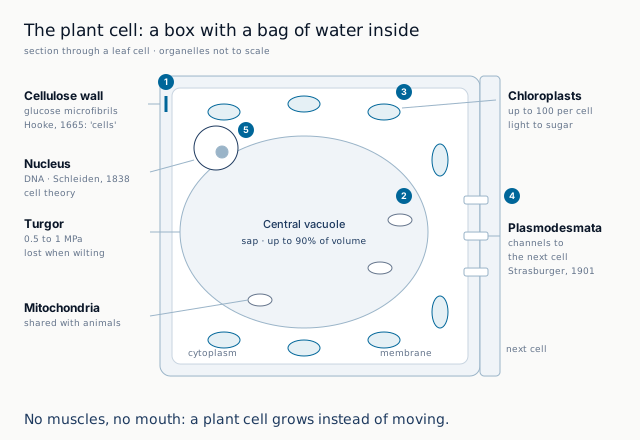
The cell wall is built from cellulose, chains of glucose bundled into microfibrils that are stronger, weight for weight, than steel, glued together with pectin and hemicellulose. Inside the wall lies the living cell: a membrane, cytoplasm, a nucleus, mitochondria and the two organelles that make a plant cell unmistakable. The chloroplasts turn light into sugar. The central vacuole , a sac of watery sap, can fill 90 per cent of a mature cell and press the cytoplasm into a thin film against the wall. That pressure, called turgor , is what holds a lettuce leaf crisp; typical values of 0.5 to 1 megapascal are several times the pressure in a car tyre. Let the vacuole lose water and the cell goes slack, which is all that wilting is.
Plant cells are also joined in a way animal cells are not. Tiny channels called plasmodesmata , named by Eduard Strasburger in 1901, thread through the walls and connect the cytoplasm of neighbour to neighbour, so a leaf is in some ways a single continuous living space partitioned by cellulose. Sugars, hormones and even viral genomes pass along them.
How we know owes much to Matthias Schleiden, who in 1838 argued that every plant is built of cells and every part of a plant grows from them; his friend Theodor Schwann extended the claim to animals a year later, and cell theory was born. Modern evidence comes from the electron microscope and from giant cells kind enough to be experimented on: the internodal cells of the pond alga Chara are several centimetres long, so physiologists could push microelectrodes into them and measure turgor directly. A cotton fibre is a single cell two to three centimetres long; the fibres of ramie, Boehmeria nivea , are longer still.
The plant cell's design explains the plant's way of life. A wall means no crawling, no swallowing and no muscles, so plants grow instead of moving, taking in water, light and air across their surfaces. A vacuole means a cell can become large and cheap, inflated with water rather than filled with expensive protein, which is why a tree can be enormous and still mostly air and sap. Hooke's little boxes turned out to be the architecture of nearly all the green on Earth.
The Vegetable Kingdom — 100 chapters on the green world that feeds us
Ready when you are.
Tap below to open the full chapter in the book reader. Anchored books jump to this chapter automatically.
The Chloroplast
The Vegetable Kingdom — 100 chapters on the green world that feeds us
Every green cell carries a colony of former bacteria. A chloroplast is a lens-shaped body about five to ten micrometres long, bounded by two membranes, and a single mesophyll cell in a spinach leaf may hold up to a hundred of them. Inside, a third membrane system folds into flattened sacs called thylakoids , stacked like coins into grana , and it is on these stacks that chlorophyll sits and the light reactions of photosynthesis run. The fluid around them, the stroma, is where carbon dioxide is turned into sugar.
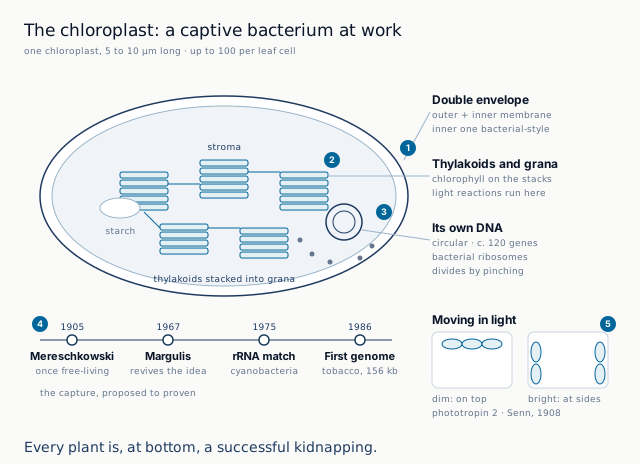
The odd thing about chloroplasts is that they are not quite part of the cell. They carry their own small circular genome of roughly 120 to 160 thousand base pairs and about 120 genes; they make some of their own proteins on bacterial-style ribosomes; and they reproduce by pinching in two, using an FtsZ ring like a dividing bacterium. A cell cannot build a chloroplast from scratch; it can only inherit one.
That is exactly what Konstantin Mereschkowski proposed in 1905: that the green bodies of plants were once free-living cyanobacteria taken in by a colourless host. The idea was mocked for sixty years. In 1967 Lynn Margulis, then publishing as Lynn Sagan, revived it in a paper that by her own account some fifteen journals had rejected, and in the 1970s the sequencing of chloroplast ribosomal RNA by Linda Bonen and W. Ford Doolittle, among others, showed it matched cyanobacteria far better than it matched the plant's own nucleus. In 1986 teams in Japan published the complete chloroplast genomes of tobacco and the liverwort Marchantia , and the case closed. The capture, a primary endosymbiosis , happened once, around 1.5 billion years ago, and gave rise to all red algae, green algae and land plants.
Chloroplasts are also surprisingly mobile. Under weak light they spread across the top of a cell to catch photons; under strong light they slide to the side walls to avoid damage, a response first described by Gustav Senn in 1908 and traced in 2001 to the blue-light receptor phototropin 2. Elsewhere the story has repeated: the freshwater amoeba Paulinella chromatophora captured its own cyanobacterium about a hundred million years ago and is still domesticating it, and the sea slug Elysia chlorotica steals chloroplasts from the alga it eats and keeps them photosynthesising for months.
What it means is that the plant kingdom is a partnership rather than a lineage. The chloroplast's cyanobacterial ancestry explains why herbicides that block bacterial-type ribosomes damage plants, why plastid DNA is the botanist's favourite barcode for identifying species, and why a leaf looks, under the microscope, like a city of captive bacteria doing the work of the Sun. Every plant is, at bottom, a successful kidnapping.
The Vegetable Kingdom — 100 chapters on the green world that feeds us
Ready when you are.
Tap below to open the full chapter in the book reader. Anchored books jump to this chapter automatically.
Why Plants Are Green
The Vegetable Kingdom — 100 chapters on the green world that feeds us
The green of a leaf is the light it refuses. Chlorophyll a , the pigment at the heart of every plant's photosynthesis, absorbs strongly in the blue around 430 nanometres and in the red around 660; chlorophyll b , its helper, fills in the gaps at 450 and 640. Between them lies the green and yellow part of the spectrum, from roughly 500 to 570 nanometres, which the pigments largely let through or bounce back. What reaches your eye is the leftover. A leaf is green for the same reason a red door is red: it is the colour it does not keep.
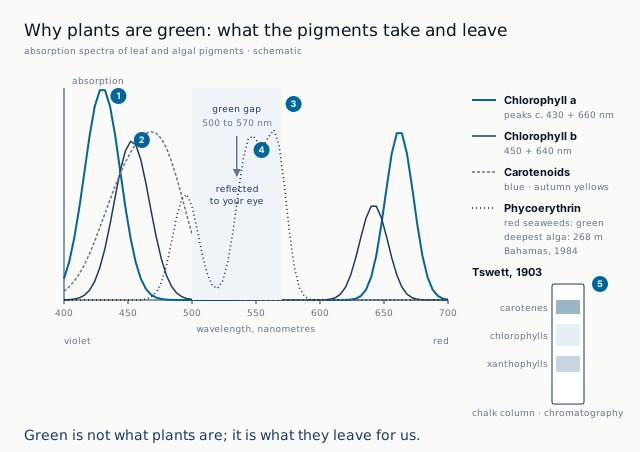
That was shown elegantly in 1883 by Theodor Engelmann, who laid a filament of the alga Spirogyra under a tiny spectrum cast by a prism and added oxygen-hungry bacteria. The bacteria crowded around the red and blue bands, where oxygen was being released, and ignored the green. Twenty years later, in 1903, the Russian botanist Mikhail Tswett ground up leaves, poured the extract through a column of chalk and watched it separate into bands of green and yellow. He called the method chromatography , the writing of colour, and it remains the chemist's basic tool.
Chlorophyll has company. Carotenoids such as beta-carotene and lutein absorb blue and blue-green light, pass energy on to chlorophyll and soak up excess light that would otherwise do damage; they are yellow and orange, and they are always present. In autumn, when a deciduous tree withdraws nitrogen from its leaves and dismantles chlorophyll, the carotenoids are simply unmasked, which is why a birch turns yellow. Reds are different. Anthocyanins are manufactured afresh in the dying leaf, at some cost to the tree, and botanists still debate why; the leading idea is that they shade the leaf's machinery while nutrients are salvaged. Red maples, Acer rubrum , in New England and the Japanese maples of Kyoto do it spectacularly; most European trees, with fewer red-leaved species, barely bother.
Not every photosynthesiser settled on green. Red seaweeds carry phycoerythrin, which absorbs the green light that chlorophyll wastes, and green light is exactly what survives deepest in clear sea water, since red is soaked up in the first ten metres and blue scatters. That is why the deepest-living photosynthetic organism ever found, a crustose red alga discovered off the Bahamas in 1984 at 268 metres, is red. Variegated leaves, the white-splashed hostas and figs of garden centres, are mostly chimeras in which some cells have lost the ability to make chlorophyll at all.
The colour of the kingdom is therefore a record of choices made billions of years ago and never revised. Satellites now read it from orbit, measuring the "red edge" where leaves stop absorbing and start reflecting, to map the planet's growing seasons. Green is not what plants are; it is what they leave for us.
The Vegetable Kingdom — 100 chapters on the green world that feeds us
Ready when you are.
Tap below to open the full chapter in the book reader. Anchored books jump to this chapter automatically.
Extremes of the Kingdom
The Vegetable Kingdom — 100 chapters on the green world that feeds us
The smallest flowering plant on Earth would fit through the eye of a needle. Wolffia , the rootless duckweed found on still water from Australia to Amazonia, is a green speck under a millimetre long that weighs around a tenth of a milligram; its flower, a single stamen and a stigma with no petals, sits in a pit on its upper surface. At the other end of the scale the parasite Rafflesia arnoldii of Sumatra and Borneo opens a single rust-red flower up to a metre across, weighing seven kilograms or more and smelling of carrion to attract the flies that pollinate it. Joseph Arnold and Stamford Raffles found the first in 1818. The plant has no leaves, stems or roots of its own; it lives as threads inside a jungle vine and appears only to flower.
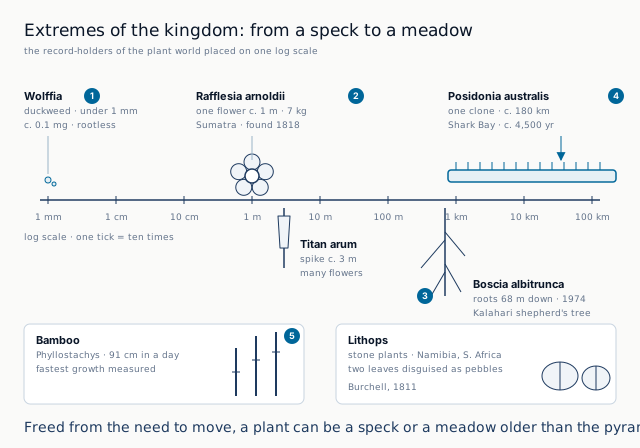
Tallest is a separate contest. The titan arum, Amorphophallus titanum , also from Sumatra, pushes up a flower spike around three metres high, the largest unbranched inflorescence known, and warms it to spread a stench that botanical gardens from Kew to Bonn advertise with queue barriers. It is technically hundreds of small flowers on one stalk, so Rafflesia keeps the single-flower record.
The biggest plant of all is almost invisible. In Shark Bay, Western Australia, a seagrass meadow of Posidonia australis stretching about 180 kilometres was shown in 2022, by genetic sampling, to be one clone, probably around 4,500 years old, spreading by its runners a few centimetres a year since the bay first flooded. The deepest roots belong to the shepherd's tree, Boscia albitrunca of the Kalahari, reported in 1974 reaching 68 metres down a mine working in South Africa's Northern Cape. The fastest growth is bamboo: some species of Phyllostachys have been measured adding 91 centimetres in a single day, which is faster than a clock's minute hand is long.
Botanists know these numbers because someone measured them, usually with a tape, a balance and patience. The seagrass record needed 18,000 genetic markers from samples across the bay; the duckweed figures come from plants raised in laboratory flasks, where Wolffia is now studied as a possible protein crop. Some extremes are about disguise rather than size. The stone plants, Lithops , of Namibia and South Africa are a pair of swollen leaves that mimic the pebbles around them, with a translucent window on top that lets light down to photosynthetic tissue buried in the soil; William Burchell described the first in 1811 after picking up what he thought was a curiously shaped stone.
Extremes are the kingdom's way of showing what a body plan can do. Freed from the need to move, a plant can be a speck, a metre-wide carrion lure, a clonal meadow older than the pyramids or a tree that drinks from the bottom of a mine. Each record is a limit that evolution found and then, somewhere, quietly tested.
The Vegetable Kingdom — 100 chapters on the green world that feeds us
Ready when you are.
Tap below to open the full chapter in the book reader. Anchored books jump to this chapter automatically.
Naming Plants
The Vegetable Kingdom — 100 chapters on the green world that feeds us
Every plant with a scientific name owes it to one book. On 1 May 1753 Carl Linnaeus published Species Plantarum , two volumes describing around 5,900 species, and in its margins he did something he regarded as a convenience: beside each long descriptive name he wrote a single word, the "trivial name". Combined with the genus, it gave a two-word label, Quercus robur , Zea mays , Rosa canina . The binomial proved so handy that botanists adopted it universally and set 1753 as the starting line: no plant name published before that date counts. His own scheme of classifying plants by counting stamens and pistils was abandoned within a century, but his names stayed.
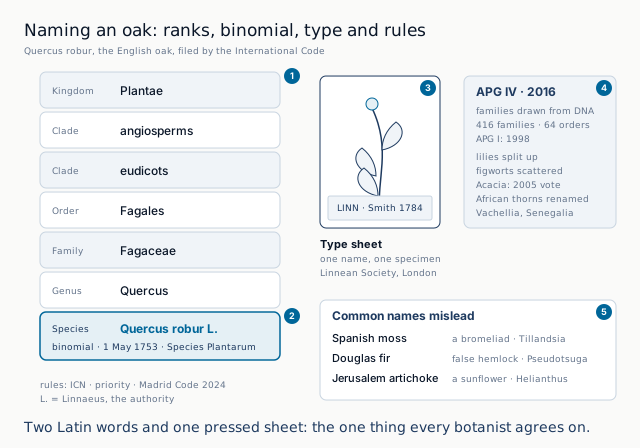
The rules are now kept in the International Code of Nomenclature for algae, fungi and plants, revised every six years at an International Botanical Congress, most recently in Madrid in 2024. Its central principle is priority: the earliest validly published name wins. Its anchor is the type specimen , a single pressed sheet, chosen when a species is described, to which the name is permanently tied. Linnaeus's own herbarium, bought by the young Englishman James Edward Smith in 1784 and now kept in a vault at the Linnean Society in London, holds the types for thousands of the world's commonest plants.
Names tell you who a plant is related to, which is why they change. For two centuries families were defined by flower structure; since 1998 the Angiosperm Phylogeny Group , an international collective of botanists, has redrawn them from DNA. Its fourth system, APG IV in 2016, recognises 416 families and 64 orders of flowering plants and moved some old friends: the lily family lost most of its members, and the figwort family was broken up and scattered. The hardest naming fight of recent decades concerned Acacia . When DNA showed the genus had to be split, the 2005 congress in Vienna let the roughly 1,000 Australian wattles keep the name, so the African thorn trees became Vachellia and Senegalia .
Common names are cheerful, local and frequently wrong. Spanish moss, Tillandsia usneoides , hanging from live oaks in Louisiana, is neither Spanish nor a moss but a bromeliad, a cousin of the pineapple. Douglas fir, the great timber tree of the Pacific Northwest, is not a fir; its name Pseudotsuga menziesii means "false hemlock" and honours Archibald Menzies, while the common name honours David Douglas, who sent its seed to Britain in 1827. The Jerusalem artichoke is a sunflower from North America.
Names are the index of everything else we know. A seed bank, a drug company and a customs officer all need to be sure that the plant in the packet is the one in the record, and the binomial, with its type sheet and its rules, is the thread that makes that certainty possible. Linnaeus's marginal convenience has become the one thing on which every botanist in the world agrees.
The Vegetable Kingdom — 100 chapters on the green world that feeds us
Ready when you are.
Tap below to open the full chapter in the book reader. Anchored books jump to this chapter automatically.
The Herbarium
The Vegetable Kingdom — 100 chapters on the green world that feeds us
A herbarium is a library in which the books are plants. Each specimen is a plant, or a piece of one, pressed flat, dried and glued or stitched to a stiff sheet of paper, with a label recording who collected it, where and when. The idea is usually credited to Luca Ghini , professor of botany at Bologna and then Pisa, who in the 1540s taught his students to press plants so they could be studied out of season. His own collection is lost, but those of his circle survive: the hortus siccus of Gherardo Cibo, begun around 1532, and the volumes of Ulisse Aldrovandi in Bologna are among the oldest in the world.
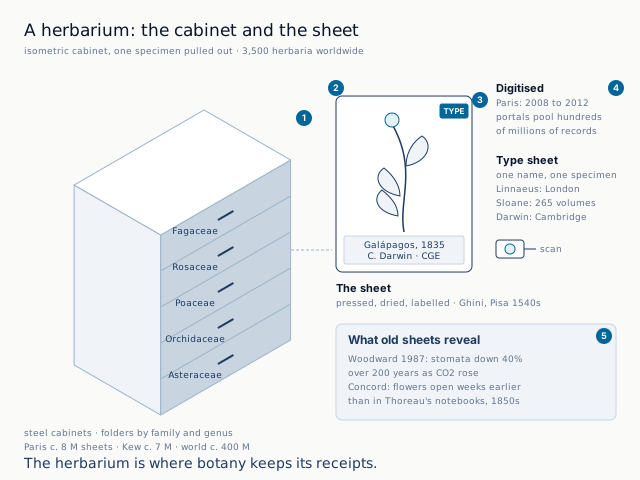
Dried, a plant lasts almost indefinitely. The Muséum national d'Histoire naturelle in Paris holds around 8 million sheets, the largest herbarium on Earth; the Royal Botanic Gardens, Kew, around 7 million; New York, St Petersburg, Geneva, Missouri and Leiden each count in the millions. Index Herbariorum, the world register, lists about 3,500 collections holding close to 400 million specimens between them. Among them lie treasures. Cambridge keeps the plants Charles Darwin collected on the Beagle , including his Galápagos specimens of 1835, which John Stevens Henslow had begged him to label by island; their island-by-island differences later fed his thinking.
The most valuable sheets are types , the single specimens to which scientific names are anchored. When a botanist suspects a new species, the first task is to check the types, which is why herbaria lend sheets to one another by the thousand and why the Natural History Museum in London still guards Hans Sloane's 265 bound volumes from the 1690s, the foundation of its collection.
Since the 2000s the sheets have been photographed. Paris digitised its entire collection between 2008 and 2012, and image portals now pool hundreds of millions of records, so a botanist in Nairobi can read a label written in Lima in 1802. That has turned herbaria into instruments for measuring change. In 1987 Ian Woodward compared leaves of eight temperate tree species collected over 200 years and found their stomatal density had fallen by 40 per cent as atmospheric carbon dioxide rose. Richard Primack's team in Massachusetts matched flowering dates on old sheets with Henry Thoreau's notebooks from Concord and showed that spring now arrives weeks earlier than in the 1850s. Sheets record where a plant once grew and no longer does, which seeds an expedition carried home and which beetles bored the leaves.
A pressed plant is a fact that can be checked. Photographs fade and descriptions mislead, but a sheet dated and placed by the hand that collected it is evidence of a kind that history rarely leaves. The herbarium is where botany keeps its receipts.
The Vegetable Kingdom — 100 chapters on the green world that feeds us
Ready when you are.
Tap below to open the full chapter in the book reader. Anchored books jump to this chapter automatically.
How Many Plants Are There?
The Vegetable Kingdom — 100 chapters on the green world that feeds us
Nobody knows how many kinds of plant there are, but botanists have got better at admitting it. The Royal Botanic Gardens, Kew, which keeps the world's checklist, reports around 350,000 accepted species of vascular plant once synonyms have been pruned; the figure was nearer 391,000 in its 2016 estimate, and the gap shows how much of the count is bookkeeping. Add perhaps 20,000 mosses, liverworts and hornworts. To that total about 2,000 new species are added every year: in 2019 alone, 1,942 plants were named, from new orchids to a tree from the Cameroon highlands.
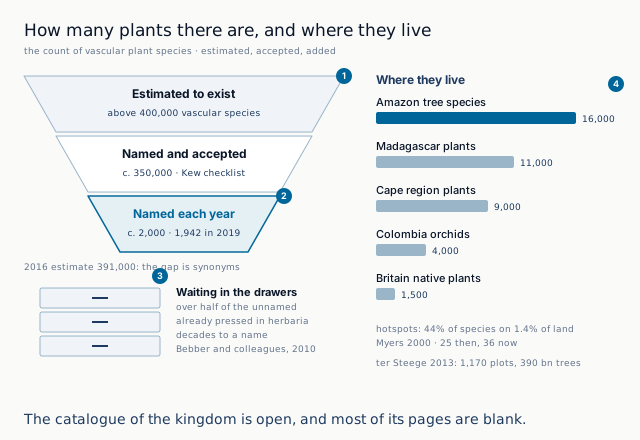
Most of them are not new to anyone but science. In 2010 a team led by Daniel Bebber examined the history of recently described species and found that the typical plant waits decades in a herbarium cupboard between being collected and being named, and that more than half of the species still undescribed may already be sitting pressed on a shelf. Estimates of the true total therefore rest on the rate at which the drawers are opened. Lucas Joppa and colleagues calculated in 2011 that around 10 to 20 per cent of flowering plants remain undescribed, which would put the final tally somewhere above 400,000.
The species are not spread evenly. In 2000 Norman Myers and colleagues defined biodiversity hotspots : regions with at least 1,500 endemic plants that had lost 70 per cent of their original habitat. The 25 they listed, since expanded to 36, hold about 44 per cent of all plant species on 1.4 per cent of the land. The Cape Floristic Region at the tip of Africa packs roughly 9,000 species into an area the size of Portugal, nearly 70 per cent of them found nowhere else. Madagascar's 11,000-odd plants are more than 80 per cent endemic. Colombia leads the world in orchids, with over 4,000. The Amazon tells the same story in trees: in 2013 Hans ter Steege and more than a hundred co-authors pooled data from 1,170 forest plots and estimated that the basin holds about 16,000 tree species, of which a mere 227 "hyperdominants" make up half of its 390 billion trees, while thousands of rare species…
That rarity is the point. A species confined to one mountain in Ecuador can be described and declared extinct in the same decade. The 2020 edition of Kew's assessment estimated that two in five plant species are threatened, and many will vanish between collection and description, known only from a sheet.
Counting plants is not a hobby. The figure sets the scale of what is at stake in forest and field, tells conservationists where a hectare protects most, and reminds the rest of us that the green world is still mostly unread. The catalogue of the kingdom is open, and most of its pages are blank.
The Vegetable Kingdom — 100 chapters on the green world that feeds us
Ready when you are.
Tap below to open the full chapter in the book reader. Anchored books jump to this chapter automatically.
Plants, Fungi and Algae
The Vegetable Kingdom — 100 chapters on the green world that feeds us
For most of history the living world had two sides: things that moved and things that did not. Mushrooms, seaweeds and plants fell together on the still side. The separation took a century. Ernst Haeckel added a third kingdom, Protista, for microbes in 1866; in 1969 the American ecologist Robert Whittaker proposed five kingdoms , giving fungi a kingdom of their own on the grounds that they feed by absorbing, animals by swallowing and plants by photosynthesis. A generation learnt it; then DNA rearranged it.
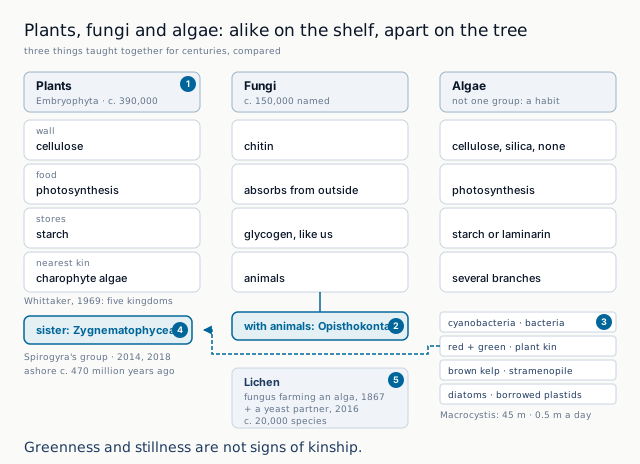
The surprise came in the 1990s, when comparisons of ribosomal and protein genes showed that fungi are closer to animals than either is to plants. The two share an ancestor that swam with a single rear flagellum, which is why the group is called Opisthokonta, "hind-tailed". Fungi build their walls from chitin , the material of insect cuticle, store energy as glycogen as we do, and have none of the cellulose, chloroplasts or starch of plants. A mushroom, in short, is a relative of ours that gave up moving. There may be 2 to 4 million species of fungi, of which about 150,000 have names.
"Algae" is not a group at all but a habit. The word covers everything that photosynthesises in water without being a land plant, and that spans several branches of the tree. Cyanobacteria are bacteria. Red and green algae are true Archaeplastida, kin of plants. Brown algae are stramenopiles, cousins of the diatoms and of potato blight; the giant kelp Macrocystis pyrifera of Californian and Tasmanian coasts grows to 45 metres and up to half a metre a day, and it is no more a plant than a sea urchin is. Diatoms, dinoflagellates and euglenids each obtained chloroplasts second-hand from engulfed algae. Together these groups do roughly half the planet's photosynthesis.
Among the green algae lies the plant kingdom's ancestry. The charophytes , freshwater algae such as the stoneworts, Chara , and the delicate filaments of Spirogyra and its relatives, are the closest living relatives of land plants; genome comparisons published in 2014 and 2018 point to the Zygnematophyceae, the group that includes Spirogyra , as the sister lineage, a finding that surprised botanists who expected the more complex stoneworts. A pond scum, it turns out, is our best model of what crawled ashore around 470 million years ago.
Fungi and algae meet in the lichen. Simon Schwendener proposed in 1867 that a lichen was a fungus farming an alga, an idea his contemporaries found distasteful; it is now textbook, and in 2016 Toby Spribille showed that many lichens also harbour a second fungus, a yeast, in their outer layer. About 20,000 lichen species crust rocks from Antarctica to the Atacama.
The lesson is that greenness and stillness are not signs of kinship. A plant is defined by its lineage, and the greengrocer's shelf, with its mushrooms and its nori, is a reunion of three kingdoms that last shared a cell more than a billion years ago.
The Vegetable Kingdom — 100 chapters on the green world that feeds us
Ready when you are.
Tap below to open the full chapter in the book reader. Anchored books jump to this chapter automatically.
How a Plant Senses the World
The Vegetable Kingdom — 100 chapters on the green world that feeds us
A plant has no eyes, ears or nerves, yet it knows which way is up, where the light is, what time it is and when it is touched. In 1880 Charles Darwin and his son Francis published The Power of Movement in Plants , the record of years of patient experiments with seedlings and little paper caps. Shading the tip of a canary grass seedling stopped it bending toward a window; shading the lower stem did not. The tip, they concluded, saw the light and sent a message downward. In 1926 Frits Went caught the messenger in a block of agar and named it auxin . Phototropism turned out to be chemistry: light on one side shifts auxin to the shaded side, which grows faster, and the shoot curves.
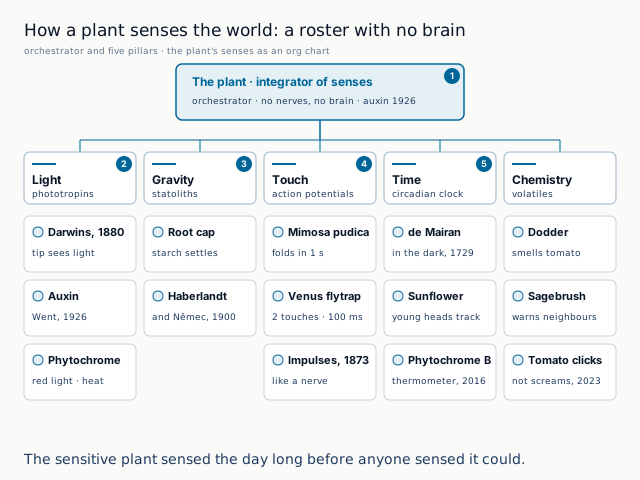
Gravity is sensed by weight. In the root cap, special cells contain dense starch grains called statoliths that settle to the bottom like sand in a tilted jar; the cells read their position and redirect auxin, so a root laid flat turns down within hours. Gottlieb Haberlandt and Bohumil Němec proposed the idea independently in 1900, and experiments in orbit have confirmed it. Time is kept by an internal clock. In 1729 the French astronomer Jean-Jacques d'Ortous de Mairan shut a sensitive plant, Mimosa pudica , in a dark cupboard and found its leaves still folded at night and opened by day, the first evidence of a circadian rhythm in any organism.
Touch can be fast. Brush a Mimosa and its leaflets fold in a second as water rushes out of hinge cells at the leaf base. The Venus flytrap, Dionaea muscipula , from a few bogs in the Carolinas, shuts in around a tenth of a second, but only if two trigger hairs are touched within about twenty seconds; it counts, using electrical impulses that John Burdon-Sanderson recorded in 1873, at Darwin's urging, and found much like those of a nerve. Plants also smell: the parasitic dodder, Cuscuta , grows toward the scent of a tomato, and wounded sagebrush warns its neighbours with volatiles. The phytochrome pigment that measures red light doubles as a thermometer, a discovery of 2016. Mature sunflowers do not follow the Sun; only young plants swing east to west, and once in flower they face east for good.
Whether any of this amounts to intelligence is a live argument. In 2006 a group of researchers proposed a field of "plant neurobiology"; the next year 36 colleagues replied, under the title "no brain, no gain", that plants have signalling but no neurons, synapses or brain, and that the metaphor misleads. Most botanists side with the sceptics while conceding the plants' point: a rooted organism that integrates light, gravity, touch, scent, heat and time without a nervous system has solved the problem of knowing the world in its own way. The sensitive plant sensed the day long before anyone sensed it could.
The Vegetable Kingdom — 100 chapters on the green world that feeds us
Ready when you are.
Tap below to open the full chapter in the book reader. Anchored books jump to this chapter automatically.
The First Photosynthesisers
The Vegetable Kingdom — 100 chapters on the green world that feeds us
Every green thing alive today, from a pond's film of algae to a giant sequoia, runs on a chemical trick invented by bacteria. Cyanobacteria were the first organisms to split water with sunlight, using the energy to fix carbon dioxide into sugar and releasing oxygen as waste. Earlier photosynthesisers had used hydrogen sulphide or dissolved iron and gave off no oxygen at all. Water was everywhere, so the new chemistry had an inexhaustible feedstock, and its waste product would eventually remake the planet.
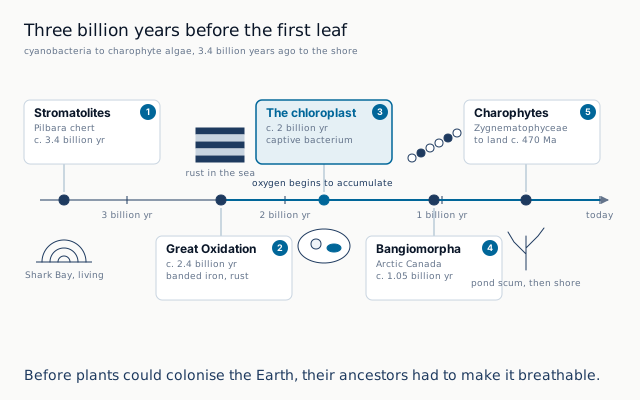
The evidence sits in rock. At Hamelin Pool in Shark Bay, Western Australia, living stromatolites still grow: knobbly domes built up, layer by layer, as mats of cyanobacteria trap sediment. Fossil stromatolites in the Pilbara's Strelley Pool chert are around 3.4 billion years old, among the oldest traces of life anywhere. Whether those earliest mats made oxygen is debated, but by about 2.4 billion years ago the atmosphere had begun to change. Banded iron formations, rust-red layers laid down as dissolved iron met oxygen in the sea, and the disappearance of certain sulphur isotope signatures mark the Great Oxidation Event . For most microbes of the day oxygen was a poison, so the first great pollution crisis in history was caused by the ancestors of plants.
The next step was a merger. Around 1.5 to 2 billion years ago a single-celled eukaryote engulfed a cyanobacterium and, instead of digesting it, kept it. The captive became the chloroplast , and its descendants sit in every leaf. Konstantin Mereschkowski proposed this in 1905 and Lynn Margulis revived it in 1967; the chloroplast's own small circular genome settled the argument. From that one event descend the red algae, the green algae and all land plants.
Green algae split early into two lines. The chlorophytes include sea lettuce ( Ulva ) and the single-celled Chlamydomonas of laboratory fame. The other line, the charophytes or streptophyte algae, led to land. Fossils such as Proterocladus antiquus from northern China, about one billion years old, show branching green algae already thriving in shallow seas. Genome sequencing has narrowed the closest living relatives of land plants not to the elegant stoneworts ( Chara ) but to the humbler Zygnematophyceae, pond scums such as Spirogyra and the drought-hardy crusts that grow on damp rock. Their genomes carry genes for stress tolerance, some acquired from soil bacteria, that land plants later put to work.
Botanists now read this history in three overlapping archives: the rocks and their isotopes, the microfossils, and the genomes that carry the merger's signature in every cell. Oxygen in the air, iron ore in the ground and the chloroplast in a blade of grass are three outcomes of the same invention. Plants did not just colonise the Earth; their ancestors first had to make it breathable.
The Vegetable Kingdom — 100 chapters on the green world that feeds us
Ready when you are.
Tap below to open the full chapter in the book reader. Anchored books jump to this chapter automatically.
Onto the Land
The Vegetable Kingdom — 100 chapters on the green world that feeds us
For nine-tenths of life's history the land was bare rock and crust. Water was the problem: a cell out of the sea dries, overheats and has nothing to float its sperm in. The plants that finally crept ashore were descended from freshwater green algae, and they solved the problem one invention at a time.
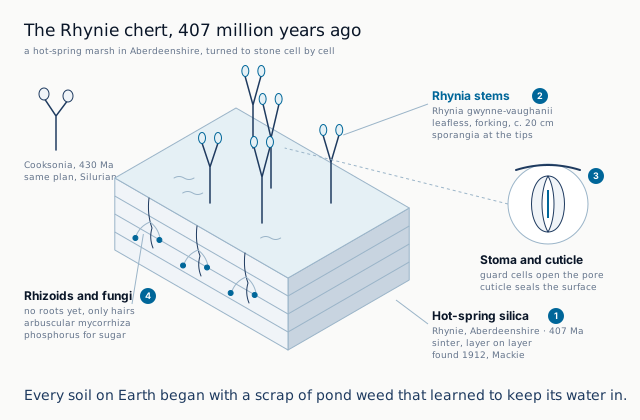
The first signs are tiny. Cryptospores , tough-walled spores found in rocks from the Ordovician period around 470 million years ago, turn up in Argentina, Oman and Saudi Arabia. They were made of sporopollenin , one of the most decay-resistant substances biology has ever produced, and they came in fused pairs and fours like the spores of modern liverworts. No stems or leaves survive from these pioneers; they were probably flat, mossy mats clinging to wet ground.
The first plant with a body we can draw is Cooksonia , from around 430 million years ago in the Silurian. Named by William Lang in 1937 after the Australian palaeobotanist Isabel Cookson, it was a few centimetres tall, a forking stem with no leaves and no roots, each branch tipped by a capsule of spores. Specimens from Devilsbit Mountain in County Tipperary, Ireland, are among the oldest known. Some already had stomata , the adjustable pores that let a plant take in carbon dioxide while rationing water, and a waxy cuticle sealing the surface.
The richest window onto this world is a field near Rhynie in Aberdeenshire, Scotland. Around 407 million years ago hot springs flooded a marsh with silica-rich water, turning plants to stone before they could rot. Found by the geologist William Mackie in 1912 and described by Robert Kidston and William Lang between 1917 and 1921, the Rhynie chert holds Rhynia , Aglaophyton , Asteroxylon and Horneophyton in cellular detail, along with mites, springtails and the earliest known insects. Aglaophyton had no roots, only hair-like rhizoids, yet its stems contain the branched structures of arbuscular mycorrhizal fungi, the same partnership that feeds most crops today. Fungi were there from the start, trading soil phosphorus for sugar before roots had been invented.
By the end of the Devonian, some fifty million years later, plants had leaves, roots, wood and seeds, and the first forests were drawing carbon dioxide out of the air. The rock weathering they drove helped cool the planet, and botanists suspect the nutrients they washed into the sea contributed to a mass extinction there. Every soil on Earth, and the oxygen in every breath, dates from the moment a scrap of pond weed learned to keep its water in.
The Vegetable Kingdom — 100 chapters on the green world that feeds us
Ready when you are.
Tap below to open the full chapter in the book reader. Anchored books jump to this chapter automatically.
Mosses, Liverworts and Hornworts
The Vegetable Kingdom — 100 chapters on the green world that feeds us
Walk along any damp wall and you are looking at the oldest design for a land plant still in business. Bryophytes , the mosses, liverworts and hornworts, number around 20,000 species: roughly 12,000 mosses, 7,000 liverworts and a few hundred hornworts. They have no true roots, no wood and no internal plumbing worth the name, so they stay small, a few centimetres tall, and drink through their whole surface.
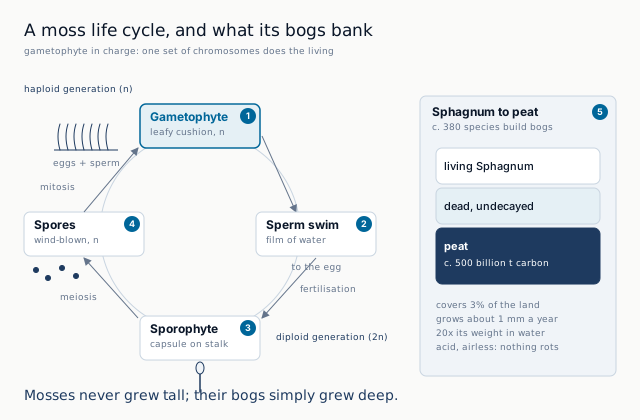
What sets them apart is which generation does the living. In a fern or an oak the plant you see is the sporophyte , with two sets of chromosomes. In a moss the leafy green cushion is the gametophyte , with one set; the sporophyte is the little brown stalk and capsule that grows out of it, feeding on its parent for its entire life. Sperm must swim through a film of water to reach the egg, which is why mosses love rain and shade. The liverwort Marchantia polymorpha , whose genome was published in 2017, is now a laboratory model for how the first land plants were built.
Their trick is endurance. Many mosses can dry out completely, stop all metabolism and revive within minutes of wetting. Syntrichia caninervis survives on the crusts of the Mojave and Gobi deserts. In 2014 a team led by Peter Convey regrew Chorisodontium moss from a frozen core on Signy Island in Antarctica that had lain in permafrost for more than 1,500 years. Hornworts such as Anthoceros keep a single large chloroplast in each cell and house nitrogen-fixing cyanobacteria in cavities, and Takakia , found on the Tibetan plateau, belongs to a lineage that split from other mosses around 390 million years ago.
One genus matters more than the rest. Sphagnum , with around 380 species, builds bogs. Its leaves hold large dead cells that soak up twenty times their weight in water, it pumps out acid, and it grows upwards on the undecayed remains of its own ancestors. The result is peat . Peatlands cover around 3 per cent of the land, from the West Siberian Lowland to the Congo basin's Cuvette Centrale, mapped only in 2017, and Scotland's Flow Country, yet they hold roughly 500 billion tonnes of carbon, more than all the world's forests. Drained and burned, as in Indonesia's fires of 2015, they release it; kept wet, they go on storing it at about a millimetre a year.
Mosses were the first plants to green the land, and they never left. They cushion the rainforest canopy, cap the tundra and insulate the taiga, and their bogs are the planet's most efficient long-term carbon store. The smallest plants are doing some of the biggest work.
The Vegetable Kingdom — 100 chapters on the green world that feeds us
Ready when you are.
Tap below to open the full chapter in the book reader. Anchored books jump to this chapter automatically.
Ferns and the Coal Forests
The Vegetable Kingdom — 100 chapters on the green world that feeds us
Trees were invented more than once, and the first attempts look odd to modern eyes. At Gilboa in New York State, quarrying in the 1850s and again in 2010 exposed the floor of a forest around 385 million years old: hundreds of root mounds of Eospermatopteris , a plant eight metres tall with a trunk like a palm's and a crown of fronds, but no true leaves at all. At nearby Cairo a slightly older site preserves the roots of Archaeopteris , the first plant to combine proper wood, a branching crown of fern-like fronds and deep roots. By the end of the Devonian it had spread across the world and built the first real forests.
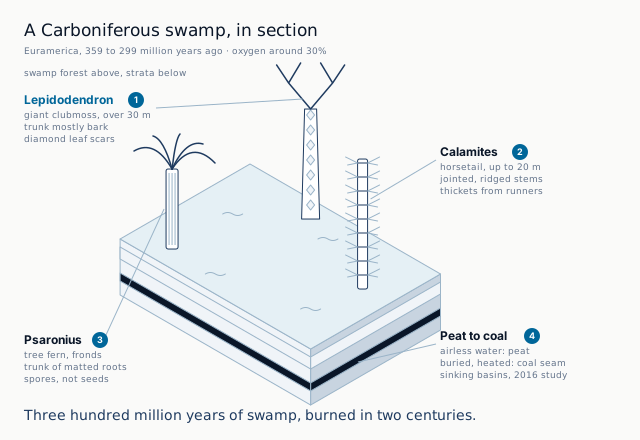
Then came the Carboniferous , from 359 to 299 million years ago, when the swamp forests of Europe and North America laid down the coal that would later fire the Industrial Revolution. The giants were not trees in any living sense. Lepidodendron , a relative of today's ankle-high clubmosses, rose more than 30 metres on a trunk made mostly of bark, its surface patterned with diamond-shaped leaf scars. Calamites , a horsetail, grew 20 metres tall in bamboo-like thickets. Tree ferns such as Psaronius and the seed-bearing Cordaites filled the gaps. Oxygen may have reached 30 per cent of the atmosphere, enough for dragonflies with 70-centimetre wingspans.
Why so much coal? One popular idea is that fungi had not yet evolved the enzymes to digest lignin , so dead wood piled up unrotted. Palaeobotanists debate this; a 2016 study found that the distribution of coal matches wet tropical basins sinking fast enough to bury peat, not a gap in the fungal toolkit. Either way, the carbon was taken out of the air for 300 million years, and we have put much of it back in two centuries.
Ferns themselves outlived the coal swamps. The fern life cycle still runs in two acts: a spore lands, grows into a heart-shaped green prothallus the size of a fingernail, and on its underside sperm swim through a film of water to an egg; from that egg rises the frond-bearing plant we recognise. Around 10,500 species survive, the second-largest group of vascular plants after the flowering plants, from the tree ferns Cyathea and Dicksonia of New Zealand and Tasmania to the floating Azolla , which hosts nitrogen-fixing bacteria and once bloomed across an Arctic sea. Equisetum , the one living genus of horsetails, has stems stiffened with silica that settlers used to scour pans.
The coal forests are gone, but their legacy is in every power station chimney and every fern unfurling in a shaded gully. We are still living on the carbon they buried.
The Vegetable Kingdom — 100 chapters on the green world that feeds us
Ready when you are.
Tap below to open the full chapter in the book reader. Anchored books jump to this chapter automatically.
The Seed
The Vegetable Kingdom — 100 chapters on the green world that feeds us
Before the seed, every land plant had to mate in the wet. Mosses and ferns release sperm that swim to an egg through a film of water, and their spores leave with no food and no protection. The seed changed the rules. It wraps an embryo in a food store and a tough coat, lets it wait, and sends it off with a packed lunch.
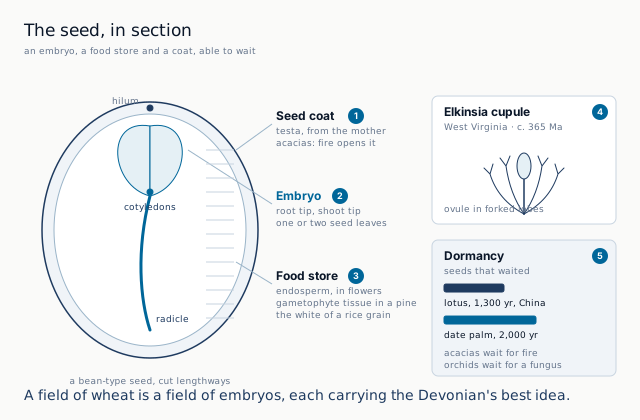
The invention arrived in the Late Devonian. Elkinsia polymorpha , found near Elkins in West Virginia and described in 1989, lived around 365 million years ago. Its ovules sat inside a cupule of forked lobes, and the integument that would become the seed coat was still a ring of separate fingers. Elkinsia and the other seed ferns were not ferns at all but the first seed plants, and the steps that led to them can be traced in the fossil record: heterospory, with large female spores and tiny male ones; the retention of the female spore on the parent; and finally the wrapping of that spore in a protective jacket.
Inside a modern seed sit three generations. The seed coat and the nucellus belong to the mother plant. The embryo, with its root tip, shoot tip and one or two seed leaves, is the child. The food store is the odd one out: in a pine it is the tissue of the female gametophyte, while in flowering plants it is endosperm , a tissue formed by a second fertilisation that belongs to neither parent exactly. That is what you eat in a grain of rice. Fertilisation itself no longer needs water. Pollen carries the male cells through the air and grows a tube to the egg, which is why conifers and grasses can breed in the dry.
Then there is time. Dormancy lets a seed sit out drought, winter or fire until conditions are right. In 2005 Elaine Solowey in Israel germinated a Judean date palm seed excavated at Masada and dated to around 2,000 years ago; the tree, nicknamed Methuselah, is now a mature male. The hard-coated seeds of Australian acacias wait for fire. Orchid seeds, by contrast, are dust with no food at all, and up to a million of them leave a single capsule to find a fungus that will feed them. At the other extreme the coco de mer palm of the Seychelles, Lodoicea maldivica , produces a seed weighing up to 18 kilograms.
The seed is the reason plants could cross deserts and mountains, the reason there are forests on dry continents, and the reason humans have stores, granaries and agriculture at all. A field of wheat is a field of embryos, each one carrying the Devonian's best idea.
The Vegetable Kingdom — 100 chapters on the green world that feeds us
Ready when you are.
Tap below to open the full chapter in the book reader. Anchored books jump to this chapter automatically.
Conifers, Cycads and Ginkgo
The Vegetable Kingdom — 100 chapters on the green world that feeds us
When the coal swamps dried out at the end of the Carboniferous, seed plants inherited the Earth. The gymnosperms , plants with naked seeds borne on cones or stalks rather than inside a fruit, dominated the Permian and the whole Mesozoic. Glossopteris , a seed fern whose tongue-shaped leaves litter rocks in India, Australia, Africa, South America and Antarctica, was among the clues that persuaded Alfred Wegener the continents had once been joined. Around 1,000 gymnosperm species survive, in four lines.
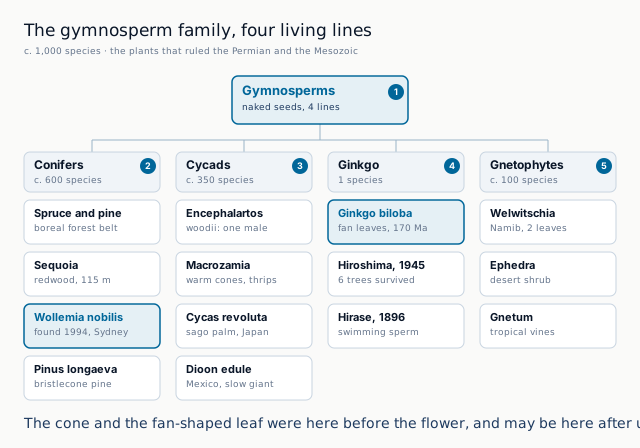
Conifers are by far the largest group, around 600 species, and they still rule the cold. The boreal forest of spruce, pine, fir and larch is the biggest forest belt on the planet. Conifer wood is the timber of ships, houses and newspapers, and their resin becomes amber. In 1994 David Noble, a parks officer abseiling into a canyon in Wollemi National Park near Sydney, found a tree no botanist had seen alive: Wollemia nobilis , a relative of the monkey puzzle known only from fossils. Fewer than 100 adults exist in the wild, their location kept secret.
Cycads , around 350 species, look like palms but are nothing of the kind. Their cones are pollinated by beetles and thrips that the plant lures with warmth and scent, and their roots host cyanobacteria. They are often called living fossils from the age of dinosaurs, yet DNA shows that today's species mostly arose in the last 12 million years; the lineage is old, the species are not. The loneliest plant in the world is a cycad: every Encephalartos woodii in cultivation is a cutting of a single male found in South Africa in 1895, and no female has ever been seen.
Ginkgo biloba stands alone. Leaves almost identical to its fan-shaped foliage appear in rocks around 170 million years old, and the lineage runs back further still. Wild ginkgo is nearly extinct, surviving in a few valleys in China, but temple gardeners kept it, and it now lines streets from Seoul to New York, shrugging off pollution and pests. Six ginkgos growing within two kilometres of the centre of the Hiroshima blast of 6 August 1945 survived and are still alive. The fourth group, the gnetophytes , includes Welwitschia mirabilis of the Namib desert, which grows just two strap-like leaves for more than a thousand years.
Flowering plants took most of the world from the gymnosperms, but not the high latitudes, the mountains or the long game. The cone, the resin and the fan-shaped leaf were here before the flower, and on present evidence they will be here after us.
The Vegetable Kingdom — 100 chapters on the green world that feeds us
Ready when you are.
Tap below to open the full chapter in the book reader. Anchored books jump to this chapter automatically.
The First Flowers
The Vegetable Kingdom — 100 chapters on the green world that feeds us
On 22 July 1879 Charles Darwin wrote to his friend Joseph Hooker at Kew that the rapid appearance of the higher plants in the fossil record was 'an abominable mystery'. Flowering plants, or angiosperms , seemed to turn up in the mid-Cretaceous already diverse, with no obvious ancestors. Nearly 150 years later the mystery is smaller but not gone.
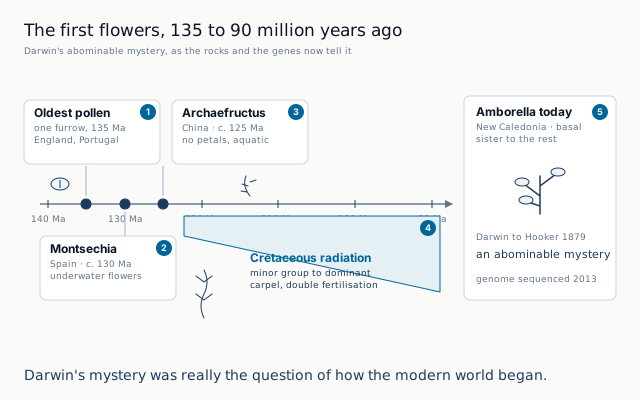
The rocks have given up some early flowers. Archaefructus , from the Yixian Formation of Liaoning in north-east China, is around 125 million years old. Described by Sun Ge and David Dilcher from 1998, it was a slender water plant with no petals or sepals, its carpels and stamens strung along a stem; some botanists think it is the sister of all living angiosperms, others place it among the water lilies. Montsechia vidalii , from limestone in the Spanish Pyrenees, is older still at around 130 million years and lived wholly submerged, like the hornwort Ceratophyllum today. The oldest undisputed angiosperm pollen , grains with a single furrow, appears in rocks from about 135 million years ago in England, Israel and Portugal. Claims of Jurassic flowers, such as Nanjinganthus from 2018, remain contested.
The living world offers a different clue. Amborella trichopoda is a sprawling shrub found only in the understorey of New Caledonia's rainforests. DNA places it as the sister of every other flowering plant, the first branch off the trunk, and its genome, sequenced in 2013, is a reference for what the ancestral flower might have carried. It has small creamy flowers, separate male and female plants, and wood without the water-conducting vessels that most angiosperms possess.
What made the flower so successful? The carpel encloses the ovules and later becomes the fruit; double fertilisation produces endosperm, a food store made only when a seed is actually fertilised, so no effort is wasted; and the flower itself recruits animals as couriers. Fast life cycles, broad leaves with dense veins and efficient vessels let angiosperms outgrow the gymnosperms. Between about 125 and 90 million years ago they went from a minor group to the dominant plants of most landscapes, and the insects, birds and mammals that eat them diversified in their wake.
Molecular clocks suggest the angiosperm line split from other seed plants in the Triassic or even the Permian, long before the first fossil flower, so either the early flowers were rare and left no trace or the clocks run fast. Botanists still argue. Today around 300,000 of the roughly 390,000 known plant species are angiosperms, and almost everything on your plate, in your wardrobe and in your garden is one of them. Darwin's mystery was really the question of how the modern world began.
The Vegetable Kingdom — 100 chapters on the green world that feeds us
Ready when you are.
Tap below to open the full chapter in the book reader. Anchored books jump to this chapter automatically.
Monocots and Eudicots
The Vegetable Kingdom — 100 chapters on the green world that feeds us
Split a bean and you find two fleshy halves; sprout a grain of maize and a single leaf spears up. The English naturalist John Ray noticed in 1682 that seedlings come in these two designs and used the number of seed leaves, or cotyledons , to divide flowering plants into two great groups. For three centuries botanists called them monocotyledons and dicotyledons, and the rule still holds up remarkably well.
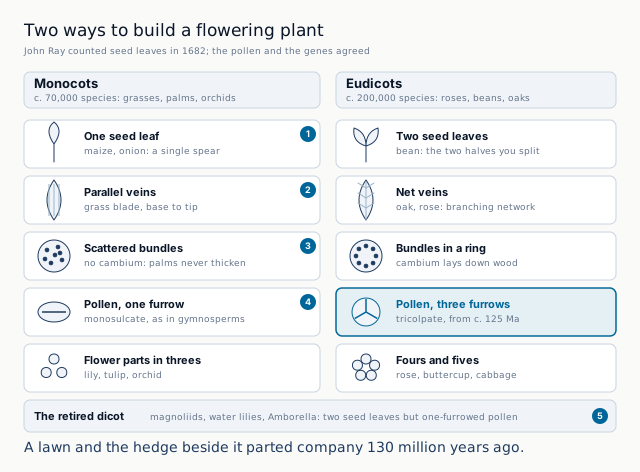
The monocots , around 70,000 species, include the grasses, palms, orchids, lilies, bananas, gingers and the onion family. Their leaves carry parallel veins, their flower parts come in threes, their vascular bundles are scattered through the stem rather than arranged in a ring, and they have no cambium, so a palm cannot thicken its trunk the way an oak does. Orchids alone number around 28,000 species, more than all the birds and mammals on Earth together. The eudicots , around 200,000 species, are the rest of what you expect of a plant: net-veined leaves, flower parts in fours and fives, a ring of vascular tissue and a cambium that makes wood. Roses, beans, oaks, cabbages, daisies and sunflowers are eudicots.
The clearest signature is in the pollen . Monocots, like the gymnosperms before them, make grains with a single furrow. Eudicots make grains with three, and the first three-furrowed, or tricolpate, pollen appears in rocks around 125 million years old from Africa and Europe, giving the group a birthday the fossils can date. Two cotyledons turned out to be the ancestral state, shared with plants that are not eudicots at all.
That is why the word 'dicot' has been retired. DNA studies in the 1990s showed that magnolias, laurels, black pepper, avocado and nutmeg, the magnoliids , along with water lilies, star anise and Amborella , branched off before the eudicots and monocots split from each other. They have two cotyledons but single-furrowed pollen, and lumping them with the roses made a group with no single ancestor. Botanists now speak of the eudicots, the 'true dicots', and treat the rest as early branches in their own right.
The split still shapes the world. Monocots gave us the staple grains and the sugar cane; eudicots gave us timber, most fruit, pulses, cotton, coffee and nearly every vegetable in the greengrocer. A lawn and the hedge beside it belong to lineages that parted company more than 130 million years ago, and a gardener weeding one out of the other is sorting plants the way John Ray did, by counting leaves.
The Vegetable Kingdom — 100 chapters on the green world that feeds us
Ready when you are.
Tap below to open the full chapter in the book reader. Anchored books jump to this chapter automatically.
The Rise of Grasses
The Vegetable Kingdom — 100 chapters on the green world that feeds us
Grass is so ordinary that it is easy to forget how new it is. The grasses , family Poaceae, number around 11,500 species and cover roughly a third of the land, yet for most of the age of flowering plants they barely existed. Their rise reshaped landscapes, teeth and, in the end, human history.
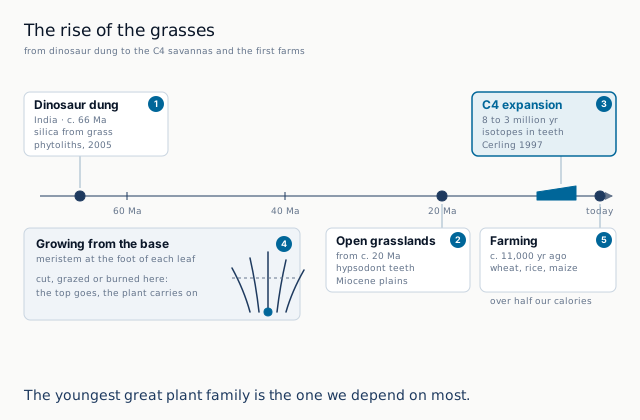
The oldest direct evidence came from an unlikely archive. In 2005 Vandana Prasad and colleagues examined fossil dung of titanosaur dinosaurs from the Lameta Formation at Pisdura in central India, about 66 million years old, and found phytoliths : microscopic silica bodies that grasses build inside their cells. The shapes matched several grass lineages, including relatives of rice and bamboo, so grasses were already diverse before the dinosaurs died out, and some dinosaurs ate them. Grasses then stayed minor for tens of millions of years, plants of forest edges and river banks.
The open grassland is a product of the Miocene. From around 20 million years ago, as the climate dried and cooled, grass-dominated plains spread across North America, Central Asia and Africa. The animals changed with them. Horses of the time grew hypsodont teeth, with high crowns that keep erupting to replace what wears away, because grass is full of silica and grit. Antelopes, rhinos and elephants did the same. Grasses, for their part, evolved to be eaten: they grow from meristems at the base of the leaf and the stem, so a grazing animal, a fire or a lawnmower removes the top and the plant simply carries on. Most other plants grow from the tip and stop when it is cut.
A second revolution came between about 8 and 3 million years ago. Carbon isotopes in fossil tooth enamel and ancient soils, read by Thure Cerling and colleagues in 1997, show grazers across Asia, Africa and the Americas switching to grasses with C4 photosynthesis , a supercharged pathway that thrives in heat, bright light and low carbon dioxide. C4 grasses now make up most of the savannas of Africa and the pampas of South America, and the maize and sugar cane in our fields. C4 has evolved independently more than 60 times in plants, at least 20 of them in grasses alone.
The savannas that spread across East Africa were the stage on which the first upright hominins walked, and when people began to farm, around 11,000 years ago, nearly everything they chose was a grass. Wheat, rice, maize, barley, sorghum and millet supply more than half of all the calories humans eat. The youngest great plant family is the one we depend on most.
The Vegetable Kingdom — 100 chapters on the green world that feeds us
Ready when you are.
Tap below to open the full chapter in the book reader. Anchored books jump to this chapter automatically.
Reading the Plant Family Tree
The Vegetable Kingdom — 100 chapters on the green world that feeds us
For two centuries the plant family tree was drawn from the outside. Linnaeus sorted plants by counting stamens; later systems, from Bentham and Hooker in the 1860s to Cronquist in 1981, used flowers, fruit and leaves and the judgement of experts. The trees looked different depending on who drew them. In 1993 the view changed from the inside.
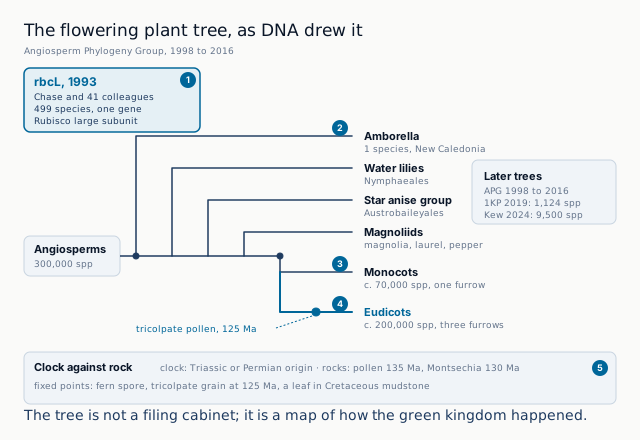
That year Mark Chase and 41 colleagues published a comparison of the gene rbcL from 499 species of seed plants. The gene encodes the large subunit of Rubisco, the enzyme that fixes carbon dioxide, and every plant carries it in its chloroplasts, so sequences could be lined up across the whole kingdom. The resulting tree confirmed the monocots, revealed the eudicots as a true group marked by their three-furrowed pollen, broke the old dicots apart, and showed that magnolias and water lilies were early branches rather than primitive roses. Many well-loved families were shuffled: the figworts lost most of their species to the plantains, and the lily family was carved into a dozen.
To keep the result usable, botanists formed the Angiosperm Phylogeny Group , an open committee that publishes a consensus classification: APG in 1998, revised in 2003, 2009 and 2016. It is the system behind the order of beds at Kew and the names in the floras. Amborella sits at the base, then the water lilies, then the star anise group, then the great mass of magnoliids, monocots and eudicots. The One Thousand Plant Transcriptomes project, published in 2019, extended the picture to algae and bryophytes using 1,124 species and found that land plants had doubled their genomes several times. Kew's Tree of Life, published in 2024, sampled 353 genes from around 9,500 species, covering nearly 60 per cent of all flowering plant genera.
Genes give the shape of the tree; fossils give it dates. A molecular clock counts mutations and converts them to time, but it must be set against fixed points: a fern spore, a tricolpate pollen grain of 125 million years, a leaf in Cretaceous mudstone. Pollen is the workhorse because sporopollenin outlasts almost everything and a single borehole yields millions of grains. When clock and rock disagree, as they do over the origin of flowers, the argument itself is productive: botanists either find older fossils or discover that evolution ran at different speeds.
The family tree now reaches from a charophyte alga to an orchid, and it is still being redrawn, partly by sequencing herbarium sheets collected two centuries ago. Names change because knowledge does. The tree is not a filing cabinet; it is a map of how the green kingdom actually happened.
The Vegetable Kingdom — 100 chapters on the green world that feeds us
Ready when you are.
Tap below to open the full chapter in the book reader. Anchored books jump to this chapter automatically.
The Root
The Vegetable Kingdom — 100 chapters on the green world that feeds us
Pull up a dandelion and you hold a taproot : one thick axis driving downward, with side roots branching from it. Pull up a tuft of grass and you hold the alternative, a fibrous root system of hundreds of thin strands of similar size spreading through the top of the soil. Both do the same jobs. They anchor the plant, they take up water and dissolved minerals, and they store food, which is why a carrot, a beetroot and a cassava are all swollen roots. Roots also hold the plant's reserve of patience: cut a dock to the ground and it returns from the crown of its taproot.
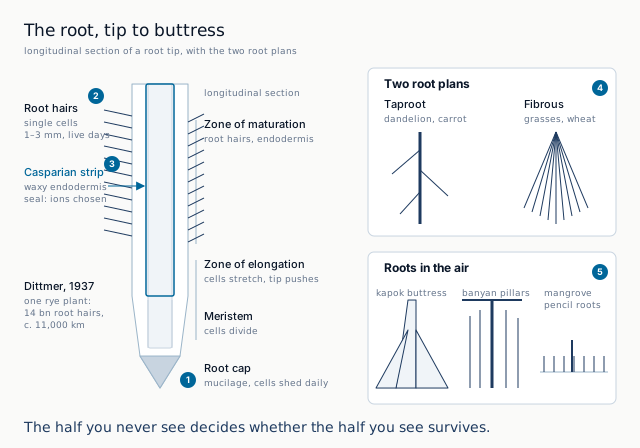
The working end of any root is its tip. A thimble of cells called the root cap shields the growing point and secretes a slimy mucilage that lubricates the push through soil; its outer cells are scraped off and replaced daily. Just behind the tip lies the meristem, where cells divide, then the zone of elongation, where they stretch and drive the tip forward, then the zone of maturation, where the epidermis sprouts root hairs . Each hair is a single cell a few millimetres long, lives only a few days, and vastly multiplies the surface in contact with soil water. Deeper in, the endodermis wraps the vascular core with a waxy Casparian strip , a seal that forces every drop of water to pass through living cells, so the plant can choose which ions it admits.
How much root does a plant have? In 1937 Howard Dittmer of the University of Iowa grew a single winter rye plant in a box of soil for four months and then counted. He found about 13.8 million roots with a combined length of around 620 km, and some 14 billion root hairs adding a further 10,600 km, more than the distance from London to Cape Town, all beneath one plant you could hold in your hand. Depth is the other surprise. Roots of honey mesquite, Prosopis glandulosa , were found 53 m down in an Arizona open-pit mine, and roots of the shepherd's tree, Boscia albitrunca , were traced to 68 m in the Kalahari.
Not all roots stay underground. The kapok, Ceiba pentandra , and many rainforest giants in Amazonia and the Congo basin spread buttress roots , plank-like flanges that brace tall trunks in thin soil. The banyan, Ficus benghalensis , drops aerial roots from its branches that thicken into pillars; the Great Banyan in Kolkata's botanic garden has more than 3,000 of them and covers about 1.5 hectares. Mangroves of the genus Avicennia send pencil roots up through the mud to breathe at low tide, ivy climbs on short adhesive roots, and maize steadies itself with prop roots at the base of the stem.
All of it is hidden work. Roots are half the plant, sometimes more, and the half we never see decides whether the half we do see survives a drought.
The Vegetable Kingdom — 100 chapters on the green world that feeds us
Ready when you are.
Tap below to open the full chapter in the book reader. Anchored books jump to this chapter automatically.
Roots and Their Partners
The Vegetable Kingdom — 100 chapters on the green world that feeds us
Dig up almost any wild plant and the roots you find are not working alone. Around 90 per cent of land plant species pair their roots with soil fungi in a partnership called a mycorrhiza , from the Greek for fungus-root. The term was coined in 1885 by the German botanist Albert Bernhard Frank, who had been asked by the Prussian government to find a way of farming truffles and instead noticed that fungal threads wrapped every rootlet of the trees the truffles grew under. The fungus gathers phosphorus, nitrogen and water from a volume of soil far beyond the reach of roots, and the plant pays in sugar: typically 10 to 20 per cent of everything it makes by photosynthesis.
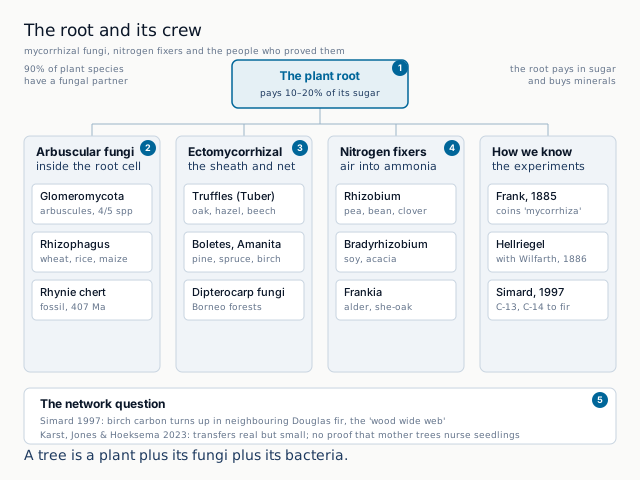
There are two main designs. Arbuscular mycorrhizal fungi, of the group Glomeromycota, push their threads inside root cells and branch into tiny tree-shaped arbuscules where the trade happens. They partner with roughly four fifths of plant species, from wheat and rice to tropical hardwoods, and they are ancient: fossils in the 407-million-year-old Rhynie chert of Scotland show arbuscules inside some of the earliest land plants. Ectomycorrhizal fungi, including truffles, boletes and the fly agaric, sheathe the root tip in a mantle and grow a net between its cells. They dominate the pine, spruce, oak, beech and eucalyptus forests of the temperate world and the dipterocarp forests of Borneo. Orchid seeds, which carry no food reserve, cannot even germinate without their own fungal partner.
Bacteria are the other great partners. Peas, beans, clover and acacias form nodules on their roots that house rhizobia, bacteria able to turn nitrogen gas from the air into ammonia the plant can use. Hermann Hellriegel and Hermann Wilfarth demonstrated this in 1886: peas grown in sterilised sand starved unless a little unsterilised soil, with its bacteria, was added. Martinus Beijerinck isolated the organism in 1888. Inside a working nodule the plant makes leghaemoglobin, a relative of our own blood pigment, which keeps oxygen low and turns the nodule pink. Alder, sea buckthorn and the Australian she-oak do the same with a filamentous bacterium called Frankia .
The idea that fungi link trees into a "wood wide web" comes from an experiment published by Suzanne Simard and colleagues in 1997, in which carbon isotopes fed to paper birch seedlings in British Columbia turned up in neighbouring Douglas fir. The phrase caught on, and with it claims that mother trees nurse their seedlings and warn each other of danger. In 2023 a review by Justine Karst, Melanie Jones and Jason Hoeksema went back through the evidence and found that common networks are real and resource transfers are measurable, but small, inconsistent and nowhere shown to help a receiving seedling in a real forest; botanists now debate how much the network matters at all.
What is not in doubt is dependence. A tree is a plant plus its fungi plus its bacteria, and most of the world's farmland runs on nitrogen fixed in nodules or on fertiliser that imitates them.
The Vegetable Kingdom — 100 chapters on the green world that feeds us
Ready when you are.
Tap below to open the full chapter in the book reader. Anchored books jump to this chapter automatically.
The Stem
The Vegetable Kingdom — 100 chapters on the green world that feeds us
A stem holds leaves up to the light and flowers up to pollinators, and it is the plant's plumbing. Running its length are vascular bundles , each a cable of two tissues: xylem , dead hollow cells that carry water and minerals upward from the roots, and phloem , living cells that carry sugar from the leaves to wherever it is needed. Slice a sunflower or a bean stem across and the bundles form a ring near the outside, leaving a pith in the centre; this is the eudicot plan, and the ring is where a cambium can later make wood. Slice a maize stalk or a palm trunk and the bundles are scattered through the ground tissue like currants in a bun, the monocot plan, which is why a palm has no bark, no rings and cannot thicken once its trunk is formed.
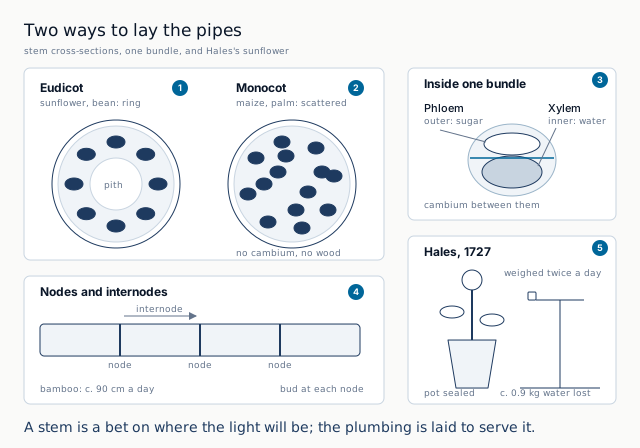
Along the stem, leaves arise at nodes , and the bare lengths between them are internodes. A bud sits in the angle of each leaf, waiting. The pattern is easy to see on bamboo, whose nodes are the rings on the cane, or on a rose, where the internodes are the lengths you cut between buds. Herbaceous stems stay soft and die back each year; woody stems add rings and persist. A giant bamboo of the genus Phyllostachys can grow about 90 cm in a day by stretching its internodes, the fastest recorded growth of any plant, though the cane never thickens afterwards.
The first person to measure what a stem does was an English clergyman, Stephen Hales, in Vegetable Staticks (1727). He sealed a sunflower in a pot, weighed it morning and evening and found it lost around 0.9 kg of water through its leaves on a hot day. He tied glass tubes to a cut grapevine and watched sap pressure from the roots push mercury up the tube, and he showed that water moved up the stem in the wood, not the bark. Marcello Malpighi had already found, in the 1670s, that stripping a ring of bark from a tree stopped sugar moving down but not water moving up, which is why ring-barking kills a tree slowly from the roots.
Stems take many disguises. Ginger and iris spread by rhizomes, horizontal stems under the ground; strawberries send out runners above it; the saguaro cactus of the Sonoran Desert, Carnegiea gigantea , is almost all stem, a pleated water tank that swells after rain and can weigh more than a tonne. Climbing plants save the cost of building a trunk by borrowing someone else's. Charles Darwin, in 1865, timed hop shoots circling once every two hours or so in search of a support, and described the coiling tendrils of passionflowers and the sticky pads of Virginia creeper. Rattan palms of Southeast Asia hook their way to the canopy on spiny whips and can run more than 100 m through the forest.
Whatever its shape, a stem is a bet on where the light will be, and the plant's plumbing is laid to serve it.
The Vegetable Kingdom — 100 chapters on the green world that feeds us
Ready when you are.
Tap below to open the full chapter in the book reader. Anchored books jump to this chapter automatically.
Wood and Rings
The Vegetable Kingdom — 100 chapters on the green world that feeds us
Wood is the stem's answer to time. In eudicot trees and conifers a thin sleeve of dividing cells, the vascular cambium , lies between the bark and the wood. Each season it lays down new xylem on its inner face and new phloem on its outer face, so a trunk thickens from a ring just under the bark while its centre is already dead. The xylem it makes is wood; the phloem, with the cork outside it, is bark. The cambium of a mature oak may add a layer only a few millimetres thick each year, yet over centuries that layer becomes a trunk two metres across.
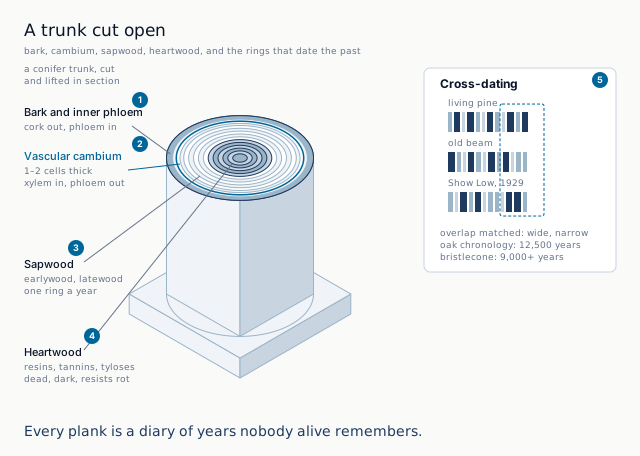
In seasonal climates the layer has texture. In spring the cambium produces wide, thin-walled cells to move water fast, the earlywood ; in late summer it produces narrow, thick-walled cells, the latewood , which is darker and denser. One pale band and one dark band make a year, and a wet year makes a wide ring while a drought makes a narrow one. The outer rings, the sapwood , still conduct water; the inner rings are plugged with resins, tannins and bubble-like tyloses and become heartwood , often darker, harder and more resistant to rot. Trees in the humid tropics, where there is no winter, may make no clear rings at all, though teak, with its dry season, does.
Reading rings as a calendar was the idea of an astronomer. Andrew Ellicott Douglass, at Lowell Observatory in Arizona, began around 1904 matching ring patterns between pines to look for the sunspot cycle, and founded dendrochronology . By cross-matching the sequence of wide and narrow rings from living trees back through older and older beams, he could assign a calendar year to any ring. In 1929 a charred beam from Show Low, Arizona, closed the last gap in his sequence and gave dates to Pueblo Bonito and other ruins of the American Southwest. The method now reaches far further: bristlecone pines, Pinus longaeva , in the White Mountains of California, including living trees nearly 5,000 years old, give a continuous chronology of more than 9,000 years, and oak and pine preserved in the gravels of German rivers run back some 12,500 years. These chronologies calibrate radiocarbon dating…
Rings also tell how trees build themselves. Wood density ranges from balsa, Ochroma pyramidale , at around 0.16 grams per cubic centimetre, light enough for Thor Heyerdahl's Kon-Tiki raft, to lignum vitae from the Caribbean at around 1.2, which sinks in water and once made ships' propeller bearings. Dense wood is slow to grow and hard to break; light wood is a race to the canopy. Most of the carbon a forest stores is in this dead tissue, laid down one thin sleeve at a time.
Every plank is a diary. Cut a tree and you can read the weather of years nobody alive remembers.
The Vegetable Kingdom — 100 chapters on the green world that feeds us
Ready when you are.
Tap below to open the full chapter in the book reader. Anchored books jump to this chapter automatically.
The Leaf
The Vegetable Kingdom — 100 chapters on the green world that feeds us
A leaf is a solar panel built from the cheapest materials a plant can afford, and thrown away when it stops paying. The flat part is the blade , held out on a stalk, the petiole , with a network of veins that bring water in and carry sugar out. Cut the blade across and it is a sandwich. On top is a waxy cuticle over a single layer of transparent epidermis; beneath that stand the tall palisade cells, packed with chloroplasts and arranged like a crowd of upright bottles to catch the light; beneath those lies the spongy mesophyll , a loose honeycomb of cells with air spaces between them where carbon dioxide diffuses to the chloroplasts; and the lower epidermis closes the sandwich, punctured by stomata. A typical leaf is only a few tenths of a millimetre thick, because light does not usefully penetrate much further.
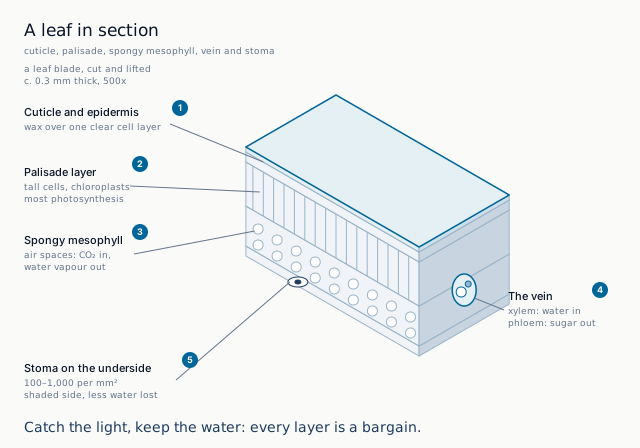
Venation gives the plant away. Grasses, lilies and palms, the monocots, run their veins in parallel lines; most other flowering plants branch them into a net, with a midrib and finer and finer loops. The reticulate net is costly but tough: a hole in a netted leaf is bypassed, while a cut across a parallel-veined leaf severs everything beyond it. Veins and cuticle survive well in rock, and fossil leaves from the Eocene of Wyoming or the Miocene of Germany are read for vein density and margin shape to estimate past rainfall and temperature.
Leaf shape runs from needle to parasol. The raffia palm Raphia regalis of central Africa holds the record for the largest leaf, a compound frond up to about 25 m long; the giant water lily Victoria amazonica floats pads up to 3 m across on ribs strong enough to carry a child. At the other end, the tiny duckweed Wolffia is a green speck less than a millimetre long with no distinct leaf at all. Compound leaves, such as the pinnate frond of an ash or the palmate hand of a horse chestnut, divide the blade into leaflets that shed wind and heat better than a single sheet. Cactus spines are leaves reduced to defence; the tendrils of a pea are leaflets turned into hooks.
How long a leaf lives is a budget decision. A thin, cheap leaf in a rich, wet place may last a few weeks; a thick evergreen leaf of holly or a bristlecone pine needle is built to last decades, the needle up to 45 years. Across thousands of species the same trade-off appears: fast and short, or expensive and long, with few plants in between. Deciduous trees in temperate forests recover most of the nitrogen from a leaf before they drop it, which is why autumn colour arrives before the fall.
The leaf is where the plant meets the sky, and every detail of its design is about catching light while keeping water.
The Vegetable Kingdom — 100 chapters on the green world that feeds us
Ready when you are.
Tap below to open the full chapter in the book reader. Anchored books jump to this chapter automatically.
Stomata
The Vegetable Kingdom — 100 chapters on the green world that feeds us
Every leaf is riddled with tiny mouths. A stoma (plural stomata, from the Greek for mouth) is a pore between two guard cells , kidney-shaped in most plants and dumbbell-shaped in grasses, which swell or sag to open or close the gap. There are commonly 100 to 1,000 of them in a square millimetre of leaf surface, mostly on the shaded underside, where the air is cooler and stiller. Across a single oak they number in the hundreds of millions. Through these pores every molecule of carbon dioxide a plant uses must enter, and through them nearly all the water a plant draws from the soil escapes as vapour: around 97 per cent of what the roots take up is lost this way.
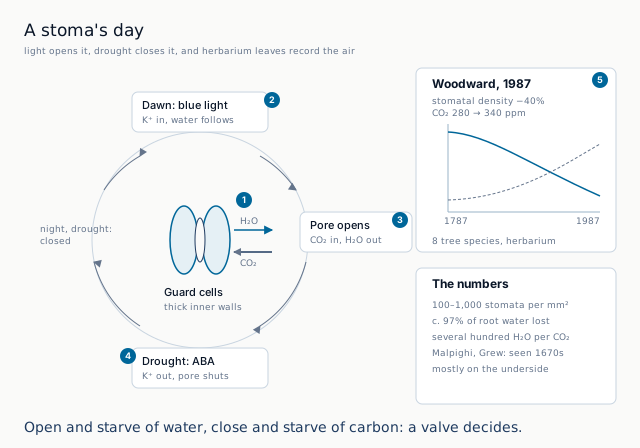
That is the stomatal trade-off. Open wide and carbon dioxide floods in, but so does the drought; close tight and the leaf keeps its water but starves. For each molecule of carbon dioxide gained, a plant in dry air may lose several hundred molecules of water. Guard cells manage the bargain minute by minute. Blue light at dawn triggers pumps that draw potassium ions into the guard cells, water follows by osmosis, the cells bulge, and because their inner walls are thicker than their outer walls they bow apart and the pore opens. When the leaf is short of water, the hormone abscisic acid reverses the process within minutes. Water lilies, whose undersides sit in water, carry their stomata on top; fully submerged plants have none.
The pores were first seen in the 1670s, when the microscope reached leaves. Marcello Malpighi in Bologna and Nehemiah Grew in London, working separately and publishing in rival volumes, both described them; Grew, in The Anatomy of Plants (1682), guessed that they let a leaf breathe out. Their role in water loss was settled only in the nineteenth century, and the potassium-pump mechanism in the 1960s and 1970s.
That fact comes from Ian Woodward, who in 1987 compared leaves of eight temperate tree species collected over the previous two centuries and found their stomatal density had fallen by about 40 per cent as carbon dioxide climbed from around 280 to 340 parts per million. Plants in a richer atmosphere need fewer pores to get the same carbon. Turned round, the relationship makes fossil leaves into a gauge of ancient air: stomatal counts on fossil ginkgo leaves have been used to estimate carbon dioxide levels across hundreds of millions of years.
Today stomata sit at the centre of a global accounting. Together they return a large share of the rain that falls on land to the atmosphere, perhaps 40 per cent, which is why a forest cools its own region and why a drought that shuts them shows up in the carbon budget of the planet within weeks. The smallest valves on Earth help set the terms of its climate.
The Vegetable Kingdom — 100 chapters on the green world that feeds us
Ready when you are.
Tap below to open the full chapter in the book reader. Anchored books jump to this chapter automatically.
How Water Climbs a Tree
The Vegetable Kingdom — 100 chapters on the green world that feeds us
A coast redwood, Sequoia sempervirens , lifts water more than 100 m from its roots to its crown every day, with no pump, no moving parts and no energy spent on the lift. A column of water that tall presses down with about ten atmospheres, so no suction from the top could ever draw it up: a vacuum pump raises water barely 10 m. The answer, proposed in 1894 by Henry Dixon and John Joly in Dublin, is the cohesion-tension theory . Water molecules cling to one another by hydrogen bonds strongly enough that a thin thread of water in a narrow tube can be pulled, like a wire, without breaking. In a tree the pull comes from the leaves.
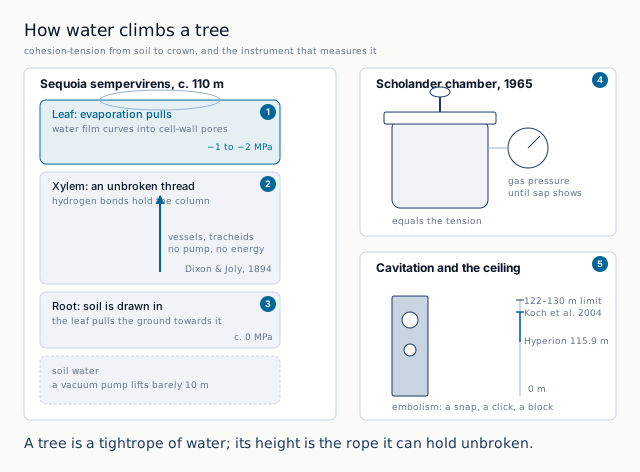
As water evaporates from the walls of cells inside a leaf, the surface of the water film curves into the tiny pores of the cell wall, and that curvature puts the whole film under tension . The tension is transmitted down through the xylem, unbroken, in threads of water a few hundredths of a millimetre wide inside the vessels and tracheids, through the trunk and into the root, where it draws water from the soil. The leaf, in effect, pulls the soil towards it. The pressures involved are negative: typically minus one to minus two megapascals in a tree on a summer afternoon, and below minus five in desert shrubs. Water at those tensions is in a metastable state, stretched further than water in any pipe we build.
The pressures were made measurable by Per Scholander in 1965. His pressure chamber clamps a cut shoot with its stump protruding through a seal, and gas is pumped in until sap just appears at the cut; the gas pressure needed equals the tension the water was under. It is still the standard instrument of plant water research, carried into orchards and canopies in a steel bomb the size of a kettle. Measurements of stretched water columns and of xylem sap have confirmed the theory, and botanists no longer seriously debate it.
That snapping, cavitation , is the theory's weakness and the tree's. An air bubble, or embolism, blocks a vessel for good unless root pressure or new growth clears it, and a drought that embolises half a tree's xylem usually kills it, which is how the great die-offs of pinyon pine in the American Southwest and eucalyptus in Australia have run. Height has a ceiling for the same reason. In 2004 George Koch and colleagues climbed the tallest redwoods in California and measured leaf water, photosynthesis and leaf size up the trunk; the top leaves were small, thick and permanently on the edge of drought, and the team calculated a maximum height of about 122 to 130 m. The tallest known tree, Hyperion, measured in 2006, stands a little under 116 m.
Every tree is a tightrope of water, and its height is the length of rope it can hold without the rope breaking.
The Vegetable Kingdom — 100 chapters on the green world that feeds us
Ready when you are.
Tap below to open the full chapter in the book reader. Anchored books jump to this chapter automatically.
Moving Sugar
The Vegetable Kingdom — 100 chapters on the green world that feeds us
Sugar made in the leaves must reach every root tip, bud, fruit and seed, and the leaf is often at the top. The tissue that carries it is the phloem , a living pipeline of sieve tubes : files of elongated cells whose end walls are perforated like a colander and whose contents, having lost nucleus and most organelles, are kept alive by a companion cell alongside. The sap they carry is syrup, commonly 10 to 30 per cent sucrose, moving at about half a metre to a metre an hour, which is slow beside xylem water but thousands of times faster than diffusion.
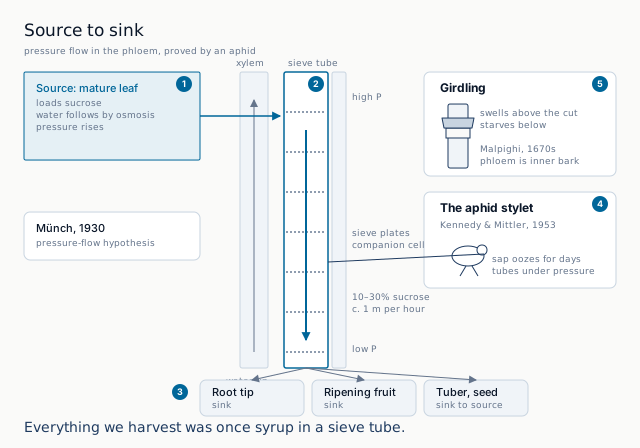
What drives it was proposed in 1930 by Ernst Münch of Munich, and his pressure-flow hypothesis still stands with modifications. At a source , a mature leaf, sugar is loaded into the sieve tubes, water follows by osmosis from the neighbouring xylem, and pressure builds. At a sink , a growing root, a ripening apple or a storage tuber, sugar is unloaded and the pressure falls. Sap simply flows from high pressure to low, down a gradient the plant maintains by loading and unloading. The same leaf can send sugar up to a flower and down to a root at the same time, through different tubes, and the direction can reverse over a season: a sugar beet root is a sink in summer and a source the following spring.
The proof came from an insect. An aphid feeds by threading its stylet into a single sieve tube and letting the pressure push sap into its gut; it taps a pressurised line. In 1953 John Kennedy and Thomas Mittler in Cambridge anaesthetised feeding aphids, cut them from their stylets and left the hollow mouthparts in place, where pure phloem sap went on oozing out for days to be collected and analysed. The stylet technique measured sap sugar, speed and pressure directly and confirmed that the tubes are under pressure, as Münch required.
Cut the pipeline and the plant shows what it was carrying. Marcello Malpighi in the 1670s removed a ring of bark from a tree and found it swelled above the cut and starved below, because the phloem lies in the inner bark; foresters still kill unwanted trees by girdling , and orchard growers once girdled a branch to swell its fruit. Beavers, deer and voles do the same by accident. Sieve tubes also carry hormones, messenger RNA and the flowering signal, so the phloem is the plant's post as well as its larder.
Everything we harvest, from a potato to a date, was once sap in a sieve tube, delivered by pressure to the place the plant chose to grow.
The Vegetable Kingdom — 100 chapters on the green world that feeds us
Ready when you are.
Tap below to open the full chapter in the book reader. Anchored books jump to this chapter automatically.
Buds, Shoots and Phyllotaxis
The Vegetable Kingdom — 100 chapters on the green world that feeds us
At the tip of every shoot sits a dome of cells smaller than a pinhead, the shoot apical meristem , which never stops dividing. It builds the plant upward and, in bumps on its flanks, lays down the beginnings of every leaf. A tiny bud forms in the angle of each leaf, and most of those buds do nothing while the tip is alive. This is apical dominance : the growing tip exports the hormone auxin down the stem, and the flow holds the lateral buds in check. Pinch the tip out and the buds below burst into side shoots, which is the whole art of hedge-clipping and the reason a tomato grower nips out the top. Kenneth Thimann and Folke Skoog showed in 1934 that a dab of auxin on a decapitated stump keeps the buds asleep just as the tip did.
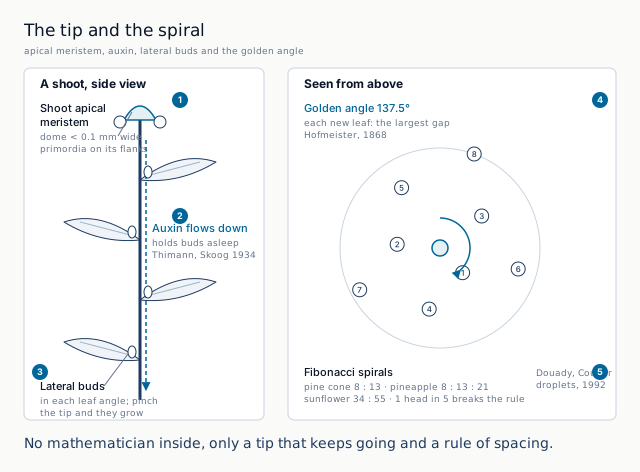
The leaves the meristem makes are not placed at random. Look down on a rosette of houseleek, a head of lettuce or the stem of a sunflower seedling and each new leaf sits at a fixed angle from the last, very often close to 137.5 degrees, the golden angle . Because that angle is an irrational fraction of a full turn, no leaf ever sits exactly above another, so each gets light and rain, and the spirals visible to the eye, the parastichies, run in two directions whose numbers are neighbours in the Fibonacci sequence. A pine cone shows 8 spirals one way and 13 the other; a pineapple 8, 13 and 21; a large sunflower head 34 and 55, or 55 and 89. Other plans exist, and are also rules: grasses alternate leaves at 180 degrees, mint and maple place them in opposite pairs that swap axis at each node, and bedstraw sets them in whorls.
The pattern is older than the explanation. Karl Friedrich Schimper and Alexander Braun measured the angles in the 1830s. In 1868 Wilhelm Hofmeister gave a rule that still holds: each new primordium arises in the largest gap left by the previous ones, as far as possible from the youngest. In 1992 the physicists Stéphane Douady and Yves Couder dropped magnetised oil droplets at a steady rate onto a dish of oil, where each repelled the last; the drops arranged themselves in golden-angle spirals of their own accord. Botanists now trace the repulsion to auxin itself: each primordium drains the hormone from its surroundings, and the next can only form where enough remains.
There is no mathematician inside the plant, only a meristem, a hormone and a rule of spacing. The same rule positions the florets of a daisy, the scales of a cycad cone and the needles of a 50-m fir. Apical dominance decides the shape of a tree, whether a single spire like a spruce or a spreading crown like an oak, and gardeners and foresters have exploited it for millennia without naming it.
A plant has no plan of itself; it has a tip that keeps going and a habit of filling the biggest gap.
The Vegetable Kingdom — 100 chapters on the green world that feeds us
Ready when you are.
Tap below to open the full chapter in the book reader. Anchored books jump to this chapter automatically.
Hormones and Growth
The Vegetable Kingdom — 100 chapters on the green world that feeds us
A plant has no nerves and no brain, yet it bends to light, ripens a fruit on cue, drops its leaves on schedule and knows how tall to grow. The coordination is chemical. Five classical plant hormones , each made in minute amounts and carried in the sap or from cell to cell, run most of it, and each was found by someone puzzling over a plant that misbehaved.
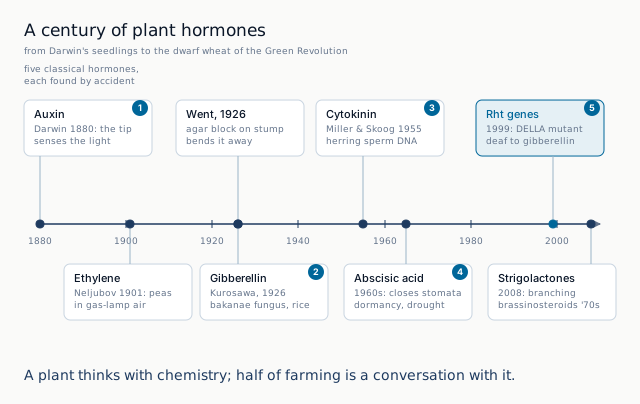
The first was auxin . Charles Darwin and his son Francis had shown in 1880 that a canary grass seedling bent towards light only if its tip was uncovered, so something must travel down from the tip. In 1926 Frits Went, a student in Utrecht, cut the tips from oat seedlings, stood them on blocks of agar for an hour, then set the blocks on one side of a decapitated stump: the stump bent away from the block, as if the tip were still there. He had collected the messenger. Auxin steers growth towards light and against gravity, holds side buds in check, starts roots on cuttings and, as a synthetic cousin, is the weedkiller 2,4-D.
Gibberellin came from a disease. Rice farmers in Japan knew the bakanae or foolish seedling disease, in which plants shoot up pale and spindly and fall over. In 1926 Eiichi Kurosawa showed that a filtered extract of the fungus responsible, Gibberella fujikuroi , made healthy seedlings do the same; Teijiro Yabuta's team crystallised the substance in the late 1930s. Plants turned out to make their own. Gibberellin lengthens stems, breaks seed dormancy and, sprayed on grapes, makes the big seedless berries of the supermarket.
The others followed. Cytokinins , which drive cell division, were found in 1955 by Carlos Miller and Folke Skoog in a flask of old herring sperm DNA that unexpectedly made tobacco cells divide; the natural version, zeatin, was isolated from maize in the 1960s. Ethylene , a gas, had been noticed in 1901 by Dimitry Neljubov in St Petersburg, whose pea seedlings grew short, fat and sideways in a laboratory lit by coal-gas lamps; the gas ripens fruit, which is why a banana in a paper bag with an apple softens faster. Abscisic acid , identified in the 1960s, closes stomata in drought and holds buds and seeds dormant.
Those genes, Reduced height-1 , came from a Japanese variety, Norin 10, by way of Norman Borlaug's breeding in Mexico in the 1950s, and were identified in 1999 as mutations in a protein called DELLA that normally restrains growth until gibberellin removes it; the mutant DELLA cannot be removed. The sd1 gene behind dwarf rice does the same job by cutting gibberellin synthesis. Newer hormones keep arriving: brassinosteroids in the 1970s and strigolactones, which control branching, in 2008.
A plant thinks with chemistry, and half of modern farming is a conversation with its hormones.
The Vegetable Kingdom — 100 chapters on the green world that feeds us
Ready when you are.
Tap below to open the full chapter in the book reader. Anchored books jump to this chapter automatically.
The Big Equation
The Vegetable Kingdom — 100 chapters on the green world that feeds us
Every meal, every forest and every lungful of oxygen comes back to one line of chemistry: six molecules of carbon dioxide and six of water, driven by light, become one molecule of sugar and six of oxygen. Written out, 6 CO2 + 6 H2O + light gives C6H12O6 + 6 O2. The equation looks like a schoolroom certainty, yet it took almost two centuries of stubborn, often eccentric experiments to assemble, one term at a time.
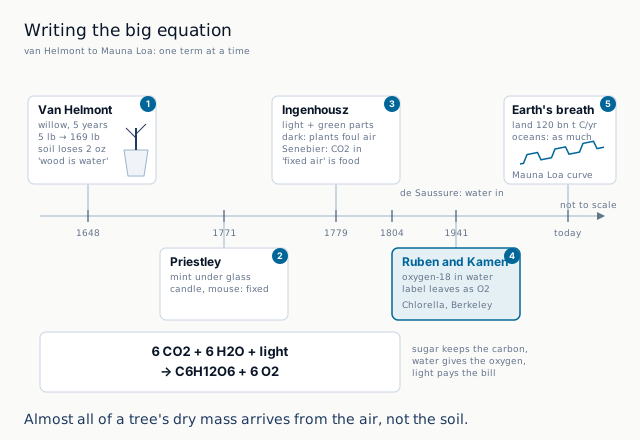
The first term was mass. In the 1640s the Flemish physician Jan Baptist van Helmont planted a willow weighing 5 pounds in 200 pounds of dried soil, watered it with rainwater and waited five years. The tree had gained more than 164 pounds; the soil, dried and reweighed, had lost about 2 ounces. He concluded, wrongly but usefully, that wood was made of water. In 1771 Joseph Priestley , a dissenting minister in Leeds, found that a sprig of mint restored air "injured" by a burning candle or a breathing mouse: the plant was giving something back. Eight years later the Dutch physician Jan Ingenhousz , working in a borrowed English country house, showed that this happened only in sunlight and only in green parts; in the dark, plants fouled the air like animals. Jean Senebier in Geneva tied the effect to the "fixed air" we call carbon dioxide, and in 1804 Nicolas-Théodore de Saussure weighed…
The last term was settled in a Californian laboratory. In 1941 Samuel Ruben and Martin Kamen gave the green alga Chlorella water labelled with the heavy isotope oxygen-18 and found the label in the oxygen bubbling out. The oxygen we breathe comes from split water, not from carbon dioxide. The sugar keeps the carbon, and the water donates the gas.
The numbers are enormous. Satellite and flux-tower estimates put gross photosynthesis on land at around 120 billion tonnes of carbon a year, and the oceans' phytoplankton add a comparable amount. A single hectare of Amazon rainforest near Manaus captures roughly 30 tonnes of carbon a year before respiration takes its share; a Kansas wheat field in June and a Sahel acacia after rain are doing the same reaction at different speeds. Mauna Loa Observatory in Hawaii records the planet's collective breath as a saw-tooth in the carbon dioxide curve, dipping each northern summer as leaves open and rising each winter as they fall.
That reaction is the only large-scale route by which sunlight becomes food. Fossil fuel is ancient photosynthesis; bread, beef and cotton are recent photosynthesis. The willow in van Helmont's pot was quietly building itself from air, and so, by way of plants, are we.
The Vegetable Kingdom — 100 chapters on the green world that feeds us
Ready when you are.
Tap below to open the full chapter in the book reader. Anchored books jump to this chapter automatically.
The Light Reactions
The Vegetable Kingdom — 100 chapters on the green world that feeds us
Photosynthesis begins with an act of violence. Water is one of the most stable molecules on Earth, and the first thing a leaf does with sunlight is tear it apart. The machinery sits in the thylakoid membranes of the chloroplast, stacked like green coins, and it runs in two stages. The light reactions capture photons and turn them into chemical currency, ATP and NADPH ; the dark reactions, covered in the next chapter, spend that currency on carbon.
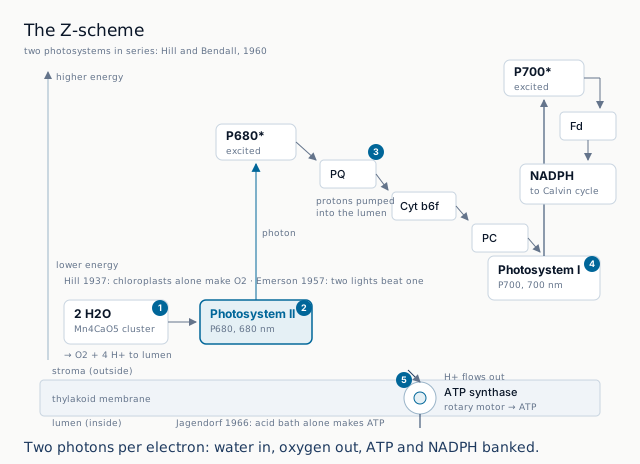
The proof that the two halves could be separated came from a Cambridge biochemist. In 1937 Robert Hill ground up chloroplasts from chickweed and spinach, lit them, and watched them release oxygen with no carbon dioxide present at all, provided he supplied an artificial electron acceptor such as ferric oxalate. The Hill reaction showed that oxygen comes from splitting water, and that the splitting can run on its own. Twenty years later Robert Emerson at Illinois found a puzzle: far-red light beyond 680 nanometres drove photosynthesis feebly, but add a little shorter-wavelength light and the two together worked far better than the sum of each alone. This Emerson enhancement effect could only mean two light-absorbing systems in series. In 1960 Hill and Fay Bendall drew them as a sideways Z in the journal Nature , and the Z-scheme has held ever since.
Here is how it runs. Photosystem II absorbs a photon at 680 nanometres and flings an electron away, leaving a hole so hungry that it pulls electrons from water. A cluster of four manganese atoms and one calcium, whose structure the Japanese team of Jian-Ren Shen resolved in 2011, cycles through five states and releases one oxygen molecule for every two waters consumed. The electron passes down a chain through plastoquinone and the cytochrome b6f complex to photosystem I , which boosts it with a second photon at 700 nanometres, high enough to reduce ferredoxin and make NADPH. Along the way protons pile up inside the thylakoid, and the gradient drives the turbine of ATP synthase , a rotary motor that Peter Mitchell's chemiosmotic theory of 1961 predicted and André Jagendorf confirmed in 1966 by making chloroplasts synthesise ATP in the dark with nothing but an acid bath.
The reaction is universal. The same photosystems run in a cyanobacterium off Hawaii, a giant kelp in Tasmania, a rice paddy in Bangladesh and the moss on a Norwegian roof, and they have been running for over two billion years, which is how the atmosphere came to have oxygen in it. Engineers trying to split water for hydrogen fuel still study the manganese cluster for hints. Every leaf is a solar cell that fixed its own design before there were eyes to admire it.
The Vegetable Kingdom — 100 chapters on the green world that feeds us
Ready when you are.
Tap below to open the full chapter in the book reader. Anchored books jump to this chapter automatically.
The Calvin Cycle
The Vegetable Kingdom — 100 chapters on the green world that feeds us
Once the light reactions have charged the chloroplast with ATP and NADPH, the carbon work begins, and it is done by a cycle rather than a straight line. Three molecules of carbon dioxide enter; one three-carbon sugar leaves; everything else is regenerated to go round again. The route was mapped in a wooden hut at Berkeley by Melvin Calvin , Andrew Benson and James Bassham between 1946 and 1954, and it earned Calvin alone the Nobel Prize in Chemistry in 1961, a fact Benson resented for the rest of his long life.
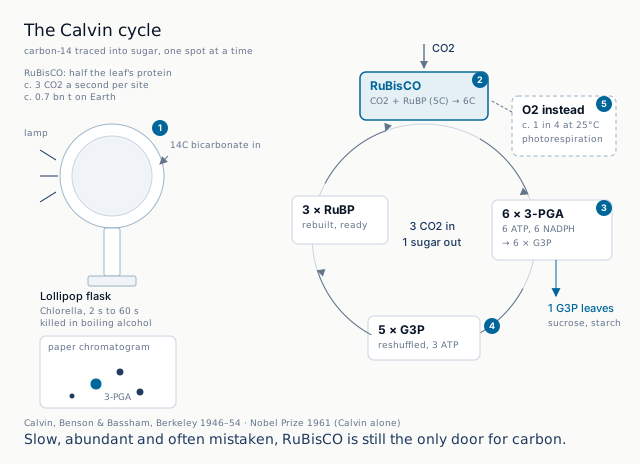
Their tool was a new atom. Carbon-14, discovered at Berkeley by Samuel Ruben and Martin Kamen in 1940, is a radioactive isotope that behaves chemically like ordinary carbon. The team suspended the green alga Chlorella in a flat glass vessel shaped like a lollipop, lit it, and squirted in labelled bicarbonate. After a chosen interval, from two seconds to a minute, they dropped the algae into boiling alcohol to stop every reaction dead. The extract went onto paper chromatograms run in two directions, then onto X-ray film, where each labelled compound left a dark spot. At the shortest times a single spot dominated: 3-phosphoglycerate , a three-carbon acid. Carbon dioxide was being bolted onto something, and the something, found after years of hunting, was ribulose-1,5-bisphosphate (RuBP), a five-carbon sugar. Five plus one makes six, which splits at once into two threes.
The enzyme that does the bolting is RuBisCO , ribulose bisphosphate carboxylase-oxygenase, discovered as "Fraction I protein" in spinach by Sam Wildman in 1947. It is probably the most abundant protein on Earth: about half the soluble protein in a leaf, and an estimated 0.7 billion tonnes worldwide according to a 2019 census by Yinon Bar-On and Ron Milo. It is also astonishingly slow, fixing roughly three carbon dioxide molecules a second per active site, where typical enzymes manage thousands. Worse, it cannot fully tell carbon dioxide from oxygen, and perhaps one reaction in four at 25 degrees grabs oxygen by mistake, launching a wasteful salvage path called photorespiration . Plants cope by making more of it.
The cycle is the same in a wheat field in the Punjab, a kelp bed off Chile and a snow alga on a Greenland glacier. Its weak link, RuBisCO's slowness, is why a tomato plant at Rothamsted or a soybean in Iowa grows faster in air enriched with carbon dioxide, and why engineers at Illinois and Cambridge are rebuilding the enzyme and its scaffolding to raise yields. Calvin's chromatograms, now in the Bancroft Library, mapped the one road by which carbon enters life.
The Vegetable Kingdom — 100 chapters on the green world that feeds us
Ready when you are.
Tap below to open the full chapter in the book reader. Anchored books jump to this chapter automatically.
C4 and CAM Plants
The Vegetable Kingdom — 100 chapters on the green world that feeds us
RuBisCO's habit of grabbing oxygen is a nuisance in a cool, damp English meadow and a disaster in the tropics, where heat raises the error rate and a plant that opens its stomata to breathe loses water by the litre. Twice over, evolution has answered with the same trick: concentrate carbon dioxide around the enzyme so that oxygen never gets a look in. One answer spreads the job across space; the other spreads it across time.
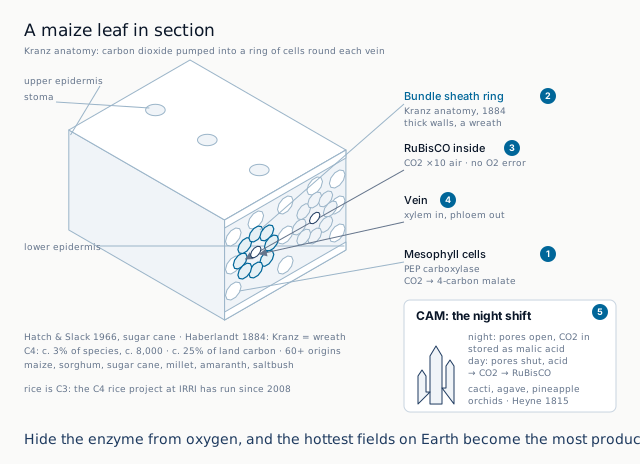
The spatial answer is C4 photosynthesis . In 1966 Hal Hatch and Roger Slack, working for a sugar company in Brisbane, fed sugar cane leaves radioactive carbon dioxide and found that the first labelled products were not the three-carbon acid of the Calvin cycle but four-carbon acids, malate and aspartate. The leaf had a front office and a back office. In the outer mesophyll cells an enzyme called PEP carboxylase, which ignores oxygen entirely, captures carbon dioxide into a four-carbon acid. That acid is shuttled inward to a ring of thick-walled bundle sheath cells wrapped around each vein, where it is broken open to release carbon dioxide at concentrations ten times higher than air, and RuBisCO, kept inside the ring, works almost without error. The German botanist Gottlieb Haberlandt had drawn the wreath-like ring in 1884 and called it Kranz anatomy ; it took eighty years to learn what…
The cost is extra ATP; the reward is speed and thrift in hot, bright places. Maize, sorghum, sugar cane, millet and most tropical grasses are C4 plants, as are many amaranths and saltbushes. They make up only about three per cent of flowering plant species, around 8,000 in all, yet by estimates from Rowan Sage and colleagues they account for roughly a quarter of the carbon fixed on land each year. The trick has evolved independently more than sixty times, which suggests it is not hard to find once the climate demands it.
The temporal answer is crassulacean acid metabolism , CAM, named after the stonecrop family in which Benjamin Heyne first noticed it in 1815: leaves of Bryophyllum in Madras tasted sour at dawn and bland by afternoon. CAM plants open their stomata at night, when the air is cool, store carbon dioxide as malic acid in their vacuoles, then shut tight at dawn and release the stored carbon to RuBisCO behind closed doors. Cacti of the Sonoran Desert, the agave that makes tequila in Jalisco, pineapple in Costa Rica, vanilla and most epiphytic orchids all run this night shift, and Opuntia cactus can go a year on water that would sustain a maize plant for a week.
Both strategies tell the same story: RuBisCO is an ancient compromise, and the hottest, driest places on Earth have been quietly redesigning the leaf around its faults.
The Vegetable Kingdom — 100 chapters on the green world that feeds us
Ready when you are.
Tap below to open the full chapter in the book reader. Anchored books jump to this chapter automatically.
Plants Breathe Too
The Vegetable Kingdom — 100 chapters on the green world that feeds us
It is easy to imagine plants as the opposite of animals, taking in carbon dioxide while we give it out. The truth is that a plant breathes exactly as we do, in every cell, day and night, and the leaf's famous intake of carbon dioxide is only a daytime surplus laid over a constant background of exhalation. Nicolas-Théodore de Saussure measured plant respiration in the dark as early as 1804; what has changed since is our understanding of how much it costs.
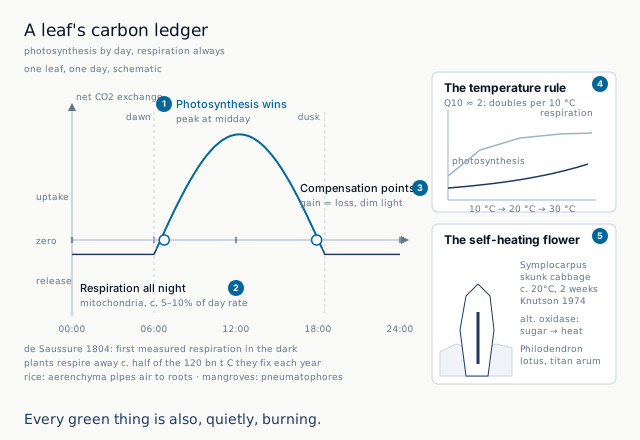
The work is done by mitochondria , the same organelles that power a human muscle. Sugar made in the chloroplast is broken down through glycolysis and the citric acid cycle, oxygen is consumed, carbon dioxide released and ATP captured to run everything photosynthesis cannot: pumping ions, building proteins, growing roots in the dark, keeping membranes intact through a winter night. Measured with an infrared gas analyser, a leaf in darkness releases carbon dioxide at perhaps five to ten per cent of its daytime rate of uptake, but the whole plant, roots included, spends far more. Global estimates suggest that plants respire away roughly half of the 120 billion tonnes of carbon they fix each year before any animal or microbe gets a share.
Temperature sets the pace. The rate of respiration roughly doubles for every 10-degree rise, a ratio biologists call Q10 , and it climbs faster than photosynthesis, which saturates in heat. This is why a tropical night is costly, why a potato in a warm cellar shrinks and sweetens, and why warming forests are being watched so anxiously: a leaf's carbon balance, net gain by day minus loss by night, can tip towards zero when nights grow hot. In the light compensation point , the dim level at which a leaf's gain just matches its loss, lies the limit of every shaded forest floor.
Roots must breathe too, and they drown. A flooded wheat field in East Anglia or a waterlogged vineyard in the Loire turns pale within days because roots deprived of oxygen cannot take up nitrogen. Rice survives by building aerenchyma , air channels down the stem that pipe oxygen to the roots, and mangroves such as Avicennia in the Sundarbans send up pencil-shaped breathing roots, pneumatophores, through the mud.
A few plants turn respiration into heat on purpose. Roger Knutson measured the skunk cabbage in 1974; the Brazilian Philodendron selloum pushes its spadix to over 40 degrees; the sacred lotus of Asia holds its flowers at 30 to 36 degrees for days; and the titan arum of Sumatra warms its spike as it releases its stench of rotting flesh to lure carrion beetles. All use an alternative oxidase that dumps the energy of sugar straight into warmth. Every green thing is also, quietly, burning.
The Vegetable Kingdom — 100 chapters on the green world that feeds us
Ready when you are.
Tap below to open the full chapter in the book reader. Anchored books jump to this chapter automatically.
Minerals from the Soil
The Vegetable Kingdom — 100 chapters on the green world that feeds us
Air and water supply three of a plant's elements: carbon, hydrogen and oxygen, which together make up about 95 per cent of its dry weight. The remaining 5 per cent must be mined from the soil, and without it the big equation stalls. Botanists now recognise seventeen essential elements , defined by the test Daniel Arnon and Perry Stout set out in 1939: a plant must be unable to complete its life cycle without it, and nothing else can substitute. Nickel, the latest, joined the list only in 1987 when barley grown without it failed to make viable grain.
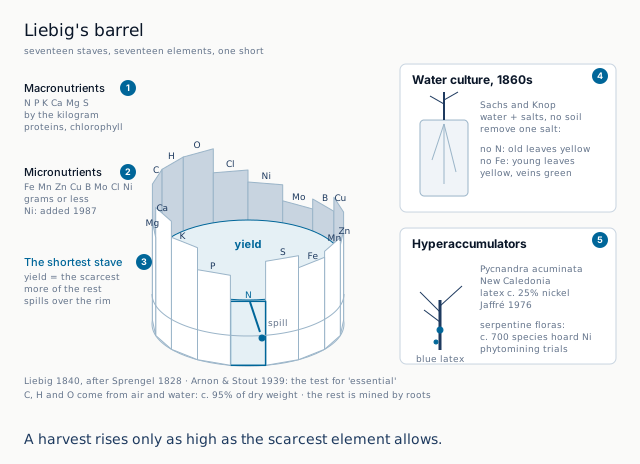
Six are macronutrients , needed by the kilogram: nitrogen for proteins and chlorophyll, phosphorus for DNA and ATP, potassium to open stomata and run the cell's electrical balance, calcium for cell walls, magnesium at the heart of every chlorophyll molecule, sulphur for two amino acids. Eight are micronutrients , needed by the gram or less: iron, manganese, zinc, copper, boron, molybdenum, chlorine and nickel. Molybdenum sits in the enzyme that reduces nitrate, so a crop can starve of nitrogen on a soil full of it, for want of a few grams of molybdenum per hectare; Australian pastures were transformed in the 1940s by exactly that discovery.
How we know comes from glass jars. In the 1860s Julius von Sachs in Germany and Wilhelm Knop raised plants to maturity with their roots in nothing but water and dissolved salts, then dropped one salt at a time and watched what went wrong. Hydroponics was born as a diagnostic tool, and the deficiency symptoms they catalogued still guide farmers: nitrogen shortage yellows the old leaves first, because the plant salvages it for new growth; iron shortage yellows the young leaves between green veins, the chlorosis familiar on rhododendrons planted in chalky soil, where iron is present but locked up at high pH.
The ruling idea came earlier. Justus von Liebig popularised in 1840 what Carl Sprengel had argued a decade before: growth is governed not by the total of nutrients but by the scarcest one, like a barrel whose shortest stave sets the water level. Liebig's law of the minimum explained why manuring with more of what a field already had did nothing, and it launched the fertiliser industry.
Some plants have turned poison into property. Serpentine soils, rich in nickel, chromium and magnesium and poor in calcium, carry their own stunted floras from California to Cuba to the Balkans, and a few hundred hyperaccumulator species pack metals into their leaves at levels that would kill a cabbage, possibly as a defence against insects. Every bite of food, in the end, is seventeen elements dug from the ground.
The Vegetable Kingdom — 100 chapters on the green world that feeds us
Ready when you are.
Tap below to open the full chapter in the book reader. Anchored books jump to this chapter automatically.
The Nitrogen Problem
The Vegetable Kingdom — 100 chapters on the green world that feeds us
Four fifths of every breath is nitrogen, and almost none of it is any use to a plant. The two atoms of the N2 molecule are held by a triple bond so strong that breaking it takes nearly a thousand kilojoules per mole, and no plant, animal or fungus has ever evolved the tool to do it. Only certain bacteria and archaea carry nitrogenase , an enzyme built around an iron-molybdenum cluster that is ruined by oxygen and must be shielded. Every protein and every strand of DNA in the living world depends on this narrow bottleneck.
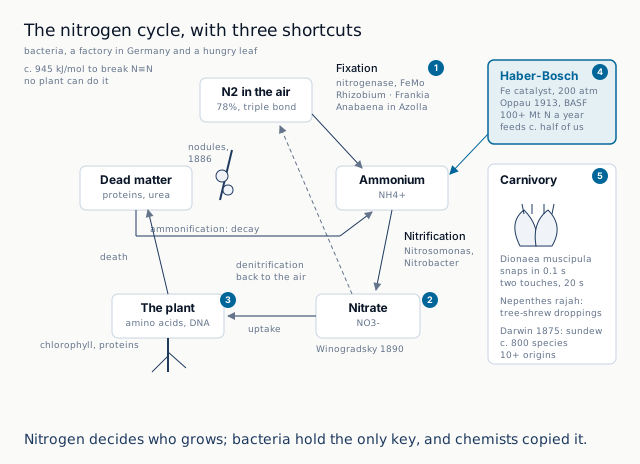
Plants have found three ways through. The first is partnership. In 1886 the German agronomists Hermann Hellriegel and Hermann Wilfarth showed that peas grew in sterile sand only when their roots carried the knobbly nodules that farmers had always noticed, and Martinus Beijerinck isolated the bacterium inside, Rhizobium , two years later. The plant builds the nodule, feeds the bacteria sugar and even makes a form of haemoglobin to keep oxygen away from the enzyme; in return it receives ammonia. Clover and beans in Europe, soy in Brazil, groundnut in Senegal and acacia across Australia all run this bargain, and Chinese rice farmers have for a thousand years floated the fern Azolla on their paddies for the nitrogen-fixing cyanobacterium Anabaena it carries in its leaves. The rest of the cycle is bacterial too: Sergei Winogradsky showed in 1890 that nitrifiers in the soil turn ammonia to…
The second way was built by chemists. In 1909 Fritz Haber in Karlsruhe squeezed nitrogen and hydrogen over an iron catalyst at high pressure and heat, and Carl Bosch at BASF scaled his table-top apparatus into a factory at Oppau that opened in 1913. The Haber-Bosch process now makes well over 100 million tonnes of nitrogen fertiliser a year, consuming around one to two per cent of the world's energy. Jan Willem Erisman and colleagues calculated in 2008 that roughly half the people alive are fed by its output; without it, the nitrogen in their bodies would never have left the air.
The third way is to eat. Where soils are sodden and acid, in bogs and tropical mountainsides, nitrogen is the scarcest thing of all, and around 800 species of plant have become carnivores , a habit that has evolved at least ten times. The Venus flytrap, Dionaea muscipula , native only to a patch of Carolina wetland, snaps shut in a tenth of a second but only after two touches of its trigger hairs within about twenty seconds, which keeps it from closing on raindrops. The pitcher Nepenthes rajah of Mount Kinabalu in Borneo has given up on insects and offers nectar to tree shrews, whose droppings it collects. Nitrogen is the element that decides who grows, and plants have gone to extraordinary lengths to get it.
The Vegetable Kingdom — 100 chapters on the green world that feeds us
Ready when you are.
Tap below to open the full chapter in the book reader. Anchored books jump to this chapter automatically.
Starch, Sugar and Cellulose
The Vegetable Kingdom — 100 chapters on the green world that feeds us
The Calvin cycle delivers a trickle of three-carbon sugar, and from that trickle a plant must build everything. Glucose is the common currency, and it is spent in three main ways: linked in pairs for transport, coiled in chains for storage, or bonded in straight ribbons for structure. The chemistry differs by the twist of a single bond, and the difference separates bread from timber.
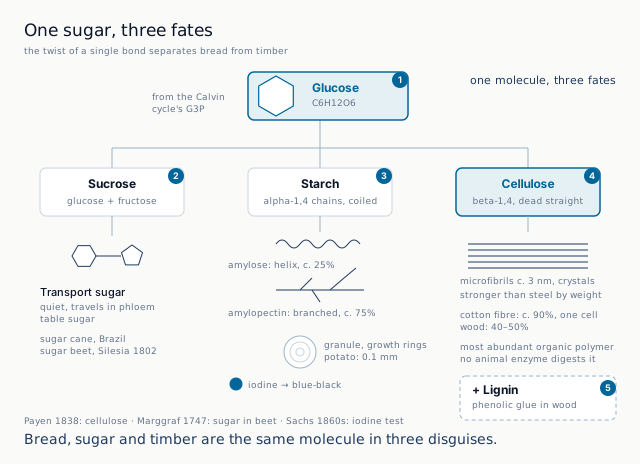
For transport, glucose is joined to fructose to make sucrose , ordinary table sugar, which is loaded into the phloem and sent wherever it is needed. Sucrose is chosen because it is chemically quiet and does not react on the journey. Sugar cane stems in Brazil and the roots of sugar beet, whose sweetness Andreas Marggraf discovered in Berlin in 1747, are simply plants that store the transport sugar itself; the first beet sugar factory opened in Silesia in 1802.
For storage, glucose is strung into starch , in two forms: amylose , a mostly straight chain that coils into a helix, and amylopectin , a branched tree of chains that makes up around three quarters of the grain. Starch is laid down in granules with concentric growth rings; potato granules reach a tenth of a millimetre and were among the first objects Antonie van Leeuwenhoek drew. The classic test is a drop of iodine, which slides into the amylose helix and turns blue-black. Julius von Sachs used it in the 1860s to show that leaves make starch only in the light: he covered half a leaf with foil, left the plant in the sun, bleached the leaf in alcohol and painted it with iodine, and only the exposed half turned dark. Rice endosperm, wheat flour, potato, cassava, yam and banana are all starch stores raided by humans, and starch supplies well over half the calories eaten on Earth.
For structure, glucose is linked in a different orientation to make cellulose , which Anselme Payen isolated from wood and named in 1838. Each chain is perfectly straight, and dozens of them pack into crystalline microfibrils a few nanometres thick, spun by rosette-shaped enzyme complexes embedded in the cell membrane. The microfibrils are stronger than steel for their weight and no animal enzyme can digest them; cows and termites need microbes. Cotton fibre, a single elongated cell on the seed coat of Gossypium , is about 90 per cent cellulose, and wood is roughly 40 to 50 per cent, the rest being hemicellulose and lignin , the stiff phenolic glue that lets a redwood stand 100 metres tall.
Sugar, starch and wall all begin as the same molecule, and the fate of a glucose is decided by one enzyme choosing one bond. Civilisation has run on that choice ever since the first loaf and the first plank.
The Vegetable Kingdom — 100 chapters on the green world that feeds us
Ready when you are.
Tap below to open the full chapter in the book reader. Anchored books jump to this chapter automatically.
Chemical Defences
The Vegetable Kingdom — 100 chapters on the green world that feeds us
A plant cannot run from a caterpillar, so it poisons it. Beyond the primary chemistry of sugar, protein and fat, plants make a vast catalogue of secondary metabolites , compounds with no role in growth whose purpose is to deter, sicken or kill. More than 200,000 are known, and the arms race that produced them, described by Paul Ehrlich and Peter Raven in 1964 as coevolution between plants and insects, has shaped a good part of the diversity of both.
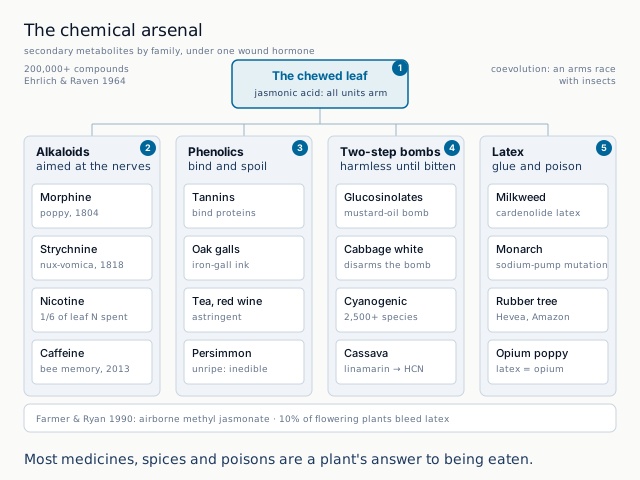
The most famous family is the alkaloids , bitter nitrogen-bearing compounds that interfere with animal nerves. Morphine from the opium poppy, isolated by the German apprentice pharmacist Friedrich Sertürner in 1804, was the first pure alkaloid; strychnine from the seeds of Strychnos nux-vomica in India followed in 1818; nicotine in tobacco is an insecticide so effective that a wild tobacco plant diverts a sixth of its nitrogen into making it. Caffeine evolved independently in coffee, tea and cacao, and in 2013 Geraldine Wright's team at Newcastle showed that low doses in citrus and coffee nectar improve a bee's memory of the flower, a drug used as a loyalty scheme.
Other families work differently. Tannins , phenolic compounds that make oak galls, tea and unripe persimmons astringent, bind proteins and make leaves indigestible. Glucosinolates in the cabbage family sit harmlessly in the cell until a bite mixes them with the enzyme myrosinase, releasing the hot mustard oils that flavour wasabi and horseradish; the cabbage white butterfly has evolved a protein that disarms the "mustard oil bomb", which is why its caterpillars eat brassicas untroubled. Cyanogenic glycosides , found in more than 2,500 species, release hydrogen cyanide when tissue is damaged. Bitter cassava, Manihot esculenta , the staple of 800 million people in Africa, Asia and South America, is one of them, and must be grated, soaked or fermented before it is safe; in drought years, when processing is rushed, outbreaks of the paralysis konzo follow in the Democratic Republic of Congo…
Around ten per cent of flowering plants bleed latex , a sticky emulsion that gums up insect mouthparts and carries poisons: the milkweed Asclepias laces it with cardenolides, and the rubber tree and opium poppy are latex plants too. The whole arsenal is coordinated by a hormone. When a leaf is chewed it makes jasmonic acid , which within minutes switches on defence genes across the plant; Edward Farmer and Clarence Ryan showed in 1990 that tomato plants even respond to the airborne methyl ester. Most medicines, spices and poisons in human history are a plant's answer to being eaten.
The Vegetable Kingdom — 100 chapters on the green world that feeds us
Ready when you are.
Tap below to open the full chapter in the book reader. Anchored books jump to this chapter automatically.
Scents and Signals
The Vegetable Kingdom — 100 chapters on the green world that feeds us
The smell of cut grass is a distress signal. Within seconds of a blade being torn, enzymes in the damaged cells turn membrane fats into a burst of six-carbon green leaf volatiles , chiefly the aldehyde known as cis-3-hexenal, and the scent that pleases a lawn-mower is, to an insect, news. Plants speak in chemistry, and their vocabulary is mostly terpenes , compounds built from five-carbon isoprene units that give pine its resin, mint its menthol, eucalyptus its cineole and lemon its limonene.
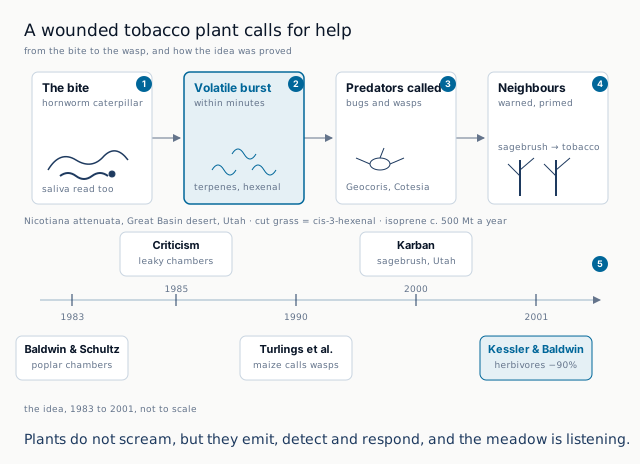
Terpenes work alone and as messages. The oleoresin of a pine is held under pressure in ducts, and when a bark beetle bores in it is flooded and glued in place by a mixture rich in alpha-pinene; a healthy ponderosa in Idaho can drown dozens of beetles a day. Eucalyptus in Australia and oaks and poplars elsewhere pour out isoprene in such quantity, around 500 million tonnes a year worldwide, that the haze over the Blue Mountains near Sydney is largely plant breath. The resin of Boswellia in Oman becomes frankincense, and the sap of Pinus in Georgia and Portugal became turpentine for ships.
The idea that plants also signal to one another was first raised in 1983, when Ian Baldwin and Jack Schultz reported that poplar and sugar maple saplings in sealed chambers made more defensive tannins when neighbouring plants were damaged, and David Rhoades found something similar in willows near Seattle. "Talking trees" made headlines and then met hard criticism; the experiments were small and the chambers leaky, and for a decade the claim was treated as an embarrassment. The rescue came from the field. In the Great Basin desert of Utah, Richard Karban clipped sagebrush, Artemisia tridentata , and found that wild tobacco plants growing downwind suffered less damage from grasshoppers and cutworms over the following season, a result repeated many times since.
The sharpest evidence came from Ian Baldwin and André Kessler in 2001, working with the wild tobacco Nicotiana attenuata in the same desert. When hornworm caterpillars chewed its leaves, the plant released a specific blend of terpenes and green leaf volatiles that summoned predatory bugs to the caterpillars' eggs and discouraged moths from laying more; herbivore numbers fell by as much as 90 per cent. Earlier, in 1990, Ted Turlings and James Tumlinson had shown that maize seedlings attacked by armyworm caterpillars call in the parasitoid wasp Cotesia marginiventris , which lays its eggs inside the caterpillar. The signal is precise: the plant can tell a caterpillar's saliva from a scalpel cut and tailors its bouquet accordingly.
The modern verdict is careful. Plants do not "scream" and have no intent, but they emit, detect and respond to airborne chemistry, and neighbours, predators and parasites all listen in. The air over a meadow is full of messages, and we have only begun to read them.
The Vegetable Kingdom — 100 chapters on the green world that feeds us
Ready when you are.
Tap below to open the full chapter in the book reader. Anchored books jump to this chapter automatically.
Anatomy of a Flower
The Vegetable Kingdom — 100 chapters on the green world that feeds us
A flower is a short shoot that has stopped growing and turned its leaves into something else. Botanists describe it as four whorls , rings of organs set one inside the next on a compressed stem, the receptacle. Outermost are the sepals, usually small and tough, which wrap the bud. Inside them sit the petals, the advertising. Then come the stamens , each a slender filament topped by an anther that makes pollen. At the centre stand one or more carpels , each with a sticky stigma, a stalk-like style and a swollen ovary holding the ovules that will become seeds. A buttercup has all four whorls in plain view; a grass flower has reduced them to scales; a tulip has sepals so petal-like that both whorls are simply called tepals.
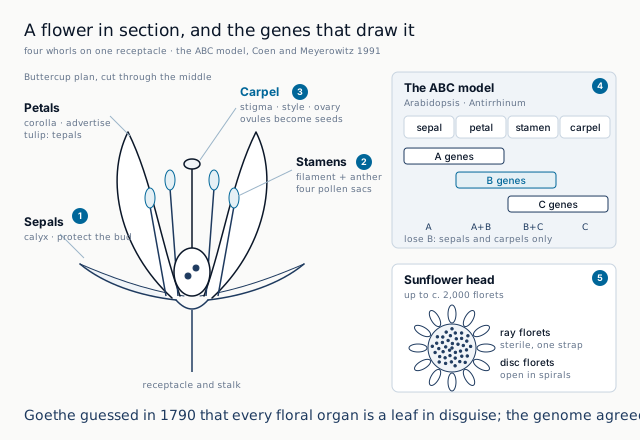
The idea that all these organs are leaves in disguise is older than the science of genetics. In 1790 Johann Wolfgang von Goethe, better known for Faust , published Versuch die Metamorphose der Pflanzen zu erklären , arguing that sepal, petal, stamen and carpel were one organ expressed in different forms. He had no mechanism to offer, only double flowers, in which stamens turn into extra petals, to argue from. Two centuries later the mechanism arrived. In 1991 Enrico Coen and Elliot Meyerowitz, working on the thale cress Arabidopsis thaliana and the snapdragon Antirrhinum majus , proposed the ABC model . Three classes of genes act in overlapping bands across the floral meristem: A alone makes sepals, A with B makes petals, B with C makes stamens and C alone makes carpels. Knock out B and the flower is sepals and carpels only; knock out C and stamens become petals and the flower repeats…
Flowers rarely come singly. An inflorescence is the branching system that carries them, and its architecture is as diagnostic as the flowers: the spike of a plantain, the umbel of a carrot, the catkin of a hazel. The most deceptive is the capitulum of the daisy family. A sunflower head is not one flower but a platter of up to two thousand tiny florets. The outer ring of showy "petals" are sterile ray florets, each a single flower with its petals fused into one strap; the dark centre is thousands of disc florets, opening in spirals from the rim inwards over about a week.
The ABC model is still being refined, with an E class of genes found to be needed for every whorl, but its basic logic holds from orchids to oaks. It explains why a flower that has lost a gene for petals is not ruined but simply rearranged, and it gives breeders a dial. Every double peony and every sterile ornamental cherry is a flower whose whorl map has been edited, first by chance and now, increasingly, on purpose. Goethe guessed the pattern; the genome confirmed it.
The Vegetable Kingdom — 100 chapters on the green world that feeds us
Ready when you are.
Tap below to open the full chapter in the book reader. Anchored books jump to this chapter automatically.
Pollen
The Vegetable Kingdom — 100 chapters on the green world that feeds us
Pollen is the plant kingdom's answer to a problem the first land plants never solved: how to get sperm to an egg without a film of water to swim through. A pollen grain is a tiny package, usually 20 to 50 micrometres across, holding a vegetative cell and, within it, a generative cell that divides to give two sperm cells. It is wrapped in two coats. The inner intine is cellulose; the outer exine is sporopollenin, one of the toughest organic materials known, resistant to acids, enzymes and heat, and sculpted into spines, ridges, pores and furrows that are specific to a family, a genus and often a species. A pine grain carries two air bladders for flight; a grass grain is a smooth sphere with one pore; a dandelion grain is a studded ball with three.
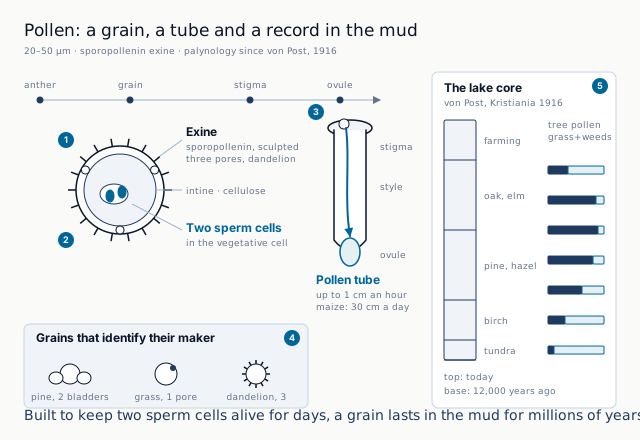
When a compatible grain lands on a stigma it rehydrates and sends out a pollen tube through one of its pores. The tube grows down the style at up to a centimetre an hour, steered by chemical signals from the ovule, and delivers the two sperm cells to the embryo sac. In maize the silk is a style, and a tube may travel 30 centimetres in a day. The pollen tube was first seen by Giovanni Battista Amici in 1824, in a portulaca, settling a long argument about whether pollen reached the ovule at all.
Because sporopollenin survives in mud for millions of years, pollen is also a record. In 1916 the Swedish geologist Lennart von Post showed a meeting in Kristiania, now Oslo, how counting grains layer by layer in a peat core revealed the forests that had grown above it since the ice retreated. Palynology was born. Cores from lakes and bogs on every continent now chart the return of birch and pine to Europe, the drying of the Sahara around 5,000 years ago, and the clearance of forest for farming. The ratio of tree pollen to grass and weed pollen is one of the most reliable ways to date when people first put a plough into a landscape.
The same toughness makes pollen an accomplice and a nuisance. In 1959 an Austrian investigator, Wilhelm Klaus, matched the pollen in mud on a suspect's boots to a single stretch of the Danube valley, and the man confessed; forensic palynology has been used in courts ever since. Hay fever, proved in 1873 by the Manchester physician Charles Blackley to be a reaction to pollen rather than to heat or hay, now affects about a fifth of people in Britain, and the daily grass pollen count, with 50 grains per cubic metre counted as high, is a routine part of the weather forecast. One grain, built to protect two sperm cells for a few days, ends up telling us what grew here ten thousand years ago.
The Vegetable Kingdom — 100 chapters on the green world that feeds us
Ready when you are.
Tap below to open the full chapter in the book reader. Anchored books jump to this chapter automatically.
Wind, Water and Self
The Vegetable Kingdom — 100 chapters on the green world that feeds us
Not every flower needs a visitor. Roughly one flowering plant in ten, and almost every conifer, throws its pollen to the wind, and the design shows it. Anemophilous flowers are small, dull and scentless, with no petals to speak of, long dangling anthers and feathery stigmas held out to comb the air. Hazel, Corylus avellana , hangs its male catkins in February before the leaves can get in the way; the female flowers are a tuft of red styles barely two millimetres long. Grasses, which cover a quarter of the land surface, are wind pollinated almost without exception, which is why a June hay meadow makes people sneeze. The method is wasteful. A single hazel catkin releases around four million grains; the chance of any one finding a stigma is minute, and the plants compensate with sheer numbers.
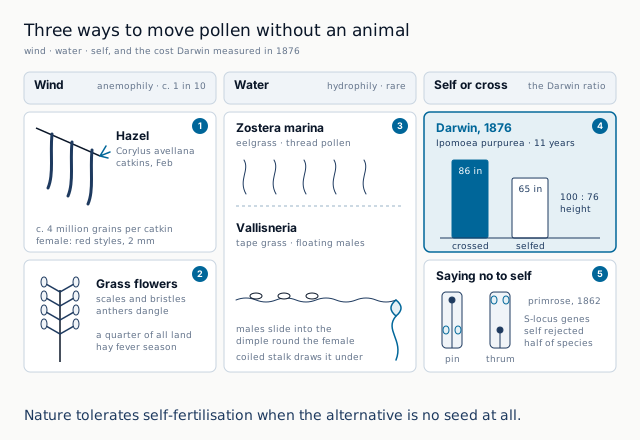
Water is rarer still. The eelgrass Zostera marina of shallow seas releases pollen as threads up to five millimetres long, which drift with the current and tangle on the stigmas of other plants. The tape grass Vallisneria of rivers and ponds has a neater trick: its tiny male flowers break free, bob to the surface and are blown like boats to the female flowers, which are held at the surface on long coiled stalks and sit in a dimple of surface tension that the males slide down into.
The third option is to pollinate yourself. Many plants do: thale cress, peas, barley and most wheat set seed from their own pollen, and violets even produce closed cleistogamous flowers in late summer that never open at all. Selfing is reliable and cheap, and a single seed can found a population, which is why so many weeds do it. But it comes at a cost, and the man who measured it was Charles Darwin. In 1876 he published The Effects of Cross and Self Fertilisation in the Vegetable Kingdom , reporting eleven years of greenhouse experiments. Crossed morning glories, Ipomoea purpurea , grew to an average of 86 inches against 65 for selfed ones, a ratio he gave as 100 to 76, and in most of his 57 species the crossed offspring were taller, heavier and more fertile. Inbreeding depression, as it is now called, is the price of a limited gene pool.
Evolution has therefore invented ways to say no. Primroses come in two forms, pin and thrum, with the anthers and stigma at different heights so that pollen is swapped between forms rather than within them; Darwin worked that out in 1862. Many plants carry self-incompatibility genes that recognise and reject their own pollen on the stigma, which is why apple orchards need a second variety. About half of all flowering plants are self-incompatible, and the rest sit somewhere on a sliding scale between inbreeding safety and outbreeding vigour. Darwin's own summary, that nature abhors perpetual self-fertilisation, is only half the story: nature tolerates it when the alternative is no seed at all.
The Vegetable Kingdom — 100 chapters on the green world that feeds us
Ready when you are.
Tap below to open the full chapter in the book reader. Anchored books jump to this chapter automatically.
Bees and Flowers
The Vegetable Kingdom — 100 chapters on the green world that feeds us
In 1793 a Berlin schoolmaster named Christian Konrad Sprengel published a book with a title that promised a great deal: Das entdeckte Geheimnis der Natur im Bau und in der Befruchtung der Blumen , the discovered secret of nature in the structure and fertilisation of flowers. Sprengel had spent years on his knees in meadows and had seen what no one had quite said: the colours, scents, nectar and spotted markings of flowers were not for our pleasure but for insects, and the insects, in exchange, carried pollen. He named the spots and streaks that point towards the nectar Saftmale , nectar guides. The book sold badly and he died poor, but Darwin read it, called it wonderful, and built on it.
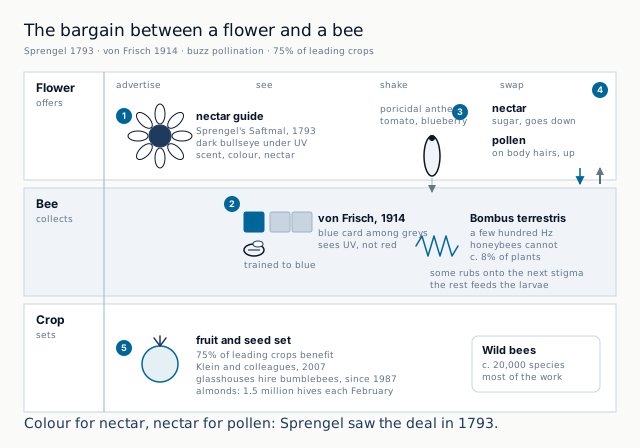
The guides turned out to be only half visible. Bees see a different slice of the spectrum from us: no red, but ultraviolet, which turns a plain yellow evening primrose into a dark-centred target. Karl von Frisch proved in 1914, by training honeybees to find sugar water on a blue card among grey ones, that bees see colour at all; a generation of zoologists had insisted they were colour blind. He went on to decode the waggle dance, and shared a Nobel Prize in 1973. Photographed under ultraviolet, a dandelion or a black-eyed Susan shows a bullseye that the bee sees and we never do.
Then there is sound. About eight per cent of flowering plants, including tomato, potato, aubergine, blueberry and cranberry, keep their pollen locked in anthers that open only by a pore at the tip. The way in is buzz pollination : a bumblebee grips the anther, disengages its wings and vibrates its flight muscles at a few hundred hertz, shaking the pollen out like salt from a cellar. Honeybees cannot do it, which is why every commercial tomato glasshouse from the Netherlands to Mexico now hires boxes of bumblebees, Bombus terrestris in Europe and Bombus impatiens in North America, a trade that began in Belgium in 1987.
The economics are large. A 2007 survey led by Alexandra-Maria Klein found that 75 per cent of the world's leading food crops benefit from animal pollination, though those crops supply only about a third of what we eat by weight; wheat, rice and maize need no bee at all. Almonds in California need 1.5 million hives trucked in every February. But the honeybee, Apis mellifera , is a managed livestock species and only one pollinator among thousands. Wild bees, from the tiny Perdita of American deserts to the carpenter bees that bore into fence posts, do most of the pollinating of wild plants and much of that of crops, and they are the ones declining. Sprengel saw the deal two centuries ago: colour for nectar, nectar for pollen. Keeping the other party to the bargain alive is now our side of it.
The Vegetable Kingdom — 100 chapters on the green world that feeds us
Ready when you are.
Tap below to open the full chapter in the book reader. Anchored books jump to this chapter automatically.
Moths, Birds, Bats and Beetles
The Vegetable Kingdom — 100 chapters on the green world that feeds us
In January 1862 Charles Darwin received a box of orchids from Madagascar. One of them, Angraecum sesquipedale , carried a nectar spur nearly 30 centimetres long with a few drops of nectar at the very bottom. He wrote that in Madagascar there must be moths with tongues able to reach it, and was mocked for it. In 1903 Walter Rothschild and Karl Jordan described a hawkmoth from the island with a proboscis of that length and named it Xanthopan morganii praedicta , the predicted one. The moth was finally filmed feeding at the orchid in 1992. The episode made the point that pollinators and flowers shape each other, and that a flower's design is a kind of portrait of its visitor.
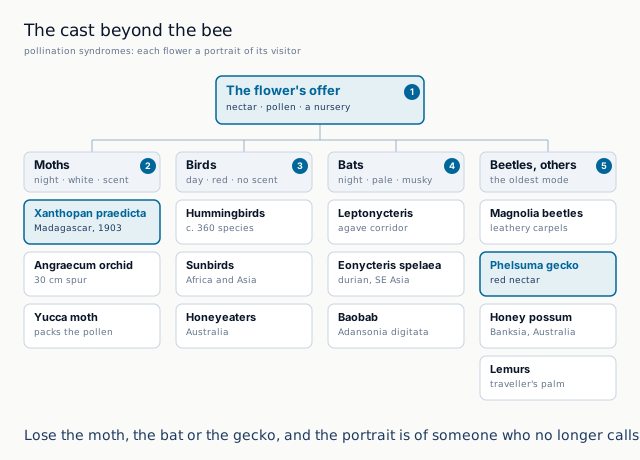
Botanists call these portraits pollination syndromes . Moth flowers are white or pale, open at dusk, heavily scented and often tubular: jasmine, honeysuckle, the yucca of the American deserts, whose moth deliberately packs pollen into the stigma before laying eggs in the ovary. Bird flowers are the opposite: red or orange, scentless, tubular and sturdy, producing dilute nectar in quantity. The roughly 360 species of hummingbird, all in the Americas, hover at fuchsias, salvias and heliconias; red is not a colour hummingbirds specially love so much as one that bees see poorly, so the flower keeps its nectar for the bird. Sunbirds in Africa and Asia, honeyeaters in Australia and the honeycreepers of Hawaii fill the same role, usually perching rather than hovering.
Bats work the night shift in the tropics. Their flowers are large, pale, open at night, smell of sour milk or cabbage and hang clear of the foliage. The lesser long-nosed bat, Leptonycteris yerbabuenae , follows the flowering of columnar cacti and agaves up a "nectar corridor" from southern Mexico to Arizona each spring, and tequila's Agave tequilana is its crop. In Southeast Asia the cave nectar bat Eonycteris spelaea pollinates the durian; in Africa the baobab, Adansonia digitata , opens its white pendulous flowers for fruit bats at dusk.
The outliers are the best evidence of all. On Mauritius the bellflower Nesocodon mauritianus produces blood-red nectar, found in 2006 to be a signal to the day geckos, Phelsuma , that pollinate it. On Madagascar, lemurs pollinate the traveller's palm. In Australia the honey possum lives entirely on Banksia nectar and pollen. Each is a reminder that the bee is one solution among many, and that losing a single pollinator can strand a flower. The orchid Darwin received still sets seed only when a particular moth, with a particular tongue, happens to visit.
The Vegetable Kingdom — 100 chapters on the green world that feeds us
Ready when you are.
Tap below to open the full chapter in the book reader. Anchored books jump to this chapter automatically.
Deceit and Traps
The Vegetable Kingdom — 100 chapters on the green world that feeds us
Most flowers pay their pollinators. A sizeable minority do not. Of some 28,000 orchid species, about a third offer no nectar, no edible pollen and no reward at all, and get themselves pollinated by lying. The bee orchids of the genus Ophrys are the most notorious. Their lip is shaped, furred and coloured like a female solitary bee and, more importantly, scented like one: the flower makes the same blend of hydrocarbons that the female uses as a sex pheromone. A male attempts to mate with the flower, picks up two pollen packets on his head, and tries again on the next one. The French amateur Maurice-Alexandre Pouyanne worked this out watching the mirror orchid, Ophrys speculum , in Algeria, and published it in 1916; few believed him for decades. Sexual deception has since been found in hundreds of orchids from Europe to Australia, where some lure wasps and even male fungus gnats.
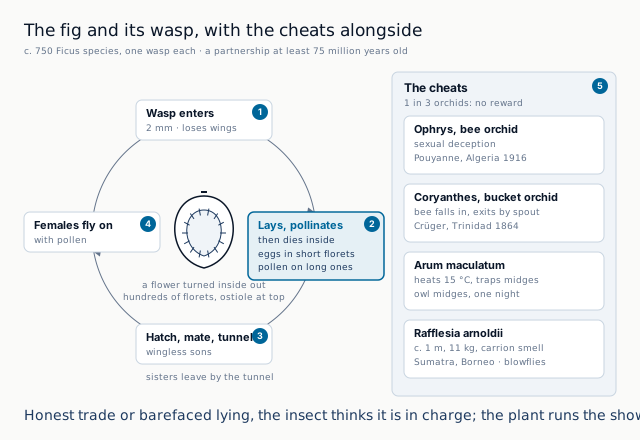
Other orchids trap rather than seduce. The bucket orchid Coryanthes of tropical America drips liquid into a bucket-shaped lip. Male orchid bees come for the scent, which they collect to woo their own females, slip on the rim and fall in. The only exit is a narrow spout past the column, where the bee is held while pollinia are glued to its back; it leaves wet and wiser, and delivers the pollen to the next bucket it falls into. Hermann Crüger described the performance in Trinidad in 1864 and sent it to Darwin.
The carrion flowers lie about death. Rafflesia arnoldii of Sumatra and Borneo, a parasite with no leaves or stem, opens a flower nearly a metre across and up to 11 kilograms that smells of rotting meat and is pollinated by blowflies. The stapeliads of southern Africa, starfish-shaped succulents, pull the same trick at a hand's width. The European cuckoo-pint, Arum maculatum , goes further. Its spadix heats up by as much as 15 degrees on an April evening, volatilising a smell of dung that draws tiny owl midges down past a ring of hairs into a chamber. They are kept overnight, dusted with pollen as the male flowers open, and freed at dawn when the hairs wilt.
The fig is the opposite case: a deal so strict it looks like a trap. Each of the roughly 750 species of Ficus is pollinated by its own species of fig wasp , usually only one, in a partnership at least 75 million years old. A female wasp two millimetres long squeezes through the fig's tiny opening, losing her wings and antennae, lays eggs in some florets, pollinates the rest, and dies inside. Her wingless sons hatch first, mate with their sisters and chew an exit tunnel; the daughters load up with pollen and leave through it to find a fig of their own. Figs fruit all year round and feed more vertebrates than any other tropical plant. Cheats and honest traders alike, the plants run the show.
The Vegetable Kingdom — 100 chapters on the green world that feeds us
Ready when you are.
Tap below to open the full chapter in the book reader. Anchored books jump to this chapter automatically.
From Flower to Fruit
The Vegetable Kingdom — 100 chapters on the green world that feeds us
Flowering plants fertilise twice. When the pollen tube reaches the embryo sac it bursts and releases its two sperm cells. One fuses with the egg to make the zygote, the start of the embryo. The other fuses with the large central cell, which already carries two nuclei, to form a triploid tissue called endosperm . The embryo will become the plant; the endosperm is its packed lunch, and ours: the white of a rice grain, the flour of wheat and the flesh of a coconut are all endosperm. This double fertilisation was first seen in 1898 by the Russian botanist Sergei Nawaschin in lilies and fritillaries, and confirmed the next year in France by Léon Guignard. It is unique to flowering plants, and it means a plant invests in food for a seed only once that seed has been fertilised.
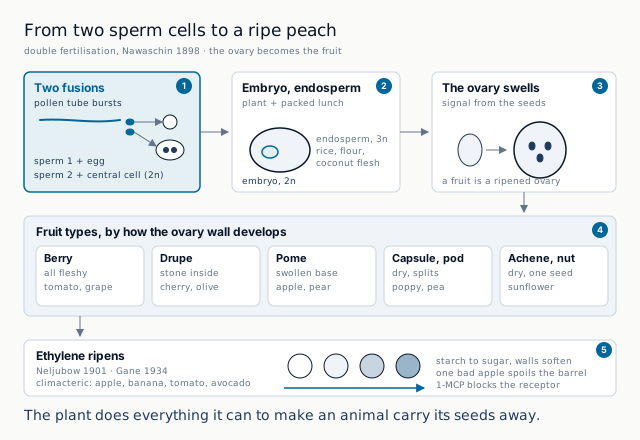
Fertilisation sends a hormonal signal back through the carpel, and the ovary begins to swell. A fruit is, strictly, a ripened ovary with its seeds, however it is dressed. Botanists sort fruits by how the ovary wall develops. A berry has a fleshy wall throughout: tomato, grape, banana and, perversely, the pumpkin, while strawberries are not berries at all. A drupe has a stony inner layer around a single seed: cherry, peach, olive, mango, coconut. A pome, the apple and pear, is mostly swollen receptacle around a papery core that is the true ovary. Dry fruits include the capsule of the poppy, the pod of the pea, the achene of the sunflower, and the nut of the hazel. The tomato's status reached the United States Supreme Court in 1893, in Nix v. Hedden ; the justices agreed it was a fruit to a botanist and ruled it a vegetable for tariffs.
Some fruits manage without seeds. Parthenocarpy , fruit set without fertilisation, is the normal state of the cultivated banana, whose wild ancestors are full of hard black seeds. Seedless grapes such as Thompson Seedless are fertilised, but the embryo aborts early, leaving only a trace of seed. Seedless watermelons are sterile triploids; seedless citrus uses a mix of all three.
Ripening is a controlled demolition run by the gas ethylene . First identified in 1901 by Dimitry Neljubow, a student in St Petersburg puzzled by pea seedlings growing sideways near gas lamps, ethylene was shown in 1934 by Richard Gane to be made by fruit itself. In climacteric fruits such as apples, bananas, tomatoes and avocados, a burst of ethylene turns starch to sugar, softens cell walls and breaks down green chlorophyll. It also spreads: one bruised apple in a barrel really does ripen and then rot the rest, which is why bananas are shipped green and gassed on arrival, and why stored apples are treated with 1-methylcyclopropene to block ethylene receptors. From two sperm cells to a ripe peach, the plant has done everything in its power to make an animal carry its seeds away.
The Vegetable Kingdom — 100 chapters on the green world that feeds us
Ready when you are.
Tap below to open the full chapter in the book reader. Anchored books jump to this chapter automatically.
Seed Dispersal
The Vegetable Kingdom — 100 chapters on the green world that feeds us
A seed that falls at its parent's feet grows up in its parent's shade, competing for the same light and water and sharing the same pests. Dispersal is the escape, and plants have more ways of leaving home than any animal has of travelling.
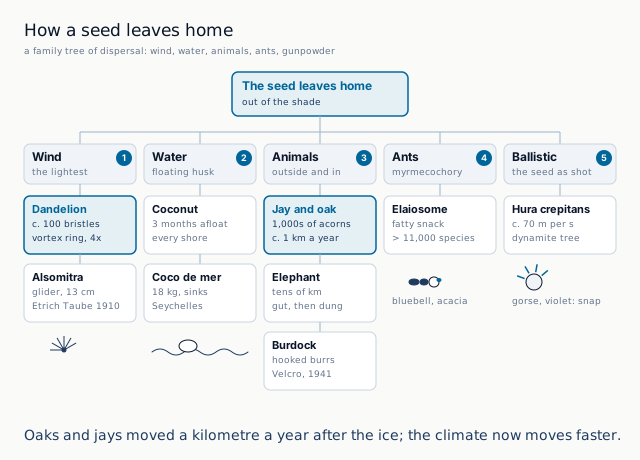
The wind carries the smallest and the cleverest. A dandelion seed hangs beneath a pappus of about a hundred bristles that looks far too open to work; in 2018 a team at Edinburgh showed that air flowing through the bristles forms a stable ring of swirling air above the parachute, giving it four times the drag of a solid disc. Orchid seeds are dust, a million to a pod, with no food reserve at all. The Javan climbing gourd Alsomitra macrocarpa goes for the glider instead: its seed sits in a transparent wing 13 centimetres across and sails for hundreds of metres through rainforest, and in 1910 the Austrian engineer Igo Etrich copied its shape for the wing of the Taube, one of the first mass-produced aeroplanes.
Water takes the coconut. Its husk is a buoyant fibre jacket and the seed can survive about three months afloat, which is how Cocos nucifera came to fringe almost every tropical beach before anyone planted it. Animals do the rest, by accident or design. A Eurasian jay, Garrulus glandarius , buries several thousand acorns each autumn and forgets enough of them to plant an oak wood; oaks spread north across Europe after the ice far faster than any acorn could roll. Fleshy fruit is a bribe: the seed passes through the gut and is dropped elsewhere with manure. In Africa and Asia elephants carry the large seeds of Balanites and other trees for tens of kilometres, and some Amazonian fruits, the avocado among them, seem to have been built for giant ground sloths and gomphotheres that vanished 10,000 years ago. Ants carry the seeds of more than 11,000 species, from bluebells to acacias, for the…
Some seeds hitch. The burdock's hooked burrs clung to the dog of the Swiss engineer George de Mestral on a walk in 1941; he looked at them under a microscope and patented Velcro in 1955. And one seed hardly disperses at all. The coco de mer, Lodoicea maldivica , grows only on two islands in the Seychelles, and its double seed, up to 18 kilograms and the largest of any plant, sinks in water and drops beside its parent. On a small island with no competitors, staying put is a strategy too.
Dispersal decides where the next generation can be, and so it decides how fast a forest can move when the climate shifts. Oaks and jays managed about a kilometre a year after the ice. The climate is now moving faster than that.
The Vegetable Kingdom — 100 chapters on the green world that feeds us
Ready when you are.
Tap below to open the full chapter in the book reader. Anchored books jump to this chapter automatically.
Dormancy and Germination
The Vegetable Kingdom — 100 chapters on the green world that feeds us
A seed is a plant that has pressed pause. Inside its coat an embryo waits beside a store of food, dried to perhaps five per cent water, its metabolism almost at a standstill. Dormancy is the refusal to grow even when water and warmth are available, and it is one of the plant kingdom's most useful inventions, because the moment a seed falls is rarely the moment it should germinate. An acorn that sprouted in a warm October would face its first winter as a seedling; a desert annual that germinated after a single shower would die before the next one.
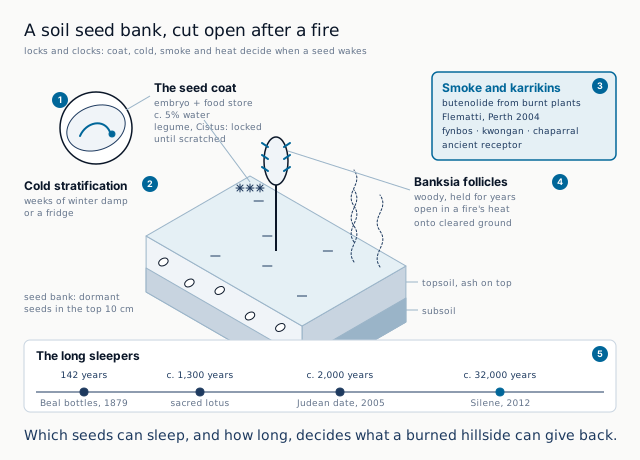
So seeds carry clocks and locks. Many temperate seeds need stratification , a spell of cold and damp lasting weeks or months, before they will grow: the winter itself is the key, and gardeners imitate it with a fridge. Hard-coated seeds of legumes and Cistus are sealed until sand, fire or a gut scratches the coat. Others wait for light, or for a flicker of red light at the surface that tells them they are not buried too deep. Lettuce seed, famously, will not germinate in the dark.
Some wait for smoke. Botanists in South Africa's fynbos knew that many of its shrubs germinated only after a bush fire, and in 1990 Johannes de Lange and Chris Boucher showed that smoke alone would do it. In 2004 a team in Perth led by Gavin Flematti identified the molecule: a small butenolide from burnt cellulose, now called a karrikin , from a Noongar word for smoke. Karrikins wake seeds across the kwongan of Western Australia and the Californian chaparral, and their receptor turns out to be ancient, present in plants that have never seen fire. Banksias go one step further and keep their seeds in woody follicles on the plant for years, opening only in the heat of a fire that has just cleared the ground of competitors.
How long can the pause last? In 2005 Sarah Sallon and Elaine Solowey in Israel germinated a Judean date palm seed excavated at Masada in the 1960s and radiocarbon dated to around 2,000 years ago; the tree, named Methuselah, is now several metres tall, and a female from a later batch bore dates in 2020. Sacred lotus seeds from a dry lakebed in China germinated after about 1,300 years. The record belongs to the narrow-leafed campion, Silene stenophylla . In 2012 Svetlana Yashina and colleagues grew flowering plants from fruit tissue stored in Arctic ground squirrel burrows in Siberian permafrost for about 32,000 years, though they had to coax placental cells into growth in culture rather than germinate the seeds.
Not every seed can wait. The acorn, the chestnut, cacao and mango are recalcitrant : they die if dried, and must grow within weeks. Which seeds can sleep, and for how long, now decides what seed banks can hold against extinction, and what the soil beneath a burned hillside can give back.
The Vegetable Kingdom — 100 chapters on the green world that feeds us
Ready when you are.
Tap below to open the full chapter in the book reader. Anchored books jump to this chapter automatically.
Clones and Other Ways
The Vegetable Kingdom — 100 chapters on the green world that feeds us
Sex is expensive. It needs a partner, a pollinator and luck, and it shuffles a set of genes that may already be perfectly suited to the spot. So many plants hedge, and some skip it entirely. A strawberry sends out runners , horizontal stems that root at the nodes and raise a daughter plant a hand's width from the parent. A tulip or an onion packs next year's shoot into a bulb of fleshy leaf bases; a crocus does the same with a corm of swollen stem; the potato stores it in a tuber, which is why every Maris Piper in Britain is genetically the same plant. Bamboo, ginger and bracken run underground rhizomes that can carry a single individual across a hillside. The Mexican hat plant, Kalanchoe daigremontiana , simply grows complete plantlets, roots and all, along the edges of its leaves and drops them.
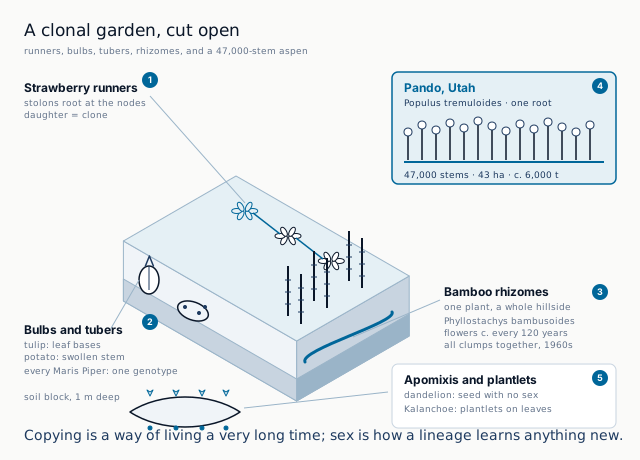
The results can be enormous. In the Fishlake National Forest of Utah a quaking aspen, Populus tremuloides , named Pando, Latin for "I spread", covers about 43 hectares with some 47,000 stems rising from one root system; its mass is estimated at around 6,000 tonnes, which makes it the heaviest known organism, and its age is thousands of years, though exactly how many botanists debate. Off Ibiza a meadow of the seagrass Posidonia oceanica stretching about 15 kilometres appears to be one clone. In Tasmania Lomatia tasmanica , King's holly, survives as a single sterile triploid clone that has been putting up new stems for an estimated 43,000 years.
Some plants fake sex. The common dandelion, Taraxacum officinale , goes through the motions of flowering and sets seed, but most European dandelions are triploid and produce seed by apomixis , without fertilisation, so every seedling is a copy of its mother. The result is hundreds of near-identical "microspecies" that have kept taxonomists arguing for a century. Hawkweeds and brambles do the same, which is why Gregor Mendel, who turned to hawkweeds after his peas, got results he could not explain.
People have been exploiting all this for as long as there have been gardens. A willow or a fig cutting roots in a jar; Theophrastus described grafting in Greece around 300 BC, and it was already old. Every Bramley apple descends from a tree grown from a pip in Nottinghamshire around 1809, and every Cavendish banana from one plant in a Derbyshire glasshouse in the 1830s. The convenience is also the danger. A clone has no variation to draw on, and the fungus that is now clearing Cavendish plantations across Asia and Latin America meets the same defences on every plant it visits. Reproduction without sex is a way of living a very long time; sex is how a lineage learns anything new.
The Vegetable Kingdom — 100 chapters on the green world that feeds us
Ready when you are.
Tap below to open the full chapter in the book reader. Anchored books jump to this chapter automatically.
What Makes a Tree
The Vegetable Kingdom — 100 chapters on the green world that feeds us
A tree is not a kind of plant but a way of being one. Botany has no order or family called Trees; the habit, a tall woody stem lifting a crown above its competitors, has evolved independently dozens of times, in conifers, in oaks and eucalypts, in legumes, roses and mallows. The first to manage it, Archaeopteris , was a relative of the ferns that cast shade across the Devonian around 385 million years ago. What unites them all is secondary growth : a thin cylinder of dividing cells, the vascular cambium, lays down wood on the inside and bark on the outside year after year, so the stem thickens as it lengthens. Stiffen that wood with lignin and a plant can stand a hundred metres tall and live for millennia.
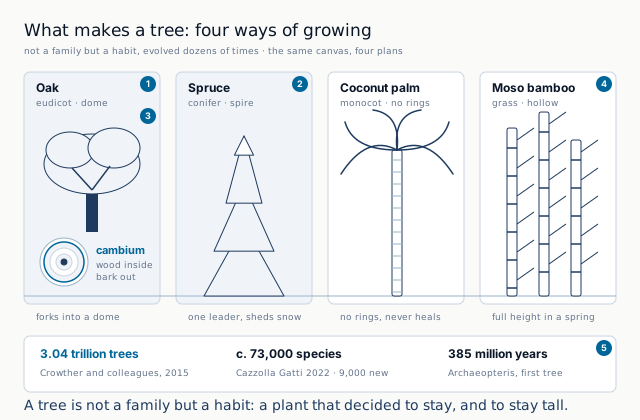
How many are there? In 2015 Thomas Crowther and colleagues combined 429,775 ground plots with satellite data and arrived at about 3.04 trillion trees, roughly 400 for every person alive, with the densest stands in the boreal north and the greatest variety in the tropics. In 2022 a team led by Roberto Cazzolla Gatti estimated the number of tree species at around 73,000, of which perhaps 9,000 are still undescribed, most of them rare and most of them in South America. GlobalTreeSearch, which counts woody plants that usually grow a single stem to over two metres, listed around 60,000 named species when it opened in 2017.
The exceptions prove the rule. A coconut palm, Cocos nucifera , is a monocot with no cambium at all; it reaches its full girth in a thickening zone just below the crown and never widens afterwards, which is why palms show no annual rings and why a wound in a palm trunk never heals over. Bamboos are grasses, hollow and jointed; the giant moso bamboo Phyllostachys edulis reaches its full height of 20 metres or more in a single spring, and culms of some species have been measured growing close to a metre in a day. The tree ferns of Australasia and the Andes hold themselves up with a sheath of fibrous roots. Dragon trees and the Joshua tree of the Mojave, both monocots, cheat with a second kind of cambium that botanists call anomalous.
Form follows the cambium too. A spruce keeps a single leader and tapers to a spire, the 'excurrent' crown that sheds snow; an oak forks again and again into a broad 'decurrent' dome. Bark, laid down by a separate cork cambium, is the dead armour that keeps water in and fire, insects and fungi out, from the paper of a birch to the half-metre fibrous jacket of a giant sequoia.
Trees matter because the habit, once invented, reshaped the planet. They built the soils, slowed the rivers, drew down enough carbon to cool the Devonian and gave the rest of life a three-dimensional world to climb into. A tree is simply a plant that decided to stay, and to stay tall.
The Vegetable Kingdom — 100 chapters on the green world that feeds us
Ready when you are.
Tap below to open the full chapter in the book reader. Anchored books jump to this chapter automatically.
The Oldest and the Biggest
The Vegetable Kingdom — 100 chapters on the green world that feeds us
The oldest known single tree is a Great Basin bristlecone pine, Pinus longaeva , growing in the White Mountains of California at around 3,000 metres. Named Methuselah, it was cored in 1957 by Edmund Schulman, who counted its rings back to a germination date of about 2833 BC, which makes it close to 4,850 years old today. Its exact location is kept secret. Nearby a sibling called Prometheus was felled in 1964 by a graduate student with a permit and turned out to be older still, nearly 4,900 years. Bristlecones live so long by growing slowly in cold, dry, nutrient-poor dolomite where nothing can rot them, and by letting most of the trunk die back to a strip of living bark that feeds a few branches.
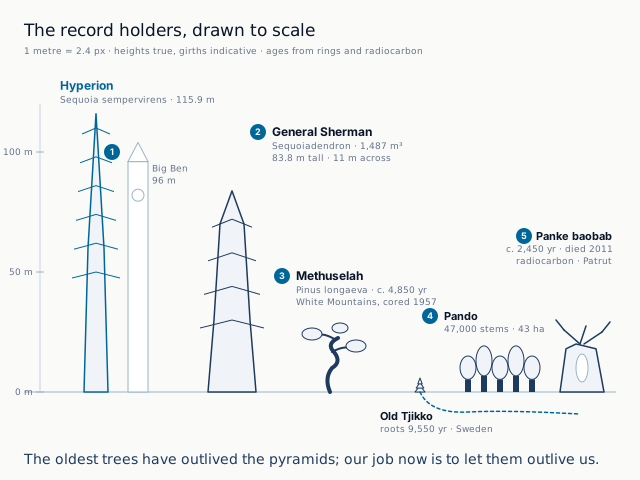
Age depends on what you count. On the Fulufjället mountain in Sweden a Norway spruce called Old Tjikko stands barely five metres tall, yet radiocarbon dating of wood from its root system, reported by Leif Kullman after its discovery in 2004, gave an age of around 9,550 years. The trunk is young; the roots have thrown up trunk after trunk since the ice retreated. Pando, a grove of quaking aspen, Populus tremuloides , in Utah's Fishlake National Forest, pushes the idea further: around 47,000 stems across 43 hectares are one male clone sharing a single root system, weighing perhaps 6,000 tonnes, the heaviest known organism. Its age is debated, with estimates running from a few thousand years to far more.
Size has its champions too. General Sherman, a giant sequoia, Sequoiadendron giganteum , in California's Sequoia National Park, holds about 1,487 cubic metres of trunk, the largest tree by volume, at 83.8 metres tall and over 11 metres across at the base. Hyperion, a coast redwood, Sequoia sempervirens , found in 2006 by Chris Atkins and Michael Taylor in Redwood National Park, is the tallest living thing at 115.9 metres; in 2022 the park closed its surroundings to visitors because trampling was damaging it. The tallest flowering plant is a mountain ash, Eucalyptus regnans , in Tasmania named Centurion, measured at 100.5 metres in 2018, and in Sabah a yellow meranti, Shorea faguetiana , climbed and taped in 2019 at 100.8 metres is the tallest tropical tree known.
African baobabs, Adansonia digitata , grow hollow and keep no reliable rings, so Adrian Patrut's team dated them by radiocarbon from the innermost wood. The Panke baobab in Zimbabwe, around 2,450 years old, was the oldest known flowering plant until it died in 2011, one of nine of the thirteen oldest baobabs that collapsed between 2005 and 2017.
These records matter because they are archives. Bristlecone rings underpin the calibration of radiocarbon dating; sequoia stumps record two millennia of fires; a dying baobab is a thermometer of a warming continent. The oldest trees have outlived the pyramids, and our job now is to let them outlive us.
The Vegetable Kingdom — 100 chapters on the green world that feeds us
Ready when you are.
Tap below to open the full chapter in the book reader. Anchored books jump to this chapter automatically.
How a Forest Grows
The Vegetable Kingdom — 100 chapters on the green world that feeds us
A bare surface does not stay bare. On 27 August 1883 the volcano Krakatau blew apart and buried what was left of the island under hot ash and pumice tens of metres deep. Nine months later a visiting naturalist found a single spider spinning a web in the sterile rock. By 1886 there were ferns, grasses and blue-green algae; by 1897 a savanna of wild sugar cane; by the 1920s a closed forest of figs and casuarinas; and today a mixed forest of over 400 plant species in which not one was planted. Succession , the orderly replacement of one community by another, had run its course within a human lifetime.
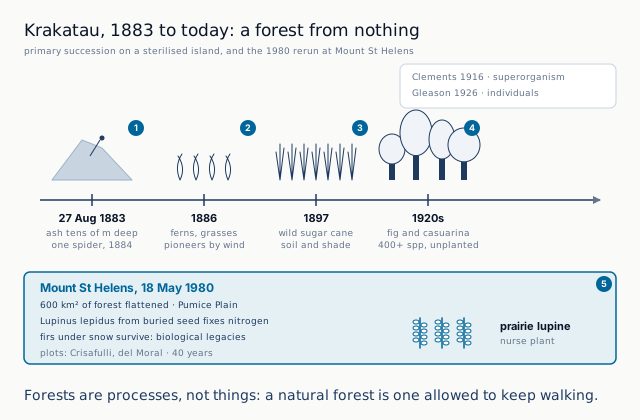
The pattern is familiar everywhere. Pioneers arrive first: light-seeded, fast-growing, sun-loving species such as fireweed, birch and alder in the north, or Cecropia in the tropics. They cast shade, build soil and are then displaced by the shade-tolerant trees, beech, hemlock, the dipterocarps, whose seedlings can wait for decades on the forest floor as a seedling bank and shoot up when a gap opens. The closing stage, in which the forest replaces itself with its own kind, is the climax.
Who decides the pattern was the great argument of twentieth-century ecology. Frederic Clements, writing from the Nebraska prairie in 1916, saw a community as a 'complex organism' developing towards a single climax fixed by climate. Henry Gleason replied in 1926 that a community was merely the species that happened to arrive and tolerate the site, an 'individualistic concept'. Modern ecology leans to Gleason, with a nod to Clements, and adds gap dynamics : Alex Watt showed in 1947 that a mature wood is a mosaic of patches of different ages, each started by a fallen tree.
Mount St Helens gave the idea its best laboratory. When the mountain erupted on 18 May 1980 it flattened some 600 square kilometres of forest and left a Pumice Plain hot enough to melt boots. Ecologists expected pioneers to blow in; instead a prairie lupine, Lupinus lepidus , germinated from buried seed, fixed nitrogen and nursed everything that followed, while silver firs and huckleberries that had been under snow sprang back from what the ecologists called biological legacies. Four decades of plots, led by Charlie Crisafulli and Roger del Moral, show a landscape recovering faster and more unevenly than any model predicted. In Alaska's Glacier Bay, where the ice has retreated some 100 kilometres since 1750, a walk down the fjord is a walk through 250 years of succession from bare gravel to spruce forest.
The lesson is that forests are not finished things but processes. Every wood is at some point on a journey that fire, wind, flood or a single falling trunk can restart, and a 'natural' forest is simply one that has been allowed to keep walking.
The Vegetable Kingdom — 100 chapters on the green world that feeds us
Ready when you are.
Tap below to open the full chapter in the book reader. Anchored books jump to this chapter automatically.
The Canopy
The Vegetable Kingdom — 100 chapters on the green world that feeds us
Stand on the floor of a tropical rainforest and you are in a dim basement, with 1 or 2 per cent of the sunlight reaching you. The life is overhead. A mature rainforest sorts itself into strata : a shrub and sapling layer, an understorey of palms and slender trees, the main canopy at 25 to 45 metres where crowns interlock into a continuous roof, and above it the emergents , giants that break through into the wind, a Brazil nut in Amazonia, a kapok, or in Borneo a dipterocarp such as the yellow meranti measured at 100.8 metres in 2019. Most of the leaves, flowers, fruit and animals are in the top third.
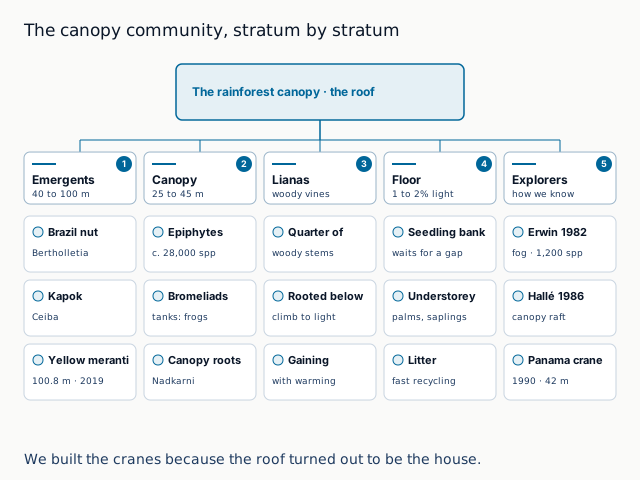
Botanists took a surprisingly long time to go up. The canopy was 'the last biotic frontier' in the phrase of the Smithsonian entomologist Terry Erwin, who in 1982 fogged nineteen Luehea seemannii trees in Panama with a short-lived insecticide and caught what fell on sheets. He identified over 1,200 species of beetle from that one kind of tree, estimated how many were specialists on it, and extrapolated to perhaps 30 million arthropod species on Earth. The figure has since been revised down, to around 6 million, but the argument changed biology: most animals live in the treetops, and most of them had never been seen.
Getting there became a discipline. Single-rope climbing techniques borrowed from cavers arrived in the 1970s; Francis Hallé's Radeau des Cimes , an inflatable raft lowered by airship onto the treetops of French Guiana in 1986, let scientists walk on the roof; and in 1990 the Smithsonian put a 42-metre construction crane in a forest park in Panama City, the first of a network that now spans Sarawak, Queensland, Switzerland and Germany, letting a gondola park above any crown. Walkways at Kakum in Ghana and Taman Negara in Malaysia opened the view to everyone.
What the climbers found was a hanging garden. Epiphytes , plants that grow on other plants without feeding on them, make up roughly one vascular plant species in ten, some 28,000 of them: orchids, ferns, mosses and, in the Americas, the bromeliads whose rosettes hold water tanks that house mosquito larvae, tiny crabs and the tadpoles of poison frogs. Nalini Nadkarni's work at Monteverde in Costa Rica showed canopy trees sprouting roots from their own branches into the soil that forms on them. Lianas, woody vines rooted in the ground, make up about a quarter of woody stems in many tropical forests and are gaining ground as the climate changes.
The canopy is where a forest meets the sky: where photosynthesis happens, where rain is caught and where carbon is fixed. We built the cranes because the roof turned out to be the house.
The Vegetable Kingdom — 100 chapters on the green world that feeds us
Ready when you are.
Tap below to open the full chapter in the book reader. Anchored books jump to this chapter automatically.
Rainforests
The Vegetable Kingdom — 100 chapters on the green world that feeds us
Tropical rainforests cover about 6 per cent of the land and hold around half of its species, and most of their bulk is trees. The largest, the Amazon, spreads across nine countries and about 5.5 million square kilometres, and a census of 1,170 plots published by Hans ter Steege and colleagues in 2013 estimated that it holds some 390 billion trees of around 16,000 species. Yet half of those trees belong to just 227 species, the hyperdominants , led by the palm Euterpe precatoria and the rubber tree Hevea brasiliensis , while thousands of rare species are known from a single plot. A hectare near Yasuní in Ecuador can hold 650 tree species, more than the whole of North America.
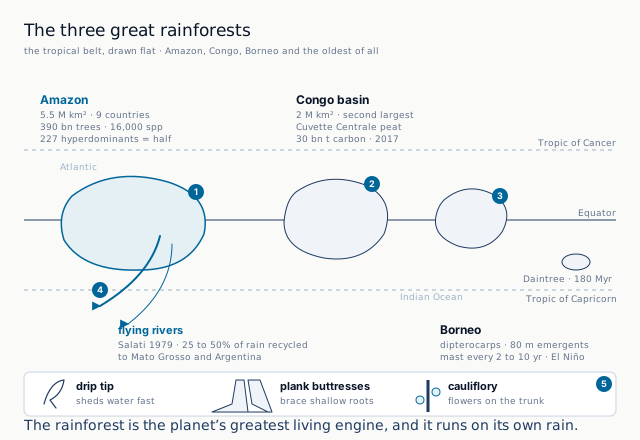
A rainforest is defined by rain, over 2,000 millimetres a year with no real dry season, and its trees are built for it. Leaves end in drip tips that shed water before fungi can settle; trunks flare into plank buttresses that brace shallow roots in soils where nutrients sit in the top few centimetres and are recycled within weeks; flowers sprout from bare trunks so that bats and beetles can find them. The soil itself is poor. The wealth is in the living biomass and in the speed of its turnover.
The Congo basin, second in size at around 2 million square kilometres, keeps a different secret. In 2017 Simon Lewis and Greta Dargie mapped a peat swamp forest the size of England in the Cuvette Centrale, holding about 30 billion tonnes of carbon in its mud. Borneo's lowland forests are ruled by one family, the Dipterocarpaceae, whose winged seeds spin down from emergents 80 metres high and whose trees fruit almost all together once every two to ten years in mast events cued by El Niño droughts, flooding the forest with more seed than the bearded pigs can eat. In Australia's Daintree the oldest rainforest lineage on Earth has stood for perhaps 180 million years.
Rainforests also make their own weather. The Brazilian scientist Eneas Salati showed in 1979, by tracing oxygen isotopes in rainwater from the Atlantic coast inland, that the Amazon recycles between a quarter and half of its rain: trees pump water into the air, it falls again downwind, and the forest waters itself. Antonio Nobre later christened the resulting airborne streams, each carrying more water than the Amazon river discharges, the 'flying rivers' that water the farms of southern Brazil and Argentina. Scientists debate the threshold, perhaps 20 to 25 per cent deforestation, past which the system could tip towards savanna.
The rainforest is the planet's greatest living engine, and it runs on its own rain.
The Vegetable Kingdom — 100 chapters on the green world that feeds us
Ready when you are.
Tap below to open the full chapter in the book reader. Anchored books jump to this chapter automatically.
Temperate and Boreal Forests
The Vegetable Kingdom — 100 chapters on the green world that feeds us
North of the deciduous woods, around the top of the world, runs the largest forest on Earth. The taiga , or boreal forest, covers about 17 million square kilometres of Canada, Alaska, Scandinavia and Russia, roughly a third of all forest and a tenth of the land, and it manages with a handful of species: spruce, pine, fir, larch, birch and aspen. The conifers are shaped for winter. A spire crown and down-sloping branches shed snow before it breaks them; needles with a waxy skin and sunken stomata lose little water when the ground is frozen and water is unobtainable; a dark colour and an evergreen habit catch every hour of a short spring.
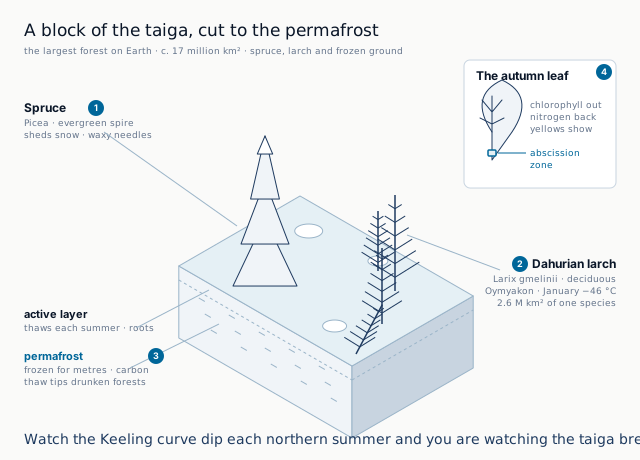
Eastern Siberia is colder still, and there the forest is deciduous. Dahurian larch, Larix gmelinii , drops its needles in autumn and sits on permafrost with roots spread in the thin layer that thaws each summer, which is why it alone forms forest in the coldest inhabited region on Earth, around Oymyakon, where January averages minus 46 degrees Celsius. Larch forests of this one species span some 2.6 million square kilometres. As the permafrost thaws, the trees tip, 'drunken forests' lean into the mud and the carbon beneath them starts to leak.
Farther south, where winters are milder and wetter, broadleaves take over: oak, beech, maple, hornbeam and lime in Europe, oak and hickory, maple and beech in eastern North America, beech and oak again in Japan and Chile. Their trick is to throw away the leaf. As days shorten, a layer of cells at the leaf base, the abscission zone, weakens; chlorophyll is dismantled and its nitrogen withdrawn into the twig, exposing yellow carotenoids that were there all summer, while sugar maples and some oaks make fresh red anthocyanins on cold bright days. New England's fall colour is the sight of a tree salvaging its assets. In the Southern Hemisphere the Nothofagus beeches of Patagonia do the same.
These forests also time their reproduction. Beech and oak mast : in some years a whole region's trees pour out nuts together, in others almost none, starving and then swamping the mice, jays and boar that eat them. The wood-pigeon flocks of a mast year and the Lyme disease peaks that follow a mouse boom are both written in acorns. The Białowieża Forest on the Polish-Belarusian border, some 1,500 square kilometres of lowland oak, lime and hornbeam with dead wood left where it falls, oaks over 40 metres tall and a herd of several hundred European bison, is the nearest thing left to the forest that once covered the continent.
Temperate and boreal forests are the lungs of the seasons: each northern summer the global carbon dioxide curve dips as they leaf out, and rises again as the leaves fall. Watch the Keeling curve and you are watching the north breathe.
The Vegetable Kingdom — 100 chapters on the green world that feeds us
Ready when you are.
Tap below to open the full chapter in the book reader. Anchored books jump to this chapter automatically.
Fire and Forests
The Vegetable Kingdom — 100 chapters on the green world that feeds us
Fire is a weather the forest expects. A lodgepole pine, Pinus contorta , of the Rocky Mountains holds many of its cones shut for years under a seal of resin that melts at around 45 to 60 degrees Celsius; only the heat of a crown fire opens them, and the seed falls onto freshly cleared ash. The strategy is called serotiny , and it was invented separately by the banksias of Australia, whose woody follicles open in the flames, and by jack pines, cypresses and the giant sequoia, whose seedlings barely survive except on burnt mineral soil. Other trees cheat death instead. Eucalypts keep dormant epicormic buds beneath thick bark and a swollen lignotuber at the base, and a blackened gum can be green again within weeks, while cork oaks and longleaf pines simply insulate themselves and wait.
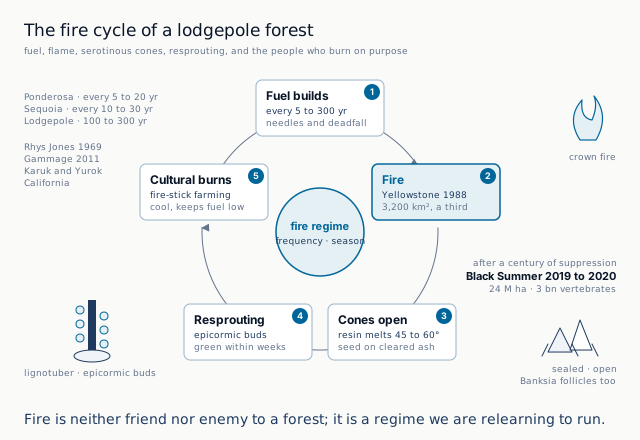
Every forest has a fire regime , a characteristic frequency, season and intensity, and its species are tuned to it. Ponderosa pine stands in the American West once burned lightly every five to twenty years; sequoia groves every ten to thirty; the lodgepole forests of Yellowstone in stand-replacing blazes every 100 to 300 years. When one of those arrived in 1988, burning about 3,200 square kilometres, more than a third of the park, newspapers mourned a landscape destroyed. The lodgepole came back in millions, in places at hundreds of thousands of seedlings per hectare, and Monica Turner's plots have tracked a forest that is now more than 35 years old.
People have been part of fire regimes for tens of thousands of years. Aboriginal Australians practised what the archaeologist Rhys Jones in 1969 called 'fire-stick farming': frequent cool burns in the right season that cleared travel routes, flushed game, encouraged yams and grass and kept fuel from building up. Bill Gammage's The Biggest Estate on Earth argued in 2011 that the first Europeans saw a continent that was, in effect, a managed park. In California the Karuk and Yurok burned oak woodlands for acorns and basketry plants until the practice was outlawed in 1850, and only in recent years has the state begun to welcome it back. A century of suppression in both countries let fuel pile up, and the fires of the twenty-first century are the bill. Australia's Black Summer of 2019 to 2020 burned around 24 million hectares and killed or displaced an estimated three billion vertebrates;…
Fire is neither friend nor enemy to a forest; it is a regime. Remove it and the fire-adapted forest decays; feed it too much and the same forest dies. What we are relearning is the old art of burning on purpose.
The Vegetable Kingdom — 100 chapters on the green world that feeds us
Ready when you are.
Tap below to open the full chapter in the book reader. Anchored books jump to this chapter automatically.
Trees and Water
The Vegetable Kingdom — 100 chapters on the green world that feeds us
A tree is a pump with no moving parts. Sunlight evaporates water from the leaves through their stomata; the loss pulls more water up the trunk; the roots draw it from the soil. A mature oak in full leaf can move several hundred litres a day this way, a big eucalypt or a Sitka spruce more, and almost all of it is not used but transpired , breathed into the air. Multiply by a forest and the numbers become geographic. Antonio Nobre's estimate for the Amazon is around 20 billion tonnes of water a day lifted into the sky by its trees, more than the river itself delivers to the Atlantic.
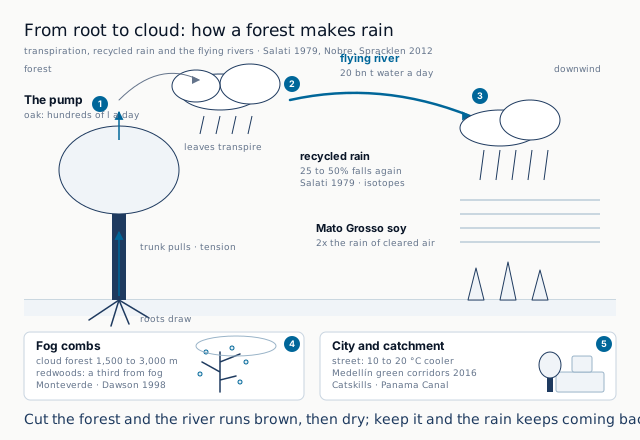
That vapour comes down again. Eneas Salati's 1979 isotope study showed that a drop of Amazon rain has, on average, fallen and been transpired several times on its way inland, and a 2012 analysis led by Dominick Spracklen found that tropical air which has passed over extensive forest produces at least twice as much rain as air that has crossed cleared land. Downwind of a forest, in other words, lie its crops: the soy fields of Mato Grosso, the maize of the Sahel below the Congo, the wheat of the Punjab beneath the Himalayan foothills.
Some forests drink from the sky directly. In the cloud forests that wrap tropical mountains between about 1,500 and 3,000 metres, at Monteverde in Costa Rica or on Kinabalu in Borneo, trees comb fog from the air with mossy branches and epiphytes, and this 'horizontal precipitation' can add a third again to the measured rainfall. California's coast redwoods do the same: Todd Dawson showed in 1998 that in a dry summer around a third of a redwood's water, and two thirds of the water of the ferns beneath it, arrives as fog drip . When Monteverde's cloud base lifted in the warming of the 1980s and 1990s, the golden toad vanished and the trees began to dry.
Cities have noticed. Forested catchments deliver clearer, steadier water than cleared ones, which is why New York City paid to protect the Catskills watershed rather than build a filtration plant, and why the Panama Canal Authority guards its forests to keep the locks full. In a street, a tree's shade and transpiration together can lower the surface beneath it by 10 to 20 degrees Celsius on a hot day; Medellín's thirty 'green corridors', planted from 2016, measurably cooled the city.
Trees are the land's way of keeping its rain. Cut the forest and the river runs brown in the wet season and dry in the dry; keep it and the rain keeps coming back. Rain, it turns out, is partly grown.
The Vegetable Kingdom — 100 chapters on the green world that feeds us
Ready when you are.
Tap below to open the full chapter in the book reader. Anchored books jump to this chapter automatically.
Forests and Carbon
The Vegetable Kingdom — 100 chapters on the green world that feeds us
Half of a dry log is carbon. Take the water out of wood and what remains is cellulose, hemicellulose and lignin, about 50 per cent carbon by mass, every atom of it pulled from the air as carbon dioxide. Add it up across the world's 4 billion hectares of forest and the figure, published by Yude Pan and colleagues in 2011 from inventories on every continent, comes to around 861 billion tonnes of carbon: 363 in living trees, 73 in dead wood, 43 in litter and 383 in the top metre of soil. The atmosphere at the time held about 830 billion tonnes. Forests, in other words, store as much carbon as the sky.
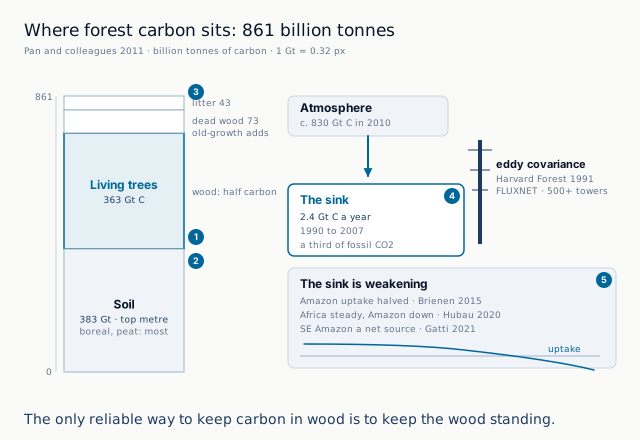
They are also still taking it in. Between 1990 and 2007 the world's forests absorbed about 2.4 billion tonnes of carbon a year, roughly a third of fossil-fuel emissions, with the strongest sinks in the tropics and the boreal north. We know this from two directions: inventories of hundreds of thousands of plots remeasured over decades, and eddy covariance towers, which sniff the breath of a forest ten times a second. Harvard Forest in Massachusetts has run one since 1991, and the FLUXNET network now links more than 500.
The surprise was the old-growth. Textbooks assumed that an ancient forest was carbon-neutral, growth balanced by decay. In 2008 Sebastiaan Luyssaert and colleagues gathered data from 519 plots of forest between 15 and 800 years old and found that stands continued to accumulate carbon well past their first few centuries, much of it in soil and dead wood. The argument that felling old forest and replanting is carbon-neutral does not survive the figures. Where the carbon sits also matters: in the Amazon most of it is in the trees, but in the boreal zone and in peat swamps the soil holds several times more than the wood above it, and a thawed or drained peatland becomes a source .
The sink is weakening. A network of 321 Amazon plots followed by Roel Brienen's team showed in 2015 that the uptake per hectare had fallen by half since the 1990s, as trees grew faster and died younger. In 2020 Wannes Hubau and colleagues found the African sink steady while the Amazon's declined, and in 2021 Luciana Gatti's aircraft flights showed the south-eastern Amazon, where fire and clearing are heaviest, now releasing more carbon than it takes in.
What this means is simple and hard. Forests are doing a third of our carbon clean-up for free, but they are a sink with a limit and a sponge that can be wrung out. Planting is useful; not felling is more so; and the only reliable way to keep carbon in wood is to keep the wood standing.
The Vegetable Kingdom — 100 chapters on the green world that feeds us
Ready when you are.
Tap below to open the full chapter in the book reader. Anchored books jump to this chapter automatically.
Living With Trees
The Vegetable Kingdom — 100 chapters on the green world that feeds us
For most of history people did not clear woods so much as farm them. Cut a hazel, ash or oak to the ground and it does not die; the stump, or stool, throws up a thicket of straight poles that can be harvested every seven to twenty years, indefinitely. Coppicing supplied firewood, charcoal, hurdles, tool handles and the wattle of wattle-and-daub for thousands of years, and some English stools, cut every generation since the Middle Ages, are among the oldest living things in the country. Bradfield Woods in Suffolk has records of coppicing from 1252 and is still cut on rotation. Where deer or cattle grazed, the cut was made above head height instead, and the result, a pollard , is why the beeches of Burnham Beeches and the oaks of Spain's dehesa have their stout trunks and knuckled crowns.
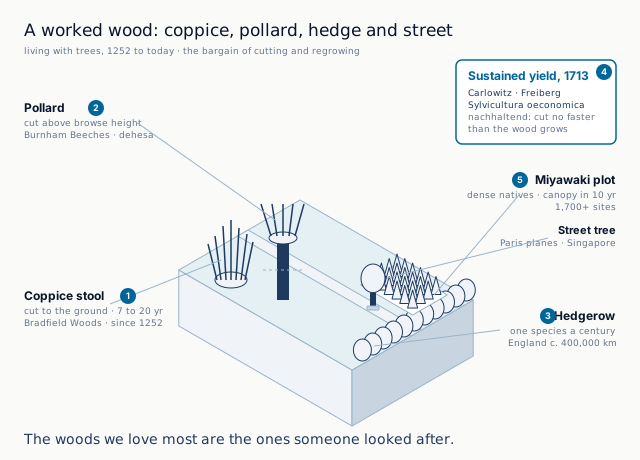
The idea that a wood should be cut no faster than it grows has a birthday. In 1713 Hans Carl von Carlowitz, a mining administrator in Freiberg, Saxony, worried about charcoal for the silver smelters, published Sylvicultura oeconomica and used the word nachhaltend , lasting or sustained, for the first time in its modern sense. 'Nachhaltigkeit', sustainability, began as forestry. From it came the German forest schools, the doctrine of sustained yield and, through Gifford Pinchot and the Indian Forest Service, the national forests of America and the plantations of the British Empire.
Hedgerows are forests drawn as lines. England has around 400,000 kilometres of them, roughly half of what stood in 1945, and the ecologist Max Hooper noticed in the 1970s that a 30-yard stretch gains about one woody species per century, so a hedge with ten species is probably a thousand years old. Oliver Rackham taught a generation to read woods the same way, by ancient woodland indicators : bluebell, wood anemone, dog's mercury and yellow archangel spread so slowly that their presence marks ground wooded since at least 1600.
Other cultures kept other bargains. Japan's satoyama , the managed woodland between village and mountain, is matched today by shinrin-yoku , forest bathing, a term coined by the Forestry Agency in 1982 and since tested by Qing Li, whose subjects showed raised immune-cell counts after two days among trees. The botanist Akira Miyawaki planted dense pockets of native species, several to a square metre, which closed canopy within a decade; his method has been used at more than 1,700 sites from Yokohama to the Netherlands. And the street tree, from Haussmann's planes along the Paris boulevards to Singapore's 'City in a Garden', is the one forest most people live in.
Living with trees was never a matter of leaving them alone. It was craft: a bargain of cutting and regrowing, planting and waiting, that kept both parties alive. The woods we love most are the ones someone looked after.
The Vegetable Kingdom — 100 chapters on the green world that feeds us
Ready when you are.
Tap below to open the full chapter in the book reader. Anchored books jump to this chapter automatically.
Mapping the Green Planet
The Vegetable Kingdom — 100 chapters on the green world that feeds us
Stand on a mountain in the tropics and you can walk through most of the world's vegetation in a day. In June 1802 Alexander von Humboldt and Aimé Bonpland climbed Chimborazo in Ecuador to about 5,900 metres, higher than anyone had recorded, noting with barometer and thermometer which plants grew at which height. The picture Humboldt published in 1807, the Naturgemälde , was a cross-section of the volcano with the plants written onto its slopes: palms and cacao at the foot, tree ferns and cinchona higher up, grasses, then lichens, then snow. It was the first serious attempt to show that climate, not chance, decides where a plant can live. Vegetation, he argued, was a readable map of the physical world.
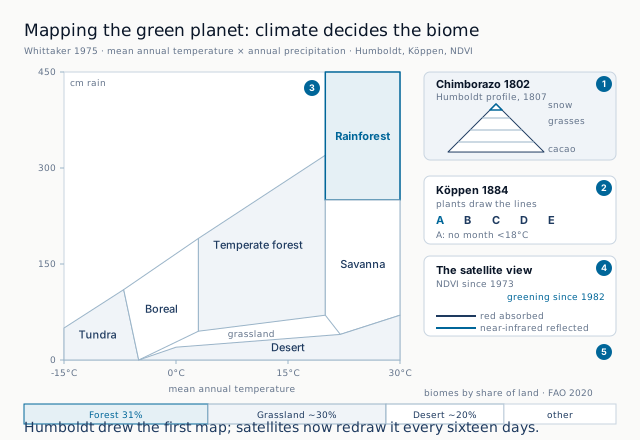
The idea became a method. Wladimir Köppen, a Russian-German climatologist who had trained as a botanist, decided around 1884 that the best thermometer was the plants themselves. His climate classification, refined in 1900 and 1918 and still in use, draws its boundaries where the vegetation changes: a tropical rainforest climate is one with no month cooler than 18 degrees Celsius, because that is where the rainforest stops. In 1975 the American ecologist Robert Whittaker drew the chart that textbooks still use, plotting mean annual temperature against annual precipitation and marking the biome that occupies each corner: tundra at the cold edge, desert at the dry one, tropical rainforest where it is hot and wet, and grassland, savanna and the forests between.
Satellites turned the map into a moving picture. The Normalised Difference Vegetation Index , devised in 1973 from the first Landsat images, compares red light, which chlorophyll absorbs, with near-infrared, which leaves reflect, so that living foliage glows on the image. Forty years of these records show the Earth greening: a 2016 study led by Zaichun Zhu found leaf area rising over a quarter to a half of the vegetated land since 1982, driven by extra carbon dioxide, warming in the north and, as a 2019 analysis showed, tree planting and intensive cropping in China and India.
By area the forests come first, about 4.06 billion hectares or 31 per cent of the land in the 2020 FAO assessment, followed by grasslands and savannas on roughly a quarter to a third, deserts and dry shrublands on perhaps a fifth, with tundra, wetlands and the Mediterranean scrub taking the remainder. Each of those is a chapter to come.
The green planet, in other words, is not a fixed mosaic but a set of boundaries that move with the weather. Humboldt drew the first map; the satellites are redrawing it every sixteen days.
The Vegetable Kingdom — 100 chapters on the green world that feeds us
Ready when you are.
Tap below to open the full chapter in the book reader. Anchored books jump to this chapter automatically.
Grasslands and Savannas
The Vegetable Kingdom — 100 chapters on the green world that feeds us
A grassland is a forest that keeps being interrupted. Across the North American prairie, the Eurasian steppe, the South American pampas and the African savanna, there is usually enough rain for trees to grow, and yet the trees do not win. What stops them is a trio of pressures: a dry season, fire, and the teeth of grazing animals. Grasses shrug all three off because they grow from the base. The dividing tissue of a grass leaf sits at the bottom of the blade, protected at or below the soil surface, so a bison, a wildebeest or a prairie fire removes only the top and the plant simply resumes. A tree sapling, growing from its tips, is killed outright. Grasslands and savannas cover somewhere between a quarter and two-fifths of the land surface, depending on how much scattered tree cover one allows.
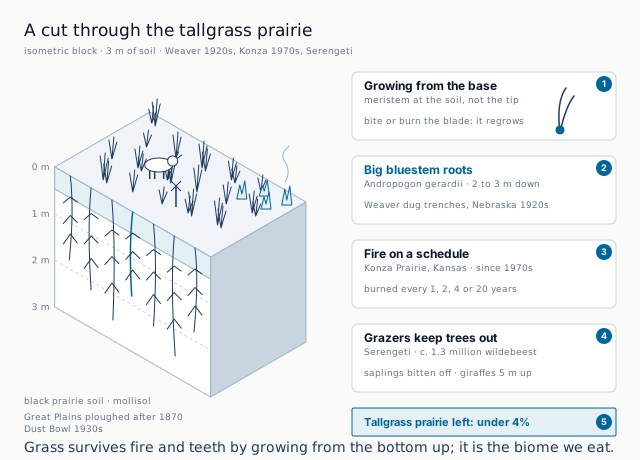
Most of a prairie is underground. In the 1920s and 1930s John Ernest Weaver of the University of Nebraska dug trenches beside prairie plants and traced their roots on paper, and found that big bluestem , Andropogon gerardii , the signature grass of the tallgrass prairie, sends roots down two to three metres, far deeper than it stands tall. Around two-thirds or more of the living weight of a prairie is below the surface, and it is this buried mass, dying and regrowing each year, that built the deep black soils of the American Midwest and the Ukrainian chernozem.
Fire and grazing have been tested, not assumed. At the Konza Prairie in Kansas, ecologists have burned fixed watersheds on schedules of one, two, four and twenty years since the early 1970s; where fire is withheld, shrubs and then trees creep in within decades. In the Serengeti the migration of some 1.3 million wildebeest mows the short grass plains, and their dung feeds it. The savanna's umbrella thorn trees, Vachellia tortilis , once Acacia , survive by growing above the browse line and trading their foliage with giraffes, which can reach five metres up and tolerate the thorns.
The Eurasian steppe runs close to 8,000 kilometres from Hungary to Manchuria and carried the horse cultures that shaped Eurasian history. The pampas of Argentina feed cattle; the Great Plains were ploughed in a few decades after 1870 and, when drought came in the 1930s, blew away as the Dust Bowl. Less than four per cent of the original tallgrass prairie survives.
Grasslands are the biome we eat. Wheat, rice, maize and the pasture of every cow are grasses, and the soils they built feed the world. Keep the fire, keep the grazers, and the grass keeps the trees at bay.
The Vegetable Kingdom — 100 chapters on the green world that feeds us
Ready when you are.
Tap below to open the full chapter in the book reader. Anchored books jump to this chapter automatically.
Deserts
The Vegetable Kingdom — 100 chapters on the green world that feeds us
A desert is defined by what it lacks, under 250 millimetres of rain a year, and its plants are defined by how they cope. There are three strategies. Succulents store water and ration it; drought-dodgers sleep through the dry years as seed; and a few extraordinary plants simply endure, decade after decade, on fog and patience. Deserts and dry shrublands cover around a fifth of the land, from the Sahara's nine million square kilometres to the cold Gobi and the fog deserts of Namibia and Chile.
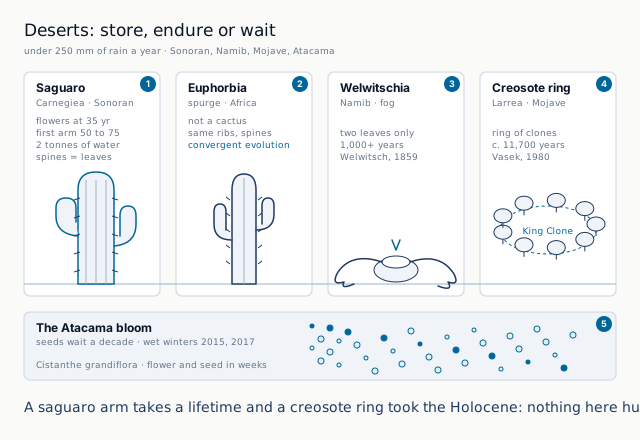
The cacti are the famous storers, and they belong to the Americas: of some 1,800 species, only one, Rhipsalis baccifera , grows wild elsewhere. The saguaro, Carnegiea gigantea , of the Sonoran Desert takes about 35 years to flower, sprouts its first arm after 50 to 75 years and may stand 12 metres tall at 150. Its pleated stem expands like an accordion after rain; a large one weighs over two tonnes, nearly all of it water. Its spines are leaves reduced to needles, shading the stem and deterring thirsty animals, and the green stem has taken over photosynthesis. In Africa and Madagascar the euphorbias, spurges unrelated to any cactus, evolved the same ribbed, spiny, leafless columns so precisely that garden visitors cannot tell them apart. Botanists call this convergent evolution , and the desert is its textbook.
The endurers are stranger. Welwitschia mirabilis of the Namib, described in 1859 by the Austrian botanist Friedrich Welwitsch, grows only two leaves in its life, which lengthen from the base, fray in the wind and sprawl across the gravel for a thousand years or more, drinking fog. In the Mojave Desert of California the creosote bush, Larrea tridentata , spreads outward as a ring of clones; in 1980 Frank Vasek measured the growth of one ring, King Clone, and put its age at about 11,700 years, older than agriculture.
Then there are the dodgers. The Atacama in Chile is the driest non-polar desert on Earth, some weather stations having recorded no rain for years, yet when a wet winter arrives, as in 2015 and 2017, the gravel plains turn pink with Cistanthe grandiflora and dozens of other ephemerals whose seeds have waited a decade for the signal. They germinate, flower and set seed in a few weeks, then vanish.
Deserts are growing as the climate dries, and the plants that have mastered them are among the slowest to replace. A saguaro arm takes a human lifetime; a creosote ring took the whole of the Holocene.
The Vegetable Kingdom — 100 chapters on the green world that feeds us
Ready when you are.
Tap below to open the full chapter in the book reader. Anchored books jump to this chapter automatically.
Mountains and the Alpine
The Vegetable Kingdom — 100 chapters on the green world that feeds us
Climb a thousand metres and the temperature drops by roughly six degrees Celsius, so a mountain compresses the world's climates into a single afternoon. Humboldt saw this on Chimborazo and Spanish settlers had already named the bands: tierra caliente at the foot, tierra templada , tierra fría and the tierra helada of frost and snow. The sharpest line is the treeline . Christian Körner of Basel has measured it on every continent and found it falls where the mean temperature of the growing season is around six to seven degrees; below that, a tree's roots and growing tips cannot build tissue fast enough to be worth the trunk. Above the treeline the forest ends abruptly or frays into krummholz , 'crooked wood', spruces and pines pruned by ice-laden wind into mats a few centimetres tall that may be centuries old.
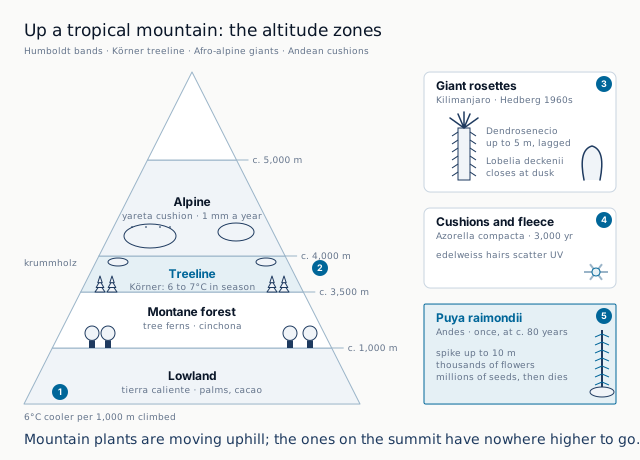
Alpine plants answer the wind by keeping low and keeping warm. Cushion plants pack thousands of tiny shoots into a dome that traps still air; inside an Andean Azorella compacta , the yareta, the temperature can run several degrees above the air around it. The cushion grows about a millimetre a year, and the largest, waist-high mounds of the Altiplano may be more than 3,000 years old. The edelweiss, Leontopodium nivale , wraps itself in woolly hairs; a 2011 study showed that the fine white filaments scatter ultraviolet light before it reaches the cells, a fleece and a sunscreen in one.
On the equator's mountains the problem is not seasons but days. Olov Hedberg, who studied the Afro-alpine flora in the 1950s and 1960s, called it 'summer every day, winter every night'. Kilimanjaro's giant groundsels, Dendrosenecio kilimanjari , stand up to five metres on trunks lagged with their own dead leaves, and the giant lobelias, Lobelia deckenii , close their rosettes at dusk around a reservoir of water that freezes at the surface and shields the bud. The Andes have the most extravagant of all: Puya raimondii , a bromeliad of Peru and Bolivia that grows for around 80 years, then raises a flower spike up to 10 metres carrying thousands of flowers, sets millions of seeds, and dies.
Mountains hold a disproportionate share of the world's plants because every valley is an island, and they are warming fast. Studies of Alpine summits, resurveyed since the early 1900s, find more species on the tops each decade as plants move uphill.
The summit flora has nowhere higher to go. When the climate climbs past the peak, the plants that grew only there are gone.
The Vegetable Kingdom — 100 chapters on the green world that feeds us
Ready when you are.
Tap below to open the full chapter in the book reader. Anchored books jump to this chapter automatically.
The Tundra
The Vegetable Kingdom — 100 chapters on the green world that feeds us
North of the treeline the ground itself is frozen. Permafrost , soil that has stayed below zero for at least two years, underlies roughly a sixth of the exposed land of the Northern Hemisphere, and in summer only a thin skin of it, the active layer, thaws: a few tens of centimetres in Siberia, perhaps a metre in warmer sites. Roots cannot pass that floor, the water above it cannot drain, and the growing season lasts six to ten weeks. Yet the sun does not set for months, and plants use every hour of it.
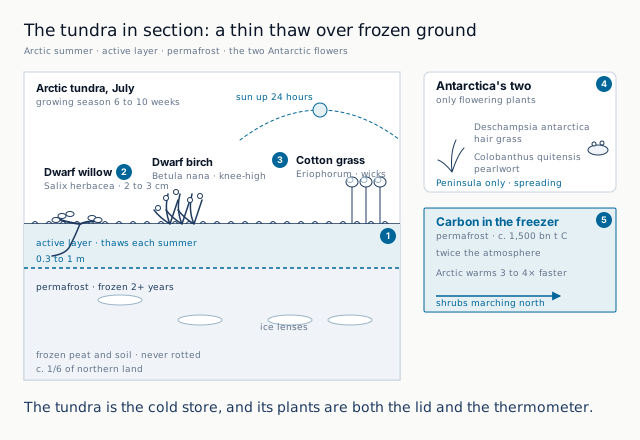
The tundra's trees are there; they are simply very small. The dwarf willow, Salix herbacea , grows a woody trunk that creeps underground and raises leaves two or three centimetres above the moss, and has been called the smallest tree in the world. Dwarf birch, Betula nana , forms knee-high thickets. Cotton grass, Eriophorum , a sedge, carries its seeds on tufts of white fibre that Arctic peoples once used for lamp wicks. The whole vascular flora of the Arctic amounts to a little over 2,000 species and subspecies, as counted by the Panarctic Flora checklist, fewer than grow on a single Andean mountain, but in summer the sedge meadows and the mats of purple saxifrage flower all at once, around the clock.
Antarctica is harder still. Only two flowering plants grow there naturally, the Antarctic hair grass, Deschampsia antarctica , and the pearlwort Colobanthus quitensis , both confined to the Peninsula and nearby islands; the rest of the continent's plant life is moss, lichen and alga. Their spread since the 1960s is itself a thermometer, and surveys on Signy Island found both expanding faster in the 2010s than in the previous fifty years.
The tundra matters most for what it hides. Permafrost holds around 1,500 billion tonnes of carbon in frozen peat and soil, roughly twice as much as the atmosphere, laid down by plants over tens of thousands of years and never rotted. The Arctic has warmed about three to four times faster than the global average since 1979, and as the active layer deepens, microbes get to work on that store. The surface shows it: satellite greenness and repeat photography record shrubification , willow and alder thickets spreading across the Alaskan and Siberian tundra as the ground warms, replacing the lichen heaths on which reindeer and caribou depend.
The tundra is the planet's cold store, and its plants are both the lid and the thermometer. As the shrubs march north, they tell us the lid is lifting.
The Vegetable Kingdom — 100 chapters on the green world that feeds us
Ready when you are.
Tap below to open the full chapter in the book reader. Anchored books jump to this chapter automatically.
Wetlands, Bogs and Swamps
The Vegetable Kingdom — 100 chapters on the green world that feeds us
Land that is wet for most of the year poses a plant one problem above all: roots drown. Waterlogged soil runs out of oxygen within hours, and every wetland plant is an answer to that. Some pipe air down through spongy tissue; some lift their roots above the water; some, in the acid bogs, give up on soil nutrients altogether and eat insects. Wetlands cover a few per cent of the land, yet they hold a wildly disproportionate share of its birds, its fish and its carbon.
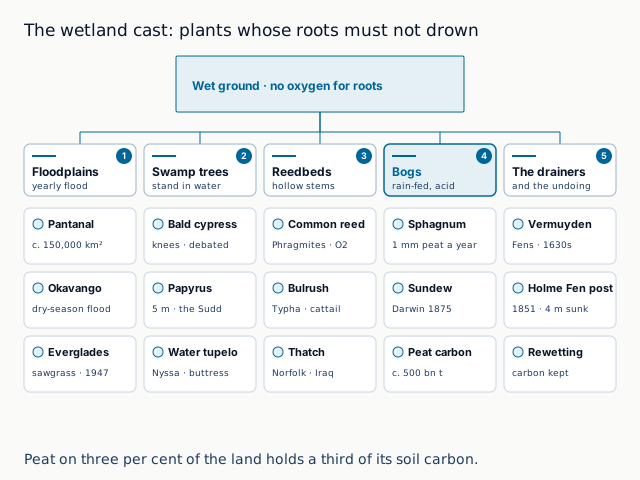
The great tropical wetlands are floodplains that breathe once a year. The Pantanal of Brazil, Bolivia and Paraguay, around 150,000 square kilometres, is the largest, its grasses and water hyacinth rising and falling with the Paraguay River. The Okavango in Botswana is a river that never reaches the sea: rain falling in the Angolan highlands arrives in the delta months later, in the dry season, and spreads across 15,000 square kilometres of papyrus channels and reed islands before evaporating. The Everglades of Florida are a river fifty miles wide and inches deep, Marjory Stoneman Douglas's 'river of grass' of 1947, where sawgrass, Cladium jamaicense , a sedge with saw-edged leaves, stretches to the horizon.
Swamps are wetlands with trees. The bald cypress, Taxodium distichum , of the American South stands in water on buttressed trunks and sends up woody knees , conical growths from its roots whose purpose botanists still debate, since experiments have failed to show that they carry air. Papyrus, Cyperus papyrus , the sedge of the Nile from which Egypt made its paper, grows five metres tall in the Sudd of South Sudan, one of the world's largest swamps. Common reed, Phragmites australis , found on every continent except Antarctica, pumps oxygen to its roots through hollow stems and is the raw material of thatch from Norfolk to the marshes of Iraq.
Bogs are the wetlands rain made. Where rainfall exceeds evaporation, Sphagnum moss builds a dome of peat above the water table, acid and starved of nutrients. Here grow the sundews, Drosera , whose sticky tentacles curl around insects; Charles Darwin fed them meat, glass and hair for his 1875 book Insectivorous Plants and found they responded to a fragment of hair weighing a fraction of a milligram. Peat forms at about a millimetre a year, and peatlands on roughly three per cent of the land hold about a third of the world's soil carbon, some 500 billion tonnes.
Humans have drained wetlands for centuries, from the Dutch engineers who emptied the English Fens after 1630 to the sugar fields of the Everglades. Rewetting them is now one of the cheapest ways to keep carbon in the ground, and the reeds come back on their own.
The Vegetable Kingdom — 100 chapters on the green world that feeds us
Ready when you are.
Tap below to open the full chapter in the book reader. Anchored books jump to this chapter automatically.
Rivers, Lakes and the Floating World
The Vegetable Kingdom — 100 chapters on the green world that feeds us
Plants came out of the water 470 million years ago, and some have gone back. Freshwater offers everything a leaf wants, light and water together, but it withholds oxygen and carbon dioxide, which diffuse through water ten thousand times more slowly than through air. The answers are written in the anatomy. Submerged leaves are thin, often a few cells thick, with no waxy cuticle and no stomata. Floating leaves put their stomata on the upper surface, the only one that sees air. And nearly every water plant is riddled with aerenchyma , spongy tissue full of air channels that runs from leaf to root and keeps the buried parts breathing.
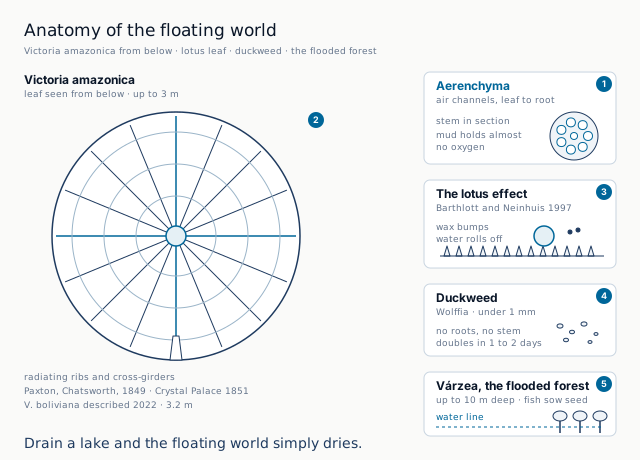
The most famous floating leaf is engineering. Victoria amazonica , the giant water lily of the Amazon, unrolls leaves up to three metres across in a few days; underneath, a lattice of ribs radiates from the stalk, braced by cross-girders, and the whole plate can carry a child. Joseph Paxton, head gardener at Chatsworth, was the first in Britain to flower it, in November 1849, and stood his young daughter Annie on a leaf for the newspapers. He said the leaf's ribbed engineering inspired the Crystal Palace of 1851. In 2022 botanists at Kew described a third species, Victoria boliviana , with leaves over three metres wide, which had been growing unrecognised in collections for a century.
The sacred lotus, Nelumbo nucifera , taught a different lesson. Its leaves emerge spotless from the mud because water cannot wet them: in 1997 Wilhelm Barthlott and Christoph Neinhuis showed that the surface is tiled with microscopic wax-coated bumps, so a droplet sits on the peaks like a ball on nails and rolls off carrying dirt with it. The lotus effect now coats paints, glass and fabrics. Lotus seeds are as remarkable: in 1995 Jane Shen-Miller germinated one from a dry lakebed in north-east China that radiocarbon dating put at around 1,300 years old.
At the other end of the scale, the duckweeds have reduced the flowering plant to a floating speck. Wolffia species are under a millimetre across, with no roots, no stems and the smallest flower known, and they double their numbers in a day or two. The water hyacinth, Pontederia crassipes , from South America, floats on bulbous leaf stalks full of aerenchyma and has become one of the worst invaders on Earth; by 1998 it smothered some 20,000 hectares of Lake Victoria.
Freshwater is less than one per cent of the planet's surface and home to a startling share of its plants, and of the threats to them. Drain a lake and the floating world simply dries.
The Vegetable Kingdom — 100 chapters on the green world that feeds us
Ready when you are.
Tap below to open the full chapter in the book reader. Anchored books jump to this chapter automatically.
The Mediterranean Five
The Vegetable Kingdom — 100 chapters on the green world that feeds us
Five small regions of the world share a climate of mild wet winters and hot dry summers, and between them hold around a fifth of the world's plant species on about two per cent of its land. They are the Mediterranean basin itself; California and its chaparral ; central Chile's matorral ; the Cape of South Africa's fynbos ; and the kwongan and mallee of south-western and southern Australia. All sit on the western edges of continents between about 30 and 40 degrees of latitude, where cold ocean currents and winter storms meet summer high pressure.
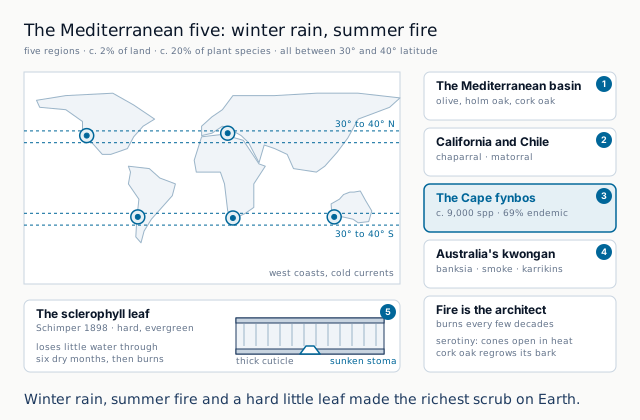
Their plants look alike because the climate demands it. The typical leaf is small, hard, leathery and evergreen, the sclerophyll leaf that Andreas Schimper named in 1898: thick cuticle, sunken stomata, built to lose as little water as possible through a six-month drought and to be worth keeping when the rains return. Olive, holm oak and cork oak in the Mediterranean, manzanita and ceanothus in California, proteas in the Cape and banksias in Australia all converged on the same hard leaf, and all of them burn.
Fire is the second architect. The summer scrub is dry, resinous and dense, and in every one of the five it burns on a cycle of decades. The plants expect it. Many banksias hold their seeds in woody cones that open only in the heat of a fire, a habit called serotiny ; many Cape and Australian species germinate only after smoke, and in 2004 a team in Perth led by Gavin Flematti isolated the chemical responsible, a family of compounds they named karrikins after the Noongar word for smoke. Cork oak survives by growing bark thick enough to be harvested; Californian chamise resprouts from a swollen root crown within weeks of a burn.
The jewel is the Cape. The Cape Floral Kingdom , the smallest of the world's six floral kingdoms at around 90,000 square kilometres, holds some 9,000 species of plant, about 69 per cent of them found nowhere else: around 660 species of Erica heath alone, the proteas including the king protea Protea cynaroides , and the restios, wiry rush-like plants that take the place of grasses. Fynbos, from the Dutch for 'fine bush', is so dense in species that a single mountain can out-count a whole nation.
These five regions are also where people most like to live, and vineyards, suburbs and more frequent fire are squeezing them. Nearly all of the Mediterranean basin's original vegetation has been altered since antiquity, and the Cape's lowland fynbos is among the most threatened habitat on Earth. Winter rain, summer fire and a hard little leaf made the richest scrub in the world; keeping it means keeping the fire on its old schedule.
The Vegetable Kingdom — 100 chapters on the green world that feeds us
Ready when you are.
Tap below to open the full chapter in the book reader. Anchored books jump to this chapter automatically.
Islands
The Vegetable Kingdom — 100 chapters on the green world that feeds us
An island is an experiment with the lid on. Few plants arrive, so the ones that do find empty niches and run riot, splitting into forms that would never survive among mainland competitors. Nowhere shows this better than Hawaii, the most isolated archipelago on Earth. Its native flowering plants descend from perhaps 290 natural arrivals in five million years or more, roughly one successful seed every 20,000 years, carried by wind, sea or a bird's gut; about 90 per cent of the species that resulted grow nowhere else.
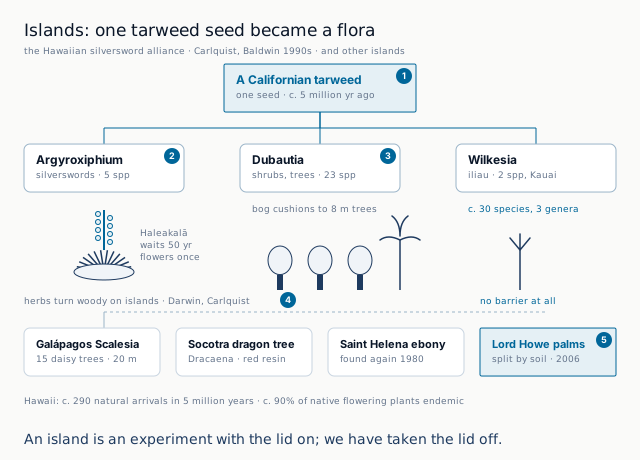
The silverswords are the showpiece. Argyroxiphium sandwicense grows on the cinder slopes of Haleakalā on Maui, a globe of silver, hair-covered sword leaves that waits up to fifty years, raises a flower spike of hundreds of heads, and dies. In the 1990s Bruce Baldwin's DNA work confirmed what Sherwin Carlquist had suspected from anatomy: the silverswords, and some 30 related species of shrubs, trees, vines and cushions in three genera, all descend from a single small tarweed that arrived from California some five million years ago. One weedy annual became a whole flora, a pattern called adaptive radiation .
Islands make plants woody. Darwin noticed it in On the Origin of Species and Carlquist catalogued it: lineages that are small herbs on the mainland turn into shrubs and trees on islands, where there are no real trees to compete with. The Galápagos have Scalesia , fifteen species of daisy that grow into forests of trees up to 20 metres, the botanical counterpart of Darwin's finches. Saint Helena had its cabbage trees and the Saint Helena ebony, Trochetiopsis ebenus , a mallow turned shrub, given up for extinct until George Benjamin found two plants on a cliff in 1980 and propagated them. Socotra, off Yemen, has the dragon's blood tree, Dracaena cinnabari , an umbrella of leaves on a trunk that bleeds red resin, one of about 300 endemic species on an island of 825.
Islands even split species without a barrier. On Lord Howe Island, 600 kilometres off Australia, the two kentia palms, Howea forsteriana and Howea belmoreana , arose from one ancestor on an island only ten kilometres long; a 2006 study led by Vincent Savolainen showed they divided by soil type and shifted their flowering times apart, so they no longer cross, a rare documented case of sympatric speciation .
Islands hold a disproportionate share of the world's plant species and of its extinctions: goats, rats, pigs and introduced weeds have done to the island floras what competitors never could. The experiment is not over, but we have taken the lid off.
The Vegetable Kingdom — 100 chapters on the green world that feeds us
Ready when you are.
Tap below to open the full chapter in the book reader. Anchored books jump to this chapter automatically.
Plants in the City
The Vegetable Kingdom — 100 chapters on the green world that feeds us
A city is a new biome, barely a few thousand years old, and plants have already moved in. It is warmer than the country around it by one to three degrees on average and far more at night, a heat island of brick and tarmac. It is drier, more trampled, richer in nitrogen, split into thousands of tiny patches, and planted with species from every continent. For some plants it is a disaster; for a surprising number it is paradise.
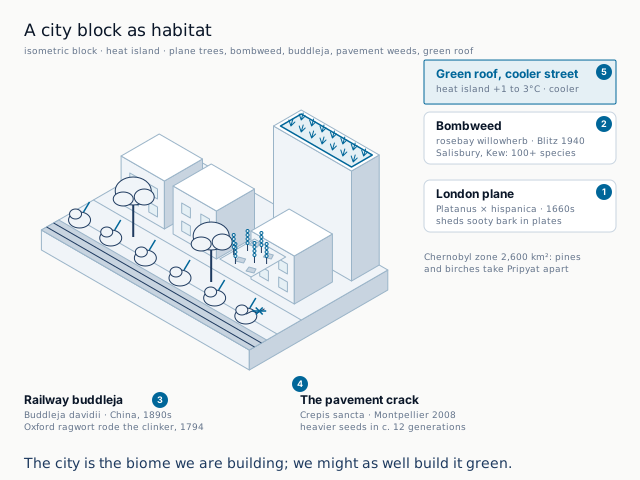
The city's signature tree is a hybrid born in a garden. The London plane, Platanus × hispanica , appeared around the 1660s, a cross between the American sycamore and the oriental plane that may have happened at Oxford or in John Tradescant's garden at Lambeth. It tolerates compacted soil, pollution and savage pruning, and it sheds its bark in plates, taking the soot with it; it lines the streets of London, Paris, Rome and New York. Oxford ragwort, Senecio squalidus , escaped from the Oxford Botanic Garden in 1794 and found the clinker of the new railways a fair imitation of its home on the lava of Mount Etna, so that by 1900 it had ridden the rails across Britain.
Disturbance is the city's gift. When the Blitz opened thousands of bomb sites across London in 1940 and 1941, rosebay willowherb, Chamerion angustifolium , once an uncommon woodland plant, carpeted the rubble in magenta so completely that Londoners called it bombweed; Edward Salisbury, director of Kew, catalogued well over a hundred species on the bombed ground, including buddleja, Buddleja davidii , a Chinese shrub introduced in the 1890s that now seeds itself along every railway cutting and into every neglected wall in Britain.
The city also breeds its own plants. In Montpellier, Pierre-Olivier Cheptou and colleagues showed in 2008 that the weed Crepis sancta growing in pavement tree pits had, within about a dozen generations, shifted to producing heavier seeds that drop beside the parent rather than feathery ones that blow onto concrete and die: evolution measured in a street. At Chernobyl, where the exclusion zone of 2,600 square kilometres was emptied in 1986, pines, birches and willows have taken the town of Pripyat apart, roots in the stairwells of the apartment blocks.
Cities now cover some three per cent of the land and hold more than half of humanity, and the plants in them matter out of proportion: street trees cool pavements by several degrees, green roofs slow stormwater, and a buddleja on a wall feeds the butterflies of an entire street. The city is the biome we are building; we might as well build it green.
The Vegetable Kingdom — 100 chapters on the green world that feeds us
Ready when you are.
Tap below to open the full chapter in the book reader. Anchored books jump to this chapter automatically.
The First Farmers
The Vegetable Kingdom — 100 chapters on the green world that feeds us
Farming was not invented once. It was invented at least seven times, on different continents, by people who had never heard of one another, within a few thousand years of the last ice age ending. The earliest well-dated centre is the Fertile Crescent , the arc of hills from the Levant through south-east Turkey to the Zagros, where einkorn, emmer wheat, barley, lentil, pea, chickpea, bitter vetch and flax, the eight founder crops, were being sown and harvested by around 11,500 years ago. Rice followed on the Yangtze and millet on the Yellow River, maize in Mexico, potato and quinoa in the Andes, taro and banana in the highlands of New Guinea, sorghum and pearl millet in the African Sahel, sunflower and squash in eastern North America.
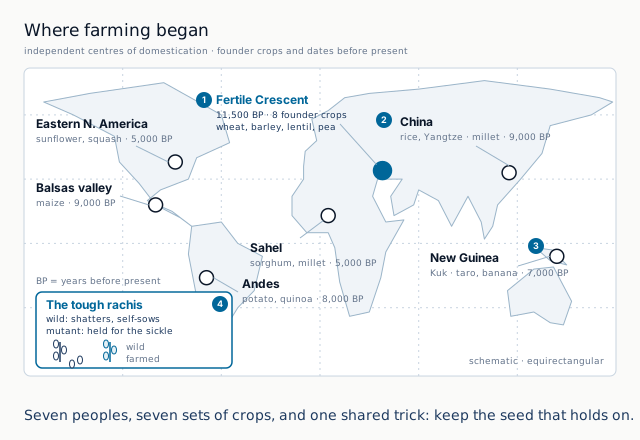
How do we know? Partly from charred seeds. At Abu Hureyra on the Euphrates in Syria, excavated by Andrew Moore in 1972 and 1973 before the Tabqa dam flooded it, archaeobotanist Gordon Hillman sieved out thousands of grains spanning the shift from gathering wild cereals to growing them. The tell-tale is a tiny piece of anatomy. A wild wheat ear has a brittle rachis , the stalk of the spike, which shatters at ripeness so the grain falls and sows itself. A few plants carry a mutation that keeps the rachis tough. In the wild that is fatal; under a sickle it is the only grain that reaches the threshing floor and the seed store. Harvest with a sickle for a few centuries and the whole population turns non-shattering. The tough rachis, larger seeds, synchronous ripening and lost dormancy together make up the domestication syndrome , and its fingerprint shows in cereals, pulses and even…
The idea of multiple centres belongs to Nikolai Vavilov, who between 1916 and 1940 led expeditions to 64 countries and noticed that each crop was most varied in one region, its probable homeland. He named eight centres in 1935. Modern genetics has moved some lines and added others but kept his map: Zea mays in the Balsas valley of Mexico around 9,000 years ago, Oryza sativa on the lower Yangtze about the same time, and at Kuk Swamp in Papua New Guinea drainage ditches for taro and banana dated to at least 7,000 years ago, a wet-tropics agriculture owing nothing to grain.
Farming was not obviously a good deal. Early farmers were shorter than their foraging ancestors, worked longer and caught more diseases from their animals and their crowded villages. But a field feeds far more people per hectare than a forest, and populations that grow can seldom go back. Within ten thousand years the descendants of those first sowers covered the planet, and so did their grasses. Everything in the rest of this part, every loaf, bowl and tortilla, begins with a stalk that refused to break.
The Vegetable Kingdom — 100 chapters on the green world that feeds us
Ready when you are.
Tap below to open the full chapter in the book reader. Anchored books jump to this chapter automatically.
Wheat
The Vegetable Kingdom — 100 chapters on the green world that feeds us
Wheat is the most widely grown crop on Earth, sown on around 220 million hectares, more land than any other plant, and harvested at roughly 790 million tonnes a year. It is also a genetic oddity. Bread wheat , Triticum aestivum , carries three whole genomes stacked inside one cell, from three different wild grasses, joined by two accidents thousands of years apart.
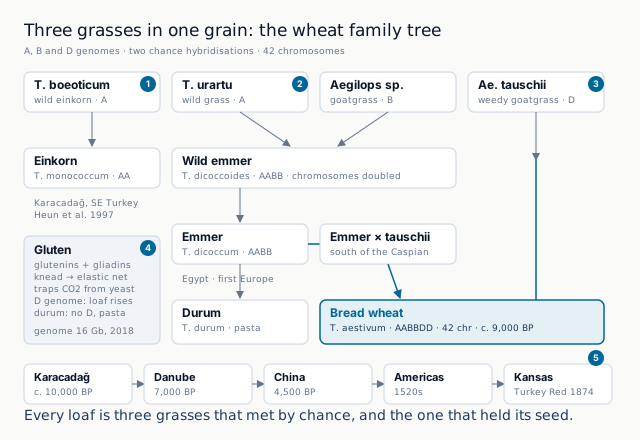
The first wheats were simpler. Einkorn , Triticum monococcum , has one genome, labelled A. In 1997 Manfred Heun and colleagues fingerprinted the DNA of 338 wild and cultivated einkorn lines and traced the crop to a single mountain range, the Karacadağ in south-east Turkey, within sight of Göbekli Tepe. Emmer , Triticum dicoccum , already carried two genomes, A and B, because its wild ancestor arose hundreds of thousands of years earlier when a wild einkorn relative crossed with a goatgrass of the Aegilops group and the hybrid doubled its chromosomes instead of dying sterile. Emmer was the wheat of Egypt and of early Europe. Then, around 9,000 years ago, somewhere south of the Caspian Sea, a cultivated emmer crossed with a weedy goatgrass, Aegilops tauschii , and acquired a third genome, D. The result had 42 chromosomes, threshed free of its husks, grew in colder, wetter places, and its…
The rising is chemistry. Wheat grain stores proteins called glutenins and gliadins; wetted and kneaded they knit into gluten , an elastic net that traps the carbon dioxide from yeast. The D genome brought the particular glutenins that make a loaf stand up. Durum, Triticum durum , a hard tetraploid descended from emmer, lacks them, which is why it makes pasta and couscous but poor bread. The bread wheat genome was finally read in full in 2018 by an international consortium: around 16 billion base pairs, five times the human genome, with more than 100,000 genes.
From the Karacadağ wheat went everywhere a cool season allows. It followed the Danube and the Mediterranean coast into Europe by 7,000 years ago, crossed to China by around 4,500 years ago, and sailed to the Americas with the Spanish in the 1520s. In 1874 Mennonite settlers carried a hard red winter wheat called Turkey Red from the Ukrainian steppe to Kansas, and the American plains became a granary. The breadbaskets of today, the Black Earth of Ukraine and Russia, the Punjab, the Canadian prairie and the Australian wheat belt, all grow the grass from one Turkish mountain. Every loaf is the work of three grasses that met by chance, and of a people who kept the one that held its seed.
The Vegetable Kingdom — 100 chapters on the green world that feeds us
Ready when you are.
Tap below to open the full chapter in the book reader. Anchored books jump to this chapter automatically.
Rice
The Vegetable Kingdom — 100 chapters on the green world that feeds us
More than half of humanity eats rice every day. Oryza sativa is harvested at around 780 million tonnes of paddy a year, nearly nine-tenths of it in Asia, and it is the only major cereal grown standing in water. The water is not a need but a trick. Rice tolerates flooding because its roots carry aerenchyma , air-filled channels that pipe oxygen down from the leaves, while most weeds drown. A paddy is a weed-control system that happens to grow grain.
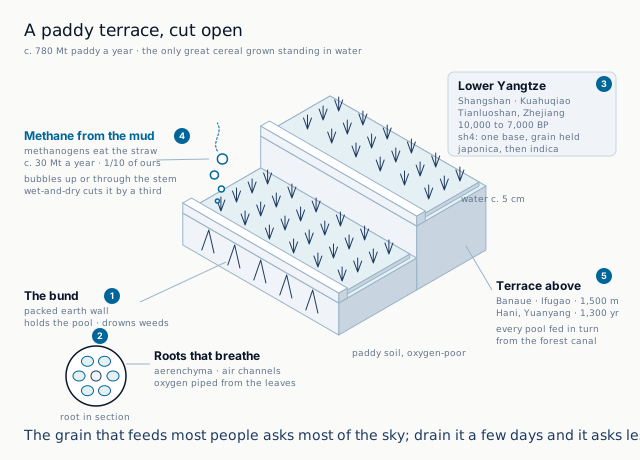
Rice was tamed on the lower Yangtze. At Shangshan, Kuahuqiao and Tianluoshan in Zhejiang, archaeologists have traced rice phytoliths and spikelet bases across the slow shift from wild to cultivated grain between about 10,000 and 7,000 years ago. The decisive gene is sh4 : one base change weakens the layer where the grain breaks from the stalk, so the spikelet stays on the plant for the harvester. Genetics has settled a long argument about the crop's two great groups. In 2012 Huang Xuehui and colleagues sequenced 446 wild and 1,083 cultivated rices and showed that japonica , the short sticky grain of China, Japan and Korea, was domesticated first, and that indica , the long-grained rice of South and South-East Asia, arose when japonica crossed with local wild rice as farming spread. Africa did it separately: Oryza glaberrima , domesticated from Oryza barthii in the inner Niger delta…
Terraces are the paddy's answer to slopes. The Ifugao terraces around Banaue in the Philippines, carved into the Cordillera and walled with stone and mud, climb to 1,500 metres and are watered by a canal system that gives every pool its turn. Their age is debated: tradition says 2,000 years, radiocarbon suggests several centuries. Either way they are engineering at the scale of a mountain range, maintained by hand.
The paddy has a cost. Flooded soil runs short of oxygen, and microbes called methanogens turn the straw and root exudates into methane , which bubbles up or travels out through the rice plant's own air channels. Rice fields emit roughly 30 million tonnes of methane a year, around a tenth of what humans release, and methane warms the planet about 80 times as strongly as carbon dioxide over 20 years. Draining the field for a few days mid-season, a practice called alternate wetting and drying, cuts the emissions by a third to a half without cutting the yield. The grain that feeds the most people also asks the most of the atmosphere, and we are learning to give it less water.
The Vegetable Kingdom — 100 chapters on the green world that feeds us
Ready when you are.
Tap below to open the full chapter in the book reader. Anchored books jump to this chapter automatically.
Maize
The Vegetable Kingdom — 100 chapters on the green world that feeds us
No crop has changed more in our hands than maize. Its wild ancestor, teosinte , Zea mays subspecies parviglumis , is a bushy grass of the Balsas river valley in south-west Mexico whose "ear" is a spike of five to twelve kernels, each sealed in a stony case that passes unharmed through a deer. A modern maize ear carries 500 or more naked kernels on a cob that cannot shed them. For a century botanists doubted the two were even related.
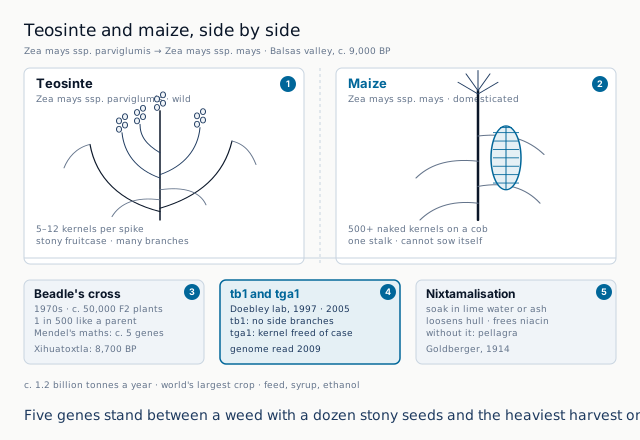
George Beadle, who had won a Nobel Prize for work on fungal genetics, was convinced they were. In the 1970s, retired, he crossed teosinte with maize and grew around 50,000 second-generation plants in Mexico. About one in 500 looked like a parent, which by the arithmetic of Mendel meant the difference lay in roughly five genes. John Doebley then found them. In 1997 his laboratory at Wisconsin showed that a regulatory change at tb1 , teosinte branched1 , suppresses side branches and makes the plant pour its energy into a few large ears; in 2005 they identified tga1 , the gene that frees the kernel from its case. Microscopic starch grains and phytoliths at the Xihuatoxtla rock shelter in the Balsas valley date the first maize to around 8,700 years ago.
Maize fed the Olmec, the Maya and the Aztec, and the Maya creation story in the Popol Vuh says the gods made people from maize dough. The dough had a secret. Maize is poor in available niacin , and a people living on it alone get pellagra, a disease of skin, gut and mind. Mesoamerican cooks soaked the grain in water with lime or wood ash, a process called nixtamalisation , which loosens the hull and frees the vitamin. When maize crossed to Europe and the American South without the ash, pellagra followed: in the United States it caused around 100,000 deaths in the early twentieth century before Joseph Goldberger traced it to diet in 1914.
Today maize is the world's largest crop by weight, at around 1.2 billion tonnes a year. Most of it never reaches a human mouth directly: it is cattle feed, pig feed, chicken feed, corn syrup, starch and, in the United States, around a third of the harvest goes to ethanol for cars. The maize genome, read in 2009, is a mosaic of jumping genes, the transposons Barbara McClintock discovered in maize chromosomes in the 1940s and for which she received a Nobel Prize in 1983. A weed with stony seeds became, kernel by kernel, the plant that feeds our animals and our engines.
The Vegetable Kingdom — 100 chapters on the green world that feeds us
Ready when you are.
Tap below to open the full chapter in the book reader. Anchored books jump to this chapter automatically.
The Potato and the Columbian Exchange
The Vegetable Kingdom — 100 chapters on the green world that feeds us
In 1972 the historian Alfred Crosby gave a name to the greatest reshuffling of living things since the continents drifted apart. He called it the Columbian Exchange : the two-way traffic of plants, animals and diseases between the Old World and the New that began with the voyages of 1492. Westward went wheat, rice, sugar cane, coffee, bananas, citrus and grapes, with horses, cattle and smallpox. Eastward went maize, cassava, sweet potato, tomato, chilli, cacao, groundnut, pineapple, vanilla, tobacco and the potato. Within two centuries there were chillies in Sichuan and Goa, tomatoes in Naples, maize in the Balkans and West Africa, and cassava across the Congo basin.
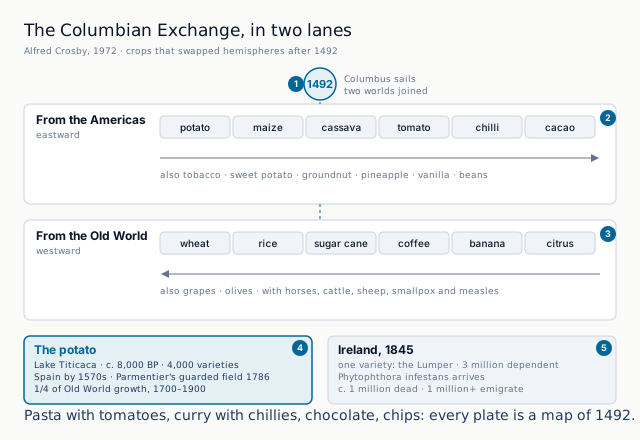
The potato , Solanum tuberosum , is the exchange's quiet giant. It was domesticated on the altiplano around Lake Titicaca, between Peru and Bolivia, around 8,000 years ago, from a group of bitter wild species, and the Andes still grow about 4,000 named varieties in every colour from purple to yellow. Quechua farmers freeze-dried it on cold nights into chuño , a store that keeps for years. The Spanish carried it home by the 1570s. In Europe it was slow to catch on, suspected as a member of the nightshade family and not mentioned in the Bible, until a French army pharmacist, Antoine-Augustin Parmentier, who had eaten little else as a prisoner in Prussia, ran a campaign. In 1786 he planted a field at Sablons outside Paris and posted guards by day, removing them at night so that curious locals would steal the tubers and plant them. Louis XVI wore the flower in his buttonhole.
The potato yields more calories per hectare than any grain and grows in cold wet places where wheat fails. Economists Nathan Nunn and Nancy Qian calculated in 2011 that it accounts for roughly a quarter of the Old World's population growth between 1700 and 1900. It also showed the danger of a single crop. Ireland by 1840 was growing one variety, the Lumper, on which three million people depended; when the water mould Phytophthora infestans arrived in 1845, the Great Famine killed around a million and drove more than a million to emigrate.
Cassava, Manihot esculenta , from the southern Amazon, became the staple of tropical Africa, which now grows about 60 per cent of the world's crop; Nigeria is the largest producer. China is today the world's largest grower of potatoes, at around 95 million tonnes. The exchange ran one way for empires and both ways for plants, and the dinner plates of every continent are now a map of it: pasta with tomatoes, curry with chillies, chocolate, chips.
The Vegetable Kingdom — 100 chapters on the green world that feeds us
Ready when you are.
Tap below to open the full chapter in the book reader. Anchored books jump to this chapter automatically.
Pulses, Roots and Oils
The Vegetable Kingdom — 100 chapters on the green world that feeds us
Grain is only a third of a meal. The rest of what farming grows falls into three families: the pulses , seeds of the pea family that carry protein; the roots and tubers , swollen storage organs that carry starch; and the oil crops , whose seeds and fruits carry fat. Each has its own history, and the first family carries a trick that keeps the others fed.
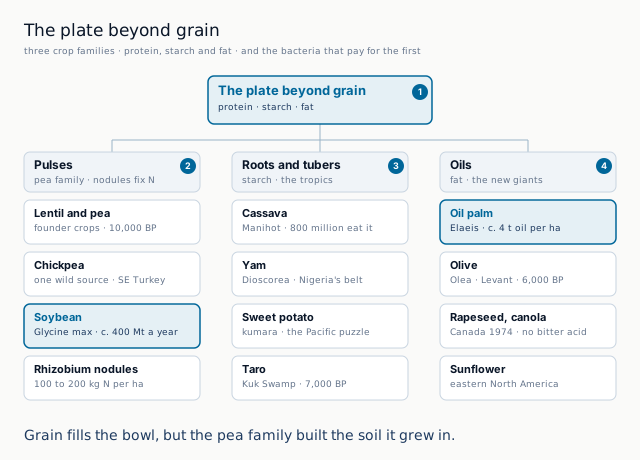
Lentil and pea are as old as wheat. Charred lentils at sites in Syria and Turkey date to around 10,000 years ago, and chickpea was tamed from a wild species found only in a corner of south-east Turkey. The pea family's secret lies in its roots. Nodules on them house Rhizobium bacteria that take nitrogen gas from the air and turn it into ammonia, feeding the plant and leaving the soil richer when it is ploughed in. A good crop of clover or beans fixes 100 to 200 kilograms of nitrogen per hectare, which is why farmers from the Romans to the Norfolk rotation sowed a legume before a cereal. The giant of the family is soybean , Glycine max , domesticated in China at least 6,000 years ago and now harvested at close to 400 million tonnes a year. Brazil overtook the United States as the top producer around 2020, and about three-quarters of the crop is crushed into meal for pigs, chickens and…
The roots feed the tropics. Cassava , Manihot esculenta , from the southern Amazon, tolerates drought and poor soil and keeps in the ground for two years, but its tissues hold cyanide-releasing compounds that must be grated, soaked or fermented away. Around 800 million people depend on it. West Africa's yam belt, led by Nigeria, grows most of the world's Dioscorea yams. And the sweet potato, Ipomoea batatas , poses a puzzle: an American plant, it was growing in Polynesia centuries before Europeans arrived, and its Polynesian name, kumara , resembles words in Quechua. Whether seafarers carried it or a seed floated, botanists still debate.
The oils are the newest giants. The African oil palm moved to Malaysia and Indonesia in the twentieth century, and those two countries now produce around 85 per cent of the world's palm oil. The olive, Olea europaea , was domesticated in the eastern Mediterranean around 6,000 years ago and still gives Spain, Italy and Greece their defining crop. Rapeseed, bred into canola in Canada in 1974 with its bitter acids removed, paints a third of the European countryside yellow each spring. Grain fills the bowl, but the pea family built the soil it grew in.
The Vegetable Kingdom — 100 chapters on the green world that feeds us
Ready when you are.
Tap below to open the full chapter in the book reader. Anchored books jump to this chapter automatically.
Fruit and the Orchard
The Vegetable Kingdom — 100 chapters on the green world that feeds us
Plant a pip from a Bramley apple and you will not get a Bramley. Apples are self-incompatible and extravagantly heterozygous, so every seed is a new and usually mediocre individual. The orchard's answer is three thousand years old. Grafting joins a cutting of the tree you want, the scion , to the roots of another, the rootstock , so that their cambium layers knit and the scion grows on as a clone. Grafting was described by Theophrastus around 300 BC, and some scholars read it in Mesopotamian texts from around 2000 BC. Every Bramley descends from one seedling planted by Mary Ann Brailsford in Southwell, Nottinghamshire, in 1809; every Granny Smith from a chance tree in Maria Ann Smith's Sydney garden in 1868. The rootstock sets the size: the dwarfing M9 stock, selected at East Malling in Kent from 1912, is why modern orchards are rows of trees you can pick without a ladder.
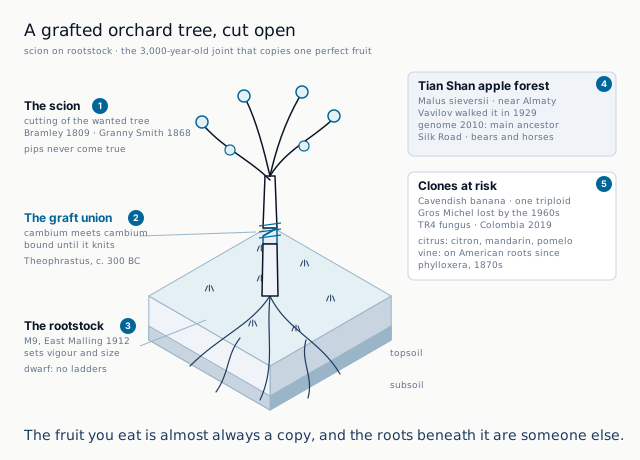
The apple itself came from the mountains. Malus sieversii still grows as a wild fruit forest on the slopes of the Tian Shan in Kazakhstan, near Almaty, a city whose old name, Alma-Ata, is usually read as "father of apples". Vavilov walked those forests in 1929 and saw apples as good as any in a market. The genome, read in 2010, confirmed Malus sieversii as the main ancestor of the cultivated apple, with later crossing from the European crab Malus sylvestris as traders carried pips west along the Silk Road.
Other fruits are cloned too. The Cavendish banana , which makes up almost all of the world's export trade, is a sterile triploid propagated from suckers, descended from a plant grown in the 1830s at Chatsworth House by Joseph Paxton. Its predecessor, Gros Michel, was wiped out as an export crop by the 1960s by the soil fungus Fusarium known as Panama disease, and a new strain, TR4, is now moving through Asia, Africa and since 2019 Latin America, with the identical Cavendish plants unable to resist it. Citrus tells a different story: genomes published in 2018 showed that every cultivated citrus descends from three wild ancestors, the citron, the mandarin and the pomelo. The sweet orange is a pomelo-mandarin hybrid, the lemon a citron crossed with sour orange, and the grapefruit arose in Barbados in the eighteenth century.
The oldest orchard crops are the olive, domesticated in the Levant around 6,000 years ago, and the grapevine, Vitis vinifera , where a 2023 study of 3,500 genomes found two domestications around 11,000 years ago, in Western Asia and the Caucasus. When the phylloxera aphid from America destroyed Europe's vineyards in the 1860s and 1870s, the cure was the orchard's oldest trick: grafting every French vine onto an American rootstock. The fruit you eat is almost always a copy, and the roots beneath it are almost always someone else.
The Vegetable Kingdom — 100 chapters on the green world that feeds us
Ready when you are.
Tap below to open the full chapter in the book reader. Anchored books jump to this chapter automatically.
Soil, Manure and Rotation
The Vegetable Kingdom — 100 chapters on the green world that feeds us
A field is a bank account. Every harvest withdraws nitrogen, phosphorus and potassium in the grain and straw, and a farm that only withdraws goes broke. Medieval Europe knew this dimly and left a third of its land fallow each year. The eighteenth-century answer was the Norfolk four-course rotation : wheat, then turnips, then barley, then clover, and round again. Turnips were hoed, which cleared weeds, and fed to sheep over winter, whose dung went back on the land. Clover, a legume, fixed nitrogen for the wheat that followed. Nothing lay idle. Charles "Turnip" Townshend, the viscount who retired from politics to his Norfolk estate in 1730, became its evangelist, and the rotation doubled yields in the counties that adopted it.
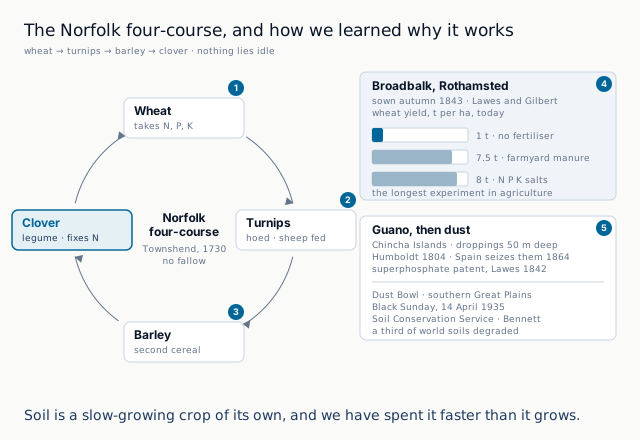
Why it worked was explained a century later. In 1840 Justus von Liebig argued that plants feed on minerals, not on humus, and that growth is limited by whichever nutrient is scarcest. Two Englishmen tested it in the ground. John Bennet Lawes, who patented superphosphate in 1842 by treating bones and phosphate rock with sulphuric acid, and the chemist Joseph Henry Gilbert sowed the Broadbalk field at Rothamsted in Hertfordshire in the autumn of 1843 with wheat on strips fed different diets: nothing, farmyard manure, or combinations of chemical salts. The strips are still sown every year, the longest-running agricultural experiment on Earth, and the unmanured plot still yields about a tonne a hectare, a fifth of its fertilised neighbours.
The nineteenth century's fertiliser was bird droppings. On the Chincha Islands off Peru, where it never rains, cormorants and boobies had piled guano up to 50 metres deep over millennia. Humboldt brought samples to Europe in 1804; by the 1850s Peru was exporting hundreds of thousands of tonnes a year, dug by Chinese indentured labourers, and in 1864 Spain seized the islands and started a war over them. The deposits were largely gone within decades, and the Haber-Bosch process would replace them.
Soil can also be lost. In the 1930s a decade of drought on the southern Great Plains of the United States, where millions of hectares of prairie had been ploughed for wheat, turned the topsoil into dust storms that darkened Washington and dropped grit on ships at sea. On Black Sunday, 14 April 1935, a wall of dust rolled across Oklahoma, and that same month Congress created the Soil Conservation Service under Hugh Hammond Bennett. Contour ploughing, shelterbelts and the terraces that Andean, Ifugao and Chinese farmers had built for centuries were the remedies. The United Nations reckons a third of the world's soils are now degraded. Soil is not dirt but a slow-growing crop of its own, and we have been spending it faster than it grows.
The Vegetable Kingdom — 100 chapters on the green world that feeds us
Ready when you are.
Tap below to open the full chapter in the book reader. Anchored books jump to this chapter automatically.
Breeding Better Plants
The Vegetable Kingdom — 100 chapters on the green world that feeds us
For ten thousand years farmers bred plants by keeping the best seed. Breeding became a science in a monastery garden. Between 1856 and 1863 Gregor Mendel grew some 28,000 pea plants at Brno, crossing tall with short, round with wrinkled, and counting. His 1866 paper showed that traits pass as discrete units in predictable ratios, three to one in the second generation. Nobody noticed until 1900, when three botanists rediscovered his rules, and within a decade plant breeding had a theory.
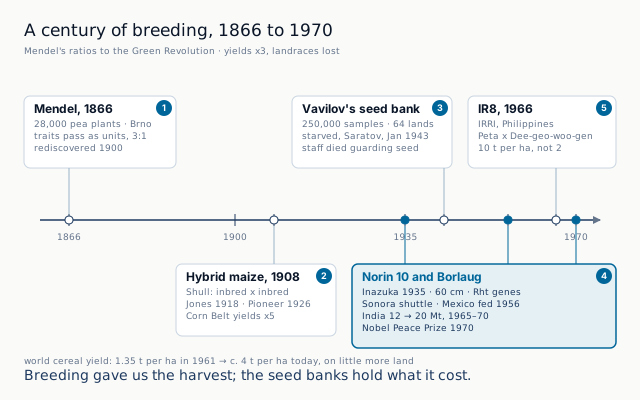
The first great application was hybrid maize . George Shull at Cold Spring Harbor showed in 1908 that inbred maize lines are feeble but their crosses are vigorous, a phenomenon called heterosis. Donald Jones made it practical in 1918 with the double cross, and Henry Wallace founded Pioneer Hi-Bred in 1926 to sell the seed. By 1960 almost every field in the American Corn Belt was hybrid, and yields have risen from under two tonnes a hectare to more than ten. Because hybrids do not breed true, farmers buy seed each year, which is also why a seed industry exists.
Breeding needs raw material. Nikolai Vavilov built the world's first great seed bank in Leningrad from expeditions to 64 countries, around a quarter of a million samples. Arrested in 1940 for his genetics, he died of starvation in a Saratov prison in January 1943. That same winter, in the besieged city, his staff guarded the collection through the famine; several of them died of hunger at their desks surrounded by edible seed, and the rice curator Dmitri Ivanov was found among his sacks.
The Green Revolution turned on one Japanese wheat. Norin 10, bred by Gonjiro Inazuka and released in 1935, stood barely 60 centimetres tall; a short stiff straw could carry a heavy, well-fertilised ear without lodging. Its dwarfing genes reached the United States in 1946 and Mexico soon after, where Norman Borlaug, shuttling between two seasons a year at Sonora and Chapingo, bred them into rust-resistant wheats. Mexico was self-sufficient by 1956; India and Pakistan sowed Borlaug's seed in the mid-1960s and India's wheat harvest went from 12 million tonnes in 1965 to 20 million in 1970, the year Borlaug received the Nobel Peace Prize. Rice followed. At the International Rice Research Institute in the Philippines, a cross of the Indonesian Peta with the Taiwanese dwarf Dee-geo-woo-gen gave IR8 in 1966, yielding up to ten tonnes a hectare where farmers were used to two.
World cereal yields have roughly tripled since 1961 on only slightly more land, and famine in Asia receded. The bill was real too: a narrower gene pool as thousands of landraces vanished from fields, dependence on fertiliser, pesticide and irrigation, and aquifers under the Punjab now falling by a metre a year. Breeding gave us the harvest; the seed banks hold what it cost.
The Vegetable Kingdom — 100 chapters on the green world that feeds us
Ready when you are.
Tap below to open the full chapter in the book reader. Anchored books jump to this chapter automatically.
Feeding Eight Billion
The Vegetable Kingdom — 100 chapters on the green world that feeds us
The world passed eight billion people in November 2022, and almost all of them eat plants that fit on one hand. Of some 390,000 known plant species, humans have cultivated at least 6,000. Today about 200 are grown at any scale, around 15 crops supply 90 per cent of our plant calories, and three grasses, rice, wheat and maize, supply more than half. The funnel is the central fact of modern agriculture, and both its strength and its danger.
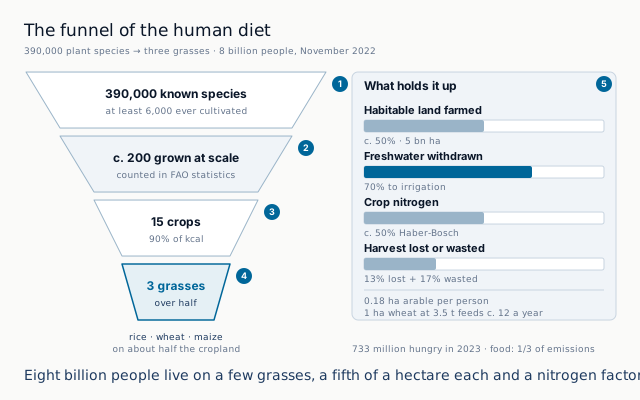
The land tells the same story. Roughly half of the planet's habitable land, about five billion hectares, is farmed. Of that, three-quarters is pasture or grows feed for livestock, which return around 18 per cent of our calories and 37 per cent of our protein; the quarter that grows crops for people directly does most of the feeding. Irrigation takes about 70 per cent of all the fresh water humans withdraw, and the fifth of cropland that is irrigated produces about 40 per cent of the food. Behind the harvest stands the chemistry of a century ago: roughly half the nitrogen in the world's crops now comes from the Haber-Bosch process, which means roughly half the people alive are built from factory-fixed nitrogen.
How much does a hectare feed? Wheat at the world average of about 3.5 tonnes a hectare yields around twelve million kilocalories, enough for a dozen people for a year; a good Dutch or Egyptian field at nine tonnes feeds thirty. Arable land works out at about 0.18 hectares per person on Earth, roughly a quarter of a football pitch. The yield gap , the difference between what a field produces and what it could with known methods, is the biggest unused resource in farming: maize in sub-Saharan Africa averages around two tonnes a hectare against eleven in the United States, and the Global Yield Gap Atlas maps the difference field by field.
The numbers hold a paradox. The world grows enough calories for everyone, about 2,900 kilocalories a person a day, yet the FAO counted around 733 million people hungry in 2023, and the food system produces about a third of greenhouse gas emissions. Growing more is not the whole answer; growing it where the hungry are, losing less of it, eating lower on the funnel and sparing land for the forest are the rest. Eight billion people live on a few grasses, a fifth of a hectare each and a nitrogen factory. The green kingdom has fed every one of us so far; the rest of this book is about keeping it able to.
The Vegetable Kingdom — 100 chapters on the green world that feeds us
Ready when you are.
Tap below to open the full chapter in the book reader. Anchored books jump to this chapter automatically.
Medicine from Plants
The Vegetable Kingdom — 100 chapters on the green world that feeds us
Plants cannot run from what eats them, so they fight with chemistry, and a molecule that stops a caterpillar's nerves or a fungus's enzymes will often do something interesting inside a human body too. For most of history that was medicine: bark, root and leaf, chosen by trial and remembered by tradition. The modern story begins when chemists learned to pull a single active compound out of the brew. In 1804 Friedrich Sertürner, a pharmacist's apprentice in Paderborn, isolated a crystalline alkaloid from opium poppy latex and named it morphine after the god of dreams. In 1820 Pelletier and Caventou extracted quinine from the bark of the Andean cinchona tree, the 'Jesuits' bark' that had been curing malarial fevers in Europe since the 1630s.
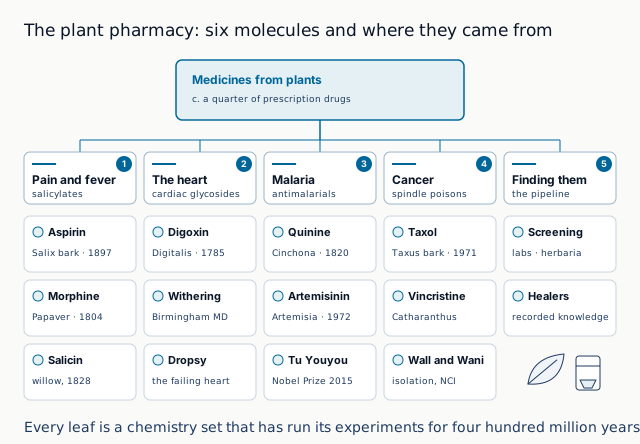
The best-known case is the willow. In 1763 the Reverend Edward Stone told the Royal Society that dried Salix bark eased agues; chemists later isolated salicin and then salicylic acid, which worked but burned the stomach. In 1897 Felix Hoffmann at Bayer made the gentler acetylsalicylic acid, sold from 1899 as Aspirin. In 1785 William Withering, a Birmingham physician, published An Account of the Foxglove , the first careful clinical study of a plant drug, setting doses of Digitalis purpurea for dropsy; its glycoside digoxin still steadies failing hearts.
The twentieth century widened the net. In 1962 American collectors sent bark of the Pacific yew, Taxus brevifolia , to a screening programme; Monroe Wall and Mansukh Wani isolated paclitaxel, sold as Taxol, which jams a dividing cell's spindle and became a mainstay against ovarian and breast cancer, now made from the needles of European yew hedges rather than by felling the tree. From the Madagascar periwinkle, Catharanthus roseus , came vincristine, which turned childhood leukaemia from a near-certain death into a mostly curable disease.
In 1969 the Chinese chemist Tu Youyou was asked to find a new malaria drug. Combing ancient texts, she found a fourth-century instruction from Ge Hong to steep sweet wormwood, Artemisia annua , in cold water; heat, she realised, had been destroying the molecule. Artemisinin, isolated in 1972, remains the backbone of malaria treatment and earned her the Nobel Prize in 2015.
Roughly a quarter of prescription medicines trace their chemistry to a plant, and the hunt continues in screening labs, herbaria and the knowledge of communities who used these plants first. Every green leaf is a chemistry set that has been running experiments for four hundred million years; we are only beginning to read the results.
The Vegetable Kingdom — 100 chapters on the green world that feeds us
Ready when you are.
Tap below to open the full chapter in the book reader. Anchored books jump to this chapter automatically.
Tea, Coffee and Cocoa
The Vegetable Kingdom — 100 chapters on the green world that feeds us
Three plants from three continents supply most of the world's daily stimulant, and all three make the same molecule for the same reason. Caffeine is a defence: it poisons the nerves of insects that chew the leaf or seed, and leaf litter laced with it suppresses rival seedlings. Humans, with larger bodies and a taste for alertness, turned the poison into a habit. Tea is Camellia sinensis , a shrub of the hills where China, Myanmar and India meet; coffee is Coffea arabica , an understorey tree of the Ethiopian highlands; cocoa is Theobroma cacao , a small tree of the Amazon basin whose seeds ferment inside a sweet pulp.
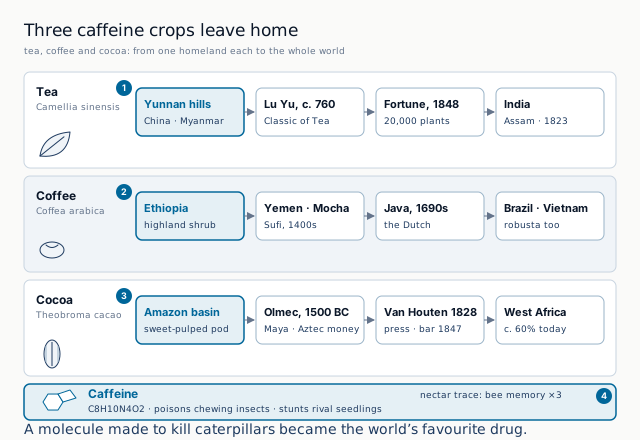
Tea came first. Lu Yu's Classic of Tea , written around 760 AD, already describes an old culture of picking, steaming and brewing, and bricks of compressed tea were currency along the routes to Tibet. Britain's thirst for it drained silver and helped drive the opium trade, so in 1848 the East India Company sent the Scottish botanist Robert Fortune into China in disguise. He shipped out some 20,000 plants and seedlings in Wardian cases, along with skilled tea workers, to the Himalayan foothills. There they met Camellia sinensis var. assamica , a native tea tree found by Robert Bruce in Assam in 1823, and Indian tea was born.
Coffee was a Sufi drink in fifteenth-century Yemen, exported through the port of Mocha and guarded as a monopoly, before the Dutch carried seedlings to Java in the 1690s and a single plant in the Amsterdam botanic garden seeded the plantations of the Americas. London's first coffeehouse opened in 1652; Lloyd's of London began as one. Today Brazil and Vietnam lead, the latter growing mainly the hardier Coffea canephora , or robusta.
Cocoa is the oldest of the three in use: residues of theobromine in Olmec pottery from Mexico date to around 1500 BC, and the Maya and Aztecs drank it frothed and bitter, spiced with chilli, and used the beans as money. Linnaeus named the genus Theobroma , 'food of the gods', in 1753. Coenraad van Houten's 1828 press separated cocoa butter from the powder, and the solid chocolate bar followed in 1847. The crop has since crossed the Atlantic the other way: Côte d'Ivoire and Ghana now grow around 60 per cent of the world's beans.
Between them these three plants employ tens of millions of smallholders and shape the mornings of billions. A chemical made to kill insects became the most widely used psychoactive drug on Earth, and we grow it on purpose.
The Vegetable Kingdom — 100 chapters on the green world that feeds us
Ready when you are.
Tap below to open the full chapter in the book reader. Anchored books jump to this chapter automatically.
Fibres: Cotton, Linen and Hemp
The Vegetable Kingdom — 100 chapters on the green world that feeds us
Before plastics, almost everything soft that was not wool or silk came from a plant cell wall. A plant fibre is a long cell, or a bundle of them, whose walls are packed with cellulose, the straight-chained glucose polymer that is the most abundant organic molecule on Earth. Cotton is the simplest case: each fibre is a single cell growing from the skin of the seed, up to four centimetres long and about 95 per cent cellulose, which twists into a flat ribbon as it dries and so catches on its neighbours when spun. Flax, hemp and jute are bast fibres, bundles running the length of the stem just inside the bark, freed by retting, which lets bacteria rot away the glue that holds them.
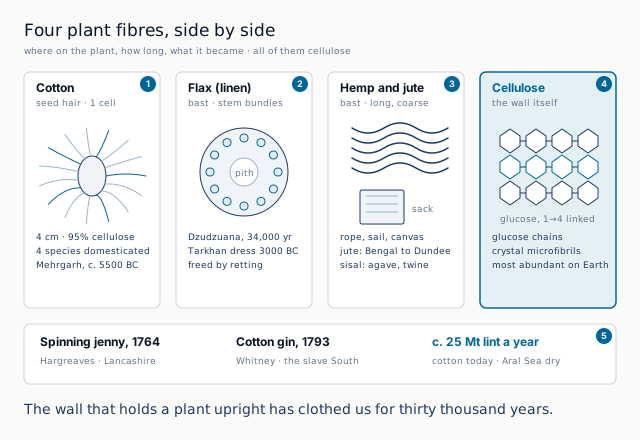
Cotton was domesticated four separate times, from four species on four continents: Gossypium arboreum in India, G. herbaceum in Africa and Arabia, G. barbadense in South America and G. hirsutum in Mesoamerica, which now supplies around 90 per cent of the world's crop. The oldest cotton threads known, preserved on a copper bead at Mehrgarh in Pakistan, are about 7,500 years old, and the Indus cities were weaving cotton cloth by 2500 BC. Hargreaves's spinning jenny of 1764, Arkwright's water frame and Whitney's gin of 1793 turned the plant into the first industrial commodity, fed Manchester's mills and bound them to slavery in the American South.
Linen is older still. Wild flax fibres, spun and some of them dyed, were found in Dzudzuana Cave in Georgia and dated to around 34,000 years ago. Linum usitatissimum wrapped Egyptian mummies in thousands of metres of cloth, and the Tarkhan dress, a pleated linen shirt of around 3000 BC, is the oldest woven garment in the world. Hemp, Cannabis sativa , gave rope and sailcloth; a ship of the line carried tens of tonnes of it, and Henry VIII ordered English farmers to grow it in 1533. Jute, from Bengal, made the sacks that carried the world's grain and turned Dundee into 'Juteopolis'; sisal, from a Yucatán agave, made the binder twine of the harvest.
Cotton remains the largest natural fibre crop, around 25 million tonnes of lint a year, and one of the thirstiest, which is why the Aral Sea is now mostly desert. The cellulose wall that holds a plant upright has clothed us for thirty thousand years, and the spinning of it built the modern world.
The Vegetable Kingdom — 100 chapters on the green world that feeds us
Ready when you are.
Tap below to open the full chapter in the book reader. Anchored books jump to this chapter automatically.
Timber and Paper
The Vegetable Kingdom — 100 chapters on the green world that feeds us
Wood is the oldest engineering material and still the most used by weight: around four billion cubic metres are cut each year, roughly half of it burned for fuel. It works because a tree is a column of hollow cellulose tubes glued with lignin , stiff along the grain and light for its strength. Looked after, it lasts. The five-storey pagoda of Hōryū-ji near Nara stands on hinoki cypress felled around 594 AD, according to its tree rings, making it the oldest wooden building in the world. HMS Victory , launched in 1765, took about 6,000 trees, nine in ten of them oak, the harvest of a hundred acres of woodland. The roof of Notre-Dame de Paris, framed from some 1,300 oaks in the thirteenth century and nicknamed 'the forest', burned in April 2019 and was rebuilt in oak by 2024.
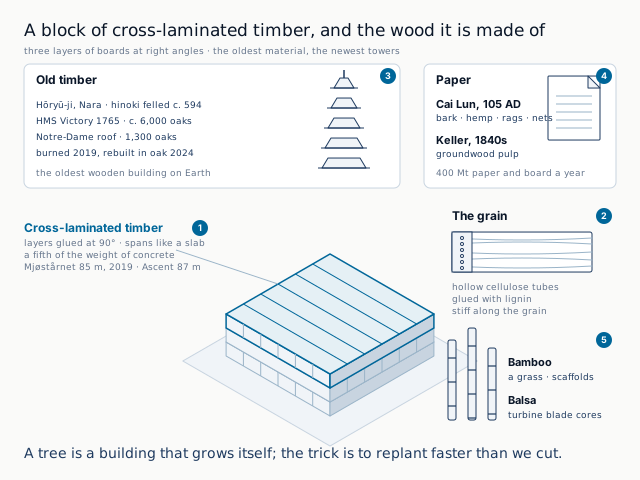
Paper is wood taken apart. In 105 AD the Han court official Cai Lun reported a method of beating bark, hemp, rags and fishing nets into a pulp and drying it in sheets, though fragments from Fangmatan show paper already existed a century or two earlier. The craft reached Samarkand by 751, Baghdad by the 790s and Spain by the twelfth century, and Gutenberg printed on it. The jump from rags to trees came in the 1840s, when Friedrich Gottlob Keller ground logs against a wet stone to make wood pulp; chemical pulping followed, newspapers became cheap, and forests from Finland to Tasmania were planted for the purpose. The world now makes over 400 million tonnes of paper and board a year.
Different woods do different jobs. Bamboo, a grass, scaffolds skyscrapers in Hong Kong, lashed in a day by hand. Balsa, the lightest commercial timber, cores wind-turbine blades. Teak resists the sea, Douglas fir makes the beams, and the hinoki of Japanese temples is replaced plank by plank in a cycle of repair that has never stopped. The newest form is the oldest idea: cross-laminated timber glues layers of boards at right angles into panels that behave like concrete slabs but weigh a fifth as much and store carbon rather than emit it. Mjøstårnet in Norway reached 85 metres in 2019, and timber towers now rise in Milwaukee, Sydney and Vienna.
Timber has carried roofs and words for all of recorded history, and it may be the material that lets cities build without burning the sky. A tree is a building that grows itself; the trick is to replant faster than we cut.
The Vegetable Kingdom — 100 chapters on the green world that feeds us
Ready when you are.
Tap below to open the full chapter in the book reader. Anchored books jump to this chapter automatically.
Rubber, Resins and Dyes
The Vegetable Kingdom — 100 chapters on the green world that feeds us
A rubber tree bleeds when cut, and the white latex that wells up is a defence, gumming the mouthparts of insects and sealing the wound. The Olmec, whose Nahuatl name means 'rubber people', were bouncing balls of it by 1600 BC, but Hevea brasiliensis latex stayed a curiosity until 1839, when Charles Goodyear, broke and obsessive, found that cooking it with sulphur made a material that neither melted in summer nor cracked in winter. Vulcanisation turned sap into tyres. The Amazon boomed; Manaus built an opera house in 1896 on rubber money while tappers were worked to death along the Putumayo.
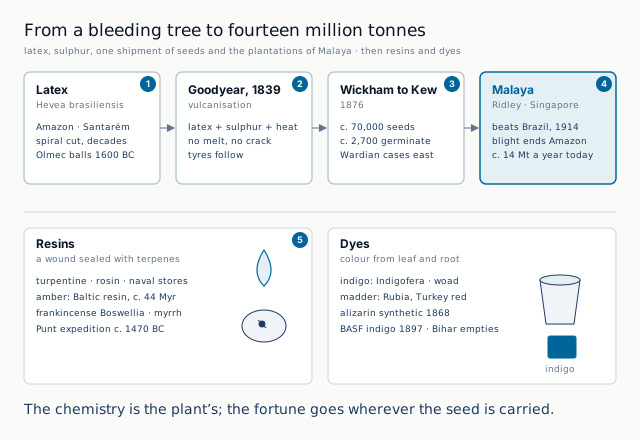
Then the trees left. In 1876 Henry Wickham gathered some 70,000 Hevea seeds near Santarém and shipped them to Kew, where about 2,700 germinated. Seedlings went in Wardian cases to Ceylon and Singapore, and Henry Ridley, director of the Singapore botanic garden, spent twenty years pressing them on sceptical planters along with a tapping cut that did not kill the tree. By 1914 Malaya out-produced Brazil, whose own plantations were wrecked by a native leaf blight the Asian trees had left behind. Today Thailand, Indonesia and Vietnam tap around 14 million tonnes a year, still almost all from Wickham's seed.
Resins are older defences. Conifers flood a wound with terpenes that set hard; distilled, they give turpentine and rosin, the 'naval stores' that waterproofed wooden ships. Left for forty million years, the same resin becomes amber, and the Baltic coast's amber, with its trapped insects and flowers, is a window into an Eocene forest. In the deserts of Oman, Yemen and Somalia, Boswellia and Commiphora trees give frankincense and myrrh, traded north since Hatshepsut's expedition to Punt around 1470 BC brought living incense trees home to Egypt.
Dyes came from leaves and roots. Indigo, from Indigofera tinctoria in India and from woad, Isatis tinctoria , in Europe, is made by fermenting a colourless precursor and letting the air turn it blue; the same molecule dyed the first jeans and still dyes most of them. Madder root, Rubia tinctorum , gave the red of Turkey red cloth and British uniforms. Both markets collapsed within a generation of chemistry: synthetic alizarin arrived in 1868, synthetic indigo from BASF in 1897, and the indigo fields of Bihar, whose forced cultivation Gandhi protested at Champaran in 1917, emptied.
Every one of these materials is a plant's way of healing or hiding, borrowed. The lesson of rubber, resin and indigo is the same: the chemistry is the plant's, and the fortunes move wherever the plant is carried.
The Vegetable Kingdom — 100 chapters on the green world that feeds us
Ready when you are.
Tap below to open the full chapter in the book reader. Anchored books jump to this chapter automatically.
Spices and Flavour
The Vegetable Kingdom — 100 chapters on the green world that feeds us
A spice is a plant's chemical weapon that happens to please us. Piperine in pepper, eugenol in cloves, cinnamaldehyde in cinnamon bark and capsaicin in chilli all evolved to deter insects, fungi and browsing mammals, and all of them were, for most of history, worth more than their weight in silver because they grew in only one place. Black pepper, Piper nigrum , is a vine of India's Malabar coast; peppercorns were pushed into the nostrils of Ramesses II at his embalming in 1213 BC, and Pliny grumbled that India drained Rome of fifty million sesterces a year. True cinnamon, Cinnamomum verum , is the inner bark of a Sri Lankan tree, rolled into quills as it dries.
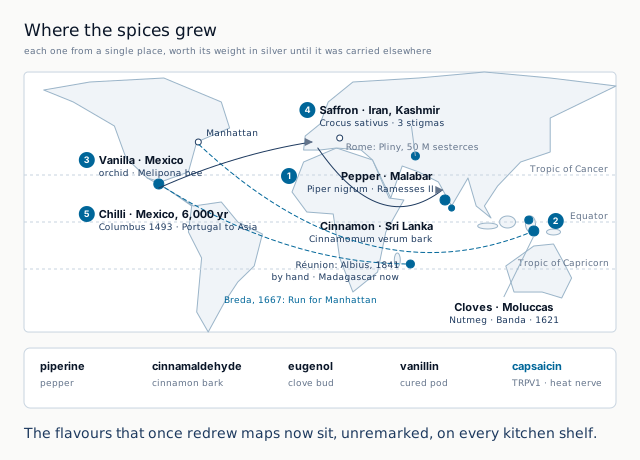
The Spice Islands made the fiercest fortunes. Cloves, the dried flower buds of Syzygium aromaticum , grew on five small volcanic islands in the Moluccas, and nutmeg and mace, the seed and its scarlet aril, only on the Banda Islands. In 1621 the Dutch East India Company seized Banda, killing or enslaving most of its people, to hold the monopoly. By the Treaty of Breda in 1667 the English gave up their claim to Run, the last nutmeg island, in exchange for a Dutch island on the other side of the world: Manhattan. The monopoly broke in 1770 when the Frenchman Pierre Poivre smuggled seedlings to Mauritius.
Vanilla, Vanilla planifolia , is an orchid from Mexico pollinated by a local bee, so outside its homeland the vines flowered and set nothing. In 1841 Edmond Albius, a twelve-year-old enslaved boy on Réunion, worked out how to lift the flap inside the flower with a sliver of bamboo and press the pollen home with his thumb. His method is still used by hand on every vanilla farm on Earth, most of them now in Madagascar. Saffron is the three red stigmas of Crocus sativus , a sterile triploid that has been divided by hand since antiquity; it takes around 150,000 flowers to make a kilogram, which is why it remains the most expensive spice by weight, and Iran grows most of it.
The chilli, Capsicum , was domesticated in Mexico around 6,000 years ago and reached Europe with Columbus in 1493; Portuguese ships carried it to India and Asia within fifty years, so completely that it now seems native there. Capsaicin fires the same nerve receptor as heat, which is why it burns without burning; David Julius shared a Nobel Prize in 2021 for finding that receptor.
Spices built trade routes, companies and empires, and moved whole peoples by force. Today they cost a few coins at any market, which is the strangest thing of all: the flavours that once redrew maps now sit, unremarked, on every kitchen shelf.
The Vegetable Kingdom — 100 chapters on the green world that feeds us
Ready when you are.
Tap below to open the full chapter in the book reader. Anchored books jump to this chapter automatically.
Sacred and Symbolic Plants
The Vegetable Kingdom — 100 chapters on the green world that feeds us
People have always asked plants to stand for something. The lotus, Nelumbo nucifera , rises spotless from mud, its leaves shedding water so completely that engineers copy the surface, and so it became the seat of the Buddha and of Lakshmi; its seeds can wait a very long time, and one dug from a dry lakebed in Liaoning germinated at an age of around 1,300 years. The Bodhi tree at Bodh Gaya, under which the Buddha sat, is a sacred fig, Ficus religiosa . A cutting of it was planted at Anuradhapura in Sri Lanka in 288 BC, and that tree, the Sri Maha Bodhi, is the oldest tree in the world with a known planting date.
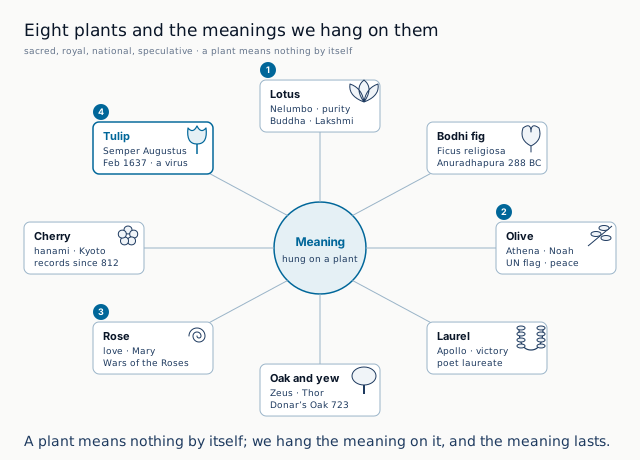
The Mediterranean wrote its symbols in silver-grey and dark green. The olive was Athena's gift to Athens and the branch in the beak of Noah's dove, which is why it circles the globe on the flag of the United Nations. The laurel, Laurus nobilis , crowned victors at the Pythian games and lives on in 'poet laureate' and 'baccalaureate'. Northern Europe looked up at the oak, sacred to Zeus at Dodona and to Thor; the missionary Boniface felled Donar's Oak at Geismar in 723 to prove a point. The yew, poisonous and near-immortal, stands in thousands of churchyards, where several, like the Fortingall Yew in Perthshire, are older than the churches.
Flowers carry the softer meanings. The rose, bred from wild species across Persia and China, became the emblem of love, of Mary, and of two English royal houses whose civil war took its name. In Japan the cherry blossom marks the beauty of what does not last; Kyoto's courtly diaries record the date of hanami back to 812 AD, a record that now shows the trees flowering earlier than at any point in twelve centuries, a climate signal written in petals. Nearly every modern nation has adopted a flower: the dahlia for Mexico, the king protea for South Africa, the thistle for Scotland, the tulip for the Netherlands.
That tulip arrived from the Ottoman court in the 1500s and by February 1637 single bulbs of streaked varieties such as Semper Augustus were changing hands for the price of a canal house. The 'flames' that made them precious were a viral infection that weakened the bulb. The crash was real, though historians such as Anne Goldgar have shown that it ruined far fewer people than legend claims.
A plant means nothing by itself; we hang the meaning on it. But the meanings last, and they have protected sacred groves, ancient trees and whole species through centuries when nothing else would.
The Vegetable Kingdom — 100 chapters on the green world that feeds us
Ready when you are.
Tap below to open the full chapter in the book reader. Anchored books jump to this chapter automatically.
Gardens and Botanic Gardens
The Vegetable Kingdom — 100 chapters on the green world that feeds us
A garden is the oldest experiment in botany: a fenced plot where plants are kept alive out of place. The Persian pairidaeza , the walled 'paradise' with its four channels of water, gave the English word and the plan of the Taj Mahal's grounds. Japan's Sakuteiki , written in the eleventh century, is the oldest garden manual in the world, and the fifteen rocks of Ryōan-ji in Kyoto, raked into gravel around 1500, are a garden with no plants at all. In England, Lancelot 'Capability' Brown removed the walls entirely, reshaping some 170 estates into lakes, lawns and clumps of oak that looked as if they had always been there.
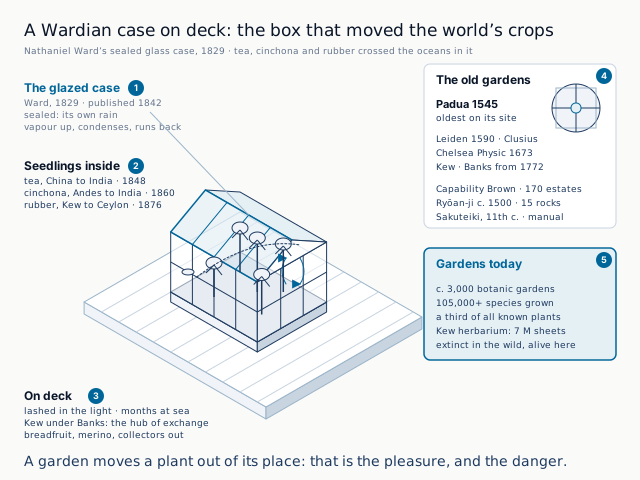
The botanic garden is a garden with a catalogue. Padua's Orto Botanico, founded by the Venetian Republic in 1545 to teach medical students which plant was which, is the oldest still on its original site; a dwarf palm planted there in 1585 was studied by Goethe in 1786 and still grows. Leiden followed in 1590, where Carolus Clusius planted the first Dutch tulips. The Chelsea Physic Garden, begun by London's apothecaries in 1673, sent cotton seed to the new colony of Georgia in 1732. At Kew, Joseph Banks turned a royal pleasure ground into an imperial exchange: breadfruit to the Caribbean, merino sheep to Australia, and collectors sent to every coast.
The exchange ran on a box. In 1829 Nathaniel Bagshaw Ward, a London doctor, sealed a moth chrysalis in a bottle with some soil and found a fern growing in it months later, kept alive by its own recycled water. His glazed Wardian case, published in 1842, survived salt spray and neglect where open pots died. Robert Fortune used it to carry tea from China to India in 1848, Clements Markham to carry cinchona from the Andes to India in 1860, Kew to send rubber seedlings to Ceylon in 1876. The same box also carried pests and diseases, and the modern quarantine of plants began partly in response.
Today around 3,000 botanic gardens hold living collections of at least 105,000 species, about a third of all known plants, together with seed banks and herbaria; Kew's herbarium alone holds some seven million sheets. Their work has shifted from acquisition to rescue, growing plants that no longer have a wild home.
A garden moves a plant out of its place, which is both the pleasure and the danger. The glass box that spread tea and rubber across the world is the ancestor of the greenhouse that now keeps extinct-in-the-wild species alive.
The Vegetable Kingdom — 100 chapters on the green world that feeds us
Ready when you are.
Tap below to open the full chapter in the book reader. Anchored books jump to this chapter automatically.
The Plant Hunters
The Vegetable Kingdom — 100 chapters on the green world that feeds us
Botany began as a list. Around 300 BC Theophrastus, Aristotle's successor at the Lyceum in Athens, wrote the Enquiry into Plants , describing some 500 kinds by root, stem, leaf and habit, many of them reported by soldiers returning from Alexander's campaigns. Dioscorides, a Greek army surgeon, compiled De Materia Medica around 60 AD, with 600 plants and their uses; copied and recopied, it was still the standard pharmacy text 1,500 years later. For most of that time knowing plants meant knowing books. The plant hunters changed that by going to look.
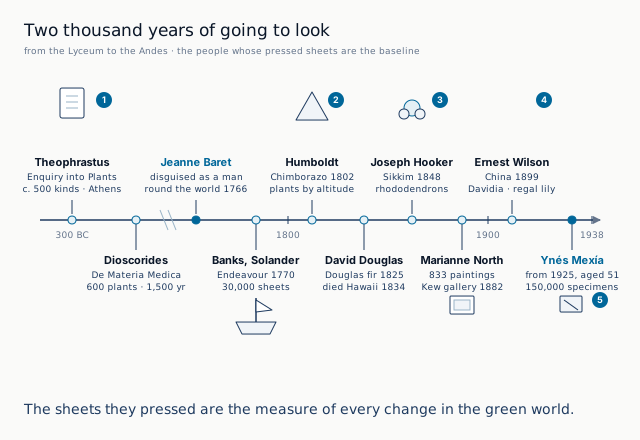
Joseph Banks and Daniel Solander sailed with Cook on the Endeavour in 1768, and at the bay they named Botany Bay in 1770 gathered so many specimens that the ship's cabin filled with drying paper; they came home with around 30,000 sheets and 1,400 species new to science. Alexander von Humboldt and Aimé Bonpland spent 1799 to 1804 in the Americas, climbing Chimborazo and noting how vegetation changed with altitude, the beginning of plant geography. Joseph Hooker walked into Sikkim in 1848, was briefly imprisoned by its raja, and returned with the rhododendrons that still fill British gardens. David Douglas, a Scottish gardener's boy, sent the Douglas fir, the sugar pine and some 240 other species home from the Pacific Northwest before dying in a Hawaiian bull pit in 1834.
The nineteenth century's great fields were China and the Himalaya. Ernest 'Chinese' Wilson collected for Veitch and then for Harvard from 1899, bringing back the handkerchief tree Davidia involucrata and the regal lily, and a limp from a landslide that broke his leg. Marianne North, who travelled alone through fourteen countries between 1871 and 1885, painted 833 oil studies of plants in their own landscapes, hung edge to edge in the gallery she built for them at Kew in 1882.
Women collected under harder rules. Jeanne Baret, disguised as a man, became the first woman to circumnavigate the globe as botanist's assistant on Bougainville's voyage of 1766. Ynés Mexía began at 51, in 1925, and in thirteen years gathered around 150,000 specimens in Mexico, Brazil and the Andes, including some 500 species new to science, before her death in 1938.
Every herbarium and every garden is the sum of these journeys, and so is the modern map of where plants live. The hunters were often agents of empire, and their collections are now being reread with the people who guided them, but the sheets they pressed remain the baseline against which every change in the green world is measured.
The Vegetable Kingdom — 100 chapters on the green world that feeds us
Ready when you are.
Tap below to open the full chapter in the book reader. Anchored books jump to this chapter automatically.
The Science of Plants
The Vegetable Kingdom — 100 chapters on the green world that feeds us
The science of plants is built in layers, each resting on the one beneath. The first layer is description: the lists of Theophrastus, the herbals, the Linnaean names. The second is measurement, and it starts with a clergyman. In Vegetable Staticks of 1727 Stephen Hales fitted glass tubes to cut vine stems and watched sap climb them, weighed potted sunflowers morning and evening to measure how much water they breathed out, and concluded that plants draw some of their substance from the air. He was right, a century before anyone could say what the substance was.
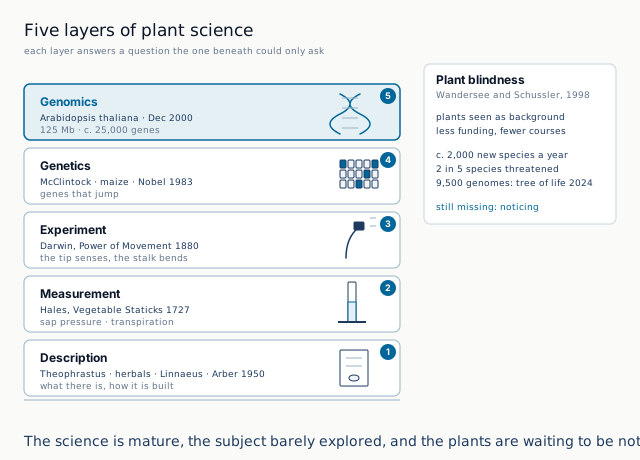
The third layer is experiment. Charles Darwin spent his last decades on plants, with his son Francis as assistant: orchids and their pollinators in 1862, climbing plants, insectivorous plants, and in 1880 The Power of Movement in Plants , in which a grass seedling capped with foil stopped bending towards light, showing that the tip senses and the stalk responds. He had found the first evidence of a plant hormone. In Cambridge Agnes Arber, working alone in a home laboratory, traced the deep logic of plant form and in 1946 became the first woman botanist elected to the Royal Society.
The fourth layer is genetics. Barbara McClintock, studying the colour patterns of maize kernels at Cold Spring Harbor in the 1940s, showed that genes could move from place to place on a chromosome. Nobody believed her for twenty years; she received the Nobel Prize, alone, in 1983. The fifth is genomics. In December 2000 an international consortium published the first plant genome, that of Arabidopsis thaliana , a roadside weed with 125 million base pairs and around 25,000 genes, and it has been the laboratory plant ever since. Rice followed in 2002, and the 2024 tree of life built from 9,500 flowering-plant genomes has redrawn whole families.
In 1998 two American educators, James Wandersee and Elisabeth Schussler, gave a name to something teachers had long noticed: plant blindness , the habit of seeing plants as background rather than as living things, with its consequences for funding, conservation and curiosity. Botany departments have closed even as the questions have grown; around 2,000 new plant species are still described every year, and two in five known species are thought to be threatened.
From Hales's tubes to the genome, each layer answered a question the one below could only ask. The science is mature, the subject is still mostly unexplored, and the plants, as ever, are waiting to be noticed.
The Vegetable Kingdom — 100 chapters on the green world that feeds us
Ready when you are.
Tap below to open the full chapter in the book reader. Anchored books jump to this chapter automatically.
Deforestation
The Vegetable Kingdom — 100 chapters on the green world that feeds us
Forests cover about 4.06 billion hectares, just under a third of the land on Earth, and every year around 10 million hectares of them are cleared, an area the size of Portugal or South Korea. That is the figure in the Food and Agriculture Organization's Global Forest Resources Assessment of 2020, averaged over 2015 to 2020. It is a smaller number than the 16 million hectares a year lost in the 1990s, and because trees are also growing back elsewhere the net loss is lower still, around 4.7 million hectares a year. The loss and the gain, though, are not the same forest. What falls is mostly old tropical forest; what grows is mostly young temperate woodland and plantation.
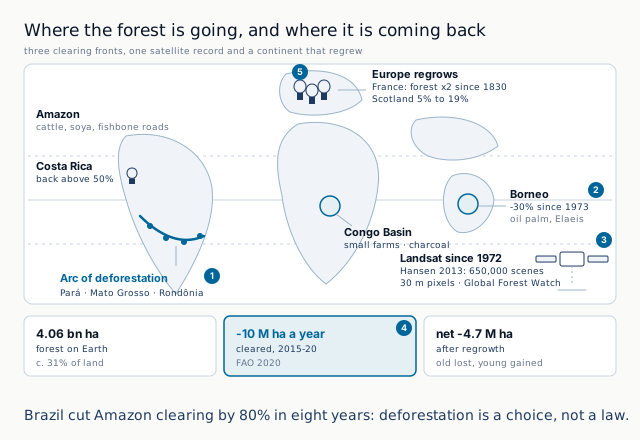
Three fronts account for most of the clearing. The arc of deforestation curves along the southern and eastern edge of the Amazon, through the Brazilian states of Pará, Mato Grosso and Rondônia, where cattle pasture and soya fields advance in the 'fishbone' pattern of side roads branching off a highway. In Borneo, shared by Indonesia, Malaysia and Brunei, roughly 30 per cent of the forest standing in 1973 had gone by 2010, much of it to oil palm, Elaeis guineensis , a West African tree that now gives the world its commonest vegetable oil. In the Congo Basin the pressure is smaller farms, charcoal and logging roads.
We know these numbers from orbit. The Landsat programme has photographed the whole land surface since 1972, and in 2013 Matthew Hansen and colleagues at the University of Maryland used 650,000 Landsat scenes to map every patch of tree cover lost or gained between 2000 and 2012 at a resolution of 30 metres. Their maps feed Global Forest Watch , launched in 2014, which anyone can open in a browser, and Brazil's own PRODES system has measured Amazon clearing from satellites every year since 1988.
That fall, and its partial reversal after 2012, is the clearest proof that deforestation is a policy choice, not a law of nature. The other proof is Europe. France has roughly doubled its forest since 1830; Scotland has gone from about 5 per cent tree cover in 1900 to 19 per cent today; across the continent the forest has been quietly expanding for a century as farming retreated uphill and coal replaced firewood. The forest transition that Europe went through is now visible in Costa Rica, Vietnam and China.
The trees that matter most are the ones still standing: old tropical forest holds more carbon and more species per hectare than anything that can be planted to replace it. A forest is the slowest crop there is, and the easiest to lose in an afternoon.
The Vegetable Kingdom — 100 chapters on the green world that feeds us
Ready when you are.
Tap below to open the full chapter in the book reader. Anchored books jump to this chapter automatically.
Invaders
The Vegetable Kingdom — 100 chapters on the green world that feeds us
Most plants moved to a new country simply die, or sit politely in a garden. A few find themselves without the insects, fungi and grazers that kept them in check at home, and in a climate that suits them, and they run. Botanists call these invasive species , and their stories have a pattern: an introduction by a gardener, a farmer or a ship; decades of quiet; then an explosion that nobody can stop with a spade.
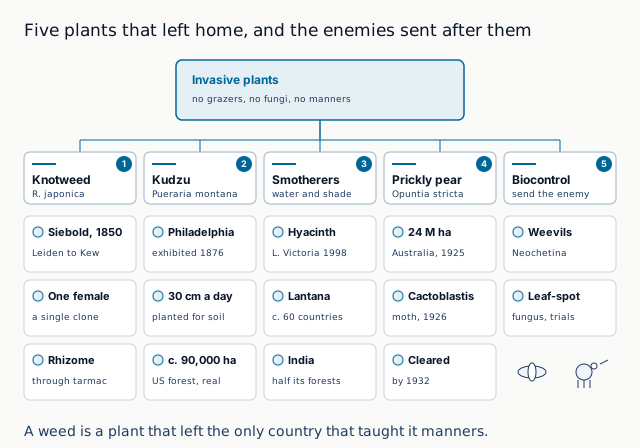
Japanese knotweed, Reynoutria japonica , arrived in Europe from the Leiden nursery of Philipp von Siebold, who sent a specimen to Kew in 1850 and sold the plant as a handsome ornamental. Almost every knotweed in Britain is a clone of one female, spreading by rhizome rather than seed; a fragment the size of a fingernail can start a new stand, and its shoots push through tarmac. Kudzu, Pueraria montana , was shown at the 1876 Centennial Exposition in Philadelphia and planted across the American South in the 1930s and 1940s to hold eroding soil, with government bounties for every acre. It can grow 30 centimetres in a day and drapes whole woods in vines. Its reputation, though, has outrun the plant: the US Forest Service's own survey found it on around 90,000 hectares of forest, a fraction of the millions often quoted.
Water hyacinth, Pontederia crassipes , a floating Amazonian plant with lilac flowers, reached Lake Victoria in the late 1980s and by 1998 had choked bays, ports and fishing grounds under mats that doubled in size every two weeks. Lantana, Lantana camara , from tropical America, now grows in some 60 countries and smothers the understorey of nearly half of India's forests. The most famous invasion is the prickly pear in Australia: by 1925 Opuntia cacti covered around 24 million hectares of Queensland and New South Wales, advancing a million acres a year.
That success founded biological control : find the enemy the plant escaped, test it carefully, and bring it over. South American weevils have since beaten back water hyacinth on Lake Victoria, and a leaf-spot fungus is being trialled on knotweed. The method has its own horror stories, which is why the testing now takes years. The best remedy is the dullest: stop moving plants without asking what will eat them.
Diagne and colleagues put the global cost of invasive species since 1970 above a trillion dollars, and plants are a large share. A weed is simply a plant that has forgotten its manners, because it left the only country that taught them.
The Vegetable Kingdom — 100 chapters on the green world that feeds us
Ready when you are.
Tap below to open the full chapter in the book reader. Anchored books jump to this chapter automatically.
Diseases and Pests
The Vegetable Kingdom — 100 chapters on the green world that feeds us
Plants have no roaming immune cells, so every cell must defend itself, and against a new enemy that evolved somewhere else the defences are often simply absent. The history of plant disease is a history of things that travelled: a spore in a cargo hold, a beetle in a log, a cutting in a nursery pot.
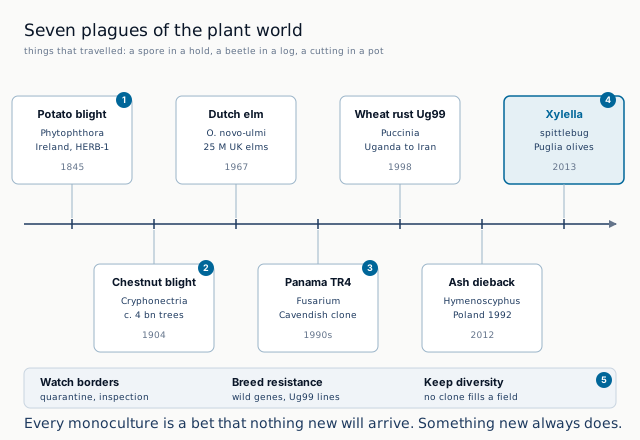
The template is the potato blight . Phytophthora infestans is not a fungus but an oomycete, a water mould closer to kelp, and it arrived in Europe from the Americas in 1845. In Ireland, where a third of the people lived almost entirely on one potato variety, the Lumper, the crop rotted in the ground for three years running; around a million people died and more than a million emigrated. In 2013 Kentaro Yoshida and colleagues sequenced the pathogen from 170-year-old herbarium leaves and identified the famine strain, HERB-1, now extinct.
Trees fall more slowly but on a larger scale. Chestnut blight, the fungus Cryphonectria parasitica , was noticed on trees at the Bronx Zoo in 1904, carried on Asian nursery stock; by 1940 it had killed some four billion American chestnuts, Castanea dentata , once a quarter of the trees in the Appalachian forests. Dutch elm disease , named for the Dutch women pathologists who described it in the 1920s, is spread by bark beetles; a more aggressive strain, Ophiostoma novo-ulmi , killed around 25 million elms in Britain after 1967. Ash dieback, Hymenoscyphus fraxineus , was first seen in Poland in 1992 and reached British woods in 2012, and is expected to kill most of the country's ash.
Crops are more vulnerable still, because a field is a monoculture by design. The banana sold worldwide, the Cavendish, is a single clone planted because it resisted the Panama disease that destroyed its predecessor, Gros Michel, in the 1950s. A new race of the fungus, Tropical Race 4 , appeared in Taiwan in the 1990s and reached Colombia in 2019. Wheat stem rust Ug99, found in Uganda in 1998, can overcome most of the resistance genes bred into wheat since the Green Revolution, and has spread as far as Iran.
The defence is the same in every case: watch borders, breed resistance, and keep diversity, because a disease that kills one clone cannot kill a field of different plants. Every monoculture is a bet that nothing new will arrive, and something new always does.
The Vegetable Kingdom — 100 chapters on the green world that feeds us
Ready when you are.
Tap below to open the full chapter in the book reader. Anchored books jump to this chapter automatically.
A Changing Climate
The Vegetable Kingdom — 100 chapters on the green world that feeds us
Plants keep better climate diaries than people do. In 1736 Robert Marsham, a Norfolk squire, began noting the first snowdrop, the first swallow and the first oak leaf at Stratton Strawless each year; his descendants kept the list until 1958, and it is the longest phenology record in Britain. In Kyoto the date of the cherry blossom festival has been written down since the year 812, first by courtiers and monks, later by newspapers. Yasuyuki Aono's reconstruction of that series shows a slow drift and then a lurch: in 2021 the cherries peaked on 26 March, the earliest in twelve centuries.
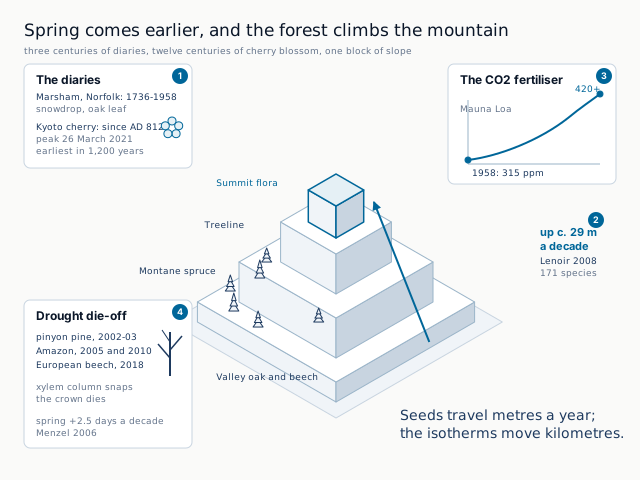
Across Europe, Annette Menzel and colleagues pooled 125,000 phenological series in 2006 and found spring events advancing by about 2.5 days a decade. Plants are moving in space as well as time. In 2008 Jonathan Lenoir compared surveys of 171 forest plant species in the mountains of western Europe and found that their optimum elevation had climbed by around 29 metres a decade through the twentieth century. On Mont Blanc and in the Alps the summit flora of 1900 has been joined by lowland newcomers; on the Andes and in the Himalaya the treeline edges upwards.
Some of the change is literally fertiliser. Carbon dioxide rose from 315 parts per million when Charles Keeling began measuring it on Mauna Loa in 1958 to more than 420 today, and because CO2 is the raw material of photosynthesis, many plants grow faster in it. Satellites show that between a quarter and a half of the vegetated land on Earth 'greened' between 1982 and 2015, and growing seasons in the north have lengthened by days to weeks. The CO2 fertilisation effect is real, but it is rationed by water, nitrogen and heat, and crops grown in high CO2 contain less protein, zinc and iron.
Heat and drought take back what CO2 gives. In 2002 and 2003 drought killed pinyon pines across the American Southwest; the Amazon droughts of 2005 and 2010 turned the forest briefly into a carbon source; across Europe the summer of 2018 browned the beech and spruce. Trees die from drought in a particular way: the water column in their xylem snaps, and the tree embolises like a diver with the bends.
Plants will follow the climate if they can, uphill and polewards, but a seed travels metres a year and the isotherms move kilometres. The ones with no uphill left, on summits and islands, have nowhere to go. The green kingdom is on the move, and the question for this century is whether we leave it room.
The Vegetable Kingdom — 100 chapters on the green world that feeds us
Ready when you are.
Tap below to open the full chapter in the book reader. Anchored books jump to this chapter automatically.
Extinction and the Red List
The Vegetable Kingdom — 100 chapters on the green world that feeds us
Since Linnaeus published Species Plantarum in 1753, botanists have named around 390,000 species of vascular plant. In 2019 Aelys Humphreys and colleagues at Stockholm and Kew combed the literature and found 571 of them recorded as extinct , about 2.3 a year, which is some 500 times the rate the fossil record would predict. That number is certainly too low: a plant is only declared extinct when someone has looked hard and found nothing, and most of the world's flora has not been looked at hard. Kew's State of the World's Plants and Fungi in 2020 estimated that two in five plant species are threatened.
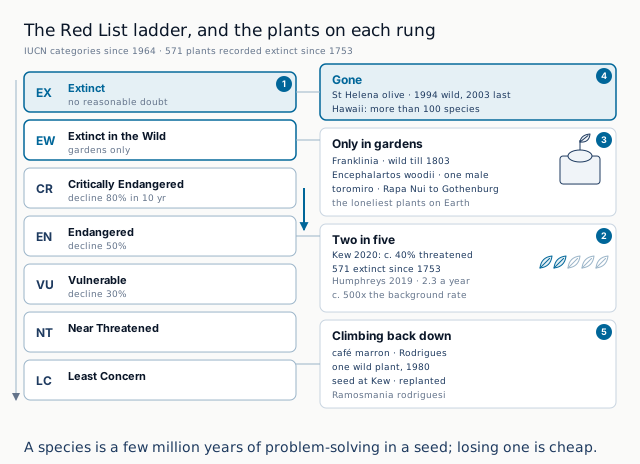
The instrument that measures the danger is the IUCN Red List , begun in 1964 and run from Gland in Switzerland. Each assessed species is placed on a ladder: Least Concern, Near Threatened, Vulnerable, Endangered, Critically Endangered, Extinct in the Wild, Extinct. The rungs are defined by numbers, such as a population that has fallen by 80 per cent in ten years, or a range below 100 square kilometres, so that a cactus in Mexico and an orchid in Borneo are judged by the same rule.
The top rungs have faces. The St Helena olive, Nesiota elliptica , grew only on one Atlantic island; the last wild tree died in 1994 and the last cutting in cultivation in 2003, so the species has moved from Extinct in the Wild to Extinct within living memory. Franklinia alatamaha , found by the Bartrams by the Altamaha River in Georgia in 1765, was last seen wild in 1803 and survives only because gardeners kept growing it. Encephalartos woodii , a cycad found by John Medley Wood in South Africa's Ngoye Forest in 1895, is known from a single male clump; its offsets grow in botanic gardens from Durban to Kew, and with no female it cannot set seed. The toromiro, Sophora toromiro , vanished from Rapa Nui around 1960, and lives on from seeds that Thor Heyerdahl's expedition carried to Gothenburg.
Islands lose most, because island plants have small ranges and no defence against goats and rats. Hawaii alone has lost more than 100 plant species. Yet the ladder runs both ways: the Mauritian café marron, Ramosmania rodriguesi , down to one wild plant in 1980, was coaxed to seed at Kew and replanted on Rodrigues.
A species is a few million years of problem-solving in a seed. Losing one is cheap; getting one back is impossible, which is why the list is kept.
The Vegetable Kingdom — 100 chapters on the green world that feeds us
Ready when you are.
Tap below to open the full chapter in the book reader. Anchored books jump to this chapter automatically.
Seed Banks and Living Collections
The Vegetable Kingdom — 100 chapters on the green world that feeds us
A seed is a plant packed for travel, and a dry, cold seed can wait for decades. That is the whole principle of a seed bank : dry the seeds to about 5 per cent moisture, seal them in foil, and freeze them at minus 18 or minus 20 degrees, where most will still germinate a century later. The idea was born in Russia. Nikolai Vavilov collected crop seeds across five continents from 1916 onwards and built a collection of some 250,000 samples at what is now the Vavilov Institute in St Petersburg. He died in a Saratov prison in 1943, and during the siege of Leningrad a dozen of his staff starved to death guarding sacks of edible rice, wheat and potatoes rather than eat the collection.
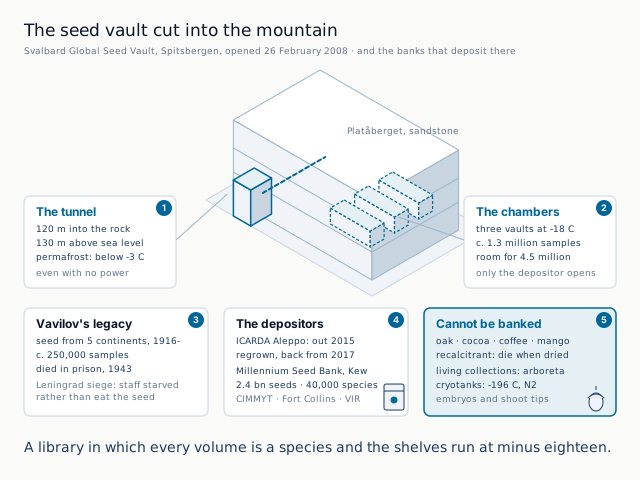
The Svalbard Global Seed Vault opened on 26 February 2008 on the island of Spitsbergen, 1,300 kilometres from the North Pole. A concrete wedge in the hillside leads to a tunnel bored 120 metres into the sandstone of Platåberget, and three chambers cooled to minus 18 degrees; if the power fails, the permafrost keeps them below minus 3. It holds duplicate copies of other seed banks' collections, sealed boxes that only the depositor may open, around 1.3 million samples from almost every country on Earth. Its first withdrawal came in 2015, when the ICARDA gene bank in Aleppo, cut off by the Syrian war, asked for its wheat, barley and lentil seeds back to rebuild in Lebanon and Morocco; the regrown seed was redeposited from 2017.
Wild plants are banked too. The Millennium Seed Bank at Wakehurst in Sussex, opened in 2000 and run by Kew, holds about 2.4 billion seeds from more than 40,000 species in vaults 20 metres underground, with partners in 97 countries collecting. The Vavilov Institute, the United States' Fort Collins vault and CIMMYT's maize and wheat bank in Mexico each hold more than 100,000 accessions.
That last problem is the frontier. Perhaps a third of critically endangered trees have recalcitrant seeds, so botanic gardens keep them as living collections , in field gene banks, orchards and arboreta, and increasingly as shoot tips and embryos held at minus 196 degrees in cryopreservation tanks. A living collection needs water, staff and luck; a frozen one needs electricity. The two keep each other honest.
A seed bank is a library in which every volume is a species and the shelves run at minus 18. It is the cheapest insurance the green kingdom has ever been offered.
The Vegetable Kingdom — 100 chapters on the green world that feeds us
Ready when you are.
Tap below to open the full chapter in the book reader. Anchored books jump to this chapter automatically.
Protecting and Restoring
The Vegetable Kingdom — 100 chapters on the green world that feeds us
There are two ways to help the green kingdom: keep what is left, and give some back. The first is older and cheaper. About 17 per cent of the world's land is now inside a protected area , from Yellowstone in 1872 to the vast new reserves of the Amazon and the Congo, and in December 2022 the 196 parties to the Convention on Biological Diversity agreed in Montreal to raise that to 30 per cent of land and sea by 2030, the target known as 30 by 30 . A line on a map is only a beginning, since many parks exist mostly on paper, but the plants inside protected forest do measurably better than those outside.
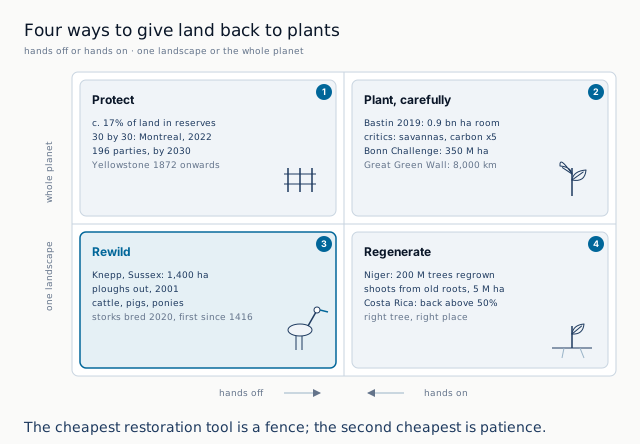
Giving land back is harder, and the arguments start at once. In 2019 Jean-François Bastin and colleagues at ETH Zürich calculated that the planet had room for another 0.9 billion hectares of tree canopy, which could store 205 billion tonnes of carbon, and the idea of planting a trillion trees caught fire. Critics replied within months that much of the 'room' was natural grassland and savanna, where trees would wreck ecosystems that had never had them, and that the carbon figure was perhaps five times too high. Out of that quarrel came a rule of thumb now used by foresters everywhere: right tree, right place , and preferably no tree at all where the land is a prairie.
The Bonn Challenge of 2011 asked countries to bring 350 million hectares of degraded land back into some kind of growth by 2030. Africa's Great Green Wall, launched by the African Union in 2007, set out to green an 8,000-kilometre belt across the Sahel from Senegal to Djibouti; progress has been slow and patchy, but in Niger farmers have regrown some 200 million trees on five million hectares simply by protecting the shoots that sprout from old roots, a method called farmer-managed natural regeneration. Costa Rica, which had cleared more than half its forest by the 1980s, paid landowners to let it return and now has more than 50 per cent cover again.
Knepp is the best-known example of rewilding : not planting, but removing the plough and letting thorn scrub, grazing and time do the design. Turtle doves, nightingales and purple emperor butterflies have arrived without an invitation.
The lesson of the last twenty years is that plants restore land faster than we can, if we stop them being eaten, burned or ploughed. The cheapest restoration tool is a fence, and the second cheapest is patience.
The Vegetable Kingdom — 100 chapters on the green world that feeds us
Ready when you are.
Tap below to open the full chapter in the book reader. Anchored books jump to this chapter automatically.
Gene Editing and New Crops
The Vegetable Kingdom — 100 chapters on the green world that feeds us
Farmers have been editing plant genes since the first wild wheat was saved for sowing; what changed in the 1980s was precision. The first genetically modified food on sale was the Flavr Savr tomato of 1994, made by the Californian firm Calgene with a gene that slowed softening so the fruit could ripen on the vine. It tasted of little and vanished by 1997, but the technique behind it, using the soil bacterium Agrobacterium to carry foreign DNA into a plant cell, built the crops that followed. In 1996 came cotton and maize carrying a gene from Bacillus thuringiensis , whose Bt protein kills caterpillars, and soya tolerant of the herbicide glyphosate. By 2019 such transgenic crops covered about 190 million hectares, mostly in the Americas, India and China, while the European Union grew almost none.
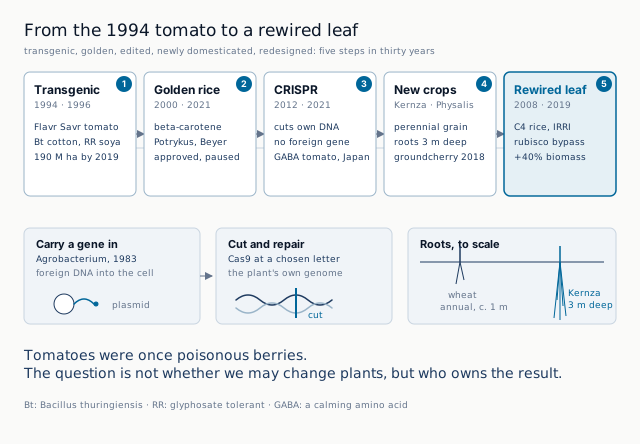
The most argued-over plant is golden rice . In 2000 Ingo Potrykus and Peter Beyer announced rice engineered with daffodil and bacterial genes to make beta-carotene in the grain, aimed at the vitamin A deficiency that blinds and kills children across Asia. It took until 2021 for the Philippines to approve it for farming, and courts have since paused it; the rice has spent longer in regulation than in fields.
The second generation does not add foreign genes at all. CRISPR , the bacterial cut-and-repair system turned into a tool by Jennifer Doudna and Emmanuelle Charpentier in 2012, lets breeders snip a plant's own DNA at a chosen letter. The first CRISPR food on sale was a tomato, the Sicilian Rouge High GABA, sold in Japan in 2021 with raised levels of a calming amino acid. In 2018 Zachary Lippman's laboratory used the same tool to domesticate the groundcherry, Physalis pruinosa , in a single generation, editing the genes for shoot architecture and fruit size that took wild tomato thousands of years to change.
The third generation rewires the engine. The C4 Rice Project, run from the International Rice Research Institute since 2008, is trying to give rice the carbon-concentrating anatomy of maize. In 2019 Paul South and colleagues at Illinois gave tobacco a shortcut around photorespiration, the wasteful side reaction of rubisco, and the plants grew 40 per cent more biomass in the field. The same edit is now being tested in potato, soya and cowpea.
Every one of these is a plant doing what plants do, only faster: tomatoes were once poisonous berries. The question is not whether we may change plants, which we have done for ten thousand years, but who owns the result.
The Vegetable Kingdom — 100 chapters on the green world that feeds us
Ready when you are.
Tap below to open the full chapter in the book reader. Anchored books jump to this chapter automatically.
Growing Differently
The Vegetable Kingdom — 100 chapters on the green world that feeds us
A plant needs light, water, carbon dioxide and about fourteen minerals, and nothing in that list says 'soil'. William Gericke at Berkeley proved it in the 1930s, growing tomato vines seven metres tall in tanks of nutrient solution and coining the word hydroponics in 1937. The method now fills the glasshouses of the Netherlands, where tomatoes grow in slabs of rock wool under glass, and a country smaller than Scotland is the world's second largest exporter of food by value.
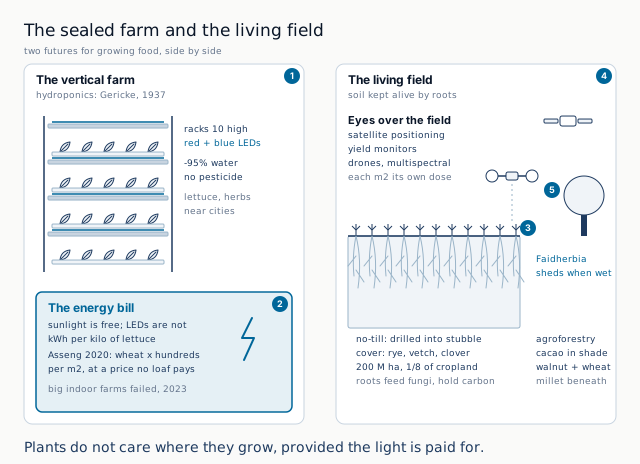
The vertical farm takes the glasshouse indoors and stacks it. Trays of lettuce, herbs and microgreens grow under LEDs tuned to the red and blue wavelengths chlorophyll absorbs, in racks ten layers high, using about 95 per cent less water than a field and no pesticide at all. The catch is the electricity. Sunlight is free, and replacing it is not: a kilogram of indoor lettuce needs several kilowatt-hours of power, and when Senthold Asseng and colleagues modelled wheat in a ten-storey farm in 2020, they found yields hundreds of times higher per square metre of ground, at an energy cost no bread could pay for. Several of the largest vertical farming companies went bankrupt in 2023. Indoors wins for salad near cities; the staples will stay in the sun.
The field is changing too, more quietly. Precision agriculture uses satellite positioning, yield monitors on the combine and drones with multispectral cameras to treat a field as thousands of small fields, giving each square metre only the fertiliser and water it needs. No-till farming, in which seed is drilled straight into last year's stubble, and cover crops of rye, vetch or clover sown over winter, keep roots in the ground all year, feed the soil's fungi and bacteria, and hold carbon; conservation agriculture of this kind now covers around 200 million hectares, about an eighth of the world's cropland.
That tree is the model for agroforestry , the oldest new idea in farming: cacao under shade trees in Ghana, walnut rows between wheat in France, coffee under Inga in Central America. Plants, meanwhile, are being asked to replace oil: Brazil has run cars on sugarcane ethanol since 1975, and maize starch becomes the bioplastic PLA.
None of these is the future on its own. The field of 2050 will probably be a soil kept alive by roots all year, watched by sensors and drones, with the lettuce grown under lights next door. Plants do not care where they grow, provided the light is paid for.
The Vegetable Kingdom — 100 chapters on the green world that feeds us
Ready when you are.
Tap below to open the full chapter in the book reader. Anchored books jump to this chapter automatically.
The Future of the Green Kingdom
The Vegetable Kingdom — 100 chapters on the green world that feeds us
Weigh everything alive on Earth and the result is a pyramid with plants at the bottom and almost nothing on top. In 2018 Yinon Bar-On, Rob Phillips and Ron Milo added up the biomass of every kingdom in carbon and found about 550 billion tonnes in total. Plants account for some 450 billion tonnes, around 80 per cent of all living matter, most of it wood. Bacteria come next at 70 billion tonnes, fungi at 12. All the animals on Earth together weigh about 2 billion tonnes of carbon; humans 0.06, and our livestock 0.1. The green kingdom is not one part of life; it is the stage on which the rest of it stands.
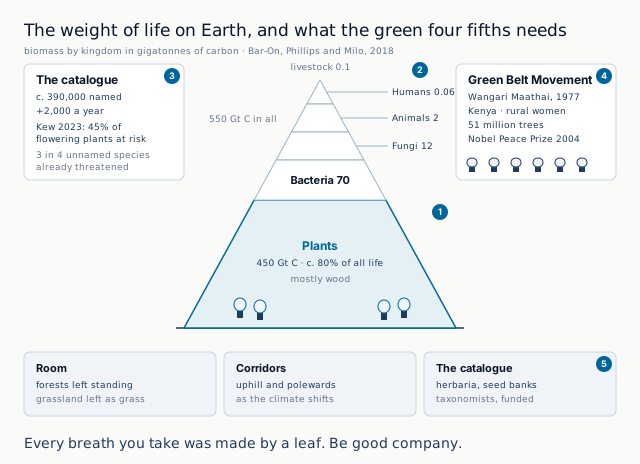
It is also the least known. Kew's State of the World's Plants and Fungi reports, begun in 2016, count around 390,000 vascular plant species named so far, with about 2,000 added each year; the 2023 edition estimated that three in four of the species still undescribed are already likely to be threatened, and that 45 per cent of all flowering plants may be at risk. Nearly half of the plants we have not yet met may be gone before anyone names them.
What plants will need from this century is mostly land, and mostly left alone: forests allowed to stand, grasslands allowed to be grasslands, corridors so that species can move uphill and polewards as the climate shifts. They will need the dull infrastructure of knowledge, the herbaria, seed banks, Red List assessors and taxonomists who have appeared through this book, funded well enough to finish the catalogue. And they will need people who think planting a tree is a reasonable response to despair.
Maathai's point was never only the trees. She saw that a woman planting a seedling near her village was also claiming a say in what happened to the land, and the government that jailed her for it understood that too. Plants and people have been negotiating since the first farmer, and the terms are up for revision.
Look back over the kingdom. A green alga learned to split water two and a half billion years ago and gave the sky its oxygen. Its descendants climbed onto land, invented wood and seed and flower, fed the dinosaurs and then the mammals, and taught a clever ape to farm. Every breath you take was made by a leaf, and every meal began in one. The plants will be here long after us, in some form; the only question this century decides is how much of their variety comes with us, and whether we were good company. Be good company.
The Vegetable Kingdom — 100 chapters on the green world that feeds us
Ready when you are.
Tap below to open the full chapter in the book reader. Anchored books jump to this chapter automatically.