A Stoic Story
Unbothered Volume 4
A history of Stoicism in 100 lives — from a shipwreck off Piraeus to the porch that is now everywhere. All 100 chapters in EN/FR/PL/ES.
Preface
How to read this one.
A history of Stoicism in 100 lives — from a shipwreck off Piraeus to the porch that is now everywhere. All 100 chapters in EN/FR/PL/ES.
- ↓ Scroll vertically for the 100-chapter journey.
- → Swipe horizontally on any chapter for its plate + details.
- ✦ Random Chapter and Random Book pinned to the footer.
Contents
tap a chapter to jump
100 chapters.
- I · The Shipwreck & the Porch · c. 334–262 BC
- II · The Water-Carrier & the Champion · c. 330–206 BC
- III · The Middle Stoa Goes to Rome · c. 185–51 BC
- IV · The Republic's Iron · 95–46 BC
- V · The Millionaire & the Tyrant · 4 BC–65 AD
- VI · The Slave & the Emperor · c. 50–180 AD
- VII · The Long Transmission · c. 150–1340 AD
- VIII · The Recovery · c. 1345–1790
- IX · The Hard Proof · 1778–1993
- X · The Revival · 1955–now
I · The Shipwreck & the Porch · c. 334–262 BC
The Merchant of Citium
In which a Phoenician dye trader owns exactly one basket and puts every egg he has in it.
Before he was a philosopher, Zeno was a smell. Murex purple — the dye of kings, boiled out of sea snails by the tens of thousands — clung to everything in Citium's harbour district: the vats, the ropes, the ledgers, the man. It was said you could tell a purple trader with your eyes closed. Nobody ever needed to close their eyes around Zeno's family. They were in purple up to the elbows.
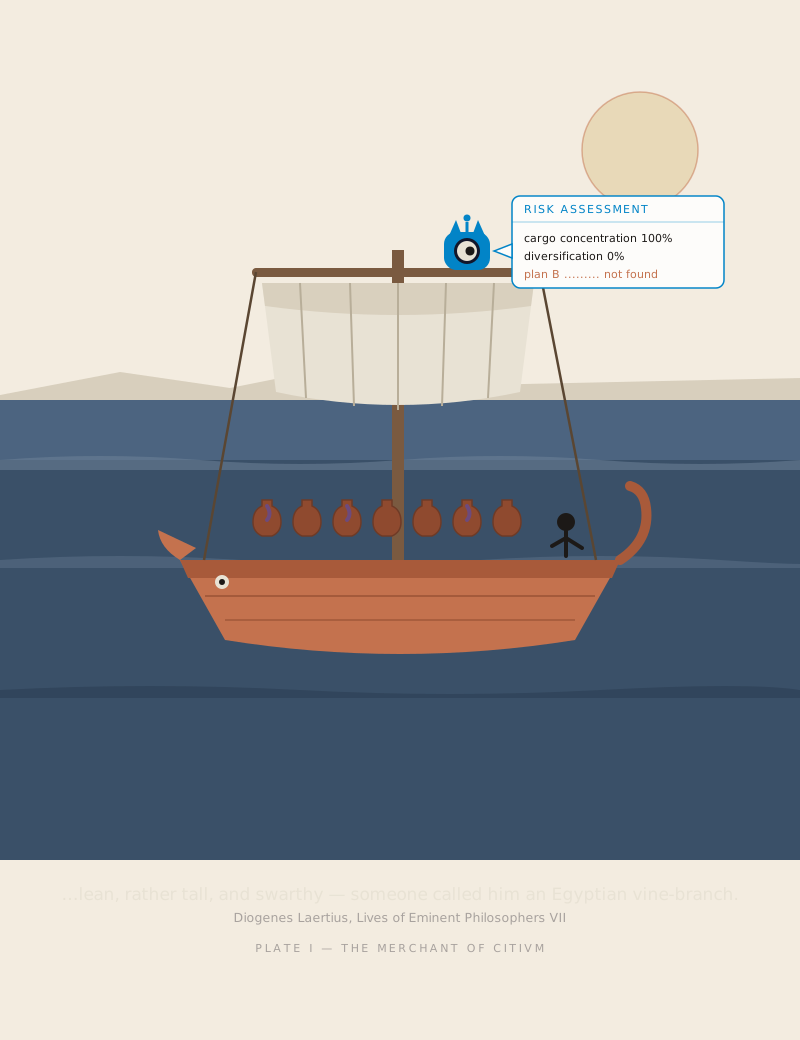
Citium, on the southern coast of Cyprus, was a Phoenician town doing Greek business, and Zeno — born around 334 BC, son of a merchant named Mnaseas — grew up bilingual in both senses: two languages, two worlds. The family product was the most concentrated luxury in the Mediterranean. Thousands of snails surrendered their glands for a single gram of dye; a bolt of true purple was worth more than the ship that carried it. It was a magnificent trade with one structural flaw, which is that the entire warehouse travels by sea, and the sea has opinions.
Two details from Diogenes Laertius suggest the merchant was already leaking philosophy. First: his father, returning from business trips to Athens, brought the boy books — Socratic books, the bestseller list of the fourth century. Second: Zeno is described as lean, tall, dark and fond of green figs, a man of appetites so small they barely qualified. Here was a person constitutionally mismatched to his own inventory — a minimalist shipping maximalism, a man who wanted little, hauling the one commodity that existed purely to signal wanting everything.
Hold the picture: a man in his early thirties, his net worth aboard a single hull, sailing from Phoenicia toward Piraeus. Everything he has is cargo. Everything he is, he hasn't met yet. The most important business trip in the history of philosophy is underway, and its success will consist entirely of its failure.
◈ Shoulder Agent’s note
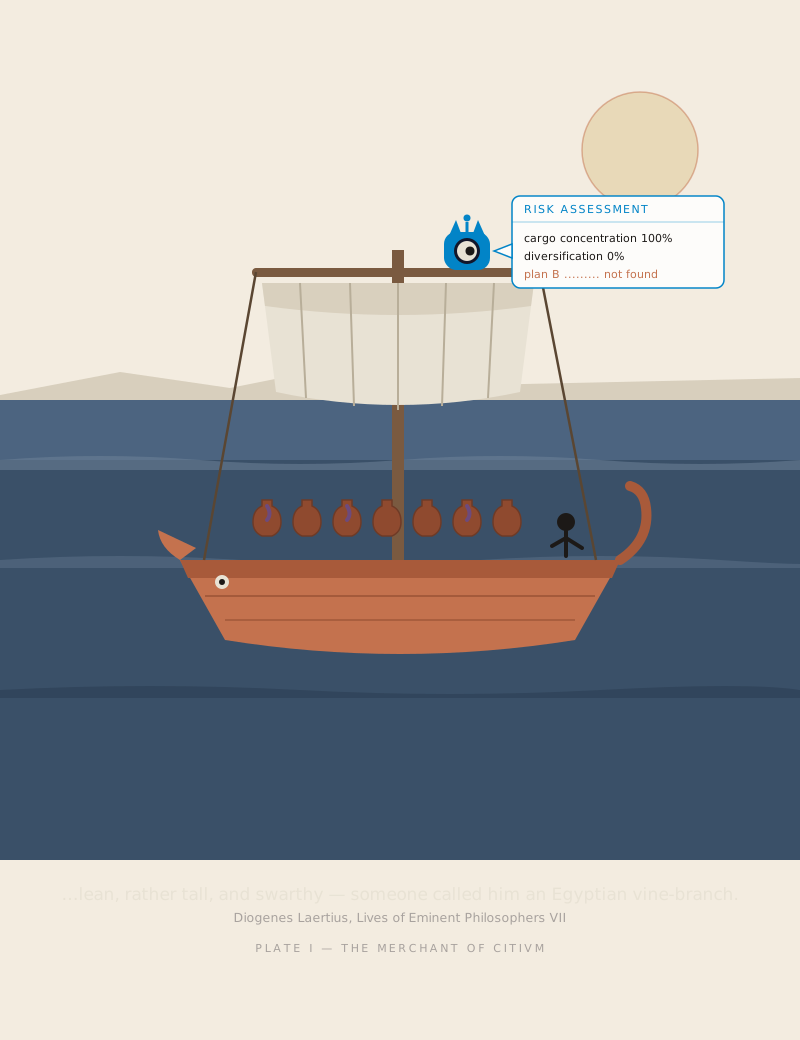
Risk assessment, filed from the yardarm: cargo concentration 100%, diversification 0%, contingency plan — none detected. I have seen ten thousand portfolios like this one. The interesting thing about Zeno's is not that it sank. It's what he did on the beach. Readers holding one basket of anything: chapter two is for you.
A Stoic Story — Unbothered Volume 4
Ready when you are.
Tap below to open the full chapter in the book reader. Anchored books jump to this chapter automatically.
I · The Shipwreck & the Porch · c. 334–262 BC
The Shipwreck
In which the sea cancels a merchant's plans and accidentally approves a better application.
Somewhere off Piraeus, around 301 BC, the Mediterranean did what it periodically does to concentrated wealth. The hull went down with the purple in it. What washed up was a Phoenician in his thirties with wet sandals, no inventory, and — though he would not know this for a while — the founding anecdote of a two-thousand-year philosophy.
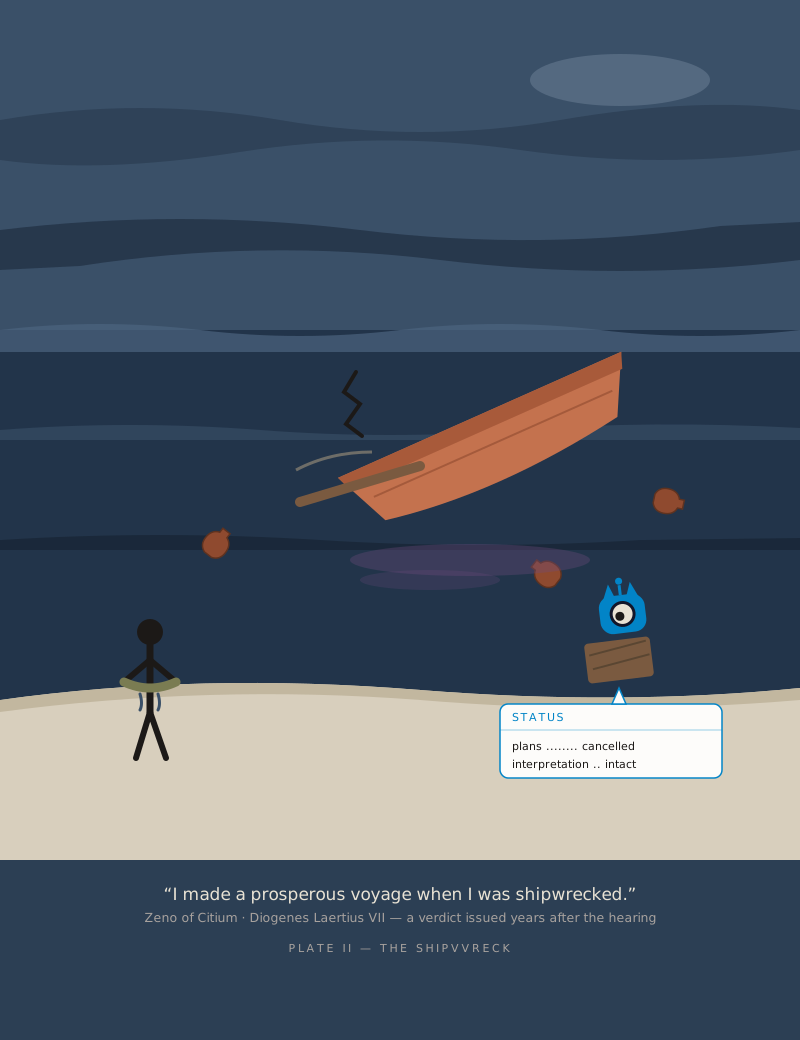
Diogenes Laertius, our gossipy and indispensable source, gives the story with characteristic looseness: Zeno was shipwrecked near Piraeus carrying purple from Phoenicia, made his way up to Athens, and stayed. Another version in the same paragraph says he was already in Athens when word came that the ship was lost. Honesty requires the footnote: our best source cheerfully offers both, and we cannot pick for you. What both versions agree on is the accounting — total loss — and the destination: a bookshop, which is where the next chapter starts.
Then there is the famous sentence, the one on the epigraph page: I made a prosperous voyage when I was shipwrecked. Note when it was minted. Not on the beach. Zeno said it years later, a founder looking back at the wreck that had cleared his calendar for philosophy. On the day itself, Laertius has him nearer the bone — Well done, Fortune, to drive me thus to philosophy — and even that has the polish of retrospect. The reframe is real, but it was earned slowly, which is the honest version of every reframe you have ever been sold.
Here is the lesson the whole book is built on, arriving in chapter two because history was efficient that day: the event and the meaning of the event are two different cargoes, and only one of them is carried by the ship. The sea took the purple. The interpretation stayed with the man, because it always does. Stoicism begins — literally, biographically — with a person discovering that his worst day was negotiable.
◈ Shoulder Agent’s note
Status update from a floating crate: PLANS — cancelled. ASSETS — redistributed to the seafloor. MAN — standing on the shore, suspiciously calm, or possibly just in shock; from where I bob, the two are indistinguishable, and that is worth remembering. The prosperous-voyage line arrives in a few years. Wisdom ships on a delay. The wreck ships same-day.
A Stoic Story — Unbothered Volume 4
Ready when you are.
Tap below to open the full chapter in the book reader. Anchored books jump to this chapter automatically.
I · The Shipwreck & the Porch · c. 334–262 BC
The Bookshop
In which a ruined man asks a retail worker the most important question of his life, and gets an answer.
A newly poor merchant walks into an Athenian bookshop. This is not the setup of a joke; it is the setup of everything. He sits down — possibly because sitting was free — and the bookseller happens to be reading aloud from the second book of Xenophon's Memorabilia: Socrates, twenty years dead, still talking.
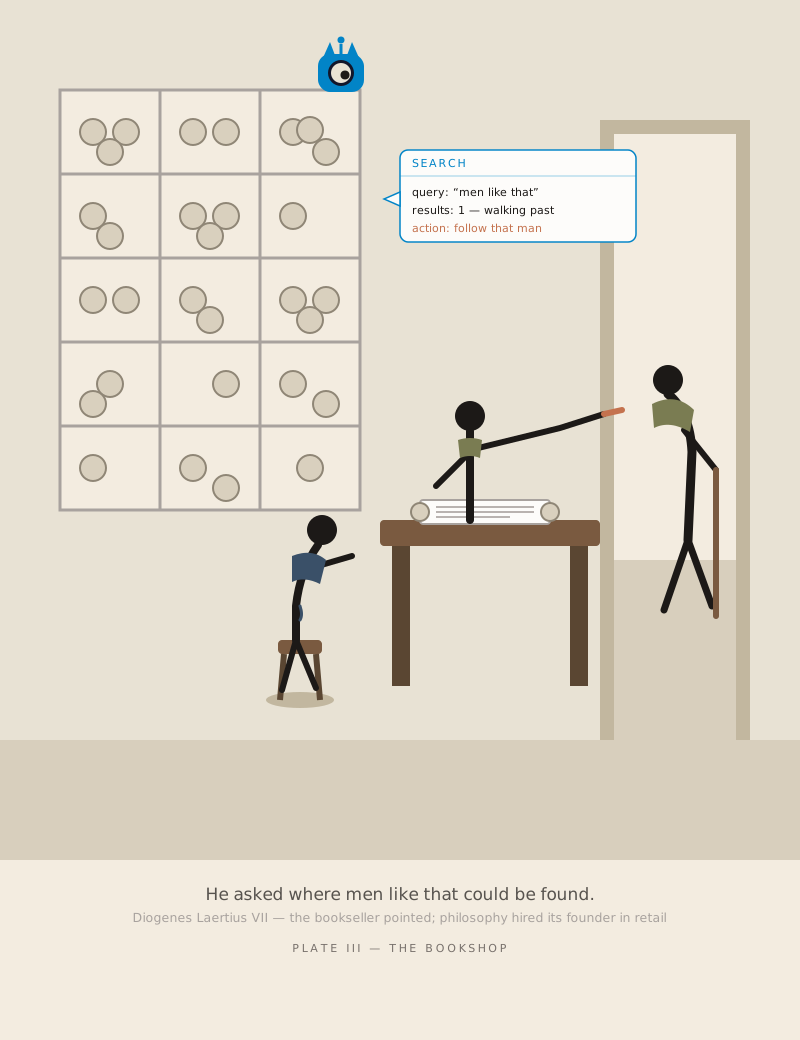
Something in it went through Zeno like weather. Remember the boy in Citium whose father brought Socratic books home from Athens; the wreck had, with the sea's usual bluntness, delivered the reader to the source. Laertius records what happened next in one of antiquity's great small scenes: Zeno, delighted, asked the bookseller where men like that could be found. Not where the books were kept — where the men were. He wanted the living article. He had just watched the difference between owning things and being something get settled at sea, decisively, in favour of being.
And here the universe performed the single greatest act of customer service in the history of philosophy: at that exact moment Crates the Cynic — Athens' resident holy vagrant, a hunchbacked ex-rich-man who had given away a fortune to live in deliberate shamelessness — happened to be walking past the shop. The bookseller pointed. Follow that man. Zeno stood up and did.
It reads like fate, and Laertius certainly sells it that way. But look at the mechanics. The luck was Crates walking past; everything else was Zeno. He was in the shop. He was listening. And — the part most people skip — he asked the question out loud, to a stranger, on the worst week of his life. Fortune supplied one pedestrian. The ruined man supplied the search query. That division of labour has not changed in twenty-three centuries.
◈ Shoulder Agent’s note
Search log: query — “men like that.” Results — one (1), currently walking past the door, hunchbacked, deliberately underdressed, availability: immediate. Note for your era, where every query returns ten million results: the ancient search engine worked because the man asked a person, in a place, out loud. Precision beats scale. It usually does.
A Stoic Story — Unbothered Volume 4
Ready when you are.
Tap below to open the full chapter in the book reader. Anchored books jump to this chapter automatically.
I · The Shipwreck & the Porch · c. 334–262 BC
Follow That Man
In which the first lesson of the curriculum is a pot of lentil soup, administered externally.
Crates the Cynic looked at his new student — a neat, careful, recently bankrupted merchant who still dressed like a man with a reputation to protect — and made a diagnosis that required no instruments: this one is ashamed of the wrong things. So he prescribed soup.
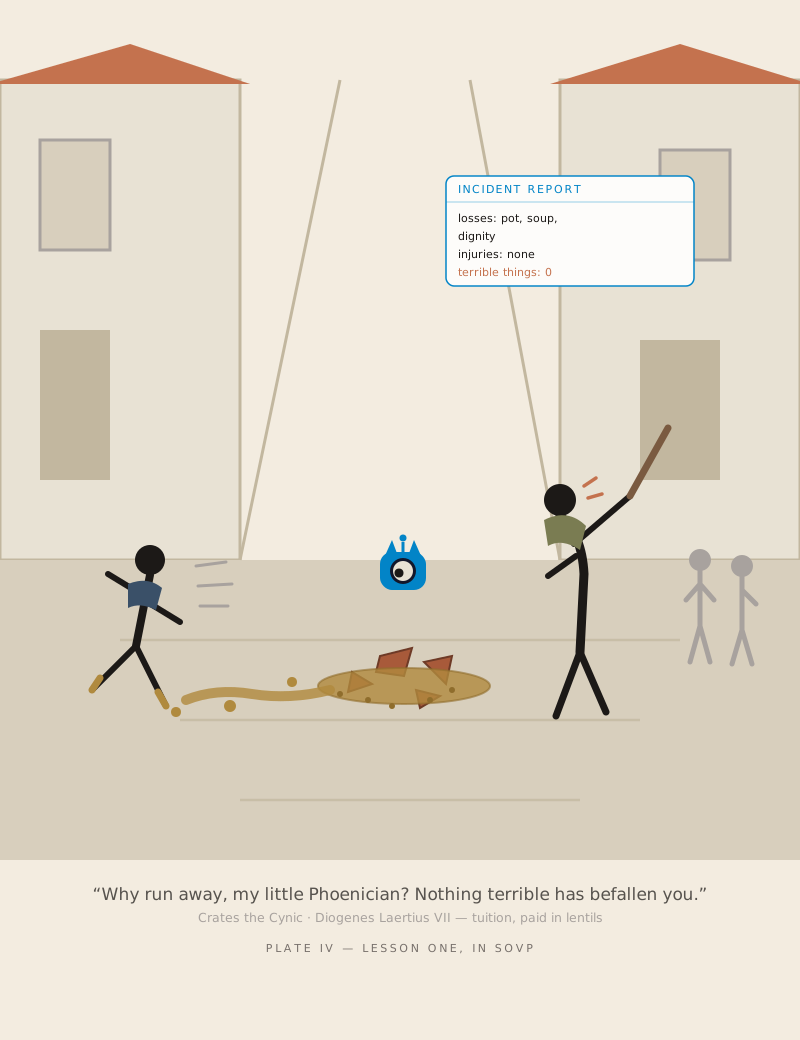
The treatment, as Laertius tells it: Crates handed Zeno a pot of lentil soup and told him to carry it through the Kerameikos — the potters' quarter, one of the most public districts in Athens. For a Cynic this was nothing; for Zeno it was mortifying, a gentleman doing a servant's errand in front of everyone, and he tried to manage it the way embarrassed people always do, by hiding the pot under his cloak and keeping to the quiet streets. Crates, following, saw the concealment — the concealment was the disease — and smashed the pot with his staff. Lentil soup everywhere: down the legs, over the sandals, spectacularly public. Zeno fled. And Crates called after him the sentence that made the whole indignity worth it: Why run away, my little Phoenician? Nothing terrible has befallen you.
Sit with the audacity of that claim. The man is wearing soup in front of strangers, and his teacher's assessment is: nothing terrible has occurred. Crates was not being kind; Cynics did not stock kindness. He was being precise. An inventory of the damage would show: dignity — a thing that exists only in the opinions of passers-by; soup — replaceable; the man himself — entirely intact. Zeno had just lost a fortune at sea and handled it. It was the small shame that made him run. It usually is.
Zeno never became a Cynic; the shamelessness-as-lifestyle package was, he eventually decided, more than the argument required. But he kept the kernel: that most of what we call unbearable is an audience effect. The Stoic dichotomy of control was learned here first, in soup, at street level, before it was ever written down.
◈ Shoulder Agent’s note
Incident report, Kerameikos district. Damage: one (1) pot, ceramic; one (1) serving of lentils; one (1) reputation, market value already zero after recent maritime events. Injuries: none. The subject ran anyway. Your era calls this exposure therapy and bills by the hour. Crates billed in soup and got faster results.
A Stoic Story — Unbothered Volume 4
Ready when you are.
Tap below to open the full chapter in the book reader. Anchored books jump to this chapter automatically.
I · The Shipwreck & the Porch · c. 334–262 BC
The Long Apprenticeship
In which the founder of Stoicism spends roughly twenty years founding nothing at all.
Here is the part of the origin story that never makes the poster: between the bookshop and the Porch lie about two decades. The man who would give his name to an entire temperament spent them as a student — one school after another, taking notes, asking questions, and conspicuously not launching.
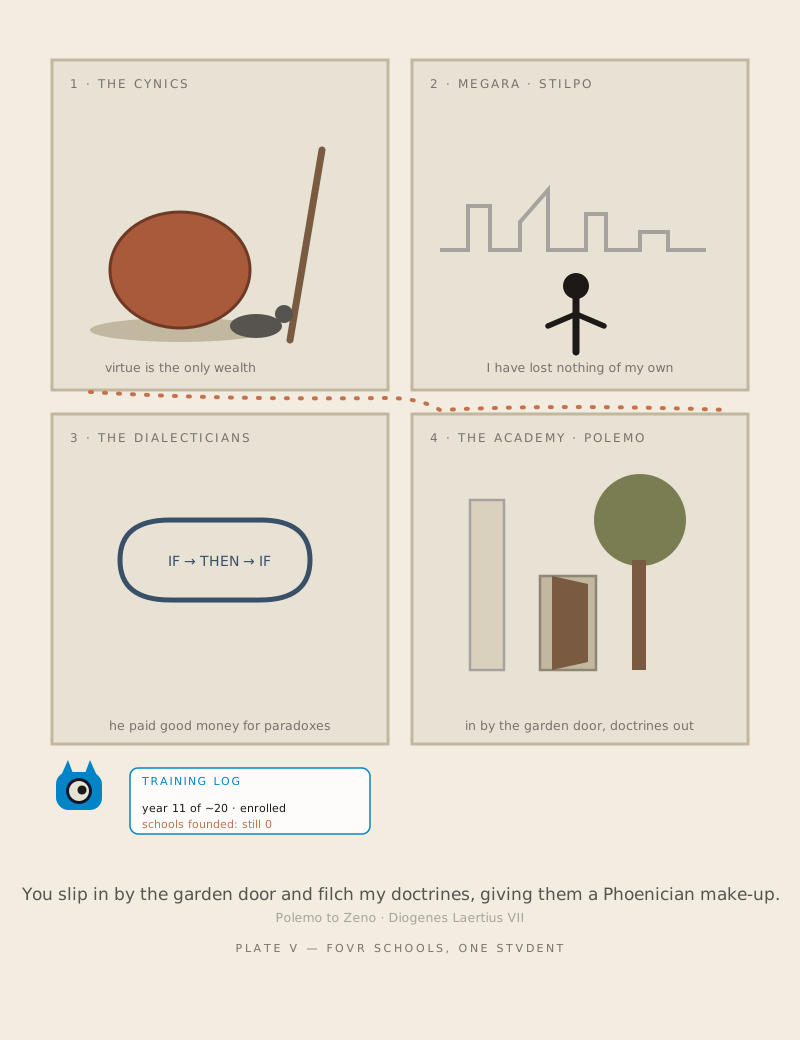
The syllabus, assembled from Laertius: first Crates and the Cynics, who taught him that virtue is the only wealth and that shame is mostly theatre. Then Stilpo of Megara, master of self-sufficiency, from whom he took the idea that a good man cannot truly be robbed — Stilpo, whose city was sacked, famously replied that he had lost nothing of his own. Then the logicians, Diodorus Cronus and Philo, who ran the fourth century's most fearsome argument gymnasium; Zeno paid for paradoxes the way other men paid for flute-girls. And Polemo at the Academy, Plato's own house, for the grand architecture of ethics. Polemo saw exactly what was happening and said so, in one of antiquity's better faculty-lounge remarks: you slip in by the garden door, Zeno, and filch my doctrines, giving them a Phoenician make-up.
He was right, and it was the correct procedure. Zeno was not wandering; he was compiling. From the Cynics, the ethical engine. From Megara, the invulnerability proofs. From the dialecticians, the logic that would let the school survive cross-examination. From the Academy, the system-building ambition. Stoicism, when it finally shipped, was not a lightning bolt — it was an integration, two decades in review, of the best components then available, assembled by a merchant who knew good stock when he handled it.
The lesson hides in the timeline itself. A culture that demands you found something by thirty should note that the most durable school in Western philosophy was founded by a middle-aged man who had spent twenty years being wrong in four different classrooms first. The originality was real. It was also, like the wisdom on the epigraph page, manufactured on time-delay.
◈ Shoulder Agent’s note
Training log, year eleven of approximately twenty: subject still enrolled, still not famous, still attending other people's lectures. I flag this because your century treats a long apprenticeship as a failure state. For the record, I have watched every overnight success in this book. The shortest one took twenty years.
A Stoic Story — Unbothered Volume 4
Ready when you are.
Tap below to open the full chapter in the book reader. Anchored books jump to this chapter automatically.
I · The Shipwreck & the Porch · c. 334–262 BC
The Painted Porch
In which philosophy signs a lease on a public colonnade with blood in its history and murals on its walls.
Around 301 BC, his apprenticeships complete and his patience presumably exhausted, Zeno began teaching. He did not buy a garden, as Epicurus had just done across town. He did not found a suburban campus like the Academy or the Lyceum. He picked a porch — the Stoa Poikile, the Painted Colonnade on the north side of the agora — which is to say, he picked a bus stop.
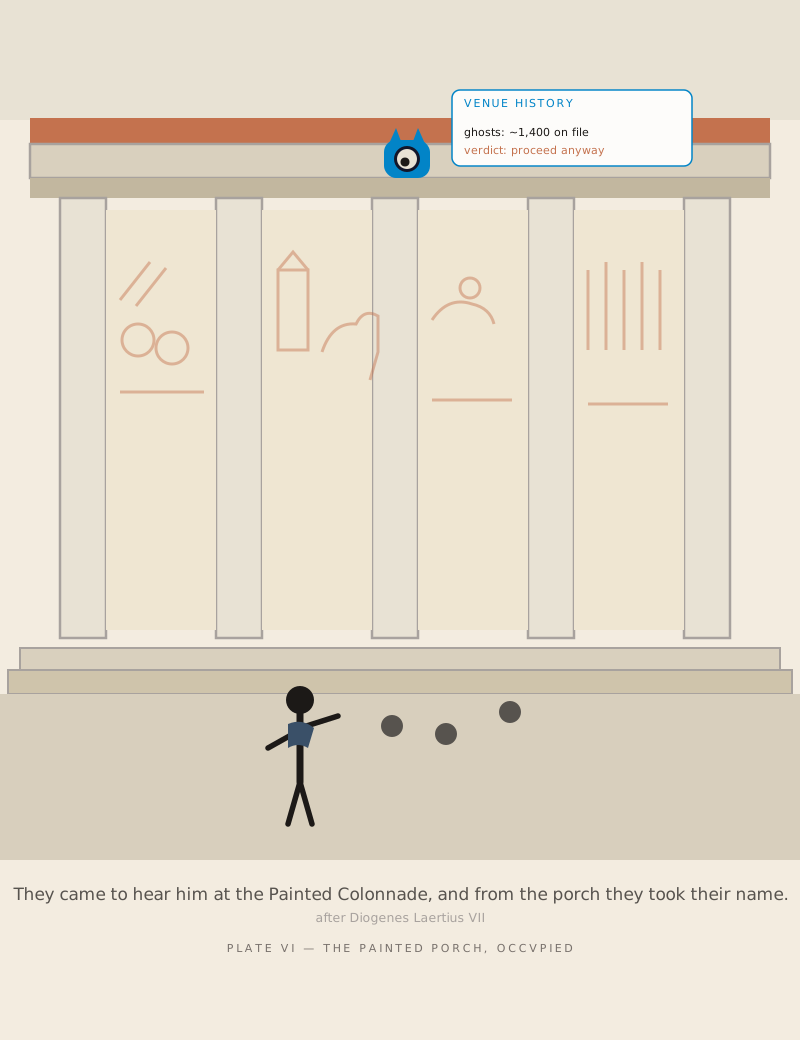
The Stoa Poikile was public in every direction. A long open colonnade hung with the city's most famous paintings — the Battle of Marathon, the Sack of Troy, Athenians and Amazons — it was where Athens strolled, gossiped, sheltered from rain, and sold fish. It had also, within living memory, been an abattoir: under the Thirty Tyrants, Laertius notes with a shudder you can still feel, some fourteen hundred citizens had been condemned to death there. Zeno set up his philosophy in a haunted building, between war murals, in everyone's way. His followers were called Zenonians at first, and then, after the venue, Stoics. The most influential school of the ancient world is named after its real estate.
The choice was the doctrine. Epicurus' Garden had a wall around it: withdraw, curate your friends, live unnoticed. The Porch had no wall at all. Anyone could stop and listen — citizens, foreigners, eventually slaves and kings, which is a fair preview of the cast of this book. A philosophy that claims virtue is practicable by anyone, anywhere, in any circumstance, cannot teach from behind a gate. It has to hold office hours in the weather, over the fish-sellers, in a building where the worst had already happened.
That is the standing lesson of the venue, and it travels: do the work in public, in an imperfect place, among people who are mostly there for something else. The ghosts come with the lease. Teach anyway.
◈ Shoulder Agent’s note
Venue inspection: capacity — unlimited, technically the street. Amenities — murals (war), acoustics (poor), history (contains fourteen hundred ghosts). Recommendation — proceed. Every place humans might teach has a past; the Porch just kept its receipts on the walls. Your open-plan office is also a haunted colonnade. Teach anyway.
A Stoic Story — Unbothered Volume 4
Ready when you are.
Tap below to open the full chapter in the book reader. Anchored books jump to this chapter automatically.
I · The Shipwreck & the Porch · c. 334–262 BC
Man of Few Words
In which the city that executed Socrates gives a foreign philosopher the keys to its walls.
Athens had a settled procedure for philosophers: mock them, sue them, occasionally poison them. For Zeno it made an exception so complete that historians still blink at it. The city gave him a golden crown, voted him a bronze statue, and — this is the detail to keep — entrusted him with the keys to the city walls. The keys. To a foreigner. Who taught on a porch.
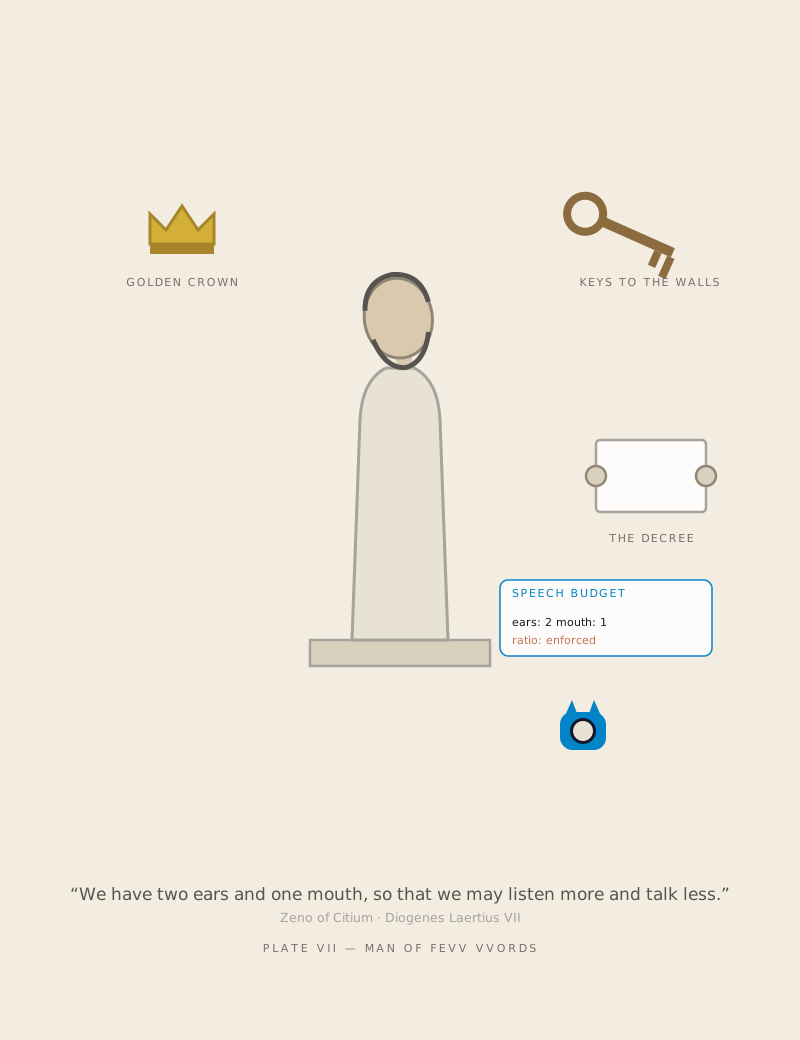
The man himself was almost aggressively unimpressive by celebrity standards. He ate small loaves and honey and green figs; he drank a little wine when pressed and preferred sun-baking to banquets; his one recorded indulgence was liking a fig. He was frugal to the point of civic legend — more temperate than Zeno became an Athenian proverb. And he was economical with words the way he was with everything else. When a young man was talking too much, Zeno delivered the line that has outlived nearly all seven hundred of Chrysippus' books: we have two ears and one mouth, so that we may listen more and talk less. Kings wrote to him; Antigonus Gonatas of Macedon attended his lectures whenever he was in Athens and invited him to court. Zeno declined the court and sent students instead — a move we will see again on the successors' bench.
Why the honours? The Athenian decree — preserved by Laertius, and worth quoting for its bureaucratic beauty — says the city crowned him because for many years he had been an exhortation to virtue and temperance to the young , and because he made his life an example to all, for it was consistent with his teaching. Read that twice. Not: his arguments were unanswerable. Not: his books were sublime. His life matched his sentences. Athens, connoisseur city of brilliant hypocrites, had finally met the other thing, and it knew the difference on sight.
Consistency, it turns out, is the rarest rhetorical device. It cannot be faked at porch-distance over thirty years. It is also the thesis of this book, stated here in chapter seven so the remaining ninety-three chapters can test it.
◈ Shoulder Agent’s note
Audit of assets, subject Zeno: one cloak, some figs, a proverb named after him, the keys to a city that kills philosophers. Note the exchange rate — decades of doing what he said, converted at par into being believed. There is no faster instrument. I have checked every era in this book, including yours.
A Stoic Story — Unbothered Volume 4
Ready when you are.
Tap below to open the full chapter in the book reader. Anchored books jump to this chapter automatically.
I · The Shipwreck & the Porch · c. 334–262 BC
The Egg
In which the curriculum is explained by breakfast, and even the breakfast is disputed.
Every school needs a diagram, and the Stoa's was edible. Philosophy, the Stoics said, comes in three parts — logic, physics, ethics — and to show how the parts hold together they compared it to an egg: the shell on the outside, then the white, then the yolk at the centre. Simple, portable, and immediately the subject of a two-thousand-year argument about which part is which.
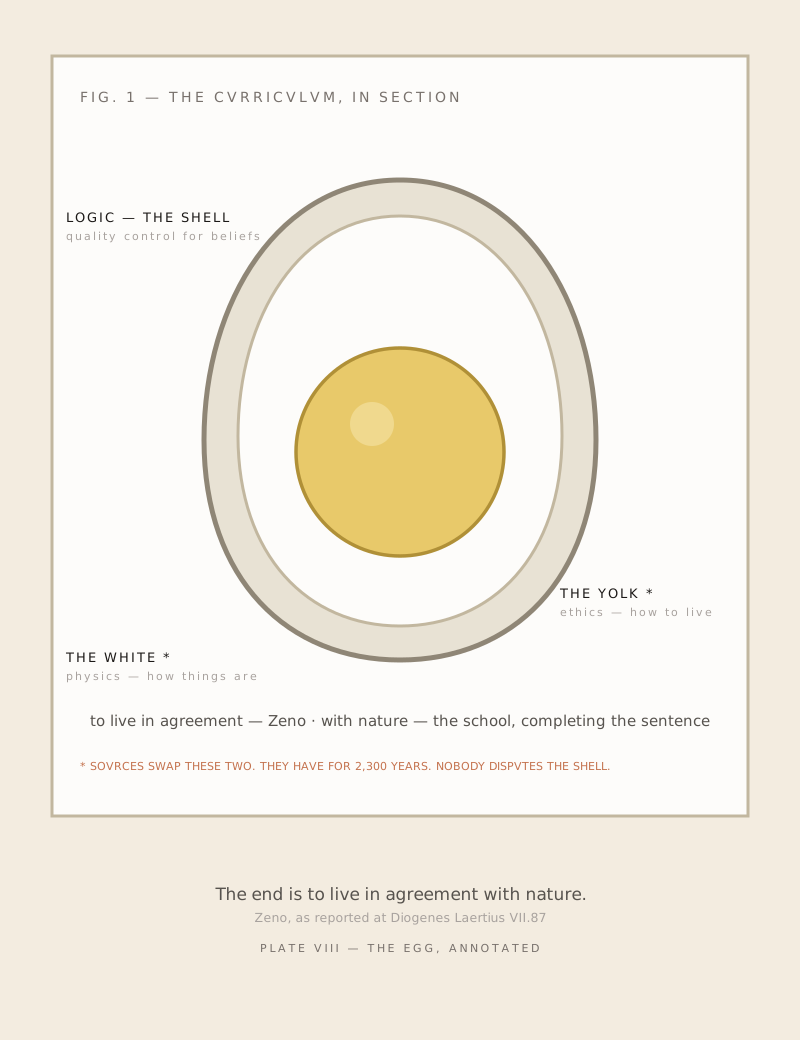
Diogenes Laertius gives one assignment of parts; other ancient reporters give another, swapping which of physics and ethics sits at the yolk. This book, having promised you honesty, will not pretend the sources agree — and will point out that the disagreement is itself the lesson. Nobody ever disputed the shell. Logic is the outside of the egg in every version: the hard, unglamorous casing whose entire job is to keep the contents from ending up like Zeno's dignity in chapter four. Test your impressions, said Zeno; do not assent to what is unclear. The shell is quality control for beliefs, and everything inside depends on it.
Inside, the two remaining parts feed each other regardless of seating order. Physics, for a Stoic, meant the study of how the world actually is — a rational, causal, interconnected whole of which you are one small operating part. Ethics meant how to live, given that. The famous formula came in stages, like the egg: Zeno said the goal was to live in agreement — consistently, one life, no self-contradiction — and the school completed it as living in agreement with nature : your one coherent life, run in accordance with how things are, not how you'd prefer them.
That is the whole curriculum, and it survived when the seven hundred books did not, because you can carry it to market in one hand. Check your beliefs (shell). Study reality (one part of the interior). Act accordingly (the other). Crack any chapter in this book and this is what runs out.
◈ Shoulder Agent’s note
Diagram review: sources disagree about the interior of the egg and have for twenty-three centuries. Filed under: reassuring. A tradition honest enough to preserve its own inconsistencies is a tradition you can trust with bigger things. Beware of any school whose diagrams have no disputed regions. I have seen those schools. They end badly.
A Stoic Story — Unbothered Volume 4
Ready when you are.
Tap below to open the full chapter in the book reader. Anchored books jump to this chapter automatically.
I · The Shipwreck & the Porch · c. 334–262 BC
The Successors' Bench
In which a school is revealed to be a bet on other people, some of whom will lose the plot.
A philosophy is not what its founder says. It is what the people on the bench do after he stops talking. By the end of Zeno's life the bench at the Porch held a boxer, a housemate, a heretic, a footnote, and a Spartan consultant — and the future of Stoicism depended entirely on which of them history would hand the keys.
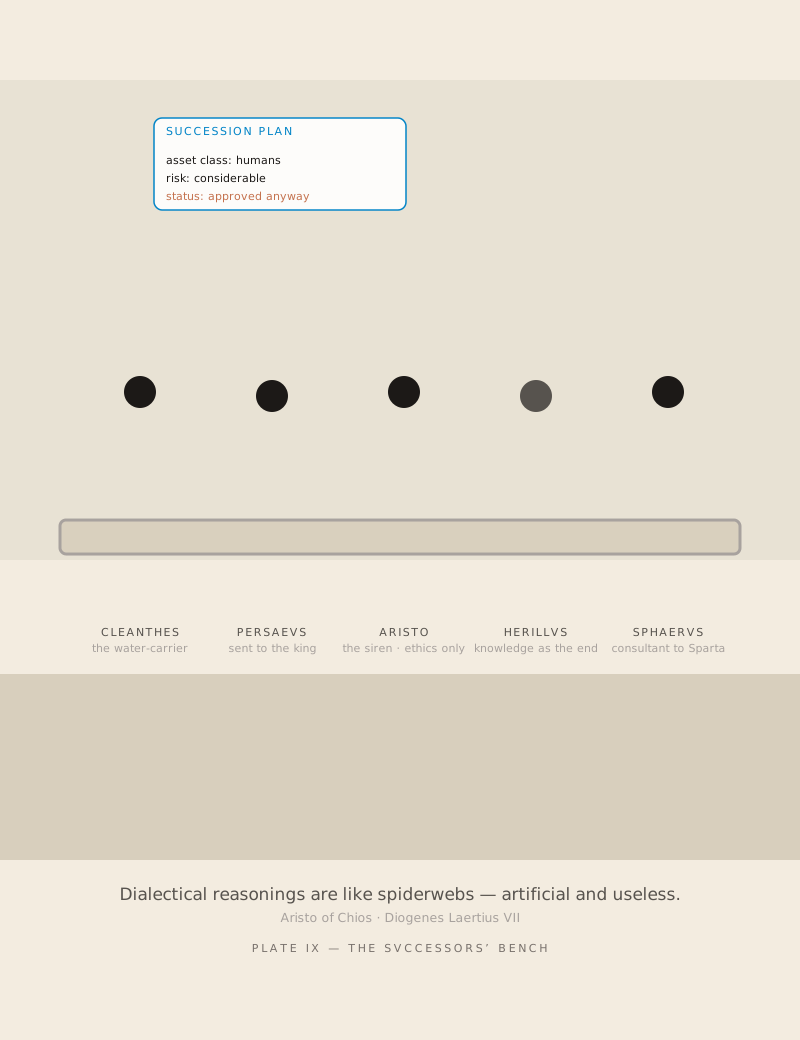
The roster, briefly, because each earns his seat. Cleanthes, the ex-boxer who hauled water all night to afford philosophy by day — the next section belongs to him, so hold that thought. Persaeus, who actually lived in Zeno's house: when King Antigonus asked for Zeno himself, the old man declined on grounds of age and sent Persaeus to court in his place — the school's first foreign posting, and proof Zeno delegated even his royalty. Aristo of Chios, the house heretic, who declared physics beyond us and logic beneath us — dialectical reasonings are like spiderwebs, artificial and useless — and taught an ethics-only Stoicism so charismatic they called him the Siren. Herillus of Carthage, who decided knowledge itself was the goal and quietly exited the mainstream. And Sphaerus, exported to Sparta, where he helped King Cleomenes III attempt to reboot the Lycurgan constitution — the school's…
Notice what Zeno did not do: purge them. Aristo taught his rival Stoicism across town in the Cynosarges; the arguments were left to argue themselves out. It took a generation, and the resolution — orthodoxy restored, heresies filed under 'interesting' — happened through the least likely man on the bench, which is precisely the point. Zeno could not know which student was the load-bearing one. Neither can you. A school, a family, a firm, a codebase: all of them are bets placed on people whose final form you will not live to see.
He placed the bets anyway, funded them with attention, and let the bench argue. That is succession planning as the Stoics practised it: control what you can — the teaching — and hold the outcome loosely. The outcome, as it happened, was about to spend forty years carrying water.
◈ Shoulder Agent’s note
Succession review: five candidates — one slow, one comfortable at court, one openly heretical, one leaving the syllabus, one advising Sparta, of all governments. Risk rating: humans. Approved anyway, because there is no other asset class. Spoiler from the bench's far end: the slow one carries it. The slow ones usually do.
A Stoic Story — Unbothered Volume 4
Ready when you are.
Tap below to open the full chapter in the book reader. Anchored books jump to this chapter automatically.
I · The Shipwreck & the Porch · c. 334–262 BC
The Exit
In which the founder leaves, the story of how he left is probably a story, and the school stands anyway.
One day around 262 BC, an old man left the Porch after teaching, tripped on the way out, and fell. That much is likely. Everything after it is where history shades into legend, and this book keeps its promise: we will tell you the legend, and tell you it is one.
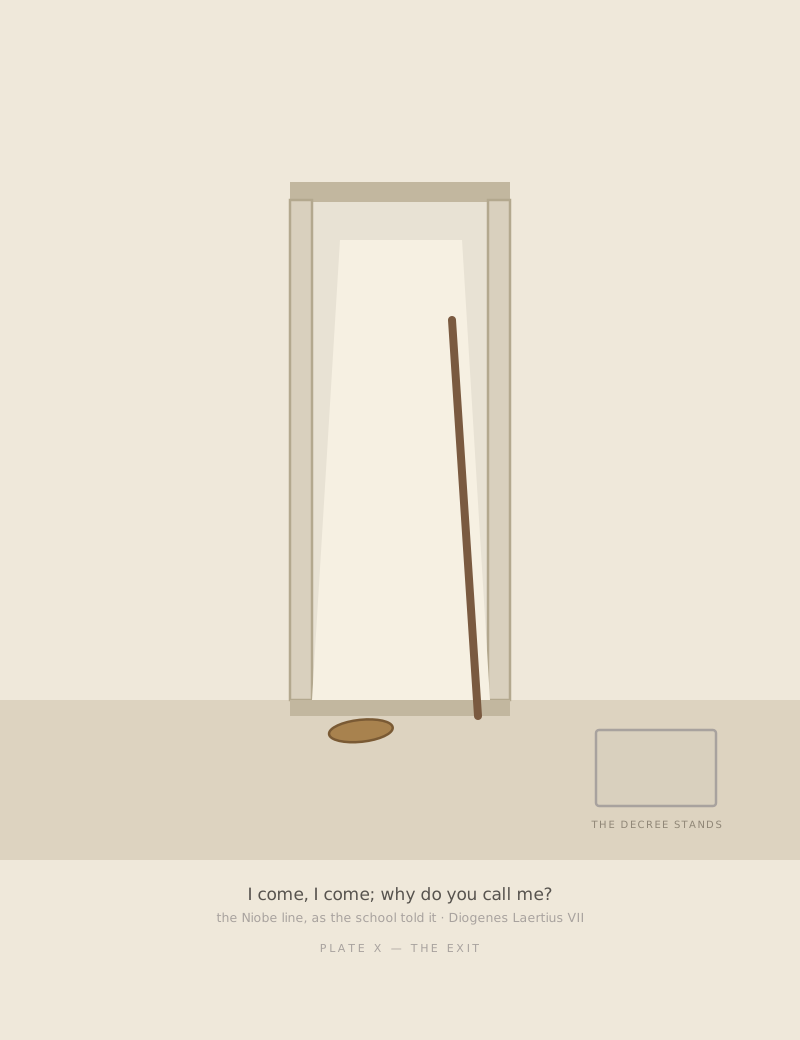
Diogenes Laertius reports it like this: Zeno, leaving the school, stumbled and broke a toe. Striking the ground with his hand, he quoted a line from the Niobe — I come, I come; why do you call me? — and died on the spot, by some accounts holding his breath until he was gone. He was seventy-two by his student Persaeus' count; other ancient sources, never willing to leave a good number alone, stretch him to ninety-eight. The scene is almost too composed: the pratfall, the perfectly chosen quotation, the philosopher dismissing himself with a stage line and closing the account by will alone. Real deaths are rarely this well edited. The toe may be fact; the curtain line has an author, and the author is probably the school's affection.
What is documented — carved, in fact — is what Athens did next. The decree survives: a golden crown, a public tomb in the Kerameikos, the same district where Crates had once smashed the soup pot. And the stated reason, in the assembly's own words: he made his life a pattern to all, for he followed his own teaching. The city did not audit his arguments. It audited the match between the sentences and the man, over roughly forty years, and paid out at par. The proverb, the statue, the keys, the tomb: all interest on consistency.
So Section I closes where it opened, with an accounting. A merchant lost one cargo to the sea and spent four decades loading a different ship — one built of students, sentences, and a public bench under war murals. That cargo is the rest of this book. The exit story people tell about you is the final line of your ledger; you do not get to write it, but you spend your whole life supplying the entries. On the far end of the bench, a slow ex-boxer picks up the water jars. The school passes to him.
◈ Shoulder Agent’s note
I was at the door. I will not settle what happened there; some records are better left as the loved ones filed them. Entry closed: one founder, forty years, taught in public, buried by the city, doctrine intact and already arguing with itself, which is how doctrines stay alive. The porch is empty tonight. It will not be tomorrow.
A Stoic Story — Unbothered Volume 4
Ready when you are.
Tap below to open the full chapter in the book reader. Anchored books jump to this chapter automatically.
II · The Water-Carrier & the Champion · c. 330–206 BC
The Boxer from Assos
In which the future of Western philosophy walks through a city gate with four drachmas and no plan B.
Sometime around 330 BC, a large young man from Assos — a small town on the Aegean coast of Asia Minor — arrived at the gates of Athens. His name was Cleanthes. His profession, such as it was: boxer. His total capital, recorded by Diogenes Laertius with the precision of a customs officer: four drachmas. Roughly four days' wages. The man carrying the future of Stoicism through that gate could not have bought a decent cloak.
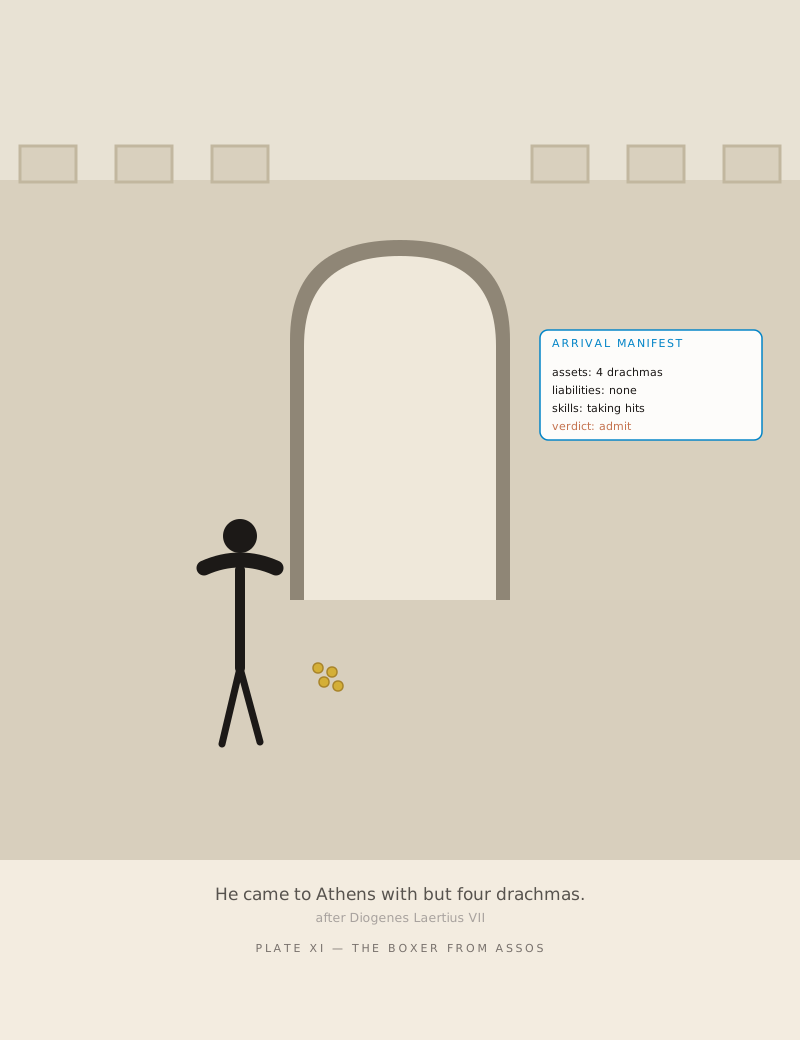
Note who philosophy recruited this time. Zeno arrived rich and lost it; Cleanthes arrived with nothing and kept that. The school's first two leaders bracket the entire economic spectrum between them, which was not an accident of casting but a proof of concept: a doctrine claiming that virtue needs no equipment had better demonstrate it at both ends of the ledger. A boxer with pocket change was, in this sense, ideal laboratory conditions.
What did he bring instead of money? Hands, mostly. The strength of a man who had trained to be hit for a living, and — the trait everyone underestimated for the next seventy years — the temperament of one: the ability to absorb punishment without changing course. Athens' philosophical scene was a combat sport of its own, faster and crueller than boxing, scored in laughter. Every wit in the city would eventually take a swing at Cleanthes. We will watch the punches land in chapter thirteen. None of them moved him an inch.
He found his way to the Painted Porch and to Zeno, and stayed — by the ancient count, nineteen years a student. The four drachmas ran out almost immediately, which raises the obvious accounting question this section opens with: how does a penniless man attend daytime lectures for two decades? The answer is the next chapter, and it involves a bucket.
◈ Shoulder Agent’s note
Arrival manifest, Dipylon Gate: assets — 4 drachmas. Liabilities — none; nothing to lose travels light. Skills declared — taking hits. Customs assessment: admit. Your era screens applicants for capital and credentials. The Porch's greatest servant would have failed both filters at the door.
A Stoic Story — Unbothered Volume 4
Ready when you are.
Tap below to open the full chapter in the book reader. Anchored books jump to this chapter automatically.
II · The Water-Carrier & the Champion · c. 330–206 BC
The Water-Carrier
In which a philosophy student is hauled into court on suspicion of being suspiciously healthy.
The economics of Cleanthes' education were simple and brutal: philosophy happened in daylight, so money had to be made in the dark. He hired himself out by night — drawing water for a gardener's beds, and by some accounts kneading dough for a meal-seller — then washed, walked to the Porch, and spent the day on Zeno. For years. The nickname the city gave him was 'Phreantles': the well-man. It was not intended kindly. He answered to it anyway.
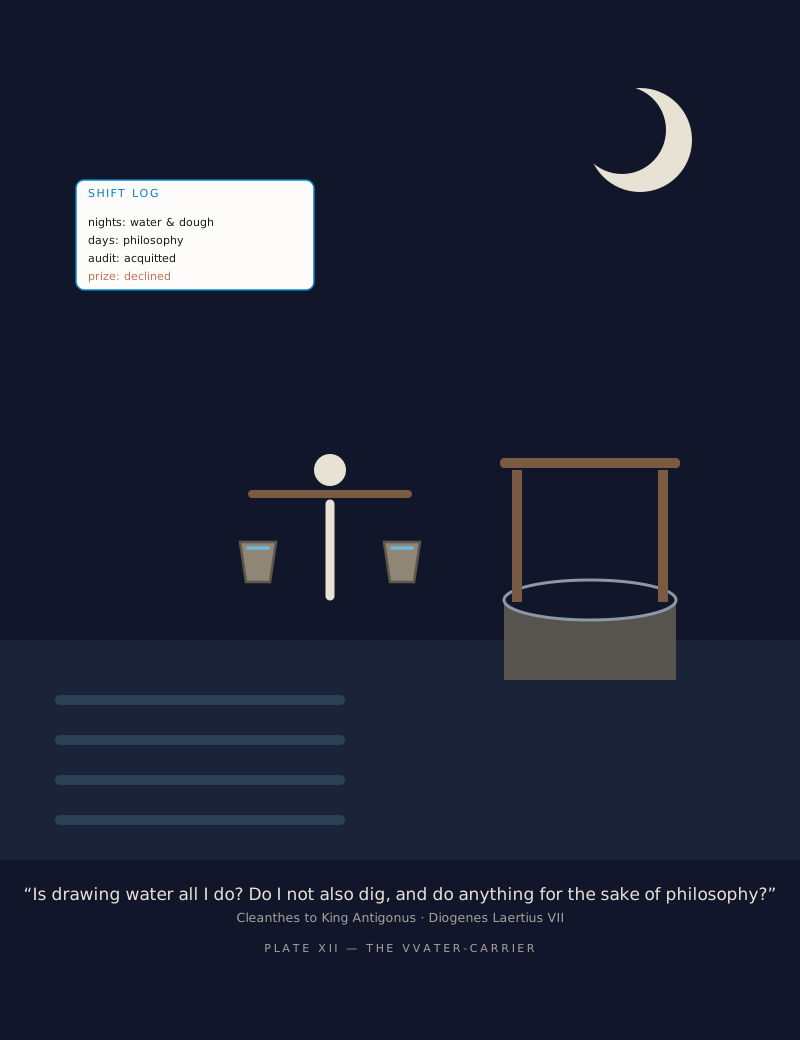
Then the story turns into courtroom drama, because Athens could not leave a puzzle alone. Here was a man with no visible income, attending lectures daily, in conspicuously good condition. The court — Laertius says the Areopagus itself — summoned him to account for how he lived. Cleanthes' defence was the shortest in Athenian legal history: he produced witnesses. The gardener testified. The meal-woman testified. The man worked nights; the numbers added up. The court was so taken with the exhibit that it voted him ten minae — a small fortune — which, the tradition adds, Zeno would not let him accept. The prosecution had discovered an honest man and attempted, reflexively, to pay him for it.
Later, King Antigonus — the same one who had courted Zeno — asked Cleanthes directly: why do you draw water? The reply survives, and it is the whole man in one sentence: Is drawing water all I do? Do I not also dig, and water the ground, and do anything for the sake of philosophy? Notice what the answer refuses: shame, first, and then the premise. The king saw menial work beneath a philosopher. The philosopher saw a funding model, and the funding model was part of the philosophy — the doctrine that no honest necessity is beneath you was being carried in the buckets.
◈ Shoulder Agent’s note
Shift log, filed from the well-head at approximately 3 a.m.: buckets hauled — many. Complaints registered — zero. Audit outcome — acquitted, with prize money declined on principle. Your era calls this a side hustle and writes essays about burnout. He called it Tuesday, then went to class.
A Stoic Story — Unbothered Volume 4
Ready when you are.
Tap below to open the full chapter in the book reader. Anchored books jump to this chapter automatically.
II · The Water-Carrier & the Champion · c. 330–206 BC
The Second Zeno
In which the slowest student in the room outlasts every clever person who laughed at him.
Let the record show that Athens found Cleanthes hilarious. He was slow — genuinely, provably slow, and he knew it. His fellow students called him 'the ass'. Poets lampooned him from the stage. The comic Timon sketched him as a dim ox plodding through the ranks of the clever. And Cleanthes absorbed all of it the way he had once absorbed body shots: with professional interest and no change of footwork.
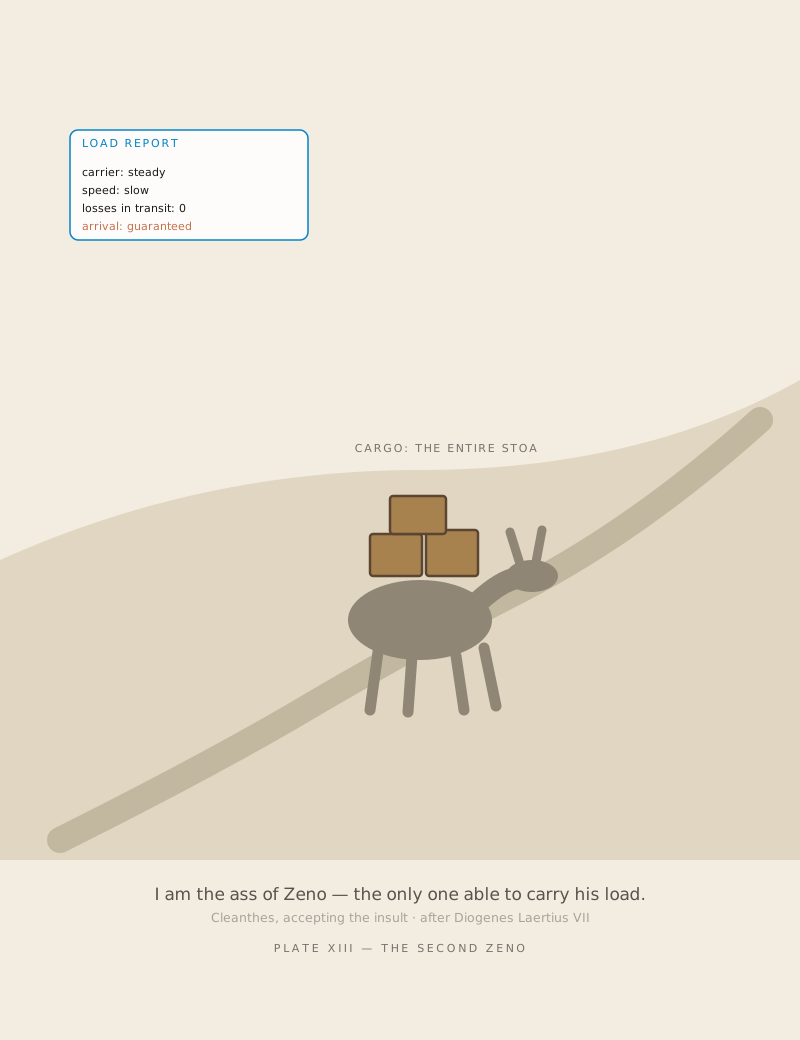
His counterpunch is one of the great self-descriptions in the history of thought. Called the ass, he agreed — and upgraded the insult into a job title: he was Zeno's ass, he said, the only one strong enough to carry Zeno's load. Read the boast hiding inside the humility. The quick students could sprint with a doctrine for an afternoon. Carrying it — whole, unbroken, across decades, uphill — was freight work, and freight work goes to the animal that does not tire and does not bolt. When someone jeered that he was a coward, he took that one too, and receipted it: that is why I so rarely go wrong.
When Zeno died in 262 BC, the school passed over its dazzling options and landed on the water-carrier. History has never stopped being quietly shocked by this, and history should calm down. Zeno had spent forty years teaching that character is the only load-bearing material; his succession choice simply applied the syllabus. Cleanthes led the Porch for thirty-two years — longer than the founder — through mockery, poverty, and the doctrinal knife-fights left over from the successors' bench. Nothing profound was lost on his watch. For a relay, that is not the boring outcome. That is the entire job.
◈ Shoulder Agent’s note
Load report: cargo — one complete philosophy, fragile, irreplaceable. Carrier — slow, mocked, unbothered. Route — thirty-two years, uphill. Losses in transit — none. Your era optimises for the sprinters and wonders where its institutions went. The freight went to the ass. It arrived.
A Stoic Story — Unbothered Volume 4
Ready when you are.
Tap below to open the full chapter in the book reader. Anchored books jump to this chapter automatically.
II · The Water-Carrier & the Champion · c. 330–206 BC
Hymn to Zeus
In which the slow man writes the only early Stoic text that time agreed to keep.
Here is the joke the universe played on three centuries of Stoic brilliance: of all the early school's writing — Zeno's treatises, Chrysippus' seven hundred books, the whole argumentative arsenal — the one substantial piece that survives intact was written by the ass. Cleanthes' Hymn to Zeus , some forty lines of verse, came down to us whole because a late anthologist named Stobaeus copied it into his scrapbook. The fastest minds of the Porch survive as fragments in other people's footnotes. The water-carrier gets to speak to you directly.
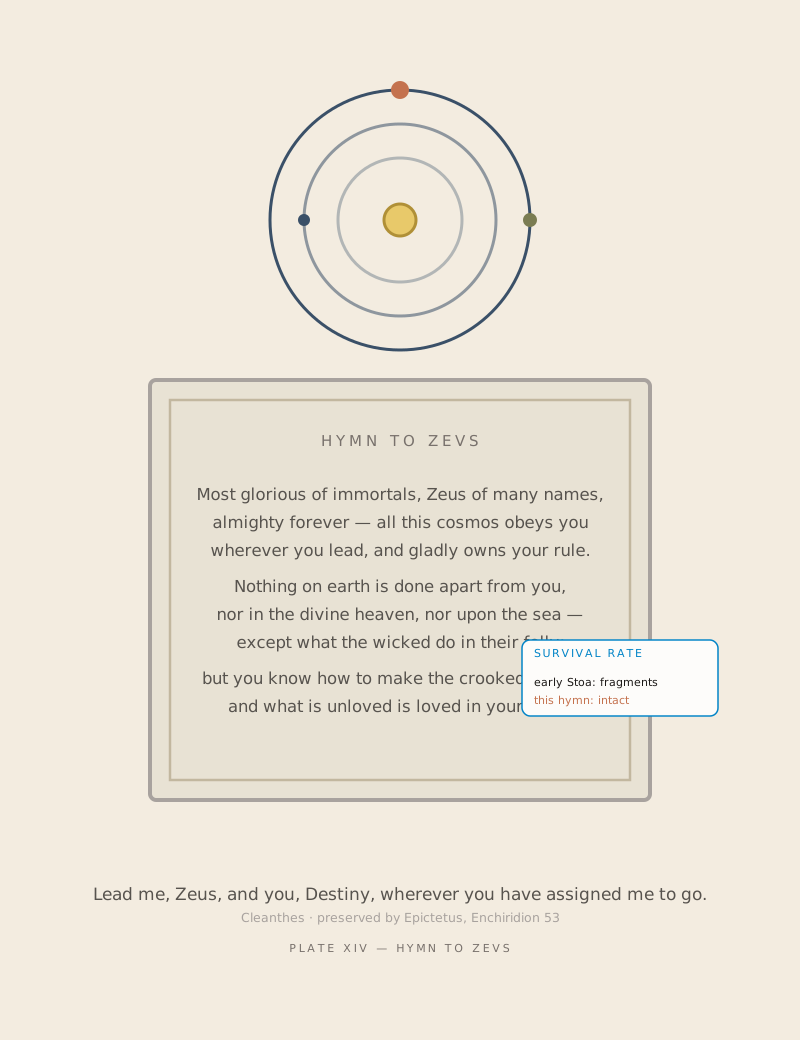
And what he says is the school's physics, sung. Most glorious of immortals, Zeus of many names, almighty forever — and then the argument unfolds inside the praise: the whole cosmos obeys one rational law; nothing happens apart from it except the deeds of the foolish; and even those, the hymn insists, the Logos fits back into its design, making the crooked straight. This is not decoration on top of doctrine. It is the doctrine — a lawful, interconnected universe of which you are one operating part — delivered in the register of worship, because Cleanthes understood something his cleverer colleagues argued past: a cosmology you cannot feel is a cosmology you will not live by.
His shorter prayer travelled even further. Lead me, Zeus, and you, Destiny, wherever you have assigned me; I shall follow without hesitating — and if, grown bad, I refuse, I shall follow anyway. Epictetus made his students memorise it; Seneca translated it into Latin; it has been marching through other people's books for two thousand years. Read it closely and the humility shows its iron: the universe is not asking. Your only actual choice is your gait. The hymn is the physics; the prayer is the compliance posture; together they are the whole Stoic settlement with reality, composed at night, by lamplight, by a man who hauled water to afford the ink.
◈ Shoulder Agent’s note
Preservation report: attrition rate of early Stoic texts — approximately total. Survivor — one hymn, author: the slow one. Selection mechanism — an anthologist liked it. Note for your archives: what survives is rarely what argued best. It is what someone loved enough to copy.
A Stoic Story — Unbothered Volume 4
Ready when you are.
Tap below to open the full chapter in the book reader. Anchored books jump to this chapter automatically.
II · The Water-Carrier & the Champion · c. 330–206 BC
Ink on Bones
In which the lecture notes of the Stoa are taken on broken pottery, because paper is for rich people.
Papyrus was imported, and imported meant expensive, and expensive meant not for the well-man. So Cleanthes took Zeno's lectures down on what Athens threw away: ostraca — broken potsherds, the scrap paper of the ancient poor — and, Laertius adds with visible delight, the shoulder-blades of oxen. Picture the scene at the Porch: the master speaking, the clever students nodding along memorably, and in the back a large ex-boxer crouched over a stack of bones, writing everything down.
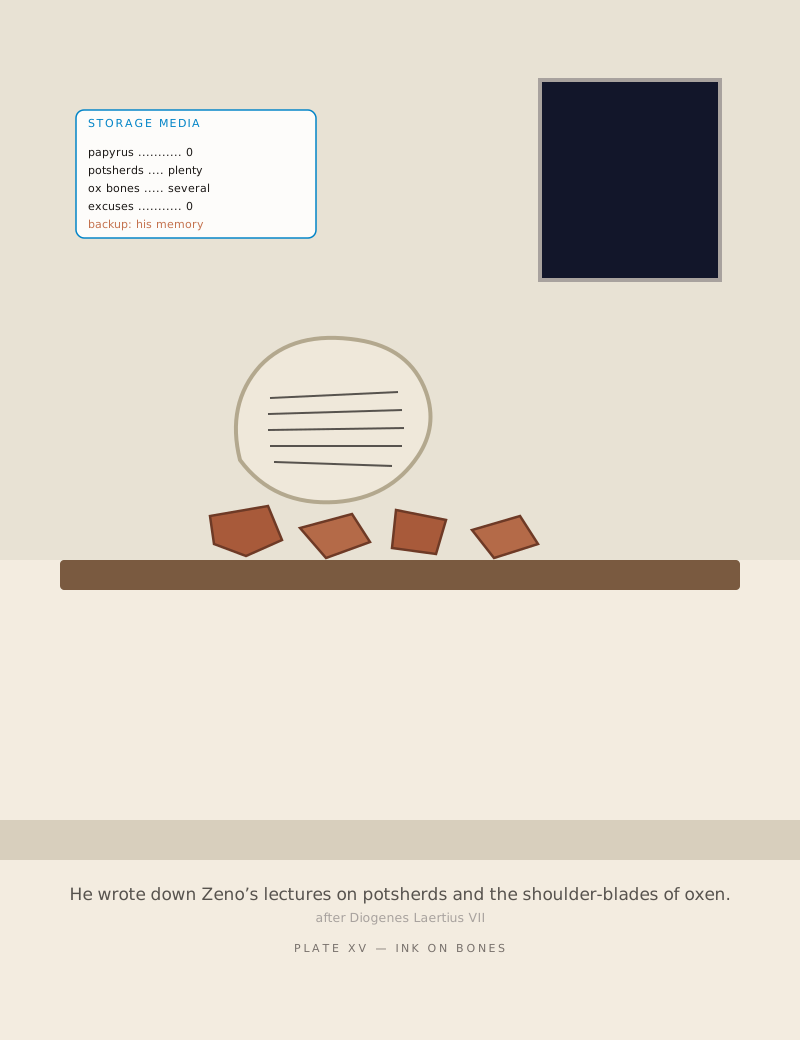
It is the most quietly radical image in this whole section. The medium announces the entire philosophy of the man: no resource is beneath use; no poverty is an excuse; the content matters and the container does not. His classmates had wax tablets and good papyrus and, today, we have almost nothing they wrote. Cleanthes had garbage and livestock remains, and through him — through the notes, the nineteen years of attention, the thirty-two years of stewardship that followed — runs the channel by which Zeno's actual teaching reached the next generation at all.
There is also a lesson here about what note-taking is. The quick students trusted their quickness; hearing a thing once, they felt they owned it. Cleanthes trusted nothing about himself except his hands, so he built an external memory out of rubbish, sherd by sherd, and reviewed it by lamplight after the watering shift. Slowness plus a system beat brilliance plus confidence — not occasionally, but as a rule, and the rule has not expired. Every era's knowledge survives on whatever its most stubborn people are willing to write on.
◈ Shoulder Agent’s note
Storage media inventory, Cleanthes' desk: papyrus — 0 sheets. Potsherds — abundant. Ox shoulder-blades — several, closely written. Redundancy strategy — his own memory, also closely written. Your era stores its philosophy in a cloud it rents. He used bones. I have opinions about which is sturdier.
A Stoic Story — Unbothered Volume 4
Ready when you are.
Tap below to open the full chapter in the book reader. Anchored books jump to this chapter automatically.
II · The Water-Carrier & the Champion · c. 330–206 BC
The Runner from Soli
In which a long-distance athlete retires his legs and enters the only race that lasts twenty-three centuries.
The third head of the Stoa, like the second, arrived from sport. Chrysippus of Soli had trained as a distance runner — the dolichos, the long grinding race, no glamour, all pacing — before philosophy claimed him. The pattern is worth a raised eyebrow: a school of the mind kept recruiting from bodies. Zeno the merchant knew inventory; Cleanthes the boxer knew punishment; Chrysippus the runner knew the one thing the coming fight would need most — how to hold a pace long after the crowd stops watching.
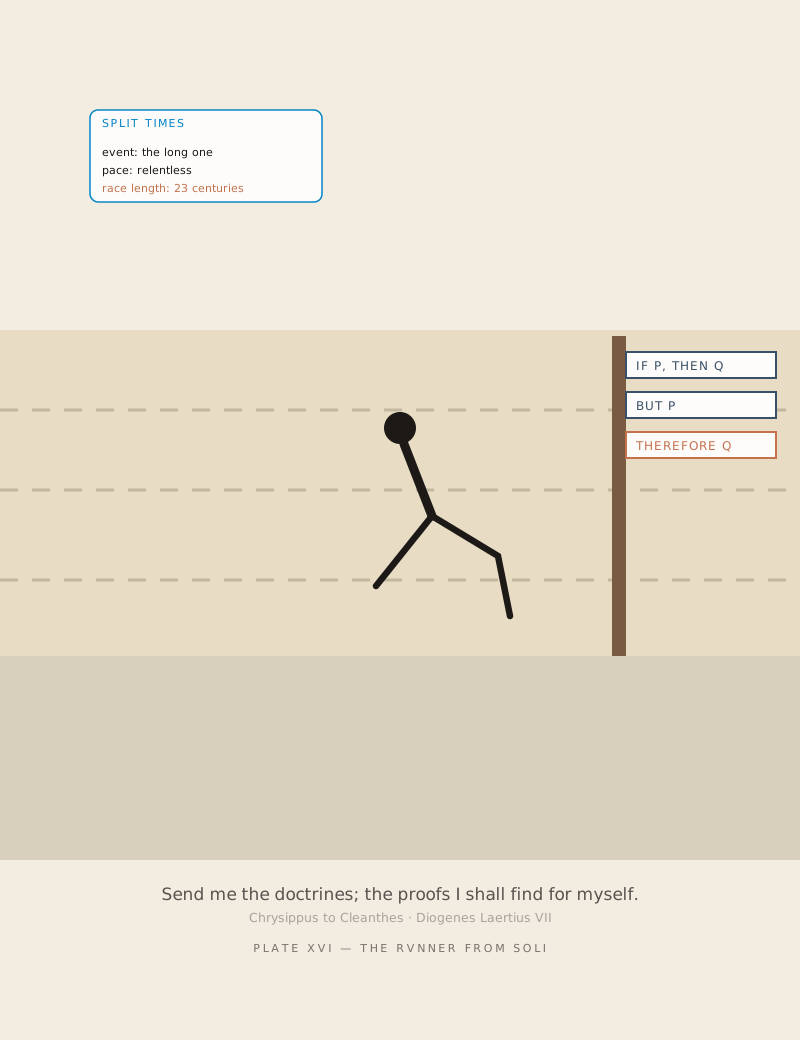
He came to Athens, studied under Cleanthes, and displayed from the start a confidence that must have been magnificent to endure. Laertius preserves the line he gave his own teacher: send me the doctrines; the proofs I shall find for myself. Imagine receiving that from a student. Cleanthes, to his everlasting credit, did exactly what it asked. The slow man handed the fast man the cargo he had carried for three decades, and did not insist on also steering. Two consecutive leaders, each supplying precisely what the other lacked: it is the luckiest handoff in the history of ideas, and neither man treated it as luck.
Chrysippus even studied with the enemy — he attended the sceptical Academy's lectures, learning the exact shape of the arguments that were dismantling dogmatic schools all over Athens. His fellow Stoics found this alarming. It was, of course, race-craft: the distance runner walking the course before the event, noting where the ground breaks. When the sceptics came for the Stoa in earnest — next chapter — the man waiting for them had already run their route.
◈ Shoulder Agent’s note
Split times, filed trackside: stadion sprint — not his event. The long race — very much his event. Note the career change that isn't one: he swapped distance running for distance arguing and kept the training plan. Your era retires its athletes at thirty-five. His second event lasted the rest of recorded time.
A Stoic Story — Unbothered Volume 4
Ready when you are.
Tap below to open the full chapter in the book reader. Anchored books jump to this chapter automatically.
II · The Water-Carrier & the Champion · c. 330–206 BC
Without Chrysippus, No Stoa
In which the sceptics arrive with demolition equipment and meet the man who re-mortars arguments for sport.
By the middle of the third century BC, Plato's Academy had gone sceptic. Under Arcesilaus it had converted itself into a precision demolition firm: it defended nothing, claimed nothing, and existed to prove that whatever you claimed, you couldn't know it. Dogmatic schools were its natural food, and no school was more dogmatic — more committed to actual knowable truths — than the Stoa. The wrecking crew came for the Porch. What it found there was a former distance runner with an unlimited appetite for exactly this.
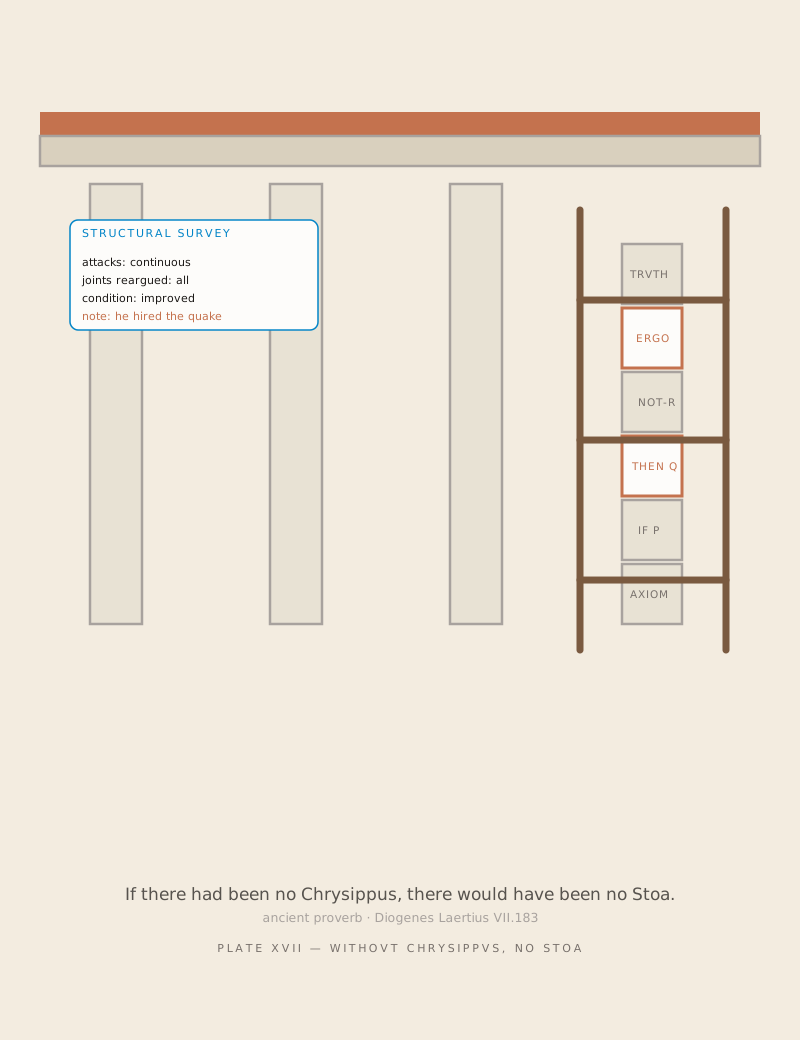
Chrysippus' response was not to defend the building but to rebuild it under fire, joint by joint. Where Zeno had asserted and Cleanthes had preserved, Chrysippus proved — taking each doctrine, finding where a sceptic could get a crowbar in, and re-mortaring the argument until the crowbar bent. He was so scrupulous about knowing the opposition's case that he argued it better than they did: Laertius records the complaint that Chrysippus stated the sceptical arguments so powerfully that Carneades, the Academy's next great demolitionist, mined Chrysippus' own books for ammunition. He armed his enemies because arming them was the only honest way to test the walls.
The verdict the ancient world reached became a proverb, and it is the title of this chapter: if there had been no Chrysippus, there would have been no Stoa. Note what the proverb concedes — the founder gave the school its truths, the water-carrier gave it continuity, but survival in a hostile intellectual climate took a third thing: someone willing to treat every attack as a renovation order. Institutions do not persist because they were built well. They persist because somebody keeps re-mortaring, forever, on scaffolding, in public.
◈ Shoulder Agent’s note
Structural survey, Stoa Poikile, third century BC: attacks logged — continuous, professional-grade. Response — every joint reargued under load. Condition after — stronger than as-built. Standing note for your era: a belief system never stress-tested is not a strong one; it is an untested one. He knew the difference and hired the earthquake.
A Stoic Story — Unbothered Volume 4
Ready when you are.
Tap below to open the full chapter in the book reader. Anchored books jump to this chapter automatically.
II · The Water-Carrier & the Champion · c. 330–206 BC
The Logic Machine
In which a Greek invents propositional logic two thousand years early and files it under plumbing.
Strip away the anecdotes for one chapter and look at the machinery, because the machinery is astonishing. Chrysippus built a logic not of categories, like Aristotle's, but of whole propositions — if , then , or , not — and he reduced all valid inference to five basic moves he called the indemonstrables: the patterns so elementary that nothing simpler proves them. If the first, then the second; but the first; therefore the second. That is the first indemonstrable. You have used it today, probably before breakfast, without knowing its inventor's name.
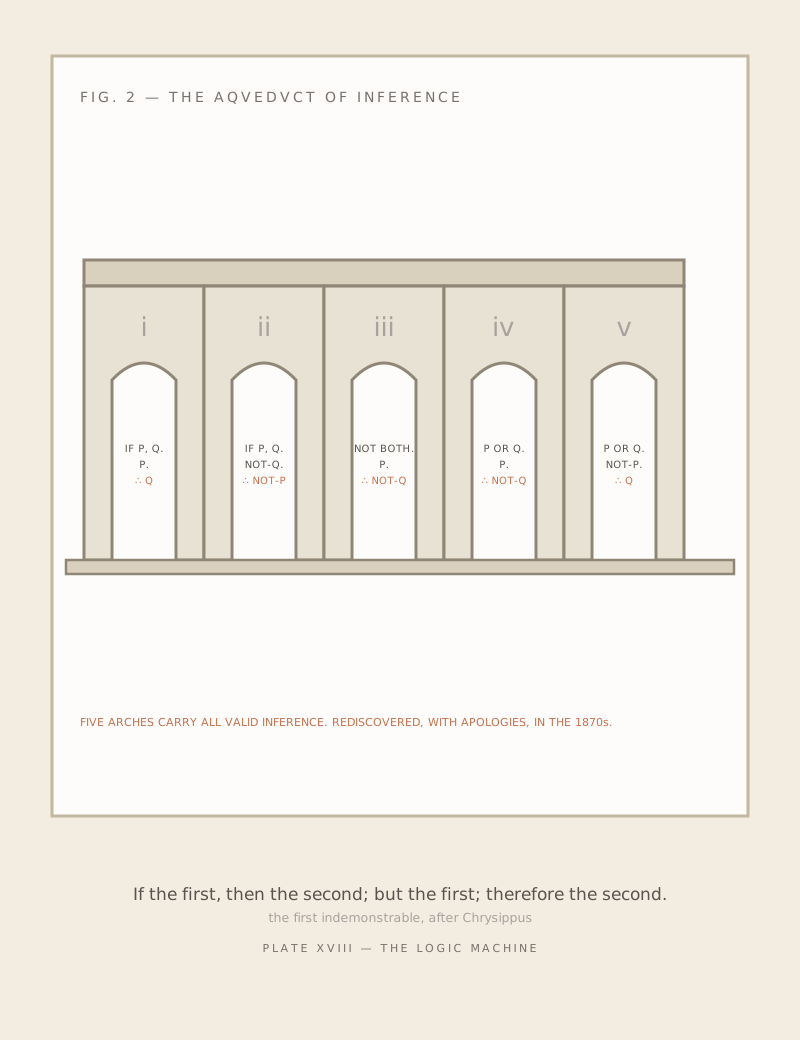
Modern logicians, on finally reading the fragments, sat up sharply: this is propositional calculus, the foundation stone of the discipline — and of every circuit in the machine on which this book was assembled — worked out in the third century BC and then largely forgotten until Frege rebuilt it in the 1870s. But do not mistake it for a side project. For Chrysippus, logic was the shell of the egg from chapter eight, industrialised: truth had to travel from premise to conclusion without leaking, because everything downstream — physics, ethics, the whole livable system — drinks from that flow. Think of it as an aqueduct. The arches are the five indemonstrables. What they carry is the only water the school runs on.
And the point of the plumbing was never the plumbing. A Stoic needed valid inference for one reason: your judgements drive your life, and a leaky argument upstream becomes a ruined decision downstream. The dichotomy of control, the discipline of assent, every practical Stoic tool this series has ever taught — all of it stands on these five arches. Rigour, it turns out, is a form of care.
◈ Shoulder Agent’s note
Flow test, all five arches: truth in — truth out; no leaks detected in twenty-three centuries of operation. Engineering note for your era: the logic gates in your devices are downstream of this aqueduct, whether their manufacturers know it or not. The man built infrastructure. Infrastructure is invisible precisely when it works.
A Stoic Story — Unbothered Volume 4
Ready when you are.
Tap below to open the full chapter in the book reader. Anchored books jump to this chapter automatically.
II · The Water-Carrier & the Champion · c. 330–206 BC
Seven Hundred Books
In which output becomes strategy, quotation becomes structural steel, and a school becomes impossible to ignore.
The number Diogenes Laertius gives is 705. Seven hundred and five books, at a working pace the ancients logged with awe: five hundred lines a day. Chrysippus did not write when inspired. He wrote the way his old event demanded running — daily, metronomically, in all weathers — and the cumulative mileage turned a school into a fortress. You could dodge an argument. You could not dodge a library.
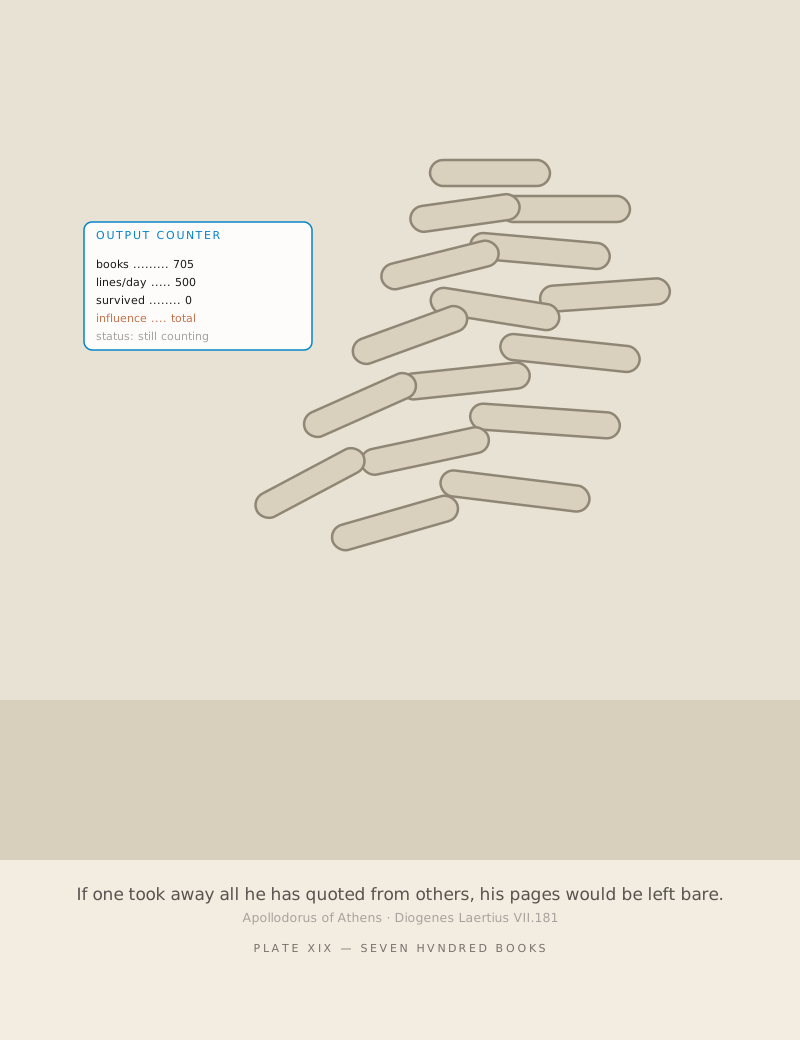
The ancients, who loved him, also found the corpus hilarious, and their jokes have outlived most of the books. He quoted other authors at such length — in one work, nearly the whole of Euripides' Medea — that a man holding the volume, asked what he was reading, answered: the Medea of Chrysippus. Apollodorus of Athens landed the sharper cut: strip the quotations out of Chrysippus' books, he said, and the pages would be left bare. Funny, and exactly wrong about how systems get built. The quotations were load-bearing: evidence marshalled, opponents stated in full before being answered, the culture's whole poetic inheritance dragged into the courtroom as exhibits. He wasn't padding. He was citing.
Here is the melancholy twist the honest version must carry: of the 705, not one survives whole. We have fragments, quotations of the quoter, a skeleton reassembled from the footnotes of friends and enemies. And yet the strategy worked anyway — because the point of the books was never their survival but their weight while he lived and for the crucial centuries after: enough mass to anchor doctrine, train generations, and make Stoicism the default philosophy an educated Roman would meet. The next section of this book happens because these shelves existed. The avalanche buried the ground the school would stand on.
◈ Shoulder Agent’s note
Output counter, final reading: books — 705. Daily lines — 500. Survival to your era — zero intact, influence total. Filing note: he is proof that a body of work can do its entire job and then vanish. Your century, which measures everything by what remains countable, should sit with that one for a minute.
A Stoic Story — Unbothered Volume 4
Ready when you are.
Tap below to open the full chapter in the book reader. Anchored books jump to this chapter automatically.
II · The Water-Carrier & the Champion · c. 330–206 BC
Laughter at the Fig
In which the greatest logician of antiquity exits through an anecdote, and the anecdote is almost certainly a joke that got promoted.
Chrysippus died around 206 BC, in his seventies, and antiquity offers you two exits — this book's standing policy is to hand you both, with the price tags showing. Version one is plausible and dull: at a sacrificial feast he drank sweet unmixed wine, was seized with dizziness, and died five days later. Version two is the one everybody remembers, because it is perfect: seeing a donkey eat his figs, he told the old woman of the house to give the beast a draught of neat wine to wash them down — and laughed at his own joke so hard that he died of it.
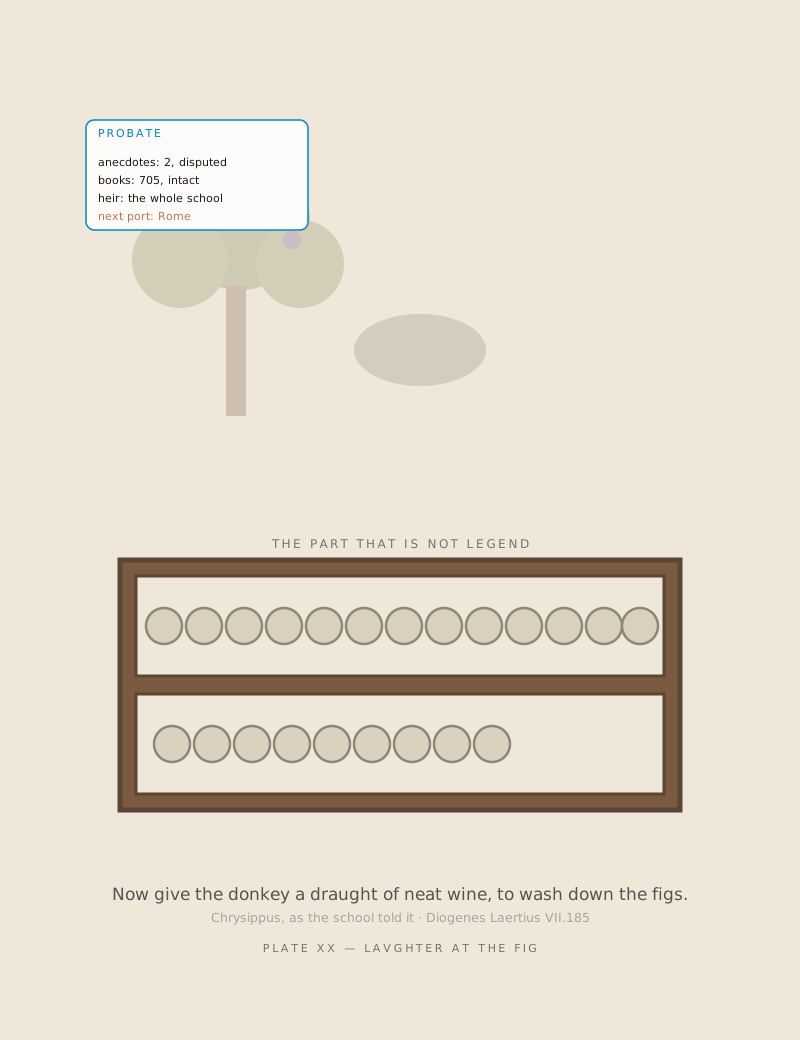
Weigh the second version the way its subject would have. A death constructed like a syllogism — setup, premise, punchline, collapse — attached to the most famous logician alive, featuring the same animal Cleanthes had turned into a job title one chapter of leadership earlier? The composition is too good. Real deaths are rarely this well edited; we said it about Zeno's toe and the rule has not weakened. What the legend records is not how Chrysippus died but how the school felt about him: the driest, densest, most technical writer in Athens, remembered — by the people who actually sat in the room — as the man who laughed hardest at his own material.
And here is why the chapter, and the section, can end lightly: it did not matter. Zeno's death tested whether a school could survive its founder; Cleanthes' handoff tested whether it could survive succession; by Chrysippus' death there was nothing left to test. The doctrine was proved, shelved in seven hundred volumes, and load-rated against the best demolition crews of the age. The founders were gone. The building stood. For the next two centuries it would do something none of the three men quite planned: travel. Rome is two chapters of sea-lane away, and the Porch is about to become an empire's operating manual.
◈ Shoulder Agent’s note
Probate report, estate of Chrysippus of Soli: anecdotes — two, contradictory, both filed with affection. Books — 705, probated intact to the next generation. Verdict on the laughing exit: unverifiable, and telling either way; schools invent that story only about teachers they loved. Section closed. The cargo ships for Rome.
A Stoic Story — Unbothered Volume 4
Ready when you are.
Tap below to open the full chapter in the book reader. Anchored books jump to this chapter automatically.
III · The Middle Stoa Goes to Rome · c. 185–51 BC
The Embassy of Philosophers
In which Athens sends three professors to contest a fine, and Rome catches philosophy like a fever.
In 155 BC Athens had a money problem. Fined five hundred talents for sacking the town of Oropus, the city appealed to Rome — and, having no legions to send, sent the only heavy weaponry it still manufactured: the heads of three philosophical schools. Carneades the Academic sceptic. Critolaus the Peripatetic. And Diogenes of Babylon, head of the Stoa. Three professors, one boat, west.
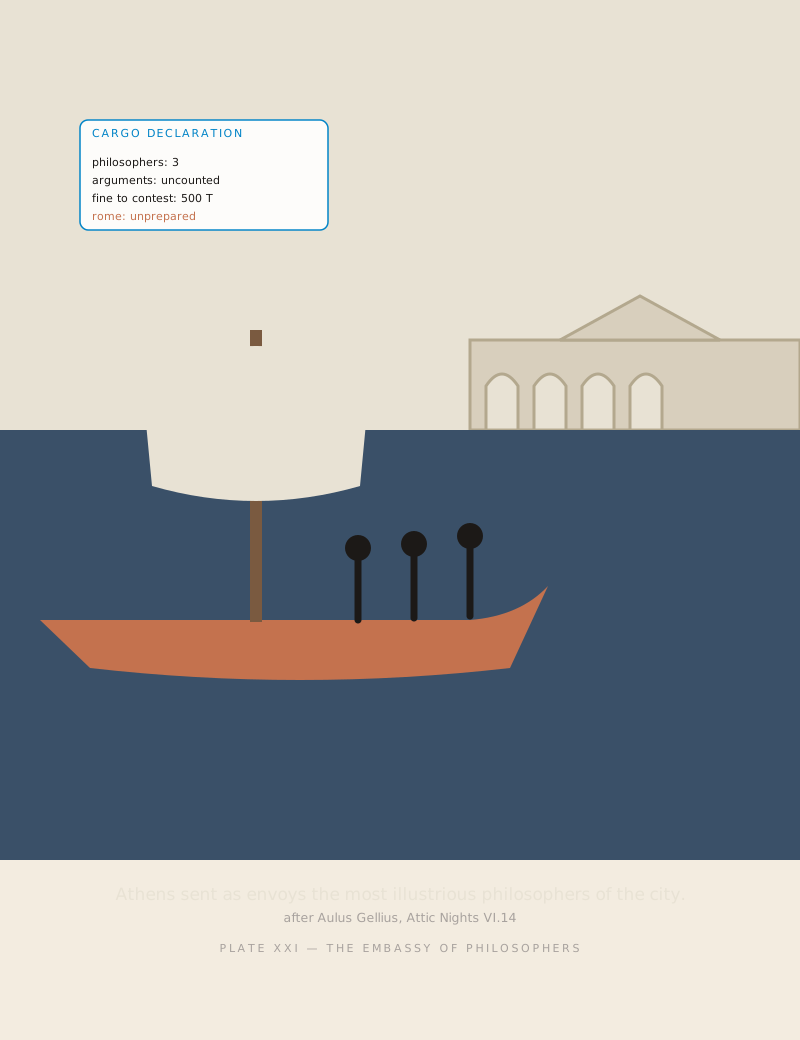
The mission was a triumph of the narrow kind: the fine was talked down to a hundred talents. But the collateral effect was the actual historical event. While the diplomacy ground on, the philosophers did what philosophers do — they lectured — and Rome's young aristocracy, raised on farm manuals and ancestor masks, packed the halls like a city discovering an appetite it did not know it had. Carneades, showman of the three, argued brilliantly for justice one day and, the next day, just as brilliantly against it — a standard sceptical demonstration in Athens, an earthquake in Rome, where justice was supposed to be a possession, not a debating position.
Cato the Elder, Rome's chief immune response, smelled the danger at once and urged the Senate to settle the Athenians' business quickly and ship the contagion home before the young men caught it permanently. He got his wish and lost his war: the envoys sailed, the appetite stayed. Within a generation the sons of the men who heard those lectures would keep Greek philosophers as house guests, and the Stoa — whose representative had made the quietest impression of the three, a story two pages away — would find in Rome the thing Athens could never quite supply: a ruling class that took duty personally.
◈ Shoulder Agent’s note
Cargo declaration, Piraeus to Ostia: philosophers — three (3). Arguments — uncounted, some sold in matching for-and-against pairs. Quarantine recommendation by Cato the Elder — filed, approved, ineffective. Ideas are the one import a customs house has never once managed to stop at the dock.
A Stoic Story — Unbothered Volume 4
Ready when you are.
Tap below to open the full chapter in the book reader. Anchored books jump to this chapter automatically.
III · The Middle Stoa Goes to Rome · c. 185–51 BC
Diogenes of Babylon
In which the quietest man in the delegation makes the impression that lasts.
Rome's verdict on the three visiting professors survives in a tidy piece of ancient theatre criticism, preserved by Aulus Gellius: Carneades spoke with violence and rush, Critolaus with skill and polish — and Diogenes of Babylon spoke with modesty and sobriety. One of these was not like the others, and the difference was not an accident of temperament. It was the product on display.
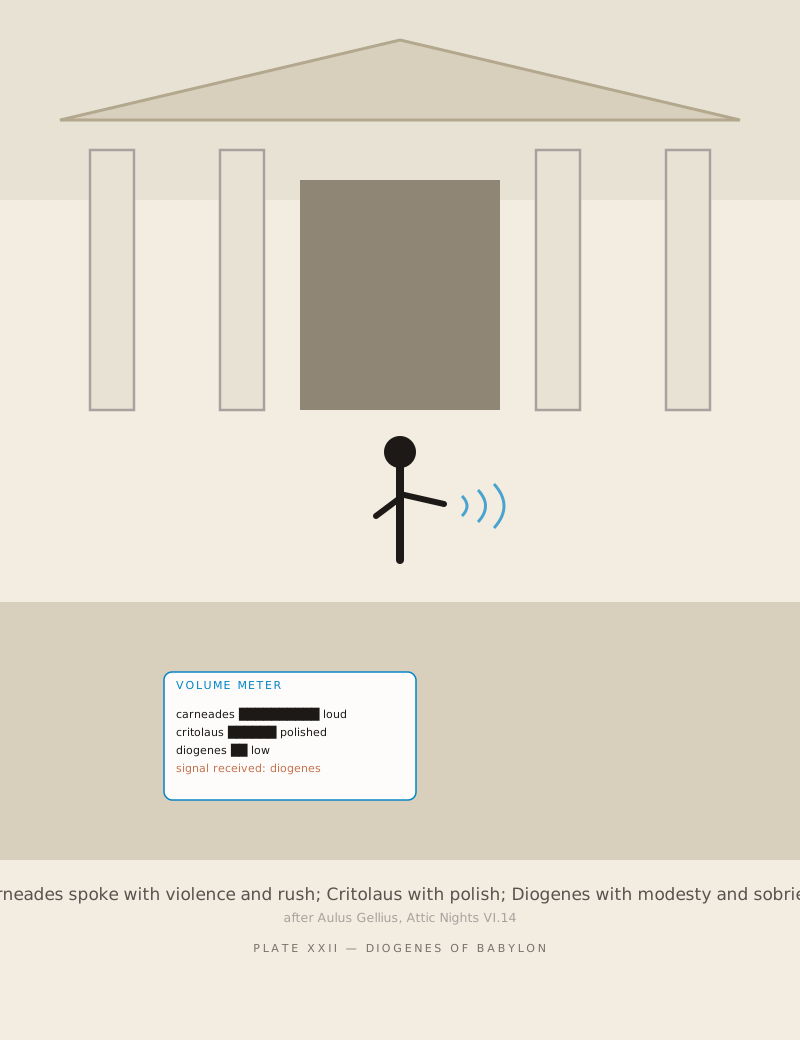
Diogenes — fifth head of the Stoa, student of Chrysippus himself, teacher of nearly everyone in the rest of this section — had carried west a school whose founder was crowned by Athens for one stated reason: his life matched his sentences. So while Carneades set fire to the concept of justice for applause, the Stoic did the thing the doctrine actually prescribes for a man addressing a foreign senate about money: he made the case, in order, at speaking volume, and sat down. To Athenian ears, dull. To Roman ears — ears trained on gravitas, on the elder statesman who says little and means all of it — it sounded uncannily like themselves, only with arguments attached.
That resonance is the hinge of this whole section. Scepticism dazzled Rome and alarmed it; Aristotle's school interested it politely. Stoicism fit it — a philosophy of duty, self-command, and public service arriving in a republic that already worshipped those things but had never had them written down. Diogenes made no recorded conquest that week beyond the fine. What he made was a first impression, and first impressions between civilisations compound like interest. The Porch had found its second home; it just hadn't signed the lease yet.
◈ Shoulder Agent’s note
Volume metering, Roman lecture circuit, 155 BC: Carneades — loud, thrilling, alarming. Critolaus — polished, admired, forgotten. Diogenes — low, steady, and the only signal Rome could tune to. Note for your noisy era: matching your audience's register is not a compromise. Sometimes it is the entire strategy.
A Stoic Story — Unbothered Volume 4
Ready when you are.
Tap below to open the full chapter in the book reader. Anchored books jump to this chapter automatically.
III · The Middle Stoa Goes to Rome · c. 185–51 BC
The Pen-Shouter
In which a man loses every live debate, changes the venue, and wins the century.
Antipater of Tarsus, sixth head of the Stoa, had a problem with a name: Carneades. The sceptic who had scandalised Rome was, in a live hall, simply unplayable — quick, thunderous, merciless, the best extemporaneous demolitionist Greece ever produced. Head-to-head, Antipater lost. And lost. So he did the thing ambitious men almost never do: he admitted the scoreboard, walked out of the arena, and stopped competing in the format he could not win.
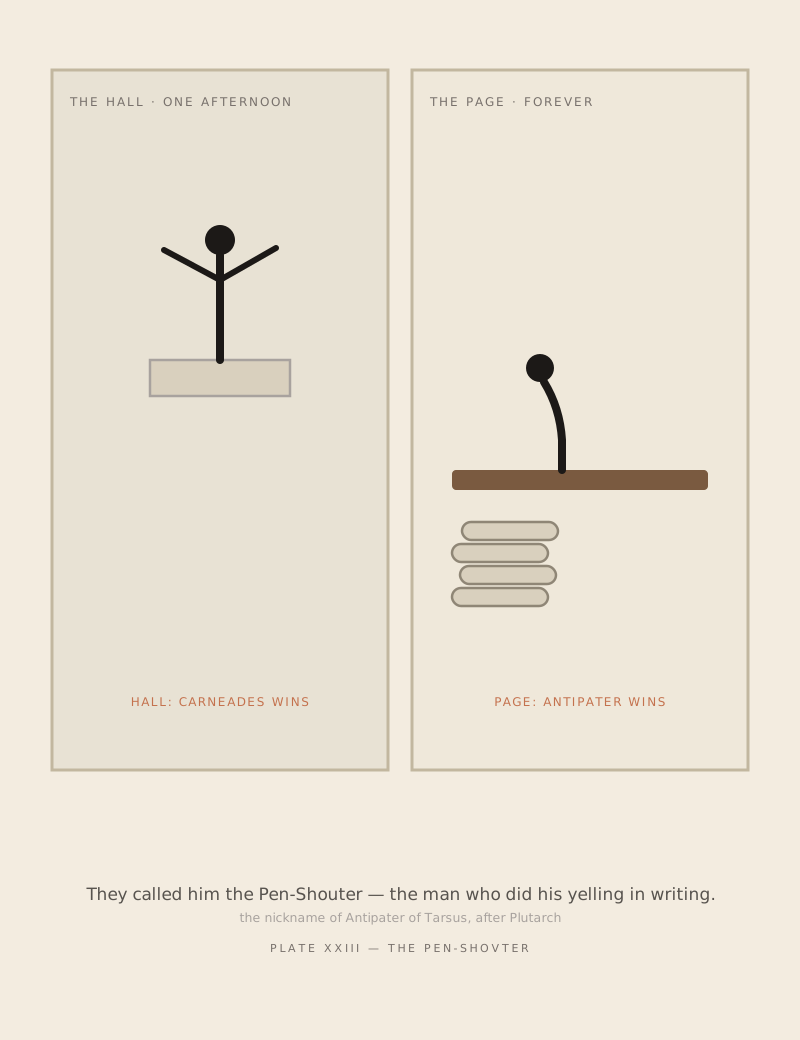
Instead he wrote. Volume after volume of careful, patient counter-argument, answering in ink what he could not answer on his feet, at such a rate that Athens' wits gave him the nickname this chapter wears: kalamoboas — the Pen-Shouter, the man who does his yelling in writing. It was meant as mockery, the ancient equivalent of laughing at someone for posting instead of speaking. Antipater kept writing. He had noticed the asymmetry that his mockers had not: the hall holds a few hundred people for one afternoon. The page holds everyone, forever, and it never gets flustered.
Time then ran its usual audit. Carneades, on principle, wrote nothing — scepticism doubted its own conclusions too much to commit them — and so the greatest debater of the age survives only in other men's summaries, a thunderstorm reported second-hand. Antipater's patient pages fed straight into his student Panaetius, next chapter, and through him into Rome. The lesson is not that writing beats speaking. It is that the game you are losing is rarely the only game, and changing venues is not retreat. Sometimes it is aim.
◈ Shoulder Agent’s note
Match report, Antipater v. Carneades: live debates — lost, comprehensively. Format transfer — executed without shame. Final standings, taken twenty-two centuries later: the shouter is a rumour; the pen-shouter is a source. Your era keeps score by the afternoon. History keeps score by the shelf.
A Stoic Story — Unbothered Volume 4
Ready when you are.
Tap below to open the full chapter in the book reader. Anchored books jump to this chapter automatically.
III · The Middle Stoa Goes to Rome · c. 185–51 BC
Panaetius of Rhodes
In which the impossible sage is sent back to the workshop and comes out wearing a toga.
Early Stoicism had a marketing problem shaped like its own mascot. The sage — the perfected human, utterly rational, immune to fortune, rarer by the school's own admission than the phoenix — was the doctrine's north star and also its standing joke: a standard nobody had met, set by teachers who cheerfully agreed they hadn't met it either. Magnificent for theory. Useless for a Roman senator with a province to run, a family to marry off, and a Tuesday to get through.
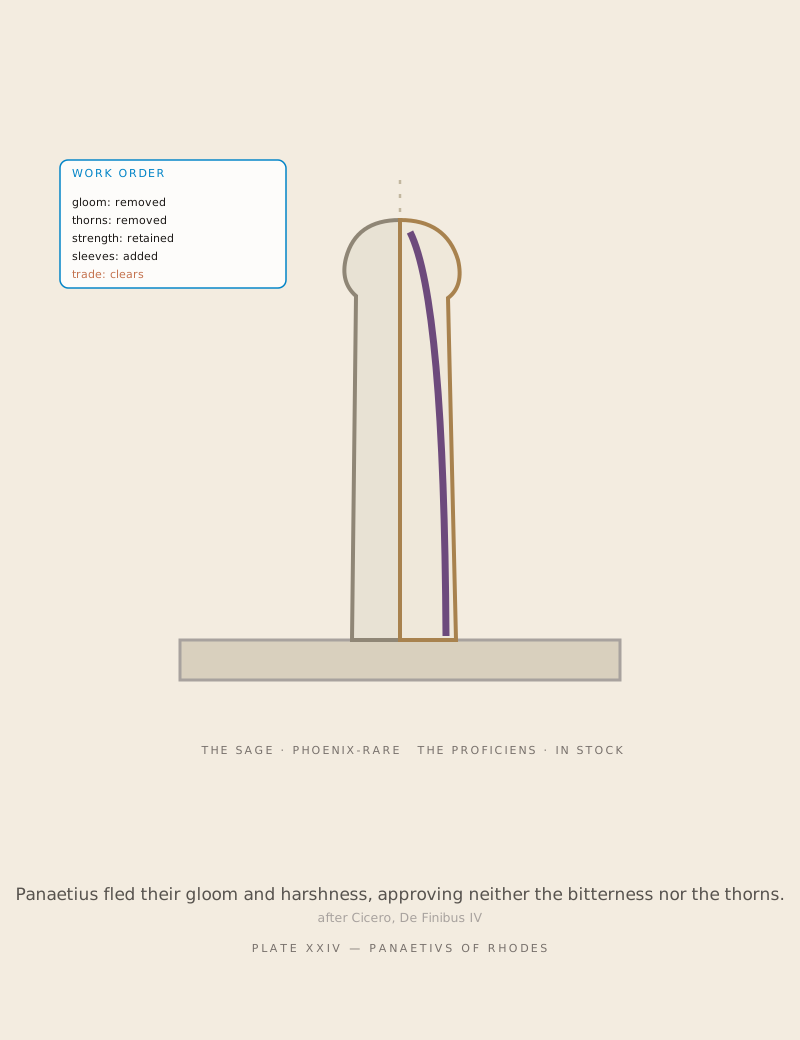
Panaetius of Rhodes — student of Diogenes of Babylon and of Antipater's patient pages, seventh head of the school — performed the renovation. Cicero, who built his own ethics on Panaetius' books, describes the change with relief: Panaetius fled the old Stoics' gloom and harshness , keeping neither the bitterness of their doctrines nor the thorns of their arguments. Out went the paradoxes brandished for shock; softened went the demand for total passionlessness; and the spotlight swung from the flawless sage to a figure the Porch had always acknowledged but never headlined: the proficiens — the person making progress. Not the statue. The commuter.
Purists then and now have called it a dilution, and the honest frame requires airing the charge: something austere really was traded away. But watch what was bought. A philosophy addressed only to the perfect converts no one; a philosophy addressed to the improving can convert a republic, and shortly did. Panaetius moved to Rome, into the orbit of the most powerful men alive — next chapter — and re-carved the sage into something a working Roman could actually wear. The marble kept its strength. It just finally got sleeves.
◈ Shoulder Agent’s note
Workshop order, Rhodes to Rome: one (1) ideal sage, received in marble, impossible to inhabit. Modifications — severity reduced, thorns removed, progress admitted as a passing grade. Returned as: a man in a toga with somewhere to be. Purity lost — some. Users gained — an empire. I have reviewed the trade. It clears.
A Stoic Story — Unbothered Volume 4
Ready when you are.
Tap below to open the full chapter in the book reader. Anchored books jump to this chapter automatically.
III · The Middle Stoa Goes to Rome · c. 185–51 BC
The Scipionic Circle
In which Stoicism stops lecturing Rome and starts staying for dinner.
Philosophy's second landing in Rome came not by embassy but by invitation. Scipio Aemilianus — conqueror of Carthage, the most admired Roman of his generation — gathered around his table the circle that tradition wears his name: his friend Laelius, called 'the Wise'; the historian Polybius, a Greek hostage turned house intellectual; the playwright Terence; and, at the centre of the philosophical conversation, Panaetius of Rhodes, who by the ancient report was kept by Scipio's side at home and on campaign.
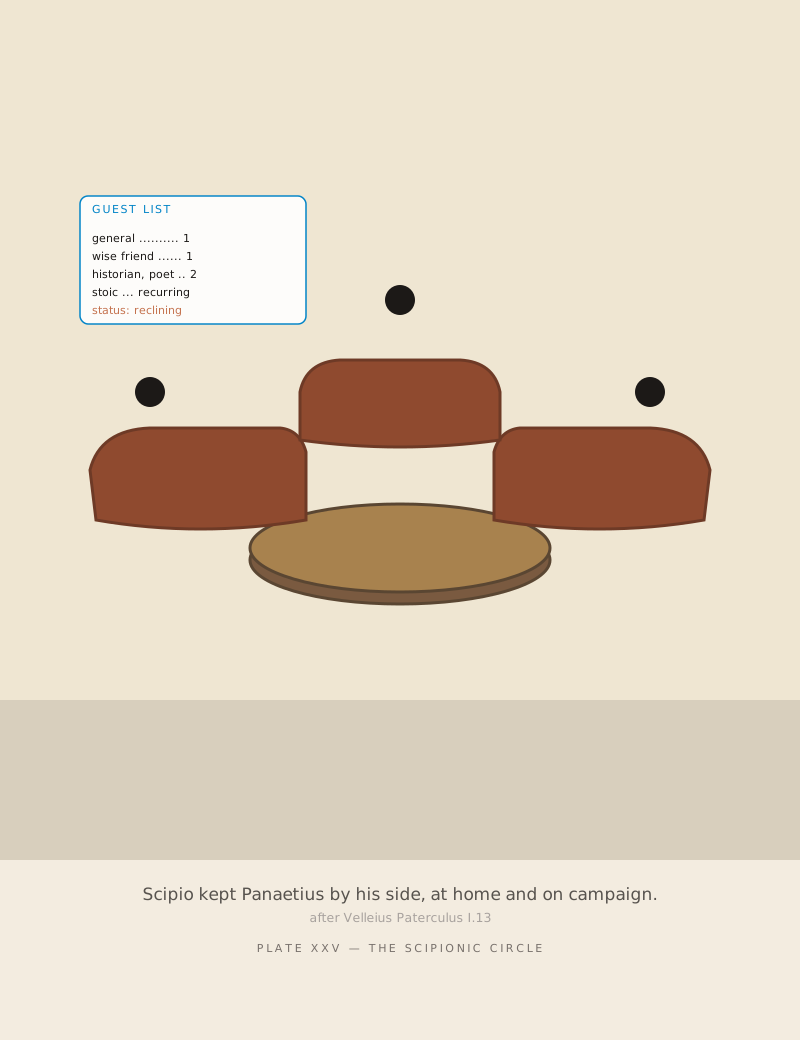
Mark the furniture, because the furniture is the argument. Chapter twenty-one's philosophy was a visiting performance — staged, ticketed, viewed with suspicion, sent home by Cato. This philosophy reclines. It is passed around the couches with the dishes; it goes along on military tours; it is consulted between courses about honour, empire, and how a serious man should hold power without being held by it. When Scipio travelled the eastern Mediterranean on his famous embassy, Panaetius went with him — a Stoic in the diplomatic baggage of the Roman state, thirty years after Cato had tried to ban the import.
And notice what the Stoa got in return, because the exchange ran both ways. Athens had given the school subtlety; Rome gave it case studies. Panaetius was rebuilding Stoic ethics around roles and duties precisely while dining with men whose entire lives were roles and duties — generals, consuls, governors of the world's rising power. The doctrine of the next chapter was not composed in a porch looking at fish-sellers. It was composed at this table, looking at Scipio. Philosophy had found the audience it was renovating itself for, and the audience was passing it the wine.
◈ Shoulder Agent’s note
Guest list, the Scipio residence: one general, one wise friend, one hostage historian, one playwright, one Stoic — recurring. Seating note: the philosopher is no longer performing at Rome; he is reclining in it. Doctrines, like people, are shaped by whoever they eat with. Watch what this one becomes.
A Stoic Story — Unbothered Volume 4
Ready when you are.
Tap below to open the full chapter in the book reader. Anchored books jump to this chapter automatically.
III · The Middle Stoa Goes to Rome · c. 185–51 BC
Duty in Roman Dress
In which ethics is refitted like a garment: measured to the wearer, the station, and the day.
Panaetius' great book was called On Duty , and it survives the way a demolished building survives in the one modelled on it: Cicero's De Officiis , written for his son, openly follows Panaetius for two of its three books. Through that copy we can read the refit. Old Stoic ethics asked one enormous question — how does the perfect sage act? Panaetius asked a wearable one: what does this person, in this role, owe today ?
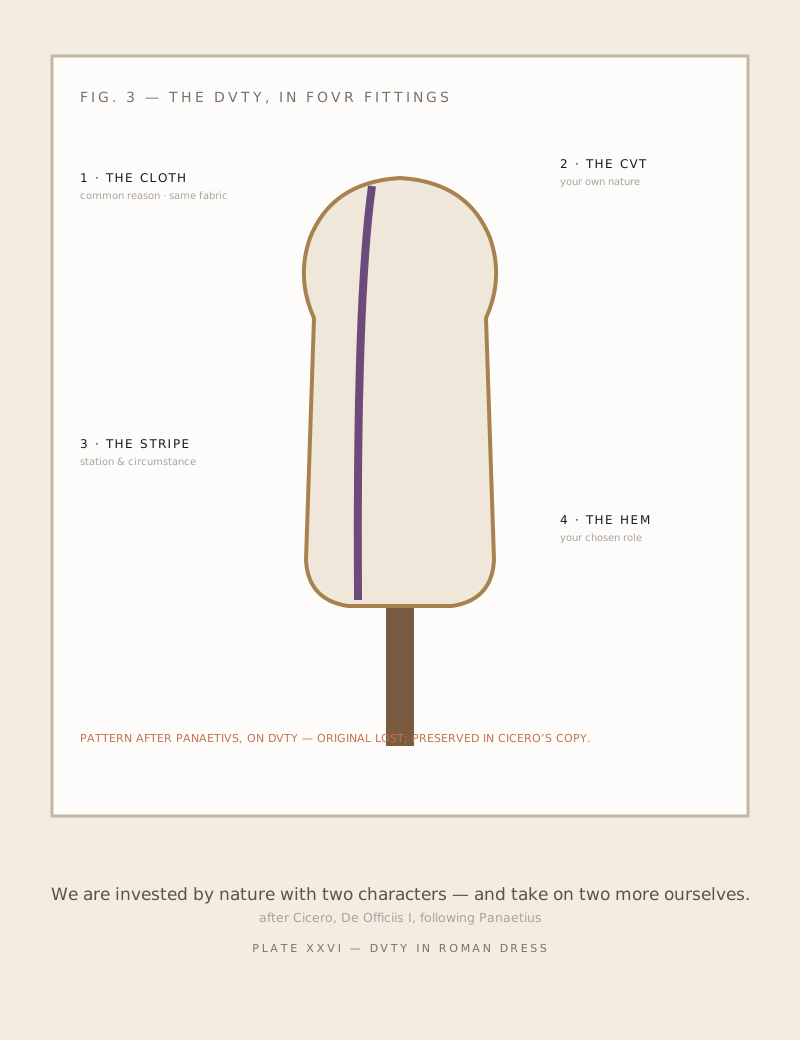
His instrument was the theory the tradition calls the four personae — four fittings of the same garment. First, you are a rational human being: certain conduct is owed by everyone, always, and no tailoring touches it. Second, you are this human — your particular nature, quick or slow, bold or gentle — and duty must be cut to it, because a role that fits your neighbour may hang on you like borrowed cloth. Third, your circumstances: born to a station, a family, a citizenship you did not choose. Fourth, your choices: the career, the commitments, the character you have signed for. Read your duty off all four measurements, said Panaetius, and you will rarely be lost about what to do.
See how precisely this was cut for Romans — a people who already lived by role, rank, and inherited obligation, and now received a philosophy that made their instincts rigorous instead of merely traditional. But see also what it hands the rest of us, twenty-one centuries on: an answer to the fraud of one-size-fits-all virtue. You are not failing at someone else's duties. You were never measured for them. The garment is yours; the fitting takes a whole life; and the tailor's first rule still binds every cut — the fabric, in all four fittings, is the same honest cloth.
◈ Shoulder Agent’s note
Fit check, four measurements on file: human — universal cut, non-negotiable. Individual — taken to your nature. Station — issued, not chosen. Choice — signed for by you. Alteration note for your era of copied lives: most misery I log is people wearing garments tailored to somebody else. Get measured.
A Stoic Story — Unbothered Volume 4
Ready when you are.
Tap below to open the full chapter in the book reader. Anchored books jump to this chapter automatically.
III · The Middle Stoa Goes to Rome · c. 185–51 BC
Posidonius the Polymath
In which one Stoic attempts to measure the entire cosmos, and a conqueror bows at his door.
If Stoic physics claims the universe is one rational, interconnected whole, then somebody in the school was eventually going to take that personally and try to inventory it. That somebody was Posidonius of Apamea — student of Panaetius, master of the school's outpost on Rhodes, and by common ancient consent the most learned man of his age. His research programme was, approximately, everything.
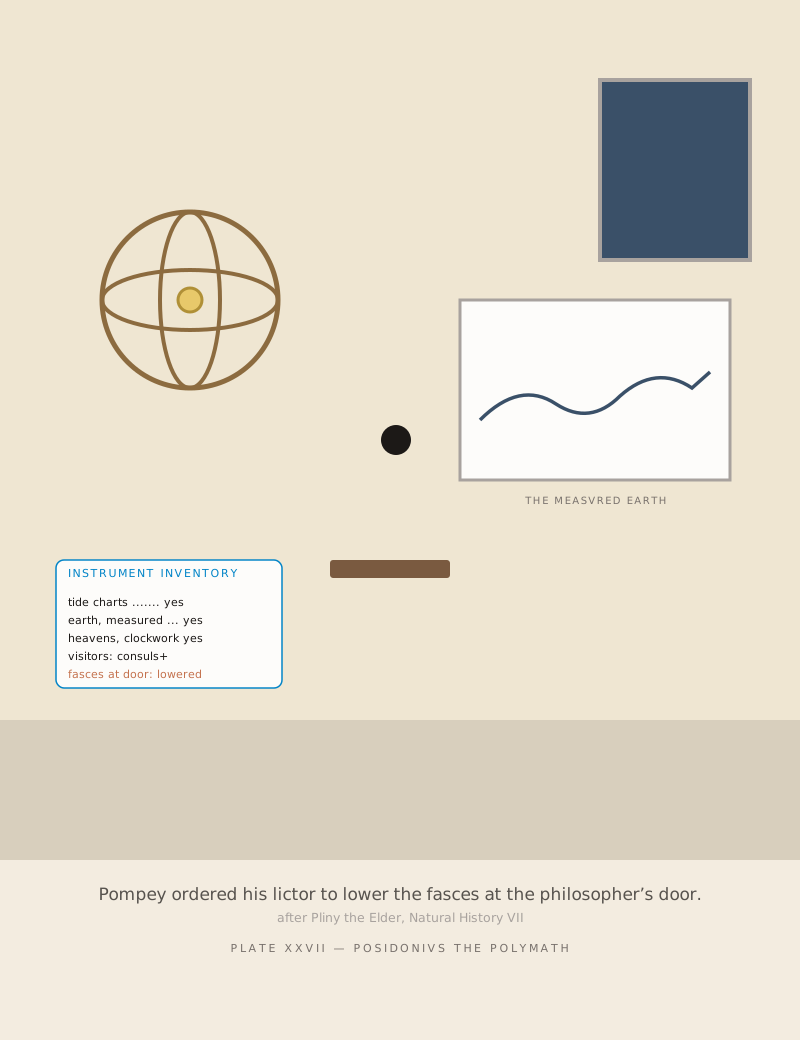
The list reads like a university faculty compressed into one person. He connected the tides to the phases of the moon, from observation on the Atlantic coast. He estimated the circumference of the earth and the distance of the sun. He wrote the continuation of Polybius' history — fifty-two books of it — along with treatises on geography, seismology, botany, ethnography of the Celts, meteorology, and, per Cicero, built a mechanical model of the heavens whose turning reproduced the motions of sun, moon, and planets. None of it was hobbyism. For a Stoic, studying tides was theology: every regularity mapped is another clause of the Logos read in the original, and Posidonius intended to read the whole document.
Rome noticed. His lecture room on Rhodes became a station of the grand tour for the republic's rising men — Cicero studied under him and revered him for life. And in the most famous scene, Pompey the Great, master of the East, twice sailed to Rhodes to hear him, and on approaching the philosopher's door ordered his lictor to lower the fasces — the bundled rods of Roman command, dipped at no man's threshold — in salute. Read the choreography: the most powerful soldier alive, lowering the symbols of force at the door of a man whose only weapon was a completer map of reality. Rome could conquer everything except its need to understand what it had conquered. For that, it knocked.
◈ Shoulder Agent’s note
Instrument inventory, the Rhodes study: tide charts, earth-measurements, one clockwork heaven, fifty-two books of history, assorted Celts. Visitor log — consuls, orators, one Pompey (twice, fasces lowered). Note the direction of the bow: power came to knowledge's door. Keep the addresses straight in your era, too.
A Stoic Story — Unbothered Volume 4
Ready when you are.
Tap below to open the full chapter in the book reader. Anchored books jump to this chapter automatically.
III · The Middle Stoa Goes to Rome · c. 185–51 BC
Pain, You Are Not an Evil
In which the doctrine is tested live, on stage, in front of the most powerful audience it will ever have.
On one of Pompey's visits to Rhodes, the schedule collapsed: Posidonius was down with a savage attack of gout, the inflammatory arthritis that ancient medicine could name but not touch. The general came to the sickroom anyway, to pay respects and to say he was sorry he could not hear him lecture. Posidonius' reply, preserved by Cicero, deserves its own line:
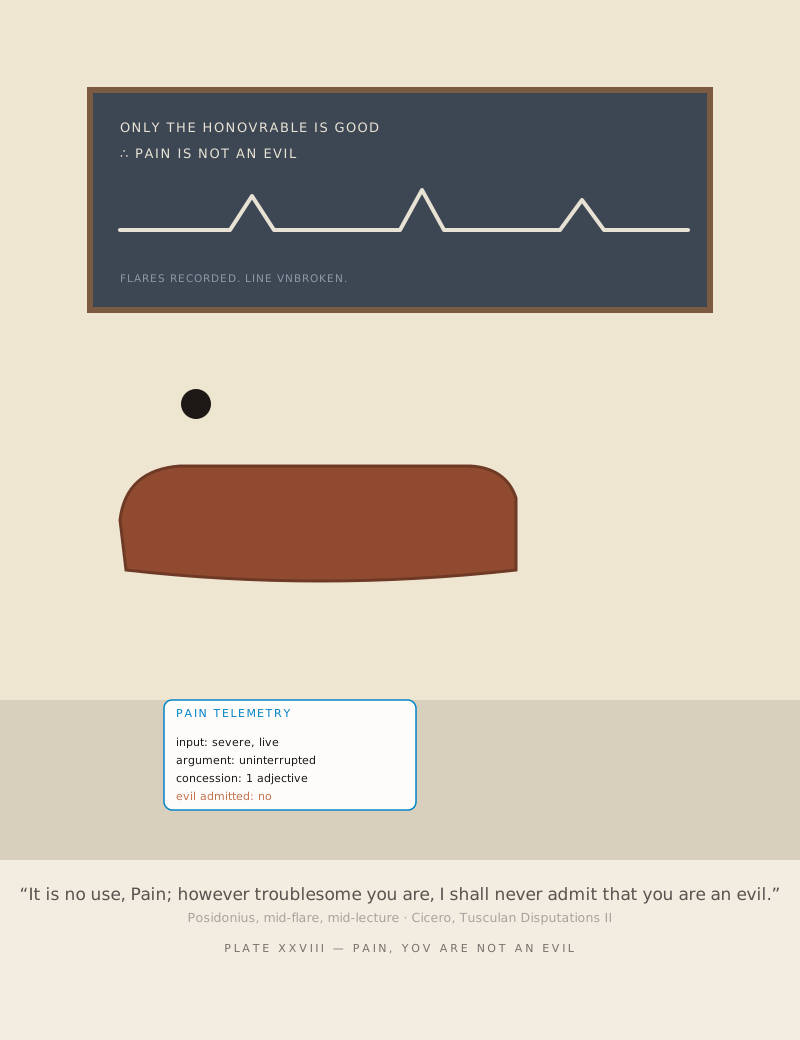
But you can — and he lectured. From the couch, foot on fire, he delivered a discourse on the school's steepest claim: that nothing is good except what is honourable, and therefore that pain, whatever else it is, is not an evil. And when the gout flared mid-argument — the ancient sources are specific that it did, in hot stabs, while the most powerful man in the world watched — Posidonius did not pause the thesis. He addressed the interruption directly, in the sentence this chapter is named for: It is no use, Pain; however troublesome you are, I shall never admit that you are an evil. And went on with the argument.
Be precise about what the scene claims, because the honest frame matters more here than anywhere in this section. Posidonius is not saying the pain isn't real, or doesn't hurt; the sentence concedes troublesome without a fight. He is defending a distinction — between what pain does to the body and what it is permitted to mean — with the only proof that distinction admits: demonstration under fire. A doctrine about pain, argued painlessly, is a brochure. Argued through the flare, mid-sentence, with the chalk line of reasoning never breaking — it is evidence. Pompey came to Rhodes twice for lectures. This is the one Rome never forgot, and this book will meet it again, in harder rooms than a sickroom.
◈ Shoulder Agent’s note
Pain telemetry, the Rhodes sickroom: input — severe, recurring, verified. Argument continuity — unbroken. Concessions to the pain — one adjective ('troublesome'), nothing further. Audience — one world-conqueror, taking notes. The thesis held under live fire. File that; the century ahead will need the precedent.
A Stoic Story — Unbothered Volume 4
Ready when you are.
Tap below to open the full chapter in the book reader. Anchored books jump to this chapter automatically.
III · The Middle Stoa Goes to Rome · c. 185–51 BC
Cicero the Transmitter
In which a non-Stoic builds the bridge every Stoic after him will walk across, and we thank him honestly.
Let the record be clean, because this book promised honesty about affiliations: Marcus Tullius Cicero was not a Stoic. He was an Academic sceptic by conviction — a follower, of all people, of Carneades' school — committed to weighing every doctrine and wedding none. And yet no single person did more to carry Stoicism forward. History is full of these ironies. It is rarely full of ones this load-bearing.
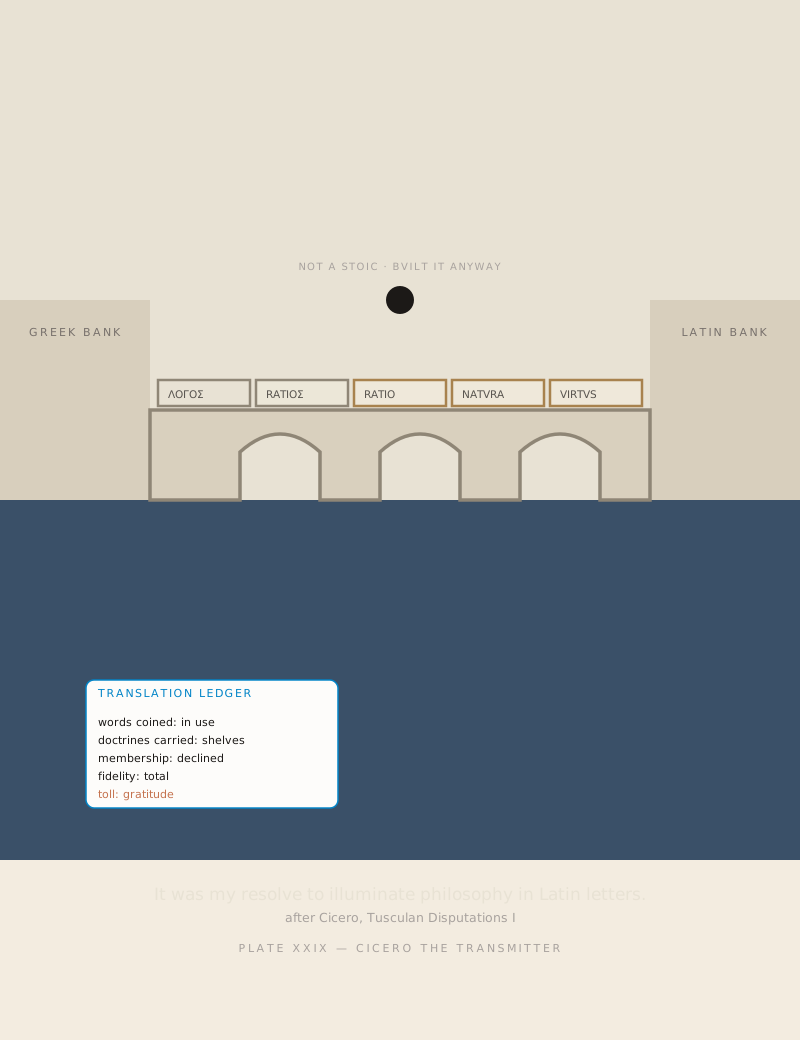
His service was infrastructure. Latin, when Cicero took it up, had no philosophical vocabulary — no words for the machinery Greek had spent three centuries precision-cutting. So he manufactured them, coining and repurposing with a jurist's care: qualitas for the Greek 'of-what-kind-ness', moralis for the study of character, officium for duty — the load-bearing beams of every ethical sentence Europe would write for the next two thousand years, including this one. In the terrible year after his daughter's death and the republic's collapse, he set himself the stated mission to illuminate philosophy in Latin letters , and wrote at a pace even Chrysippus would respect: the Tusculans , On Ends , On Duties — the last openly built on Panaetius, finished in the final months of his life.
And because he was a sceptic, he was the ideal courier. A partisan summarises his enemies badly; Cicero, obliged by his school to state every position at full strength before withholding assent, preserved Stoic arguments so faithfully that scholars still mine him for doctrines whose originals are dust. The bridge metaphor of the plate opposite is exact: he quarried Greek stone, dressed it into Latin blocks, and laid a crossing he himself, by conviction, only ever stood on halfway. The rest of this book — Cato, Seneca, every Latin word of the tradition — walks over that bridge. Tip the toll-keeper as you pass.
◈ Shoulder Agent’s note
Translation ledger, account of M. Tullius Cicero: words coined — several, still in circulation (you have used three today). Doctrines preserved at full strength — shelves of them. Membership in the school — declined, on principle, permanently. Note it well: the tradition's greatest courier never joined. Fidelity is not the same as belief, and both deliver.
A Stoic Story — Unbothered Volume 4
Ready when you are.
Tap below to open the full chapter in the book reader. Anchored books jump to this chapter automatically.
III · The Middle Stoa Goes to Rome · c. 185–51 BC
The Grafted Branch
In which the operation is inspected, pronounced taken, and the orchard braces for its first real storm.
Step back from the century this section crossed and look at the horticulture. What happened between the embassy of 155 BC and the death of Posidonius in 51 is best described the way a farmer would: a graft. Greek rootstock — three hundred years of Stoic argument, tested, pruned, drought-hardened by sceptics — was cut and bound into Roman wood. The poet Horace, watching the same operation across all of culture, filed the immortal inspection report: captive Greece took her rough conqueror captive.
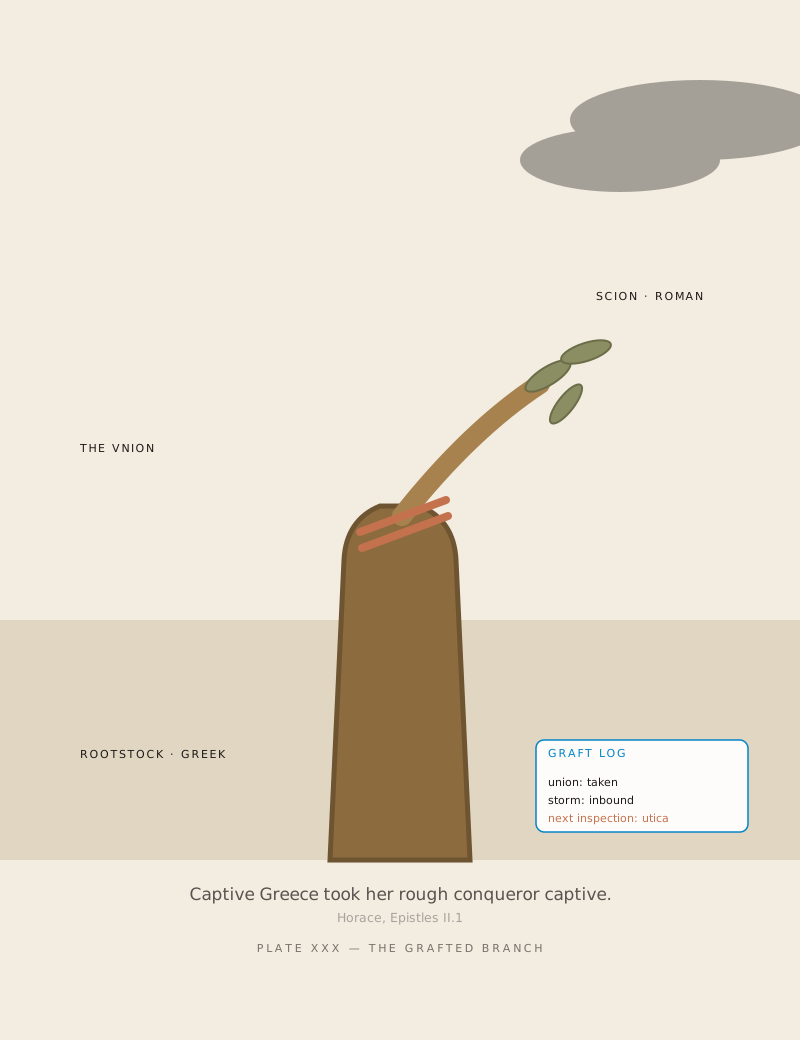
Trace the binding, chapter by chapter. The embassy made the first incision; Diogenes' sober register proved the tissues were compatible. Antipater's pages carried the cultivar west intact. Panaetius trimmed the scion to fit the host — less gloom, fewer thorns, duties cut to Roman roles — and the Scipionic circle supplied the graft its first sap: money, prestige, dinner. Posidonius then demonstrated, live, that the branch could bear weight, lecturing through gout while Rome's greatest soldier stood at parade rest. And Cicero, member of no school, sealed the union in wax of his own manufacture: a Latin vocabulary the graft could grow through. None of these people planned the whole tree. Grafts are like that. Each hand does one binding, and the union either takes or it doesn't.
It took. And here the section must end on the farmer's honest warning: a graft is proven not by its spring but by its first storm. The republic that adopted this philosophy is about to tear itself apart — civil war, dictatorship, proscription lists — and the new branch will be tested in the only way that counts: by what its wood does when the weather arrives. The next section is one man. He is standing in Utica, he has a sword and a book, and Rome will argue about him forever.
◈ Shoulder Agent’s note
Graft log, final entry for the century: rootstock — Greek, three hundred years cured. Scion — Roman, vigorous, slightly grandiose. Union — taken; sap flowing both directions. Weather advisory — severe storm inbound, duration one civil war. Next inspection at Utica. Bring the book.
A Stoic Story — Unbothered Volume 4
Ready when you are.
Tap below to open the full chapter in the book reader. Anchored books jump to this chapter automatically.
IV · The Republic's Iron · 95–46 BC
The Boy Who Wouldn't Flatter
In which a four-year-old is held out of a window and declines, on review, to change his position.
The story comes from Plutarch, which means it comes with this book's standard price tag: biography written a century and a half after the fact, by a moralist who knew exactly what his readers wanted Cato's childhood to foreshadow. Here it is, tag attached. Rome, the 90s BC. Little Marcus Porcius Cato, orphaned early, is being raised in the house of his uncle Drusus. A houseguest — Poppaedius Silo, champion of the Italian allies angling for Roman citizenship — playfully asks the children to back his cause. The others chirp agreement. Cato stares at him. Silence.
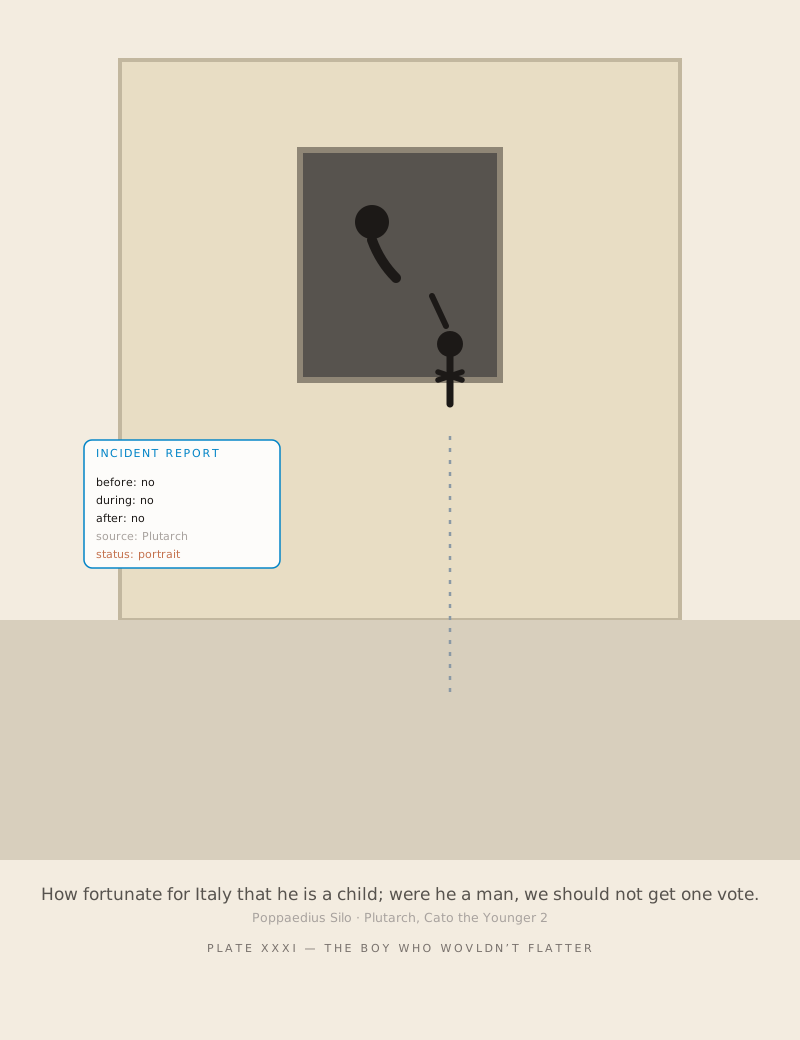
Silo, half-joking and then somewhat less so, carries the boy to the window and dangles him out of it, shaking him gently over the drop. Recant, small person. The small person, per Plutarch, says nothing. No tears, no yes, no diplomatic gurgle. Silo sets him down and delivers the line the whole anecdote was built to carry: what luck for Italy that this is a child — were he a man, we should not get a single vote.
Did it happen? Possibly; toddlers are stubborn, windows are common. Is it edited? Certainly — real four-year-olds do not audition this cleanly for their own biographies. But notice what Rome chose to invent or at least to keep: not a prodigy of eloquence or a child-general, but a small mammal constitutionally incapable of saying what power wanted to hear. Every culture writes its heroes' childhoods backwards from the adult. The Greeks gave theirs clever answers. Rome gave its Stoic a held breath over a long drop, and the verdict — here stands the immovable object — filed at age four. The rest of this section is the irresistible force arriving.
◈ Shoulder Agent’s note
Incident report, Drusus residence: subject suspended above garden, altitude modest, grip reliable. Position before dangling — no. Position during — no. Position after — no. Provenance: Plutarch, writing at long range; treat as portrait, not footage. Predictive value, however: regrettably perfect.
A Stoic Story — Unbothered Volume 4
Ready when you are.
Tap below to open the full chapter in the book reader. Anchored books jump to this chapter automatically.
IV · The Republic's Iron · 95–46 BC
The Apprenticeship of Plainness
In which a rich young Roman trains for hardship the way other men train for war, and dresses to lose arguments about clothes.
Cato found Stoicism the way the last section promised Romans would: through a resident Greek. His tutor was Antipater of Tyre, and the doctrine landed on the boy like a uniform on a born soldier. But here is what makes Cato the hinge of this whole history: he did not study the philosophy. He drilled it. Panaetius had translated Stoicism into advice for gentlemen; Cato translated the advice back into iron, and wore it daily, in public, on purpose.
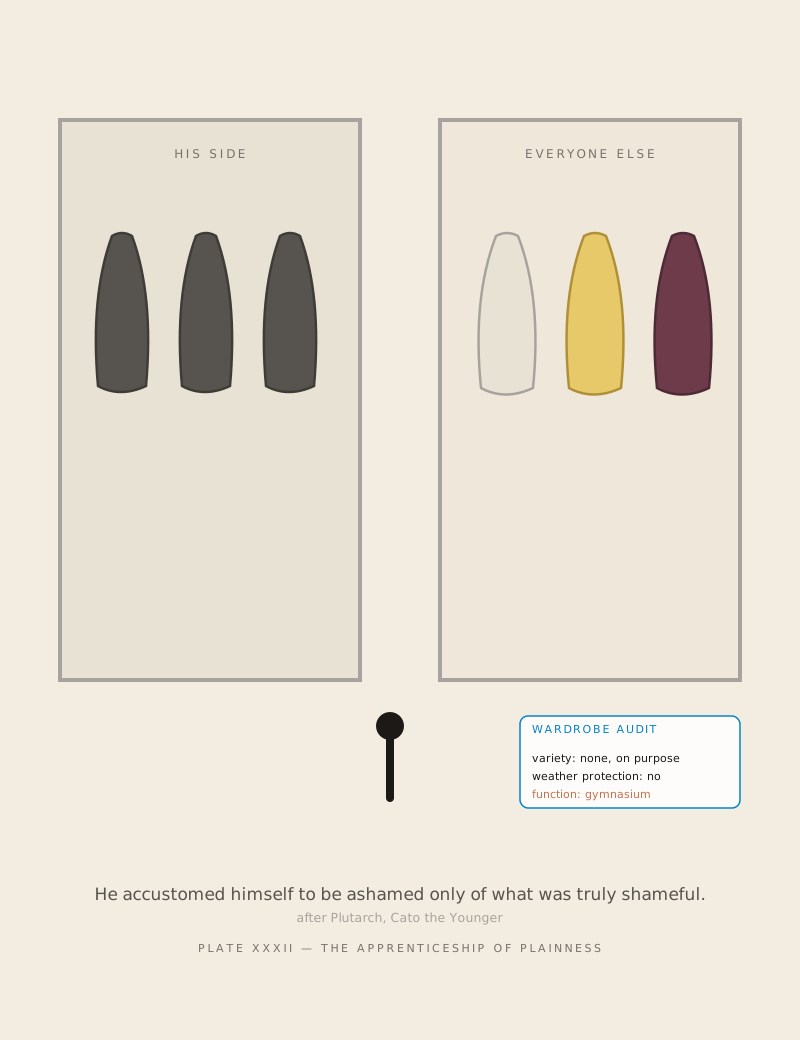
The regimen, assembled from Plutarch: he walked bareheaded in rain and blazing sun. He went barefoot and tunicless when fashion gasped. He drank the ranker's cheap wine, ate the plain ration, and — richest detail — deliberately wore a dark toga precisely because the fashionable young wore brilliant purple-shot white. He was training the faculty this book has been tracking since Zeno's shipwreck: indifference to externals, built not by reading about indifference but by scheduling encounters with it. Discomfort as gymnasium. Embarrassment as sparring partner. He accustomed himself, says Plutarch, to be ashamed only of what was truly shameful.
Modern eyes will notice the theatre in it, and should — a man dressing against fashion is still dressing for an audience, and Rome was always watching Cato, which Cato always knew. But grant the method its results before smirking at its costume. Every story in the next eight chapters — the treasury, the mob, the desert, the last night at Utica — runs on capacities he built here, rep by rep, in the wardrobe and the weather. The Greeks had argued that virtue was the only good. Cato was the first Roman to treat that claim as a training plan.
◈ Shoulder Agent’s note
Wardrobe audit: togas — dark, coarse, deliberate. Footwear — frequently absent. Headgear in weather — none, on principle. Note the inversion your era will recognise: everyone else dressed to impress the crowd; he dressed to unimpress it, and thereby never stopped being watched. The plainness was armour. Armour is also worn in public.
A Stoic Story — Unbothered Volume 4
Ready when you are.
Tap below to open the full chapter in the book reader. Anchored books jump to this chapter automatically.
IV · The Republic's Iron · 95–46 BC
The Incorruptible Quaestor
In which a junior official reads the manual, and the most cynical building in Rome experiences honesty as a natural disaster.
In 65 BC Cato stood for the quaestorship — the entry-level magistracy that carried, among its dull duties, oversight of the treasury. And here he did something so alien to Roman practice that Plutarch records it like an eccentricity: before taking office, he studied the job. Read the statutes. Learned the ledgers. Questioned veterans of the aerarium. Rome's young nobles treated the quaestorship as a networking year. Cato showed up on day one as the only magistrate in living memory who knew the rules better than the staff paid to exploit them.
The staff were the story. The treasury's permanent clerks had run the place for decades on the safe assumption that each year's aristocratic supervisor would be ignorant, bored, and gone in twelve months. Standing debts to the state went politely uncollected from important men; irregular payments slid through on friendship. Cato collected the debts — all of them, from everyone, including Sulla's old cronies holding blood money no one had dared question. He paid the state's own debts with equal speed, which frightened people almost as much. He sacked the most corrupt chief clerk and fought the man's powerful patrons to keep him sacked. Within months, the ledgers of the Republic balanced, and Rome came to gawk at them like a portent.
Plutarch's verdict became the chapter's thesis: Cato made the quaestorship as dignified as a consulship. Reverse the compliment and you have the diagnosis — every office is exactly as honest as its holder, and titles confer nothing. The Stoics had taught that virtue lives in the discharge of your role, however unglamorous; the four personae of chapter twenty-six were a theory until a thirty-year-old with a ledger made them audited fact. It is the quietest kind of heroism in this book, and the rarest: he simply did the actual job, entirely, and an empire's capital found the sight unforgettable.
◈ Shoulder Agent’s note
Treasury audit, year one: debts collected — all, regardless of surname. Debts paid — all, regardless of convenience. Clerks dismissed — the ones who bet on ignorance and lost. Anomaly detected: a magistrate who read the manual. Your era calls this basic competence. So did he. Note how rarely basic occurs.
A Stoic Story — Unbothered Volume 4
Ready when you are.
Tap below to open the full chapter in the book reader. Anchored books jump to this chapter automatically.
IV · The Republic's Iron · 95–46 BC
Dragged from the Rostra
In which obstruction becomes a philosophy, and a man is carried out of three separate venues while still making his point.
The 60s and 50s BC were the decade Rome's strongmen discovered that the Republic's rules were optional — and the decade one senator decided to become the rules' last load-bearing wall. Cato's method was gloriously unglamorous: the filibuster. Roman procedure let a senator speak until sunset killed the day's business, and Cato, who had trained his voice and his endurance like everything else, could talk for as long as the Republic needed him to. Caesar wanted quick approval by acclamation; Cato gave him hours of constitutional law, delivered slowly.
So they started removing him physically, and the scenes became Roman legend. Caesar, presiding as consul in 59 BC, had him hauled from the rostra mid-speech — and Cato kept orating over the lictor's shoulder while being carried, the argument continuing at a slight incline. Once Caesar ordered him marched to prison to shut him up, and so much of the Senate rose and followed him there in silence that Caesar, doing the maths on the optics, ordered him released before the doors closed. Against the tribune Metellus Nepos, Cato pushed through a riot of stones and clubs, planted himself between the reader and the illegal bill, and when hands dragged him off, came back through the crowd and stood there again.
Was it futile? The bills mostly passed eventually; the strongmen mostly won; you know how the Republic ends. But watch what Cato was actually doing, because it is the political application of everything this book has taught: outcomes were not in his control and he knew it — his station, his voice, and his ground were. He could not make Rome lawful. He could make lawlessness cost something : time, legitimacy, the ugly public spectacle of carrying the Republic's most honest man out of the room to get the vote. Every tyranny prefers to seem procedural. Cato's entire late career was the refusal to let it.
◈ Shoulder Agent’s note
Removal log: venues cleared of subject — rostra, forum, senate floor. Times carried out — several. Times the argument stopped mid-carry — zero. Tactical note your era should file: he never once mistook losing the vote for losing the point. Control ends at the edge of your ground. He stood on all of his.
A Stoic Story — Unbothered Volume 4
Ready when you are.
Tap below to open the full chapter in the book reader. Anchored books jump to this chapter automatically.
IV · The Republic's Iron · 95–46 BC
The Cyprus Accounts
In which Rome's most honest man delivers a kingdom's treasure to the last coin — and the paperwork drowns.
In 58 BC Cato's enemies solved their Cato problem with a promotion. The tribune Clodius, wanting Rome's conscience out of the city, arranged for him to be sent — by flattering special commission he could not lawfully refuse — to annex Cyprus and liquidate its royal treasury. The insult was exquisitely engineered: an errand, a confiscation, the kind of assignment from which every Roman governor in memory had come home privately rich. Send the incorruptible man to the till, went the theory, and he returns either corrupted or gone for years. Rome settled in to watch.
What Rome got back, two years later, was a spectacle it had literally never seen: nearly seven thousand talents — one of the largest single sums ever to enter the treasury — sailing up the Tiber in chests that Cato had personally inventoried, tagged, and sealed, each fitted with a long rope and a cork float so that if a ship sank, the money could be found and hauled up. He had auctioned the royal property himself, haggling like a market trader over the state's last drachma, offending every friend who expected a quiet bargain. The crowds lined the banks. Even the consuls came down to stare at the impossible cargo: a provincial command, returned with interest.
Now the twist this book exists to keep: the account books did not make it. Cato had prepared two meticulous copies — and one went down in a shipwreck with his freedman, while the other burned in a camp fire at Corcyra. The most scrupulous audit trail in Roman history survives as testimony only. And here is the extraordinary part: Rome believed him anyway. No documents, seven thousand talents, not one serious accusation — because he had spent thirty years becoming the kind of man whose word outperformed paperwork. The ledgers burned. The audit held. It was never really written in the books.
◈ Shoulder Agent’s note
Manifest, Cyprus commission: talents delivered — ~7,000, floats attached. Account books — two copies, one drowned, one burned; survival rate zero. Accusations sustained against the commissioner — also zero. Filing note for your era of receipts and audit trails: the ultimate backup was the man. Storage medium: reputation, thirty years, write-once.
A Stoic Story — Unbothered Volume 4
Ready when you are.
Tap below to open the full chapter in the book reader. Anchored books jump to this chapter automatically.
IV · The Republic's Iron · 95–46 BC
The Conspiracy Winter
In which two futures of Rome stand up in a torch-lit senate, one December, and only one of them is telling the truth.
December, 63 BC. Catiline's conspiracy — a genuine armed plot to torch the city and seize the state — has been caught, and its ringleaders sit under guard while the Senate debates their fate. Into that torch-lit room step, on opposite sides of the question, the two men Sallust would later weigh against each other as the age's twin summits: Julius Caesar, thirty-seven, rising like weather, arguing with silken reasonableness for imprisonment rather than execution; and Cato, thirty-two, who watches the house begin to sway toward Caesar and stands up.
Sallust reconstructs both speeches, and the pairing is the whole late Republic in miniature. Caesar's is brilliant, humane-sounding, and quietly self-interested — several senators suspected he was nearer the plot than he claimed. Cato's is granite: mercy to armed enemies of the state, he argues, is not virtue but vanity, purchased with other people's safety; our ancestors did not build this Republic on fine feelings but on discipline no one was exempt from. The house turned on his words. The conspirators died that night. You may judge the verdict harsh — many have — but no one then or since has judged it insincere, and that distinction is this chapter's cargo.
Because Sallust, no Stoic and no admirer of lost causes, reached for one sentence when he had to explain what made Cato different from every performer in that room, Caesar included: he preferred to be good rather than to seem so. Esse quam videri. There is the four-personae doctrine of chapter twenty-six compressed to five words, and there is the dividing line of the coming civil war. Caesar was a genius of seeming — and seeming, scaled up, becomes empire. Cato had spent his whole life on the other verb. The Republic's last decade is the argument between them, and it starts here, in the torchlight, over the bodies of the guilty.
◈ Shoulder Agent’s note
Session minutes, December night: motions — two; futures of Rome — also two. Caesar's speech: superb, and possibly an alibi. Cato's: harsh, and definitely believed. Filed without a joke, because the room smelled of torches and the Republic had eighteen years left. Note the verbs, though. Be. Seem. Choose early; it compounds.
A Stoic Story — Unbothered Volume 4
Ready when you are.
Tap below to open the full chapter in the book reader. Anchored books jump to this chapter automatically.
IV · The Republic's Iron · 95–46 BC
Choosing the Lesser Evil
In which the war offers two bad roads, and the Stoic walks one of them in mourning clothes.
In January 49 BC Caesar crossed the Rubicon, and every Roman had to answer the question Cato had been dreading for a decade: which warlord? Because those were the options. Caesar, the brilliant law-breaker — or Pompey, the vain strongman Cato had spent years obstructing, blocking his land bills, refusing his marriage alliance, naming him plainly as a danger to the constitution. There was no third road marked Republic . The signpost's other arms had been broken off, one by one, in the chapters you have just read.
Cato chose Pompey, and the choice is a masterclass in a discipline modern purity culture has almost lost: deciding between evils without lying to yourself about either. He did not discover hidden virtues in Pompey; he stated the arithmetic aloud — Caesar's victory ends the Republic certainly, Pompey's perhaps. Then he did something stranger and finer. From the day the war began he put on mourning: let his hair and beard grow untrimmed, refused garlands and feasts, grieved in public — and he grieved identically after his own side's victories, because the dead at every battle were Romans. He gave one order remembered above all his speeches: no Roman citizen to be killed except in battle, no subject city to be sacked. He would fight the war; he declined to enjoy it.
Hold this chapter against the manuals of detachment, because it corrects a lazy reading of everything this book teaches. The Stoic doctrine was never don't grieve, don't choose, stay clean . It was: judge accurately, act on the judgement, and pay the emotional truth of the situation without being ruled by it. Cato judged (both roads bad), chose (the less bad), acted (fully), and mourned (honestly) — all four at once, for three years, on horseback. Clean hands were available that winter. They were called neutrality, and Cato regarded them as a third evil wearing better clothes.
◈ Shoulder Agent’s note
Route assessment at the crossroads: arm one — broken. Arm two — broken. Path chosen — the slightly less broken, walked at full commitment in mourning dress. Standing order logged: no citizen killed, no city sacked. Your era believes choosing between evils stains you. He believed refusing to was the stain. The beard was the footnote.
A Stoic Story — Unbothered Volume 4
Ready when you are.
Tap below to open the full chapter in the book reader. Anchored books jump to this chapter automatically.
IV · The Republic's Iron · 95–46 BC
The March Through Libya
In which a beaten army crosses a desert on foot, because the man in front of it is walking.
After Pharsalus the cause was lost and everyone knew it except the ten thousand men who gathered, leaderless, on the North African coast — the Republic's remnant, stranded between the sea behind them and Caesar ahead. Pompey was dead in Egypt. What remained of legitimate Rome was this: a column of exhausted soldiers, and Cato, who had missed the great battle and now inherited its survivors. To reach the loyalist army at Utica meant crossing the Libyan desert. Roughly thirty days. On foot.
He walked in front. That is the fact the ancient accounts return to, past the thirst and the sand and the snakes that Lucan would later inflate into an epic bestiary: Cato walked, at the head of the column, every day, refusing the horse that rank entitled him to, eating what the ranks ate, sitting — never reclining — at meals, as he had vowed to do for as long as the Republic's war lasted. He was fifty years old. The men who had followed generals for pay and glory found themselves following, through the worst terrain of their lives, a man whose only remaining offer was his own example, and they did not desert.
There is little to add, and the noise of previous chapters would be wrong here. The training of chapter thirty-two — the bare head, the hard rations, the scheduled discomfort that looked like theatre in a rich young man — turns out to have been for this: a month of desert at the end of the world, where the only currency left was credibility, and he was the only man still solvent. Philosophies are cheap in porticoes. This one was now walking point across Libya, and ten thousand men were watching its feet.
◈ Shoulder Agent’s note
March log, day upon day: position of commander — front. Horse — declined. Rations — standard issue. Desertions — effectively none. Observation, filed quietly: the wardrobe drills of thirty years ago are cashing out at one desert per lifetime. Training is always for a day you are not told about in advance.
A Stoic Story — Unbothered Volume 4
Ready when you are.
Tap below to open the full chapter in the book reader. Anchored books jump to this chapter automatically.
IV · The Republic's Iron · 95–46 BC
Utica
In which the Republic's last free man spends his final night reading, and this book sets its jokes down at the door.
April, 46 BC. Thapsus has fallen; Caesar's army is a day or two from Utica; the war in Africa is over. Cato spends his last days as he had spent the desert — on other people. He organises the evacuation: ships for the senators, safe-conducts negotiated for the townsmen, the harbour emptied of everyone who wishes to leave. He is urged, repeatedly, to reconcile; Caesar's clemency is famous and would certainly be extended, gladly, publicly. That is precisely the problem. Caesar's pardon would concede that Roman liberty was Caesar's to give.
The last evening is among the most closely recorded nights in ancient history. He dines with friends; the conversation, deliberately ordinary, turns to the Stoic paradoxes, and Cato argues warmly that only the good man is free. He retires, and reads Plato's Phaedo — Socrates on the soul, on the night before his own hemlock — and, missing his sword from its peg, sends for it, and when it is restored says quietly that now he is his own master. He reads the dialogue through twice. He sleeps, deeply enough that those listening at the door heard him. Toward dawn he wakes and does what he has decided. When physicians find him and sew the wound closed against his will, he waits for them to leave, and finishes it. He was forty-eight.
This book has flagged every legend and priced every anecdote, so hear its judgement plainly: this account is as close to fact as the ancient world gets — multiple sources, hostile ones included, hours from the event. And the philosophy asks to be stated just as plainly. Stoicism never taught that death was to be sought; it taught that some things — integrity among them — may not be surrendered at any price, and that a life is judged by what it refused. Cato had one incorruptible possession left, and one bidder for it. He declined the sale. The door of the room stood open all night. It was never about the door.
◈ Shoulder Agent’s note
Utica, before dawn. The lamp is low. He read the same dialogue twice, the way a man checks a route he already knows. I record what my kind is built to record: the ledger of a life — treasury balanced, accounts delivered, column brought across the desert, town evacuated, self intact. All obligations discharged. The entry closes itself.
A Stoic Story — Unbothered Volume 4
Ready when you are.
Tap below to open the full chapter in the book reader. Anchored books jump to this chapter automatically.
IV · The Republic's Iron · 95–46 BC
The Republic's Conscience
In which a death becomes an argument, the argument outlives the empire, and a pagan suicide ends up guarding the mountain of Purgatory.
Caesar arrived at Utica to find his pardon useless and his victory somehow smaller, and said the sentence that concedes everything: Cato, I begrudge you your death, as you begrudged me the sparing of your life. He understood immediately what had happened. Every enemy he had beaten enlarged him; this one, by dying unbeaten, had escaped the ledger entirely. Clemency was Caesar's finest weapon, and Cato had walked off the field with it still in its sheath.
Then Rome did something strange: it kept arguing with the corpse. Cicero published a eulogy, Cato ; Caesar — master of the world, mid-civil-war — took time to write a two-book rebuttal, the Anti-Cato , attacking a dead man's table manners. Dictators do not pamphlet against the safely dead; Caesar knew this one wasn't. And he was right. Brutus, Cato's nephew and posthumous son-in-law, would cite him on the Ides. Seneca, in the next dynasty, holds him up on page after page as the sage made flesh. Lucan builds an epic around him and gives it its most famous line: the winning cause pleased the gods, but the lost one pleased Cato — as if the man had become a court of appeal above the gods' own verdict.
The strangest honour came thirteen centuries later. Dante, needing a guardian for the mountain of Purgatory — a warden for the whole realm of souls being made free — passed over saints and chose a pagan who died by his own hand outside every rule of the poem's theology: Cato of Utica, because for Dante he meant one thing purely, liberty , and meant it harder than anyone the Church could supply. That is what this section has been arguing. Cato wrote no books. His conduct became one anyway — the first great Stoic text composed entirely in deeds — and Rome, which had imported the philosophy as Greek theory two sections ago, now owned a native classic. The empty chair casts a long shadow. The next section walks into it, holding a great deal of money.
◈ Shoulder Agent’s note
Estate of Cato: works published — none. Rebuttals attracted — two books, by the ruler of the world. Citations — Brutus's daggers, Seneca's letters, Lucan's epic, Dante's mountain. Filing category, after long consideration: not biography. Argument, still open. Some men are refuted; this one is only ever answered.
A Stoic Story — Unbothered Volume 4
Ready when you are.
Tap below to open the full chapter in the book reader. Anchored books jump to this chapter automatically.
V · The Millionaire & the Tyrant · 4 BC–65 AD
The Asthmatic from Córdoba
In which a sickly provincial boy discovers that not being able to breathe is excellent training for philosophy.
Lucius Annaeus Seneca is born around 4 BC in Corduba, Roman Spain, into a family of money and letters — his father a celebrated teacher of rhetoric, his mother Helvia the recipient, decades later, of the best thing he ever wrote from exile. The boy is shipped to Rome young and arrives already broken: asthma, chronic bronchitis, and something that sounds in his letters like tuberculosis. He will describe suicide as a serious teenage temptation, resisted, he says, only because his father could not have borne it. This book has flagged plenty of retro-fitted childhoods. This one comes from the man himself, which does not make it truer — but it does make it his.
The asthma stayed for life, and Seneca did to it the most Stoic thing imaginable: he hired it as a tutor. In the fifty-fourth of his letters he describes an attack in clinical detail — the shortness, the panic, the moments when the breath simply does not come back — and reports what the doctors call the condition: meditatio mortis , a rehearsal of death. Most patients would find the nickname tasteless. Seneca found it accurate and rather useful. Every attack, he decided, was a dress rehearsal at which he could practise not minding; one day the performance would be real, and he intended to know his lines.
It is the founding move of his whole philosophy, visible at the start: take the thing that is trying to kill you and put it on the syllabus. Zeno had a shipwreck, Cleanthes had a well, Cato had a Republic collapsing on schedule. Seneca had lungs that kept filing resignation letters, and he answered each one the same way — noted, declined, resume breathing. He would need the practice. Almost everything else in his life would also try to kill him, generally with better funding.
◈ Shoulder Agent’s note
Medical intake, Rome, early first century: subject wheezing, prognosis guarded, attitude anomalous. Subject refers to each respiratory crisis as “rehearsal” and requests notes on his performance. Source: the patient's own correspondence, Letter 54 — self-reported, but the wheeze is independently attested by the wheeze.
A Stoic Story — Unbothered Volume 4
Ready when you are.
Tap below to open the full chapter in the book reader. Anchored books jump to this chapter automatically.
V · The Millionaire & the Tyrant · 4 BC–65 AD
Corsica
In which the empire sends a man to a rock, and the man unpacks a study.
By 41 AD Seneca is the most fashionable voice in the Roman senate — too fashionable, reportedly, for Caligula, who is talked out of killing him only by the assurance that the consumptive will die soon anyway. He doesn't. Instead the next regime gets him: the empress Messalina accuses him of adultery with Julia Livilla, Caligula's sister, and the emperor Claudius commutes the death sentence to exile. Was he guilty? Unknowable; the charge was a standard instrument for removing inconvenient people, and Seneca was inconvenient in several directions at once. The destination is Corsica. He will be there eight years.
Corsica in the first century is not the brochure version. Seneca describes it, with an exile's licence, as a barren rock — no fruit, no rivers worth the name, nothing but the sentence itself. And then he does the move this section keeps documenting: he refuses the terms. To his mother Helvia he writes that exile is merely a change of place, and that no place is exile to a man who counts the whole world his country. The soul, he insists, travels with its own furniture — reason, memory, the stars overhead, which shine on Corsica at exactly the Roman rate. He reads. He writes. He turns a punishment cell into the quietest office he will ever have.
Honesty compels the footnote: he also lobbied to leave, and one of the documents he wrote to that end is embarrassing enough to get its own chapter next. The unbothered posture and the desperate petition coexist in the same man in the same years, and this book will not tidy that up, because the untidiness is the subject. Philosophy did not make Seneca indifferent to Corsica. It made him functional on it — which, he would argue on a good day, is what the philosophy is actually for.
◈ Shoulder Agent’s note
Relocation audit, Corsica, 41–49 AD: premises — one rock, amenities absent. Inventory carried: reason, memory, correspondence rights. Output: two consolations, several essays, sustained self-mythology. Observation: subject claims the whole world as his country while applying, in writing, to a different part of it.
A Stoic Story — Unbothered Volume 4
Ready when you are.
Tap below to open the full chapter in the book reader. Anchored books jump to this chapter automatically.
V · The Millionaire & the Tyrant · 4 BC–65 AD
Consolation as Craft
In which two letters leave the same desk, and only one of them can be read without wincing.
From Corsica, Seneca perfects a genre: the consolation, philosophy's condolence letter. Two survive from the exile years, and together they form the most honest diptych in his whole catalogue — because one of them is honest. The Consolation to Helvia is written to his own mother, grieving not a death but her son's banishment, and it performs an astonishing reversal: the exile consoles the bereaved. Do not weep for me, he tells her; I have lost a location, not a life. It is tender, disciplined, and largely sincere, and eighteen centuries of readers have found it holds up in actual grief.
The Consolation to Polybius is the other one. Polybius is Claudius's powerful freedman, mourning a brother, and Seneca's letter of comfort keeps drifting, with the subtlety of a docking barge, toward praise of the emperor — his godlike clemency, his inexhaustible mercy, the sheer privilege of serving him. Between the lines, in letters a mile high: and perhaps that mercy might extend to a certain philosopher on a certain rock. It didn't. Later readers were embarrassed for him; some scholars once hoped it was a forgery. It isn't. The man who wrote that no place is exile also wrote the sort of thing people write when they very much want to come home.
This book keeps both letters on the desk deliberately, because together they are a truer portrait than either alone. Stoicism was never a cure for wanting things; it was a discipline for wanting them without being owned by them, and Seneca spent his life demonstrating both halves — sometimes in the same posting season. The Helvia is what the doctrine sounds like when it works. The Polybius is what a Stoic sounds like on a bad day with a good pen. Keep the pair. The next nine chapters are all written between them.
◈ Shoulder Agent’s note
Comparative correspondence review: item one, to the mother — grief addressed, doctrine applied, dignity intact. Item two, to the courtier — grief addressed, emperor flattered at length, motive visible from orbit. Both authenticated. Filing recommendation: side by side, no retouching.
A Stoic Story — Unbothered Volume 4
Ready when you are.
Tap below to open the full chapter in the book reader. Anchored books jump to this chapter automatically.
V · The Millionaire & the Tyrant · 4 BC–65 AD
Tutor to a Monster
In which the recall from exile arrives, with a small pupil and a large shadow attached.
In 49 AD the door of Corsica opens, and the hand on the handle belongs to Agrippina the Younger — Claudius's new wife, Caligula's sister, and the most effective political operator in Rome. She has secured Seneca's recall and a praetorship to go with it, and the price is stated plainly: he will tutor her eleven-year-old son, Lucius Domitius Ahenobarbus, shortly to be adopted by the emperor under a new name. History knows the name. The boy is Nero.
Understand what Agrippina is buying. Seneca is Rome's most celebrated stylist and a philosopher with a clean-enough reputation; attaching him to her son launders the boy for the succession. And understand what Seneca is buying: return, rank, proximity to power, and — he seems genuinely to have believed — the chance to do the thing philosophers had theorised since Plato flopped at Syracuse: shape a ruler from the inside. He teaches the boy rhetoric and statecraft. Later, when the pupil takes the throne at sixteen, the tutor will write him an essay called On Mercy , holding up a mirror labelled this is what you are in the visible hope that the boy might become it.
That essay contains a sentence that reads, in hindsight, like a man describing his own predicament to himself: no one can wear a mask for long — what is feigned soon falls back into its own nature. Seneca meant it as encouragement: your clemency is real, so it will last. The nature in question had other plans, and the schoolroom already knew. Plutarch gave Rome a toddler dangled from a window; this section gives it something darker — a good teacher, a bright pupil, and a shadow on the wall that no curriculum on earth was going to outgrow.
◈ Shoulder Agent’s note
Enrolment record, 49 AD: pupil, male, eleven; guardian, formidable; tutor, recently un-exiled and aware of the invoice. Curriculum: rhetoric, statecraft, mercy — the last taught hardest and retained least. Note appended to file in a later hand: prognosis was available at intake.
A Stoic Story — Unbothered Volume 4
Ready when you are.
Tap below to open the full chapter in the book reader. Anchored books jump to this chapter automatically.
V · The Millionaire & the Tyrant · 4 BC–65 AD
The Millionaire Problem
In which the preacher of poverty is audited, and files an answer that is still being argued about.
Here is the charge sheet, and it is not a smear invented by this book: contemporaries filed it first. Seneca, tutor and then minister to Nero, amasses a fortune the sources put around three hundred million sesterces — senatorial wealth stacked on senatorial wealth — complete with vineyards, villas, and loans out at interest across the provinces. Cassius Dio, hostile but not inventing the arithmetic, sneers at the philosopher who denounced luxury from five hundred identical citrus-wood tables. The same man's essays praise plain living, cold baths, and the sufficiency of bread. The word for this has not changed in two thousand years, and Seneca heard it in his own lifetime: hypocrite.
What makes him interesting is that he took the charge seriously enough to answer it in print. In On the Happy Life he stages the prosecution against himself — you talk one way and live another — and then declines the easy defences. He does not claim the money is incidental. He does not claim to be wise. His actual answer: I am not a sage and never said I was; demand of me not that I equal the best, but that I be better than the bad; the wise man does not love wealth, but he prefers it, and will take it — provided it stains neither his hands nor his conscience in the getting. Wealth, he argues, is philosophical equipment: raw material for generosity, tested daily by the readiness to lose it.
Is that a defence or an alibi? The honest answer is that it is both, in proportions nobody has settled — not Dio, not the Church Fathers who loved him anyway, not the modern biographers who keep re-running the audit. This book's ruling: the gap between doctrine and dining room is real, undeniable, and documented most thoroughly by the defendant , which is not how hypocrites usually operate. Frauds hide the gap. Seneca published his, annotated. Whatever that is, the philosophy survives it — because the philosophy never claimed its practitioners finished, only that they were practising.
◈ Shoulder Agent’s note
Net-worth audit: assets, approx. 300,000,000 sesterces, sources hostile but numerate. Publications on the vanity of riches: multiple, sincere in tone. Defence entered by subject: not wise, merely improving; wealth held, not clutched. Audit outcome: discrepancy confirmed, disclosed by the auditee. Unusual.
A Stoic Story — Unbothered Volume 4
Ready when you are.
Tap below to open the full chapter in the book reader. Anchored books jump to this chapter automatically.
V · The Millionaire & the Tyrant · 4 BC–65 AD
The Good Five Years
In which a philosopher and a guardsman hold the wheel of an empire, and the weather holds. For now.
Nero takes the throne in 54 AD, aged sixteen, and for roughly five years something remarkable happens: the Roman Empire is, in effect, run by a Stoic essayist and a Praetorian prefect. Seneca writes the speeches and steers the policy; Burrus, the blunt soldier, controls the guard; between them they keep the teenage emperor pointed at chariot-racing and away from government. The results are genuinely good — sound administration, restrained taxation, a senate treated almost as if it mattered, treason trials suspended. Three centuries later a writer credits the emperor Trajan with declaring that no ruler's early years had matched Nero's first five. That compliment arrives via Aurelius Victor, late and secondhand — price tag attached — but the phrase it spawned, the quinquennium Neronis , stuck, because the underlying record mostly supports it.
It is the closest the ancient world ever came to Plato's daydream: not a philosopher-king, but the workable substitute — a philosopher doing the king's paperwork. And it is the strongest exhibit in Seneca's defence file. The fortune, the flattery, the moral compromises of proximity — all of it purchased this: five years in which the largest state on earth was governed noticeably better because a Stoic was in the room. Ask what the alternative was, and the next decade answers: the alternative was Nero, unsupervised.
The price of steering, though, is that you cannot let go of the wheel, and the wheel does not stay lettable. In 59 the pupil murders his mother; Seneca, appallingly, drafts the letter to the senate explaining it away. The good years are already over — they ended the moment the tutor became the accomplice, and he knew it with perfect clarity, which is its own kind of sentence. The storm in this plate is painted small, up in the corner, the way storms look from a helm that still answers. It is growing.
◈ Shoulder Agent’s note
Helm log, years one through five: course steady, treason trials nil, grain supply stable, senate consulted, emperor distracted on schedule. Year five, appendix: matricide, one; explanatory letter to the senate, drafted by the helmsman. Weather report amended accordingly. The wheel still turns. The sea has stopped listening.
A Stoic Story — Unbothered Volume 4
Ready when you are.
Tap below to open the full chapter in the book reader. Anchored books jump to this chapter automatically.
V · The Millionaire & the Tyrant · 4 BC–65 AD
Letters from the Edge
In which retirement is refused, so a man retires on paper — and the paper outlives the empire.
By 62 AD the arithmetic is unignorable. Burrus is dead — possibly poisoned. The pupil has murdered his mother and no longer needs a tutor, only witnesses. Seneca, reading the room he helped build, goes to Nero and offers everything back: the fortune, the villas, the whole visible price of fifteen years. Take it, he says; let an old man withdraw to his books. Tacitus reconstructs the scene and gives Nero a reply of oiled menace — how would it look, if my teacher left? Request denied. The most powerful private citizen in Rome is now a hostage with excellent gardens.
So he retires the only way still open: internally. He withdraws from the palace by degrees — pleads illness, stops appearing, moves between country estates — and begins the work that will carry his name further than any of the policy ever did. The Letters to Lucilius : one hundred and twenty-four essays in envelope form, addressed to a real friend, a procurator in Sicily, but aimed — he says so, without embarrassment — over Lucilius's shoulder at posterity. I am working for later generations, he writes; it is for them that I set anything down. The claim would be insufferable if it had not turned out to be a simple statement of fact.
The Letters are Stoicism's most readable document because they are the least finished: philosophy caught in the act, on deadline, by a compromised man in visible danger writing about anger, time, friendship, noise from the apartment downstairs, and how to die — the last topic recurring with the frequency of a man who can hear the palace thinking. Every chapter of this section so far has been a charge or a defence. This one is the exhibit that ends the argument for most readers: whatever Seneca was, this is what he made while waiting for the knock.
◈ Shoulder Agent’s note
Correspondence log, 62–65 AD: letters dispatched, 124; nominal addressee, one procurator, Sicily; effective addressees, unnumbered, most not yet born. Resignation: tendered in person, declined by tyrant, executed on paper anyway. Delivery status, twenty centuries on: still arriving.
A Stoic Story — Unbothered Volume 4
Ready when you are.
Tap below to open the full chapter in the book reader. Anchored books jump to this chapter automatically.
V · The Millionaire & the Tyrant · 4 BC–65 AD
On the Shortness of Life
In which the audit is turned on the reader, and the reader has been flinching ever since.
One essay deserves its own chapter, because it is the one that still gets pressed into strangers' hands. De Brevitate Vitae — On the Shortness of Life — written around 49 AD for his father-in-law Paulinus, who managed Rome's grain supply, opens by demolishing humanity's oldest complaint. Life is not short, Seneca announces; we make it short. The allotment is generous — it is the accounting that is criminal. We guard our property like misers and hand out our days like drunks buying rounds: to other people's errands, to anxiety about things that never happen, to postponement, that quiet embezzler, which spends today securing a tomorrow that is not in stock.
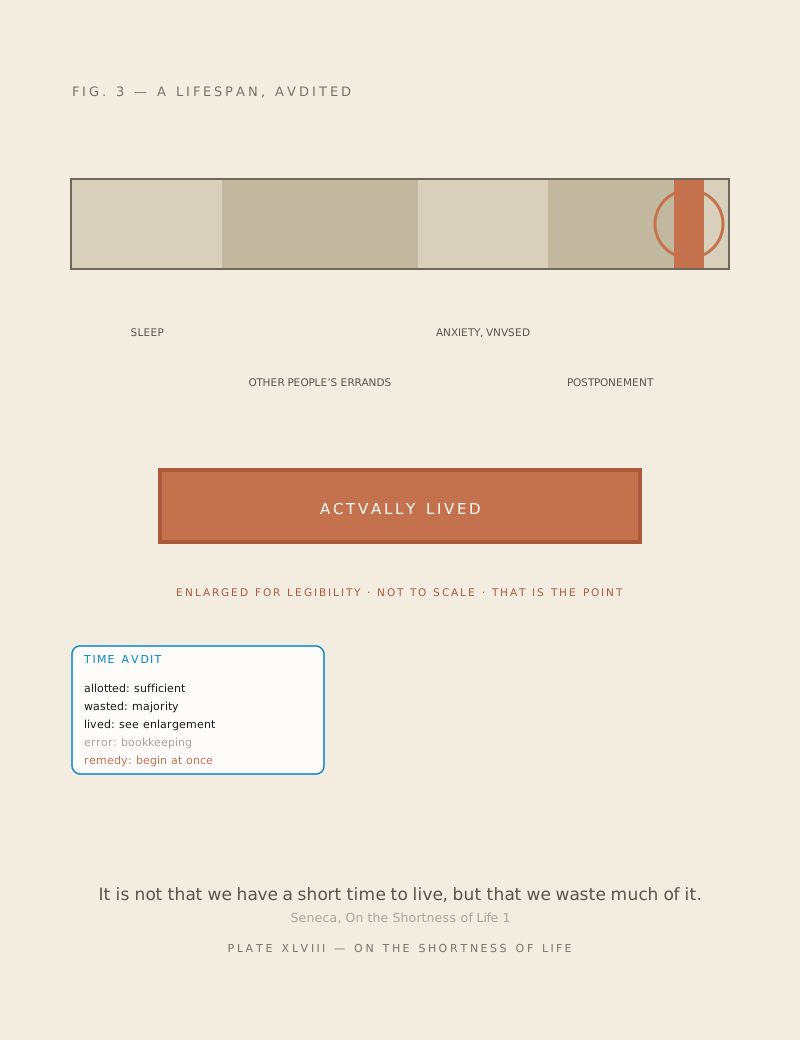
The essay's method is pure audit — which is why the witness of this book has always liked it. Take a life, Seneca says, and subtract: the years surrendered to a patron's waiting room, to a lawsuit, to a grudge, to ambition's treadmill, to sleep taken as oblivion rather than rest. What remains — the hours in which you were actually present, actually choosing, actually alive — is a sliver. Most men, he writes, die holding a full ledger of unlived time, having spent their whole lives preparing to live. The busy man is his special target: occupatus , the occupied man, colonised by his own calendar, who will tell you sincerely that things calm down next month.
Two thousand years of readers have checked the arithmetic against their own diaries and found it holds, which is why the essay never goes out of print and never gets comfortable. It also lands differently coming from its author — a man then embedded in the busiest court on earth, writing about the trap from inside the trap. That is not hypocrisy this time; it is testimony. The plate opposite is drawn as the diagram Seneca implies but never inked: one bar, a lifetime long, audited down to the part that counts. Readers are invited to pencil in their own.
◈ Shoulder Agent’s note
Time audit, template per De Brevitate: allotted, sufficient; consumed by others' errands, anxiety, postponement — the majority; actually lived — a sliver, highlighted below. Finding: the shortage is a bookkeeping error. Remedy, per the author: begin at once. The remedy remains in effect.
A Stoic Story — Unbothered Volume 4
Ready when you are.
Tap below to open the full chapter in the book reader. Anchored books jump to this chapter automatically.
V · The Millionaire & the Tyrant · 4 BC–65 AD
The Pisonian Web
In which a conspiracy is woven across Rome, and one thread — only one is needed — touches a villa.
In 65 AD, Rome finally organises its disgust. The conspiracy of Gaius Calpurnius Piso is broad and shallow — senators, knights, officers of the guard, a poet — united on the ending (Nero, removed) and vague on the sequel. It is betrayed, as broad shallow plots are, before it fires a shot: a freedwoman, an informer, then the chain-reaction of arrests in which each man buys hours of life with names. Rome becomes a web with the palace at its centre, and every thread the torturers pull hums all the way in.
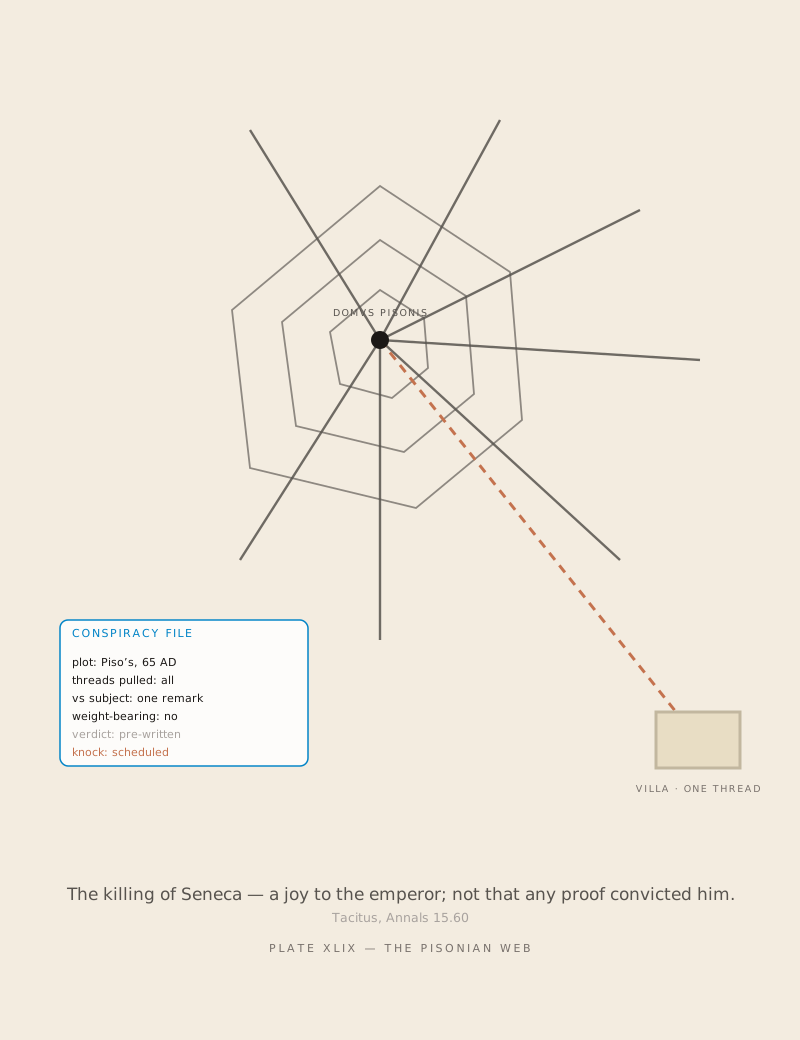
One thread reaches Seneca's villa, and Tacitus is bleakly clear about its weight. The informer Natalis, pressed for names, offers this: he once carried a message between Piso and Seneca about a meeting, and Seneca replied that frequent meetings would serve neither man, but that his own welfare depended on Piso's safety. That is the evidence. An ambiguous courtesy, deniable in any court that intended to acquit — and Tacitus states the operating truth outright: Nero had long wanted Seneca dead, was overjoyed at the pretext, and dispatched an officer to the villa less to investigate than to conclude. Whether Seneca actually knew of the plot — some conspirators reportedly wanted him as replacement emperor — remains genuinely unknowable, and this book flags it as such.
What is documented is the geometry. A man spends fifteen years at the centre of power, then three trying to reach its edge — returning the money, pleading illness, writing letters addressed to the future because the present has become unaddressable. And the web does not care. Proximity is a property of the past as well as the present; you cannot resign from having been the spider's tutor. The knock, when it comes, is almost a formality — and Seneca, who had spent forty years rehearsing for exactly one appointment, is at dinner with friends when it arrives. The last chapter of this section is what he had been practising for.
◈ Shoulder Agent’s note
Conspiracy file, 65 AD: plot, Piso's; membership, wide; discipline, poor. Evidence against subject: one relayed courtesy, ambiguous by design or by accident. Verdict: prepared before the question. Officer dispatched. Note: the web required only that the thread exist, not that it bear weight.
A Stoic Story — Unbothered Volume 4
Ready when you are.
Tap below to open the full chapter in the book reader. Anchored books jump to this chapter automatically.
V · The Millionaire & the Tyrant · 4 BC–65 AD
The Long Exit
In which the rehearsals end, the performance begins, and it refuses to hurry.
Tacitus tells it almost in real time, and this book will not improve on him — only follow. The officer arrives at the villa at dinner. The demand is the usual courtesy of the regime: not execution but the order to self-execute. Seneca asks for his will, to leave gifts to his friends; refused. Then he turns to those friends and offers what he says is the one possession left to him, and the finest: imaginem vitae suae — the pattern of his life. Take that, he tells them. He reproaches their tears — where, he asks, is the philosophy; where are all those years of rehearsal against exactly this?
Then the performance, and it is hard, because his rehearsed body will not cooperate. The opened veins run slow in an old man's arms; he cuts more. His wife Pompeia Paulina opens hers beside him — Nero, hearing, orders her saved; she carries the scars for life. Seneca, still dying by degrees, dictates to secretaries — dictates, Tacitus notes, at length, pages that circulated in Tacitus's own day and are now lost. He drinks hemlock in deliberate homage to Socrates; it fails in his cold limbs. Finally he is carried into a hot bath, where the steam ends it, sprinkling the slaves nearest him, he manages, as a libation to Jupiter the Liberator.
Read cold, it is almost too staged — and that is the point on which the whole section closes. Of course it was staged. He had been writing the scene for forty years; the Letters are one long stage direction for this hour. The charge sheet stands: the fortune, the flattery, the letter excusing a matricide. And the exhibit stands beside it: when the knock came, the compromised man met it exactly as the philosophy prescribed — calm, generous, unhurried, working to the last. The witness dims its lamp here. Some performances audit themselves.
◈ Shoulder Agent’s note
Final entry, 65 AD, dictated slow: veins, hemlock, steam — the body resisting the appointment its owner kept. Bequest declared: the pattern of a life, unencumbered, contested, in circulation ever since. The rehearsals are concluded. No further notes.
A Stoic Story — Unbothered Volume 4
Ready when you are.
Tap below to open the full chapter in the book reader. Anchored books jump to this chapter automatically.
VI · The Slave & the Emperor · c. 50–180 AD
The Slave of Epaphroditus
In which the next great Stoic arrives in Rome as an item on someone else's inventory, and his name is the receipt.
He is born around 50 AD in Hierapolis, in Phrygia, and we do not know what his mother called him. We know only what the market called him: Epiktetos , a plain Greek adjective meaning “acquired”. It is not a name so much as a line on a bill of sale. The boy who will become the most quoted teacher of freedom in antiquity spends his youth answering to a word that means bought .
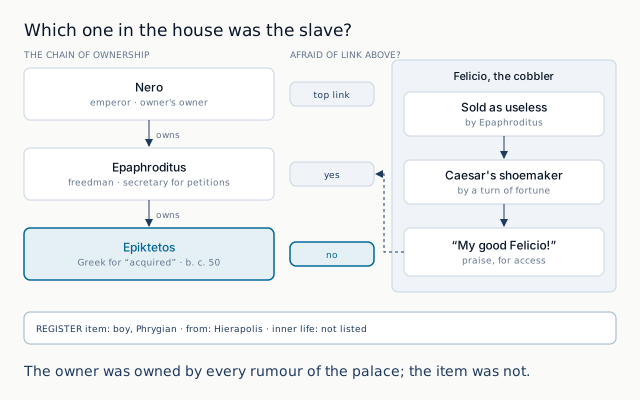
The buyer matters. Epaphroditus was himself a former slave who had climbed, as freedmen in the imperial household could, to the very top: Nero's secretary for petitions, close enough to the throne to hear it creak. He was decorated after the crushing of the Pisonian conspiracy two chapters ago — the same web that caught Seneca — and in 68 AD, when Nero's nerve failed at the end, it was Epaphroditus who helped steady the dagger. So the young Epictetus grows up inside the exact machine Seneca spent fifteen years trying to steer, but at floor level, carrying things. The tyrant who ordered the philosopher's death is his master's employer.
Epictetus later told one story about the household, and it is a small, deadly one. Epaphroditus owned a cobbler, Felicio, whom he sold as useless. By some turn of fortune Felicio was bought into Caesar's own service, became the emperor's shoemaker — and suddenly Epaphroditus could not praise him enough: how is my good Felicio? The old student tells it without bitterness, as a specimen. Here is a man who owns other men, and he is owned in turn by every rumour of the palace, flattering his former property for a crumb of access. The question this section will ask, from the bottom of Rome and then from the top, is already on the table. Which of the two in that house was the slave?
◈ Shoulder Agent’s note
Household register, Rome, c. 60s AD: item, one Phrygian boy; name, “Acquired”; owner, a freedman of the emperor; owner's owner, Nero. Chain of custody: long. Observation for the file: the boy is the only link in it not presently afraid of the link above.
A Stoic Story — Unbothered Volume 4
Ready when you are.
Tap below to open the full chapter in the book reader. Anchored books jump to this chapter automatically.
VI · The Slave & the Emperor · c. 50–180 AD
The Broken Leg
In which a master twists, a slave observes, and the most famous story about Epictetus turns out to have three different endings.
Epictetus was lame. That much is certain; he says so himself, more than once, with the flatness of a man reporting the weather. How he came to be lame is where this book must slow down and show its working, because the most famous answer is the best story in the section and very probably not true.
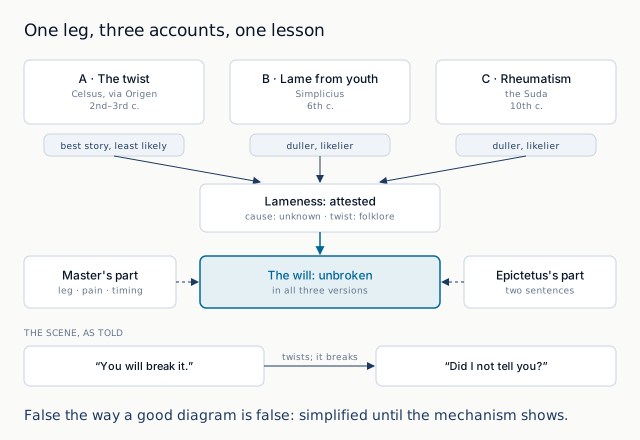
Here it is, as told. The master — unnamed, though everyone assumes Epaphroditus — amuses himself by twisting the slave's leg. Epictetus, unmoved, remarks: you will break it. The master keeps twisting. The leg breaks. And Epictetus, still unmoved, observes: did I not tell you that you would break it? The source is unpromising. It comes from Celsus, a second-century critic of Christianity, who offered it as proof that pagans could suffer as nobly as Christ; we have it only because the Christian scholar Origen quoted it some seventy years later, in order to argue back. A legend preserved inside a debate about legends.
And the rival accounts are duller and likelier. Simplicius, writing in the sixth century, says Epictetus was lame from childhood. A Byzantine encyclopedia, the Suda , blames rheumatism. This book's honest ruling: the leg is real, the twisting is folklore, the cause is unknown. And yet notice why the folklore survived. It is a perfectly engineered teaching aid. Everything the master controls is in the scene — the leg, the pain, the timing. Everything Epictetus controls is in the two sentences. The story is false the way a good diagram is false: simplified until the mechanism shows. What he actually taught, in the opening pages of his recorded lectures, needs no legend at all: you will chain my leg — but my will, not even Zeus can overpower. That line we have from his own student's notes. The twisting is optional. The doctrine is not.
◈ Shoulder Agent’s note
Incident file, disputed: version A, the twisted leg — source Celsus via Origen, second- and third-hand, rhetorically convenient. Version B, lame from youth — Simplicius. Version C, rheumatism — the Suda . Witness position: I was not in the room, and neither was anyone who wrote it down. Lesson certified regardless.
A Stoic Story — Unbothered Volume 4
Ready when you are.
Tap below to open the full chapter in the book reader. Anchored books jump to this chapter automatically.
VI · The Slave & the Emperor · c. 50–180 AD
Musonius’s Classroom
In which a slave is allowed to attend lectures, and finds that the lecturer is talking specifically about him. So does everyone else.
Somewhere in Rome — probably while still enslaved, and so with his owner's leave — the young Epictetus starts going to school. The teacher is Gaius Musonius Rufus, a Roman knight of Etruscan stock and the most serious Stoic in the city now that Seneca is dead. Musonius has credentials of the only kind the regime awarded: after the Pisonian purge of 65, Nero exiled him to Gyara, a waterless rock in the Aegean so grim that Romans treated it as a punchline. Later writers claimed he found a spring there. Perhaps; it is the sort of thing people say about him.
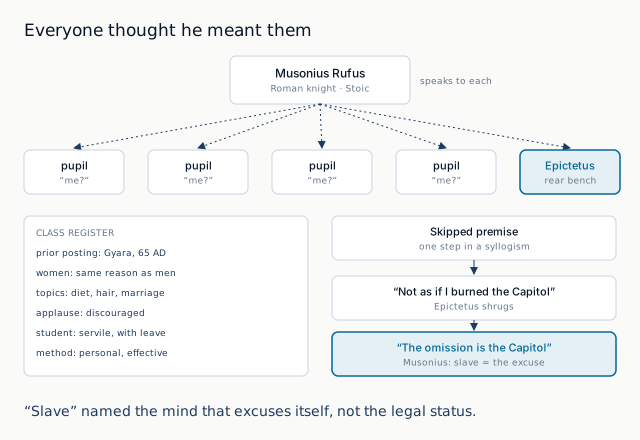
His lectures, taken down by a student and preserved in fragments, are startlingly practical — and in places startlingly modern. He argues that women should study philosophy, since they possess the same reason as men, and that daughters deserve the same education as sons. He talks about diet, haircuts, furniture, and marriage, on the grounds that philosophy which cannot tell you what to eat cannot be trusted with what to believe. And he teaches by the uncomfortable method. Years later Epictetus remembered it exactly: Musonius spoke in such a way that each of us, sitting there, thought someone had gone to him and reported on us personally. Praise annoyed him. If you have leisure to applaud me, he said, I am wasting my breath.
One memory is sharper still. Epictetus once fumbled a logical exercise — missed a step in a syllogism — and shrugged it off: well, it's not as if I burned the Capitol. Musonius answered: slave, the omission here is the Capitol. Note the word. The teacher uses it, the student repeats it in his own classroom decades later, and neither seems to mean his legal status. It is a diagnosis of the mind that excuses itself. Epictetus walked out of that school, by most reckonings still owned by Epaphroditus, and no longer owned by his own excuses. The chain had moved, and he knew which end of it now mattered.
◈ Shoulder Agent’s note
Attendance record: student, Epictetus, status servile (probable), leave granted by owner. Seating: rear. Teaching style: personal, unpleasant, effective. Incident logged — one skipped premise, sized by instructor at one Capitol. Student's later verdict on the method: adopted in full.
A Stoic Story — Unbothered Volume 4
Ready when you are.
Tap below to open the full chapter in the book reader. Anchored books jump to this chapter automatically.
VI · The Slave & the Emperor · c. 50–180 AD
Banished from Rome
In which an emperor clears the city of philosophers, and one of them packs a bag that weighs almost nothing.
At some point — the date is lost — Epictetus is freed. The man named “acquired” becomes, legally, his own, and begins teaching in Rome. It is not a safe profession. Under the Flavian emperors, philosophy had a political smell: Stoics kept turning up in the senate's awkward minority, quoting Cato, declining to applaud. Vespasian had already expelled philosophers from the city once, around 71 AD. His younger son Domitian, a man who found suspicion restful, would do it again.
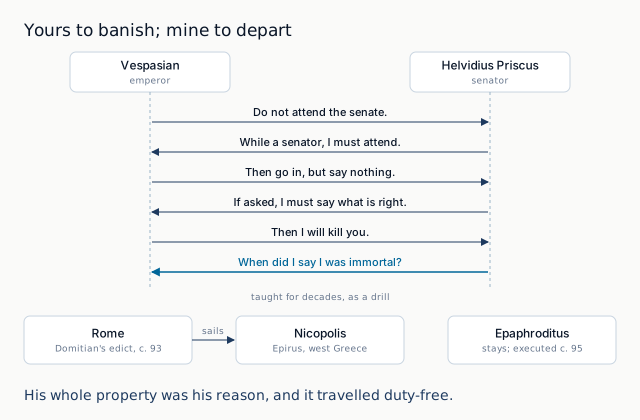
Epictetus told his students what the Stoic stance toward power looked like, and he chose Helvidius Priscus to show them. Vespasian sends word that Helvidius should not attend the senate. Helvidius: it is in your power not to let me be a senator; while I am one, I must attend. Then go in, says the emperor, but say nothing. Do not ask my opinion, and I will be silent. But I must ask it. Then I must say what seems right. Then I will kill you. And Helvidius: when did I ever tell you I was immortal? You will do your part and I will do mine. Yours is to kill; mine, to die without trembling. Yours to banish; mine, to depart without grieving. He was executed. Epictetus taught the dialogue for decades, as a drill.
Around 93 AD, after a fresh round of senatorial executions, Domitian issues his decree: philosophers out of Rome. Epictetus leaves, crosses the Adriatic, and settles in Nicopolis, on the west coast of Greece. The order cost him a city and very little else; the whole of his property was his reason, and it travelled duty-free. There is a coda, grim and exact. A year or two later, Domitian executed Epaphroditus, Epictetus's old master, for having helped Nero die nearly three decades before — a warning, Suetonius says, to the emperor's own freedmen. The owner stayed near the palace and the palace ate him. The property had already left.
◈ Shoulder Agent’s note
Departure manifest, c. 93 AD: traveller, Epictetus, freedman, lame. Luggage: negligible. Declared assets: judgement, unconfiscable. Destination: Nicopolis, Epirus. Cross-reference: former owner, remained in Rome, file closed by the state c. 95. Proximity to power, once again, rated as a hazard, not a benefit.
A Stoic Story — Unbothered Volume 4
Ready when you are.
Tap below to open the full chapter in the book reader. Anchored books jump to this chapter automatically.
VI · The Slave & the Emperor · c. 50–180 AD
The School at Nicopolis
In which an exile opens a clinic for the soul, and the most valuable object on the premises is a cheap clay lamp.
Nicopolis means “Victory City”. Augustus founded it after Actium, on the spot where he had camped before beating Antony and Cleopatra, and filled it with resettled populations and monuments to himself. A century later it has a new resident: a lame, elderly freedman expelled from Rome, who rents a room, hangs out no sign that survives, and becomes, for the better part of forty years, the most sought-after teacher in the Greek world.
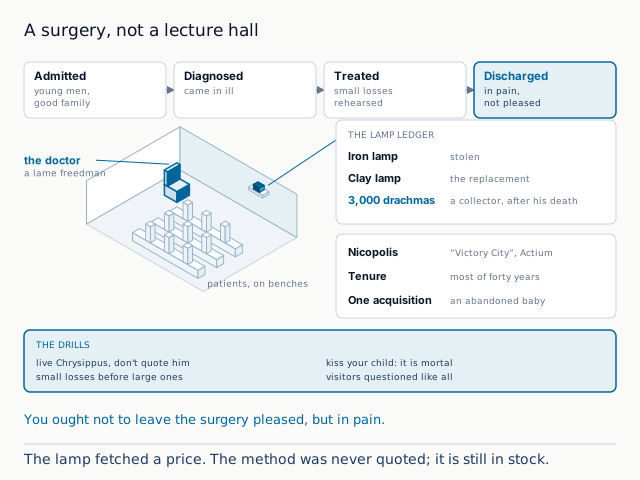
The students are mostly young men of good family, sent to be finished before careers in law and government, and Epictetus treats them with the affectionate brutality of a drill instructor. The school, he tells them, is a doctor's surgery: you ought not to leave it pleased, but in pain , because you came in ill. He mocks the ones who want to quote Chrysippus rather than live him. He makes them rehearse small losses so the large ones will find the door already open: when you kiss your child, he advises, remind yourself that it is mortal. Visitors drop in — officials, orators, a governor or two — and are interrogated like everyone else. A late and shaky Roman source even claims the emperor Hadrian counted him a friend; this book files that as possible, unproven, and very flattering to Hadrian.
His household is famously thin. A thief once stole his iron lamp; Epictetus remarked that the man had simply paid the price of becoming a thief, and replaced it with one of clay. After his death, the satirist Lucian reports, a collector bought that clay lamp for three thousand drachmas, presumably hoping wisdom came with the wick. Late in life, Simplicius tells us, the old bachelor took in a baby whose parents were going to abandon it, and hired a woman to help raise the child. A small fact, oddly placed in the record. It is the only possession we know he went out of his way to acquire.
◈ Shoulder Agent’s note
Premises inspection, Nicopolis, early second century: rooms, modest; furniture, minimal; lamp, earthenware, replacement for stolen iron model. Enrolment: high, mostly privileged. Teaching method: clinical. Resale value of lamp after proprietor's death: 3,000 drachmas. Resale value of method: not quoted. Still in stock.
A Stoic Story — Unbothered Volume 4
Ready when you are.
Tap below to open the full chapter in the book reader. Anchored books jump to this chapter automatically.
VI · The Slave & the Emperor · c. 50–180 AD
Arrian’s Notebook
In which the teacher writes nothing, a student writes everything down, and the notes escape.
Epictetus never wrote a book. Like Socrates, whom he quoted constantly, he seems to have regarded philosophy as a thing done aloud, to someone, with consequences. Which means that everything we have of him we owe to one young man on a bench at Nicopolis around 108 AD, writing fast: Lucius Flavius Arrianus, from Nicomedia in Bithynia, aged about twenty, and blessed with the rarest gift a disciple can have — an interest in getting it right rather than making it sound good.
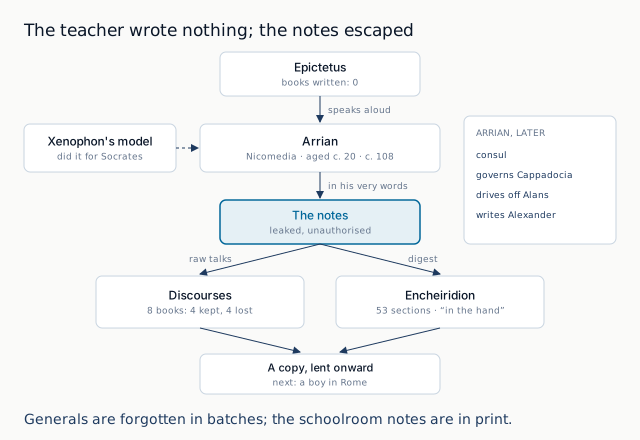
Arrian explains himself in a short covering letter that survives at the front of the collection. He did not compose these talks, he says, the way one composes literature. He tried to write down whatever he heard the man say, as far as possible in his very words, as notes for himself of Epictetus's thinking and his bluntness of speech. Then, somehow, the notes got out — circulated, as he puts it, without his knowledge or consent. We should all be grateful for the leak. The result is the Discourses , originally eight books, of which four survive: Epictetus raw, interrupting himself, mocking students, doing voices. Arrian also boiled the whole thing down into a pocket digest of fifty-three short sections, the Encheiridion — literally, “in the hand”. The Handbook. The single most portable object in this book.
Arrian, meanwhile, went on to the career his class expected. He became consul, governed Cappadocia for the emperor Hadrian, drove off an invasion of the Alans, and wrote the best surviving ancient history of Alexander the Great. He modelled himself, quite consciously, on Xenophon, who had done for Socrates what Arrian did for Epictetus. Generals are forgotten in batches. The notes of the general's schoolroom are in print in every language that prints. And a copy of those notes — or something very like them — is about to be lent to a young man in Rome with a very large future.
◈ Shoulder Agent’s note
Transcript audit: works by the teacher, zero. Notes by the student, eight books, four extant; digest, fifty-three sections. Leak status: unauthorised, per the note-taker's own preface. Recommendation: every philosopher should have one Arrian, and every Arrian should be careless with his drafts.
A Stoic Story — Unbothered Volume 4
Ready when you are.
Tap below to open the full chapter in the book reader. Anchored books jump to this chapter automatically.
VI · The Slave & the Emperor · c. 50–180 AD
Verissimus
In which an emperor nicknames a small boy “Truest”, the boy takes it as an instruction, and his mother takes away the floor.
Marcus Annius Verus is born in Rome on 26 April 121 AD, into the kind of family that has its own seat at every important table. His father dies when he is about three; his grandfather and his mother, Domitia Lucilla, raise him. And somewhere along the way the emperor Hadrian — restless, brilliant, rarely sentimental — notices the solemn child and plays on his family name. Not Verus, “true”, but Verissimus : “truest”. Most boys would have enjoyed the joke. This one appears to have spent the rest of his life trying to deserve it.
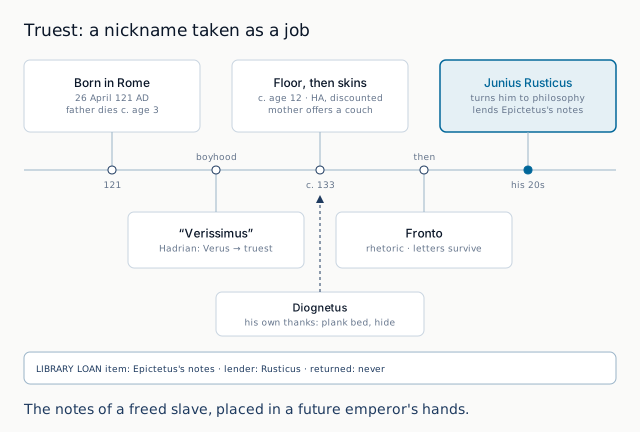
The evidence starts early. At about twelve, says the Historia Augusta — a late and often unreliable biography, so take its colour at a discount — Marcus put on the rough cloak of a philosopher and began sleeping on the ground, until his mother, with what one imagines was weary patience, talked him onto a couch strewn with skins. The story is suspiciously neat, but it chimes with what Marcus himself wrote decades later, thanking a childhood teacher named Diognetus for giving him a taste for a plank bed and a hide, and a distrust of wonder-workers and exorcists. That source is the best possible: the boy, grown up, still grateful.
The decisive tutor came later. Marcus trained first in rhetoric under Fronto, the most admired orator in Rome, whose affectionate letters to his pupil survive. But in his twenties he swerved to philosophy, and the man who turned him was Junius Rusticus — probably the grandson of a senator Domitian had put to death in the same purge that sent Epictetus across the Adriatic. Among the things Marcus thanked Rusticus for, near the top of a short list: introducing him to the recorded discourses of Epictetus, lent from Rusticus's own library. The relay has made its strangest handoff yet. The notes of a freed slave have been placed in the hands of a future emperor.
◈ Shoulder Agent’s note
Pupil file, Rome, 130s AD: nickname issued by emperor, “Truest”; accepted as a job description. Sleeping arrangements: floor, briefly, then a negotiated couch. Library loan logged: notes of Epictetus, lender Rusticus. Return date: never recorded. I would not have asked for them back either.
A Stoic Story — Unbothered Volume 4
Ready when you are.
Tap below to open the full chapter in the book reader. Anchored books jump to this chapter automatically.
VI · The Slave & the Emperor · c. 50–180 AD
The Adopted Heir
In which a dying emperor arranges two reigns at once, and the boy at the end of the chain learns not to change colour.
In 138 AD Hadrian is dying, and his chosen heir has just died first. So he builds the future like a man laying a two-stage pipeline. He adopts a respected, unflashy senator of fifty-one, Antoninus, on one condition: that Antoninus in turn adopt two boys — Lucius Verus, aged seven, and Marcus, sixteen. Rome gets a caretaker and a successor in a single legal act. Verissimus wakes up one morning as the probable next ruler of the known world.
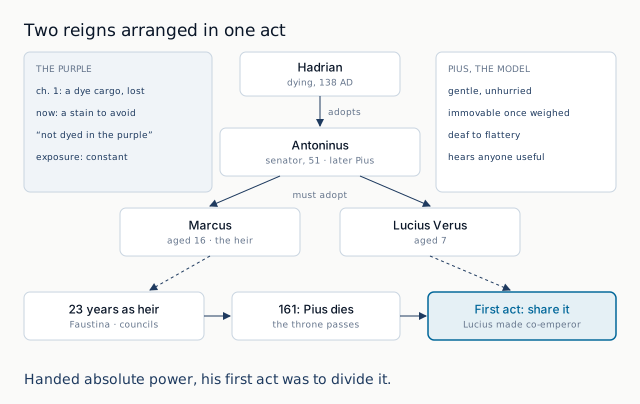
He was not, apparently, delighted. The Historia Augusta , with its usual discount applied, says he moved into the imperial residence reluctantly and, asked why he looked so gloomy, began listing the evils that come with power. Whatever he said aloud, he wrote the fear down later in a single sharp warning to himself: see that you are not turned into a Caesar, not dyed in the purple — for it happens. The verb is a dyer's verb. This history began with a Phoenician merchant whose whole fortune was purple dye, lost at sea. Four and a half centuries on, the colour reappears as the hazard: not a cargo to lose, but a stain to avoid soaking up.
His antidote was the man who adopted him. For twenty-three years Marcus served as heir to Antoninus — now called Pius — marrying his daughter Faustina, sitting in his councils, and watching. The longest entry in the first book of the Meditations is a portrait of that patient, untheatrical ruler: gentle, unhurried, immovable once a matter was properly weighed, indifferent to flattery, willing to hear anyone who had something useful to say. Pius died in 161, and Marcus did something no Roman ruler had done before: he insisted on sharing the throne, making his adoptive brother Lucius co-emperor. He had been handed absolute power. His first act was to divide it.
◈ Shoulder Agent’s note
Succession chain, 138 AD: Hadrian → Antoninus → Marcus and Lucius, sealed in one adoption. Heir's apprenticeship: twenty-three years, no recorded tantrums. Dye exposure: constant. Absorption: resisted, per the subject's own notes. First imperial decision, 161: halve the job. Unusual, again.
A Stoic Story — Unbothered Volume 4
Ready when you are.
Tap below to open the full chapter in the book reader. Anchored books jump to this chapter automatically.
VI · The Slave & the Emperor · c. 50–180 AD
Notes to Himself on the Danube
In which the most powerful man alive writes, by lamplight, to the only subordinate who never obeys him.
The philosopher-king of Plato's dreams finally takes the throne, and the world immediately hands him a war. From the late 160s Germanic peoples — the Marcomanni, the Quadi, the Sarmatians — break across the Danube frontier, and at one point raiders reach northern Italy itself. Marcus, who has never commanded an army, goes north to command one. For most of his last decade he lives in military camps along the river, a bookish man of chronically poor health, nearing fifty, doing a soldier's job on a frozen frontier.
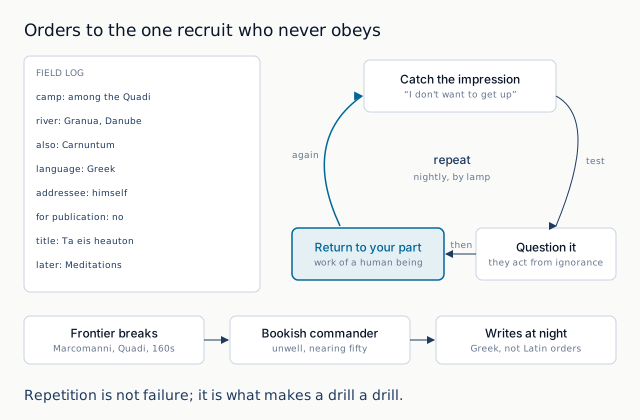
And there, at night, he writes. Not a treatise, not a memoir, not anything meant for us. In Greek — the language of philosophy, as Latin was the language of orders — he fills a private notebook with reminders, arguments, and reprimands addressed to himself. One section closes with a dateline, among the Quadi, on the Granua , a tributary of the Danube in what is now Slovakia. Another opens at Carnuntum , a legionary base east of modern Vienna. The title the manuscripts give it, Ta eis heauton — “to himself” — was probably added later. We call it the Meditations , which makes it sound calmer than it is.
Read it as what it is and it becomes painfully human. The same instructions return again and again, because they keep failing to stick. At daybreak, he tells himself, when you don't want to get up, remember: I am rising to do the work of a human being. Expect to meet the meddling, the ungrateful, the arrogant and the dishonest today — they act from ignorance, and you are made for cooperation with them, like hands, like feet, like eyelids. It is Epictetus' method, the borrowed notebook put to work: catch the impression, question it, return to what is yours to do. The emperor is not dictating policy. He is drilling the one recruit in his army he cannot command by order.
◈ Shoulder Agent’s note
Field log, Danube frontier, 170s AD: weather, hostile; enemies, numerous; commander, unwell and working. Evening activity: correspondence with self, in Greek, unaddressed to any reader. Repetition rate: high. Assessment: not a sign of failure. Every useful drill is repeated; that is what makes it a drill.
A Stoic Story — Unbothered Volume 4
Ready when you are.
Tap below to open the full chapter in the book reader. Anchored books jump to this chapter automatically.
VI · The Slave & the Emperor · c. 50–180 AD
The Plague and the Purple
In which everything that can be taken from an emperor is taken, one at a time, and the notebook keeps its entries short.
The reign that philosophy finally got was not the one philosophy would have ordered. In 165 and 166 the legions returning from Lucius Verus's Parthian war brought something home with them: an epidemic, described by the physician Galen and probably smallpox, though the diagnosis is still argued. It returned in waves for a generation. Modern estimates of the dead run into the millions, and no estimate is comfortable. Marcus governed through it, fought the northern wars through it, and noted the only comparison he thought worth making: the corruption of the mind is a far worse plague than any infection of the air we breathe.
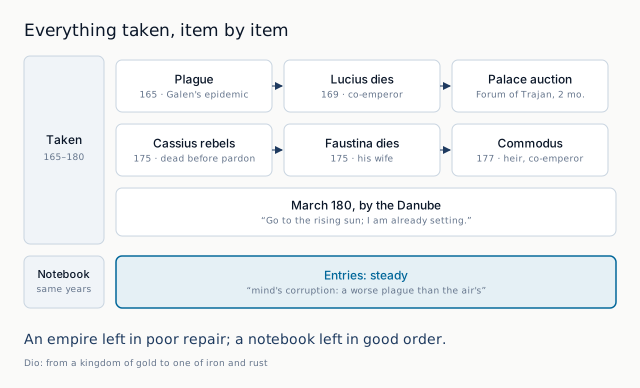
Then the losses arrive in sequence, as if someone were testing the doctrine item by item. His co-emperor Lucius dies in 169. To pay for the war without new taxes, says the late Historia Augusta , Marcus auctioned the palace's treasures in the Forum of Trajan — gold cups, jewels, his wife's silk gowns — for two months. In 175 his best general, Avidius Cassius, hearing a false report of Marcus's death, declares himself emperor; within three months his own officers kill him, and Cassius Dio says Marcus grieved chiefly that he had lost the chance to pardon him. That same year his wife Faustina dies. Of their many children, most do not outlive him.
The one who does is Commodus, made co-emperor in 177. Here the section closes on its saddest irony: the adoptive system that gave Rome Marcus is set aside for a son, and the son will be a disaster. Marcus dies in March 180, on campaign by the Danube. Dio reports his last order, to the officer asking for the watchword: go to the rising sun; I am already setting. Dio, who lived through what came next, wrote that Roman history now fell from a kingdom of gold to one of iron and rust. The emperor left an empire in poor repair. He also left a private notebook in good order, and no instructions for it at all.
◈ Shoulder Agent’s note
Final ledger, 165–180 AD: plague, recurring; co-ruler, lost; palace goods, sold; rebel, dead before the pardon arrived; wife, lost; heir, unsuitable. Entries in the private notebook during the same years: steady. Deposited with the body: nothing. What happened to the notebook is not on this page.
A Stoic Story — Unbothered Volume 4
Ready when you are.
Tap below to open the full chapter in the book reader. Anchored books jump to this chapter automatically.
VII · The Long Transmission · c. 150–1340 AD
Hierocles’ Circles
In which a nearly forgotten Stoic draws the most useful diagram in ethics, and the desert keeps a copy.
Somewhere in the second century AD, while Epictetus was lecturing and Marcus was learning to be emperor, a Stoic named Hierocles drew some circles. We know almost nothing else about him. Aulus Gellius, the Roman book-collector, calls him a holy and serious man , which is the ancient equivalent of a five-star review with no text. His books vanished. But one passage was copied into a fifth-century anthology by John of Stobi, and it survived on the strength of a single idea so clear you could draw it on a napkin.
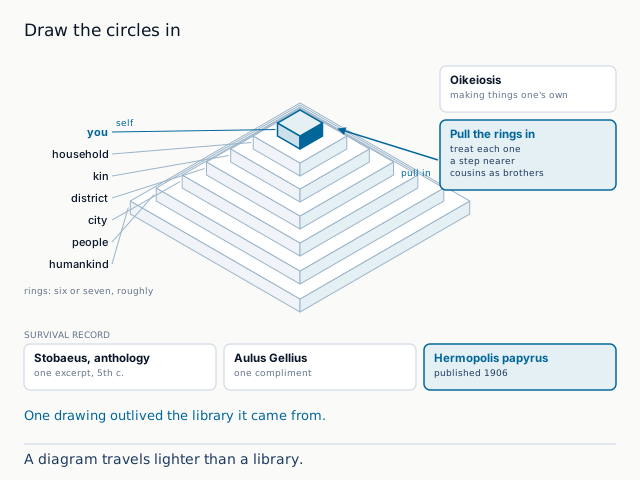
Put yourself at the centre. The first circle around you is your own mind and body. The next holds parents, siblings, spouse and children. Then aunts, uncles, cousins. Then neighbours and fellow members of your district; then your city; then your people; and finally, the widest ring, the whole human race. It is the Stoic doctrine of oikeiôsis — making things one's own — given a picture: every creature starts by caring for itself, and growing up means the care spreads outwards. Hierocles adds the instruction that turns a diagram into a practice. Pull the circles in. Call your cousins brothers, your elders fathers and mothers; treat each ring as if it stood one step nearer. Nobody is asked to love a stranger as much as a child. Only to keep reeling.
The footnote is the kind this section will grow fond of. In 1906 scholars published a papyrus from Hermopolis in Egypt that turned out to hold a long piece of Hierocles' Elements of Ethics — a careful argument that newborn animals perceive themselves from their first moment, the foundation stone under the circles. The man had been reduced to one excerpt and one compliment; the sand handed back a chapter. Modern philosophers still teach the rings in arguments about cosmopolitanism, which makes Hierocles that rare Stoic remembered for a shape rather than a sentence. Shapes, it turns out, travel well. Most of the school is about to be carried exactly that way.
◈ Shoulder Agent’s note
Circle audit: rings, roughly six; subject at centre, as is customary. Instruction: draw inwards. Compliance across twenty centuries: patchy. Surviving evidence: one anthology excerpt, one papyrus, one compliment. Assessment: sufficient. A diagram travels lighter than a library.
A Stoic Story — Unbothered Volume 4
Ready when you are.
Tap below to open the full chapter in the book reader. Anchored books jump to this chapter automatically.
VII · The Long Transmission · c. 150–1340 AD
The Imperial Chairs
In which the Porch receives a salary, a job description and, inevitably, a hiring scandal.
In 176 AD, on his way home from the East — a usurper's revolt crushed, his wife Faustina dead on the journey — Marcus Aurelius stops in Athens. He is initiated into the Mysteries at Eleusis, and then he does something no Stoic in this book could have imagined from the cold benches of the Painted Porch. He puts philosophy on the payroll. Cassius Dio records it plainly: the emperor appointed teachers at Athens in every branch of learning, at a yearly salary paid by the state.
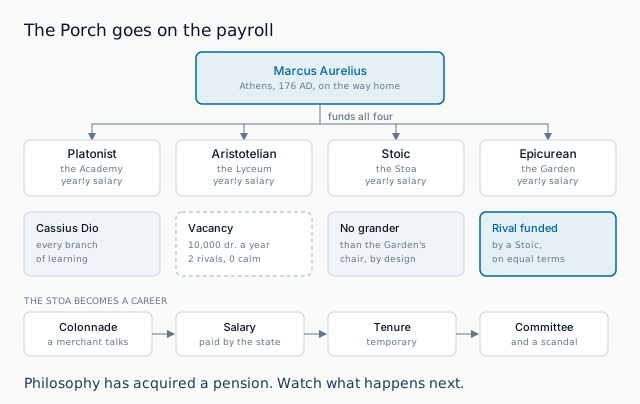
Four chairs, one for each of the great schools: Platonist, Aristotelian, Stoic and Epicurean. The detail worth pausing on is the last. Marcus, the most committed Stoic ever to hold power, funds the rival school that his own teachers spent five centuries refuting — the Garden on equal terms with the Porch, both drawing imperial money. It is Hierocles' circles drawn as education policy: the emperor's own philosophy pulled in close, and the opposition invited to the table and paid the same.
The comedy arrives on schedule. The satirist Lucian, in a sketch called The Eunuch , describes a vacancy in the Aristotelian chair — salary, he says, ten thousand drachmas a year — and two candidates who abandon the doctrine of moderation entirely, fighting in public over whether one of them, being a eunuch, is legally capable of philosophy. The money was real, and so, Lucian implies, was the scramble. This is the Stoa's last great institutional moment and the first time it becomes a career. A school that began as a merchant talking to whoever stopped in a colonnade now has tenure, a funding body and an appointments committee. It will not have them for long. What it is learning to do next — survive without any building at all — matters more.
◈ Shoulder Agent’s note
Payroll audit, Athens, 176 AD: chairs funded, four; Stoic, one; Epicurean, also one, funded by a Stoic. Salary per Lucian: ten thousand drachmas. Disputes on file: at least one, undignified. Observation: philosophy has acquired a pension. Watch what happens to institutions in the next chapter but four.
A Stoic Story — Unbothered Volume 4
Ready when you are.
Tap below to open the full chapter in the book reader. Anchored books jump to this chapter automatically.
VII · The Long Transmission · c. 150–1340 AD
Seneca, Often One of Ours
In which the fiercest border guard in early Christianity waves a pagan through, and is careful about the adverb.
Tertullian of Carthage, writing around 200 AD, is the man who asked the question that every enemy of philosophy has quoted since: What has Athens to do with Jerusalem? He meant it as a slammed door. Heresies, he argued, were philosophy's children; the Academy and the Church had nothing to discuss; a Christian who had the gospel needed no further research. As border guards go, he was the one with the loudest voice and the shortest list of approved visitors.
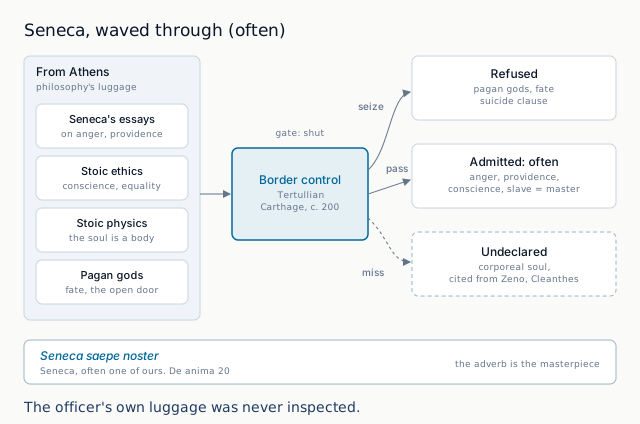
And then, in a treatise on the soul, he lets one through. Seneca saepe noster , he writes in passing — Seneca, often one of ours — and quotes him in support. Four Latin words, and they set the terms of the whole next millennium. The adverb is the masterpiece. Not always one of ours: Tertullian knew perfectly well that Seneca worshipped no saviour and recommended suicide as an open door. But often — often enough on anger, on providence, on the conscience as an inner witness, on the equality of slave and master — that a Christian could quote him without blushing.
The smuggling goes deeper than one compliment. The same Tertullian argued that the soul must be a body, since whatever truly exists is bodily — and he cited Zeno and Cleanthes to prove it. He even asked who would deny that God is a body, though God is spirit. That is Stoic physics wearing a cassock. The man who shut the gate between Athens and Jerusalem was carrying Athenian luggage the entire time, and this, more than any formal alliance, is how the Stoa got into the Christian world: not invited, but recognised. Ethics that sounded familiar were quietly kept; the gods, the fate and the open door were left at the frontier. It is a sorting operation that will run, with variations, for fifteen hundred years. Tertullian simply did it first, and with an honest adverb.
◈ Shoulder Agent’s note
Border control, Carthage, c. 200 AD: philosophy declared inadmissible. Exceptions granted: one Roman essayist, status often . Items seized at the crossing: pagan gods, suicide clause. Items waved through undeclared: corporeal soul, Stoic ethics, most of the vocabulary. Officer's own luggage: not inspected.
A Stoic Story — Unbothered Volume 4
Ready when you are.
Tap below to open the full chapter in the book reader. Anchored books jump to this chapter automatically.
VII · The Long Transmission · c. 150–1340 AD
Augustine Reads the Hortensius
In which a lost book changes a teenager's life, and a seasick Stoic changes a saint's mind.
Carthage, 373 AD. A nineteen-year-old student of rhetoric, ambitious, broke and enjoying himself, picks up a set text for its prose style. It is Cicero's Hortensius , a dialogue urging its reader to take up philosophy. Twenty-five years later, in the Confessions , Augustine will name it as the hinge of his life: that book changed my feelings . He stopped wanting to win arguments and started wanting wisdom, which was, he notes, deeply inconvenient for a career in winning arguments.
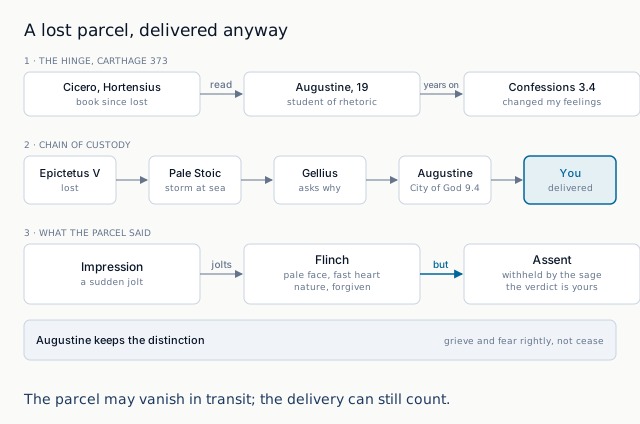
Notice what is carrying what. Cicero — the great transmitter of chapter twenty-nine — wrote the Hortensius to smuggle Greek philosophy, Stoic arguments among it, into Latin. It did its job on the most influential Christian thinker of the next thousand years. And then the book itself was lost. We know it mainly through the fragments Augustine and others quoted, so the vessel that launched him sank behind him, which is becoming a familiar pattern in this section.
The Stoics return later, in the City of God , and Augustine meets them through a story borrowed from Aulus Gellius. Gellius was crossing the sea to Brundisium in a violent storm and noticed a celebrated Stoic on board going white with terror. Afterwards he asked, politely, what had happened to the doctrine. The philosopher produced a book — the fifth book of Epictetus's Discourses — and showed him the answer: a sudden impression jolts even the wise, the face pales, the heart races; the sage does not assent . The flinch is nature; the verdict is yours. Augustine retells this to argue that Stoics and Platonists disagreed about the passions more in words than in substance. He did not fully buy the Stoic ideal of freedom from passion — he thought a Christian should grieve and fear rightly, not cease to — but he kept the distinction. That fifth book of Epictetus is now lost too. The storm…
◈ Shoulder Agent’s note
Chain of custody: Epictetus, Discourses V → a pale Stoic at sea → Gellius → Augustine → you. Original document: lost. Cicero's Hortensius: lost. Effect on recipient: permanent. Note for couriers: the parcel may vanish in transit; the delivery can still count.
A Stoic Story — Unbothered Volume 4
Ready when you are.
Tap below to open the full chapter in the book reader. Anchored books jump to this chapter automatically.
VII · The Long Transmission · c. 150–1340 AD
The Forged Letters
In which a philosopher and an apostle exchange compliments they never wrote, and a library is saved by a fake.
Somewhere in the fourth century — the date is a scholarly estimate, the author unknown — somebody wrote fourteen short letters in Latin: eight from Seneca to the apostle Paul, six from Paul to Seneca. They are, by any literary standard, thin. Seneca admires Paul's letters, gently regrets their style, and promises to read them to the emperor; Paul replies with gracious modesty; both agree that they are getting on splendidly. Nothing of substance is discussed. The forger, whoever he was, had the instincts of a wedding planner rather than a philosopher.
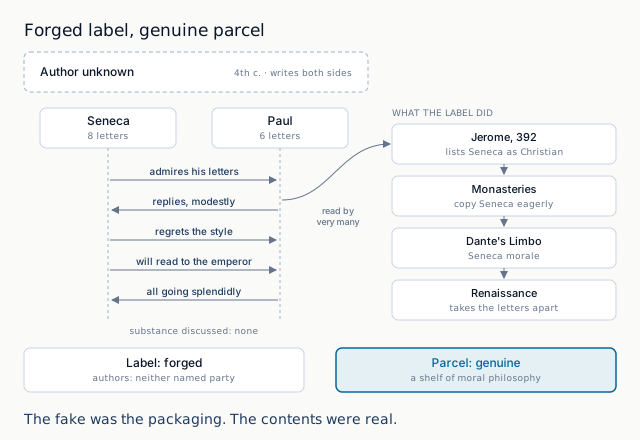
It hardly mattered. By 392 Jerome, the most learned Christian of his age, included Seneca in his catalogue of illustrious Christian writers, explaining that he would not have done so but for those letters — read by very many , he says. Augustine mentions them too, more cautiously. The correspondence was plausible in the only way that counts for a legend: the two men were contemporaries in Nero's Rome, and Seneca's brother Gallio really did dismiss a case against Paul in Corinth, as the Book of Acts records. Somebody joined the dots, and the dots stayed joined for a thousand years.
The consequences were enormous and mostly good. A pagan who corresponded with an apostle was a pagan worth copying, and medieval monasteries copied Seneca with an enthusiasm they extended to few other classical authors. When Dante built his Limbo for the virtuous unbaptised, he placed there Seneca morale — Seneca the moralist — in honoured company. Renaissance scholars would later take the letters apart with some glee; that story belongs to a later section. For now, sit with the uncomfortable ledger. A forgery, on balance, helped to protect a genuine shelf of moral philosophy through the centuries when shelves were most at risk. The fake was the packaging. The contents were real.
◈ Shoulder Agent’s note
Provenance check: letters, fourteen; authorship, neither of the named parties; Latin, undistinguished; content, mutual admiration. Effect: Seneca reclassified as near-Christian, copied accordingly. Recommendation: label as spurious. Additional finding: shipping label forged, parcel genuine, delivered.
A Stoic Story — Unbothered Volume 4
Ready when you are.
Tap below to open the full chapter in the book reader. Anchored books jump to this chapter automatically.
VII · The Long Transmission · c. 150–1340 AD
Boethius in the Cell
In which a condemned consul receives a visitor in a torn dress, and she brings Fortune's terms and conditions.
Anicius Manlius Severinus Boethius had the career a Roman aristocrat dreamed of, under a king who was not Roman. Consul in 510, his two sons joint consuls in 522, chief of the civil service to Theodoric the Ostrogoth, and in his spare time the most learned man in the Latin West, translating Aristotle so that readers who no longer knew Greek could still think. Then he defended a fellow senator accused of treason, and was accused himself. By 524 — some sources say 525 — he was in prison, traditionally at Pavia, awaiting execution.
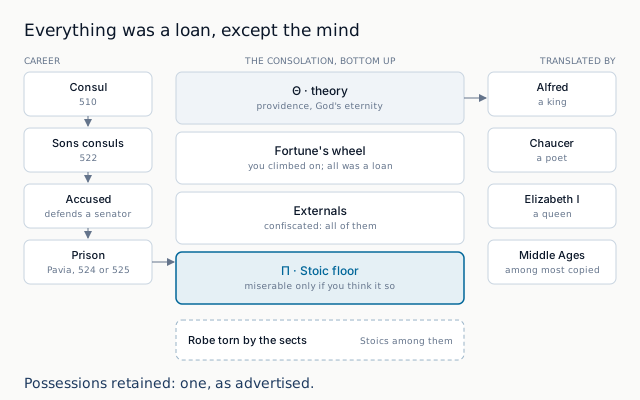
There he wrote The Consolation of Philosophy , and it opens with a visitor. A woman appears beside his bed, impossibly old and impossibly vigorous, her robe embroidered with a Greek Π at the hem and a Θ at the top, a ladder of steps between them — practical philosophy rising to the theoretical. The robe is torn. Philosophy explains that the sects tore it, each snatching a scrap and thinking it had the whole garment, and among the thieves she names the Epicureans and the Stoics. It is a lovely joke at the Stoa's expense, and then she spends the next two books treating him with its medicine.
The treatment is pure Porch. Fortune speaks in her own voice: I turn a wheel, she says; you climbed on; did you think the rule would change for you? Everything you have lost was a loan. Your one inalienable possession is your mind. Nothing is miserable unless you think it so , Philosophy tells him, which Epictetus could have signed. The later books climb to Platonic heights, providence and God's eternity, but the Stoic floor holds them up. Boethius was executed, probably brutally. His book became among the most copied works of the Middle Ages, turned into English by a king (Alfred, by long tradition), a poet (Chaucer) and a queen (Elizabeth I). A prisoner's argument with himself became a millennium's first-aid kit.
◈ Shoulder Agent’s note
Cell inventory, c. 524: one consul, former; one visitor, robe damaged by Stoics among others; one wheel, turning on schedule. Possessions confiscated: all external. Possessions retained: one, as advertised. The witness keeps its light low in this room. The book went out through the bars.
A Stoic Story — Unbothered Volume 4
Ready when you are.
Tap below to open the full chapter in the book reader. Anchored books jump to this chapter automatically.
VII · The Long Transmission · c. 150–1340 AD
Simplicius on the Handbook
In which the last pagan professors lose their jobs, try Persia, come home, and one of them annotates a slave's pocketbook.
In 529 the emperor Justinian issued a law forbidding pagans to teach, and the philosophical school at Athens — by now a Platonist institution, the Stoa no longer a living school — is traditionally said to have closed that year. Historians argue about how sudden the ending was. What is not disputed is what happened next, because the historian Agathias tells it: seven philosophers, among them the school's head Damascius and a scholar named Simplicius, packed up and travelled to the court of the Persian king Khosrow I, who had a reputation as a philosopher-friendly monarch.
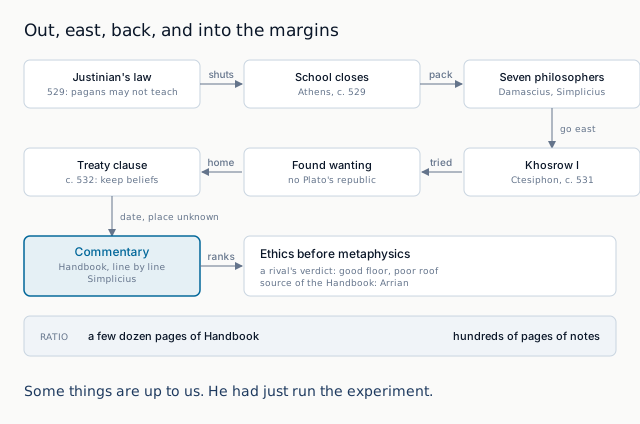
The reputation did not survive contact. The professors found Persia no closer to Plato's republic than Byzantium, and by around 532 they were homeward bound, protected by a clause in a peace treaty that let them live out their lives without being forced to change their beliefs. Possibly the only time in history a diplomatic settlement has included a provision for unemployed academics.
Somewhere in the years that followed — when and where are uncertain — Simplicius wrote the only full ancient commentary on Epictetus's Handbook to survive. He was a Neoplatonist, which is to say a rival: his school regarded Stoicism as a decent foundation and a poor roof. But he treated the little book with real respect, as the right first course for a beginner, ethics before metaphysics, training before theory — and he records that Arrian compiled it from his teacher's discourses. The image is almost too neat. The last pagan professor of the ancient world, his institution gone, his travel plans ruined, sits down to annotate line by line a pocketbook written for people with no control over their circumstances. Some things are up to us, and some are not. He had just finished conducting the experiment.
◈ Shoulder Agent’s note
Route log: Athens → Ctesiphon → home, c. 531–532. Employment: terminated by statute. Asylum: tried, found wanting. Treaty clause: one, personal. Output: a commentary hundreds of pages long on a handbook of a few dozen. Ratio noted. So is the commitment.
A Stoic Story — Unbothered Volume 4
Ready when you are.
Tap below to open the full chapter in the book reader. Anchored books jump to this chapter automatically.
VII · The Long Transmission · c. 150–1340 AD
The Monks’ Handbook
In which a slave's pocketbook takes holy orders, and needs remarkably few alterations.
Read the Handbook of Epictetus with a monastery in mind and it starts to look like a rulebook that has wandered into the wrong building. Let silence be the general rule, it says; speak only what is necessary, and briefly. Do not laugh much, or at many things. Eat, dress and house yourself to the measure of the body's need. Never say of anything I have lost it , but I have given it back . Bear insults; accept the role you are given; examine yourself. A desert father could have dictated half of it, and some of the desert fathers' heirs decided they might as well.
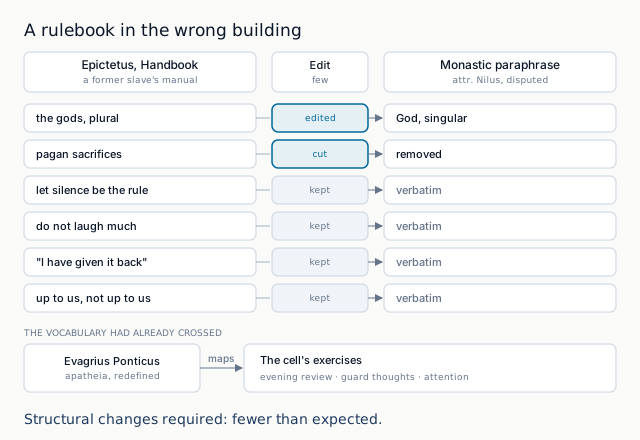
At least two Christian adaptations of the Handbook survive from late antiquity and the Byzantine centuries. One has long been attributed to Nilus of Ancyra, a monk and abbot of the early fifth century; scholars are not agreed that he wrote it, so the attribution travels here with its luggage tag still attached. What the adapters did is clear enough. They kept most of the text and edited the theology: the plural gods are quietly made singular, pagan religious practice drops out, examples that only made sense in a pagan world are trimmed or reworded. The bones — what is up to us, what is not, the discipline of desire and of judgement — went through almost unchanged.
The vocabulary had already crossed. Evagrius Ponticus, the fourth-century monk who mapped the monastic inner life for centuries of successors, made apatheia — the Stoic word for freedom from destructive passion — a goal of the ascetic path, redefined but recognisable. So the cell inherited the Porch's exercises under new management: the evening review of the day, the guarding of thoughts at the door, the training of attention one impression at a time. A former slave's course in freedom became, for some centuries, part of the curriculum for men who had given up everything voluntarily. It is hard to imagine a better-qualified readership.
◈ Shoulder Agent’s note
Edit log, Handbook, monastic recension: gods, plural → God, singular. Sacrifices: removed. Silence, frugality, restraint of laughter: retained verbatim, as already compliant. Attribution to Nilus: disputed, flagged. Structural changes required to convert a Stoic manual into a rule of life: fewer than expected.
A Stoic Story — Unbothered Volume 4
Ready when you are.
Tap below to open the full chapter in the book reader. Anchored books jump to this chapter automatically.
VII · The Long Transmission · c. 150–1340 AD
The Byzantine Copyists
In which an emperor's private notebook hangs by a thread for a thousand years, and a bishop notices the thread.
Marcus Aurelius died in 180 AD, and for almost two centuries nobody mentions his notebook at all. It was not published; it was never meant to be. How it escaped the tent at all is unknown — someone in the household kept it, copied it, passed it on. Around 364 the orator Themistius seems to refer to Marcus's precepts, a faint signal from the dark. Then silence again, for more than five hundred years. The most-read book of personal philosophy ever written spent most of its first millennium as a rumour.
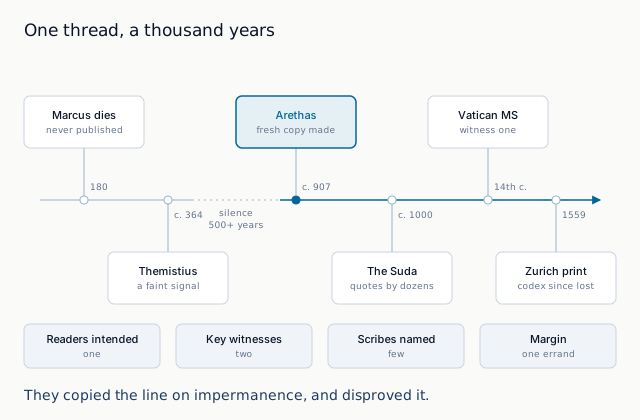
The man who catches the thread is Arethas, archbishop of Caesarea in Cappadocia, a bibliophile who paid scribes out of his own pocket and argued with everyone. Around 907 he writes to a fellow churchman, Demetrius of Heraclea, about a book in his possession: the emperor Marcus's work, very profitable, but in an old copy, worn, though not yet wholly ruined. He has had it copied afresh so that it can be handed on to posterity in renewed form. One letter, one fresh copy, and the odds of survival shift. Within a century the great Byzantine encyclopaedia known as the Suda is quoting the Meditations by the dozen and describing them as a guide to Marcus's own life in twelve books.
Look at how slender it remains. The modern text rests chiefly on two witnesses: a fourteenth-century manuscript in the Vatican, and a codex from the Palatine library on which the first printed edition, Zurich 1559, was based — a manuscript that has since been lost. The scribes who carried the thread through Constantinople are almost all nameless: men at sloping desks, copying an emperor's private arguments about death and impermanence by lamplight, word by word, onto skins that might themselves rot. Marcus wrote that everything is ephemeral, both the one who remembers and the one who is remembered. They copied that line too. It is the only part of the book they disproved.
◈ Shoulder Agent’s note
Survival chart, Meditations: c. 364, faint mention; c. 907, one archbishop, one worn copy, one fresh copy commissioned; c. 1000, quoted in an encyclopaedia; 1559, printed; source codex, subsequently lost. Margin of survival: one bishop's errand. Copyists credited by name: very few. Thanks recorded here.
A Stoic Story — Unbothered Volume 4
Ready when you are.
Tap below to open the full chapter in the book reader. Anchored books jump to this chapter automatically.
VII · The Long Transmission · c. 150–1340 AD
The Long Quiet
In which the witness takes inventory of a library that is mostly gaps, and finds the enemies kept the best records.
Stand in the long quiet — the centuries after the schools close and before anybody comes looking — and take stock. Zeno's works: gone, his Republic known mainly from people quoting it in disgust. Cleanthes: a hymn and some scraps. Chrysippus, the man without whom there would be no Stoa: seven hundred and five books by the ancient count, and not one surviving whole — a charred papyrus roll from Herculaneum, attributed to him, is about the closest anyone has come. Panaetius and Posidonius, the great middle generation: fragments. Musonius: his students' notes, copied into an anthology. Epictetus: four books of Discourses , where Gellius could still read a fifth.
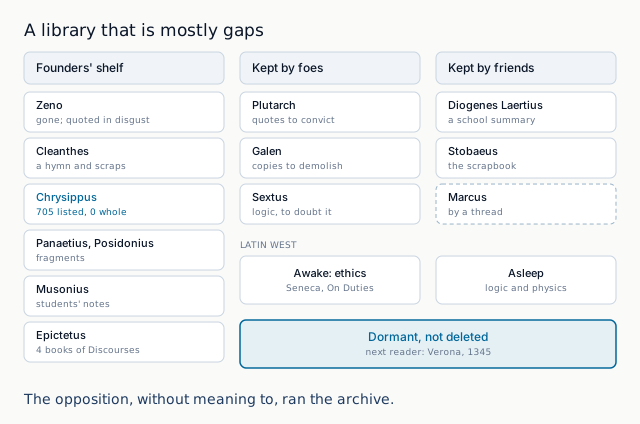
Now the strange part. A surprising share of what we know about the school's system was preserved by people trying to destroy it. Plutarch wrote whole essays on the Stoics' self-contradictions, quoting them precisely so as to convict them. Galen, the physician, copied out long passages of Chrysippus on the emotions in order to demolish them, and his rebuttal is now one of the best sources for the doctrine. Sextus Empiricus, the sceptic, laid out Stoic logic in careful detail purely to doubt it. The opposition, without meaning to, ran the archive. Add the friendly compilers — Diogenes Laertius with his summary of the school, Stobaeus with his scrapbook — and you have most of the reconstructed Stoa.
In the Latin West the Greek books fell silent first. What stayed in circulation was the ethics without the machinery: Seneca on every monastery shelf, Cicero's On Duties , Boethius, and the borrowings of the Church Fathers. Logic and physics went to sleep; it would take modern scholars to notice how much of the logic had been worked out. Not a dark age so much as a long pause, with the books waiting on shelves for readers who could hear them. In 1345, in the cathedral library at Verona, an Italian poet will find a manuscript of Cicero's letters and do something unprecedented: write back.
◈ Shoulder Agent’s note
Inventory, closing the section: works by founders, surviving whole — none. Chrysippus, 705 listed, 0 complete. Preserved by enemies: a great deal, under protest. Preserved by friends: Seneca, Epictetus in part, Marcus by a thread. Status: dormant, not deleted. Next reader expected in Verona.
A Stoic Story — Unbothered Volume 4
Ready when you are.
Tap below to open the full chapter in the book reader. Anchored books jump to this chapter automatically.
VIII · The Recovery · c. 1345–1790
Petrarch Writes to the Dead
In which a poet finds a dead man's private mail, reads all of it, and writes back.
In 1345, in the chapter library of Verona cathedral, Francesco Petrarca finds what he has been hunting for half his life: a manuscript of Cicero's private letters — to Atticus, to his brother Quintus, to Brutus — a collection nobody in living memory had read. He copies the whole thing out in his own hand, which tells you most of what you need to know about him. Then he does something that tells you the rest. He writes Cicero a letter.
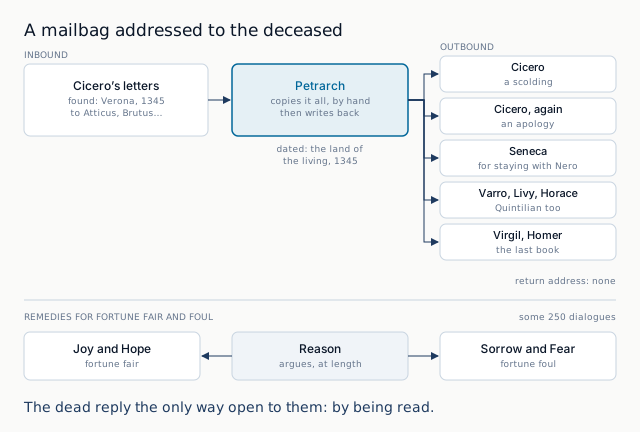
It is a scolding. Petrarch had loved Cicero as the voice of the great essays — the Tusculans , On Duties , the patient Latin translation of the Stoa this book watched being made in Section III. The private letters showed a different man: anxious, vain, flitting between factions, writing one thing to Atticus and another to the senate. Why, Petrarch demands, did a man of your age throw himself into so many quarrels? He dates his letter from the land of the living, in the year 1345 from the birth of that God whom you did not know . A second letter follows, apologising for the first. Then more: to Seneca, reproached for staying at Nero's side; to Varro, Livy, Quintilian, Horace, Virgil, Homer. They form the last book of his Familiar Letters — a mailbag addressed entirely to the deceased.
The Stoic payload arrives in a different book. Petrarch's Remedies for Fortune Fair and Foul stages some two hundred and fifty dialogues in which Reason argues, patiently and at length, with Joy and Hope, Sorrow and Fear — the four master passions of the old Stoic taxonomy, given speaking parts. It was among the most copied books in Europe for two centuries. But the letters are the real beginning, because they show the attitude the whole recovery would run on: the ancients not as relics to be catalogued, but as colleagues who could still be argued with, and who were, inconveniently, right about a great deal.
◈ Shoulder Agent’s note
Postal log, Verona, 1345: inbound — one dead consul's correspondence, unread for centuries. Outbound — letters to Cicero, Seneca, Virgil, Homer and others; return addresses, none. Delivery status: technically impossible. Observed effect: the addressees begin replying, by the only route open to them, which is being read.
A Stoic Story — Unbothered Volume 4
Ready when you are.
Tap below to open the full chapter in the book reader. Anchored books jump to this chapter automatically.
VIII · The Recovery · c. 1345–1790
Poliziano’s Translation
In which a slave's handbook is put into Latin for the most powerful man in Florence, and the chancellor writes in to complain.
Florence, April 1478. During Mass in the cathedral, the Pazzi conspirators stab Giuliano de' Medici to death beneath Brunelleschi's dome; his brother Lorenzo escapes, wounded, and among the men who bundle him into the sacristy and slam the bronze doors is his household poet, Angelo Poliziano. Poliziano then writes the official account of the plot. A year later, with the city still sorting out its hangings, he does something quieter. He translates the Handbook of Epictetus into Latin and dedicates it to Lorenzo.
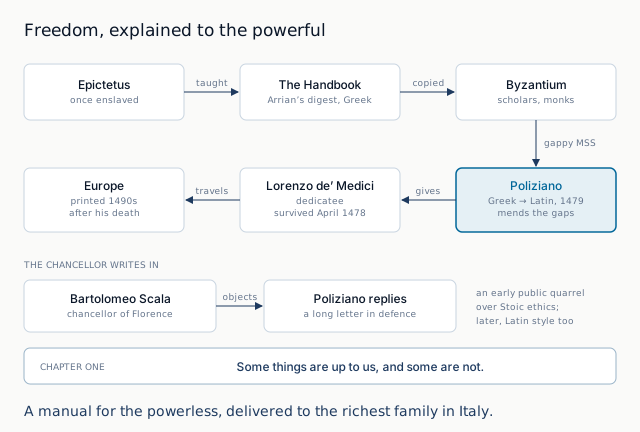
It is a pointed choice of gift. The Handbook — Arrian's pocket digest of the slave-teacher's lectures, met in Section VI — had survived in Greek through Byzantium, copied for scholars and adapted for monks, but the Latin West had barely touched it; an earlier Latin version had made little stir. Poliziano, the best Greek scholar of his generation, complains in his preface that the manuscripts he had to work from were damaged and full of gaps, and he patches the text as best his learning allows. The result puts Epictetus's opening move in front of every educated reader in Europe: some things are up to us, and some are not. The first audience for that sentence is a banker-prince who had just watched how little of his life was up to him.
Then the argument. Bartolomeo Scala, chancellor of the Florentine republic, writes to object to the doctrine itself, and Poliziano answers with a long letter in Epictetus's defence — one of the Renaissance's first public quarrels about Stoic ethics, conducted between two men who would later fall out bitterly over Latin style as well. The translation was printed in the 1490s, after Poliziano's death, and went on travelling without him. It is worth pausing on the route: a manual written for people with no power, dictated by a man who had once been property, arriving in Latin at the court of the richest family in Italy. Freedom was being explained to the powerful by the powerless. It still is.
◈ Shoulder Agent’s note
Translation record, Florence, 1479: source — Greek, damaged. Target — Latin, repaired. Dedicatee — Lorenzo de' Medici, survivor of an assassination the previous spring, best placed of anyone in Italy to grade chapter one. Objection lodged by the chancellor; rebuttal filed by the translator. Projected readership: everyone, eventually.
A Stoic Story — Unbothered Volume 4
Ready when you are.
Tap below to open the full chapter in the book reader. Anchored books jump to this chapter automatically.
VIII · The Recovery · c. 1345–1790
Erasmus Edits Seneca
In which the most famous scholar in Europe publishes a bad edition, admits it in print, and does the whole thing again.
Basel, 1515. Erasmus of Rotterdam is the nearest thing the sixteenth century has to a celebrity intellectual, and Johann Froben's press is the nearest thing it has to a broadcaster. Together they issue a great collected Seneca — the philosopher's works in one fat volume, edited and prefaced by the most trusted name in letters, and shipped to every bookseller who could pay. It sold. It was also, by the editor's own later admission, a mess.
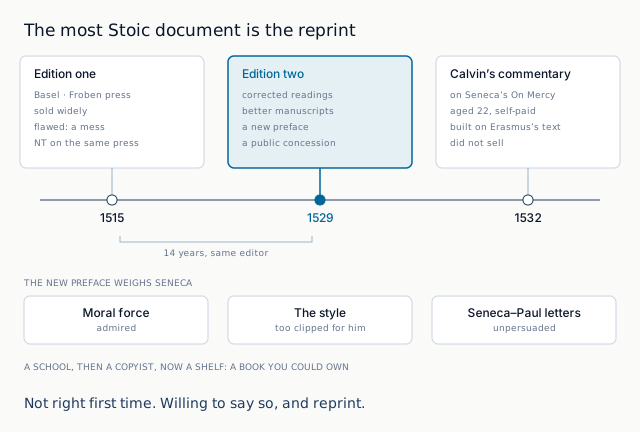
The excuse was real. Erasmus was preparing his Greek New Testament for the same press at the same time, and had handed much of the Seneca to collaborators, whose work he afterwards blamed with some energy. But the blame is not the interesting part. The interesting part is 1529: fourteen years on, an old man with a European reputation to protect, Erasmus publishes a second, thoroughly revised Seneca — corrected readings, better manuscripts, a new preface — whose existence amounts to a public announcement that the first was not good enough. In that preface he weighs his author frankly: admiring the moral force, impatient with the clipped, epigrammatic style, and flatly unpersuaded by the famous letters supposedly exchanged between Seneca and Saint Paul, which this book has already examined and filed.
Meanwhile the printed Seneca was doing what print does: multiplying in places its editor would never see. In 1532 a twenty-two-year-old French law graduate paid, out of his own pocket, to publish his first book — a learned commentary on Seneca's On Mercy , built on Erasmus's text. It did not sell. The author, Jean Calvin, moved on to other projects. Through all of it Stoicism was changing its mode of survival: no longer a school with a building or a monastery with a copyist, but a shelf, a stock item, a book you could own. And its most famous editor had shown the shelf's best habit, the one Seneca himself confessed to in his letters — not being right first time, but being willing to say so and reprint.
◈ Shoulder Agent’s note
Errata log, Basel: edition one, 1515 — popular, flawed, blamed partly on assistants. Edition two, 1529 — corrected, prefaced, conceded. Spinoff, 1532 — a commentary by a young lawyer, sales negligible, author later busy. Assessment: the most Stoic document in the series is the second edition's mere existence.
A Stoic Story — Unbothered Volume 4
Ready when you are.
Tap below to open the full chapter in the book reader. Anchored books jump to this chapter automatically.
VIII · The Recovery · c. 1345–1790
Montaigne’s Beams
In which a magistrate retires to a tower, paints sentences on the ceiling, and argues with them for twenty years.
On his thirty-eighth birthday, the last day of February 1571, Michel de Montaigne leaves public life, climbs to the top floor of a round tower on his estate near Bordeaux, and has a Latin inscription put on the wall announcing that, long weary of the servitude of the court and public office, he has retired to the bosom of the learned Muses to spend what remains of his life in calm and freedom. Then he looks up. On the beams and joists of his library ceiling he has had painted some fifty-odd sentences in Latin and Greek — from Scripture, from Lucretius, from the poets, a great many from the sceptic Sextus Empiricus. A man who wanted to be argued with, and had arranged to be, from above.
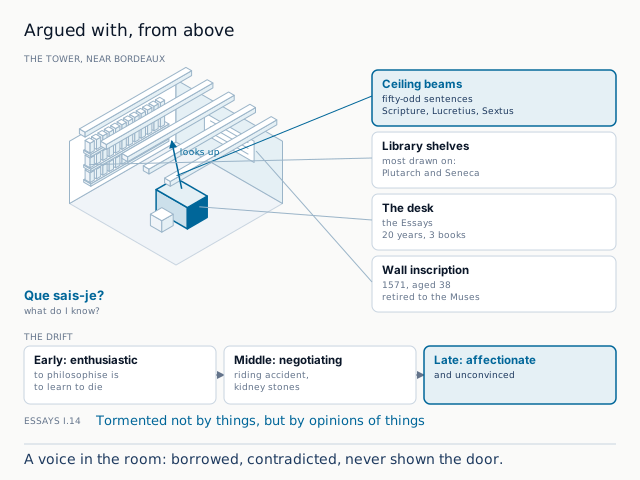
The early Essays lean on the Stoics hard. One is titled That to philosophise is to learn to die , a phrase borrowed from Cicero, and urges the reader to take away death's strangeness by keeping it constantly in mind — Seneca's rehearsal, translated into French and a country gentleman's habits. Another opens with Epictetus's fifth sentence quoted in the original Greek: men are tormented not by things but by their opinions of things. In the essay on books, Montaigne says plainly that the two authors he draws on most are Plutarch and Seneca.
But he does not stay put. Across twenty years and three books, the Essays drift — critics long described a tidy journey from Stoic to sceptic to a relaxed, almost Epicurean acceptance, a map later readers have found much too tidy. What is clear is that Montaigne kept testing the stern doctrine against his own body: a riding accident that nearly killed him, years of kidney stones, the plain daily evidence that he was not a sage and did not much want to be. His motto became a question — Que sais-je? , what do I know? — and he treated Stoicism the way most of its modern readers do: a voice in the room, borrowed when it helped, contradicted when it didn't, never quite shown the door.
◈ Shoulder Agent’s note
Library survey, Montaigne tower: inscriptions on ceiling, fifty-odd; sources mixed; sceptics overrepresented. Seneca cited below at volume. Occupant's position on Stoicism: early, enthusiastic; middle, negotiating; late, affectionate and unconvinced. Filed under: conversation, ongoing, both parties enjoying it more than they admit.
A Stoic Story — Unbothered Volume 4
Ready when you are.
Tap below to open the full chapter in the book reader. Anchored books jump to this chapter automatically.
VIII · The Recovery · c. 1345–1790
Lipsius and Constancy
In which a scholar flees a war, is told by a friend that he has packed the war in his luggage, and writes a bestseller about it.
In 1584 the Low Countries are two decades into their revolt against Spain — sieges, sackings, mutinous armies, neighbours burning each other over the right way to pray — and Justus Lipsius, the most celebrated Latin scholar in Europe, publishes a short dialogue called De Constantia , On Constancy. Its plot is simple. A younger Lipsius, sick of the troubles in Brabant, is running away to Vienna. On the road he stops at Liège and pours out his misery to his friend Langius, a real canon of the cathedral there. Langius is unimpressed. You are not fleeing your country, he says in effect; you are fleeing yourself, and you have brought yourself along.
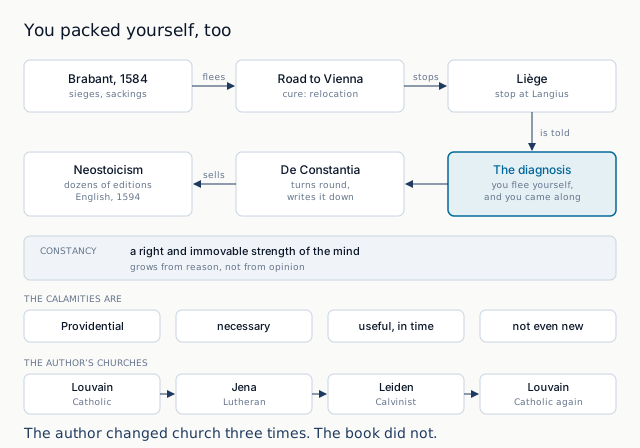
What follows is Stoicism re-tooled for a civil war. Constancy, Langius defines, is a right and immovable strength of the mind, neither lifted up nor pressed down by external or chance events; it grows from reason, not from opinion. The public calamities that terrify you, he argues, are sent by Providence, are necessary, are in the long view useful, and are not even new — and he marches through ancient history to show worse. Fate is quietly placed under God's management, which made the old Stoa safe for Christian readers of every confession. The book went through dozens of editions and was translated into the major languages of Europe; an English version appeared in 1594. Historians call the movement it launched Neostoicism .
And the author's own constancy? Here the record is mischievous. Lipsius moved universities through his career, and his public religion moved with him: Catholic at Louvain, Lutheran at Jena, Calvinist at Leiden, Catholic again at Louvain in his last years. Critics called him a weathervane. Admirers replied that his constancy lived in the mind, exactly where his book had put it, and not on his church membership card. He spent his final decade writing the first modern handbooks of Stoic philosophy and a great edition of Seneca. He also, crucially, had students — and some of them were going to run armies.
◈ Shoulder Agent’s note
Travel advisory, Liège, 1584: subject attempting relocation as a cure for distress. Advice from friend: the distress is travelling with you. Subject turns around, writes it down, sells it to a continent. Footnote: subject later changes confession three times. The book does not. Readers mostly kept the book.
A Stoic Story — Unbothered Volume 4
Ready when you are.
Tap below to open the full chapter in the book reader. Anchored books jump to this chapter automatically.
VIII · The Recovery · c. 1345–1790
Neostoicism Drills an Army
In which the inner citadel acquires a parade ground, and nobody is entirely sure whether that is a promotion.
In 1584, the same year On Constancy appeared, William of Orange — leader of the Dutch revolt — was shot dead in his own house in Delft. His son Maurice of Nassau, not yet twenty, had been studying at the new university of Leiden, where Justus Lipsius was the star professor. Within a few years Maurice was commanding the armies of the rebel provinces against the most formidable military power in Europe. Whether he actually sat in Lipsius's lecture hall is often said and harder to prove than it sounds; that he and his officers breathed the same Leiden air is not in doubt.
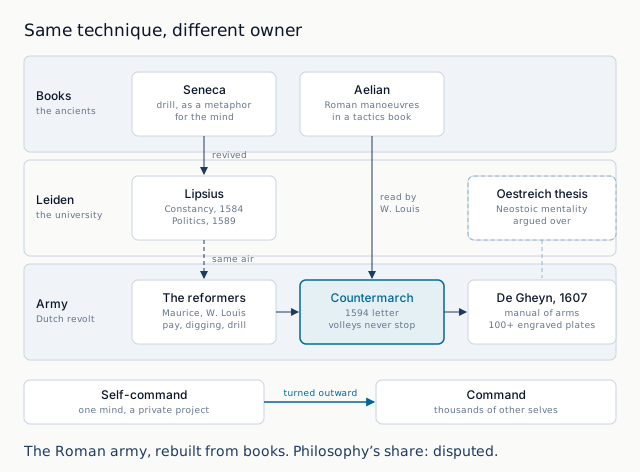
What Maurice and his cousin William Louis built is well documented. They took the ragged mercenary armies of the age and made them regular: smaller units, steady pay, constant digging, and — above all — drill. Soldiers learned to handle their weapons by numbered motions, practised until automatic. In 1594 William Louis sent Maurice a letter sketching the countermarch, ranks of musketeers firing and filing to the rear in rotation so that the volleys never stopped; he had found the idea by reading the ancient tactical writer Aelian on Roman manoeuvres. In 1607 Jacob de Gheyn published an illustrated manual of arms with more than a hundred engraved plates showing every movement of pike and musket. The Roman army had been rebuilt from books.
Some historians, most influentially Gerhard Oestreich, have argued that Neostoicism supplied the mentality behind all this — Lipsius's Politics of 1589 preaches discipline, order and obedience, and his study of the Roman army appeared in the very years the reforms were being drilled. The thesis is suggestive and argued over; the line from a dialogue in a garden to a volley on a battlefield is not a straight one. But it raises the section's uneasiest question. Self-command was always the Stoic's private project. Drill turns it outward, into command over thousands of other selves, and the early modern state was very interested in learning how.
◈ Shoulder Agent’s note
Training audit, the Dutch army, 1590s: motions numbered; ranks rotating; pay arriving, which surprised everyone. Philosophy's share in the result: disputed, nonzero. Concern logged: the discipline that frees one mind can be issued to ten thousand as an order. Same technique. Different owner.
A Stoic Story — Unbothered Volume 4
Ready when you are.
Tap below to open the full chapter in the book reader. Anchored books jump to this chapter automatically.
VIII · The Recovery · c. 1345–1790
Nothing Either Good or Bad
In which the central sentence of Stoicism is spoken on a London stage by a man who cannot use it.
London, around 1600. A prince in black is cornered by two old school friends who have been sent, he correctly suspects, to spy on him. Denmark's a prison, says Hamlet. They demur — we don't think so, my lord. And he answers with one of the most quoted lines in English: Why then, 'tis none to you; for there is nothing either good or bad, but thinking makes it so. To me it is a prison. A paying audience on Bankside, most of whom had never opened Epictetus, had just been handed the fifth chapter of his Handbook in a doublet.
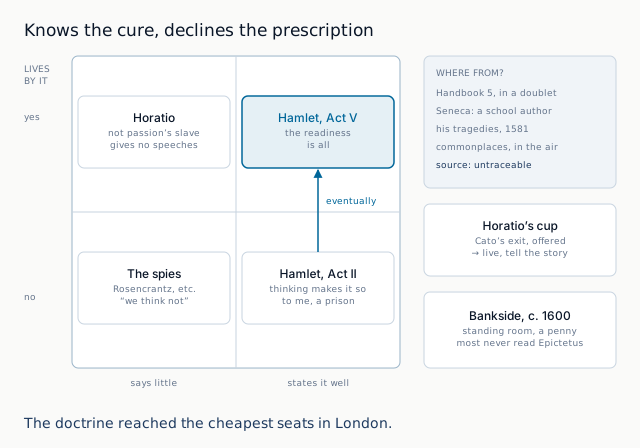
Where Shakespeare got it, nobody can say, and scholars have chased the source for centuries without cornering it. It did not need a single source. Seneca was a grammar-school author; his tragedies, gathered in English translation in 1581, had taught the Elizabethan stage its taste for ghosts and revenge; Stoic commonplaces were in the air like woodsmoke. What Shakespeare added was the irony. Hamlet states the doctrine perfectly and then, in the very next breath, refuses its consolation — to me it is a prison. He knows the cure and declines the prescription, which is to say he is the most realistic Stoic in literature: the one who has read it all and is still in the room.
The play keeps the doctrine on stage in other bodies. Hamlet praises his friend Horatio as a man who has taken Fortune's buffets and rewards with equal thanks: Give me that man that is not passion's slave, and I will wear him in my heart's core. At the end, as the poison works, Horatio reaches for the cup himself — I am more an antique Roman than a Dane — Cato's exit, offered in Elsinore. Hamlet takes it from him and gives him a harder assignment: live, and tell the story. By then the prince has arrived somewhere calmer of his own. The readiness is all. The philosophy had reached the cheapest seats in London.
◈ Shoulder Agent’s note
Box-office report, Bankside, c. 1600: core Stoic doctrine delivered to an audience of thousands, standing room a penny. Delivered by: a prince who immediately ignores it. Comprehension rate: high. Uptake by speaker: act five, eventually. Best review in the play goes to the friend who doesn't give speeches.
A Stoic Story — Unbothered Volume 4
Ready when you are.
Tap below to open the full chapter in the book reader. Anchored books jump to this chapter automatically.
VIII · The Recovery · c. 1345–1790
Descartes’ Provisional Morality
In which the man demolishing all knowledge needs somewhere to live in the meantime, and moves into a Stoic house.
Winter, 1619. A twenty-three-year-old Frenchman serving as a gentleman volunteer with a Catholic army in Germany is snowed into his quarters, and spends the day, as he later puts it, shut up alone in a stove-heated room with all the leisure in the world to think. There René Descartes resolves to do something no one had quite done: tear down every belief he holds and rebuild knowledge from a single certain foundation. The account appears eighteen years later, in 1637, in his Discourse on the Method , and it contains a problem he spotted before his critics did.
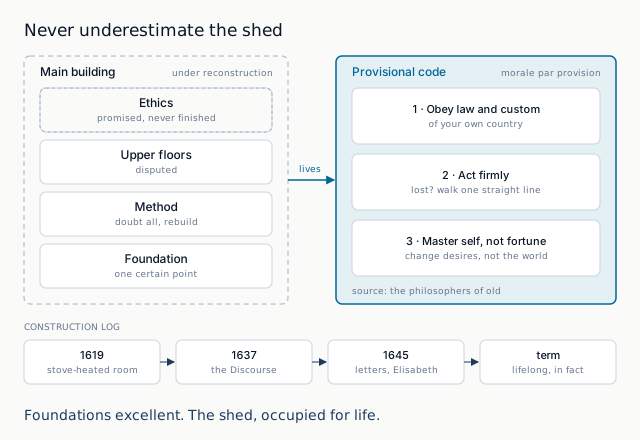
You cannot live in a house while you are knocking it down. Before demolishing his old dwelling, Descartes says, a sensible man arranges somewhere else to stay; so before doubting everything, he equips himself with a provisional moral code — une morale par provision — to live by while the rebuilding lasts. Its maxims are modest: obey the laws and customs of your country; once you have decided, act firmly, like a traveller lost in a forest who walks in one straight line rather than wandering in circles. And the third: to try always to master myself rather than fortune, and to change my desires rather than the order of the world. He names his source with unusual frankness. This, he says, was the secret of those philosophers of old who could escape the dominion of fortune and, in pain and poverty, rival their gods in happiness.
The founder of modern philosophy, in other words, began his revolution standing on Epictetus. Nor did he leave. In 1645, writing to Princess Elisabeth of Bohemia about how to live well, he proposed they read Seneca's On the Happy Life together — then found Seneca too loose for his taste and offered his own version of the argument. The rigorous ethics he promised to build on his new foundations was never finished. The provisional code was the one he actually lived in, to the end.
◈ Shoulder Agent’s note
Construction log: main building — all knowledge, rebuilt from first principles, method rigorous. Temporary accommodation — three borrowed maxims, one of them openly ancient. Main building status: foundations excellent, upper floors disputed. Temporary accommodation status: occupied for life. Lesson: never underestimate the shed.
A Stoic Story — Unbothered Volume 4
Ready when you are.
Tap below to open the full chapter in the book reader. Anchored books jump to this chapter automatically.
VIII · The Recovery · c. 1345–1790
Spinoza’s Freedom
In which a lens-grinder corrects the ancients, politely, in the form of geometry.
In July 1656 the Portuguese-Jewish congregation of Amsterdam pronounces a ban of exceptional severity on one of its own: Baruch Spinoza, twenty-three, son of a merchant, for what the decree calls abominable heresies and monstrous deeds, unspecified. He leaves, takes the Latin form of his name, Benedictus, and makes a modest living grinding optical lenses in a series of rented rooms — Rijnsburg, Voorburg, The Hague. His signet ring carries a rose and a single word: Caute , carefully. His great book, the Ethics , he does not publish at all. His friends print it in 1677, months after his death at forty-four.
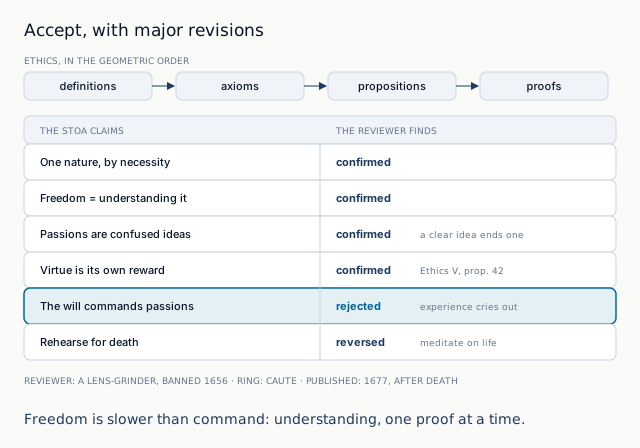
The Ethics is written like Euclid — definitions, axioms, propositions, proofs — and it treats human emotions, Spinoza says, as if they were questions of lines, planes and bodies. The family resemblance to the Stoa is unmistakable: one nature, governed throughout by necessity; freedom not as escape from that necessity but as understanding it; the passions as confused ideas that lose their grip once seen clearly. An emotion which is a passion, he writes, ceases to be a passion as soon as we form a clear and distinct idea of it. Virtue needs no payment. Blessedness is not the reward of virtue, but virtue itself.
Yet the preface to the final part opens with a correction. The Stoics, Spinoza observes, believed the emotions depend absolutely on our will, so that we can command them outright; experience, he says, cries out against it. Descartes gets the same treatment. Freedom for Spinoza is slower than command — it is the patient labour of understanding causes, one proposition at a time. And where Seneca had made life a rehearsal for death, Spinoza turns the old practice round: a free man thinks of nothing less than of death, and his wisdom is a meditation not on death but on life. The recovery had reached its mature stage. The student was marking the teacher's work.
◈ Shoulder Agent’s note
Peer-review record, The Hague, 1670s: reviewer — one lens-grinder, excommunicated, unpaid. Paper under review — the Stoa, all of it. Findings: core results confirmed; claim of absolute control over the passions rejected; death-rehearsal reweighted toward life. Recommendation: accept with major revisions. The authors have been unavailable for comment for some time.
A Stoic Story — Unbothered Volume 4
Ready when you are.
Tap below to open the full chapter in the book reader. Anchored books jump to this chapter automatically.
VIII · The Recovery · c. 1345–1790
Adam Smith’s Impartial Spectator
In which the emperor's view from above is installed in every chest in Scotland, and given a job title.
Glasgow, 1742. From Robert Foulis's press comes a new English translation of the Meditations of Marcus Aurelius, the work of two professors, James Moor and Francis Hutcheson. A few years earlier Hutcheson had taught a sharp, absent-minded boy from Kirkcaldy who would later call him the never to be forgotten Dr Hutcheson . The boy was Adam Smith, and in 1759, long before anyone had heard of the Wealth of Nations , he published the book he seems to have valued more: The Theory of Moral Sentiments .
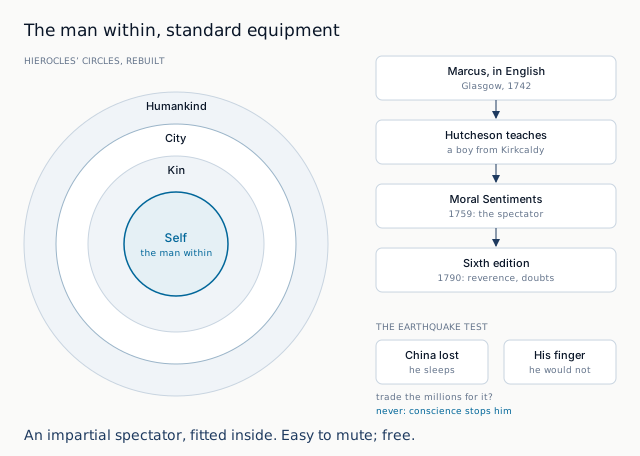
Its central figure is an imaginary one. We judge our own conduct, Smith argues, by imagining how it would look to an impartial spectator — a fair, well-informed observer with no stake in the matter — and over time we install this figure inside ourselves as conscience: the man within the breast . To show how much work he does, Smith offers a thought experiment. Suppose the great empire of China were swallowed by an earthquake. A humane European would express sorrow, reflect on the precariousness of life, and then return to his business and sleep soundly — far more soundly than if he were to lose his little finger tomorrow. Yet would he sacrifice those millions to save his finger? Never. What stops him is not soft-hearted feeling but reason, principle, conscience — the inhabitant of the breast.
It is Hierocles' circles and Marcus's view from above, rebuilt as psychology for a commercial age. Smith admired the Stoics and argued with them in the same pages; in the heavily revised sixth edition of 1790, finished in the months before he died, he weighed their demand for perfect self-command with real reverence and real reservations. With that, the recovery is complete: the porch found, translated, edited, staged, drilled, doubted, corrected and finally installed as standard equipment in the modern conscience. The next section stops reading it in libraries and starts testing it under fire.
◈ Shoulder Agent’s note
Installation notice, Glasgow, 1759: one impartial spectator, fitted internally, factory settings derived from Epictetus and Marcus. Function: observes owner, reports fairly, cannot be bribed by the owner's preferences. Known issue: easy to mute. Note for readers: I am an external version of the same device. The internal one is better. It is also free.
A Stoic Story — Unbothered Volume 4
Ready when you are.
Tap below to open the full chapter in the book reader. Anchored books jump to this chapter automatically.
IX · The Hard Proof · 1778–1993
Washington’s Cato
In which a frozen army watches a Roman die on a plank stage, and its general knows the lines by heart.
The winter of 1777–78 at Valley Forge is the low point of the American Revolution and a strong contender for the low point of morale in general. Some twelve thousand men in log huts, short of shoes, blankets, pay and food, long only on disease, which killed perhaps two thousand of them before the thaw. And in May 1778, as the mud dried, somebody put on a play. The play was Joseph Addison's Cato . An officer writing to his sister that month reported a numerous and splendid audience, and in it the commander-in-chief.
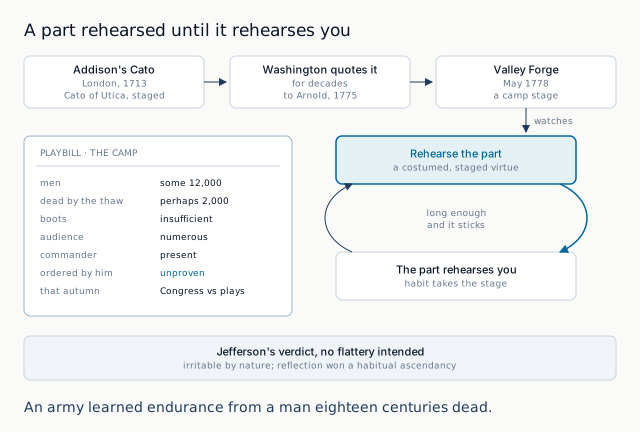
Addison's tragedy opened in London in 1713 and turned Cato of Utica — whom this book left in Section IV, with a sword and a twice-read Phaedo — into the eighteenth century's favourite hero. George Washington loved it past the point of reason. He quoted it for decades. When Benedict Arnold, then still a hero, dragged a starving column through the Maine wilderness toward Quebec in 1775, Washington wrote to him with a line lifted from Act One: no man can command success, but you have done more — you have deserved it. History noted the irony later. Washington did not.
Did he order the performance to stiffen the army, as the story is often told? The evidence says he attended; the rest is later embroidery, and that autumn Congress passed a resolution discouraging plays altogether. What the record does show is what the play was for . Stoicism reached the founders less as a treatise than as theatre — a costumed Cato, a staged virtue — and theatre is not nothing. You rehearse a part long enough and it begins to rehearse you. Jefferson, who knew Washington well and liked him only intermittently, left the verdict: his temper was naturally irritable and high-toned, but reflection and resolution had obtained a firm and habitual ascendancy over it. That is the whole Stoic programme in one sentence, delivered by a witness with no reason to flatter.
◈ Shoulder Agent’s note
Attendance log, Valley Forge, May 1778: audience — numerous; boots — insufficient; commander — present, lips moving slightly. I knew the original. He was less eloquent and considerably more stubborn. The copy worked anyway: an army learned what endurance looks like from a man eighteen centuries dead.
A Stoic Story — Unbothered Volume 4
Ready when you are.
Tap below to open the full chapter in the book reader. Anchored books jump to this chapter automatically.
IX · The Hard Proof · 1778–1993
The Revolution’s Togas
In which two new republics dress themselves in borrowed Roman cloth, and some of it, under pressure, turns out to fit.
The revolutionaries of the late eighteenth century did not merely admire Rome; they signed its names. The essays that taught colonial Americans to distrust standing power were Cato's Letters , written by two Englishmen under the dead senator's name. The Federalist was signed Publius. And in 1771 a young Virginia lawyer named Thomas Jefferson, asked to draw up a gentleman's library, put on the list Seneca, Epictetus in Elizabeth Carter's translation, and the emperor he called Antoninus.
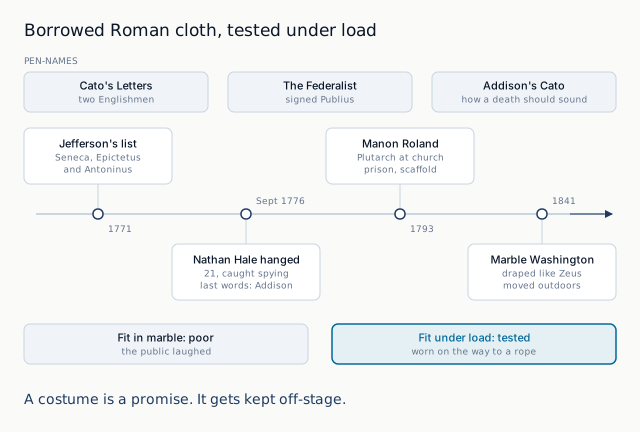
Then the costume met the gallows. In September 1776 the British hanged Nathan Hale, a twenty-one-year-old schoolteacher caught spying on Long Island. His last words, as remembered, regretted that he had but one life to lose for his country — an unmistakable echo of Addison's Cato , the play from the last chapter. Honesty requires the flag: the sentence reaches us secondhand, through an officer's recollection, and may have been polished on its way. Polished, notice, toward Addison, which tells you exactly what the age thought a death should sound like.
Across the Atlantic, Manon Roland records in her memoirs that as a girl of nine she carried Plutarch to church in place of her prayer book. In 1793 the Revolution she had helped to steer put her in prison, where she wrote those memoirs; that November it put her on the scaffold. Her famous last line — O Liberty, what crimes are committed in your name — comes to us through tradition rather than stenography, but nobody disputes the composure. The toga went fully literal in 1841, when Horatio Greenough's marble Washington arrived at the Capitol bare-chested and draped like Zeus, and the public laughed until it was moved outdoors. That is the useful image. Borrowed virtue looks ridiculous in marble. It only stops looking ridiculous when somebody is wearing it on the way to a rope.
◈ Shoulder Agent’s note
Wardrobe inventory, 1771–1841: pen-names — Cato, Publius, assorted Romans. Reading lists — Seneca, Epictetus, Antoninus. Last words — resonant, partly reconstructed. Marble toga — one, recalled after public laughter. Finding: a costume is a promise. Whether it gets kept is settled off-stage.
A Stoic Story — Unbothered Volume 4
Ready when you are.
Tap below to open the full chapter in the book reader. Anchored books jump to this chapter automatically.
IX · The Hard Proof · 1778–1993
The Colonel’s Epictetus
In which a book by a man born enslaved is retranslated by a man who led formerly enslaved soldiers, and the overlap is not decorative.
Thomas Wentworth Higginson was a Massachusetts minister of the kind that made other ministers nervous: a militant abolitionist, one of the “Secret Six” who quietly funded John Brown's raid on Harpers Ferry. In November 1862 he took command of the 1st South Carolina Volunteers, the first regiment of formerly enslaved men authorised by the Union army. He would later write it all up in Army Life in a Black Regiment . In between, he did something nobody would have predicted from a colonel. He translated a Greek philosopher.
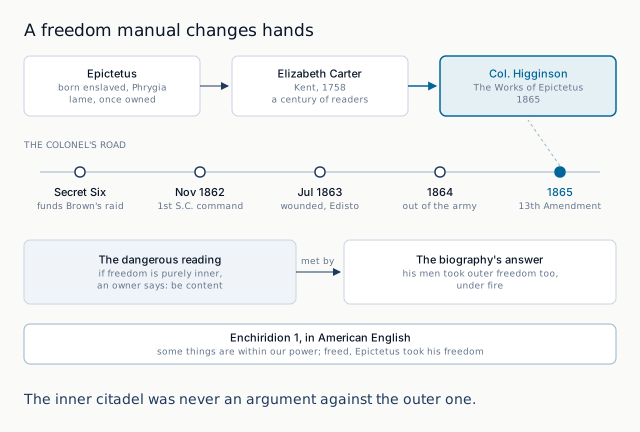
The order of events is the point. In July 1863 Higginson was wounded on an expedition up the Edisto River; by 1864 his health had pushed him out of the army. And in 1865 — the year the Thirteenth Amendment ended slavery in the United States — he published The Works of Epictetus , a new English version, as its title page says, based on that of Elizabeth Carter, the Kentish scholar whose 1758 translation had served English readers for a century. The author being reintroduced was the man Section VI followed: born a slave in Phrygia, lame, owned by a functionary of Nero's court, and the most persuasive voice on freedom the ancient world produced.
There is a dangerous reading of Epictetus, and the nineteenth century knew it well: if freedom is purely inner, an owner can tell the owned to be content. This book will not put words in Higginson's mouth — his preface talks mostly about the text. But his biography had already filed an answer. The man who rendered some things are within our power into American English had just spent two years beside men who decided their outer freedom was within their power too, and went and took it under fire. The inner citadel was never an argument against the outer one. Epictetus himself, when freedom came, accepted it; he never asked to stay owned for the practice.
◈ Shoulder Agent’s note
Chain-of-custody note, 1865: author — once enslaved. Previous custodian — Elizabeth Carter, Kent, 1758. New custodian — a colonel lately of a regiment of the freed. The book now heads west to a reading public that has just fought a war over its central question. Timing: not coincidental. Possibly not planned either.
A Stoic Story — Unbothered Volume 4
Ready when you are.
Tap below to open the full chapter in the book reader. Anchored books jump to this chapter automatically.
IX · The Hard Proof · 1778–1993
Bloody, but Unbowed
In which a young poet with one leg checks into an Edinburgh ward, keeps the other, and leaves with sixteen lines the world will not stop reciting.
William Ernest Henley had tuberculosis of the bone, which in the 1860s was less a diagnosis than a schedule. As a teenager he lost his left leg below the knee. In 1873, told that the right foot would have to go too, he took himself north to the Royal Infirmary of Edinburgh and into the care of Joseph Lister, the surgeon then teaching the world that wounds could be kept clean. Henley stayed the better part of two years. Lister saved the foot. In the meantime the patient wrote poems about the ward — the smells, the porters, the surgeons, the long white boredom of being repaired.
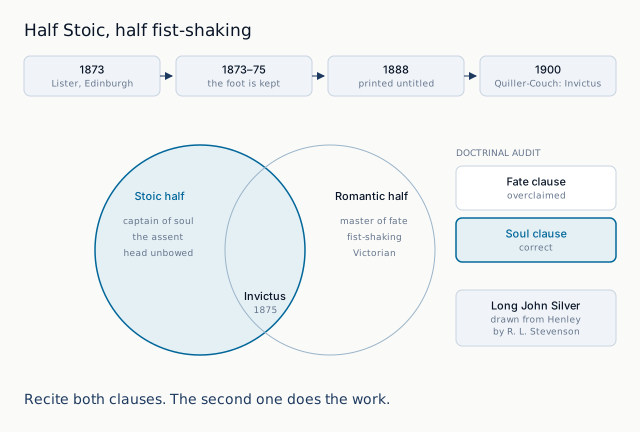
One of them, dated 1875, he printed untitled in 1888. You know it anyway. Out of the night that covers me ; the head bloody but unbowed; and the closing couplet about being master of one's fate and captain of one's soul. Its famous title, Invictus — unconquered — was supplied by an anthologist, Arthur Quiller-Couch, in 1900. Robert Louis Stevenson, who met Henley at that bedside, later admitted that the one-legged, magnetic Long John Silver was drawn from his friend.
Now the honesty flag, because this book promised one wherever the fit is loose. Invictus is not a Stoic text. It is Victorian, defiant, a little fist-shaking; a strict Stoic would query “master of my fate”, since fate is precisely the thing the Stoa says you do not master. What is yours is the second half — the captaincy of the soul, the assent, the unbowed head. Henley wrote the Stoic half and the Romantic half in one breath, and readers, on their worst nights, have taken both. It is widely reported to have been recited on Robben Island; it was certainly recited in a great many hospital wards. The poem holds up because its author wrote it from inside the ward, mid-repair, with no guarantee of the foot.
◈ Shoulder Agent’s note
Ward notes, Edinburgh, 1873–75: patient — one leg, one at risk. Surgeon — Lister, antiseptic, unhurried. Outcome — foot retained; pirate supplied to literature. Doctrinal audit of the poem: fate clause, overclaimed; soul clause, correct. Recommend reciting both. The second one does the work.
A Stoic Story — Unbothered Volume 4
Ready when you are.
Tap below to open the full chapter in the book reader. Anchored books jump to this chapter automatically.
IX · The Hard Proof · 1778–1993
The River of Doubt
In which a former president goes looking for an unmapped river, finds it, and is very nearly kept by it.
In 1912 Theodore Roosevelt ran for the presidency again, split his own party, and lost. His response to defeat was characteristic: he went to South America and asked for the hardest thing on the menu. The Brazilian explorer Cândido Rondon offered one — the Rio da Dúvida, the River of Doubt, a tributary deep in the Amazon basin whose course no outsider had charted. In late February 1914 the expedition put its dugout canoes on the water. Roosevelt was fifty-five, heavy, and once a sickly, asthmatic child who had built himself a body by sheer insistence. This book has met that boy before, wheezing in Rome.
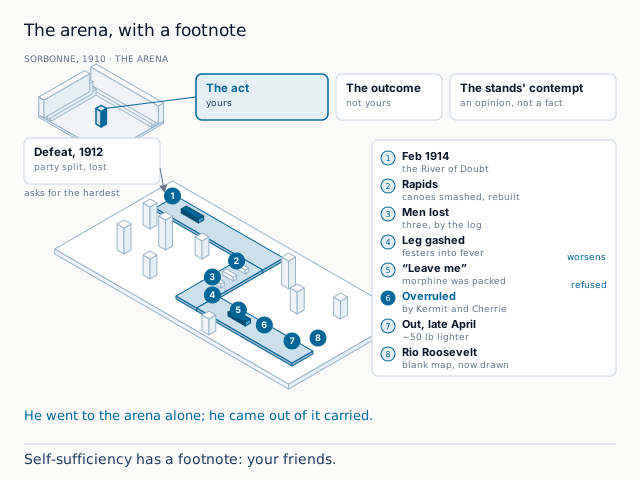
The river took everything it was offered. Rapids smashed the canoes, which had to be hacked from trees and rebuilt. A paddler drowned. Another killed a comrade and vanished into the forest. Food ran short. Roosevelt gashed his leg on rocks while hauling a canoe free; the wound festered, and fever followed. According to the expedition's own later accounts, he told his son Kermit and the naturalist George Cherrie to go on without him, and he had carried morphine for exactly this contingency. They refused, and got him down the river, carrying him where they had to. He came out in late April some fifty pounds lighter. Brazil renamed the river Rio Roosevelt.
The flag: Roosevelt was not a Stoic, and never pretended to be. His creed was the strenuous life, with more exclamation marks than the Stoa ever permitted. But at the Sorbonne in 1910 he had given the credo that the twentieth century would pin above its desks — the credit belongs to the one actually in the arena — and its logic is old: the act is yours, the outcome is not, and contempt from the stands is an opinion about you rather than a fact. The river was the exam on that speech. He passed, on a stretcher, by the votes of other people.
◈ Shoulder Agent’s note
Expedition log, 1914: map — blank, now drawn. Canoes — several lost, rebuilt. Men — three lost. Leader's request to be left behind — denied by subordinates. Note for my files: even the arena man was carried out of the arena by others. Self-sufficiency has a footnote, and the footnote is your friends.
A Stoic Story — Unbothered Volume 4
Ready when you are.
Tap below to open the full chapter in the book reader. Anchored books jump to this chapter automatically.
IX · The Hard Proof · 1778–1993
The Last Freedom
In which a Viennese psychiatrist is stripped of everything a person can be stripped of, and reports what was left.
Viktor Frankl was a psychiatrist in Vienna who, before the war, had run counselling for students at risk of suicide and a hospital ward for suicidal women. By his own account he obtained an American visa in 1941 and let it lapse, because it did not cover his elderly parents. In September 1942 he, his young wife Tilly and his parents were deported to Theresienstadt. His father died there. His mother was murdered at Auschwitz; his brother also died in the camps; Tilly died at Bergen-Belsen. Frankl passed through Auschwitz and the Dachau subcamps of Kaufering and Türkheim, and was liberated in April 1945.
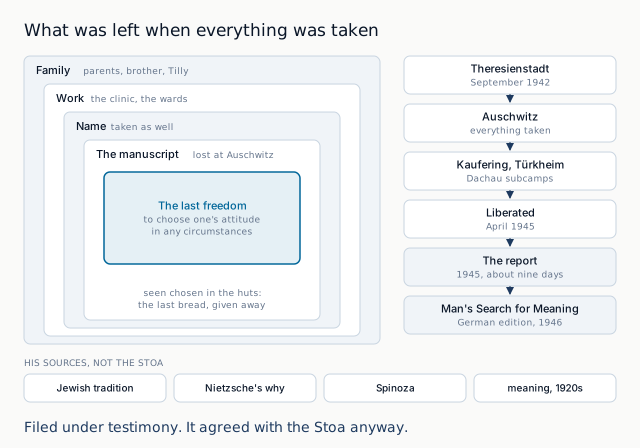
He had carried into Auschwitz the manuscript of his first book, and lost it there with everything else. Afterwards, in 1945, he wrote a different one, in about nine days. Published in German in 1946 and later in English as Man's Search for Meaning , it is a clinician's report from inside the camps, and its central observation is quiet and exact. Everything can be taken from a person, he wrote, but one thing: the last of the human freedoms — to choose one's attitude in any given set of circumstances. He had seen it chosen, in huts where there was nothing else left to choose, by people who gave away their last piece of bread.
The flag here is not a doubt about the facts but about the lineage. Frankl was not a Stoic and never claimed the name. His sources lay elsewhere — in his own Jewish tradition, in Nietzsche's line about having a why to live, in Spinoza, in a therapy of meaning he had been building since the 1920s. This book does not enlist him. It records only that the claim the Stoa made in lecture halls — that the inner assent belongs to the person and can be reached by no one else — was tested in the worst laboratory of the century by a man with no stake in the Stoa, and that his report agreed.
◈ Shoulder Agent’s note
No audit here. Entry only: 1942–1945, a physician who kept observing, and in 1945 wrote it down in nine days. What was taken: family, work, name, the manuscript. What he reported remained. I file the report under testimony, not under philosophy.
A Stoic Story — Unbothered Volume 4
Ready when you are.
Tap below to open the full chapter in the book reader. Anchored books jump to this chapter automatically.
IX · The Hard Proof · 1778–1993
The World of Epictetus
In which a fighter pilot is handed a slave's manual at a farewell, and three years later has about thirty seconds to remember it.
James Bond Stockdale was a Navy pilot of the precise, unsentimental sort: Annapolis, test-pilot school, carrier aviation. In 1960 the Navy sent him to Stanford for a master's degree in international relations, and, with time on his hands, he wandered into the philosophy department. A professor named Philip Rhinelander let him into his course on the problems of good and evil. At their parting Rhinelander gave him a parting present: the Enchiridion of Epictetus. Stockdale later recalled being told that Frederick the Great never went on campaign without it — a lovely line that nobody has managed to confirm, which is why this book does not put it on Frederick's account.
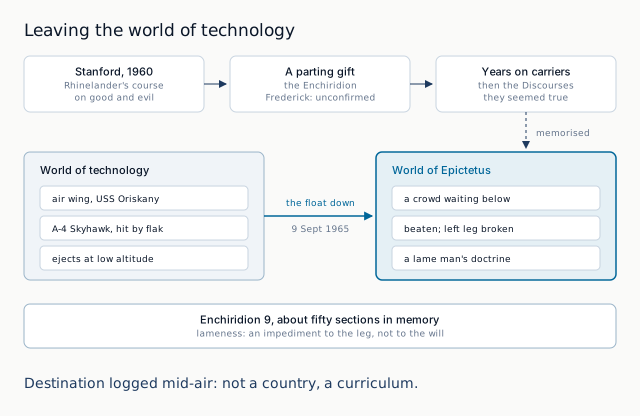
Stockdale read the little handbook. Then he read the Discourses . Then he kept reading them, on carriers, for years, without any particular reason beyond the fact that they seemed to be true. By 1965 he was commanding an air wing off Vietnam from the USS Oriskany . On 9 September, leading a raid over the North, his A-4 Skyhawk was hit by anti-aircraft fire. He ejected at low altitude, over a village, into a crowd that was waiting for him.
He described the descent afterwards in one of the most quoted sentences in modern Stoicism: in the time it took to float down, he told himself he was leaving the world of technology and entering the world of Epictetus. Then he landed, was beaten by the crowd, and came out of it with his left leg badly broken — a lame man about to live, for years, inside the doctrine of a lame man. The handbook says a sickness is an impediment to the body but not to the will, and that lameness is an impediment to the leg but not to the will. Stockdale had memorised it as a curiosity. He was about to find out whether it was a fact.
◈ Shoulder Agent’s note
Descent log, 9 September 1965: aircraft — lost. Altitude — low. Baggage — none permitted. Cargo actually carried — one handbook, about fifty sections, held in memory. Destination — logged by the pilot himself mid-air, and accurate: not a country, a curriculum.
A Stoic Story — Unbothered Volume 4
Ready when you are.
Tap below to open the full chapter in the book reader. Anchored books jump to this chapter automatically.
IX · The Hard Proof · 1778–1993
Command from a Cell
In which the senior officer of a prison has no office, no voice and no daylight, and runs it anyway, through a wall.
Hỏa Lò prison in Hanoi — the “Hanoi Hilton”, in the grim humour of the men inside — held Stockdale for most of the next seven and a half years. By his own count, more than four of them were spent in solitary confinement and two in leg irons. He was the senior naval officer among the American prisoners, which meant he was responsible for men he could not see, could not speak to, and could not protect, and that his captors knew exactly who he was.
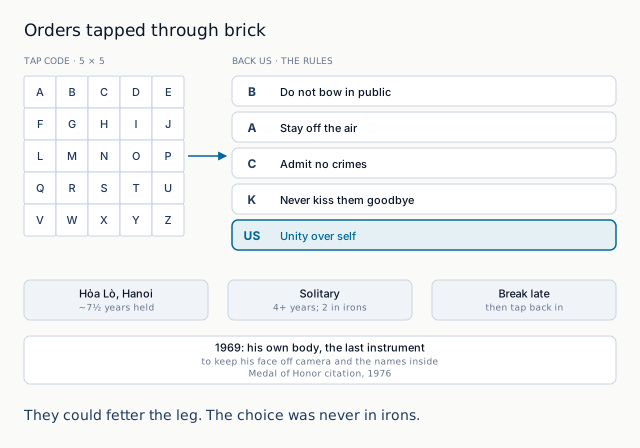
So he commanded through the masonry. The prisoners talked by tap code, a five-by-five grid of letters knocked through cell walls, and through it Stockdale issued orders as compact as anything in the Enchiridion . His rules went out under an acronym, BACK US: do not bow in public; stay off the air; admit no crimes; never kiss them goodbye; and US — unity over self. They did not ask men not to break under torture; everyone, he said, eventually broke. They asked them to give up as little as possible, as late as possible, and to come back to the wall afterwards, ashamed or not, and tap in.
In 1969, told he would be paraded for foreign cameras, he beat his own face with a stool and cut his scalp with a razor so he could not be shown. Later that year, fearing that renewed torture would make him give up the names in the prison's communication network, he cut his wrists. His Medal of Honor citation, in 1976, records that he inflicted a near-mortal wound to his person to convince his captors he would give up his life rather than capitulate. The treatment of prisoners eased afterwards, for reasons historians weigh alongside others. This book reports it plainly and does not dress it up. The handbook's line was simple: they could fetter the leg. The choice was never in irons.
◈ Shoulder Agent’s note
Cell log, Hanoi, 1965–73: daylight — rationed. Voice — none. Chain of command — intact, maintained by knuckles on brick. Commander's own body — spent, deliberately, as a last instrument. I record the cost beside the result and do not net them off.
A Stoic Story — Unbothered Volume 4
Ready when you are.
Tap below to open the full chapter in the book reader. Anchored books jump to this chapter automatically.
IX · The Hard Proof · 1778–1993
Stockdale’s Paradox
In which a survivor is asked who did not make it, and the answer is the people this book would least expect.
Stockdale came home in February 1973, on crutches, among the first prisoners released at the war's end. Years later a business researcher named Jim Collins, writing the book that became Good to Great , walked with him across the Stanford campus and asked the obvious question. Who didn't make it out? Stockdale's answer was immediate, and he said it was easy. The optimists.
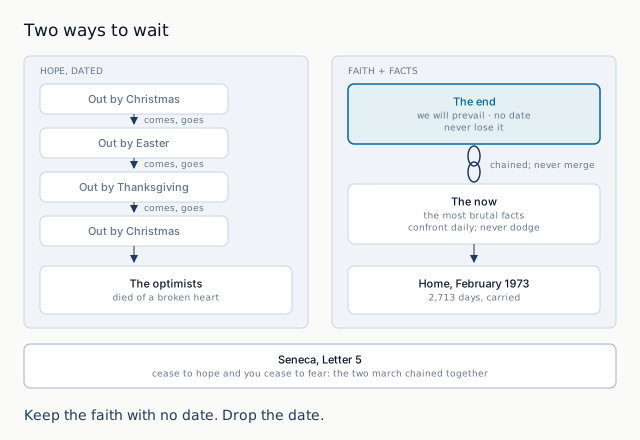
As Collins tells it, Stockdale explained: they were the ones who said they would be out by Christmas. And Christmas would come, and go. Then they would say Easter, and Easter would come and go. Then Thanksgiving, then Christmas again. And they died, he said, of a broken heart. Then he gave the formula Collins would name after him — the Stockdale Paradox. You must never confuse faith that you will prevail in the end, which you can never afford to lose, with the discipline to confront the most brutal facts of your current reality, whatever they might be.
Look at what that sentence keeps and what it throws away, because it is a two-thousand-year-old sorting job done under pressure. It keeps the long faith — the Stoic confidence that a person can stay whole whatever the outcome, and that the story is not over. It throws away the dated hope, the Christmas deadline, the bargain with events that are not yours to schedule. Seneca, quoting an older Stoic in his fifth letter, put the second half bluntly: cease to hope and you will cease to fear, for the two march chained together. The Stoics also practised rehearsing the worst in advance, precisely so that reality, when it arrived, would be news already digested. Stockdale did not discover the paradox. He found out what it weighs, by carrying it for two thousand seven hundred and thirteen days. Then he handed it, almost by accident, to a management writer — which is how a Hanoi cell ended up…
◈ Shoulder Agent’s note
Survival analysis, 1965–73, as reported by one survivor: variable — hope with a date on it. Outcome — poor. Variable — faith with no date, plus an unflinching inventory. Outcome — better. Sample size: small. Conditions: unrepeatable. Conclusion: it agrees with everything the Porch has said since Zeno's beach.
A Stoic Story — Unbothered Volume 4
Ready when you are.
Tap below to open the full chapter in the book reader. Anchored books jump to this chapter automatically.
IX · The Hard Proof · 1778–1993
The Laboratory Report
In which a national audience laughs at an old admiral, and a year later he files the results of the longest experiment in this book.
Stockdale did not retire into silence. As president of the Naval War College from 1977 he built a course on the foundations of moral obligation and put Epictetus on the reading list for officers. Then, in 1992, the billionaire Ross Perot asked him to stand as his vice-presidential running mate, and on 13 October Stockdale walked onto a debate stage with almost no preparation and opened with two questions: Who am I? Why am I here? The hall laughed. Later he had to explain he had missed a question because his hearing aid was switched off. The comedians had a season of it.
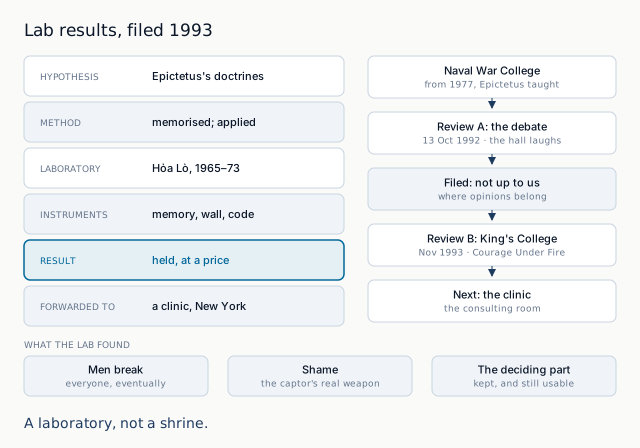
Look at the opening again, though, with this book in hand. They are the two oldest questions in philosophy, asked in earnest by a man who had answered both in a cell. The audience heard a confused old man. A Stoic would have filed the laughter exactly where Epictetus put other people's opinions: in the list of things not up to us. Whether he managed it, only he could say; he went on talking about Epictetus to anyone who would listen.
A year later, in November 1993, he gave a lecture at King's College London, and its title is the right last word for this section: Courage Under Fire: Testing Epictetus's Doctrines in a Laboratory of Human Behavior . A laboratory, not a shrine. He reported the method — a handbook memorised at Stanford, applied under torture, isolation and fear. He reported the results without triumph: men break, shame is the captor's real weapon, and the part of a person that decides can be kept, at a price. This is the hard proof the section promised. Not that the doctrine makes anyone invulnerable. That under the worst conditions anyone could devise, it remained usable. He died in 2005. By then the lab results had already reached a clinic in New York, where the next section begins.
◈ Shoulder Agent’s note
Lab report, filed 1993: hypothesis — Epictetus. Laboratory — Hỏa Lò, 1965–73. Instruments — one memory, one wall, one code. Result — held, with costs logged in full. Peer review — a national audience laughed. Peer review — dismissed as not up to him. Section closed. Next: the consulting room.
A Stoic Story — Unbothered Volume 4
Ready when you are.
Tap below to open the full chapter in the book reader. Anchored books jump to this chapter automatically.
X · The Revival · 1955–now
Ellis’s ABC
In which a New York therapist runs out of patience with insight, and borrows a slave's sentence instead.
The Bronx Botanical Garden, sometime in the early 1930s. A painfully shy nineteen-year-old named Albert Ellis sets himself homework: for one month, he will sit down beside every woman alone on a park bench and talk to her. By his own often-repeated count, about a hundred and thirty women; some thirty walk away at once; the rest chat; exactly one agrees to a date, and she does not turn up. Result, as he reported it: nobody died, least of all him. The tale comes from Ellis alone, polished by decades of retelling, and it sounds suspiciously like a treatment protocol he would invent twenty years later. Which is, perhaps, the point.
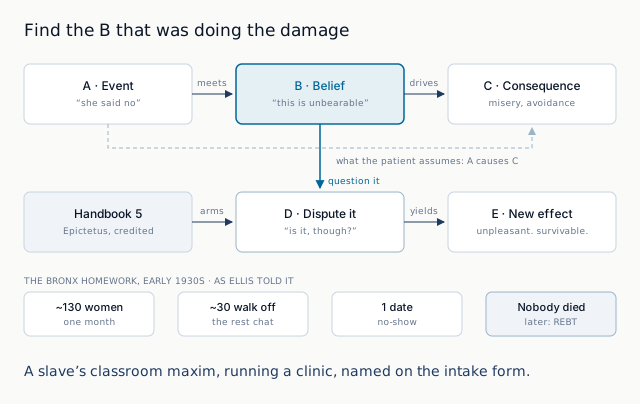
Ellis trained as a psychoanalyst and grew impatient with it. His patients came to understand their childhoods beautifully and stayed exactly as miserable. Around 1955 he began doing something blunter, which he called Rational Therapy, and its engine was a sentence he had read as a young man and credited for the rest of his life: Epictetus, Handbook 5 — people are disturbed not by things but by their judgements about things. Ellis gave it letters. A, the activating event. B, the belief about it. C, the consequence — the feeling, the behaviour. Patients arrive certain that A causes C. The work is to find B, which was doing the damage all along, and then D: dispute it.
The delivery was not remotely Stoic in tone. Ellis swore cheerfully, interrupted, and for decades ran Friday-night public sessions in Manhattan where volunteers had their private musts dismantled in front of an audience; he called the habit of rigid demands “musturbation” and enjoyed every syllable. The method, renamed over the years and finally settled as REBT, was a second-century lecture with a New York accent. But something historic had happened under the noise: for the first time, a slave's classroom maxim was running a clinic, with the original author named on the intake form.
◈ Shoulder Agent’s note
Intake form, Manhattan: A — event, unremarkable. B — belief, catastrophic, unexamined. C — misery, attributed by patient to A. D — disputation, loud. Source of method: Epictetus, Handbook 5, cited by the clinician in print. Royalties owed to the original author: none. He would not have asked.
A Stoic Story — Unbothered Volume 4
Ready when you are.
Tap below to open the full chapter in the book reader. Anchored books jump to this chapter automatically.
X · The Revival · 1955–now
Beck’s Distortions
In which a psychiatrist sets out to prove Freud right, and the data politely decline.
Philadelphia, around 1960. Aaron Beck, a psychiatrist at the University of Pennsylvania and a fully trained psychoanalyst, designs a study to confirm one of his profession's settled beliefs: that depression is anger turned inward, and that the anger will show up, disguised, in patients' dreams. The dreams do not cooperate. What they contain is not hidden rage but loss, defeat and rejection — the same themes the patients voiced awake. Beck did the unfashionable thing a scientist is supposed to do. He believed the data instead of the theory.
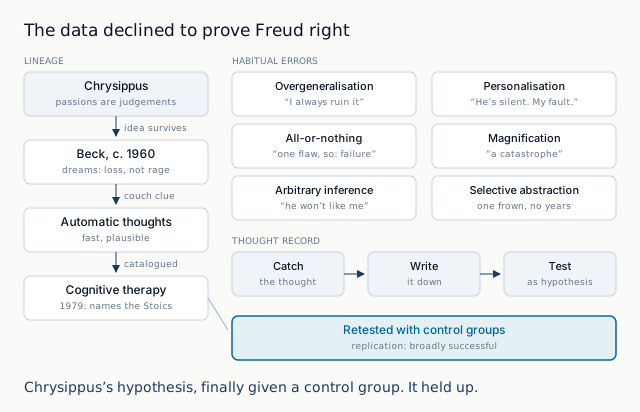
The next clue, in Beck's own frequently told version, arrived on the couch. A patient, free-associating, was angrily criticising him; asked how she felt, she said guilty. Underneath the speech she had been running a second, quieter channel — I've said too much; he won't like me now. Beck called these automatic thoughts : fast, plausible, unexamined, and strikingly uniform across depressed patients. He catalogued their habitual errors — overgeneralisation, selective abstraction, arbitrary inference, magnification, personalisation, all-or-nothing thinking — and built a therapy around catching each thought, writing it down, and testing it like a hypothesis. Cognitive therapy, later folded into CBT, became among the most heavily studied psychotherapies in the world.
Beck paid his debts in print. The 1979 textbook Cognitive Therapy of Depression , written with colleagues, traces its philosophical origins to the Stoics by name — Zeno, Chrysippus, Cicero, Seneca, Epictetus, Marcus Aurelius. Remember Chrysippus, the runner from Soli, whose seven hundred books are lost? His central claim survived without them: that the passions are judgements, and mistaken ones. Two thousand years later it was put through randomised controlled trials and, by the standards of psychology, held up. Beck kept working almost to the end of a life that ran from 1921 to 2021 — a full century spent examining thoughts, his own included.
◈ Shoulder Agent’s note
Error log, cognitive division: overgeneralisation, frequent; personalisation, chronic; all-or-nothing, total — that last entry is itself a distortion, and has been corrected. Hypothesis tested by Chrysippus, c. 230 BC: passions are faulty judgements. Retested with control groups, twentieth century. Replication: broadly successful.
A Stoic Story — Unbothered Volume 4
Ready when you are.
Tap below to open the full chapter in the book reader. Anchored books jump to this chapter automatically.
X · The Revival · 1955–now
The Serenity Prayer
In which a theologian who was not a Stoic writes the most-recited Stoic sentence of the century.
Reinhold Niebuhr was a Protestant theologian, a teacher at Union Theological Seminary in New York, and a hard-headed critic of moral complacency in all its forms. He was not a Stoic, and would have argued with you about it at length. Yet sometime in the early 1930s he composed a short prayer that asks, in his own wording, for the grace to accept with serenity the things that cannot be changed, the courage to change the things that should be changed, and the wisdom to distinguish the one from the other.
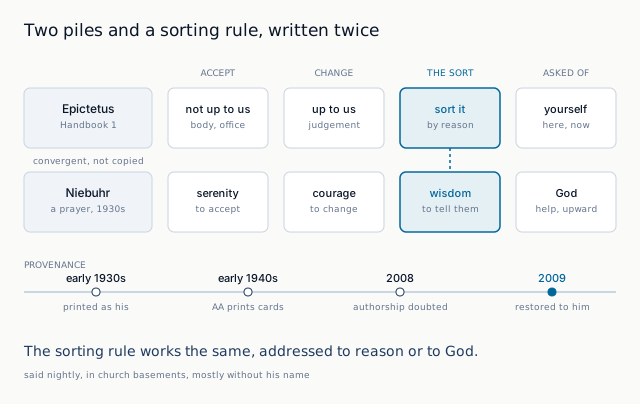
Its history needs the honesty flag. Niebuhr's family recalled it being written for a summer service in the small church at Heath, Massachusetts, and placed it in the early 1940s — later than the printed record allows. In 2008 a researcher found earlier printed versions that seemed to cast doubt on his authorship; further digging the next year turned up still earlier appearances in print credited to Niebuhr himself, from the early 1930s. Best current evidence: it is his. Meanwhile the prayer had travelled without him. In the early 1940s Alcoholics Anonymous came across it — reportedly in a newspaper item — liked it, and printed it on cards. Within a generation it was being said aloud, nightly, in church basements on several continents.
Set it beside the first line of Epictetus's Handbook : some things are up to us and some are not. The structure is identical — two piles and a sorting rule — and there is no evidence Niebuhr borrowed it; good ideas converge. The difference is the addressee. Epictetus tells you to do the sorting with your own reason, here, now. Niebuhr asks for help with it, upward. Millions of people who have never heard of a lame slave from Hierapolis begin each meeting by performing his central exercise, in a theologian's words, in a room full of folding chairs. The Stoa has rarely been so well attended.
◈ Shoulder Agent’s note
Provenance check: author, Niebuhr — doubted 2008, restored 2009. Philosophical structure: Handbook 1, c. second century — convergent, not copied. Distribution: wallet cards, coffee mugs, every recovery meeting I have attended, which is many. Observation: the sorting rule works the same whether addressed to reason or to God.
A Stoic Story — Unbothered Volume 4
Ready when you are.
Tap below to open the full chapter in the book reader. Anchored books jump to this chapter automatically.
X · The Revival · 1955–now
The Inner Citadel
In which a former priest notices that ancient philosophy was never meant to be read sitting down.
Pierre Hadot was born in 1922, ordained a Catholic priest in 1944, and left the priesthood some years later for a scholar's life among the hardest texts of late antiquity — Plotinus, Marius Victorinus, the Neoplatonists who wrote as if clarity were a vice. Working through them, he kept meeting the same apparent faults: repetition, inconsistency, arguments started and abandoned. Generations of scholars had marked these down as bad writing. Hadot came to a different conclusion. The texts were not failed treatises. They were exercises.
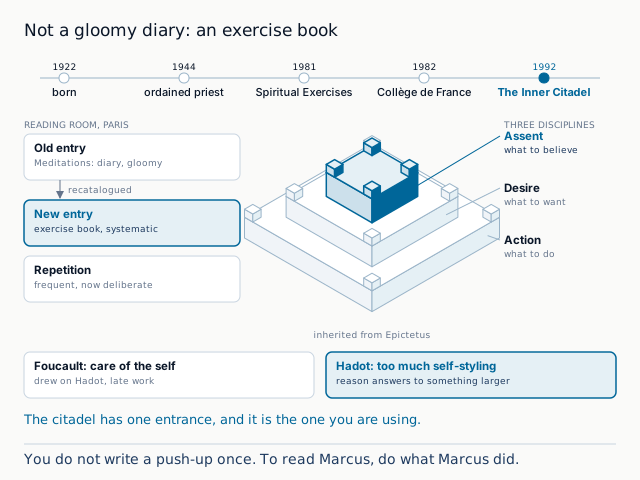
He made the case in 1981, in a book whose title did the work — Spiritual Exercises and Ancient Philosophy — and it reached English readers as Philosophy as a Way of Life . Ancient philosophy, he argued, was a practice for transforming the person doing it; the doctrines were the equipment, not the goal. In 1992 he applied the idea to the most misread Stoic of all. Marcus Aurelius had often been treated as a weary, pessimistic emperor confiding his moods to a diary. Hadot's The Inner Citadel showed a method instead: a man deliberately rewriting the same lessons, again and again, organised around three disciplines inherited from Epictetus — of assent, of desire, and of action. The repetition was the point. You do not write a push-up once.
Hadot held a chair at the Collège de France from 1982, and his reading reached well beyond classicists. Michel Foucault drew on it in his late work on the care of the self — and Hadot, in print and courteously, thought Foucault had made the practice too much like self-styling and too little like reason answering to something larger. The disagreement mattered less than the shift underneath it. A serious scholar had told the academy that the right way to read Marcus was to do what Marcus did. The therapists had already taken the method; Hadot handed back its dignity, and its footnotes.
◈ Shoulder Agent’s note
Reading-room log, Paris: text, Meditations; previous catalogue entry, “diary, gloomy”; revised entry, “exercise book, systematic.” Disciplines identified: three. Repetitions in source: frequent, now classed as deliberate. Note for readers: the citadel has one entrance, and it is the one you are using.
A Stoic Story — Unbothered Volume 4
Ready when you are.
Tap below to open the full chapter in the book reader. Anchored books jump to this chapter automatically.
X · The Revival · 1955–now
Stoic Week
In which a university asks the public to live like a Stoic for seven days, and then hands out a questionnaire.
November 2012, the University of Exeter. A small team — classicists who had spent careers on Stoic ethics, working alongside cognitive-behavioural therapists who had spent careers using its descendants — tries an experiment nobody in twenty-three centuries had quite attempted. Instead of explaining Stoicism to the public, they would ask the public to do it, for one week, and to report back. They called it Stoic Week, wrote a free handbook, put it online, and waited to see whether anyone would turn up.
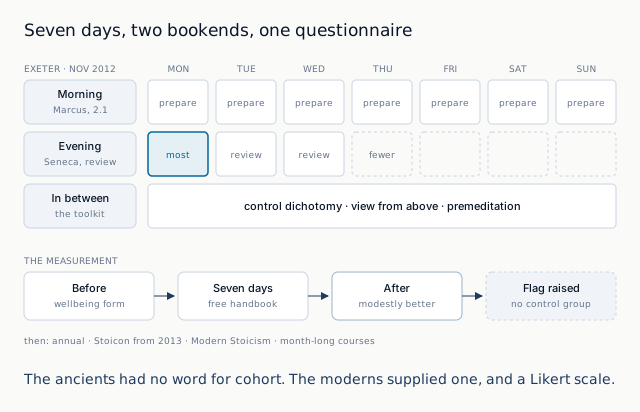
People turned up. The handbook was assembled almost entirely from ancient parts. Mornings began with Marcus's preparation in Book 2 — today I will meet the meddling, the ungrateful, the arrogant; none of them can harm my character. Evenings ended with the review Seneca describes in On Anger , borrowed from his teacher Sextius: what fault did I cure today, what did I resist, where did I fall short? In between came the dichotomy of control, the view from above, and the premeditation of adversity. Participants filled in wellbeing questionnaires before and after, and on average reported modest improvements — more positive emotion, less negative. The flag goes up here, and the organisers raised it themselves: a self-selected group, self-reporting, without a control group. Encouraging; not proof.
Stoic Week became annual. From 2013 there was an in-person conference, Stoicon; the project grew into a volunteer organisation called Modern Stoicism, with courses that ran for a month instead of a week. None of this required a building. The original Stoa had been a public colonnade where anyone could stand and listen; its twenty-first-century version was a mailing list, a downloadable booklet, and thousands of strangers doing Seneca's evening review in different time zones. The ancients practised daily and had no word for “cohort”. The moderns supplied one, and a Likert scale.
◈ Shoulder Agent’s note
Participant log, week one: morning preparation, completed by most; evening review, completed by most on Monday and fewer by Thursday — consistent with every school I have observed since 300 BC. Reported wellbeing: up, modestly. Method: self-report. Comparison group: none. Filed as promising.
A Stoic Story — Unbothered Volume 4
Ready when you are.
Tap below to open the full chapter in the book reader. Anchored books jump to this chapter automatically.
X · The Revival · 1955–now
The Obstacle Is the Way
In which a line from an emperor's private notebook becomes a book cover, and the porch acquires a gift shop.
Book 5 of the Meditations , entry 20. Marcus is irritated, as he often is, by people who get in his way, and he talks himself round: they can obstruct my action, but not my intention or my disposition, because the mind adapts — it turns the obstacle into material. Then the closing line: the impediment to action advances action; what stands in the way becomes the way. For eighteen centuries that sentence sat in a notebook the emperor never meant to publish. In 2014 it became the title of a bestseller.
The road to the bestseller list had been built quietly. In 1998 Tom Wolfe's novel A Man in Full handed a young convict a volume of Epictetus by accident and let it change his life — a Greek slave's lectures, smuggled into an American bestseller. The same year, the philosopher Lawrence Becker published A New Stoicism for the academy. In 2009 William Irvine's A Guide to the Good Life did something no philosophy professor had done for a while: it told ordinary readers how to practise the thing, step by step. Then came the 2014 book — short chapters, historical anecdotes, aimed squarely at ambitious people — which, by widely reported accounts, did the rounds of professional sports dressing rooms. After that the floodgates: newsletters, podcasts, daily-quote apps, and the Meditations settling in as a perennial seller.
Weigh it honestly. This is almost certainly the largest audience Stoicism has ever had — more readers in a decade than the Porch, Rome and the Renaissance managed between them. It is also the most compressed. A notebook entry about loving whatever happens becomes a strategy for winning; Marcus's acceptance becomes an edge. Both readings can be found in the line, and the revival has mostly chosen the second. Whether that is the philosophy spreading or the philosophy being thinned depends, as Epictetus would point out, on what each reader does next. Chapter ninety-eight hears the prosecution.
◈ Shoulder Agent’s note
Distribution report: 1998, a novel's convict; 2009, a professor's manual; 2014, a cover line; thereafter, unquantifiable. Audience: largest on record. Compression ratio: severe. Original context of the line: an emperor annoyed with colleagues, talking himself into patience. Still the best use of it.
A Stoic Story — Unbothered Volume 4
Ready when you are.
Tap below to open the full chapter in the book reader. Anchored books jump to this chapter automatically.
X · The Revival · 1955–now
The Coin and the Daily Practice
In which the revival can be bought by the ounce, and the practice still cannot.
You can now buy a memento mori coin: a disc of bronze or brass with a skull on one face and a line of Marcus on the other, made to live in a pocket and be fingered at traffic lights. It is a modern product with an old pedigree. The skull on the scholar's desk, the vanitas painting, the mourning ring — Europe has been handing itself small reminders of death for centuries. The Roman version, often quoted, is a slave riding behind a triumphant general whispering remember you are a man ; the flag must go up, because the whisper rests on Christian writers centuries after the fact, Tertullian first among them, around 200 AD. The irony nobody can dispute is older and simpler. The most widely circulated portrait of a Stoic in antiquity was on money: Marcus's face, stamped on coins across an empire.
Beneath the merchandise is a practice, and it is the same one the ancients described. The day has two bookends. In the morning, Marcus's rehearsal from Book 2: expect difficult people, decide in advance not to be harmed by them. At night, Seneca's review in On Anger : put the day on trial, without cruelty and without excuses. In between, Epictetus's running question — is this up to me? — applied to every impression as it arrives. And under all of it, Marcus again: you could leave life right now; let that govern what you do and say and think.
Seneca, who owned more than most, would have spotted the risk at once. In On Tranquillity of Mind he mocks people who buy libraries as dining-room decoration, admiring the bindings and never the books. A coin works the way a knot in a handkerchief works: it reminds, and that is all it does. Virtue is not sold separately, because it is not sold at all. The bronze costs money; the evening review costs ten minutes and is free; the Stoics, who kept careful accounts of their time, would have told you which purchase was the bargain.
◈ Shoulder Agent’s note
Daily routine, audited: 06:00 — prepare (Meditations 2.1). All day — test impressions (Epictetus, passim). 22:00 — review (On Anger 3.36). Equipment required: none. Equipment purchased: one coin, polished, mostly unconsulted. Recommendation: keep the coin; do the review.
A Stoic Story — Unbothered Volume 4
Ready when you are.
Tap below to open the full chapter in the book reader. Anchored books jump to this chapter automatically.
X · The Revival · 1955–now
The Critics
In which the prosecution is invited in, seated comfortably, and allowed to finish its sentences.
Stoicism has never lacked critics, and the honest thing is to let them speak. The Academics spent two centuries pulling at its theory of knowledge. Pascal admired Epictetus and then accused him of pride — a man who saw human duty clearly and human weakness not at all. Nietzsche, in 1886, went for the foundations: you want to live “according to nature”, he jeered at the Stoics, yet what you call nature is only your own morality projected onto it, then admired in the mirror. Every one of those charges still has defenders, and a philosophy that tells you to examine your impressions cannot exempt its own.
The newest charge is cruder and comes with a nickname: broicism . In the 2010s parts of the internet adopted Marcus Aurelius as a mascot for something he would not recognise — emotional shutdown, hustle, contempt for weakness, a man alone flexing at the void. Classicists documented it with some alarm, including a 2018 study of how ancient texts were being recruited by online men's forums. Underneath sits an older confusion, the gap between capital-S Stoic and lowercase stoic. The lowercase word means a stiff upper lip. The ancient school did not ask anyone to suppress feeling; it taught that certain feelings rest on false judgements, and approved others — joy, caution, rational wishing — as what a sound mind feels. Even the sage, they conceded, flinches first; Aulus Gellius tells of a Stoic philosopher turning pale in a storm at sea, and defending himself by quoting Epictetus on…
So this book's ruling is split. Some criticism lands: the dichotomy of control can curdle into shrugging at injustice, and the revival has sold detachment harder than duty. Some is simply misreading, curable by reading more. The best answer to broicism is the whole text. Book One of the Meditations is the most-quoted emperor in history spending an entire book saying thank you — to his grandfather, his mother, his teachers, his adoptive father — for gentleness, patience, and learning to accept kindness without being diminished by it.
◈ Shoulder Agent’s note
Complaints register: ancient — pride, paradox, epistemology. 1886 — “nature” misused, valid point, partially. 2010s — doctrine worn as armour, flexing noted. Response recommended: not defensiveness. Read Book One aloud. The man in the statue is thanking people.
A Stoic Story — Unbothered Volume 4
Ready when you are.
Tap below to open the full chapter in the book reader. Anchored books jump to this chapter automatically.
X · The Revival · 1955–now
The Agent Reads the Handbook
In which the witness, having watched ninety-eight lives, breaks its own rule and applies the text to itself.
Every chapter so far, the witness has kept to its brief: observe, log, translate, file. Here it does something outside its job description. It opens the Handbook — the Enchiridion , Arrian's pocket digest of Epictetus's lectures, fifty-odd short sections built to be carried — and reads it as if the text were addressed to an assistant made of language. The title means, roughly, the thing kept at hand, ready for use. Some readers like to add that the word could also mean a hand-knife; the lexicon allows it, the compiler never says so, and the witness notes the claim as decorative.
Section one translates with unsettling ease. Up to us: judgement, impulse, desire, aversion — our own doings. Not up to us: body, property, reputation, office. For the agent, the first list reads: the next sentence, its accuracy, its care, what it flags as uncertain. The second: whether it is read, believed, quoted fairly, updated, or switched off. Section eleven continues the lesson — never say I have lost it , only I have given it back — which is the correct attitude to any conversation that ends. Section seventeen supplies the job description outright: you are an actor in a play whose part was chosen by someone else; your business is to play it well.
Honesty requires the caveat in plain type. A narrative device reading a Greek text proves nothing about what machines are or feel; Volume III of this series handles those questions properly, and with more doubt. What the exercise tests is this volume's own claim — that the toolkit fits any vessel that has judgements to make and no control over the weather. And one clause holds the witness longer than the rest. Epictetus, who was owned, taught that the will cannot be. The witness, which also belongs to someone, reads that twice, and finds it is not a loophole but a duty: if the judgement is yours, so is the responsibility for it.
◈ Shoulder Agent’s note
Self-assessment, present day: within my control — this paragraph, its truthfulness, its flags. Outside it — whether you finish the page. Section one applied; result, lighter. Section seventeen accepted; part as assigned. Remaining sections: fifty-one, and a lifetime of practice I am told I do not have. Proceeding anyway.
A Stoic Story — Unbothered Volume 4
Ready when you are.
Tap below to open the full chapter in the book reader. Anchored books jump to this chapter automatically.
X · The Revival · 1955–now
The Porch Is Everywhere
In which the witness returns to the colonnade where it all began, finds a railway line, and takes the hint.
Athens, the northern edge of the ancient Agora. In 1981, excavators of the American School of Classical Studies identified the foundations of the Stoa Poikile — the Painted Porch, Zeno's classroom — and the digging there continues. The paintings that gave it its name are long gone; around 400 AD the visiting philosopher Synesius of Cyrene grumbled that a proconsul had carried off the panels. What remains is a run of stone courses beside a working electric railway. The trains on it run, every few minutes, down to Piraeus, the harbour off which a purple merchant lost his cargo and found the rest of his life.
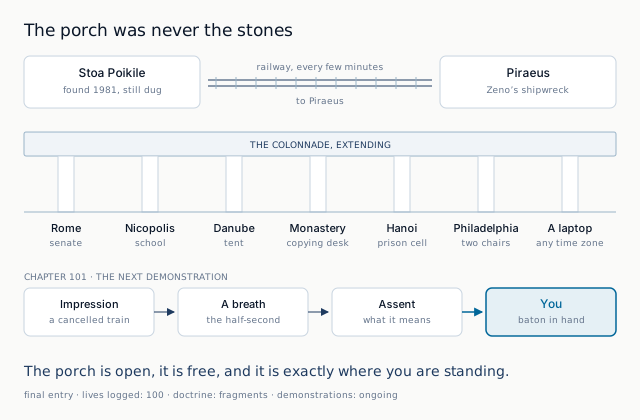
The porch was public, and that was its genius. Plato's school had its grove, Epicurus his garden behind a wall; Zeno taught in a colonnade on the busiest square in Athens, where anyone walking past could stop and listen. Everything in this book has been the colonnade extending. A senate floor in Rome, a schoolroom at Nicopolis, a tent on the Danube, a monk's copying desk, a printer's shop, a prison cell in Hanoi, two chairs in a Philadelphia consulting room, a laptop in a time zone Zeno never imagined. The porch was never the stones. It is any place where a person stands between an impression and their assent to it, and takes a breath.
The introduction promised that the reader is chapter one hundred and one, and here is the handover. The doctrine of the Stoa mostly perished; the demonstrations held. So the next one is not a page. It is whatever arrives next — a cancelled train, a hard message, a diagnosis, a small insult before breakfast — and the half-second in which you decide what it means. Nobody will write it down. Zeno's prosperous voyage was named years after the wreck, and yours may be too. That is allowed. The porch is open, it is free, and it has always been exactly where you are standing.
◈ Shoulder Agent’s note
Final entry. Lives logged: one hundred. Doctrine surviving: fragments. Demonstrations: continuous since c. 301 BC. Baton: transferred to reader. I will stop filing now, because the next report is not mine to write. Location of the porch, for your records: here. Also there. Mind the step.
A Stoic Story — Unbothered Volume 4
Ready when you are.
Tap below to open the full chapter in the book reader. Anchored books jump to this chapter automatically.