The Authority Book
How a 100-entry book wins clients
A field guide for consultants, coaches, agencies and expert-led firms on writing a 100-entry branded book that does the selling before the first meeting: niche, entries, structure, AI-assisted production, design, editions, launch and the sales conversation. 100 chapters across 10 parts, one diagram per chapter.
Preface
How to read this one.
A field guide for consultants, coaches, agencies and expert-led firms on writing a 100-entry branded book that does the selling before the first meeting: niche, entries, structure, AI-assisted production, design, editions, launch and the sales conversation. 100 chapters across 10 parts, one diagram per chapter.
- ↓ Scroll vertically for the 100-chapter journey.
- → Swipe horizontally on any chapter for its plate + details.
- ✦ Random Chapter and Random Book pinned to the footer.
Contents
tap a chapter to jump
100 chapters.
The Handshake Before the Meeting
The Authority Book — How a 100-entry book wins clients
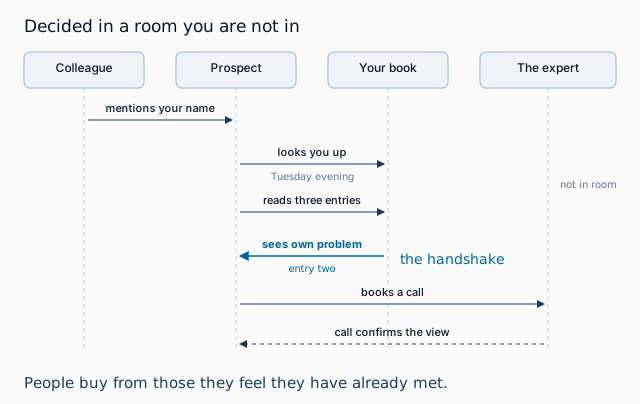
Most buying decisions are made in a room you are not in. A prospect hears your name from a colleague, looks you up on a Tuesday evening, reads whatever you have left lying about on the internet, and forms a view. By the time they book a call, the call is mostly a confirmation. You are not pitching; you are being checked against an impression that has already set.
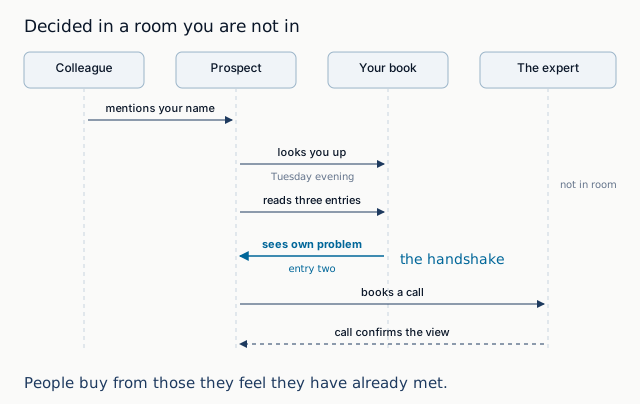
This is uncomfortable for experts, who tend to believe that if they could only get in front of the right person, their competence would speak for itself. It would, too. The trouble is the getting in front. Competence is invisible until someone has spent time with it, and nobody spends time with a stranger's competence unless something has given them a reason to.
A book is that reason. Not a book in the sense of a hardback sitting in an airport, though it can become one, but a structured, generous body of your thinking that a buyer can explore before they ever speak to you. A hundred entries, each one useful, each one in your voice, each one quietly demonstrating that you have been here before. The prospect reads three entries over coffee and recognises their own problem in the second. That recognition is the handshake. The meeting merely follows it.
This guide is about building that book deliberately: choosing the niche, finding the hundred entries, structuring them, producing them with AI agents without sanding off your voice, designing them, putting them into several editions, launching them, and using them in the conversations that actually pay your bills. It is written for consultants, coaches, agencies and the many small firms whose product is, in the end, a person who knows things.
You can test the principle this week without writing a word of the book. Look at the last five clients who signed with you quickly and ask what they had read, watched or heard of yours before the first call. Then look at the five who took months and ask the same question. The pattern is usually blunt. The fast ones arrived pre-introduced. The slow ones had to be introduced in the meeting, which is the most expensive place to do it.
None of this requires you to become a celebrity, a thought leader, or anyone who uses the phrase thought leader without wincing. It requires you to write down what you know, in an order that helps, and to put it where your buyers can find it. That is a smaller task than it sounds, and a larger asset than it looks. The meeting is where the deal is signed. The book is where it is decided.
The Authority Book — How a 100-entry book wins clients
Ready when you are.
Tap below to open the full chapter in the book reader. Anchored books jump to this chapter automatically.
Brochures Are Read Once
The Authority Book — How a 100-entry book wins clients
Every firm has a brochure, even if it is now called a capabilities deck or a services page. It lists what you do, who you have done it for, and a few phrases about passion and partnership. It is read once, by someone already half-interested, and then it is filed in the same mental drawer as every other brochure they have ever been sent.
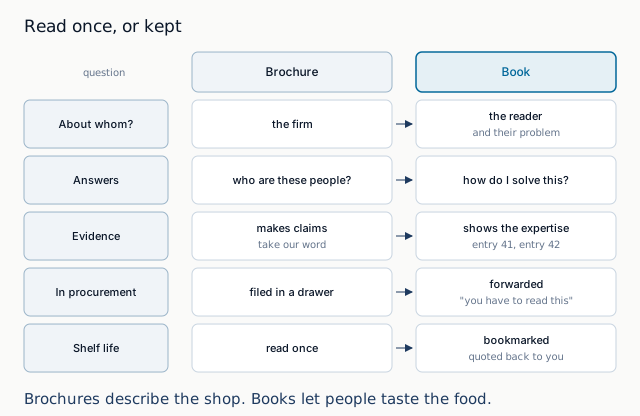
The reason is simple. A brochure is about you. It answers the question who are these people? , which is a question the buyer is only mildly curious about. A book is about the reader. It answers the question how do I solve this? , which is the question keeping them up at night. One gets skimmed. The other gets bookmarked, forwarded, and quoted back to you in the first meeting.
There is a further difference in what each format can carry. A brochure can make claims. It can say we are experts in supplier negotiation . A book can show the expertise: entry forty-one on the three clauses suppliers always try to remove, entry forty-two on what to do when they succeed. The buyer does not need to take your word for anything because the evidence is in front of them, and they have tested it against their own experience while reading.
This is why a book survives procurement in a way a brochure rarely does. When a buyer has to justify a choice to a committee, they forward the thing that makes them look good for having found it. Nobody forwards a brochure with the subject line you have to read this . People do forward an entry that explains their exact problem better than they could.
You will still need a services page. People need to know what to buy and how. But stop expecting it to do the persuading. Its job is to be found after the persuading has happened, as the practical next step for someone who has already decided you know what you are talking about.
Here is a useful exercise for this week. Take your current brochure or services page and count the sentences that are about the reader's problem rather than your firm. Most people find the ratio is somewhere near one in five. Then take the best paragraph about the reader's problem and ask whether it could be expanded into a standalone entry of five hundred words that someone would read for its own sake. If it can, you have found the first of your hundred. If it cannot, you have found the reason your brochure does so little. Brochures describe the shop. Books let people taste the food.
The Authority Book — How a 100-entry book wins clients
Ready when you are.
Tap below to open the full chapter in the book reader. Anchored books jump to this chapter automatically.
Why a hundred? Not ten, which is a blog post, or thirty-seven, which is a number nobody chose on purpose? The honest answer is partly psychological and partly practical, and both parts work in your favour.
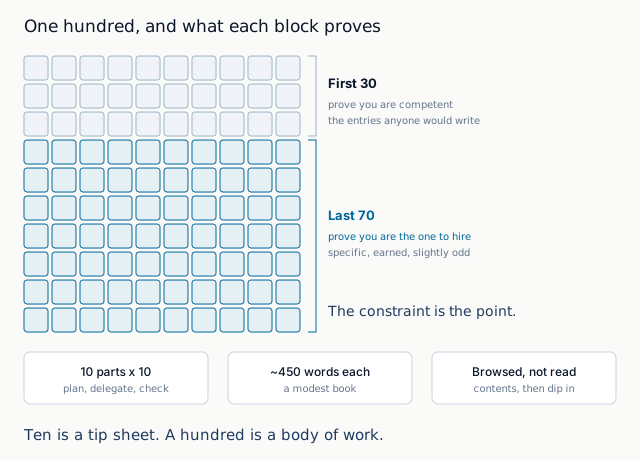
Psychologically, a hundred signals completeness. A Top 10 is a teaser; a Top 100 is a reference. When a buyer sees that you have a hundred distinct, useful things to say about their problem, they infer, correctly, that you have thought about it for a long time. The number does some of the persuading before a single entry is read. It is a little like a restaurant with a long wine list: you may only order one glass, but you trust the cellar.
Practically, a hundred is the size at which a book stops being read and starts being browsed. Nobody sits down to read a hundred entries in order, and that is fine. They read the contents, find the three that match their week, and dip in. Next month they come back for two more. A book that rewards browsing gets opened far more often than one that demands to be read cover to cover, and each opening is another moment of contact with your thinking.
It also gives you a production shape. Ten parts of ten entries is a grid you can plan, schedule, delegate and check. You know at any moment how far along you are. You can write one part a week, or one a day if you have done the groundwork. You can spot a thin part at a glance. The structure carries you through the middle of the project, which is where most books go to die.
There are objections. A hundred feels like a lot. It is less than it feels. At four to five hundred words per entry, it is the length of a modest non-fiction book, and most experts have said every word of it already, in meetings and emails and on calls. A hundred can also look like padding if the entries are thin. That is a real risk, and much of this guide is about avoiding it. Every entry must teach one thing a reader could use this week. If you cannot find a hundred such things, your niche may be too narrow, and that is useful information too.
So commit to the number before you start. Do not hedge with around a hundred or a hundred or so . The constraint is the point. It forces you to dig past the obvious twenty entries everyone in your field would write, into the specific, earned, slightly odd knowledge that only you have. That is where the authority lives. The first thirty entries prove you are competent. The last seventy prove you are the one to hire.
The Authority Book — How a 100-entry book wins clients
Ready when you are.
Tap below to open the full chapter in the book reader. Anchored books jump to this chapter automatically.
Generosity as Positioning
The Authority Book — How a 100-entry book wins clients
The first fear most experts have about writing a book is that they will give away the secret sauce. If the method is all in print, why would anyone pay for it? It is a reasonable worry and almost entirely unfounded.
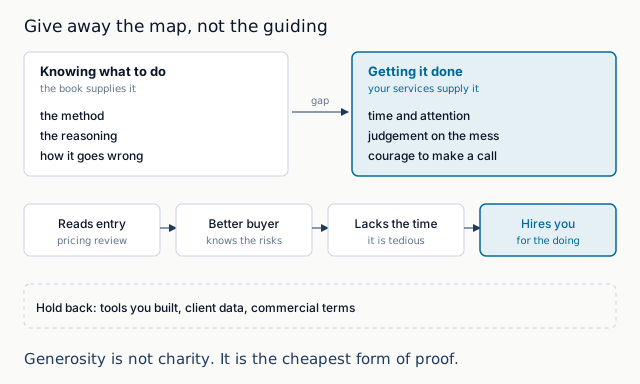
Consider how professional services are actually bought. Nobody hires an accountant because they lack access to tax rules; the rules are published. They hire one because applying the rules to their own messy situation is tedious, risky and outside their competence. The same is true of almost every field. Knowing what to do and getting it done are separated by time, attention, judgement and the courage to make a call. Your book supplies the first. Your services supply the rest.
In fact, giving the method away tends to increase demand for the implementation. A reader who works through your entry on running a pricing review now understands why pricing reviews matter, what a good one looks like, and how many ways it can go wrong. They are better informed, which makes them a better buyer. They also realise they do not have the time to do it properly. You have, in effect, written their business case for them.
There is a positioning effect too. In a crowded market, the firm that explains most clearly is assumed to understand most deeply. Generosity reads as confidence. A competitor who keeps everything behind a sales call looks, by comparison, either unsure of their method or anxious about being copied. Neither is a good look.
That does not mean you must publish every template, price sheet and client file. Hold back what is genuinely proprietary: specific tools you have built, client data, the commercial details of how you work. But be generous with the thinking. The thinking is what demonstrates that you are worth hiring, and it is the part competitors cannot really copy, because it only works when applied with the judgement that produced it.
A practical test for this week: list the five questions prospects most often ask you on first calls. For each, ask whether answering it fully in writing would cost you a sale or win you one. Most people find that four of the five are questions they answer for free on calls anyway, at great cost in time. Writing them down once, properly, lets you stop answering them live and start the call further along.
The experts who worry most about giving things away are often those with the least to give. If your knowledge would be exhausted by a hundred entries, the book will tell you so. If it would not, the book will tell your buyers. Either way you learn something. Generosity is not charity. It is the cheapest form of proof there is.
The Authority Book — How a 100-entry book wins clients
Ready when you are.
Tap below to open the full chapter in the book reader. Anchored books jump to this chapter automatically.
The Invisible Expert
The Authority Book — How a 100-entry book wins clients
Most expertise is invisible, and not because experts are shy. It is because expertise lives in places that cannot be seen from outside: in the head of the person who has it, in hundreds of emails sent to individual clients, in calls nobody recorded, in decisions that were obvious to the expert and therefore never explained.
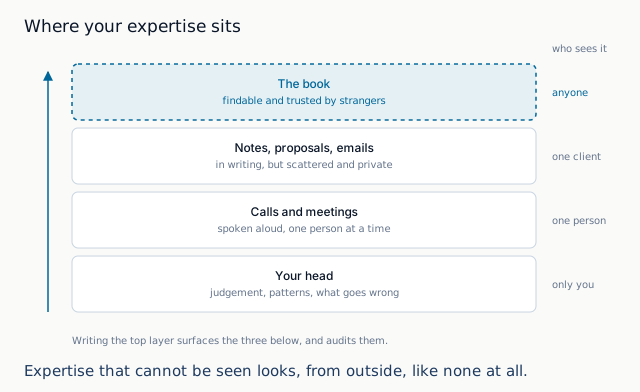
Think of where your own knowledge currently sits. At the bottom, in your head, is the most valuable layer: the judgement, the pattern recognition, the sense of what usually goes wrong. Above that, slightly more visible, are your calls and meetings, where some of it gets spoken aloud to one person at a time. Above that are your notes, proposals and emails, which capture fragments in writing but are scattered and private. And then, for most experts, there is nothing on top. No layer that a stranger could find, read and learn from.
The result is a curious unfairness. Two consultants may be equally capable, but the one who has written things down will be perceived as more capable, because only that one can be assessed without a meeting. The other is relying on referrals and luck. Referrals are lovely. They are also not a strategy, and they tend to dry up exactly when you need them.
A book is the top layer. It takes what is buried in the lower three and brings it to the surface in a form that strangers can find and trust. It does not create expertise you do not have. It makes visible the expertise you do have, which is, for most people reading this, considerably more than the market currently knows about.
There is a pleasant side effect. Writing the top layer clarifies the lower ones. Experts often discover, halfway through the book, that they hold views they had never quite articulated, or that two of their standard recommendations contradict each other. The book becomes an audit of your own thinking, and you come out of it sharper in meetings as well as more visible outside them.
This week, try a small excavation. Open your sent folder and search for the longest email you wrote to a client in the last three months. Read it as a stranger would. Ask what it reveals about how you think, and whether anyone other than that one client has ever seen it. Most people find something worth publishing in the first search. That email was expertise doing its job in private. The book is where it starts doing its job in public, for everyone you have not met yet. Visibility is not vanity. It is simply making sure the right people can find what you already know.
The Authority Book — How a 100-entry book wins clients
Ready when you are.
Tap below to open the full chapter in the book reader. Anchored books jump to this chapter automatically.
Proof You Can Hold
The Authority Book — How a 100-entry book wins clients
There is an old sales maxim that people believe what they can touch. It is not quite true, since most of us believe plenty of things we cannot touch, but it points at something real. Evidence that exists as an object carries more weight than evidence that exists as a claim.
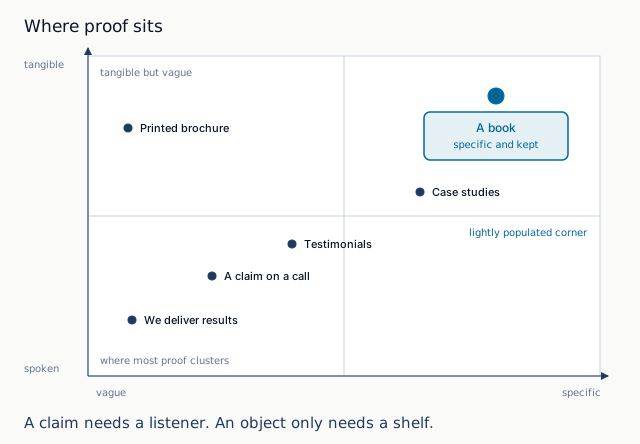
Plot the ways experts try to prove themselves on two axes. One axis runs from vague to specific: from we deliver results to here is exactly how we fixed onboarding for a forty-person firm . The other runs from intangible to tangible: from words in a meeting to something the buyer can keep, forward and come back to. Most proof clusters in the vague, intangible corner. Testimonials are slightly better. Case studies are better still. A book sits in the far corner, specific and tangible at once, and that corner is lightly populated.
The tangibility matters even when the book is digital. A PDF in someone's downloads folder, a web reader they have bookmarked, an app on their phone: these are objects in the buyer's world that persist after you have left the conversation. They can be shown to a colleague. They can be checked again before a decision. A claim made on a call evaporates by the next meeting. A book stays where it was put.
Print takes this further. A physical copy on a desk is the oldest credibility device there is, and it still works, perhaps better than ever now that so little arrives by post. It is not that a printed book is more true than a PDF. It is that someone clearly thought it was worth the trouble of making, and that signal is hard to fake.
Specificity is the other half. A book that stays at the level of principles is tangible but vague, which puts it in the same box as a nicely printed brochure. The proof is in the detail: the named failure mode, the worked example, the number of steps, the question to ask on day three. Readers trust specificity because it is expensive to fake. Anyone can say they understand procurement. Only someone who has been in the room can describe the moment when the finance director goes quiet.
So when you plan your book, check every entry for both qualities. Is it something a reader could hold on to and come back to? Does it say something specific enough that only a practitioner could have written it? If an entry fails either test, it is a claim dressed as proof.
This week, gather every form of proof you currently offer prospects and place each on those two axes. Notice how empty the specific-and-tangible corner is. That emptiness is your opportunity. Fill it with a hundred things worth keeping, and you will no longer have to ask anyone to take your word for it.
The Authority Book — How a 100-entry book wins clients
Ready when you are.
Tap below to open the full chapter in the book reader. Anchored books jump to this chapter automatically.
Format Lends, Content Keeps
The Authority Book — How a 100-entry book wins clients
A book borrows authority from the format before a word has been read. That is useful and slightly unfair, and it is worth being clear-eyed about both halves of the sentence.
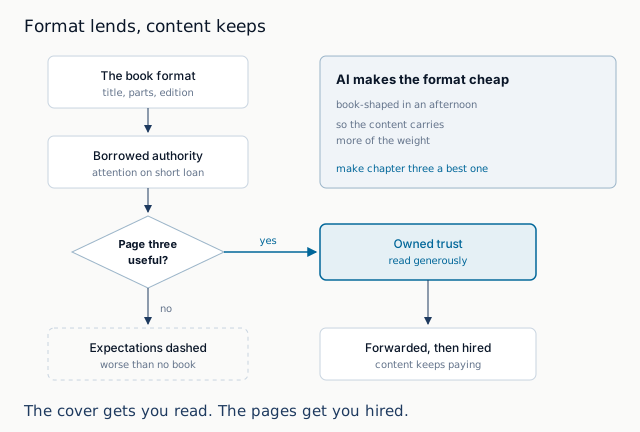
The format lends. People have been trained for centuries to treat books as serious. A book implies an author who sat down and thought something through, an editor who checked it, a structure that was planned rather than improvised. Calling your collection of advice a book, giving it a title, a contents page, parts and an edition date, triggers that inherited respect. A blog with the same hundred posts would not. It is the same words in a different jacket, and the jacket matters.
But the format only lends; it does not give. The borrowed authority buys you attention, and attention is a loan with short terms. Within a few pages, the reader decides whether the content matches the jacket. If the entries are thin, generic or obviously padded, the book format makes things worse, not better, because it raised expectations that were then disappointed. A weak book is more damaging than no book, in the same way a bad suit is worse than a decent jumper.
Content keeps. If the reader finds, on page three, something they had not thought of and can use, the borrowed authority converts into owned trust. From then on they read generously, assume competence, and forward the book to colleagues. The format opened the door. The content is what lets you stay in the room.
This is why the rest of this guide spends far more time on entries, structure and voice than on covers and layouts. Design matters, and there is a part on it, but design is in service of content. A beautiful book of empty advice is a beautiful brochure, and we have already discussed what happens to brochures.
It is also why AI-assisted production, which this guide encourages, comes with a warning. Agents can produce book-shaped objects very quickly. They can produce the format in an afternoon. What they cannot produce, without your knowledge feeding them, is content worth keeping. The faster the format becomes, the more the content carries the weight. That is not a reason to avoid the tools. It is a reason to be ruthless about what you put into them.
A useful check this week: pick any business book on your own shelf that you never finished. Ask what made you stop. It is rarely the cover or the typeface. It is usually that the book promised more than the pages delivered, and you noticed somewhere around chapter three. Your readers will notice at the same point. Make sure that chapter three is one of your best. Formats are rented. Trust is bought outright.
The Authority Book — How a 100-entry book wins clients
Ready when you are.
Tap below to open the full chapter in the book reader. Anchored books jump to this chapter automatically.
What a Book Does to a Pipeline
The Authority Book — How a 100-entry book wins clients
Ask any expert what slows their sales and you will hear a familiar list: too many calls that go nowhere, too much time explaining the basics, prospects who do not understand the value until the third meeting, decisions that drift for months. A book does not fix all of these. It quietly improves most of them.
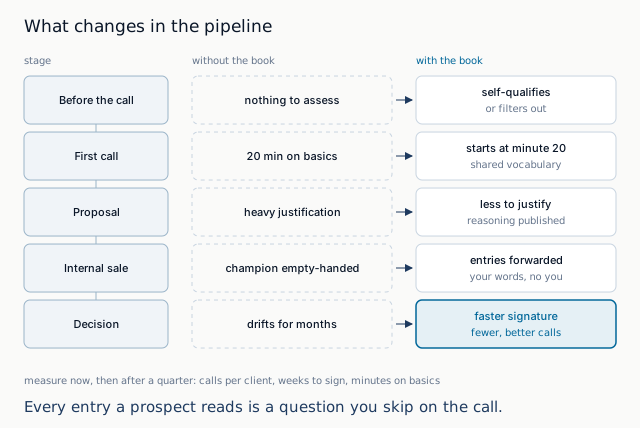
It qualifies. A prospect who has read a few entries and still books a call is already partly sold on your approach. One who read a few entries and disagreed has filtered themselves out, which saves both of you an hour. Over time, the calls you take become more likely to convert, because the book has done some of the sorting before the calendar invite was sent.
It shortens the explanation. Much of a first meeting is usually spent establishing shared vocabulary: what you mean by a diagnostic, why you start with interviews, what a good outcome looks like. If the buyer has read entries on each of these, you can skip ahead. Calls start at minute twenty. Proposals need less justification because the reasoning has been published.
It speeds decisions. Buyers rarely decide alone. They have to explain the choice to a partner, a board or a finance director. A book gives them something to forward that makes the case on your behalf, in your words, without you in the room. The internal sale, which is where many deals stall, gets easier when the champion has good material to work with.
None of these effects is dramatic on its own. You will not see a sudden flood of signed contracts the week the book goes live. What you will see, over a few months, is a gradual change in the texture of your sales conversations. People arrive using your language. They reference entries by name. They ask better questions. The ratio of calls to clients improves, and the calendar has fewer meetings that should have been emails.
To see this happen, you need to be able to notice it. Before the book exists, write down three things about your current pipeline: roughly how many first calls it takes to win a client, roughly how long from first call to signature, and roughly how much of a typical first call is spent on basics. You do not need precise figures. A rough honest guess is enough to compare against later.
Then, after the book has been in circulation for a quarter, ask the same three questions. If nothing has changed, something is wrong with the book or with how it is being used, and later parts of this guide will help you find out which. If things have changed, you will know the book is earning its keep. A pipeline is mostly friction. A good book is mostly lubricant.
The Authority Book — How a 100-entry book wins clients
Ready when you are.
Tap below to open the full chapter in the book reader. Anchored books jump to this chapter automatically.
This guide is written for a fairly specific kind of business, and it is worth being honest about the edges. A hundred-entry book is a serious undertaking, even with good tools, and it pays best where certain conditions hold.
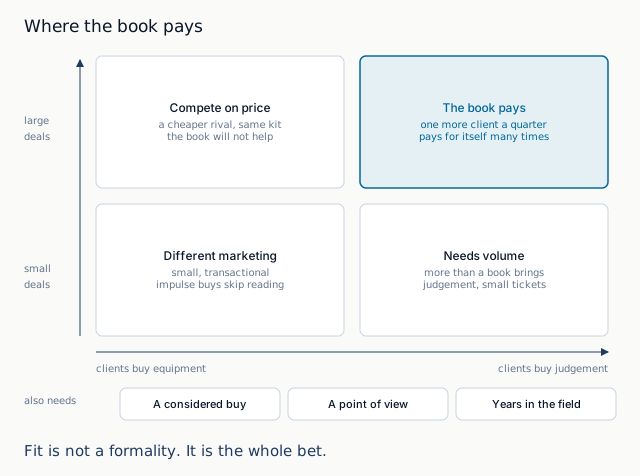
It suits people whose product is their expertise. Consultants, obviously. Coaches who work with leaders or teams rather than selling generic motivation. Agencies that differentiate on how they think, not just what they make. Accountants, lawyers, architects, recruiters and specialist firms of a dozen kinds whose clients are, in the end, buying judgement. If what you sell could be replaced by a cheaper competitor with the same equipment, a book will not help much. If what you sell is your way of seeing a problem, a book is the most efficient way of showing it.
It suits businesses where each client is worth a meaningful amount. If a single engagement keeps you going for weeks or months, then winning even one extra client a quarter because of the book makes it worthwhile many times over. If your typical sale is small and transactional, you will need volume the book cannot easily deliver, and a different kind of marketing will serve you better.
It suits businesses with a long or considered buying process. The more a buyer researches before deciding, the more chances the book has to be part of that research. Impulse purchases do not involve reading.
It suits people willing to hold a point of view. A book of carefully neutral advice, offending nobody and committing to nothing, will be ignored. If you have opinions about how your field should work, and you are prepared to put them in writing, you have the raw material. If you would rather not, a book will feel like a chore and read like one.
Who should not bother? Anyone hoping the book will substitute for a weak offer. Anyone who has not yet worked with enough clients to have a hundred useful things to say; a year or two more in the field will produce a better book. Anyone who wants to be famous rather than hired, since this guide is about winning clients, not followers. And anyone unwilling to read and edit what their tools produce, because the book will carry their name whether they read it or not.
If you recognise yourself in the first group, keep going. Take ten minutes this week to write down, in one sentence, what clients pay you for that they could not easily get elsewhere. If the sentence comes easily, the book will too. If it does not, that sentence is the first thing to work on, and it would be the first thing to work on even if you never wrote a book. Fit is not a formality. It is the whole bet.
The Authority Book — How a 100-entry book wins clients
Ready when you are.
Tap below to open the full chapter in the book reader. Anchored books jump to this chapter automatically.
The Asset That Keeps Working
The Authority Book — How a 100-entry book wins clients
Most marketing evaporates. A post is seen for a day, a talk is remembered for a week, a campaign runs for a month and then stops when the budget does. The effort is real, the return is real, but nothing is left behind once the activity ends. You are paying rent on attention.
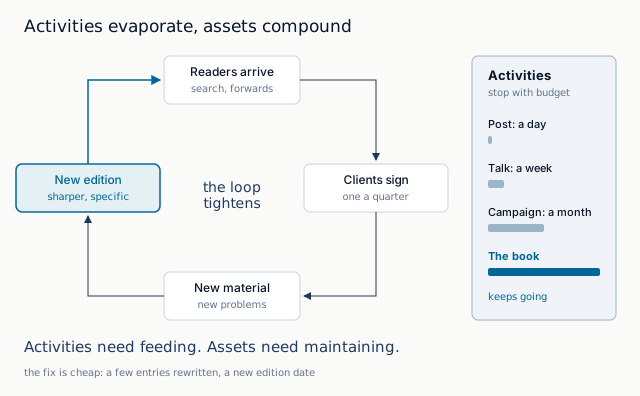
A book is different because it is an asset rather than an activity. Once written, it keeps working without further effort. A prospect finds it next spring through a search you have forgotten about. A client forwards it to a former colleague who has just moved to a firm that needs you. An entry gets quoted in someone else's newsletter. None of this requires you to do anything on the day it happens. The work was done once and is now being repaid in instalments.
It also compounds. Each client the book helps you win becomes a source of new material: a fresh problem, a new example, a refinement of an entry that turned out to be slightly wrong. Feed those back into a refreshed edition, and the book gets better and more specific to your market each year. Better books attract better clients, who generate better material. The loop tightens.
Compare this with the alternative most experts default to, which is a steady stream of posts and articles. These have their place, and later chapters show how to use the book to feed them. But on their own they never accumulate into anything a buyer can assess as a whole. A hundred posts scattered over two years are not a hundred-entry book. They are a hundred separate first impressions, most of which nobody saw.
The compounding only happens if you keep the book alive. A book that is written, launched and then never touched will slowly date. References go stale, examples feel old, and readers start to notice that the edition says a year that is no longer this one. The fix is cheap: a short, scheduled refresh, a few entries rewritten, a new edition date, and a reason to tell people about it again. This guide returns to the refresh habit near the end, because it is where the real value of the asset sits.
For now, a small shift in thinking is enough. This week, look at the marketing time you spent last month and divide it into two piles: work that will still be doing something for you in a year, and work that has already stopped. Most people find the second pile much larger. The point of the book is to tilt that ratio, not by working harder but by putting effort into something that stays put. Write it once, look after it, and let it go on shaking hands while you are busy doing the work it won you.
The Authority Book — How a 100-entry book wins clients
Ready when you are.
Tap below to open the full chapter in the book reader. Anchored books jump to this chapter automatically.
Narrow Enough to Be Chosen
The Authority Book — How a 100-entry book wins clients
The most common mistake in planning an authority book is writing it for everyone. It feels safe. A book on better leadership or growing your business has an enormous potential audience, and surely a few of them will become clients. They will not, because a book for everyone is a book nobody recognises as being for them.
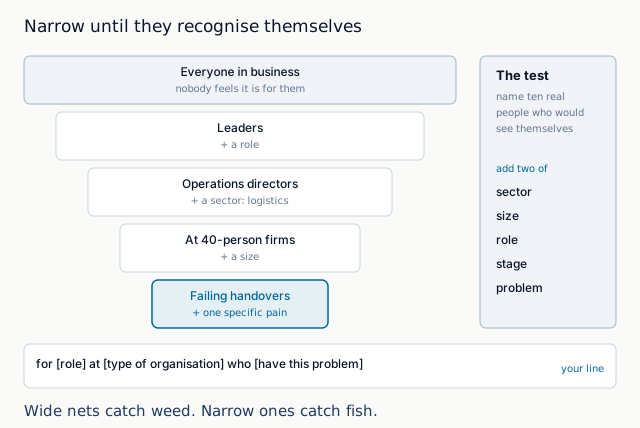
Buyers are looking for a match. When an operations director at a forty-person logistics firm searches for help, she is not looking for leadership advice. She is looking for someone who understands why her shift handovers keep failing and what to do on Monday. A book called The Shift Handover: 100 Fixes for Logistics Operations will get her attention in a way that Leading High-Performing Teams never will, even if the second book contains the same advice somewhere in chapter sixty.
Narrowness feels like giving up readers. It is actually a way of gaining the right ones. The size of your market does not matter much when you only need a handful of clients a year. What matters is that the people who could become clients feel, on first sight, that this was written for them. That feeling is the difference between a book that sits in a downloads folder and one that gets read on the train home.
There is a practical benefit too. A narrow niche makes the hundred entries easier to find. Generic advice runs out quickly, and you end up writing variations of the same five ideas. Specific problems have specific sub-problems, each with its own detail. A book on supplier negotiation for independent restaurants can go much deeper than a book on negotiation, because you know who is at the table, what they are buying and how they get squeezed.
How narrow is narrow enough? A useful test: could you name ten real people who would immediately recognise themselves as the reader? Not types of people, actual names. If you can, the niche is probably right. If you find yourself writing business owners or leaders or anyone who wants to grow , keep narrowing. Add a sector, a size, a role, a stage, or a specific problem. Usually two of those are enough.
You may worry that a narrow book will limit the work you can take on. In practice it rarely does. A book on one niche positions you as an expert, and experts get asked about adjacent problems all the time. The logistics director will hire you for the handover problem and then ask about rostering. The book gets you in; your competence widens the door.
This week, write your niche as a single line in this shape: for [role] at [type of organisation] who [have this problem] . Then cut whichever part is vaguest and replace it with something more specific. You can always write a second book for the neighbours. Being chosen requires being recognisable first.
The Authority Book — How a 100-entry book wins clients
Ready when you are.
Tap below to open the full chapter in the book reader. Anchored books jump to this chapter automatically.
The Reader Is the Buyer
The Authority Book — How a 100-entry book wins clients
Experts tend to write for other experts. It is natural: those are the people whose respect they want, whose work they read, and whose critique they fear. The result is books full of nuance, jargon and careful qualifications that impress peers and lose clients.
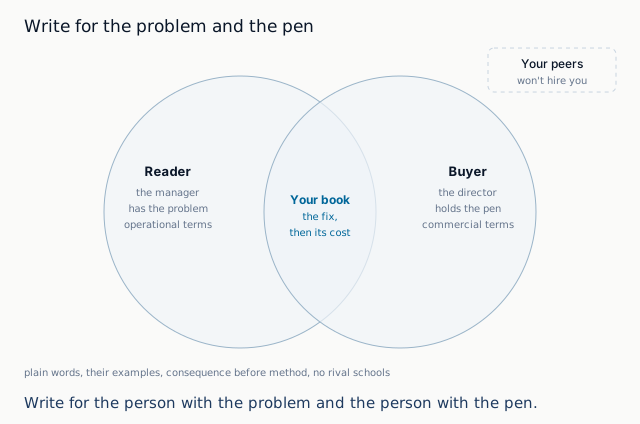
Your peers are not going to hire you. Your buyers are. And buyers are usually not experts in your field; that is precisely why they need you. They are experts in their own field, intelligent, busy and slightly impatient, and they want to understand their problem well enough to make a decision about it. Write for them.
That means a few concrete changes. Define terms the first time you use them, or better, choose words that need no definition. Lead with the consequence the reader cares about before the method you care about. Use examples from their world, not yours: the operations director's shift handover, not the theory of organisational communication. Cut the paragraph where you defend your approach against a rival school of thought that the reader has never heard of.
It also means being honest about who signs. In many firms, the person who reads your book is not the person who approves the budget. The reader might be a manager who has the problem; the buyer might be a director who controls the spend. The best authority books speak to both, by framing problems in operational terms and consequences in commercial ones. Entry thirty can explain how to fix the handover; its last paragraph can mention what the failures were costing in overtime.
There is a risk of overcorrecting into simplicity. Buyers are not children. They can handle complexity when it is relevant to them, and they notice when they are being talked down to. The aim is clarity, not dilution. You can say difficult, precise things in plain language, and the effort of doing so tends to sharpen the thinking as well as the prose.
One way to stay on the right side of this line is to write with a specific person in mind. Not a persona with a stock photo and an invented name, but a real client you have worked with and liked. Imagine them reading each entry. Would they understand it without asking you? Would they find it useful? Would they forward it? If the answer to any of these is no, rewrite.
Your peers may, in fact, read the book and find it a bit obvious in places. Let them. Peers rarely notice that obviousness to an expert is revelation to a buyer, and they are not your market. Try this week: take one paragraph you have written for clients recently and show it to someone outside your field. Ask them to underline any word they would not use themselves. Those underlines are the distance between you and your buyer. Close it.
The Authority Book — How a 100-entry book wins clients
Ready when you are.
Tap below to open the full chapter in the book reader. Anchored books jump to this chapter automatically.
Writing the Promise Line
The Authority Book — How a 100-entry book wins clients
Every authority book needs a promise line: one sentence that says what the reader will get from it. Not a mission statement, not a tagline, not a list of topics. A promise. After reading this, you will be able to do something you could not do before.
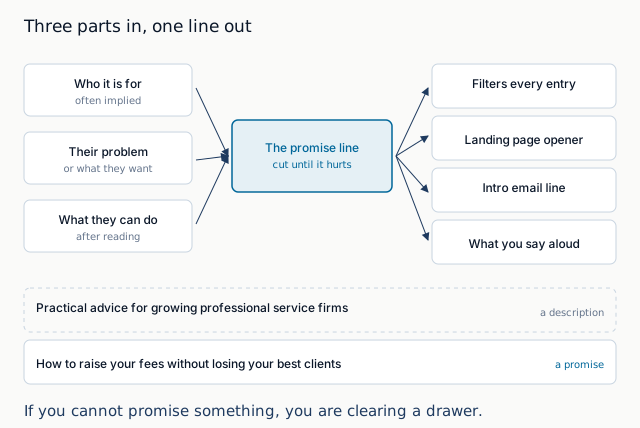
Most first attempts are too vague. Practical advice for growing professional service firms is a description, not a promise. It says what is inside without saying what changes for the reader. Compare How to raise your fees without losing your best clients . That one has a reader in mind, names a problem they recognise, and commits to an outcome they want. It is also slightly frightening to write, because now you have to deliver it.
A good promise line usually has three parts, though they need not appear in this order. Who it is for, sometimes implied. What problem they have, or what they want. What they will be able to do after reading. Fill in all three, then remove words until it hurts. The subtitle of a book is often the best home for the result, sitting under a shorter title that does the catching.
The promise line does more work than you might expect. It is the filter for every entry: if an entry does not move the reader closer to the promised outcome, it does not belong. It is the opening line of the landing page, the first sentence of every email introducing the book, and the thing you say when someone asks what you have written. A clear promise line makes all those jobs easy. A muddy one makes all of them hard.
Beware promises you cannot keep. Double your revenue in ninety days is a promise, but it is the kind that attracts the wrong readers and invites justified scepticism. Buyers in professional markets have been oversold for years and have excellent detectors. A modest, specific, achievable promise is far more persuasive than a grand one. Run your first pricing review in a fortnight will win more trust than transform your profitability .
Test the line on three people who fit the niche. Do not ask whether they like it; people are polite. Ask what they think the book will help them do. If their answer matches your intent, the line works. If it does not, the line is promising something different from what you mean, and it is much cheaper to find that out now than after you have written a hundred entries.
This week, write ten versions of your promise line. Write them fast and do not judge them while writing. Then choose the one that a buyer would most want to be true, and that you could most confidently make true. That one is your book. The others are useful mainly for showing you what it is not.
The Authority Book — How a 100-entry book wins clients
Ready when you are.
Tap below to open the full chapter in the book reader. Anchored books jump to this chapter automatically.
Titles are where experts most often indulge themselves. After months of serious thought, it is tempting to reach for something clever: a pun, a metaphor, an allusion to a novel. The trouble is that clever titles work brilliantly on people who already know what the book is about, and not at all on people who do not. Your buyers are the second group.
A title has one job, which is to make the right person pick the book up. It does this in a fraction of a second, usually as a small image in a list or a line of text in an email. In that moment the reader has to understand what the book is about and whether it is for them. Clever titles demand a second look to decode. Most readers do not give a second look.
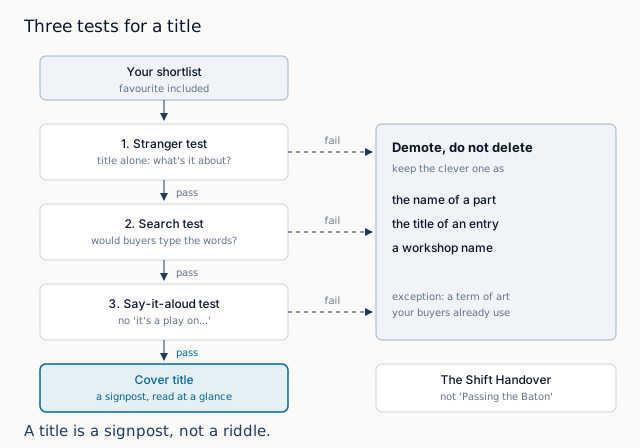
So prefer clarity. The Shift Handover tells a logistics manager exactly what they are getting. Passing the Baton might be more charming, but it could be about relay running, succession planning or relationships. You can add charm in the subtitle, or in the entries, where the reader has already committed to reading. The title is not the place to make them work.
A useful structure is a short main title naming the subject or outcome, followed by a subtitle that carries the promise and, if you must, the wit. The Authority Book: How a 100-entry book wins clients is plain to the point of austerity, and that is deliberate. You know what it is about, who it is for and what it claims. That is enough.
Run three tests on any shortlist. First, the stranger test: show the title alone, with no subtitle, to someone in your target market and ask what the book is about. If they cannot tell you, it fails. Second, the search test: would your buyer type any of the words in the title into a search box when looking for help? If none of the words are ones they would use, discovery will suffer. Third, the say-it-aloud test: can you introduce the book in conversation without explaining the title? If you find yourself saying it's a play on , start again.
There is one exception worth allowing. If your field already has a strong term of art that your buyers use, it can anchor a title even if it sounds odd to outsiders. Your buyers are the only audience that counts, and they will recognise their own vocabulary immediately.
This week, list every title you have been considering and apply the three tests ruthlessly. Most people find that their favourite fails the first. That is normal and slightly painful. Keep the favourite as the name of a part, or an entry, or a workshop. Give the cover to the title that does its job. Clever is a luxury. Clear is a courtesy.
The Authority Book — How a 100-entry book wins clients
Ready when you are.
Tap below to open the full chapter in the book reader. Anchored books jump to this chapter automatically.
Ranked List or Hundred Chapters
The Authority Book — How a 100-entry book wins clients
There are two main shapes for a hundred-entry authority book, and the choice affects everything from how you find entries to how readers use the result. Both work. They suit different expertise and different buyers.
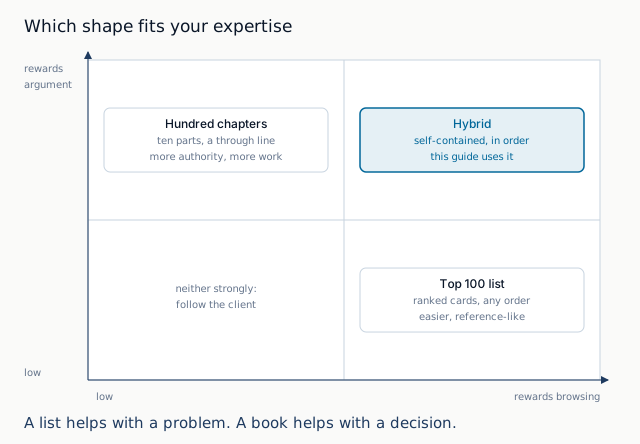
The first is the Top 100: a ranked or categorised list of a hundred discrete items, each with a short, self-contained explanation. The 100 Most Common Pricing Mistakes . 100 Questions to Ask Before Hiring an Agency . Each entry stands alone, entries can be read in any order, and the format is built for browsing. It works especially well on a phone, as a scroll of cards, and it is the easier of the two to write because each entry has a clear scope. Top 100 entries tend to be shorter, which suits buyers who want reference rather than reading.
The second is the hundred-chapter book: ten parts of ten chapters, written as flowing prose with an argument that builds from start to finish. Each chapter still teaches one thing, but there is a through line. Chapter forty assumes you have met the ideas in chapter twelve. It reads more like a conventional book, rewards sustained attention, and carries more authority with buyers who value depth. It is also more work, because each chapter must be good on its own and fit the whole.
Plot your expertise on two axes. How much does your field reward browsing, where buyers want to dip in to solve a specific problem? How much does it reward argument, where the value lies in a way of thinking that only makes sense as a whole? Fields high on browsing suit the Top 100. Fields high on argument suit the chapter book. Many end up in a hybrid: a hundred chapters, each self-contained enough to browse, arranged so that a reader who goes in order gets the argument too.
The hybrid is what this guide recommends for most experts, and it is the format this guide itself uses. Ten parts give the structure an arc; ten chapters per part give each part enough room; every chapter is written to stand alone. The same data can then be published as a ranked card deck for phones and as a book for reading, which later parts cover in detail.
If you are unsure, consider how clients currently use your advice. If they mostly ask specific questions and want quick answers, lean towards the list. If they mostly need to understand a new way of thinking before they can act, lean towards the chapters. If both, build the hybrid and let the editions handle the difference.
This week, take five of your likely entries and write the first paragraph of each twice: once as a ranked item, once as the opening of a chapter. Read both versions and notice which you find easier to write and which a client would find more useful. Those are not always the same answer. When they differ, follow the client.
The Authority Book — How a 100-entry book wins clients
Ready when you are.
Tap below to open the full chapter in the book reader. Anchored books jump to this chapter automatically.
The Angle Competitors Avoid
The Authority Book — How a 100-entry book wins clients
Every field has things its practitioners know and rarely say in public. The software project that was doomed from the scoping call. The coaching engagement that worked because the client was ready, not because of the coach. The marketing campaign that succeeded for reasons nobody on the team could explain. These unspoken truths are the best raw material for an angle, because they are interesting, credible and almost entirely absent from your competitors' marketing.
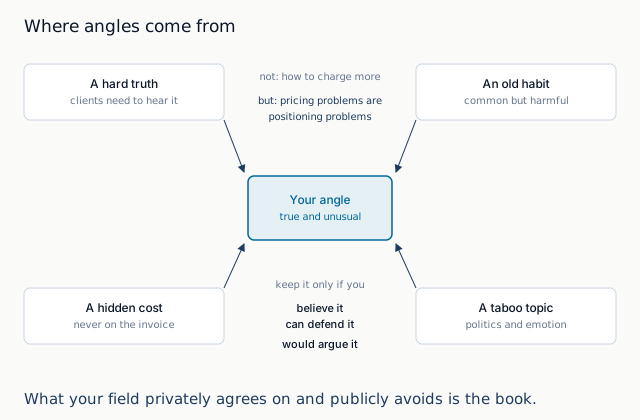
An angle is the particular stance your book takes on its subject. Two books on pricing can cover similar ground and feel completely different, because one says here is how to charge more and the other says most of your pricing problems are positioning problems in disguise . The second is an angle. It reframes the subject in a way the reader has not seen, and it implies that its author has spotted something others have missed.
Good angles often come from the uncomfortable centre of your field. Look for a hard truth that clients do not want to hear but need to. An old habit everyone follows that you have found to be counterproductive. A hidden cost that nobody puts on the invoice. A topic that is slightly taboo: the politics, the emotions, the cases where the textbook method fails. Any one of these can anchor a book, and the best angles touch several.
There is a reason competitors avoid these angles. They feel risky. Saying that most change programmes fail because of the sponsor, not the method, might offend a sponsor who could hire you. Saying that most coaching outcomes depend on client readiness might seem to undermine the value of coaching. But buyers know these things already, or suspect them. A book that says them plainly, and then explains what to do about them, earns trust that bland books cannot. It signals that you are honest enough to be useful.
You do not need to be contrarian for its own sake. An angle built purely on disagreement wears thin quickly, and readers can smell a manufactured controversy. The aim is to be truthful in a way that happens to be unusual. Your angle should be something you believe, can defend with experience, and would happily argue with a client across a table.
This week, write down three things you believe about your field that you have never put in a proposal. Then ask, for each, what a client would do differently if they believed it too. The one that would change client behaviour the most is probably your angle. It may feel exposed. That is generally a sign you are near the truth rather than far from it. Safe angles are where books go to be ignored.
The Authority Book — How a 100-entry book wins clients
Ready when you are.
Tap below to open the full chapter in the book reader. Anchored books jump to this chapter automatically.
The Problem Ladder
The Authority Book — How a 100-entry book wins clients
Not all problems are worth writing about equally. Some your buyers will pay almost anything to solve; others they will acknowledge politely and never act on. An authority book should spend most of its pages on the first kind, and a useful tool for sorting them is the problem ladder.
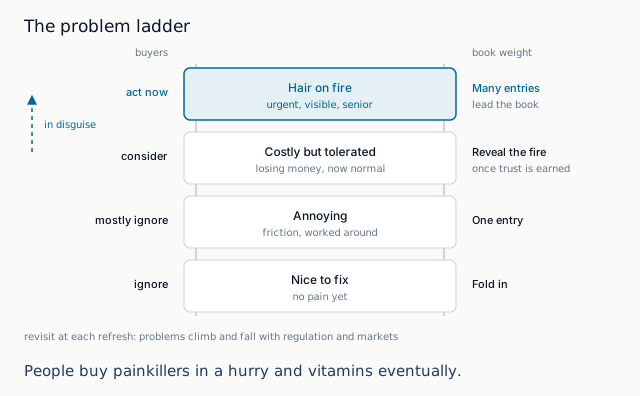
Picture four rungs. At the bottom are nice-to-fix problems: things that would be better if improved but are not causing pain. Above them are annoying problems: friction that people complain about but work around. Above those are costly-but-tolerated problems: issues that are clearly losing money or time but have become normal. At the top are hair-on-fire problems: urgent, visible, and keeping someone senior awake. Buyers act on the top rung, consider the second, and mostly ignore the bottom two.
Write the list of problems your clients bring to you, then place each on the ladder. Be honest. Many experts discover that their favourite subjects, the ones they find most intellectually interesting, sit on the lower rungs. Buyers do not care about them nearly as much as the expert does. Meanwhile the problems that actually trigger a purchase are often less glamorous: a missed deadline, a lost client, a board asking awkward questions.
The ladder shapes the book in two ways. First, it tells you where to put the weight. Top-rung problems deserve multiple entries, from diagnosis to fix to prevention. Lower rungs might get one entry each or be folded into others. Second, it tells you what to put first. A reader who opens the book and finds their urgent problem addressed in the first part will keep reading. One who finds a discussion of nice-to-haves will close it.
There is a subtlety. Some of the most valuable advice concerns problems that buyers place lower than they should: the costly-but-tolerated issue they have stopped noticing. Part of your authority comes from showing them that a second-rung problem is really a top-rung one in disguise. That is a powerful move, but it works best once you have earned trust by addressing what they already know hurts. Lead with their urgency, then introduce yours.
Problems move up and down the ladder over time. Something tolerated last year may be urgent now because of regulation, a market shift or a change in technology. When you refresh the book, revisit the ladder. Entries addressing problems that have climbed deserve promotion; those addressing problems that have fallen can be shortened or merged.
This week, take your list of client problems and rank them on the ladder. Then look at your website and count how much space goes to each rung. The mismatch is usually striking. The book is a chance to correct it, putting your best words where your buyers' worst days are.
The Authority Book — How a 100-entry book wins clients
Ready when you are.
Tap below to open the full chapter in the book reader. Anchored books jump to this chapter automatically.
Having a Point of View
The Authority Book — How a 100-entry book wins clients
Information is free. Every reasonably well-documented field has more freely available advice than any buyer could read in a lifetime, much of it accurate. If your book merely collects that information, however neatly, it competes with everything else on the internet and with every AI assistant that can summarise the same sources in seconds. It will lose.
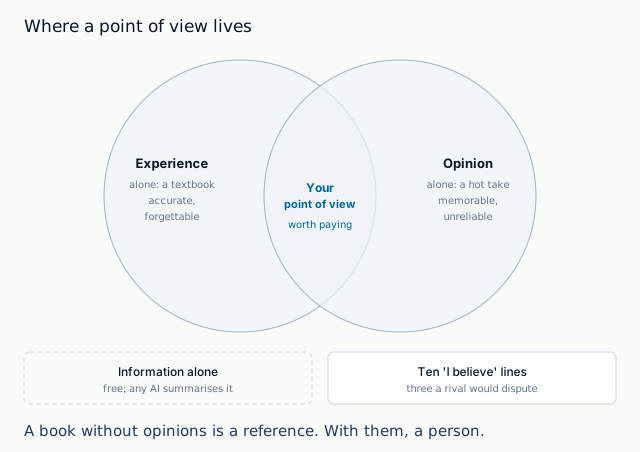
What a buyer cannot get elsewhere is your point of view: the specific way you see the problem, earned through specific experience and expressed with specific conviction. A point of view sits where experience and opinion overlap. Experience without opinion produces a textbook, accurate and forgettable. Opinion without experience produces a hot take, memorable and unreliable. Both together produce something worth reading: a practitioner telling you what they think, and showing why.
Points of view are usually visible in small moments. An entry that says most guides recommend X; I have stopped recommending it, and here is why . A sentence that names a common practice as a waste of time. A preference for one approach over another, stated plainly with reasons. These moments are where readers sit up. They are also where readers decide whether they agree with you, which is exactly the decision you want them to make before they hire you.
Some experts find this hard. Professional training often rewards hedging: it depends , there are many approaches , each situation is different . All true, and all useless to a reader trying to make a decision. You can acknowledge complexity and still say what you would do. In fact, buyers expect you to. They are paying, ultimately, for someone who will commit to a view.
A point of view also helps with AI-assisted production, which later parts cover. Agents are very good at producing balanced, comprehensive, opinion-free prose. Left alone, they will write a perfectly reasonable book that sounds like nobody in particular. Your point of view, stated clearly in the brief and enforced in the edit, is what stops this. It is the ingredient the machine cannot supply.
You do not need to be strident. A point of view can be expressed quietly, even gently. What matters is that it is present and consistent. A reader should finish any entry knowing what you think, not just what is known.
This week, write a list of ten statements about your field that start with I believe . Make at least three of them ones a respectable competitor would disagree with. Keep the list somewhere you will see it while writing. When an entry feels flat, check whether it reflects any of the ten. If it does not, it is probably information, not authority. Information is plentiful. Conviction is scarce, and scarcity is what people pay for.
The Authority Book — How a 100-entry book wins clients
Ready when you are.
Tap below to open the full chapter in the book reader. Anchored books jump to this chapter automatically.
Ten Entries Before a Hundred
The Authority Book — How a 100-entry book wins clients
Before committing to a hundred entries, write ten. This is the cheapest test you can run on an authority book, and it will save you from the most expensive mistake: discovering after months of work that the promise does not land.
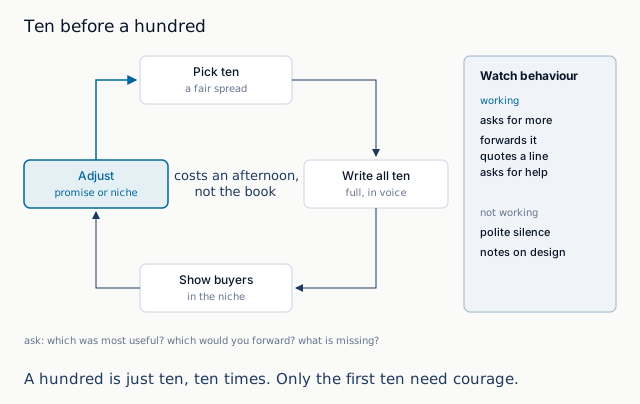
Choose ten entries that represent the book fairly. Not the ten easiest, and not the ten most exciting, but a spread: a couple from the start, a couple from the middle, a couple from the hard end, and at least one on the top-rung problem from your ladder. Write them properly, at full length and in your real voice, as if they were going into the finished book. Then put them in front of people who fit your niche.
What you are looking for is not praise. People are polite and will usually say something nice. Watch for behaviour instead. Do they ask for more? Do they forward it to someone? Do they quote a line back to you? Do they ask whether you could help with the problem in entry six? Those are signs the promise is working. Polite silence, or feedback about the design, usually means it is not.
This sample has a second life as a sales tool. Ten good entries in a prospect's world are already a small authority piece. Later in this guide, a whole chapter covers the spec sample, where you build a ten-entry preview for a specific prospect and send it before the call. The technique starts here, with you testing your own book on your own market.
Expect to adjust. Most first samples reveal that the promise is slightly off, that the niche is slightly too broad, or that one kind of entry consistently outperforms another. That is the point. Changing the promise after ten entries costs an afternoon. Changing it after a hundred costs the book. If the sample flops completely, take that seriously too: it might mean the niche is wrong, or that the angle is not as interesting to buyers as it is to you.
A few practicalities. Give the sample a title and a promise line, so readers know what the full book will be. Keep it short to read, ideally a single document or a simple web page. Ask two or three specific questions alongside it rather than what did you think? : which entry was most useful, which one would you forward, and what is missing. And give yourself a deadline for collecting responses, so the test does not become another reason to delay.
This week, pick your ten and write one. Just one, properly. It will show you how long an entry really takes, how your voice holds up at length, and whether the promise feels real when you are inside it. A hundred is just ten, ten times. The first ten are the only ones that need courage.
The Authority Book — How a 100-entry book wins clients
Ready when you are.
Tap below to open the full chapter in the book reader. Anchored books jump to this chapter automatically.
The One-Page Brief
The Authority Book — How a 100-entry book wins clients
Before production starts, everything you have decided about the book should fit on one page. Reader, promise, angle, title, format, and a few notes on voice. If it does not fit on one page, you have not decided yet; you have only accumulated thoughts.
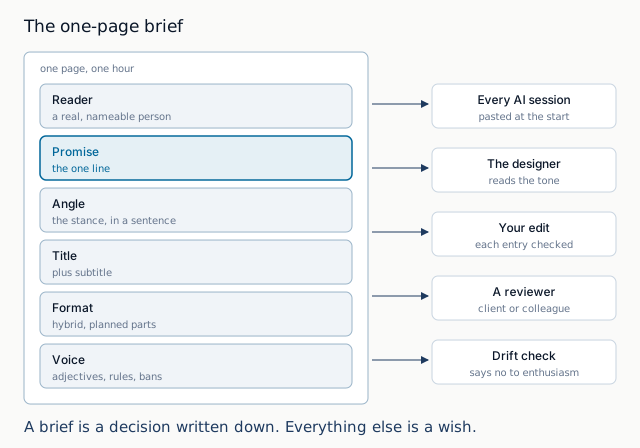
The one-page brief is the document you will return to more often than any other. It is what you will paste into the start of every session with an AI agent, so that the draft knows who it is writing for and what it has sworn to deliver. It is what a designer will read to understand the tone. It is what you will check each entry against when editing. It is what a colleague or client reads when you ask them to review. A sprawling strategy document cannot do these jobs. A single page can.
A workable brief has six short sections. The reader: one sentence on who they are, in enough detail that you could name a real person. The promise: the one-line promise from earlier. The angle: the stance that makes this book yours, in a sentence or two. The title and subtitle. The format: Top 100, hundred chapters or hybrid, with the planned parts. And voice: three or four adjectives, a couple of rules, and a list of phrases you never want to see.
Writing the brief forces trade-offs you have been postponing. You discover that you want the book to be both rigorous and light, both comprehensive and short, both for directors and for their teams. Some of these tensions can be held. Most need resolving, and the page is where you resolve them. If you find yourself writing and a lot, try replacing some of them with rather than .
The brief is also your defence against drift. Halfway through a project, it is very easy to add an entry because it is interesting, or to change tone because you have been reading someone you admire. Each change seems small. Together they produce a book that started as one thing and ended as another. Checking new ideas against the brief keeps the book coherent, and gives you a polite reason to say no to your own enthusiasm.
It can change. If the ten-entry sample suggests the promise is wrong, update the brief. If a client conversation reveals a sharper angle, update it. But update it deliberately, as a decision, and re-check the outline against the new version. A brief that changes silently is not a brief.
This week, write yours. Give yourself one hour and one page, and do not let either stretch. Print it, read it aloud, and ask whether a stranger could use it to produce something close to the book in your head. If they could, you are ready for the next part. If not, the gap you feel is the part of the book you have not yet thought about. Better to find it here than in entry sixty-three.
The Authority Book — How a 100-entry book wins clients
Ready when you are.
Tap below to open the full chapter in the book reader. Anchored books jump to this chapter automatically.
You Already Know Ninety
The Authority Book — How a 100-entry book wins clients
The most daunting moment in an authority book project is the blank list. A hundred entries sounds like a mountain, and the natural response is to wonder whether you really know a hundred things worth saying. You almost certainly do. The problem is not knowledge; it is retrieval.
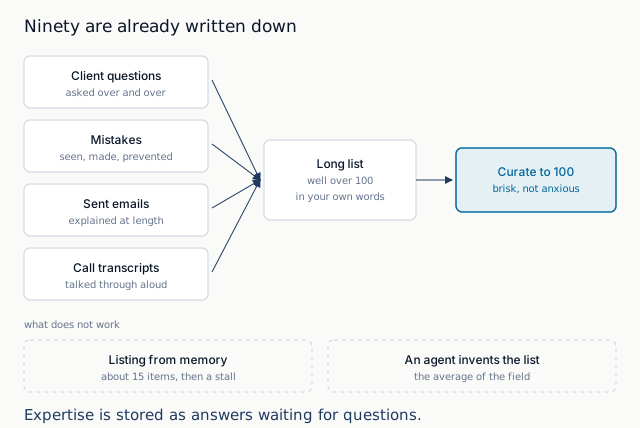
Experienced practitioners carry an enormous amount of useful knowledge that they never consciously catalogue. It surfaces when it is needed: when a client asks a question, when a project hits a familiar snag, when a junior colleague is about to make a mistake you have seen before. In those moments the knowledge is instant and precise. Ask the same expert to list everything they know, cold, and they will produce about fifteen items and then stall.
So do not start by trying to list everything you know. Start by going to the places where your knowledge has already been triggered and written down. The questions clients ask you, over and over. The mistakes you have seen, made or prevented. The emails where you explained something at length to one person. The calls where you talked a client through a problem. Each of these is a deposit of expertise, laid down at the moment it was needed, and they are much easier to mine than your memory.
The next few chapters take each of these sources in turn: the sent folder, client questions, call transcripts and the mistakes inventory. Together they will usually produce far more than a hundred candidate entries, which is what you want. A long list gives you room to choose, and choosing is where quality comes from.
There is a mindset shift worth making early. You are not writing a hundred new things. You are recovering ninety-odd things you have already said, and adding a handful you have been meaning to say. That reframing matters because it changes the task from creation to curation. Creation is slow and anxious. Curation is brisk and rather satisfying, like clearing out a cupboard and finding it full of things you are glad to own.
It also changes how you use AI tools. An agent asked to invent a hundred entries on your subject will produce a perfectly plausible list, drawn from the average of everything written on the topic. That list will look reasonable and contain nothing that only you could have written. An agent asked to extract entries from your own emails, notes and transcripts will produce something entirely different: a list rooted in your experience, in your vocabulary, about problems your clients actually had.
This week, set a timer for twenty minutes and write down every question a client has asked you in the last month. Do not filter. Most people reach twenty or thirty before the timer goes. That list alone is a third of a book. The rest is waiting in places you have not yet looked.
The Authority Book — How a 100-entry book wins clients
Ready when you are.
Tap below to open the full chapter in the book reader. Anchored books jump to this chapter automatically.
Mining the Sent Folder
The Authority Book — How a 100-entry book wins clients
Your sent folder is a draft of your book, written in instalments over years and addressed to one reader at a time. Every long email in which you explained something to a client, advised a colleague, or argued for an approach is a candidate entry. Most experts have hundreds of these, and almost none have ever been read by more than one person.
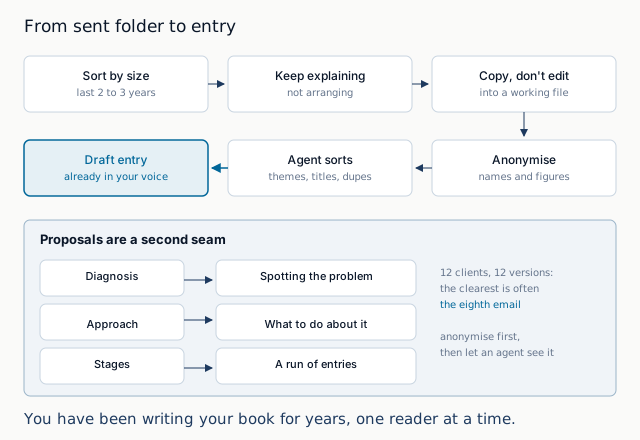
Start with length. Search your sent mail for messages above a certain size, or simply sort by size if your client allows it, and skim the longest ones from the last two or three years. You are looking for messages where you explained rather than arranged: not let's meet Thursday but here's why I think the rollout went wrong . When you find one, copy the explanatory part into a working file. Do not edit yet. Just collect.
Then strip identifying details. Client names, project names, figures that could identify a business, anything said in confidence. The book will draw on these experiences, but it must not expose them. Replace specifics with representative ones: a forty-person logistics firm rather than the real name. This is both an ethical requirement and a practical one, since prospects reading your book will wonder how you would treat their information.
Proposals are another rich seam. A good proposal usually contains a diagnosis of the client's problem, an explanation of why your approach suits it, and a description of what will happen at each stage. Each of these can become one or more entries. The diagnosis becomes an entry on recognising the problem. The approach becomes an entry on what to do about it. The stages become a sequence of entries on doing it well.
An AI agent is useful here, provided you control what it sees. You can give it a folder of anonymised excerpts and ask it to group them by theme, suggest entry titles, and flag duplicates. Do not give it raw client correspondence; anonymise first, then process. The agent is not finding your ideas for you. It is sorting them, which is tedious work you would otherwise do badly at eleven at night.
You will find repetition. You have probably explained the same thing to twelve different clients in twelve slightly different ways. That is good news. It tells you the topic matters, and it gives you twelve versions to choose the best phrases from. Often the clearest explanation is buried in the eighth email, written after you had already explained it seven times and finally found the right analogy.
This week, spend an hour in your sent folder and collect ten explanatory excerpts. Anonymise them as you go. Read them back together and notice how much of the book is already written, in your voice, about real problems. The work from here is mostly assembly. Your past self has done the writing. Your present self only needs to edit it.
The Authority Book — How a 100-entry book wins clients
Ready when you are.
Tap below to open the full chapter in the book reader. Anchored books jump to this chapter automatically.
Client Questions Are Chapters
The Authority Book — How a 100-entry book wins clients
Every question a client asks more than once is an entry. That is the simplest rule in this guide and one of the most productive. It works because repeated questions mark exactly the points where buyers get stuck, which are exactly the points where your book can help them.
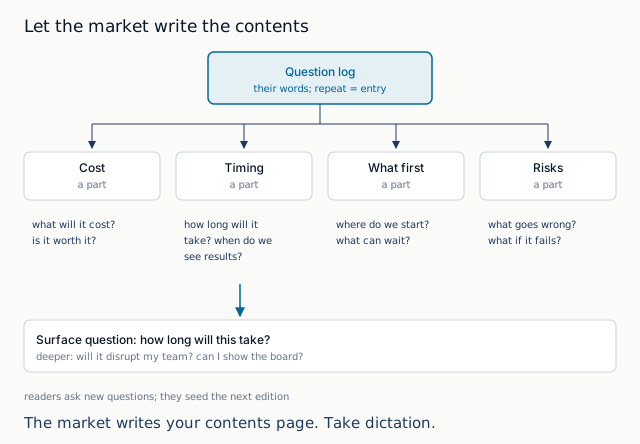
Start a question log if you do not already have one. A plain document, a note on your phone, a column in a spreadsheet; the format does not matter. Every time a client, prospect or colleague asks you something substantive, write down the question in their words. Not your rephrasing of it, their actual words. The difference matters, because their words are the ones future readers will search for and recognise.
Within a few weeks the log will show patterns. Certain questions recur in different forms. Others cluster into themes: questions about cost, about timing, about what to do first, about what can go wrong. Each recurring question is an entry. Each cluster might be a part. You are, in effect, letting your market design your table of contents, which is a far better designer than you are.
Questions also tell you about framing. A client who asks how long will this take? is often really asking will this disrupt my team? or can I show results before the board meeting? Your entry can answer the surface question and the deeper one together, which makes it more useful than a straight answer and demonstrates the kind of insight that wins work.
Do not overlook the questions prospects ask before they become clients. These are especially valuable, because they reveal the doubts and confusions that stop people buying. An entry that answers a pre-sale question honestly, including the parts that might make you look less essential, does two jobs at once: it helps the reader and it removes a barrier to working with you.
There is a loop here that keeps going after the book is published. Readers will ask new questions, prompted by entries. Those questions become candidates for the next edition. Over time the book becomes a living record of what your market needs to know, refined by the market itself. Few marketing assets have that property.
If you have been in practice a while, you can reconstruct a question log from memory and records rather than waiting weeks. Go back through meeting notes, discovery call summaries, and the frequently asked questions page you never updated. Ask colleagues what clients ask them. Ask a couple of clients what they wish they had known before starting.
The Authority Book — How a 100-entry book wins clients
Ready when you are.
Tap below to open the full chapter in the book reader. Anchored books jump to this chapter automatically.
Transcripts as Ore
The Authority Book — How a 100-entry book wins clients
Many experts speak better than they write. On a call, explaining something to a client who is visibly confused, they find the right analogy, the vivid example, the plain sentence. Then they sit down to write and produce something stiff and over-qualified. The fix is to capture the speaking and turn it into writing, and recorded calls make this easy.
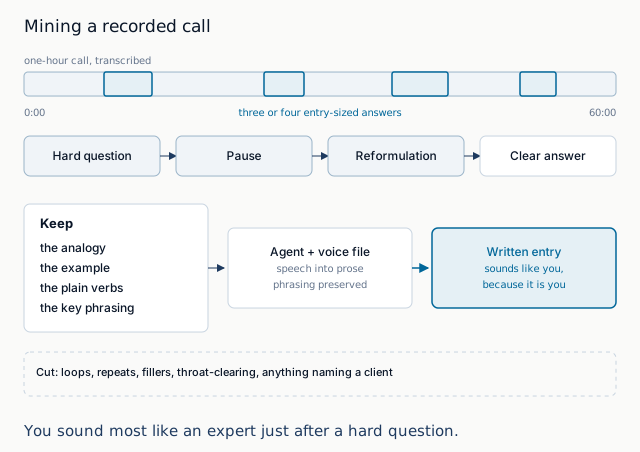
If you already record client calls with permission, as many people now do routinely, you have a large archive of your own expertise expressed in your natural voice. If you do not, start with the calls where recording is appropriate: internal workshops, webinars, podcast appearances, or sessions where a client has explicitly agreed. Transcription is now cheap and accurate enough to use without much tidying.
What you are looking for in a transcript is the moment when someone asked a hard question and you answered well. These moments have a recognisable shape: a pause, a reformulation, and then a clear explanation, often with an example. Mark them, extract them, and save them as raw material. A single hour-long call can contain three or four entry-sized explanations.
Spoken explanations need some work to become written ones. People speak in loops, repeat themselves, and use fillers that look odd on the page. But the core, the structure and the phrasing of the key point, often survives intact and is better than what you would have written from scratch. Keep the analogy. Keep the example. Keep the plain verbs. Cut the throat-clearing.
AI agents are particularly good at this conversion. Give one a transcript excerpt and a voice file, and ask it to produce a written entry that preserves your phrasing and examples while removing the verbal clutter. The result is usually a strong first draft that sounds like you, because it is made of you. Compare this to asking the agent to write an entry from a topic alone, which will produce something accurate and anonymous.
Be scrupulous about confidentiality. A transcript of a client call contains the client's words as well as yours, and often their business details. Use only your own explanations, strip anything identifying, and never put a client's situation into the book in a form they would recognise without their permission. If an explanation only makes sense with the client's context, generalise the context.
Podcasts and talks are especially useful because they were already intended to be public. If you have appeared as a guest anywhere, the transcript is a ready-made seam of entries in your speaking voice, already cleared for publication.
The Authority Book — How a 100-entry book wins clients
Ready when you are.
Tap below to open the full chapter in the book reader. Anchored books jump to this chapter automatically.
The Mistakes Inventory
The Authority Book — How a 100-entry book wins clients
The most valuable thing an expert knows is usually what goes wrong. Success stories are pleasant and often unrepeatable; they depend on timing, luck and circumstances that will not recur. Failures are instructive and highly repeatable. The same mistakes happen again and again, to different people in different firms, and someone who has seen them many times can spot them early and steer around them.
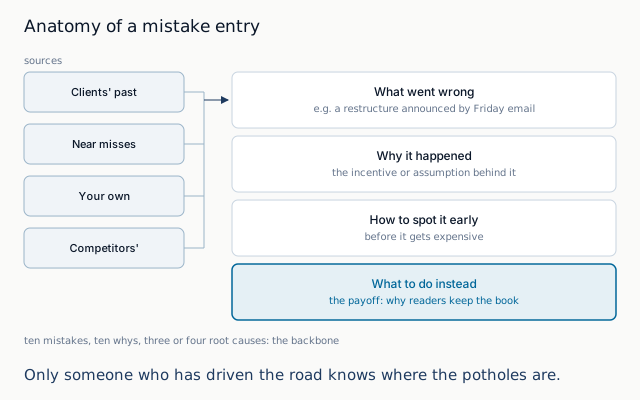
Build a mistakes inventory. List every mistake you have seen in your field: ones clients made before they hired you, ones they nearly made while working with you, ones you made yourself, and ones you have watched competitors make. Be generous with the list and harsh with the descriptions. Poor communication is not a mistake; it is a category. Announcing the restructure on a Friday afternoon by email is a mistake.
Each mistake is an entry with a natural shape. What went wrong, described concretely enough that the reader recognises it. Why it happened, which is usually more interesting than the mistake itself, because it reveals the incentive or assumption behind it. How to spot it early, before it becomes expensive. And what to do instead. That last layer is the payoff, the reason the reader keeps the book.
Mistake entries are unusually persuasive. They demonstrate experience more vividly than any success story, because you can only describe a failure in detail if you have been close to it. They also create a mild, productive anxiety: a reader recognises a mistake they are about to make and is grateful you pointed it out. Gratitude is a fine foundation for a client relationship.
Include your own mistakes. It is tempting to present yourself as having always known best, but readers find that implausible, and it makes you less trustworthy, not more. An entry that says I used to recommend this, and here is what happened is more credible than any amount of confident instruction. It shows that your advice has been tested, and that you change your mind when the evidence demands it.
The inventory also helps with balance. Books written entirely from the positive side, how to do things well, can feel abstract and preachy. A healthy dose of mistakes keeps them grounded and gives readers something to measure themselves against. A rough guide: if more than a third of your entries could be framed as a mistake to avoid, consider whether that should be the book's whole angle.
This week, write down ten mistakes you have seen clients make in the last year. For each, write one sentence on why it happened. You will find that the why sentences cluster around three or four root causes. Those root causes are probably the backbone of your book's argument. The mistakes are the evidence. Your job is to connect them.
The Authority Book — How a 100-entry book wins clients
Ready when you are.
Tap below to open the full chapter in the book reader. Anchored books jump to this chapter automatically.
Borrowing the Canon Carefully
The Authority Book — How a 100-entry book wins clients
Every field has its canon: the established frameworks, models and ideas that practitioners learn and reference. You will need to draw on some of them. Readers expect to see them, and leaving them out entirely looks either ignorant or evasive. The question is how to use the canon without turning your book into a summary of other people's work.
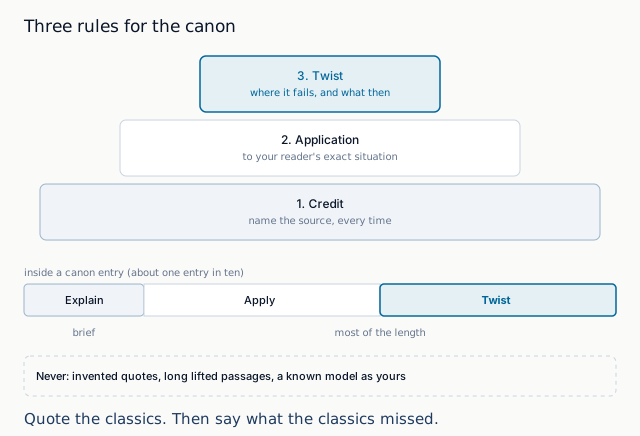
The first rule is credit. If you are using someone else's framework, say so, by name, every time. This is basic honesty, and it is also good positioning. Readers who know the framework will see that you know it too; readers who do not will learn something and appreciate the reference. What does not work is presenting a well-known model as your own invention, which knowledgeable readers will notice and which undermines everything else you say.
The second rule is application. Do not simply explain the framework; that has been done, usually better, by its originator. Show how it applies to your reader's specific situation. A general model of change becomes much more useful when you explain what it looks like inside a family-owned manufacturing firm with a founder who is about to retire. That application is yours, even if the model is not.
The third rule is the twist. The best canon entries add something: a limitation you have discovered, an adaptation that works better in your niche, a case where the framework fails and what to do then. This is where your point of view lives. The standard advice is X; in my experience with firms like yours, it works only if Y is a sentence worth reading, and it can only be written by someone with real experience.
Be careful with direct quotation. Short quotes with attribution are fine. Long passages lifted from someone else's book are not, both legally and stylistically. Paraphrase in your own words, credit the source, and move quickly to your application. Never invent quotes or attribute words to real people that they did not say; that is the fastest way to lose a reader's trust entirely, and an easy mistake to make if you let an AI agent fill gaps unsupervised.
There is a balance to strike. A book that ignores the canon looks naive. A book that leans on it too heavily looks derivative. A reasonable target is that perhaps one entry in ten engages substantially with an established idea, and that every such entry spends most of its length on application and twist rather than explanation.
This week, list the three frameworks you reference most often with clients. For each, write down one situation where it works well in your niche and one where it does not. The second list is more valuable. It is the part of the canon you have earned, and the part nobody can get from the original source.
The Authority Book — How a 100-entry book wins clients
Ready when you are.
Tap below to open the full chapter in the book reader. Anchored books jump to this chapter automatically.
The Long List of Three Hundred
The Authority Book — How a 100-entry book wins clients
Once you have mined your emails, questions, transcripts and mistakes, combine everything into a single long list. Aim for three hundred candidate entries. Yes, three hundred, for a book of a hundred. The surplus is not waste. It is the raw material that makes the final hundred good.
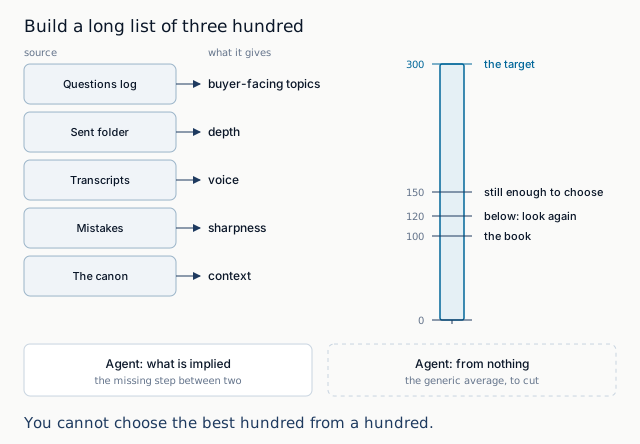
A long list works because quality comes from selection. If you have exactly a hundred ideas, every one goes into the book, including the weak ones. If you have three hundred, you can choose the best third, and the book is noticeably stronger. Editors have known this forever: the best collections are made by people who cut ruthlessly from a large pool.
Reaching three hundred feels hard until you stop judging while listing. Write each idea as a short working title or a single sentence. Do not worry about overlaps, gaps, or quality. Include ideas you are not sure about, ideas that seem too obvious, and ideas that might be two entries. The list is a net, not a filter. Filtering comes later.
Combine sources deliberately. Your questions log gives you buyer-facing topics. Your sent folder gives you depth. Transcripts give you voice. The mistakes inventory gives you sharpness. Canon entries give you context. A long list drawn from all five has a natural balance that a list from any one source lacks.
AI agents are useful at this stage, with a caveat. Ask an agent to read your collected material and suggest additional entries that are implied but missing, such as the step between two entries you already have, or the opposite of a mistake you listed. These suggestions are often good, because they are grounded in your material. Do not ask it to generate entries from nothing, or the list will fill with the generic average of your field, and you will waste time cutting them.
Organise lightly as you go. A simple spreadsheet with columns for working title, source, rough theme and a one-line note is enough. The theme column will become useful when you start structuring. Avoid the temptation to build an elaborate system; the list only needs to last a week or two before it becomes an outline.
You may find you blow past three hundred. Fine. You may stall at a hundred and fifty. That is fine too, and still enough to make a strong selection. If you stall below a hundred and twenty, take it seriously: it might mean your niche is too narrow, or that you have not looked hard enough in one of the sources. A later chapter deals with what to do when the well runs dry.
The Authority Book — How a 100-entry book wins clients
Ready when you are.
Tap below to open the full chapter in the book reader. Anchored books jump to this chapter automatically.
Culling to a Hundred
The Authority Book — How a 100-entry book wins clients
Now the editor comes in. You have a long list of somewhere between one hundred and fifty and three hundred candidates, and you need exactly a hundred. Culling is where the book gets its quality, and it is more enjoyable than people expect, provided you have a clear set of tests.
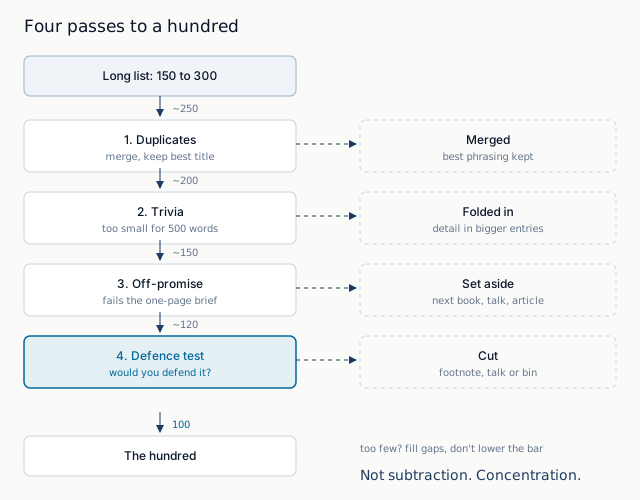
First, remove duplicates. You will find the same idea several times, phrased differently because it came from different sources. Merge them into one entry, keeping the best title and noting the richest source material. A list of two hundred and fifty often shrinks to two hundred at this stage without any hard decisions.
Second, remove trivia. These are entries that are true but too small to deserve five hundred words: a single tip that could be a sentence in another entry, a fact that is interesting but not useful. Fold the best of them into larger entries as supporting detail; let the rest go.
Third, remove anything off-promise. Check each candidate against your one-page brief. Does it help the reader move toward the promised outcome? Some of your favourite ideas will fail this test, because they belong to a different book. Keep them in a separate file. They may become the next book, or a talk, or an article.
Fourth, and most important, the defence test. For each remaining candidate, ask: would I defend this in front of a sceptical client? Not is it correct , but would you stand behind it, with your name on it, across a table from someone who disagreed? Entries that pass are authority. Entries that fail are filler, and readers can feel the difference even if they cannot name it.
Count after each pass. If you have more than a hundred after all four, cut further by ranking the survivors on usefulness to the reader and dropping the lowest. If you have fewer, look at the gaps, which the next chapter addresses, rather than lowering your standards.
Be wary of keeping entries for sentimental reasons. Every expert has a pet topic that they find fascinating and clients find slightly baffling. If it passed the defence test but fails the usefulness ranking, it probably belongs in a footnote, a talk, or the bin. Likewise, beware of keeping safe entries simply because they are uncontroversial. A book with no entries anyone could disagree with is a book with no point of view.
The Authority Book — How a 100-entry book wins clients
Ready when you are.
Tap below to open the full chapter in the book reader. Anchored books jump to this chapter automatically.
Filling the Gaps
The Authority Book — How a 100-entry book wins clients
After the cull, your hundred will have holes. Some stages of the buyer's journey will be overcrowded, with eleven entries about implementation, while others will be thin, with barely one about how to know whether you need help at all. Gaps are normal. Finding them deliberately is better than letting readers find them for you.
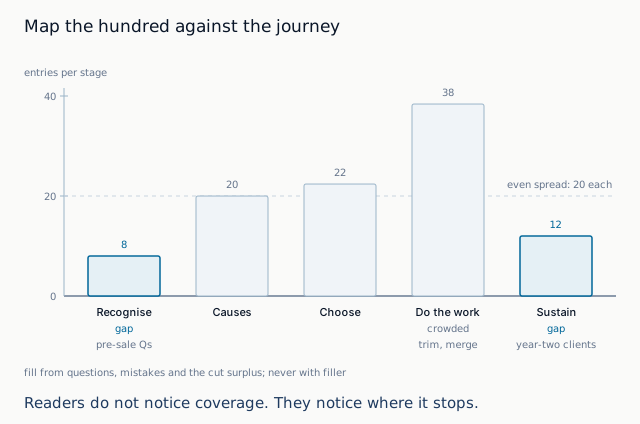
Map the list against the journey. A simple version for most professional services has five stages: recognising the problem, understanding its causes, choosing an approach, doing the work, and sustaining the result. Place each of your hundred entries in one stage. Then count. A healthy book has entries spread across all five, with somewhat more weight on the stages where your buyers struggle most.
Draw this as a grid if it helps. Across the top, the journey stages. Down the side, a rough measure of coverage: how many entries, how deep, how specific. The cells with high stage importance and low coverage are your gaps. They are where readers will feel the book thin out, and often where they would most like your help.
Common gaps follow a pattern. Experts tend to under-write the beginning, because recognising the problem feels too obvious to them, and the end, because sustaining results is less exciting than achieving them. Both matter enormously to buyers. The beginning is where they decide whether the book is for them; the end is where they decide whether you can be trusted for the long haul.
To fill a gap, go back to your sources with a specific question. If the beginning is thin, look in your questions log for things prospects ask before they buy. If the end is thin, ask long-standing clients what they wish they had known in year two. If a middle stage is thin, look at your mistakes inventory: there are probably failure modes you have not yet turned into entries.
You can also borrow from your surplus. Entries you cut for being off-promise or too small may fill a gap well once rewritten with a different focus. A tip that was too slight for its own entry might combine with two others into a solid entry about the journey stage you were missing.
Resist the urge to fill gaps with generic material just to make the numbers work. A gap filled with filler is worse than a gap noticed and addressed honestly. If you genuinely have little to say about one stage, it may be better to rebalance the parts so that stage gets fewer entries, and to acknowledge that your expertise is concentrated elsewhere.
The Authority Book — How a 100-entry book wins clients
Ready when you are.
Tap below to open the full chapter in the book reader. Anchored books jump to this chapter automatically.
When the Well Runs Dry
The Authority Book — How a 100-entry book wins clients
Sometimes, despite honest mining and generous listing, you cannot reach a hundred good entries. You cull your long list and land at sixty-five. You fill the gaps and reach seventy-eight. The remaining twenty-two either do not exist or would be filler. This is a useful signal, and it is worth reading correctly before you reach for the padding.
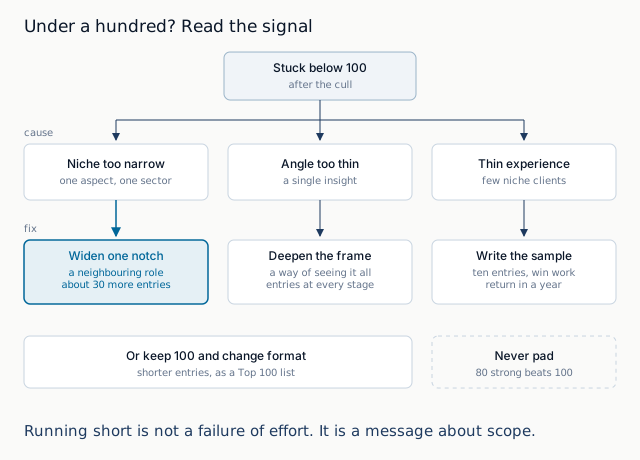
The first and most common cause is a niche that is too narrow. You chose a precise reader and a precise problem, which was the right instinct, but you went a step too far. There are only so many things to say about one aspect of one process in one sector. The fix is to widen by one notch: add an adjacent problem, a neighbouring role, or the stages either side of the one you focused on. Usually one notch is enough to open up thirty more entries.
The second cause is an angle that is too thin. Some angles make a great article but not a book. If your book is built around a single insight, however true, you may run out of ways to apply it. The fix here is not to widen the audience but to deepen the frame: change the angle from a single insight to a way of seeing the whole problem, which will generate entries across every stage.
The third cause is less comfortable. Sometimes the well runs dry because you do not yet have enough experience in this particular niche. You know a lot about the field generally but have worked with only a handful of clients in this specific corner. A book written now would be stretched. The honest fix is to write a smaller piece first, perhaps the ten-entry sample, use it to win work in the niche, and come back to the book in a year with more material.
Whatever you do, do not pad. Padding is easy to produce, particularly with AI agents, which will cheerfully generate twenty plausible entries on any subject. Those entries will look fine at a glance and read as hollow on closer inspection, and readers will notice. A book with eighty strong entries and twenty filler ones is weaker than a book of eighty, and the hundred-entry format is not worth that cost.
There is a case for keeping the number and changing the format: a hundred shorter entries, as a Top 100 list, instead of a hundred full chapters. If your material is genuinely rich but some topics only merit a paragraph, the list format accommodates that honestly.
This week, if you are below a hundred, write down which of the three causes fits best. Be honest; the third is the hardest to admit and the easiest to spot from outside. Then take the matching fix. A smaller true book beats a larger padded one, and a well that ran dry is still a well. It just needs a deeper hole.
The Authority Book — How a 100-entry book wins clients
Ready when you are.
Tap below to open the full chapter in the book reader. Anchored books jump to this chapter automatically.
A hundred entries in a single flat list is not a book. It is a heap. Readers cannot hold a hundred items in their heads, and they cannot navigate a list without landmarks. The simplest and most robust structure is ten parts of ten entries each, and it is worth understanding why it works before you start moving entries around.
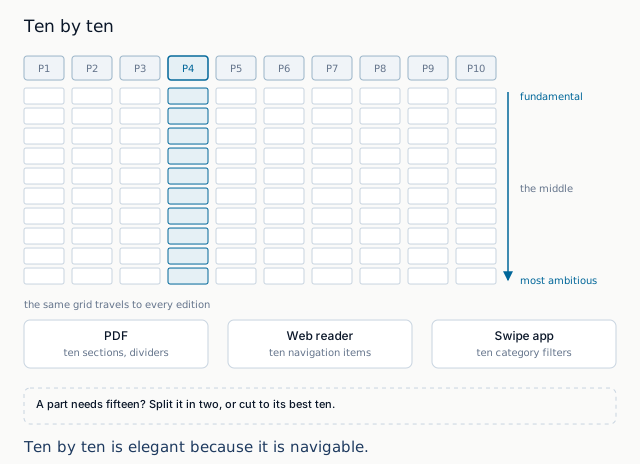
Ten parts give the reader a map. A contents page with ten part titles can be read in a few seconds and remembered roughly afterwards. Each part title tells the reader what kind of help lives there, so they can go straight to the part that matches their week. Ten is enough to cover a subject properly and few enough to grasp at a glance.
Ten entries per part give each part enough room to develop an idea without sprawling. A part with three entries feels like an aside; a part with twenty feels like its own book. Ten lets a part start with fundamentals, work through the middle, and end with something ambitious, which gives each part a small arc of its own. That arc matters for readers who go in order, and it does no harm to readers who browse.
The grid also gives you, the author, a production rhythm. You can plan one part at a time, write one part at a time, and check one part at a time. You always know how far along you are. A part that feels thin is visible immediately, because it has seven strong entries and three you are not proud of. The symmetry exposes weakness in a way a looser structure would hide.
Resist the urge to break the grid for one special part that deserves fifteen entries. It may deserve fifteen, but the reader's sense of the book's shape is worth more than one part's completeness. Either split the big part into two, or cut it to ten and move the extras to where they also fit. The constraint will improve the writing; it forces you to choose the ten best rather than include the fifteen available.
Similarly, avoid uneven parts dressed up as flexibility. A book where part three has six entries and part seven has fourteen tells the reader that the structure was an afterthought. They may not consciously notice, but the book will feel slightly unbalanced, like a room where one wall is closer than it should be.
The grid works across formats too. In a PDF, ten parts become ten sections with clear dividers. In a web reader, they become ten navigation items. In a swipeable app, they become ten categories a reader can filter by. The same structure travels everywhere, which is one reason later chapters can treat editions as outputs of a single source.
The Authority Book — How a 100-entry book wins clients
Ready when you are.
Tap below to open the full chapter in the book reader. Anchored books jump to this chapter automatically.
Ranking Without Regret
The Authority Book — How a 100-entry book wins clients
If you choose the Top 100 format, you face a question the chapter book avoids: what order do the entries go in, and what does the order mean? A ranked list implies that number one matters more than number fifty. Readers take this seriously. They will skip to the top ten, argue about the order, and judge your expertise partly by whether the ranking makes sense. So rank deliberately.
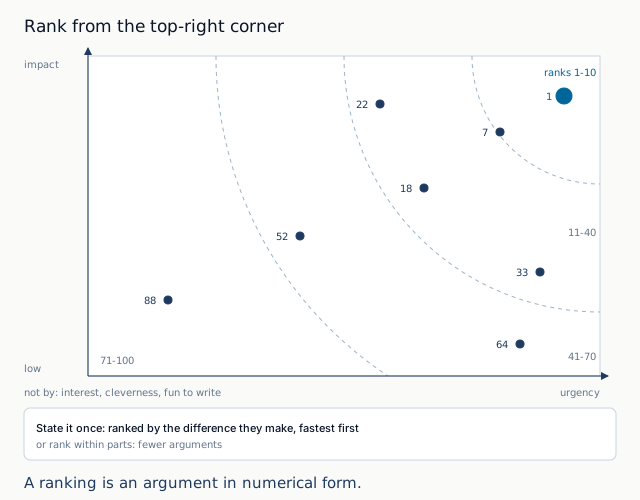
First decide what the ranking measures. The most useful measure for an authority book is usually a combination of impact and urgency: how much difference fixing this makes, and how soon the reader needs to fix it. An entry that addresses a high-impact, urgent problem goes near the top. One that addresses a low-impact, eventual problem goes near the bottom. Picture a simple grid with impact on one axis and urgency on the other, and rank from the top-right corner outwards.
Avoid ranking by how interesting the entry is to you, how clever it is, or how much you enjoyed writing it. These are author-facing measures, and readers can tell when a list was ordered for the author's pleasure. The ranking should be a service to the reader: start here, then here, then here.
State the ranking principle once, at the start. A single sentence is enough: these are ranked by how much difference they make, fastest first . This lets readers understand the logic and argue with it intelligently, which is far better than leaving them to guess. It also protects you from the criticism that a particular entry is too low; if it fits the principle, the ranking holds.
Expect to adjust. Your first ranking will be wrong in places. Read it in order and notice where the sequence feels off: an entry at number twelve that a reader could not use without first reading number forty, or two adjacent entries that are almost the same idea. Fix these by swapping or merging. Then read it again. Three passes usually produce a ranking that feels right.
You can combine ranking with categories. Many Top 100 books rank within categories rather than overall: ten parts, each ranked internally. This preserves most of the reader benefit while reducing the arguments, since nobody can easily dispute that an entry in part three is ranked below one in part six. It also maps neatly onto the ten-by-ten grid.
If ranking feels false for your material, because the entries genuinely have no hierarchy, do not force it. Use categories without numbers, or the chapter book format. A false ranking undermines trust more than no ranking at all.
The Authority Book — How a 100-entry book wins clients
Ready when you are.
Tap below to open the full chapter in the book reader. Anchored books jump to this chapter automatically.
From Ground Floor to Thesis
The Authority Book — How a 100-entry book wins clients
A hundred-chapter book needs an arc: a reason why part one comes before part two, and why the book ends where it does. Without an arc, the parts are just ten topics in arbitrary order, and readers who go from beginning to end feel no sense of progression. With one, the book builds toward something, and the last part lands with the weight of everything before it.
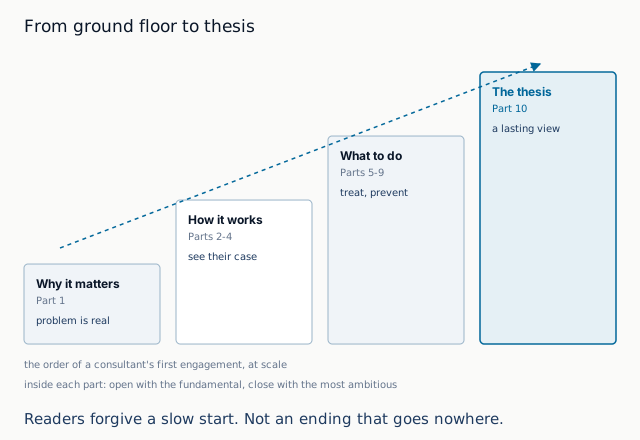
The most reliable arc for an authority book runs from ground floor to thesis. Part one establishes why the subject matters: the problem, its cost, the reason the reader should care. The middle parts explain how things work and what to do, moving roughly from simpler topics to harder ones, from diagnosis to treatment to prevention. The final part steps back and states the book's central claim plainly: the one idea you would want a reader to remember if they forgot everything else.
This shape mirrors how a good consultant runs a first engagement. You start by establishing that the problem is real and worth solving. You explain how it works, so the client understands their own situation. You set out what to do, in an order that makes sense. And you end with a perspective that reframes the whole thing, giving the client a way of seeing their business that lasts beyond the project. The book does the same, at scale, without you in the room.
Within each part, a smaller arc helps. Open each part with its most fundamental entry, the one a reader needs before the others make sense. Close each part with its most ambitious entry, the one that pushes furthest or connects to the next part. The middle eight entries can be ordered more loosely, by logic or by journey stage.
The thesis part deserves particular care. It is easy to run out of energy by part ten and fill it with leftover entries that did not fit elsewhere. Resist this. Part ten should contain your most considered thinking: what the future holds for your field, what the reader should take away, and the single claim the whole book has been building toward. Its last entry should state that claim in a sentence anyone could quote.
You will not get the arc right first time. Draft it, then read just the ten part titles in order, as if they were the chapters of a short story. Does each one follow from the last? Does the last one feel like a conclusion? If you could swap two parts without anyone noticing, the arc is too weak; find what makes one logically prior to the other.
This week, write the ten part titles on a single line, separated by arrows. Read the line aloud. If it sounds like a journey, keep it. If it sounds like a list, keep working. The arc is what turns a hundred useful entries into one useful book, and it is the difference between a reader who browses and a reader who believes.
The Authority Book — How a 100-entry book wins clients
Ready when you are.
Tap below to open the full chapter in the book reader. Anchored books jump to this chapter automatically.
One Entry, One Lesson
The Authority Book — How a 100-entry book wins clients
Every entry in an authority book should teach one thing a reader could use this week. Not three things, not a general overview, not background. One lesson, clearly stated, practically useful, and complete enough that the reader could act on it without reading anything else.
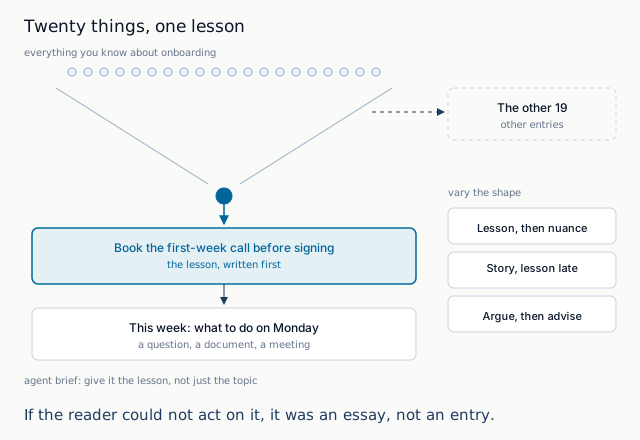
This rule sounds restrictive and is in fact liberating. It tells you what to put in and, more importantly, what to leave out. When you sit down to write an entry on onboarding new clients, you might know twenty things worth saying. The rule forces you to choose: this entry is about the first-week call. The other nineteen things belong to other entries, or to none.
The this week part matters. Readers of authority books are practitioners with problems, not students with time. An entry that teaches a principle with no obvious application is interesting but forgettable. An entry that teaches a principle and then shows what to do with it on Monday morning is useful, and useful is what readers remember and forward. The final paragraph or two of most entries should be concrete: a question to ask, a document to check, a meeting to hold differently.
It also makes entries work in isolation. Because each one carries a complete lesson, a reader who finds entry fifty-three through a search, or because a colleague forwarded it, gets real value without context. That is essential for a book that will mostly be browsed, and it is what makes individual entries suitable as social posts, email lessons and talking points, as later parts describe.
A good discipline is to write the lesson as a single sentence before drafting the entry. Book the first-week call before the contract is signed, not after. If you cannot write that sentence, the entry is not ready; you are still working out what it is about. Once you have the sentence, everything in the entry should either lead to it, support it, or show how to apply it.
There is a risk of making entries feel formulaic: setup, lesson, application, close, a hundred times over. Vary the shape. Some entries can open with the lesson and spend their length on nuance. Some can open with a story and arrive at the lesson late. Some can argue against a common belief and only then state what to do instead. The one-lesson rule constrains the content, not the form.
When working with AI agents, put the one-sentence lesson in the brief for each entry. It is the single most effective way to stop an agent from producing a sprawling overview, which is its natural tendency. An agent told what the one lesson is will build around it. An agent told only the topic will cover everything it can find.
The Authority Book — How a 100-entry book wins clients
Ready when you are.
Tap below to open the full chapter in the book reader. Anchored books jump to this chapter automatically.
The Entry Template
The Authority Book — How a 100-entry book wins clients
A hundred entries need a repeatable shape, both for your sanity as a writer and for the reader's comfort as they move through the book. Not a rigid formula that makes every entry feel the same, but a default structure you depart from deliberately rather than by accident.
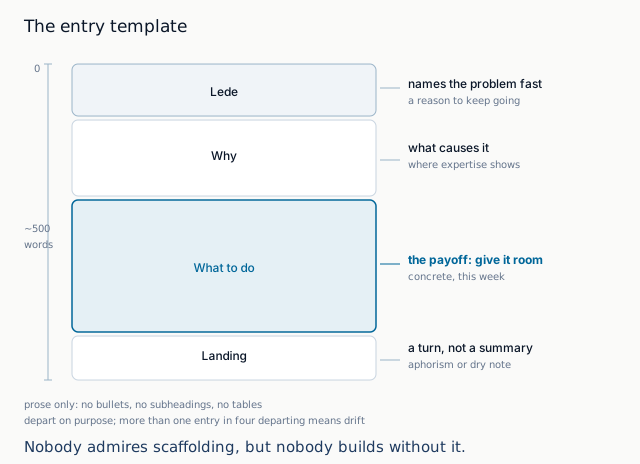
A workable template has four movements. First, a lede: an opening paragraph that names the problem quickly and gives the reader a reason to keep going. Second, the why: a paragraph or two on what causes the problem, which is usually where your expertise shows most clearly. Third, the what: what the reader should do, concretely, ideally this week. Fourth, the landing: a final sentence or two that closes the entry with a turn, an aphorism or a dry observation, rather than a summary.
Of the four, the third movement is the payoff. It is the part the reader came for, the part they will act on, and the part that demonstrates you can help with more than diagnosis. Give it room. Many experts write a long, elegant why and a short, hurried what, because explanation is more comfortable than instruction. Readers want the reverse.
Length matters too. Between four and five hundred and fifty words is a good range for a chapter-book entry. Short enough to read in a couple of minutes; long enough to say something substantial. A Top 100 entry might be shorter, but the same four movements still apply, compressed. If an entry runs much longer, it is probably two entries. If it runs much shorter, it is probably a paragraph in another entry.
The template also makes AI-assisted drafting more reliable. An agent given a four-part structure, a one-sentence lesson, and some source material will produce a much more usable draft than one given only a topic. You can write the template into your voice file, with notes on what each movement should do and how long it should be. The agent will follow it, and you can edit from a consistent starting point rather than from a different shape every time.
Departures from the template should be deliberate. Some entries work better opening with a story. Some work better as an argument with a twist at the end. Some are naturally a sequence of steps that resist being divided into why and what. Let those entries take their own shape. But notice when you are departing, and why; if more than a quarter of entries ignore the template, either the template is wrong or you are drifting.
Inside the template, prose rules. No bullet lists inside entries, no subheadings, no tables. These belong in reference documents. A book is read in sentences and paragraphs, and the absence of bullets forces you to show how ideas connect rather than just listing them.
The Authority Book — How a 100-entry book wins clients
Ready when you are.
Tap below to open the full chapter in the book reader. Anchored books jump to this chapter automatically.
Openings That Earn the Next Line
The Authority Book — How a 100-entry book wins clients
Readers of authority books are browsers, not captives. They open an entry, read the first sentence, and decide in about a second whether to read the second. If the opening does not earn their attention, they move on, and the entry might as well not exist. Openings matter more in a hundred-entry book than in almost any other kind of writing.
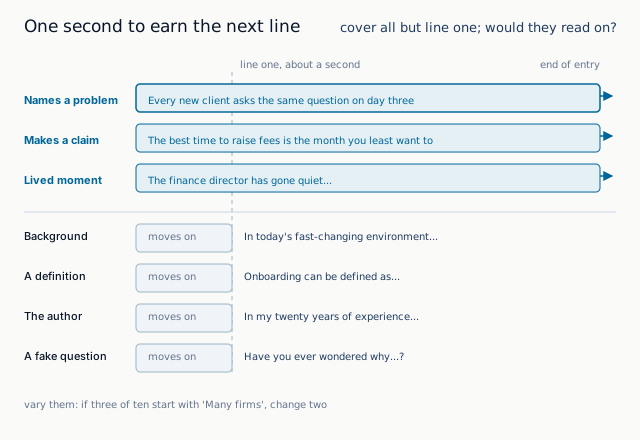
A good opening does one of a few things quickly. It names a problem the reader recognises: Every new client asks the same question on day three, and most firms answer it badly. It makes a claim the reader wants to test: The best time to raise your fees is the month you least want to. It describes a moment the reader has lived: The finance director has gone quiet, and you are not sure whether that is good. Each of these gives the reader a reason to read on, because it promises that the entry is about them.
Weak openings tend to share a few habits. They start with background: In today's fast-changing business environment. They start with definitions: Onboarding can be defined as. They start with the author: In my twenty years of experience. They start with a rhetorical question that nobody was asking. All of these delay the moment when the reader finds out whether the entry is for them, and most readers will not wait.
The opening paragraph should work as a lede in the journalistic sense: if the reader stopped after it, they would still have the gist. This is a high bar but a useful one. It forces you to lead with what matters and to trust that a reader who is interested will continue for the detail.
There is a craft to making openings varied across a hundred entries. If every entry begins with a problem statement, the book becomes monotonous. Mix problem, claim, scene, surprise and occasionally a plain direct instruction. Read the first sentences of all ten entries in a part one after another, and listen for repetition. If three start with Many firms , change two.
AI agents tend to produce safe, warm-up openings unless told otherwise. Put examples of strong openings in your voice file, with a note that the first sentence should name the problem or make a claim. Then check every draft's first line during editing; it is the single sentence most worth rewriting by hand.
A test you can apply at once: cover everything but the first sentence of an entry and show it to someone in your niche. Ask whether they would read on. If they hesitate, rewrite it.
The Authority Book — How a 100-entry book wins clients
Ready when you are.
Tap below to open the full chapter in the book reader. Anchored books jump to this chapter automatically.
Landings, Not Summaries
The Authority Book — How a 100-entry book wins clients
The end of an entry is where most writers lose their nerve. Having made the point, they feel compelled to make it again, in case the reader missed it. In summary, the first-week call is critical, and firms that get it right see better results. The reader did not miss it. They read it two paragraphs ago, and now they are reading it again, and they notice.
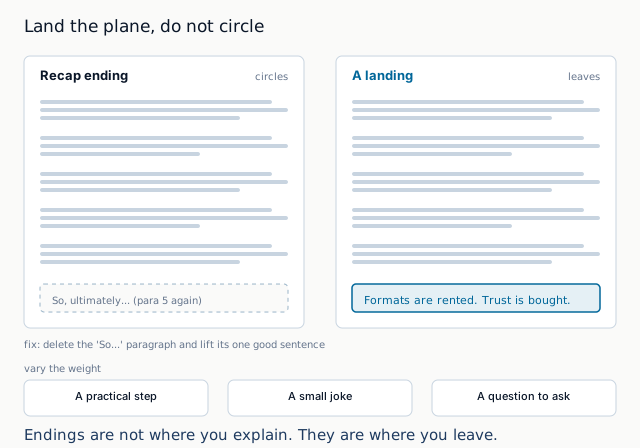
Summaries are useful in reports, where the reader may skip to the end. In a short entry they are padding, and padding at the end is particularly damaging because it is the last thing the reader experiences. An entry that ends flatly feels flat, however strong its middle.
The alternative is a landing: a final sentence or two that closes the entry with a turn. It might be an aphorism that compresses the lesson into a memorable shape. It might be a dry observation that reframes what came before. It might be a slight twist, an implication the reader had not quite seen. What it should not be is a restatement. A landing moves the reader one small step further, rather than walking them back to where they already were.
Good landings are often short. Fatigue is a reliable signpost. Formats are rented. Trust is bought outright. A brief that changes silently is not a brief. They work because they leave the reader with something to carry, a phrase that will come back to them when the situation arises. Aphorisms are memorable in a way that summaries never are.
A specific failure to watch for is the restating final paragraph. You write five good paragraphs, then a sixth that begins So or Ultimately and goes on to say what the fifth said, slightly more generally. This is the most common weakness in AI-drafted prose, and it is common in human prose too. The fix is almost always to delete the final paragraph and move its best sentence, if it has one, to the end of the previous paragraph.
Landings can be overdone. A book in which every entry ends with a portentous one-liner becomes tiring, like a friend who ends every story with a moral. Vary the weight. Some entries can end on a quiet practical note: what to do on Monday, said plainly. Some can end with a small joke. Some can end with a question the reader should ask themselves. The rule is simply that the ending should add something, not repeat something.
When editing, read only the last two sentences of each entry in a part, one after another. If they sound repetitive, or if several say the same kind of thing, vary them. If any could be deleted without loss, delete them.
The Authority Book — How a 100-entry book wins clients
Ready when you are.
Tap below to open the full chapter in the book reader. Anchored books jump to this chapter automatically.
Categories Readers Can Use
The Authority Book — How a 100-entry book wins clients
Part titles and category names are the main way readers navigate an authority book, and they are frequently wasted on labels that make sense only to the author. Methodology , Frameworks , Advanced Topics : these describe how the author thinks about the material, not what the reader needs from it. A reader scanning the contents does not know which one contains help with their problem.
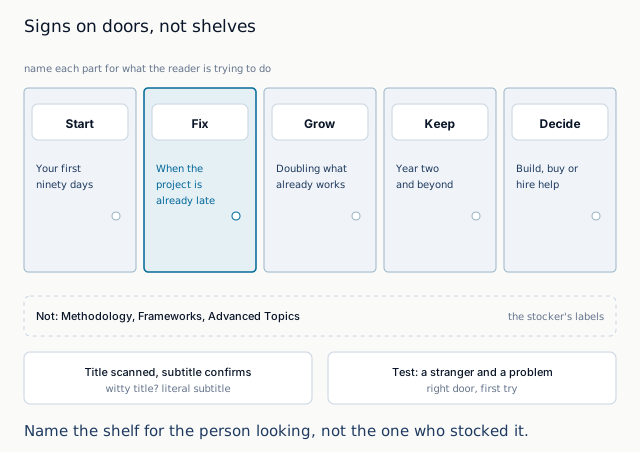
Name parts for reader needs instead. What is the reader trying to do when they open this part? Get started, fix something that is broken, grow something that works, keep something going, decide between options. A part named for the need tells the reader immediately whether it is for them. When the Project Is Already Late is more navigable than Recovery Methodology , even if they contain the same entries.
This approach also tests your structure. If you cannot name a part after a reader need, the part may be organised around your thinking rather than theirs. That is not always wrong, especially for the opening and closing parts, which often carry the argument rather than a specific need. But most of the middle parts should map onto something a reader would recognise as their situation.
A good part title is short, plain and specific, with a one-line subtitle that adds detail. Finding a Hundred Entries: mining what you already know. The title is what the reader scans; the subtitle confirms they have found the right place. Keep both free of jargon, metaphor and wordplay, for the same reasons as the book title.
Categories matter even more in digital editions. In a swipeable app or web reader, they become filters and navigation tabs. A reader on a phone might see only the category names and a handful of entries at a time. Clear, need-based names let them jump straight to what they want; abstract names leave them scrolling.
Test your names on someone who has not read the book. Give them the ten part titles and a specific problem, and ask which part they would open. If they choose correctly, the names work. If they hesitate or choose wrongly, rename until they can find their way without help.
There is a temptation to be clever with part titles, especially when the book title has been made plain. A little personality is fine, but navigation comes first. If a part title is witty, the subtitle must be literal, so the reader is never in doubt about what lies inside.
The Authority Book — How a 100-entry book wins clients
Ready when you are.
Tap below to open the full chapter in the book reader. Anchored books jump to this chapter automatically.
Threads and Cross-References
The Authority Book — How a 100-entry book wins clients
A hundred entries that each teach one lesson risk feeling like a hundred separate tips. The structure helps, but what really turns a collection into a book is a handful of threads: ideas that recur across parts, connecting entries that might otherwise feel unrelated, and quietly building the book's argument.
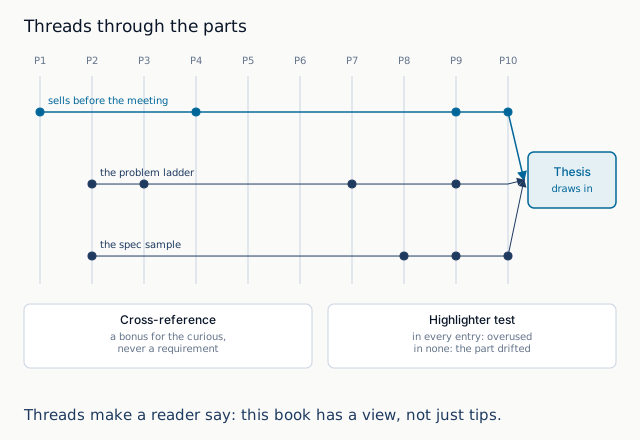
A thread is a concept, a phrase or a principle that appears in several entries in different contexts. In this guide, for example, the idea that the book does the selling before the meeting runs through almost every part. It appears in the opening chapter, returns in the part on sales conversations, and arrives as the thesis at the end. A reader who goes in order feels it accumulate. A reader who browses meets it often enough to understand that it matters.
Choose three to five threads for your book. They should be ideas central to your point of view: the things you believe most firmly about your field. Then, as you plan entries, note where each thread naturally appears. Not every entry needs a thread, and no entry should be forced to carry one, but most parts should touch at least one, and the thesis part should draw them together.
Cross-references are the explicit version. As the entry on the problem ladder describes or see the chapter on spec samples tells the reader that another entry develops this idea further. Use cross-references sparingly. Too many make a book feel like a maze, and they break the principle that each entry should stand alone. A good rule is that a cross-reference should be a bonus, never a requirement: the entry makes sense without it, but a curious reader can follow it for more.
Threads also give your book a vocabulary. When a phrase recurs, readers start to use it. Clients begin a meeting by saying they think they have a top-rung problem, or that they need a spec sample. That shared language is a powerful sign that the book is working, and it shortens conversations because you are both using words you have already defined.
When drafting with AI agents, list your threads in the voice file with a sentence explaining each. Ask the agent to weave the relevant one in where it fits naturally, and to avoid forcing it. Then check during editing that threads appear with consistent wording and do not become repetitive.
A practical exercise: take a highlighter, digital or otherwise, and mark every appearance of one thread across a part. If it appears in every entry, it is overused. If it appears in none, either the thread is not really central or the part has drifted from your argument.
The Authority Book — How a 100-entry book wins clients
Ready when you are.
Tap below to open the full chapter in the book reader. Anchored books jump to this chapter automatically.
The Last Entry States the Case
The Authority Book — How a 100-entry book wins clients
Entry one hundred is the most important entry in the book. It is the last thing a reader who goes in order experiences, the entry most likely to be quoted, and the place where the whole argument should come to rest. It should state the book's thesis plainly, in a way that a reader could repeat in a sentence to a colleague.
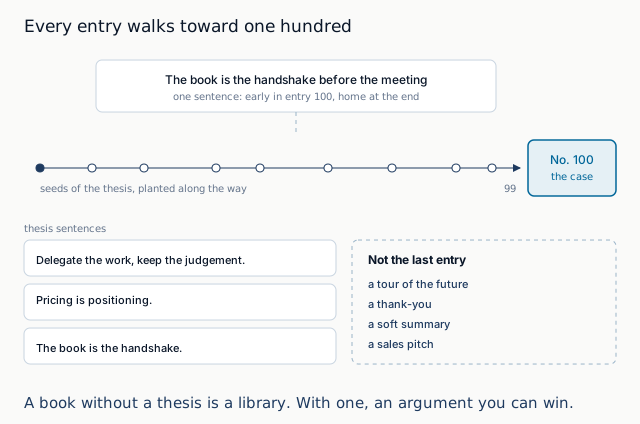
Many experts avoid this. They end with an entry about the future, or a generous thank you, or a soft summary of the parts. These can be pleasant, but they waste the moment. A reader who has given you ninety-nine entries' worth of attention has earned your clearest statement of what you believe. Give it to them.
The thesis should not be a surprise. If it is, the book has not been building toward it. It should feel like the natural conclusion of everything before it, the idea the threads have been converging on, said once with full conviction. A good test is that a reader who has only browsed should still recognise it, because they will have met pieces of it scattered through the parts.
Write the thesis as a single sentence first. Delegate the work, keep the judgement. Pricing is positioning. The book is the handshake before the meeting. Then write the entry around it: why you believe it, how the parts of the book support it, what it asks of the reader. The sentence should appear early in the entry, ideally in the first paragraph, and the entry should end by bringing it home.
This entry also serves a commercial purpose, though it should never read as a pitch. A reader who finishes the book and agrees with the thesis is well on the way to becoming a client, because they now see their problem the way you do. They do not need to be told to book a call. If they agree, they will. If the final entry ends with a sales message, it undermines the generosity of the hundred entries before it and makes the whole book feel like an elaborate brochure.
Instead, make the thesis useful in its own right. Show the reader how to apply it tomorrow. Give them a question to ask in their next meeting, a decision to revisit, a way of looking at their week differently. If the thesis changes their behaviour, the book has done its job, and whether or not they hire you, they will remember who changed their mind.
Write entry one hundred early. Not first, perhaps, but certainly before you write the middle parts in earnest. Knowing where the book ends helps you build toward it, and you will find yourself planting the seeds of the thesis in earlier entries without forcing it.
The Authority Book — How a 100-entry book wins clients
Ready when you are.
Tap below to open the full chapter in the book reader. Anchored books jump to this chapter automatically.
The Factory, Not the Typewriter
The Authority Book — How a 100-entry book wins clients
For most of publishing history, writing a book meant sitting at a typewriter, or its descendants, and producing words in order until there were enough of them. The bottleneck was the writing itself. A hundred-entry book written that way took months, and many expert books were abandoned somewhere around entry thirty, when the author's enthusiasm met their calendar.
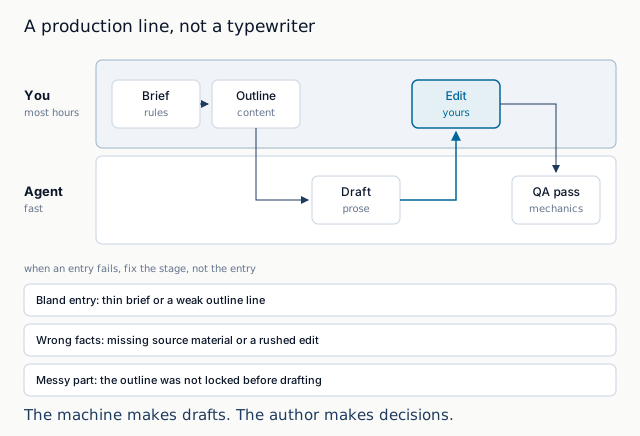
AI agents have moved the bottleneck. Producing fluent prose is no longer the hard part. An agent given good inputs can draft a solid entry in the time it takes you to make coffee. What has become hard, and valuable, is everything around the drafting: deciding what to say, giving the agent the right material, checking what comes back, and editing until it sounds like you and says what you mean.
This calls for a different mental model. Not a typewriter, where you produce the words, but a factory, where you design a process with stages and quality checks, and the words come out the other end. The stages are roughly: a brief that sets the rules, an outline that fixes the content, drafting that turns outline into prose, editing that turns prose into your prose, and a QA pass that catches mechanical errors. Each stage has a clear input and output. Each can be improved independently.
The payoff stage is editing. Everything upstream exists to give the editing stage good material; everything downstream exists to check the editing was done. Editing is where your knowledge, judgement and voice enter the book, and it is the stage you must never delegate entirely, however good the tools become.
Thinking in stages has practical benefits. When something goes wrong, you can find which stage failed. A bland entry usually means a thin brief or a weak outline line, not a bad draft. A factually wrong entry means the source material was missing or the editing was rushed. A badly structured part means the outline was not locked before drafting began. Fixing the stage fixes every entry that passes through it, which is far more efficient than fixing entries one at a time.
It also helps you plan time sensibly. Most of your hours should go into the stages that only you can do: the brief, the outline, the editing. The drafting can be fast. If you find yourself spending most of your time rewriting drafts from scratch, the upstream stages need more attention, because the agent is guessing at things you have not told it.
The factory model is not cold. A well-run workshop produces handmade goods; the process exists so that the craftsperson spends their time on the parts that need craft. Your book will still be yours, and arguably more so, because you will have had time to think about every entry rather than merely to type it.
The Authority Book — How a 100-entry book wins clients
Ready when you are.
Tap below to open the full chapter in the book reader. Anchored books jump to this chapter automatically.
Brief Before Prompt
The Authority Book — How a 100-entry book wins clients
The quality of an AI-drafted entry depends almost entirely on what the agent knew before it started. Clever prompting matters far less than people think. What matters is context: who the reader is, what the book promises, what the entry must teach, what the author sounds like, and what source material to draw on. Supply that context well and a plain request produces a good draft. Supply it badly and no amount of prompt engineering will help.
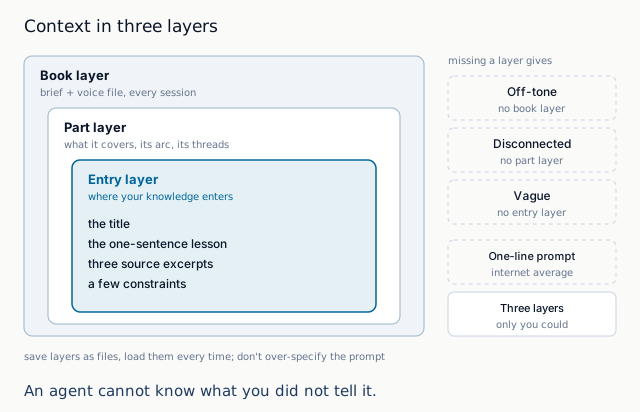
Think of context in three layers, narrowing from the book to the entry. At the top is the book brief and voice file: the one-page brief from earlier, plus a document describing how you write. This layer is the same for every entry and should be supplied every time. Below it is the part brief: a short note on what this part of the book covers, how it fits into the arc, and what threads it should carry. Below that is the entry prompt: the title, the one-sentence lesson, the source material, and any specific instructions.
Each layer has a different job. The book layer sets the boundaries and the tone. The part layer gives coherence, so that ten entries in a part feel related rather than random. The entry layer gives precision, so that each entry teaches its one thing rather than drifting into a general overview. Missing any layer produces a recognisable failure: off-tone without the first, disconnected without the second, vague without the third.
The entry layer is the payoff, because it is where your specific knowledge enters. A prompt that says write an entry on client onboarding will get you an average of everything ever written about onboarding. A prompt that says write an entry teaching that the first-week call should be booked before the contract is signed, drawing on these three anonymised email excerpts will get you something only you could have produced.
Save your layers as files. Do not retype the brief at the start of each session or rely on memory; you will forget things and introduce inconsistencies. Most current agent tools let you attach files or keep project-level instructions that apply to every session. Use them. Your book brief and voice file should be loaded automatically every time.
Resist the urge to put everything into the entry prompt. Long, detailed prompts that try to control every sentence produce stiff drafts. Give the agent the lesson, the material and the constraints, and let it draft. You will edit anyway, and editing a natural draft is easier than editing one contorted by too many instructions.
This week, write the three layers for one part of your book: the book brief you already have, a part brief of a paragraph, and entry prompts for two entries. Draft those two entries with an agent. Compare the results to what you get from a one-line prompt with no context. The difference will persuade you more than anything this chapter can say.
The Authority Book — How a 100-entry book wins clients
Ready when you are.
Tap below to open the full chapter in the book reader. Anchored books jump to this chapter automatically.
Capturing Your Voice
The Authority Book — How a 100-entry book wins clients
The greatest risk in AI-assisted book production is not error but anonymity. Agents write competent, balanced, slightly over-explained prose that sounds like nobody in particular. A book in that voice may be accurate and useful, but it will not feel like you, and readers deciding whether to hire you want to meet you, not a well-informed stranger.
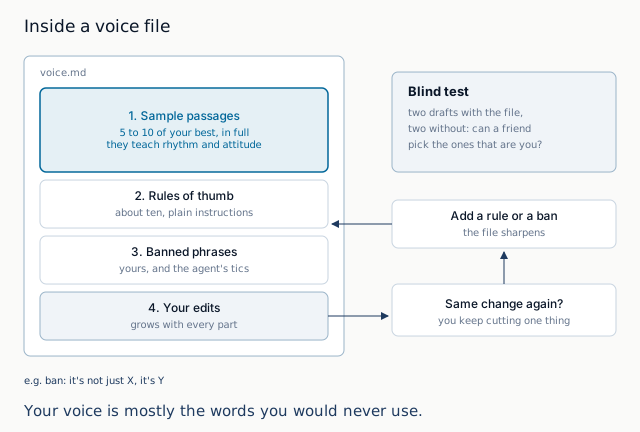
A voice file fixes this, or at least makes it fixable. It is a document that describes how you write, in enough detail that an agent can imitate you and an editor can check whether it did. It has four layers, and the most important is the first.
Sample passages come first because examples teach more than descriptions. Choose five to ten passages of your own writing, or transcribed speech, that sound most like you at your best: an email that explained something well, a paragraph from a talk, a post that people responded to. Include them in full. An agent will absorb rhythm, vocabulary and attitude from examples far more reliably than from any list of adjectives.
Rules of thumb come next. These are the things you do consistently: short sentences, British spelling, a habit of ending on a dry observation, a preference for concrete examples over abstractions, a tendency to address the reader directly. Write them as plain instructions. Keep the list short; ten rules are more useful than forty.
Banned phrases are the third layer, and they are surprisingly powerful. Every writer has words and constructions they would never use, and every agent has habits that give its prose away. List both. Overused intensifiers, corporate abstractions, certain transitions, the reflexive it's not just X, it's Y construction, any phrase you wince at when you see it in other people's writing. The agent will avoid them, and the prose will immediately sound less generic.
The fourth layer grows over time: your edits. As you edit drafts, notice the changes you keep making. If you repeatedly cut a certain kind of sentence, add a rule. If you repeatedly replace one word with another, add it to the banned list. After twenty or thirty entries, your voice file will be much sharper than when you started, and the drafts will need less editing.
Test the voice file early. Draft two entries with it and two without, and show all four to someone who knows you well, without saying which is which. If they can identify the ones that sound like you, the file is working. If not, the samples probably need replacing with more distinctive passages.
The Authority Book — How a 100-entry book wins clients
Ready when you are.
Tap below to open the full chapter in the book reader. Anchored books jump to this chapter automatically.
One Part at a Time
The Authority Book — How a 100-entry book wins clients
The temptation, once you have a brief and an outline, is to ask an agent for the whole book at once. It may even appear to work. A hundred entries will arrive, roughly the right length, roughly on topic. Then you start reading and discover that entry seventy-three is a weaker version of entry twelve, that the voice drifted somewhere around part six, and that several entries got truncated mid-paragraph because the output ran out of room.
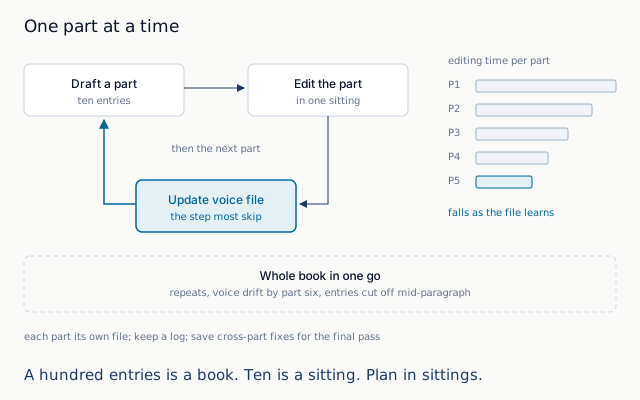
Work one part at a time instead. Ten entries is a manageable batch: small enough that the agent can hold the part brief, the voice file and the source material for each entry in view at once, and large enough that you see the part as a whole rather than as isolated entries. It is also a sensible unit for you, because you can edit a part in one sitting and judge whether its arc works.
The rhythm is a loop. Draft a part. Edit the part. Then, before drafting the next, update the voice file with what you learned from editing. This last step is the payoff, and it is the one most people skip. Each part you edit teaches you something about where the agent's drafts diverge from your voice. Capture that lesson in the voice file, and the next part's drafts will be better. By part five, editing should be noticeably faster than it was in part one.
Batching by part also protects against technical failures. Agent outputs have limits, and long outputs are more likely to be cut off, repeated or quietly summarised. Ten entries of around five hundred words each is comfortably within what current tools handle well. A hundred entries in one go is not, and failures at that scale are tedious to find.
Save each part as its own file. This makes it easy to redo a part without touching the rest, to compare versions, and to assemble the book at the end from verified pieces. It also lets you work out of order if you need to. Writing part ten early, for example, helps you plant its thesis in earlier parts.
Keep a running log of each part: when it was drafted, when it was edited, what changed in the voice file as a result, and any entries that need revisiting. This takes a minute per part and saves considerable confusion later, especially if the project is interrupted by client work, which it will be.
Resist editing across parts while drafting. If you notice something in part three that should change part one, note it in the log and move on. Going back mid-flow breaks the rhythm and invites endless revision. There will be a full-book pass at the end, where cross-part issues get fixed together.
The Authority Book — How a 100-entry book wins clients
Ready when you are.
Tap below to open the full chapter in the book reader. Anchored books jump to this chapter automatically.
The Outline Is the Contract
The Authority Book — How a 100-entry book wins clients
Before any prose is drafted, the outline should be locked: all ten parts named, all hundred entries titled, each with its one-sentence lesson and a note on source material. Locked means you do not change it casually during drafting. It is a contract between you and the production process, and like most contracts, it saves arguments later.
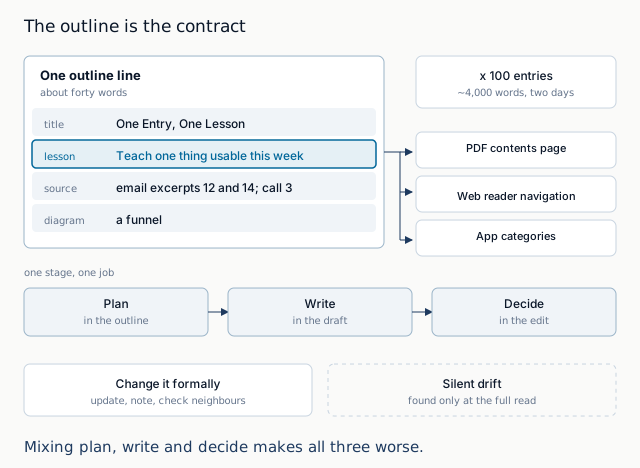
The reason is simple. If you start drafting with a loose outline, every entry becomes a small planning exercise as well as a writing one. You decide what it is about while drafting, which means the draft cannot be checked against anything. Entries overlap because you forgot what the previous one covered. Parts lose their arcs because the order was never fixed. By the end, you have a hundred entries that need restructuring, and restructuring finished prose is much harder than restructuring an outline.
With a locked outline, the agent knows exactly what each entry must do, and so do you. Drafting becomes a matter of executing a plan, not discovering one. When a draft comes back, you can check it against its outline line: does it teach the stated lesson? does it use the noted material? does it stay inside its scope? Any deviation is visible immediately, which makes editing faster and more confident.
This is the payoff of the outline: no surprises. Not because the drafts are perfect, but because you know in advance what each one should be, so you can see clearly when it is not.
A good outline line for each entry has four parts. The title. The one-sentence lesson. The source: which emails, transcripts or notes to draw on. And a note on diagram, if the book has them. That is about forty words per entry, four thousand for the book. Writing it takes a day or two. It is the most valuable two days of the project.
Locked does not mean frozen. Sometimes drafting reveals that an entry is wrong: two entries are really one, or an important lesson is missing. When that happens, change the outline formally. Update the file, note the change, and check whether the change affects other entries. What you must avoid is the silent drift, where an entry quietly becomes something else during drafting and nobody notices until the full-book read.
Save the outline in a structured format that both you and the agent can read. A simple JSON file or a spreadsheet works. It becomes the spine of the book's data, and later, when you produce multiple editions, the same structure will drive the PDF contents page, the web reader navigation and the app categories.
The Authority Book — How a 100-entry book wins clients
Ready when you are.
Tap below to open the full chapter in the book reader. Anchored books jump to this chapter automatically.
Agents Draft, You Decide
The Authority Book — How a 100-entry book wins clients
The author of an AI-assisted book is not a typist and not a passive approver. The role is closer to editor-in-chief: the person who decides what goes in, what comes out, what the book says and how it says it. Agents draft. You decide. Every entry in the book should pass through your judgement before it reaches a reader, and the book should be one you would sign, line by line.
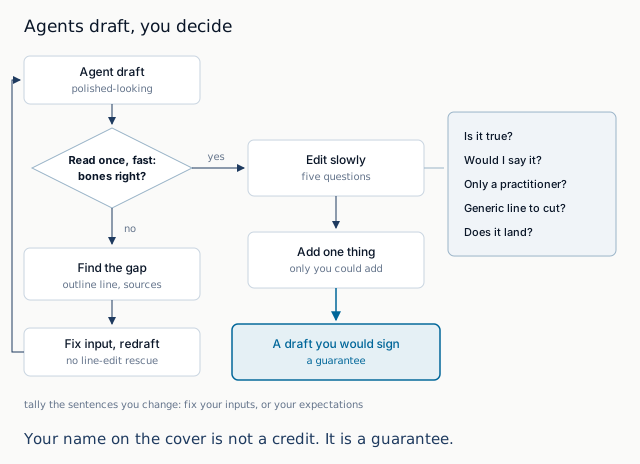
Most drafts will land in one of two places. Some are good enough to edit: the structure is right, the lesson is clear, the voice is close, and the work is in tightening sentences, adding specifics and fixing the ending. Others are not: the draft misunderstood the lesson, filled space with generalities, or took an angle you would never take. These need rewriting, either by redrafting with a better prompt or by writing the entry yourself.
The decision between the two should be quick. Read the draft once, fast, and ask whether the bones are right. If they are, edit. If they are not, do not try to rescue it with line edits; you will spend longer and end up with something worse. Go back to the outline line and the source material, find out what the agent was missing, fix the input, and redraft.
The goal of editing is the payoff: a draft you would sign. Not one that is merely acceptable, or one that sounds fine, but one where you would be comfortable having a client read any sentence of it aloud and ask you to explain. That standard is demanding. It is also the only one that works, because readers will judge you by every sentence regardless of who wrote the first draft.
Editing an agent's draft is a particular skill. The prose usually looks polished, which makes it easy to read past problems. Read slowly and ask specific questions. Is this true? Is this what I would say? Is this specific enough that only a practitioner could have written it? Is there a generic sentence I can cut or replace with a real example? Does the ending land or restate? Mark everything that fails, then fix it.
A useful habit is to add one thing to every entry that only you could add: a detail from a real situation, a phrase you actually use with clients, a limitation you have discovered, a small opinion. Even when the draft is good, this personal layer is what makes the entry yours rather than merely correct. It often takes only a sentence or two.
Expect your editing rate to improve. Early parts may need heavy work; later ones less, as the voice file sharpens and you learn where the agent tends to go wrong. If editing does not get faster after a few parts, look upstream: the brief, the outline or the source material is probably thin.
The Authority Book — How a 100-entry book wins clients
Ready when you are.
Tap below to open the full chapter in the book reader. Anchored books jump to this chapter automatically.
Fact-Checking the Fluent
The Authority Book — How a 100-entry book wins clients
AI-drafted prose has a dangerous quality: it is fluent even when it is wrong. A sentence stating a false statistic reads exactly as smoothly as one stating a true principle. An invented quote attributed to a real person looks just like a real quote. A confident description of a regulation that changed last year sounds authoritative. Fluency is not evidence, and an authority book that contains confident errors damages the authority it was meant to build.
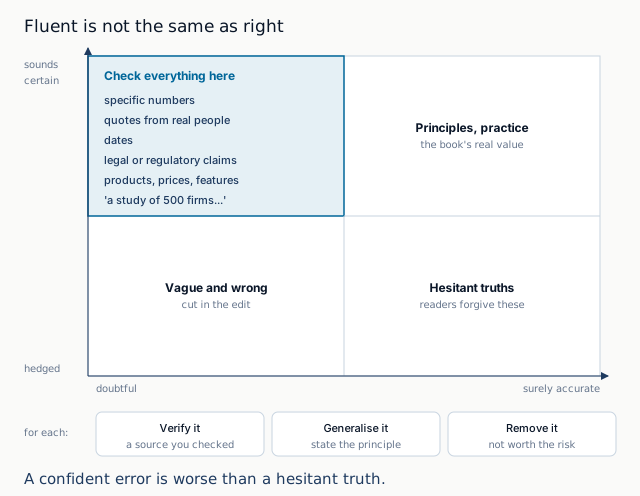
Picture the risk on two axes: how confident a sentence sounds, and how likely it is to be accurate. The dangerous quadrant is high confidence, uncertain accuracy: specific numbers, named sources, dates, legal or regulatory claims, descriptions of products and tools, and anything presented as research. These are where agents most often produce plausible errors, and where errors do most harm. Check everything in that quadrant.
Some categories deserve a blanket rule. No statistics presented as fact unless you have a source you have personally checked. No quotes attributed to real people unless you can point to where they said it. No specific claims about products, prices or features, which change too fast to keep accurate in a book. No legal or regulatory statements beyond the general principle unless verified for your jurisdiction. When in doubt, describe the principle rather than the specific; it is less vivid and much safer.
Agents also invent examples that sound real. A study of five hundred firms found is a common construction, and it may refer to nothing at all. Replace invented studies with your own experience, clearly labelled as such: in the firms I have worked with . That is both more honest and more persuasive, because it is something only you can say.
Build fact-checking into the production line, not as an afterthought. After editing each part, do a separate pass looking only for checkable claims. Highlight every number, name, date and source. For each, either verify it, generalise it, or remove it. This pass is faster than it sounds, because a well-written authority book should not contain many such claims; most of its value is in principles and practice, not data.
Be especially careful with your own field's received wisdom. Many professions repeat statistics that nobody has traced to a source in years. An agent will repeat them too, fluently. If you cannot find where a figure came from, leave it out. Your credibility is not worth a number you cannot defend.
Dates and currency matter. A book published this year should be correct as of this year. Check that descriptions of tools, practices and regulations are current, and date the edition clearly so readers know when it was accurate.
The Authority Book — How a 100-entry book wins clients
Ready when you are.
Tap below to open the full chapter in the book reader. Anchored books jump to this chapter automatically.
Killing the Generic Sentence
The Authority Book — How a 100-entry book wins clients
A generic sentence is one that anyone could have written about any subject. Communication is key to success. Every business is different. It's important to consider all the options. These sentences are not wrong. They are simply empty, and a book full of them feels empty too, however much useful content sits between them.
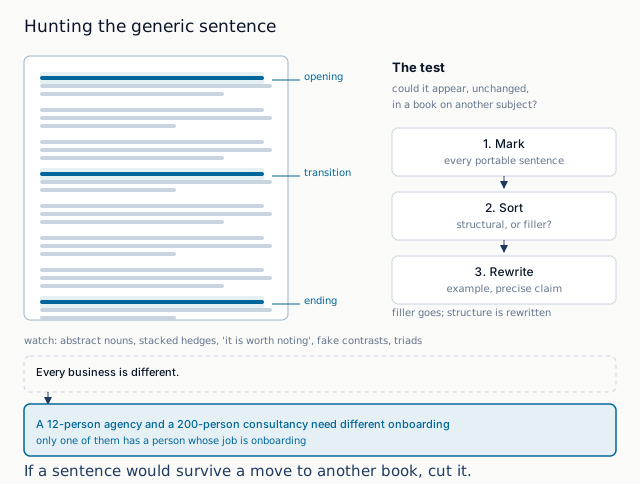
Agents produce generic sentences by default, because they are the statistical centre of everything ever written. Humans produce them too, especially when tired or uncertain. Either way, they creep into drafts in predictable places: openings, transitions, and endings, where the writer is getting started, changing direction, or trying to wrap up. Hunting them down is one of the most effective edits you can make.
The test is simple. For any sentence, ask: could this appear, unchanged, in a book about a completely different subject? If every business is different could appear in a book on marketing, recruitment or catering, it is generic. Either cut it or replace it with something specific. A twelve-person agency and a two-hundred-person consultancy need different onboarding, mostly because only one of them has a person whose job is onboarding says something.
Work through a draft in three passes. First, find every sentence that could appear in another book, and mark it. Second, for each marked sentence, decide whether it is doing structural work, such as connecting two ideas, or whether it is filler. Filler goes. Third, rewrite the structural ones with specifics: a real example, a named situation, a precise claim. What remains is the payoff: sentences only you could have written.
Watch for particular patterns. Abstract nouns doing the work of verbs: the implementation of improvements instead of improving . Hedges stacked on hedges: it may perhaps be worth considering . Throat-clearing transitions: it is worth noting that , in today's world . Fake contrasts: it's not just about X, it's about Y . Lists of three abstract qualities: clarity, consistency and commitment . Add the ones you find to your voice file's banned list.
You will not eliminate every generic sentence, and you should not try. Some plain connecting sentences are necessary, and a book in which every sentence strains for specificity becomes exhausting. The aim is to reduce them until the reader no longer notices them, and to make sure none sits in a prominent position: first sentence, last sentence, or the start of a paragraph.
This edit has a cumulative effect. A single generic sentence does little harm. Twenty in an entry make it feel like a template. Two thousand in a book make readers wonder whether anyone was home. Cutting them is how the book starts to sound like a person.
The Authority Book — How a 100-entry book wins clients
Ready when you are.
Tap below to open the full chapter in the book reader. Anchored books jump to this chapter automatically.
Editing catches problems of judgement. A QA pass catches problems of mechanics: entries that are too short, parts with the wrong number of entries, diagram labels that will not fit, two endings that say the same thing, a stray bullet list where prose should be. These are tedious for a human to check across a hundred entries and trivial for a script. Let the script do it.
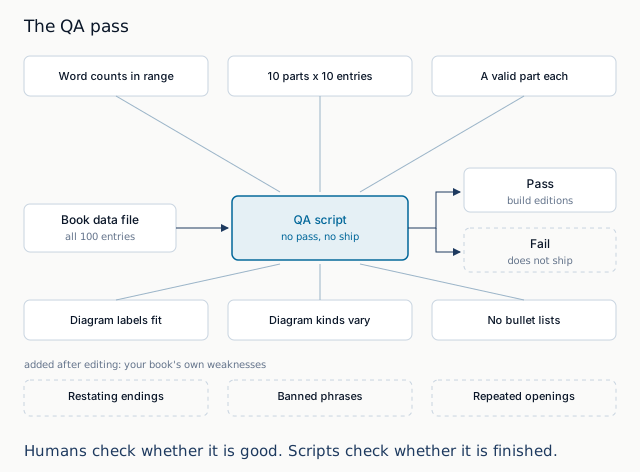
A good QA script is a small piece of code that reads the book's data file and checks a list of rules. Word counts within range for every entry. Exactly ten parts with exactly ten entries each. Every entry assigned to a valid part. Diagram labels within their character limits. No more than two consecutive diagrams of the same kind within a part, so the book does not feel visually repetitive. No bullet lists inside entries. You can ask an agent to write it in an afternoon; you will run it dozens of times.
Add checks for the failures you find during editing. If you keep catching restating final paragraphs, add a check that compares the last paragraph of each entry with the one before it and flags high overlap. If certain banned phrases keep slipping through, add a search for them. If entries keep starting with the same three words, flag that. The QA script becomes a record of your book's particular weaknesses, encoded so they cannot recur unnoticed.
The script is the hub of the production line's final stage. Every part passes through it before being marked done, and the whole book passes through it before any edition is built. A book that fails QA does not ship. That rule sounds rigid, and it is, which is the point. It removes the temptation to ignore small problems on a deadline.
QA is not a substitute for editing. A book can pass every mechanical check and still be dull, wrong or unlike you. The script tells you that each entry is the right length, not whether it is worth reading. Treat a passing QA run as a minimum, the floor beneath which nothing ships, not as evidence of quality.
It does, however, free your attention for what matters. Without a script, part of your mind is always counting words and checking structure while you edit. With one, you can edit for meaning and voice, knowing the mechanics will be caught later. That shift in attention is worth more than the time the script saves.
Keep the script with the book. When you produce a new edition, run it again. When you take on a client book, adapt it. Over time it becomes part of your production system, a quiet guarantee that every book you produce meets the same baseline.
The Authority Book — How a 100-entry book wins clients
Ready when you are.
Tap below to open the full chapter in the book reader. Anchored books jump to this chapter automatically.
Speed Is Not the Product
The Authority Book — How a 100-entry book wins clients
AI-assisted production is fast. Once the brief, voice file and outline are in place, drafting a part can take an hour, and a disciplined author can move from blank page to finished book in days rather than months. This is genuinely new, and it changes what is possible for busy experts. It is also easy to misread.
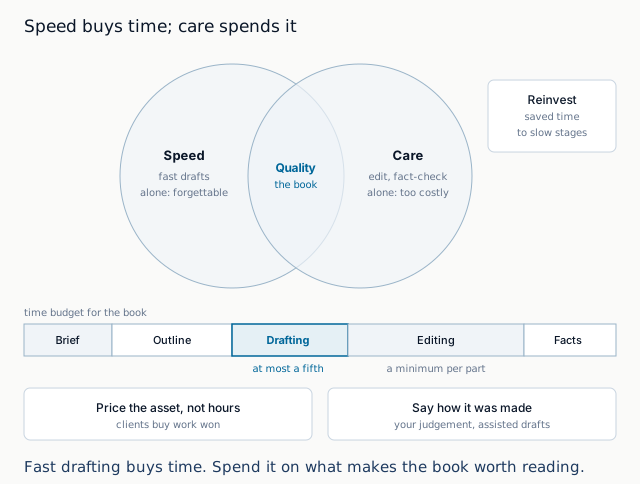
Speed is not the product. Readers do not care how long your book took to produce. They care whether it helps them. A book written in a week that helps is worth far more than one written in a year that does not, but the week is not what makes it valuable. The value is in the knowledge, the judgement, the structure and the editing. Speed is simply the condition that makes those affordable.
The right way to use speed is to reinvest it. Time saved on drafting is time available for the stages that matter: a sharper brief, a better outline, more thorough editing, more careful fact-checking, a second pass on the weakest part. The best AI-assisted books are not the fastest ones. They are the ones where the author spent the saved time on care. Quality lives where speed and care overlap, and either alone falls short.
There is a trap on the other side. Some authors, discovering that drafting is fast, conclude that the whole book should be fast, and skip the slow stages. The result is a book that was easy to make and is easy to forget. Readers notice, and an authority book that reads as hastily produced damages the authority it was meant to build.
Be straightforward about how the book was made. You do not need to narrate your tools in the introduction, but you should never claim or imply that an AI-assisted book was produced the old way. If a reader or client asks, tell them: the knowledge and judgement are yours, the drafting was assisted, and every entry was edited and approved by you. Most people find this reassuring rather than off-putting, because it describes a careful process.
The same applies if you produce books for clients, which the final part of this guide covers. Price on the value of the finished asset and the expertise that goes into it, not on hours spent typing. A client is buying a book that wins them work, not a quantity of your time. Faster production means you can deliver that book with more care, more revisions and better design within the same engagement. That is a better offer, not a cheaper one.
A useful discipline is to set a minimum editing time per part and keep to it, however good the drafts look. It protects quality from your own enthusiasm.
The Authority Book — How a 100-entry book wins clients
Ready when you are.
Tap below to open the full chapter in the book reader. Anchored books jump to this chapter automatically.
Looks Like a Book, Not a Deck
The Authority Book — How a 100-entry book wins clients
Most business documents are designed like presentations: big headings, bullet points, bold colours, a logo on every page, and lots of white space with not much in it. Experts who have spent years producing decks tend to design their book the same way. It is the wrong instinct. A book that looks like a deck reads like a deck, and decks are skimmed and forgotten.
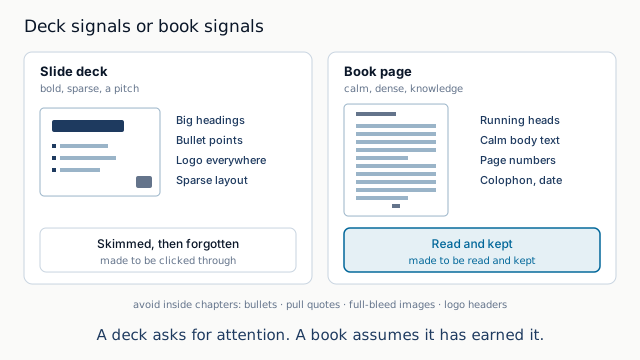
Book conventions exist for a reason. Readable body text at a comfortable size. Generous margins. A clear hierarchy of title, part and chapter. Running heads so readers know where they are. A contents page. Page numbers. A colophon with the edition and date. These conventions signal seriousness before a single word is read. They tell the reader that this is something to be read, not presented, and that someone took the trouble to make it properly.
They also make the book easier to read. Long passages of prose need different design from slides. Line length matters: too long and the eye loses its place; too short and the rhythm breaks. Leading, the space between lines, affects how tiring a page is. Paragraph spacing and indentation help the reader track the argument. None of this is visible when done well, which is precisely why it is worth doing.
The choice is between two sets of signals. Deck signals say this is a pitch : bold, sparse, designed to be clicked through. Book signals say this is knowledge : calm, dense, designed to be read and kept. Your book is meant to be the second, so it should look like the second.
This does not mean the book must look old-fashioned. Modern book design is clean, often minimal, and entirely compatible with a contemporary brand. Think of the design of good contemporary non-fiction rather than a textbook: confident typography, a restrained palette, one strong accent colour, and diagrams that feel integrated rather than pasted in. What it avoids is the visual noise of marketing: gradients, stock photography, slogans in large type, and anything that looks like it is trying to sell.
A few deck habits are especially worth avoiding. Bullet points inside chapters, which break prose into fragments and make arguments look like lists. Pull quotes on every page, which interrupt reading for no gain. Full-bleed images that push text onto the next page. Headers with your logo and tagline, which make the book feel like a brochure. Callout boxes summarising each chapter, which tell readers they can skip the chapter.
If you do not have a book designer, use a good template. Several publishing tools produce competent book layouts from structured text, and the rest of this part describes how to adapt one to your brand. Competent and calm beats elaborate and noisy every time.
The Authority Book — How a 100-entry book wins clients
Ready when you are.
Tap below to open the full chapter in the book reader. Anchored books jump to this chapter automatically.
Brand Without Logo Soup
The Authority Book — How a 100-entry book wins clients
An authority book needs to look like it came from you. That does not mean covering it in your logo. In fact, the more visible your branding, the more the book looks like marketing, and the less readers trust it. The art is to carry your brand in ways that feel native to a book: colour, type, tone and a few consistent details.
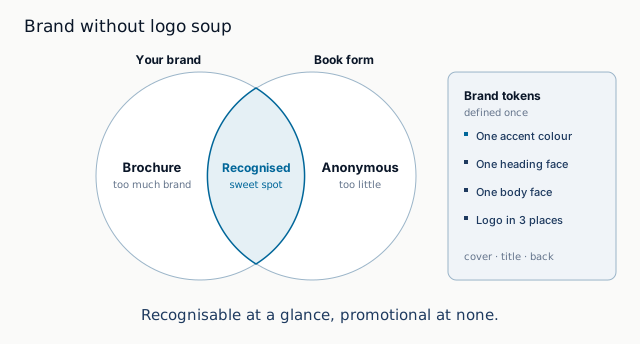
Start with colour. Most brands have a primary colour. Use it as the book's single accent: in part dividers, in the focal element of diagrams, perhaps in chapter numbers or a thin rule under headings. One colour, used sparingly and consistently, is enough to make a book recognisably yours. Using your full brand palette, with secondary and tertiary colours, tends to look busy on a page designed for reading.
Type is the second carrier. If your brand has a typeface, consider using it for headings, where it will be noticed, while choosing a highly readable typeface for body text, which may not be the same thing. Many brand fonts are designed for short marketing copy and become tiring over five hundred words. A book can pair a brand heading face with a classic text face without losing identity.
The logo belongs in a few places only. The cover, perhaps small. The title page. The back cover or final page, with a line about your firm and how to contact you. That is enough. Readers know who wrote the book; they do not need reminding on every page. A logo in the running head of every page turns the book into stationery.
Tone is part of the brand too. If your firm is known for being calm and precise, the book's design should be calm and precise. If it is known for energy and boldness, a bit more contrast and colour may suit. The design should feel like meeting you, the same way the voice should.
There is a sweet spot where your brand and the book form overlap. Too much brand and it is a brochure. Too little and readers do not connect it with you. The overlap is where a reader sees the book, recognises the accent colour from your website, notices the heading typeface from your proposals, and connects the two without feeling sold to. That recognition builds over time, especially if you produce more than one book.
Consistency across editions matters. The PDF, the web reader, the printed copy and the app should share the same accent colour, the same heading type and the same diagram style. A reader who meets the book in several forms should recognise it each time. That is much easier if you define the brand tokens once, as a small set of colours and font choices, and use them everywhere.
The Authority Book — How a 100-entry book wins clients
Ready when you are.
Tap below to open the full chapter in the book reader. Anchored books jump to this chapter automatically.
Typography Does the Work
The Authority Book — How a 100-entry book wins clients
If you only have time to get one design decision right, make it the body text. Most of a book is body text. Readers spend almost all their time looking at it. If it is comfortable to read, the book feels good even when other design choices are modest. If it is uncomfortable, no amount of clever layout will save it.
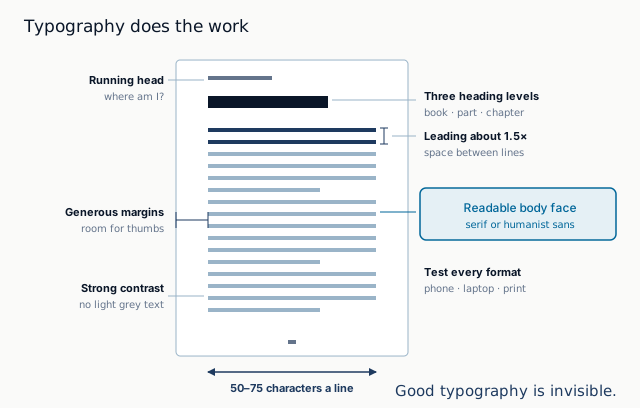
Comfortable body text comes from a few decisions working together. A typeface designed for reading at length, which usually means a well-made serif or a humanist sans-serif with open shapes. A size large enough to read without strain on the format you are using. Line length of roughly fifty to seventy-five characters, which keeps the eye from getting lost. Leading of around one and a half times the type size. Sufficient contrast between text and background. None of these is exotic. All of them are commonly ignored.
Headings come next. They should be clearly different from body text, through size, weight or typeface, but not so loud that they dominate the page. A good heading hierarchy has only a few levels: book title, part title, chapter title. Most authority books need no headings inside chapters, since entries are short and written as continuous prose.
Margins and white space matter more than people expect. Generous margins make a page feel calm and considered. Cramped margins make it feel like a contract. On screen, margins mostly mean keeping text away from the edges and limiting line length on wide displays. In print, they mean leaving room for thumbs and binding.
Beware the decorative temptations. Fancy typefaces for body text, text in light grey to look elegant, very small sizes to fit more on a page, justified text without proper hyphenation that leaves rivers of white space. Each of these makes reading harder. Readers will not consciously notice; they will simply find the book tiring and stop sooner.
Test on the real formats. Body text that looks fine on a large monitor may be too small on a phone. Text that reads well on a phone may look sparse in print. Since your book will appear in several editions, check the typography in each. Most good publishing tools let you set different sizes per format while keeping the same typefaces.
A useful shortcut: borrow the typographic settings of a book you find comfortable to read. Measure its line length, estimate its type size and leading, and note its margins. You are not copying its design, just learning from settings that have already been tested on readers.
The Authority Book — How a 100-entry book wins clients
Ready when you are.
Tap below to open the full chapter in the book reader. Anchored books jump to this chapter automatically.
One Diagram Per Entry
The Authority Book — How a 100-entry book wins clients
Most authority books are walls of text, occasionally interrupted by a stock photo. Adding one simple diagram to every entry changes the experience entirely. The book becomes easier to browse, easier to remember, and noticeably more distinctive. It also forces you to understand each entry well enough to draw it, which improves the writing.
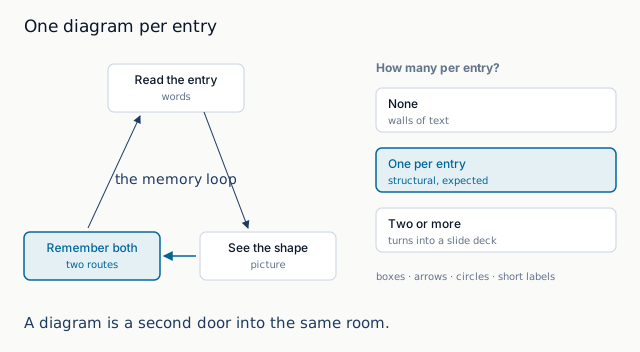
The case for diagrams rests on how people remember. A reader who encounters an idea in words and then sees it as a shape has two routes back to it: the phrase and the picture. Weeks later, the picture often comes back first. A reader who remembers that funnel with the three tiers can find their way back to the entry and the lesson. Words alone fade faster.
Diagrams also help browsing. A reader flicking through a hundred entries can see at a glance what kind of idea each one contains: a process, a choice, a cycle, a comparison. That visual signal helps them find what they need, in the same way headings help in a reference book. In a swipeable app, the diagram often becomes the face of the card, the thing that catches the eye before the title.
The payoff is memory: the loop from reading the entry, to seeing its shape, to remembering both together. That loop is what makes the book stick, and what makes readers quote it to colleagues weeks later.
One per entry is the right number. More than one per entry turns the book into a slide deck. Fewer than one makes the diagrams feel occasional and decorative rather than structural. One per entry, consistently, makes them part of the book's identity. Readers come to expect them and look for them.
Keep them simple. The diagrams in an authority book are not infographics, data visualisations or illustrations. They are small, abstract shapes with a few short labels: a chain of three or four steps, a hub with satellites, a two-by-two grid, a funnel, a cycle. Simple diagrams are faster to produce, easier to read, and more consistent across the book. They also work well at small sizes, which matters on phones.
Diagrams can be generated from data. If each entry in your book's data file includes a small diagram specification, such as the kind of diagram, its labels and which element is the focal point, a single drawing engine can render all hundred consistently. This is far more efficient than drawing each one by hand, and it means changing the design of every diagram at once is a small change to the engine.
The Authority Book — How a 100-entry book wins clients
Ready when you are.
Tap below to open the full chapter in the book reader. Anchored books jump to this chapter automatically.
Choosing the Diagram
The Authority Book — How a 100-entry book wins clients
A small vocabulary of diagram kinds covers almost every idea an authority book needs to express. The skill is matching the kind to the shape of the idea, so that the diagram clarifies rather than decorates. A mismatched diagram is worse than none: it suggests a structure the idea does not have.
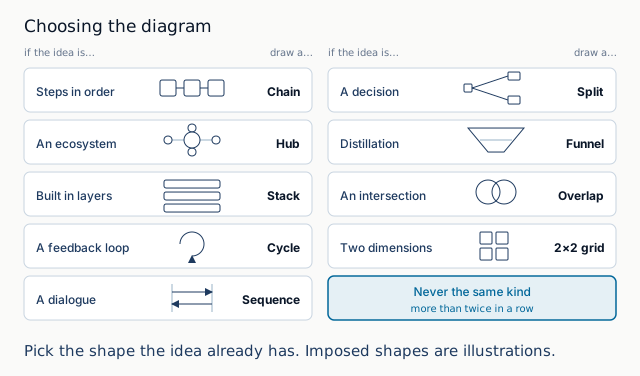
A chain, a short horizontal sequence of steps, suits processes: things that happen in order, where each step depends on the one before. A hub, a centre with satellites, suits ecosystems: one thing surrounded by the parts that feed it or depend on it. A stack, horizontal layers, suits architectures and hierarchies: things built on other things. A cycle suits feedback: processes that loop and improve each time round. A sequence of messages between two actors suits dialogues and protocols: who says what to whom, in what order.
A split, a question with two branches, suits decisions: a choice the reader must make, with the better path highlighted. A funnel suits distillation: many inputs narrowing to a few outputs, such as a long list becoming a short one. A two-circle overlap suits intersections: where two things meet to produce a third. A two-by-two grid suits positioning: where something sits relative to two dimensions, with the most interesting cell highlighted.
Choosing is a matter of asking what the idea is really about. If the entry describes steps, use a chain. If it describes a choice, use a split. If it compares along two dimensions, use a grid. When an idea could fit several kinds, choose the one that best shows the payoff. An entry about building a long list and culling it could be a chain, but a funnel shows the narrowing, which is the point.
Vary the kinds across a part. If every entry in a part uses a chain, the diagrams stop helping readers distinguish entries. A simple rule is never to use the same kind more than twice in a row within a part. This occasionally forces you to look at an idea from a different angle, which is often productive: a process might also be a cycle, if you notice that its last step feeds back into its first.
Some ideas resist diagrams. An entry that is mainly a story, or a nuanced argument, may not have an obvious shape. In those cases, look for the decision or contrast at its heart and draw that. Almost every useful lesson involves a choice or a comparison, even if it is implicit.
If you are generating diagrams from data, the vocabulary becomes a schema: a fixed set of kinds, each with defined label slots and limits. That constraint keeps the book consistent and makes it easy to check that every diagram fits its kind.
The Authority Book — How a 100-entry book wins clients
Ready when you are.
Tap below to open the full chapter in the book reader. Anchored books jump to this chapter automatically.
Every diagram in an authority book should have exactly one focal element: the node, box, layer or cell that carries the entry's payoff. It is drawn in the accent colour; everything else is neutral. A reader glancing at the diagram should see the focal element first and understand, before reading a word, where the lesson lands.
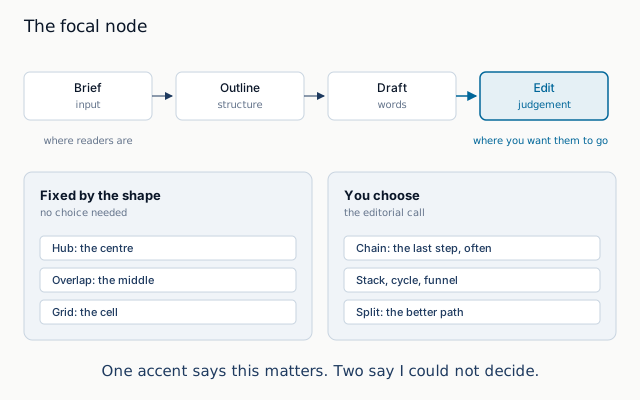
This sounds like a small design detail. It is actually a discipline that improves the whole book. To choose the focal element, you have to know what the payoff of the entry is. Not the input, not the context, but the result: the thing the reader should do, the outcome they want, the insight that changes their view. If you cannot decide which element is focal, the entry probably does not have a clear payoff, and the writing needs work.
The focal element is almost never the first step. In a chain from brief to outline to draft to edit, the payoff is the edit, where the author's judgement turns a draft into a book. In a funnel from a long list to a short one, the payoff is the bottom tier, the final hundred. In a split between two options, it is the better option. Readers' eyes go to colour, so put the colour where you want their attention to end, not where the process begins.
One focal element per diagram, never two. Two accents compete, and the reader's eye flicks between them without settling. If you feel an entry needs two highlighted elements, it is probably two entries, or one of the two is less important than you think. Choose.
Some diagram kinds fix the focal element by their shape. A hub's centre is focal by definition, since it is what everything else serves. The overlap of two circles is focal, since the intersection is the point. In a grid, the highlighted cell is focal. For other kinds, such as chains, stacks, cycles, funnels and splits, you choose which element to accent, and that choice is where the editorial judgement lives.
The accent colour should be your brand's primary colour, used nowhere else in the diagram. Everything else should be in neutral tones that work in both light and dark modes. This keeps the diagrams consistent across the book and makes the focal element unmistakable.
When generating diagrams from data, the focal element is a single number in the specification: the index of the element to accent. That makes it easy to review across the whole book. A quick script can list every entry with its focal label, and you can read down the list checking that each one is the payoff and not the input.
The Authority Book — How a 100-entry book wins clients
Ready when you are.
Tap below to open the full chapter in the book reader. Anchored books jump to this chapter automatically.
Labels You Can Read
The Authority Book — How a 100-entry book wins clients
Diagram labels have to be short. Not short as a stylistic preference, but short because the boxes are small, the screens are small, and nobody reads a sentence squeezed into a rectangle. Ten characters per label in a four-step chain. A dozen or so for the centre of a hub. A couple of dozen for a wide stack layer. These limits feel brutal at first. They turn out to be one of the most useful constraints in the book.
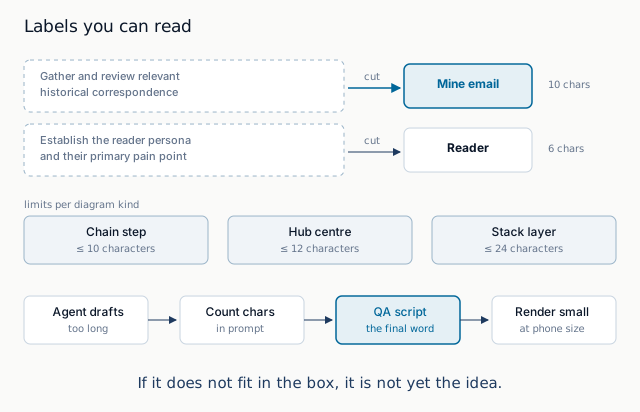
Short labels force clarity. To label a step in ten characters, you have to know exactly what the step is. Gather and review relevant historical correspondence becomes Mine email . Establish the reader persona and their primary pain point becomes Reader . The process of cutting shows you what the essential idea is, stripped of qualifications. Often the short label is clearer than the long phrase it replaces, not merely shorter.
There is a craft to it. Prefer nouns and short verb phrases. Drop articles. Use the vocabulary of the entry, so the label connects to the text. Avoid abbreviations that readers have to decode; a label that needs a key has failed. Avoid jargon that only experts know. If a concept genuinely cannot be named in the space available, the diagram kind may be wrong; a stack with longer layers might suit better than a chain with short boxes.
Consistency matters across the book. If the same idea appears in several diagrams, use the same label each time. Readers learn your vocabulary through repetition, and the diagrams are part of that vocabulary. A concept called Spec sample in one diagram and Prospect preview in another looks like two different things.
Label limits should be checked mechanically. When you write diagram specifications by hand or with an agent, it is easy to exceed a limit by a character or two without noticing. A QA script that checks every label against its kind's limit catches these instantly. Without it, you will find them later as clipped text or overlapping boxes in the finished edition, which is a much worse time to find them.
Agents are especially prone to long labels, because they default to completeness. When asking an agent to suggest diagram specifications, include the limits in the prompt and ask it to count. Then check anyway. The script is the final word, not the agent's assurance.
Test the labels at actual size. A label that looks fine on a desktop monitor may be unreadable on a phone. Render a few diagrams at the smallest size they will appear and check that every label can be read without zooming. If not, shorten further or reconsider the kind.
The Authority Book — How a 100-entry book wins clients
Ready when you are.
Tap below to open the full chapter in the book reader. Anchored books jump to this chapter automatically.
The Cover at Thumbnail Size
The Authority Book — How a 100-entry book wins clients
Most people who ever see your book's cover will see it small. A thumbnail in an email. A tile in a social feed. An icon on a landing page. A small image in a list of resources. The full-size cover, viewed at leisure, is a rare event. Design for the thumbnail first, and the full size will take care of itself.
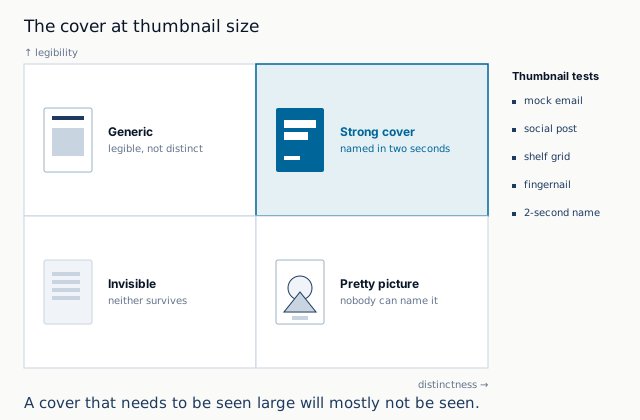
At thumbnail size, only a few things survive. The title, if it is large enough and short enough. A strong shape or colour block. Perhaps your name. Everything else, the subtitle, the tagline, the illustration detail, the small print, disappears into a blur. A cover that relies on any of these to communicate will fail at the size where most of its communication happens.
Judge a cover on two qualities. Legibility: can the title be read at the smallest size the cover will appear? Distinctness: does it look different from other covers in the same space? A cover high on both is strong. A cover that is legible but generic blends into every other business book. A cover that is distinctive but illegible is a nice image that nobody can name.
Legibility usually means a short title in a large, heavy typeface with strong contrast against its background. This is one reason the earlier advice on titles matters: a three-word title can be set large; a twelve-word title cannot. Distinctness usually comes from colour and composition: your accent colour, used boldly, in a layout that does not look like the default template every other expert used.
Keep the cover simple. A plain background in your accent colour or a neutral, the title large, the subtitle smaller, your name, perhaps a single graphic element such as one of the book's diagrams enlarged. That is enough. Stock photography of handshakes, lightbulbs, mountain summits and people pointing at whiteboards should be avoided; they signal generic business content, which is the opposite of what you want.
A series look helps if you plan more than one book. Using the same layout, typeface and position of elements across several covers, with only the colour and title changing, makes each book recognisable as part of a set. Over time, readers start to recognise your covers before they read them. That recognition is worth more than any individual cover's cleverness.
Test the cover in context. Place a thumbnail of it in a mock email, a mock social post, and a grid of other business book covers. Shrink it to the size of a fingernail. Can you still read the title? Does it stand out from its neighbours? If not, simplify until it does.
The Authority Book — How a 100-entry book wins clients
Ready when you are.
Tap below to open the full chapter in the book reader. Anchored books jump to this chapter automatically.
Light, Dark and Paper
The Authority Book — How a 100-entry book wins clients
An authority book in 2026 will be read on at least three kinds of surface: screens in light mode, screens in dark mode, and paper. Often it will also be read on a phone, which brings its own constraints. Designing for one and hoping the others work is how books end up with invisible diagrams, unreadable accent colours and text that glares at night. Design for all of them from the start.
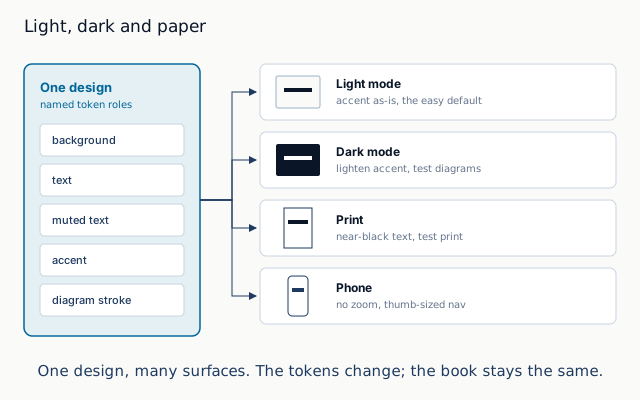
The core idea is a single design expressed through tokens. Rather than choosing fixed colours for text, backgrounds, rules and diagrams, define them as named roles: background, text, muted text, accent, diagram stroke. Each role has a value for light mode, a value for dark mode, and a value for print. Change the surface, and every element updates together. The book looks consistent everywhere, because it is the same design with different values.
Light mode is the default most people design for, and the easiest. Dark text on a light background, accent colour as-is. Dark mode needs more thought. The background darkens, text lightens, and your accent colour may need adjusting, since a deep brand colour that looks rich on white can become nearly invisible on dark grey. Diagram strokes and fills need the same attention. Test every diagram kind in dark mode; it is where problems hide.
Print has its own rules. Colours look different on paper, usually duller. Very light greys may disappear. Fine lines may break up. Text should be pure or near-pure black for crispness. Margins need room for binding. If you plan a printed edition, produce a test print early and check it in daylight.
Phones are the surface most likely to be underestimated. A large share of readers will meet your book on a phone first, perhaps through a link in a message or a post. Text must be readable without zooming. Diagrams must work at small sizes. Navigation must be usable with a thumb. If the book does not work on a phone, a large share of potential readers will never get past the first screen.
Diagrams are the hardest element to get right across surfaces. They combine lines, fills, text and an accent, all of which must remain legible in every mode. Generating diagrams from data with a single engine helps enormously here: the engine reads the colour tokens for the current surface and draws accordingly, so one diagram specification produces correct output everywhere.
This week, take one finished entry with its diagram and view it in light mode, dark mode, printed on paper, and on a phone. Note every problem. Most authors find at least one per surface. Fix them at the token level, not one element at a time, and every entry will improve at once.
The Authority Book — How a 100-entry book wins clients
Ready when you are.
Tap below to open the full chapter in the book reader. Anchored books jump to this chapter automatically.
A System for Many Books
The Authority Book — How a 100-entry book wins clients
The first book is the expensive one. You design the layout, choose the typefaces, define the colour tokens, build or adapt the diagram engine, set up the editions and write the QA script. All of that takes time and thought. The second book should take a fraction of the design effort, because most of it already exists. That only happens if you build the first book as a system rather than a one-off.
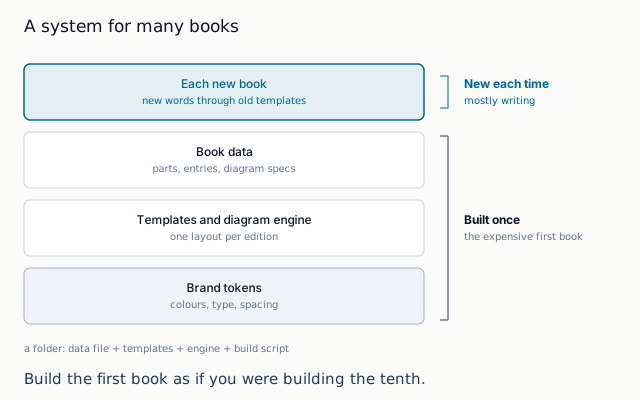
Think of it in layers. At the bottom are brand tokens: colours, typefaces and spacing, defined once and used everywhere. Above them are templates and the diagram engine: the layouts for each edition and the code that draws diagrams from specifications. Above those is the book's data: the structured file containing parts, entries and diagram specs. At the top is each new book, which is simply new data passed through existing templates using existing tokens.
The payoff is the top layer. When the system works, a new book is mostly a matter of writing new content. The design, the editions, the diagrams and the QA are all handled by what you built for the first one. You can focus entirely on what the book says, which is where your time is most valuable.
Separating content from design is the key decision. If your book is written directly in a design tool, with formatting applied by hand, the second book starts from scratch. If it is written as structured data and rendered by templates, the second book reuses everything except the words. The first approach feels faster at the start and is much slower overall.
A system also makes refreshes easy. When you update the book next year, you change the data and rebuild. Every edition updates together, every diagram redraws, and the QA script checks the result. Without a system, a refresh means editing each edition separately, which is tedious enough that it often does not happen.
If you produce books for clients, which the last part covers, the system becomes your production capability. Each client book uses the client's brand tokens with your templates and engine. The design quality is consistent across clients, the production is predictable, and you can quote fixed timelines because you know what each stage involves.
Keep the system simple. It is tempting to build an elaborate publishing platform. Resist this until you have produced several books and know which features you actually need. A folder with a data file, a few templates, a diagram engine and a build script is a perfectly good system. Complexity can be added when the books demand it.
The Authority Book — How a 100-entry book wins clients
Ready when you are.
Tap below to open the full chapter in the book reader. Anchored books jump to this chapter automatically.
One Source, Many Outputs
The Authority Book — How a 100-entry book wins clients
The single most useful technical decision in an authority book project is to keep the whole book in one structured source file and generate every edition from it. One file holds the metadata, the ten parts, the hundred entries and their diagram specifications. From that file, templates produce a PDF, a print-ready layout, a web reader and a swipeable app. Change the file, rebuild, and every edition updates together.
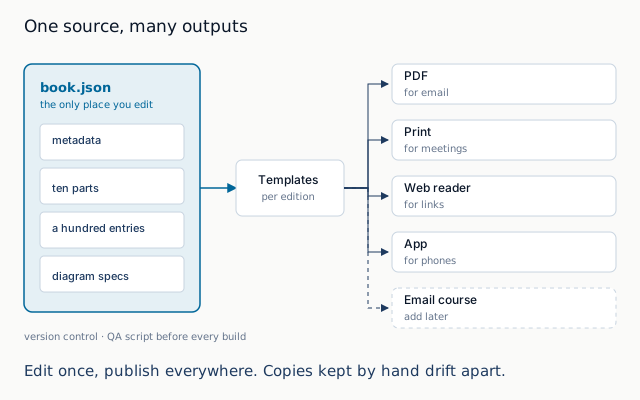
The alternative, which most people fall into by accident, is to maintain each edition separately. The PDF lives in a design tool, the web version in a website builder, the email course in a marketing platform. Each started as a copy of the same text, and each has since drifted, because a typo fixed in one was never fixed in the others. A year later, nobody is sure which version is correct, and refreshing the book means editing five things.
A single source avoids this entirely. It also changes how you think about editions. They stop being separate products to maintain and become views of the same book, each suited to a different situation: the PDF for email, print for meetings, the web reader for links, the app for phones. You can add a new edition later, an email course or a slide deck, by writing one new template, without touching the content.
The structure of the source file matters. It needs to be simple enough that you, an agent and a script can all read it, and rich enough to drive every edition. A JSON file with top-level metadata, a list of parts, and a list of entries, each with part, title, body and diagram, is enough for most books. Keep formatting inside entries minimal: plain paragraphs, occasional emphasis, perhaps one quotation. Anything more complicated tends to render differently across editions.
The source is the book. Treat it accordingly. Keep it under version control so you can see what changed and when. Run the QA script against it before every build. Back it up. When a client or colleague wants to suggest changes, have them suggest changes to the source, or to a view of it, not to one edition.
This approach suits AI-assisted production particularly well. Agents can read and write structured data reliably, so drafting parts directly into the source format is straightforward. Scripts can check it. Templates can render it. The whole pipeline from brief to editions becomes a sequence of well-defined transformations on one file.
There is a small upfront cost. Setting up templates for each edition takes time, especially the first time. But the cost is paid once, and the benefits compound with every edit, every refresh and every new book.
The Authority Book — How a 100-entry book wins clients
Ready when you are.
Tap below to open the full chapter in the book reader. Anchored books jump to this chapter automatically.
The PDF Is the Workhorse
The Authority Book — How a 100-entry book wins clients
Of all the editions of an authority book, the PDF does the most work. It is the edition that gets attached to emails, forwarded between colleagues, downloaded from landing pages, saved to desktops and opened on the train. It is not glamorous. It is reliable, universal and portable, and those qualities matter more than glamour for an asset whose job is to travel.
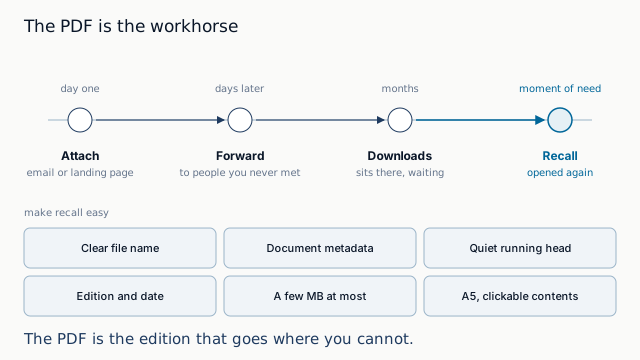
Design the PDF for the way it will actually be used. Most PDFs are read on screens, not printed. A comfortable reading size on a laptop or tablet matters more than strict print conventions. An A5 or similar small page size works well, since it fits a screen without much zooming and feels like a book rather than a report. Clickable contents, so readers can jump to a part, and working links to your website and contact details are both worth the small effort.
The PDF's journey follows a pattern. It is attached to an email or downloaded from a page. It is forwarded, often more than once, to people you have never met. It sits in a downloads folder until someone needs it. And eventually, at the moment a problem arises, someone remembers it and opens it again. That last step, recall, is the payoff. The PDF is a time-delayed handshake, waiting in someone's files until they are ready.
To support recall, make the PDF easy to find again. Give the file a clear name: the book's title and your name, not final_v3_print . Set the document metadata, so the title shows correctly in file browsers and search. Put your name and the book's title on every page in a quiet running head, so a reader who opens a random page knows what they are looking at.
Think about the first and last pages. The first page after the cover should tell the reader what the book is and who it is for, in a sentence or two. The last page should tell them who you are and how to get in touch, briefly, without a hard sell. Between those two, the book should be pure value.
Keep the file size reasonable. Some email systems reject large attachments, and some readers will be on slow connections. Diagrams generated as vector graphics are small; photographs are not. A hundred-entry book with simple diagrams should be a few megabytes at most.
Date the PDF. The edition and date should be on the title page or colophon, so readers know how current it is. This matters more for PDFs than other editions, because PDFs persist long after you have published a newer version. A reader who finds an old PDF should be able to tell that it is old.
The Authority Book — How a 100-entry book wins clients
Ready when you are.
Tap below to open the full chapter in the book reader. Anchored books jump to this chapter automatically.
Print as a Calling Card
The Authority Book — How a 100-entry book wins clients
In a world where almost everything arrives on a screen, a printed book is an event. It is heavier than a business card and lighter than a proposal. It sits on a desk and gets picked up by colleagues. It does not vanish into a downloads folder or get buried under new email. For an authority book, print is less a distribution channel than a calling card: a physical object that represents you in rooms you are not in.
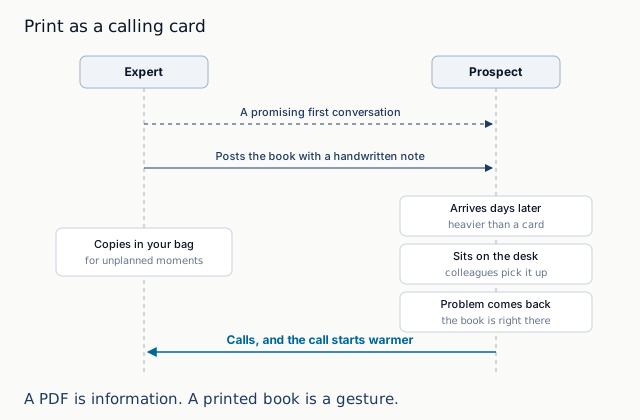
You do not need a large print run. Print-on-demand services can produce small quantities, or even single copies, at modest cost, and the quality is now good enough for most purposes. What matters is having a handful of copies available for the moments when a physical book makes a difference: a prospect you particularly want, a meeting with a board, a conference where you are speaking, a thank-you for a client who referred you.
The posted copy is the classic move. You have had a promising first conversation with a prospect. Afterwards, rather than sending a follow-up email that will be skimmed, you post them a copy of the book with a short handwritten note. It arrives a few days later. It sits on their desk. When they next think about the problem you discussed, the book is there, physically, reminding them of you. The call that follows is warmer than any email could have made it.
Print also changes how meetings feel. Bringing a copy to a meeting and leaving it behind signals preparation and seriousness. Sliding a copy across the table when a specific topic comes up, open to the relevant entry, is a quietly powerful move. The prospect does not just hear your advice; they hold it.
Design matters more in print than on screen, because physical flaws are harder to ignore. Check margins for binding, check that diagrams print clearly, check that the cover looks right when held. Order a proof copy before ordering several. Read it with a pen in hand; you will find things the screen did not show you.
Keep print in proportion. It is a calling card, not your main channel. Most readers will meet your book on a screen, and that is fine. Print is for the high-value moments where a gesture matters: the handful of prospects who could become significant clients, the occasions where a physical object will be remembered.
A small practical point: keep a few copies at your desk and a couple in your bag. A book that is in a box in the cupboard when the moment arrives is not a calling card. The best opportunities to hand someone a copy are often unplanned.
The Authority Book — How a 100-entry book wins clients
Ready when you are.
Tap below to open the full chapter in the book reader. Anchored books jump to this chapter automatically.
A PDF is a file. A web reader is a place. Publishing your authority book as a set of web pages on your own domain gives it a permanent address, makes every entry linkable, and lets readers search, browse and arrive from anywhere. It is the edition that turns your book from an attachment into a destination.
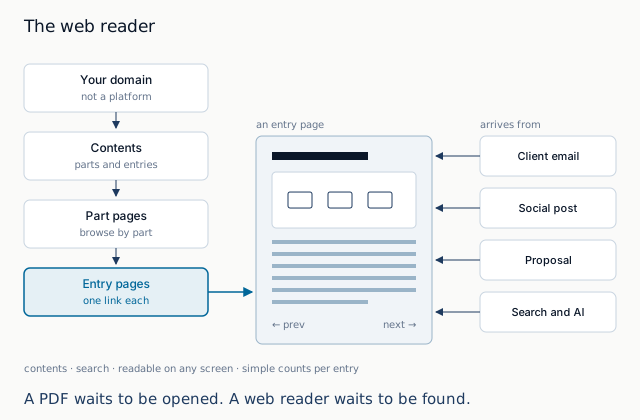
The single most valuable feature of a web reader is that every entry has its own link. This changes how you use the book. In a client email, instead of attaching a PDF and saying see page forty-three , you can link directly to the entry that answers their question. In a social post, you can share one entry. In a proposal, you can reference three entries with links. Each link is a small, precise piece of evidence, delivered exactly where it is needed.
Linkability also helps discovery. Entries on the web can be found by search engines, by AI assistants that read the web, and by people following links from elsewhere. A buyer searching for help with a specific problem may land directly on the entry that addresses it, without ever having heard of your book. That is the handshake happening without any effort on your part.
The reader should be simple and fast. A contents page listing the parts and entries. A page per entry with the title, the body, the diagram, and links to the previous and next entries. Navigation by part. A search box. Readable typography on any screen size. That is enough. Resist adding features that slow it down or clutter the reading experience.
Host it on your own domain. Your website, or a subdomain of it, rather than a third-party platform. This keeps the readers' attention on your brand, lets you control the experience, and means the links will keep working as long as your site does. Third-party platforms change their rules, their designs and sometimes their existence; your domain does not, unless you let it lapse.
Decide whether to gate it, which a later chapter covers in detail. A common approach is to leave the web reader fully open, so entries can be found and shared, and offer the PDF or printed edition in exchange for an email address. That way discovery is unrestricted, and the readers who want to keep a copy identify themselves.
Keep analytics simple and respectful. Knowing which entries are read most often is useful; it tells you what your market cares about and which entries to improve or promote. Detailed tracking of individual readers is less useful and can feel intrusive. A basic count of visits per entry is usually enough.
The Authority Book — How a 100-entry book wins clients
Ready when you are.
Tap below to open the full chapter in the book reader. Anchored books jump to this chapter automatically.
The Swipeable App
The Authority Book — How a 100-entry book wins clients
Phones are where most reading now happens, and phones are not good at books. Long pages, small text and fiddly navigation make even a well-designed web reader feel like work on a small screen. A swipeable app solves this by presenting each entry as a card: one entry per screen, swipe to move on, tap to read more. It is how people already consume content on their phones, and a hundred-entry book fits the format naturally.
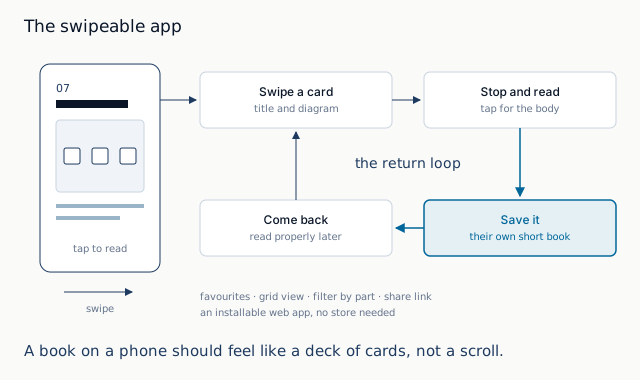
Each card shows the entry's number, title and diagram at a glance, with the body text a scroll or tap away. A reader can move through a part in a minute, getting the shape of each idea from its title and diagram, and stop to read in full when one catches their attention. It is browsing at its most efficient, and it suits the way busy buyers actually use reference material: in short bursts, between other things.
The loop that makes the app valuable is the return. A reader swipes through some cards, saves a few that matter to them, and comes back later to read those properly. Saving is the payoff, because it turns a casual browse into a personal collection. A buyer with five of your entries saved on their phone has, in effect, built their own short version of your book, focused on their problems. That is a strong position to be in when they next need help.
The app does not need to be a native app in an app store. A web app, designed for phones and installable to the home screen, does everything required without the cost and friction of store distribution. It can be built from the same source file as the other editions, using the same diagrams and the same brand tokens.
Design for thumbs. Large tap targets, swipe gestures that feel natural, navigation by part that does not require precise taps. Text should be readable without zooming. Diagrams should be legible at card size, which is another reason to keep labels short.
Include a few simple features that reward return visits. Favourites, so readers can save entries. A view that shows all entries as a grid of small cards, for quick scanning. Filters by part. A link to share an entry. Perhaps a gentle prompt, after a reader has saved several entries, offering the full PDF or a conversation. Keep it light; the app should feel like a gift, not a funnel.
For many readers, the app will be the edition they use most. It is always in their pocket, it is quick to open, and it rewards a minute of attention. That makes it unusually good at keeping you present in a buyer's mind over the weeks or months before they are ready to talk.
The Authority Book — How a 100-entry book wins clients
Ready when you are.
Tap below to open the full chapter in the book reader. Anchored books jump to this chapter automatically.
The Email Course Edition
The Authority Book — How a 100-entry book wins clients
A hundred entries make a very long email course. Too long, perhaps, for a single sequence, but the material is ready-made for something more useful than a newsletter that struggles for topics: a structured series of lessons delivered to readers' inboxes, each one a complete entry, each one bringing them a step further into your way of thinking.
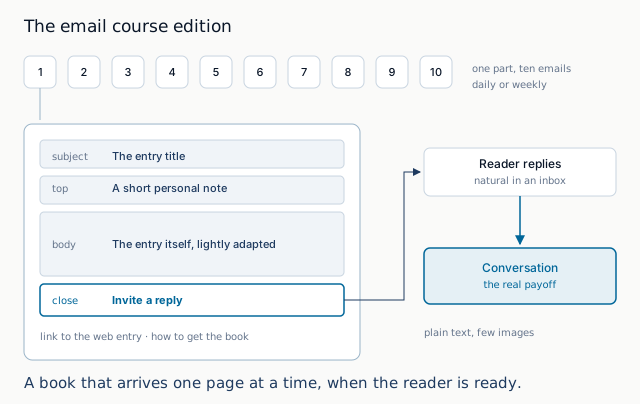
The simplest version takes one part of the book and sends it as ten emails over ten days or ten weeks. Each email contains one entry, lightly adapted: a subject line based on the entry's title, a short personal note at the top, the entry itself, and a closing line inviting the reader to reply. A reader who completes the series has absorbed a substantial part of your thinking, one manageable piece at a time.
The reply invitation is where the value lies. An email arrives in a personal space, and it is natural to reply to it. A reader who finds an entry particularly relevant may hit reply and say so, or ask a question about their situation. That reply is the start of a conversation, which is exactly what an authority book is meant to provoke. The payoff of the email edition is not the subscription or the open rate. It is the conversation.
You can offer several courses from one book: one per part, or themed collections drawn from across parts. A course for people just starting to think about the problem, drawn from the early parts. A course for people in the middle of implementation, drawn from the practical parts. A short course of the ten most essential entries for people who will never read the whole book. Each is an entry point into the same body of work.
Keep the emails plain. Rich formatting, heavy images and elaborate templates make emails look like marketing and push them toward the promotions folder. A plain email with good text and perhaps a single diagram image looks like a message from a person, and is more likely to be read and answered.
Be generous with timing. A daily email for ten days suits a short, focused course. A weekly email suits a longer series, giving readers time to apply each entry before the next arrives. Let readers choose if your tools allow it. The aim is to be welcome, not to fill an inbox.
Link each email to the web reader version of its entry, so readers can share it or find it again. Include a quiet line at the bottom about how to get the whole book. Do not turn every email into a sales message; the entries are the persuasion.
The Authority Book — How a 100-entry book wins clients
Ready when you are.
Tap below to open the full chapter in the book reader. Anchored books jump to this chapter automatically.
Talks From Chapters
The Authority Book — How a 100-entry book wins clients
A well-structured authority book is also a library of talks. Each part is a coherent argument about one aspect of your subject, built from ten entries with a beginning, a middle and an ambitious end. That is very nearly the shape of a good talk. With some selection and adaptation, any part can become a keynote, a workshop or a webinar, and the book provides the takeaway.
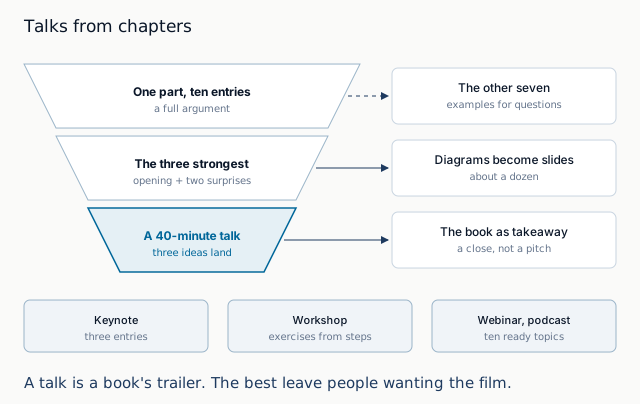
The conversion is mostly about cutting. A part of ten entries contains too much for a talk of forty minutes; audiences can absorb three or four main ideas, not ten. Choose the three strongest entries from the part: usually the opening entry, which sets up the problem, and two others that carry the most surprising or useful lessons. Build the talk around those. The remaining seven become supporting material, examples you can draw on in questions, and the reason to read the book afterwards.
The diagrams become slides. Each entry already has a simple diagram with a focal element, which is exactly what a good slide should be: one idea, visually clear, with the payoff highlighted. A talk built from three entries might have a dozen slides, most of them diagrams from the book, with a few title slides between sections. The visual consistency between talk and book reinforces the connection.
Workshops work slightly differently. Instead of presenting the lessons, you have participants apply them. Each entry's practical element, the thing to do this week, becomes an exercise. A two-hour workshop might work through five entries from a part, with participants doing each exercise on their own situation. They leave with work done and a book that explains it further.
Speaking and the book reinforce each other. A talk gives you a reason to mention the book, and an audience that has just heard you speak is unusually receptive to reading more. The book gives the talk depth, because you can refer people to it for the detail you had to cut. Offering the book to attendees, in whatever edition suits, is a natural close that does not feel like a pitch.
Webinars and podcast appearances follow the same logic. Each part is a ready-made topic. When a host asks what you would like to talk about, you can offer any of ten subjects, each backed by a structured argument and a set of examples. That makes you an easy guest to book, which is a surprisingly important quality.
Record what you can. A talk based on a part, recorded and transcribed, becomes source material for the next edition of the book, often with sharper phrasing than the original entries, because speaking to a live audience forces clarity.
The Authority Book — How a 100-entry book wins clients
Ready when you are.
Tap below to open the full chapter in the book reader. Anchored books jump to this chapter automatically.
Every entry in your book is a piece of social content waiting to be released. A single entry contains a hook in its first line, a lesson in its middle, a diagram that works as an image, and a landing that works as a quote. Released one at a time, across the channels your buyers use, a hundred entries become months of useful posts that all point back to the same body of work.
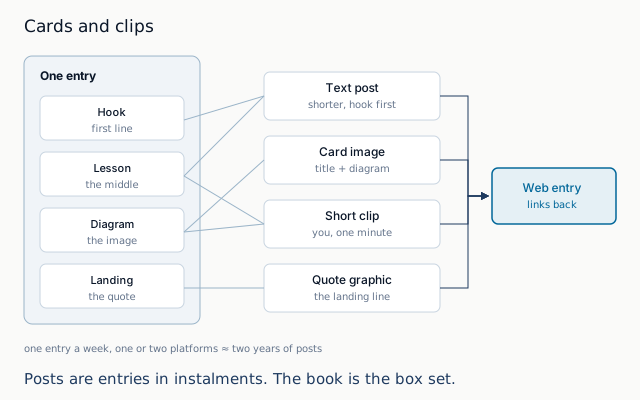
One entry can become several pieces. A text post adapting the entry, shorter than the original, with the first line as a hook and the lesson as the body. A card image combining the entry's title and diagram, designed for the size and shape of the platform. A short video clip of you explaining the entry in a minute or two, perhaps with the diagram on screen. A quote graphic using the landing sentence. Each is suited to a different moment and platform, and all of them are derived from one source.
The economics are attractive. Most experts struggle with social content because each post requires a new idea. With a book, the ideas exist; the work is adaptation, which is much faster and can be partly automated. An agent can draft a post from an entry in moments, with your voice file ensuring it sounds like you. Card images can be generated from the diagram specifications. Clips need you on camera but no new thinking.
Consistency is the other advantage. Content derived from a book carries the book's threads, vocabulary and point of view. Over weeks and months, readers of your posts absorb a coherent way of thinking, not a random scatter of tips. When they eventually find the book, it feels familiar. When they eventually talk to you, they already speak your language.
Link each piece back to its entry in the web reader. A reader who finds the post useful can click through to the full entry, and from there browse the book. This is how social content stops evaporating: each post is a doorway to the asset rather than a standalone piece that disappears after a day.
Pace yourself. One entry a week across one or two platforms is sustainable for most experts and will take about two years to work through the book, by which time you will have a second edition. Daily posting is possible but tends to burn out, and the quality of adaptation suffers. Choose a rhythm you can keep.
Choose platforms by where your buyers actually are, not where content is fashionable. For most professional services, that means one professional network, perhaps a newsletter, and video only if you are comfortable on camera. Being present in one place consistently beats being present everywhere occasionally.
The Authority Book — How a 100-entry book wins clients
Ready when you are.
Tap below to open the full chapter in the book reader. Anchored books jump to this chapter automatically.
Versions and Editions
The Authority Book — How a 100-entry book wins clients
Every authority book starts ageing on the day it is published. Examples become dated, tools change, regulations move, and your own thinking develops. A book that carries no date gives readers no way to judge how current it is. A book that carries an old date and has never been updated tells them you have moved on. The answer is to date every edition clearly and plan the refresh from the start.
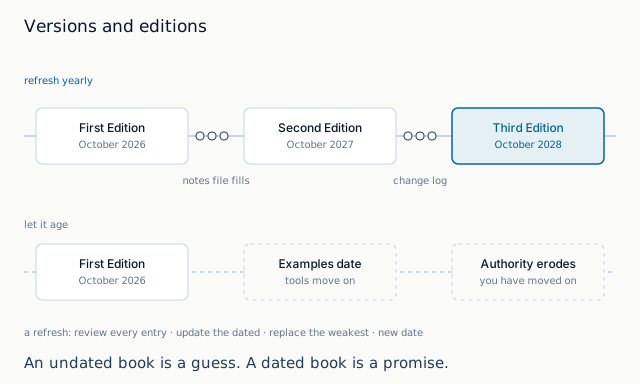
Put the edition and date in the colophon and on the title page: First Edition, October 2026 . This is a small act of honesty that readers appreciate. It tells them when the content was current, and it sets up the expectation that there will be later editions. It also gives you something to announce when the refresh happens: a new edition is news, a quiet edit is not.
Plan a refresh cycle. For most fields, an annual refresh is about right: frequent enough to keep the book current, infrequent enough to be manageable. Fast-moving fields may need more frequent updates to certain parts. A refresh does not mean rewriting the book. It means reviewing every entry, updating the ones that have dated, replacing the weakest few with better material collected over the year, and changing the edition date.
The choice each year is between letting the book age and refreshing it. Letting it age costs nothing at first and slowly erodes the book's authority, as readers notice that its examples and references belong to a previous era. Refreshing costs a few days of work and keeps the asset working. If you built the book as a single source with templates, the rebuild is trivial; the work is entirely in the content review.
Keep a change log. Note what changed in each edition and why. This helps you, because you can see how the book and your thinking have evolved. It also helps readers who return to the book, since you can tell them what is new. A short note in the introduction of each new edition, listing the main changes, is a good way to bring back readers who read the earlier one.
Collect material for the next edition continuously. Questions readers ask, entries that prompted disagreement, mistakes you have seen since publishing, new examples from client work. Keep a file for each part and drop notes into it as they arise. When the refresh comes, you will have a year of material ready, and the work will be curation rather than invention.
Decide what to do with old editions. Usually the right answer is to replace them everywhere you control: the web reader shows the current edition, the PDF download is the current edition, and printed copies are reordered. Copies already in the world will persist, which is fine; the edition date tells readers what they have.
The Authority Book — How a 100-entry book wins clients
Ready when you are.
Tap below to open the full chapter in the book reader. Anchored books jump to this chapter automatically.
Owning the Canonical Copy
The Authority Book — How a 100-entry book wins clients
Your book will end up in many places. A PDF in hundreds of downloads folders. Entries quoted in posts and newsletters. Perhaps a listing on a retail platform. Perhaps a version hosted by a partner. That spread is good; it is the book doing its job. But somewhere, there should be one canonical copy that you control completely, and it should be on your own domain.
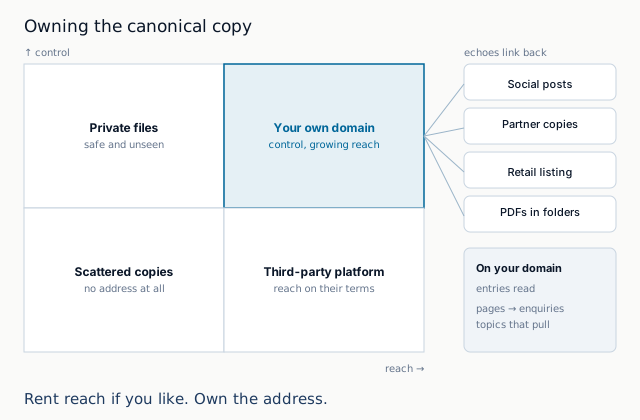
The canonical copy is the version you point everyone to. It is always the current edition. It is where search engines and readers find the authoritative text. It is where you control the design, the experience and what happens next for a reader who wants to talk to you. Every other copy is an echo of it, and links back to it where possible.
Picture the options on two axes: how much control you have over the copy, and how much reach it gets. Third-party platforms often offer reach with little control: they decide how your book looks, what sits next to it, and whether readers can contact you. Private files offer control with little reach. Your own domain, well linked, offers the best combination: full control and reach that grows over time as links and search visibility accumulate.
The risks of not owning the canonical copy are real. Platforms change their terms, their algorithms and sometimes their existence. A book that lives primarily on someone else's platform can lose its audience overnight through no fault of its own. A book on your own domain stays put. Its links keep working. Its readers can always find it.
Ownership also matters for data. When readers find your book on your domain, you know which entries are read, which pages lead to enquiries, and which topics attract attention. That information shapes the next edition and your marketing. On a third-party platform, that data belongs to the platform, if it is available at all.
This does not mean avoiding other platforms. Distribute widely: post entries on social networks, list the book where it makes sense, let partners share it. But always link back to the canonical copy. Make it the place where the full book lives, the newest edition is published, and a reader can take the next step with you.
Keep the domain simple and memorable. The book's title as a path on your main site works well. A separate domain for the book can work too, especially if you expect the book to have a life of its own, but it adds something to maintain. Whichever you choose, make sure it is renewed automatically; an expired domain is an embarrassing way to lose an asset.
The Authority Book — How a 100-entry book wins clients
Ready when you are.
Tap below to open the full chapter in the book reader. Anchored books jump to this chapter automatically.
Launch to a Room, Not the World
The Authority Book — How a 100-entry book wins clients
The instinct, when a book is finished, is to announce it to the world. A post, a press release, an email to the entire list, perhaps a launch event. Most of these produce a brief flurry of attention and then silence. The world, it turns out, is busy, and it has not been waiting for your book.
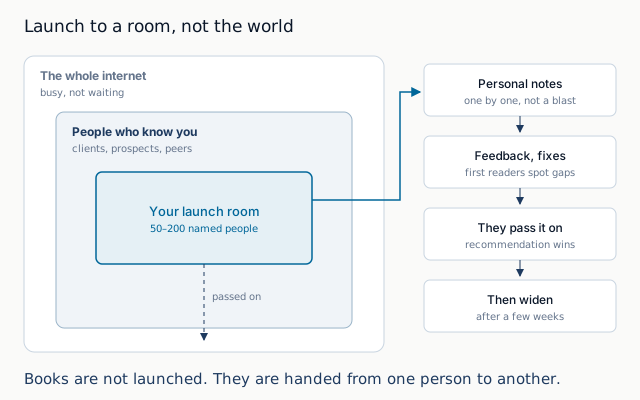
Launch to a room instead. Not the world, but a specific, small group of people who already know you, who fit your niche, and who are likely to find the book genuinely useful. Clients, past clients, warm prospects, respected peers, people who have asked you for advice. A room of fifty or a hundred people, each of whom you could name, is worth more at launch than ten thousand strangers who might glance at a post.
The reason is that authority books spread through recommendation, not broadcast. A buyer who receives the book from someone they trust, with a note saying you should read this , will read it. A buyer who sees a post about it in a feed will scroll past. Your launch room is the first link in that chain of recommendation. If they find it useful, they will pass it on, and their recommendations will reach people you could never reach directly.
There is also a practical benefit. A small launch lets you learn before the book reaches a wider audience. The first fifty readers will notice things: a confusing entry, a missing topic, a typo in the diagram on page forty. Fixing these before the wider push means the version most people see is better than the one you launched.
Choosing the room is the important step. Start with everyone you have worked with in the last few years who fits the niche. Add prospects you have spoken to recently. Add peers whose opinion your buyers respect, who might mention the book. Add anyone who has asked you a question that the book answers. You will likely end up with somewhere between fifty and two hundred names. That is your launch list.
Then reach each of them personally, which the next few chapters describe in detail. Not a mass email with a merge field, but a short, individual note explaining why you thought of them. This takes time. It is the best time you will spend on the launch.
Only after the room has had the book for a few weeks should you widen. By then you will have feedback, perhaps some early responses you can mention, and a better book. The wider launch, through social channels, borrowed audiences and partners, will land on people who are more likely to hear about the book from someone in the room first.
The Authority Book — How a 100-entry book wins clients
Ready when you are.
Tap below to open the full chapter in the book reader. Anchored books jump to this chapter automatically.
The First Fifty Readers
The Authority Book — How a 100-entry book wins clients
The first fifty readers of your book matter more than the next five thousand. They set its reputation, shape its next edition, and start the chain of recommendations that carries it beyond your network. Choosing them carefully and treating them well is the most important thing you can do at launch.
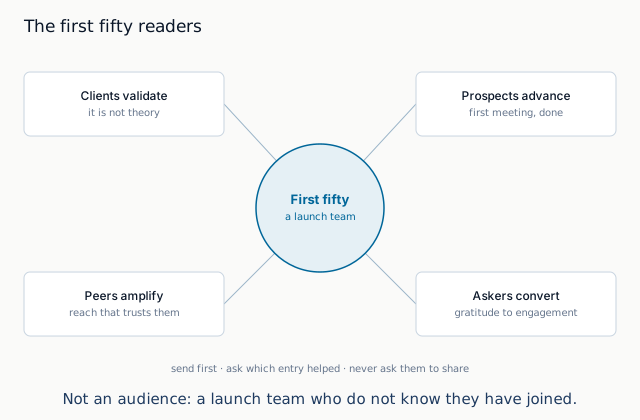
They come from four groups. Clients, current and past, who know your work and can confirm that the book reflects it. Warm prospects, who have expressed interest and might be moved closer to a decision. Peers, respected in your field or adjacent to it, whose mention of the book carries weight with your buyers. And askers: people who have, at some point, asked you a question that the book answers. Each group reads the book differently and helps it in different ways.
Clients validate. When a client says this is exactly how they work with us , it confirms to other readers that the book is not theory. Ask clients whether they would be willing to share a line about it. Some will. Their words, used with permission, are more persuasive than anything you can say about yourself.
Prospects advance. A prospect who reads the book and finds their situation described is likely to move toward a conversation. The book has done the work of a first meeting without the meeting.
Peers amplify. A respected peer who mentions the book in their newsletter, their talk or a conversation with a client carries it to an audience that trusts them. Choose peers whose audiences overlap with your buyers but who are not direct competitors.
Askers convert. Someone who once asked you a question and now receives a book that answers it in depth is likely to be grateful, and gratitude often becomes engagement.
Treat them as insiders. Send them the book before anyone else. Tell them they are among the first. Ask them for a specific kind of feedback: which entry was most useful, which one they disagreed with, what is missing. Thank them individually when they reply. Mention in the next edition that early readers shaped it, without naming anyone who has not agreed.
The Authority Book — How a 100-entry book wins clients
Ready when you are.
Tap below to open the full chapter in the book reader. Anchored books jump to this chapter automatically.
One of the first decisions at launch is whether to ask readers for something in exchange for the book, usually an email address. Gating builds a list of interested readers. Leaving the book free maximises the number who read it. Both have merit, and the best answer for most authority books is a mixture: open where discovery matters, gated where commitment is shown.
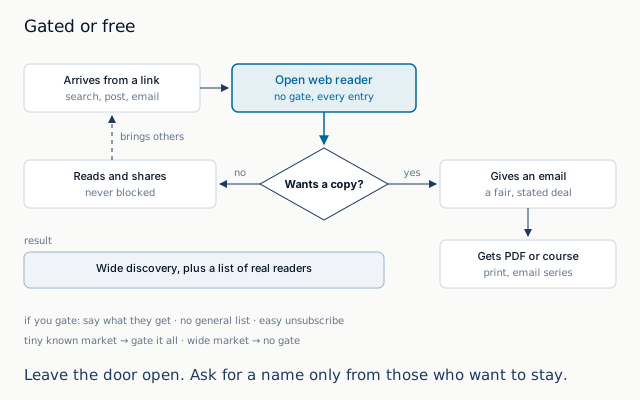
The case for gating is straightforward. An email address lets you follow up: send the email course, announce new editions, invite readers to events. A list of people who downloaded your book is a list of people interested in your subject, which is valuable. And asking for an address filters for slightly more committed readers.
The case against gating is also straightforward. Every gate loses readers. Some will not want to give their address. Some will intend to and forget. Some will be wary of being added to a marketing list. And gated content cannot be found by search engines or shared freely, which reduces the book's reach beyond your immediate network. For an asset whose job is to make you known to strangers, that is a significant cost.
The mixture works like this. Leave the web reader completely open: every entry readable, linkable and searchable, with no barriers. This is the edition that gets found, shared and quoted. Then offer the PDF, the printed edition, or an email course as something extra, in exchange for an address. Readers who have found the web reader useful and want to keep a copy will happily give an address; readers who just want to read one entry are not blocked.
The open web reader is the payoff of this approach. It does the work of discovery, attracting readers you would never have reached otherwise. The gated extras capture the most interested of them, giving you a list made up largely of people who have already read some of the book and want more. That list is smaller but far more valuable than one built by gating everything.
If you do gate, be honest and modest. Say what readers will receive and how often. Do not add them to a general marketing list without asking. Make unsubscribing easy. Readers of authority books are professionals who have been oversold, and they remember how they were treated.
There are exceptions. If your buyers are a very small, well-defined group, and you know them all already, a fully gated book sent personally may suit better. If your market is wide and discovery matters most, a fully open book with no gate may be right. But for most experts, open web plus gated extras is the sensible default.
The Authority Book — How a 100-entry book wins clients
Ready when you are.
Tap below to open the full chapter in the book reader. Anchored books jump to this chapter automatically.
The Landing Page
The Authority Book — How a 100-entry book wins clients
Your book needs one page that introduces it: the place every link, post and email points to when someone wants to know what the book is and how to get it. A good landing page is short, plain and focused on a single action. A bad one is a brochure in disguise, cluttered with everything you could say about the book and yourself.
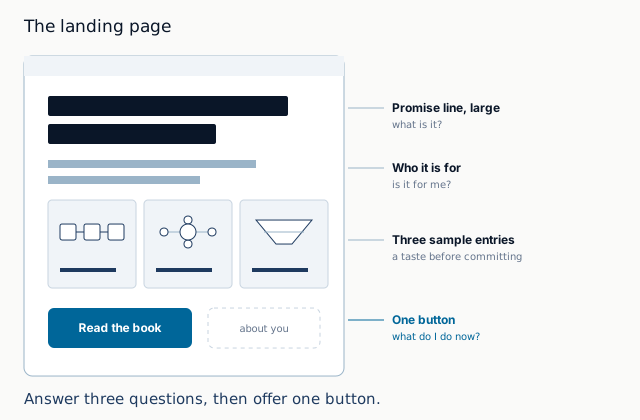
Build it in layers, from top to bottom. At the top, the promise line, large: what the reader will get from the book. Below it, a sentence on who the book is for, specific enough that the right reader recognises themselves. Below that, a few sample entries, or their titles and diagrams, so the reader can taste the content before committing. And at the bottom, one button that does one thing: read the book, download the PDF, or start the email course.
One button is the payoff. Every element above it exists to make the reader want to press it. A page with several buttons, read online , download , subscribe , book a call , follow us , divides attention and reduces the chance that any of them is pressed. Choose the single most important action and make it obvious. Secondary options, if you must have them, can sit quietly lower down.
Sample entries are the most persuasive element. Readers believe what they can test. Three real entries, in full or in substantial excerpt, prove the book is worth reading far more effectively than any description. Choose entries that represent the book's range and quality, and that are likely to resonate with the target reader. Diagrams help here too: a reader scanning the page sees three distinctive shapes and senses that this is not an ordinary book.
Resist the temptation to add an author biography at the top. Readers care about the book first and the author second. A short paragraph about you, with a photo if you like, can sit near the bottom, after the reader has already decided they are interested. At the top it reads as self-promotion.
Keep the page fast and readable on a phone. Many readers will arrive from a link in a message or a post, on a small screen, with limited patience. A page that loads slowly or requires zooming will lose them before they reach the button.
Test the page on someone in your niche who has not seen it. Watch them read it, or ask them to describe it afterwards. Can they tell you what the book is, who it is for and what they would do next? If any of those answers is vague, the page needs work at that layer.
The Authority Book — How a 100-entry book wins clients
Ready when you are.
Tap below to open the full chapter in the book reader. Anchored books jump to this chapter automatically.
Sending It Personally
The Authority Book — How a 100-entry book wins clients
The most effective way to distribute an authority book at launch is also the least scalable: sending it personally, to one person at a time, with a short note explaining why you thought of them. It takes longer than a mass email. It produces far more readers, far more replies, and far more conversations, which is the point.
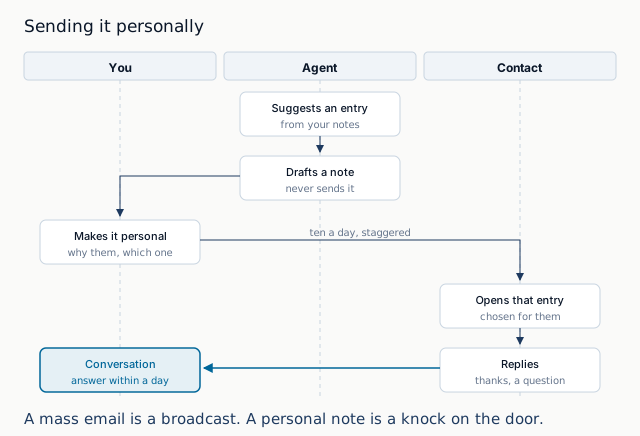
A personal note is short. Three or four sentences. Why you are sending it: I've finally written down how I approach supplier negotiations. Why you thought of them specifically: Entry twenty-three made me think of the conversation we had about your packaging supplier. What you would like, if anything: No need to reply, but I'd be curious which part is most useful for you. And the link or attachment. That is all.
The specific mention is what makes it work. Pointing to a particular entry that relates to something you know about them shows that you have thought about them, not just added them to a list. It also gives them a reason to open the book and a starting point that is guaranteed to be relevant. Readers who start with an entry chosen for them are much more likely to keep reading than readers who start at page one.
The payoff is the conversation. A personal note invites a personal reply, and replies to personal notes are common in a way that replies to newsletters are not. Some will say thank you. Some will comment on the entry you mentioned. Some will ask a question about their situation. Each of these is the start of a conversation, and conversations are where work comes from.
This approach takes time. Fifty personal notes might take a couple of hours, especially if you choose an entry for each person. It is time well spent. Compare the results of fifty personal notes with a broadcast to five hundred, and the personal notes usually win on every measure that matters: opens, reads, replies and meetings.
You can use AI to help, but carefully. An agent can suggest which entry might be most relevant to each contact, based on notes you provide about them. It can draft a note for you to edit. What it should not do is send notes automatically, or produce notes that sound templated. The value of a personal note is that it is personal; a note that reads as generated loses that value and may cost you some trust.
Stagger the sending. Send ten or so a day over a week or two, rather than fifty at once. This makes replies manageable, so you can respond promptly and personally to each one, and it lets you adjust the note if early replies suggest a better approach.
The Authority Book — How a 100-entry book wins clients
Ready when you are.
Tap below to open the full chapter in the book reader. Anchored books jump to this chapter automatically.
After the personal launch, the book needs a steady public presence, and the simplest way to provide one is to serialise it. Post one entry, or an adapted version of one, on the channel your buyers use most. Then another. Then another. Over weeks and months, the book becomes a continuous stream of useful content, each piece pointing back to the whole.
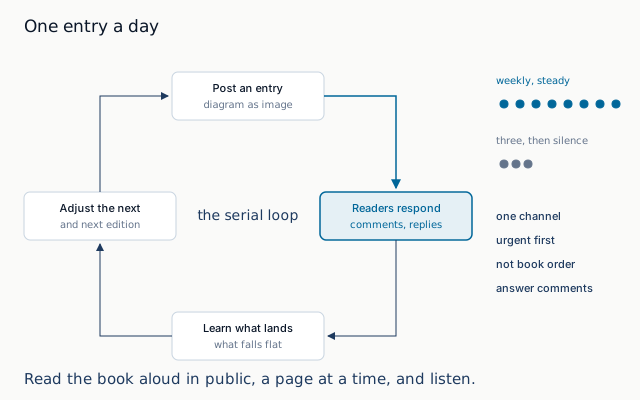
The rhythm can be daily, if you have the energy and your audience welcomes it, or weekly, which is more sustainable for most experts. What matters is consistency. A reader who sees a useful entry from you every week starts to expect it, look for it, and associate you with the subject. A reader who sees three entries one week and nothing for a month forgets.
Choose one channel and do it well. For most professional services, that means the professional network where buyers spend time, or a newsletter, or both. Do not try to serialise across every platform at once; the adaptation work multiplies, and the quality suffers. One channel, posted consistently, beats five channels posted sporadically.
The loop is what makes serialisation valuable. You post an entry. Readers respond: comments, shares, messages, questions. You learn which entries resonate and which fall flat, which ideas provoke disagreement, which questions readers ask that the book does not answer. That learning shapes the next posts and, eventually, the next edition. The responses are the payoff, because they tell you what your market cares about in real time.
Adapt each entry for the channel. A five-hundred-word entry may be too long for a social post; cut it to the lede, the core lesson and the landing, with a link to the full entry. Use the diagram as the image. Write the first line as a hook, since that is what people see before deciding to expand the post. Keep your voice: the adaptation should sound like the book, not like generic social content.
Do not post the entries in order. Book order is designed for readers who go from start to finish; social readers arrive at random. Start with the entries most likely to resonate with your buyers, usually the ones addressing urgent problems or challenging common beliefs. Save the more foundational entries for later, when your audience has some context.
Respond to every substantive comment. A post that generates a conversation is far more valuable than one that generates likes, and conversations only continue if you take part. Some of those conversations will move into private messages, and some of those will become meetings.
The Authority Book — How a 100-entry book wins clients
Ready when you are.
Tap below to open the full chapter in the book reader. Anchored books jump to this chapter automatically.
Borrowed Audiences
The Authority Book — How a 100-entry book wins clients
Your own network is finite. To reach buyers who have never heard of you, you need to borrow other people's audiences: podcast hosts, newsletter writers, event organisers, community leaders and anyone else whose readers or listeners overlap with your buyers. A book makes this much easier, because it gives hosts a reason to have you and gives their audience something to take away.
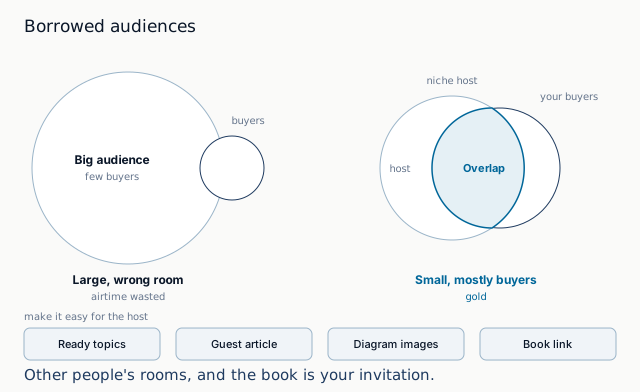
The overlap is what matters. A large audience with no buyers in it is useless to you; a small audience made up mostly of buyers is gold. Look for hosts whose audience shares your niche: the newsletter that operations directors in logistics actually read, the podcast for founders of small agencies, the community for coaches working with senior leaders. These are often smaller and less glamorous than the big names, and they are usually much more effective.
The book changes the pitch. Without it, you are asking a host to give you airtime because you are an expert, which every guest claims. With it, you are offering their audience something specific: a conversation about a particular entry or part, plus access to the book afterwards. Hosts want guests who bring value to their audience, and a structured body of work is easy to plan an episode or article around.
Make it easy for them. When you approach a host, suggest two or three specific topics, each based on a part of the book. Offer a short guest article adapted from an entry. Provide the diagram as an image. Offer their audience a link to the book or a particular edition. The less work the host has to do, the more likely they are to say yes.
Guest articles for newsletters and publications are especially efficient. An entry, lightly adapted with an introduction for the new audience, makes an excellent guest piece. It costs you little additional effort, provides real value to the host's readers, and points them back to the book. Many newsletter writers welcome good guest contributions, especially from practitioners with something specific to say.
Podcasts take more time but build more trust. Listeners spend half an hour or more with your voice, which creates a sense of familiarity that text cannot match. Prepare by choosing two or three entries to discuss in depth, with stories and examples, and mention the book naturally once or twice, not as a pitch.
Track which borrowed audiences produce results. Some will send readers to the book; some will produce enquiries; some will produce nothing. Over time you will learn which kinds of host suit your niche, and you can focus on more of those.
The Authority Book — How a 100-entry book wins clients
Ready when you are.
Tap below to open the full chapter in the book reader. Anchored books jump to this chapter automatically.
Partners Who Pass It On
The Authority Book — How a 100-entry book wins clients
Some of the best distribution for an authority book comes from businesses that serve the same buyers as you without competing with you. An accountant whose clients need the operations advice you give. A software provider whose customers struggle with the implementation problems you solve. A recruitment firm whose candidates join companies facing the challenges you address. These partners can pass your book to their clients, and their recommendation carries weight you could not buy.
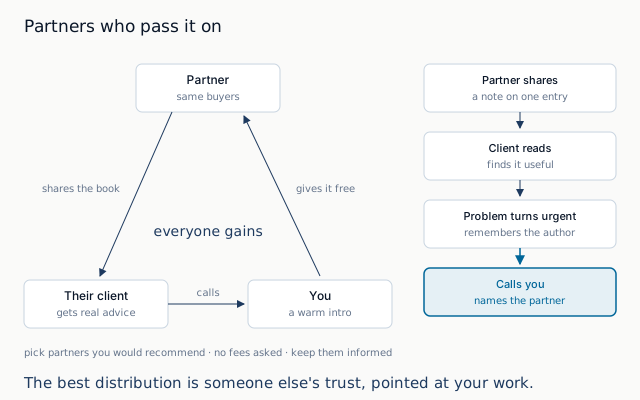
The logic is mutual benefit. Partners want to give their clients something useful, because it strengthens their own relationship. Your book is something useful that costs them nothing to share. Their clients get valuable advice. The partner looks thoughtful for providing it. You get introduced to buyers who trust the person introducing you. Everyone gains, which is why the arrangement tends to last.
The chain works like this. A partner shares the book with a client, perhaps with a note recommending a particular entry. The client reads it and finds it useful. When the problem the book addresses becomes pressing, the client remembers it, and remembers that you wrote it. They get in touch, often mentioning the partner. The call is the payoff: a warm introduction arriving through a channel you did not have to manage.
Approach partners with something concrete. Offer them the book to share with their clients, perhaps with a short introduction from them at the front of a co-branded edition, or a dedicated landing page. Suggest specific entries that their clients would find most relevant. Make clear that you are not asking for referral fees or formal arrangements; you are offering something useful for them to give away.
Some partnerships become more formal over time. A partner who sees their clients responding well to your book might want to work with you more closely: joint events, co-written entries, or referral arrangements. Let these develop naturally rather than proposing them upfront. The book is the first step; trust built through it makes further steps possible.
Choose partners carefully. Their reputation becomes associated with yours, and yours with theirs. A partner whose clients are poorly served, or whose approach contradicts yours, can damage the book's credibility. Look for partners you would recommend to your own clients, and whose clients you would be glad to serve.
Keep partners informed. Tell them when a new edition comes out. Thank them when an introduction comes through them. Share any feedback from their clients, with permission. Partnerships fade when they feel one-sided, and a little communication keeps them alive.
The Authority Book — How a 100-entry book wins clients
Ready when you are.
Tap below to open the full chapter in the book reader. Anchored books jump to this chapter automatically.
Marketplaces and Shelves
The Authority Book — How a 100-entry book wins clients
Should your authority book be listed on retail marketplaces, available to buy as an ebook or in print alongside every other business book? The question tempts most authors, because being on a shelf, even a virtual one, feels like proof of being a real author. The honest answer is that marketplaces are worth a modest effort for credibility and rarely worth much effort as a channel.
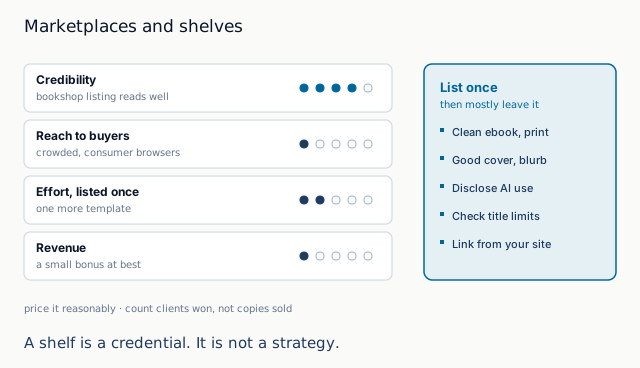
Retail listings do bring some credibility. A buyer who searches for you and finds your book on a familiar retail site sees that it exists in the same world as other published books. A link to a retail listing in a speaker biography or a proposal reads well. For some audiences, available in bookshops still carries weight, even when the bookshop is a website.
As a channel for reaching buyers, though, marketplaces are weak for authority books. They are crowded, discovery is hard without significant promotion, and the people browsing them are mostly looking for consumer books, not specialist advice from practitioners. A niche authority book will typically sell a handful of copies through marketplaces and reach very few new buyers. Your own channels, the web reader, personal sends, partners and borrowed audiences, will do far more.
There are also rules to observe. Major self-publishing platforms now require you to disclose when content has been generated with AI assistance, and some limit how many titles an account can publish in a period. Read the current terms carefully before listing, and comply fully. An authority book that is delisted for breaching platform rules does more harm than one that was never listed.
The sensible approach is to list once, properly, and then mostly leave it. Produce a clean ebook and print edition, list them with a good description and cover, link to them from your own site, and then focus your launch energy elsewhere. The listing will do its quiet credibility work without needing much attention.
Do not price the retail edition as a revenue line. The book's commercial value is in the clients it helps you win, not in copies sold. Price it reasonably, so it does not look either suspiciously cheap or absurdly expensive, and treat any income as a small bonus. If you find yourself tracking retail sales closely, you are measuring the wrong thing.
Watch the details. Retail editions need proper metadata, categories and descriptions, and they often need slightly different formatting from your own editions. If you built the book from a single source, generating a retail-ready file should be a matter of one more template.
The Authority Book — How a 100-entry book wins clients
Ready when you are.
Tap below to open the full chapter in the book reader. Anchored books jump to this chapter automatically.
The Long Tail of a Launch
The Authority Book — How a 100-entry book wins clients
Most launches are judged by what happens in the first week: how many downloads, how many shares, how many responses. For an authority book, the first week is the least important part of its life. The real value accumulates over months and years, as the book is found, recommended and returned to long after the launch has been forgotten.
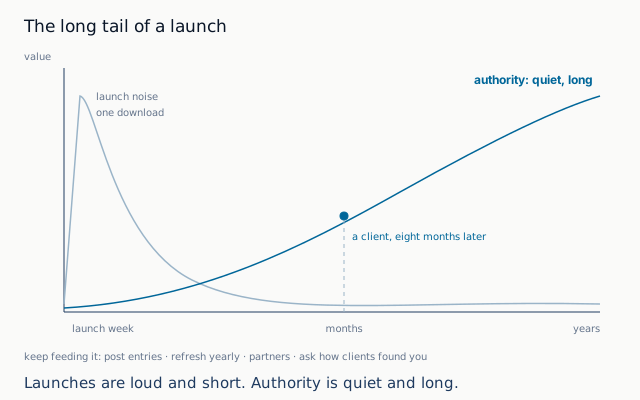
Think about how buyers actually use authority books. Someone downloads the PDF in launch week because a colleague mentioned it. They read two entries and save it. Eight months later, the problem the book addresses becomes urgent, and they search their files and find it. They read four more entries. They get in touch. In launch-week metrics, they were a single download. In reality, they were a client, eight months in the making.
This long tail is why the launch should not be the end of your effort. It is the beginning of a sustained presence: entries posted regularly, the book mentioned in talks and conversations, partners passing it on, the web reader quietly accumulating search traffic. Each of these keeps the book findable, so that when buyers' problems become urgent, the book is there.
It is also why patience matters. If the first month produces few direct results, do not conclude that the book has failed. Authority builds slowly. A book that produces modest early results and keeps producing them for years is far more valuable than a viral moment that fades in a week. Judge the book over quarters, not days.
Keep the book alive actively. Mention it in new contexts. Refresh it annually. Add new entries when you learn something worth sharing. Respond to readers who get in touch. Each of these renews the book's presence and extends its tail. A book that is never mentioned after launch week will be forgotten as quickly as any other launch.
Look for unexpected tails. Some entries will turn out to be much more popular than others, often not the ones you expected. Some readers will come from places you never targeted. Some partners will share it in ways you did not anticipate. Pay attention to these surprises, and follow them; they often reveal opportunities your original plan missed.
Measure the tail honestly. Ask every new client how they found you, and listen for the book. Note when prospects mention specific entries. Track which entries are read most often in the web reader over time, not just at launch. These signals, gathered over a year, give a much truer picture of the book's value than any launch-week number.
The Authority Book — How a 100-entry book wins clients
Ready when you are.
Tap below to open the full chapter in the book reader. Anchored books jump to this chapter automatically.
Send the Book Before the Call
The Authority Book — How a 100-entry book wins clients
The simplest way to use an authority book in sales is also the most effective: send it before the first call. Not after, as a follow-up, and not during, as a reference. Before. When a prospect books time with you, send them the book, or a few chosen entries from it, with a short note. By the time you speak, they will have met your thinking, and the call can start somewhere much more useful.
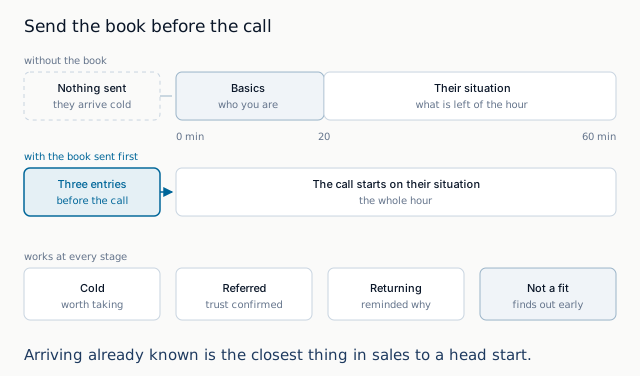
The note matters. Do not just attach the PDF and say in case it's useful . Choose two or three entries that relate to what you know about the prospect's situation, and point to them: Before we speak, entries fourteen and thirty-one might be worth a look; they cover the onboarding problem you mentioned. This shows you have thought about them, gives them a manageable amount to read, and ensures what they read is relevant.
Most prospects will read at least one entry. Some will read all three and more. A few will read nothing, which is fine; you have lost nothing. The ones who read arrive with context. They understand your approach. They may have questions about a specific entry, which gives the conversation an immediate focus. They may have already decided they want to work with you, and the call is about details.
The payoff is a call that starts warm. Instead of spending the first twenty minutes establishing who you are and how you think, you can start with their situation and how your approach applies to it. That is a better use of both your time, and it moves the conversation toward a decision faster.
This works for prospects at any stage. A cold prospect who agrees to a call is still unsure about you; the book gives them reasons to take the call seriously. A warm prospect referred by a client already trusts you somewhat; the book confirms and deepens that trust. A prospect returning after a long gap is reminded why they were interested.
It also filters. Occasionally a prospect reads the entries and realises your approach is not what they want. They may cancel the call or come to it with a clear objection. Either outcome saves time. A prospect who disagrees with your book is unlikely to be a good client, and discovering that before the call is a kindness to both of you.
Make it a habit. Every time a call is booked, before the calendar invite is even confirmed, choose the entries and send the note. It should take five minutes. Within a few weeks, you will notice a difference in how calls feel, and probably in how many of them lead to work.
The Authority Book — How a 100-entry book wins clients
Ready when you are.
Tap below to open the full chapter in the book reader. Anchored books jump to this chapter automatically.
The most powerful way to use the authority book method in sales is not to send your own book but to build a small piece of the prospect's. A spec sample is ten entries written for a specific prospect's world, about their problem, in their context, delivered as a short branded document or a live web page. It shows them, rather than tells them, what you would do for them.
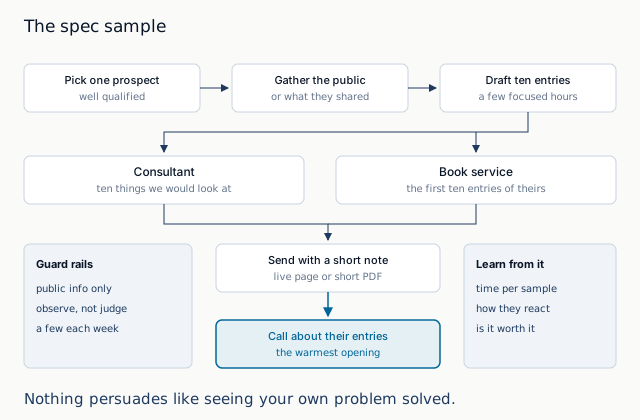
The idea comes from creative industries, where designers and agencies have long produced speculative work to win clients. Done the old way, spec work was expensive and often wasted. Done with the production methods described in this guide, it is fast enough to be practical. With good inputs and a clear brief, ten strong entries can be drafted, edited and laid out in a few focused hours.
For a consultant or coach, the spec sample is usually ten things we would look at in your business , based on public information and whatever the prospect has shared. For an agency offering authority books as a service, which the next part covers, it is literally the first ten entries of the prospect's own book, written in their voice and branded in their colours. Either way, the prospect sees their own situation reflected back with insight they have not had before.
Send it with a short note. Here are ten observations about your onboarding process. The full picture, plus what to do about each, is what we would cover together. Or, for book services: Here are the first ten entries. The other ninety, plus the web reader and app, would follow. Then propose a call to discuss.
The payoff is the conversation. A prospect who receives a thoughtful spec sample is very likely to take a call, because they want to talk about what you have written about them. The call starts with their reaction to specific entries, which is the warmest possible opening. You are not pitching; you are discussing their business, with evidence that you understand it.
Spec samples take effort, so choose prospects carefully. They work best for prospects who are well-qualified: the right size, the right problem, a realistic chance of buying. Do not produce them for everyone. A modest number each week, sent to well-chosen prospects, produces better results than a large volume sent indiscriminately.
Respect the prospect's information. Use only what is public or what they have shared with you. Do not speculate about confidential matters, and be careful that observations based on limited information are framed as observations, not judgements. A spec sample that gets something important wrong, or presumes too much, can backfire.
The Authority Book — How a 100-entry book wins clients
Ready when you are.
Tap below to open the full chapter in the book reader. Anchored books jump to this chapter automatically.
Talking Through Entry Twelve
The Authority Book — How a 100-entry book wins clients
Once prospects have read parts of your book, entries become useful tools in the conversation itself. Instead of explaining your approach from scratch, you can refer to an entry they have read and build on it. Instead of making abstract claims, you can point to a specific lesson. The book becomes the scaffolding for the call.
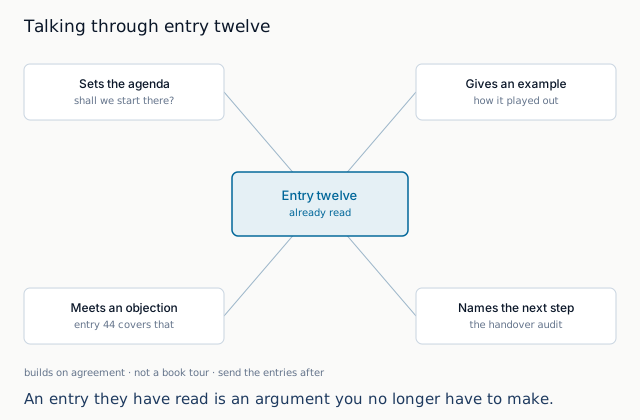
An entry can serve several purposes in a sales conversation. It can set the agenda: You mentioned entry twelve on handover failures; shall we start there? It can provide an example: This is the situation entry twelve describes; here is how it played out for a firm like yours. It can address an objection: You are worried about disruption; entry forty-four explains how we sequence the work to avoid that. And it can define the next step: The first thing we would do is what entry twelve calls the handover audit.
In each case, the entry carries some of the weight. The prospect has already read it, so you do not need to explain the basics. They have already accepted some of its reasoning, so you are building on agreement rather than starting cold. And because it is written down, it feels more authoritative than something you say on the spot.
Have the book open during calls. When a topic comes up that an entry addresses, mention it by number or title, and offer to send the link afterwards. This reinforces the book's value, gives the prospect something to share with colleagues, and makes your follow-up email write itself: Here are the three entries we discussed.
Be careful not to turn the call into a book tour. The conversation should be about the prospect's situation, not about your book. Entries are tools to help that conversation, not substitutes for it. If you find yourself reciting entries rather than listening, step back. The best calls are mostly the prospect talking, with you occasionally connecting what they say to something in the book.
Prospects sometimes disagree with an entry. This is useful. A disagreement about a specific written point is much easier to discuss than a vague unease about your approach. You can explore why they disagree, whether their situation is different, and whether the entry needs nuance for their context. Sometimes they are right, and you learn something for the next edition. Sometimes the discussion reveals that they are not a good fit, which is also useful to know.
Over time, you will notice certain entries come up repeatedly in sales conversations. These are your most commercially important entries. Make sure they are among the best in the book, and consider promoting them more prominently in the landing page, the email course and your social posts.
The Authority Book — How a 100-entry book wins clients
Ready when you are.
Tap below to open the full chapter in the book reader. Anchored books jump to this chapter automatically.
Objections Already Answered
The Authority Book — How a 100-entry book wins clients
Every expert hears the same objections from prospects, over and over. We tried something like this before and it didn't work. It's not the right time. We could do this ourselves. How do we know it will work for a firm our size? Each objection takes time to address on a call, and each one, if not handled well, can stall or end the conversation. An authority book can answer most of them before they are raised.
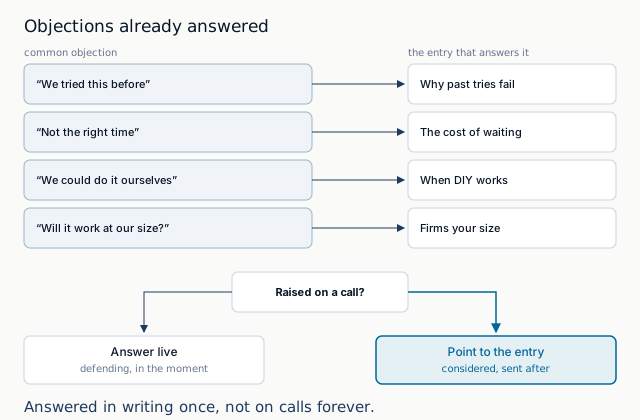
List the objections you hear most often. For each, ask whether there is an entry in the book that addresses it, directly or indirectly. If there is, make sure it is a good one: honest, specific and persuasive. If there is not, consider writing one for the next edition. Over time, the book should contain a thoughtful response to every common objection, written calmly and without defensiveness.
The advantage of answering objections in writing is that the response is considered. On a call, you answer under pressure, in the moment, sometimes clumsily. In an entry, you have had time to think, to find the best example, and to address the real concern behind the stated one. A prospect who reads a well-written response before the call may never raise the objection at all.
When an objection does come up on a call, you have a choice: answer it live, or point to the entry. Answering live can work well, but it puts you in the position of defending yourself. Pointing to the entry, that is a fair concern; entry fifty-seven addresses exactly that, and I'll send it after the call , shifts the dynamic. You are not defending; you are referring them to a considered answer you wrote for everyone. It signals that the concern is common, that you have thought about it carefully, and that you are not rattled.
Be honest in objection entries. If a prospect's concern is sometimes valid, say so, and explain when. Doing this yourself works well if you have someone with the time and experience to lead it; here is how to tell. Honest answers are more persuasive than defensive ones, because they show you are not merely selling. Some prospects will read the honest answer and realise they do need help. Others will realise they do not, and you will have saved a wasted engagement.
Objection entries also help prospects sell internally. When a champion has to persuade a sceptical colleague, they can forward the relevant entry rather than trying to reconstruct your argument from memory. The objection gets answered in your words, at your quality, by someone the colleague trusts.
This week, write down the five objections you hear most often. For each, find the entry that addresses it, or note that none does. For any gap, draft a short entry. Then, on your next calls, try pointing to the entry rather than answering live. Notice how the conversation changes.
The Authority Book — How a 100-entry book wins clients
Ready when you are.
Tap below to open the full chapter in the book reader. Anchored books jump to this chapter automatically.
Leave-Behinds That Get Opened
The Authority Book — How a 100-entry book wins clients
After a sales meeting, most experts send a follow-up email with a summary, perhaps a proposal, and an attachment or two. Much of this goes unread. A leave-behind built from your book, focused on what you actually discussed, is far more likely to be opened, read and shared.
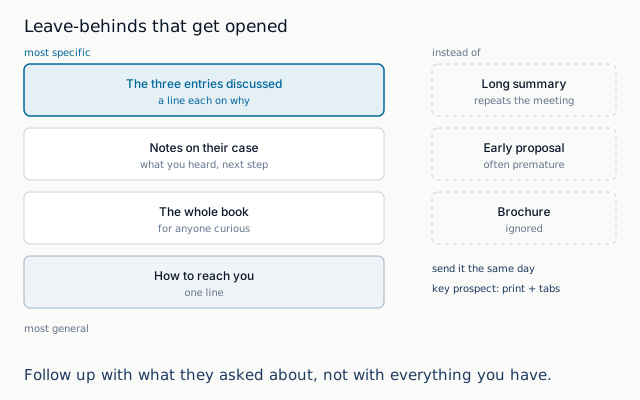
Structure the follow-up in layers, from most specific to least. At the top, the three entries you discussed in the meeting, linked or attached, with a sentence each on why they matter for this prospect. Below that, a short note on their specific situation: what you heard, what you would recommend, what the next step might be. Below that, a link to the whole book, for anyone who wants to read more. And at the bottom, how to reach you.
The specific entries are the payoff. They are directly relevant to the conversation, they have already been mentioned, and they give the prospect something concrete to read, think about and share. A prospect who wants to explain the meeting to a colleague can forward the entries rather than trying to summarise from memory. A colleague who reads them gets your thinking first-hand.
Compare this to the typical follow-up: a long summary email, a proposal document, and a general brochure. The summary repeats what the prospect already heard. The proposal is often premature. The brochure is ignored. The specific entries, by contrast, add value, extend the conversation, and help the prospect move toward a decision.
Keep the note on their situation short. A few paragraphs at most. Reflect back what you heard, so they know you listened. Connect it to the entries, so they see how your thinking applies. Suggest a clear next step, whether that is another conversation, a small paid piece of work, or a proposal. Do not try to make the full case in the follow-up; the entries do much of that work.
Print can help here too. For a particularly important prospect, a printed copy of the book posted after the meeting, with the three discussed entries marked with tabs or a note, is memorable in a way no email can be. It sits on their desk, and the next time they think about the problem, it is there.
Send the follow-up promptly, ideally the same day. The meeting is fresh in both your minds, and the entries will feel like a natural continuation of the conversation rather than an afterthought. A follow-up sent a week later feels like a chase.
The Authority Book — How a 100-entry book wins clients
Ready when you are.
Tap below to open the full chapter in the book reader. Anchored books jump to this chapter automatically.
The Follow-Up Ladder
The Authority Book — How a 100-entry book wins clients
An authority book is free, or nearly so. Your services are not. The gap between the two can feel large to a prospect: reading a free book is easy, but committing to a substantial engagement is a big step. A follow-up ladder bridges that gap with intermediate offers, each a small step up from the last, each building trust and moving the prospect closer to the engagement that sustains your business.
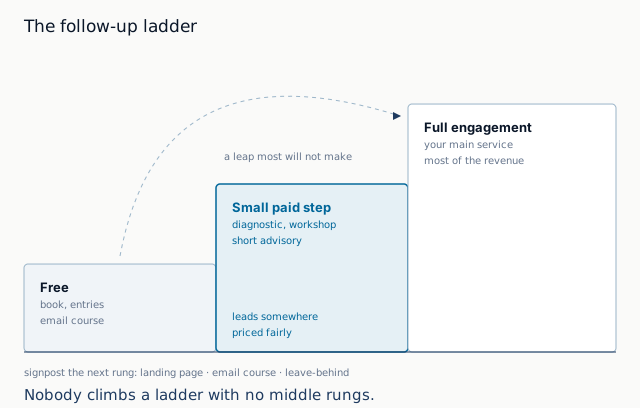
The ladder has three broad rungs. At the bottom, free: the book, individual entries, the email course, perhaps a short call. This is where most readers stay, and that is fine. In the middle, a small paid first step: something modest in scope and commitment that delivers real value and lets the prospect experience working with you. At the top, the full engagement: the main service you offer, which is where most of your revenue comes from.
The middle rung is the one most experts neglect, and it matters most. Without it, prospects face a leap from free to full engagement, and many will not make it. With it, they can take a smaller step, see the value, and then take the next. The middle rung reduces risk for the buyer, which makes it easier for them to say yes.
Good middle-rung offers grow naturally from the book. A diagnostic or audit that applies the book's framework to the prospect's situation. A workshop that works through one part of the book with their team. A short advisory engagement focused on the problem addressed in a specific entry. Each of these delivers something useful on its own and leaves the prospect understanding why the full engagement would be valuable.
Design the middle rung to lead somewhere. A diagnostic should end with recommendations that naturally suggest the full engagement. A workshop should surface problems the team cannot solve alone. The aim is not to trick prospects into buying more, but to ensure that the small step shows them clearly what the larger step would offer. Many will take it. Some will not, and they will still have received something worth paying for.
Make each rung visible. On the landing page, at the end of the email course, in the leave-behind after a meeting, readers should be able to see what the next step up is. Not a hard sell, but a clear signpost: if you want help applying this, here is how we start.
Price each rung consistently with the value it delivers, and do not underprice the middle rung to make it irresistible. A middle rung priced too low attracts the wrong buyers and signals that your time is not valuable. It should feel like a sensible, modest commitment for a meaningful result.
The Authority Book — How a 100-entry book wins clients
Ready when you are.
Tap below to open the full chapter in the book reader. Anchored books jump to this chapter automatically.
Workshops, Audits and Retainers
The Authority Book — How a 100-entry book wins clients
An authority book is not just a marketing asset; it is also a product catalogue in disguise. Each part, each cluster of entries, suggests a service you could offer. The book describes your thinking, and the services are ways for clients to have that thinking applied to their situation. Looking at the book this way often reveals offers you had not formalised.
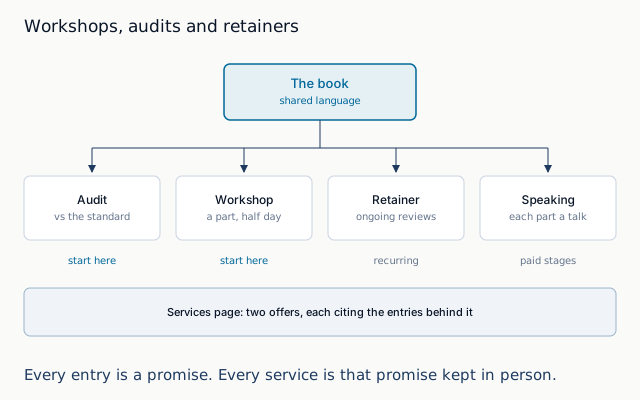
Audits are the most natural. If your book describes what good looks like in a particular area, an audit measures a client's current state against that standard and recommends what to change. The book provides the framework, so the audit is quick to design and easy to explain: we will assess your onboarding against the twelve entries in part four. Clients understand exactly what they are getting, and the output is concrete.
Workshops come next. Each part of the book can become a workshop, as an earlier chapter described. A half-day workshop working through one part with a client's team delivers immediate value and introduces the team to your thinking. It is also a natural middle rung on the follow-up ladder, and it often leads to further work as teams discover problems they want help with.
Retainers grow from the book's ongoing nature. Many of the problems your book addresses are not solved once; they need ongoing attention. A retainer offering regular advice, periodic reviews, or continued support in applying the book's framework gives clients continuity and gives you predictable revenue. The book provides the shared vocabulary that makes these relationships efficient.
Speaking is a fourth offer, especially for experts whose books establish them as authorities. Conferences, corporate events, and industry gatherings often pay speakers, and a book makes you easier to book. Each part is a talk; the book is the takeaway.
The hub of all these is the book itself. It is the common reference, the shared language, and the evidence of expertise that makes each service credible. Clients who come through the book arrive already understanding what you offer, because they have read it. That makes every service easier to sell and easier to deliver.
Do not try to offer everything at once. Start with the service that most naturally follows from the book and that your buyers most need. Usually that is an audit or a workshop, because they are concrete and modest in scope. Add others as demand appears. A clear, small range of offers is easier for buyers to understand than a long menu.
The Authority Book — How a 100-entry book wins clients
Ready when you are.
Tap below to open the full chapter in the book reader. Anchored books jump to this chapter automatically.
Measuring Whether It Pays
The Authority Book — How a 100-entry book wins clients
An authority book is an investment of time and attention, and like any investment it should be judged by whether it pays. This is harder than it sounds, because the book's effects are diffuse and delayed. A prospect might read three entries, forget about you, see a post six months later, and then get in touch after a referral. Did the book win that client? Partly. Measuring it honestly requires a few simple habits.
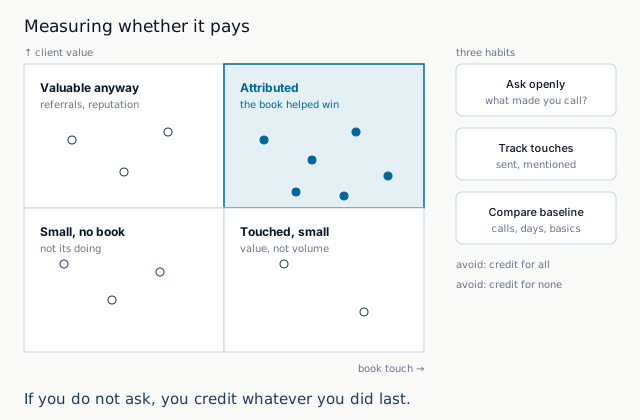
The first habit is asking. Every new client, and every prospect who books a call, should be asked how they found you and what they had read or seen before getting in touch. Ask openly, without leading: what made you reach out? Note the answer. Over time, a pattern emerges. Some clients will mention the book directly. Others will mention a post derived from it, or a partner who passed it on, or an entry a colleague forwarded.
The second habit is tracking touches. When you send the book to a prospect, note it. When a prospect mentions an entry on a call, note it. When a client says the book helped them decide, note it. A simple spreadsheet or a field in your client records is enough. You are building a record of where the book appeared in each client's journey.
Picture the results on two axes: how much the book touched the client's decision, and how valuable the client turned out to be. Clients with high book involvement and high value are the ones the book clearly helped win. If that corner fills up over a year, the book is paying. If it stays empty, either the book is not being used in sales, or it is not persuading.
Avoid two common mistakes. The first is crediting the book for everything, which feels good and teaches you nothing. Many clients would have come anyway, through referrals or reputation. The second is crediting it for nothing, because no client ever says I hired you because of your book . Few will. The book's influence is usually one factor among several, and your job is to estimate its share honestly.
Compare against your baseline. Earlier in this guide, you were asked to note how many calls it took to win a client, how long from first call to signature, and how much of a first call was spent on basics. Ask the same questions a quarter or two after the book is in use. Changes in those numbers, even rough ones, are a good indicator of the book's effect on your sales process.
Measure value, not volume. Downloads, page views and followers are easy to count and only loosely connected to whether the book wins clients. One well-placed spec sample that lands a significant client is worth more than ten thousand downloads. Focus on the measures that connect to revenue.
The Authority Book — How a 100-entry book wins clients
Ready when you are.
Tap below to open the full chapter in the book reader. Anchored books jump to this chapter automatically.
Leading Indicators
The Authority Book — How a 100-entry book wins clients
Revenue is a lagging indicator. By the time it shows whether your book is working, months have passed, and you have little chance to adjust. Leading indicators are the weekly numbers that predict revenue before it arrives. Tracking a handful of them lets you see early whether the book is doing its job, and change course if it is not.
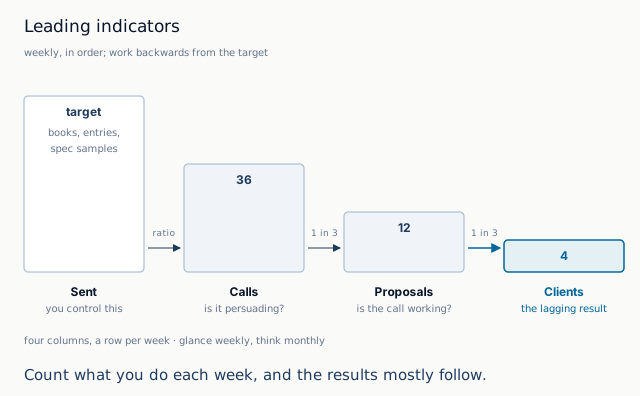
For an authority book used in sales, a simple chain of four indicators works for most experts. Books and spec samples sent to prospects each week. Calls booked as a result. Proposals or paid first steps that follow those calls. And clients won. Each step feeds the next, and the ratios between them tell you where the process is working and where it is leaking.
The first number is the one you control most directly. How many prospects received the book, a set of entries, or a spec sample this week? If this number is low, nothing downstream can be high. Many experts discover that their book is excellent but they are simply not sending it to enough people. Set a weekly target and keep to it.
The second number tells you whether the book is persuading. If you send many books but few prospects book calls, either the book is not landing or it is going to the wrong people. Look at who you are sending it to and which entries you are pointing them to. Adjust both.
The third and fourth numbers tell you whether calls are converting. If calls are booked but few lead to proposals or clients, the problem may be in the conversation rather than the book. The earlier chapters on using entries in calls, handling objections and the follow-up ladder are the places to look.
Keep the tracking simple. A spreadsheet with four columns and a row per week is enough. Review it every week, briefly, and every month, more thoughtfully. Look for trends rather than individual weeks; one slow week means little, but four slow weeks in a row is a signal.
Set targets based on what you need, working backwards. If you want a certain number of new clients a quarter, and roughly one in three proposals becomes a client, and roughly one in three calls becomes a proposal, you can work out how many calls you need, and how many books to send to get them. The ratios will be rough at first and sharpen as you collect data.
The Authority Book — How a 100-entry book wins clients
Ready when you are.
Tap below to open the full chapter in the book reader. Anchored books jump to this chapter automatically.
Keep, Refresh or Kill
The Authority Book — How a 100-entry book wins clients
At some point, you will have to decide whether your authority book is working. Not in the first week, when it is too early to tell, and not after two years, when you have spent too long on something that might not have been helping. Decide on evidence, by a date you set in advance, using the indicators and attribution you have been tracking.
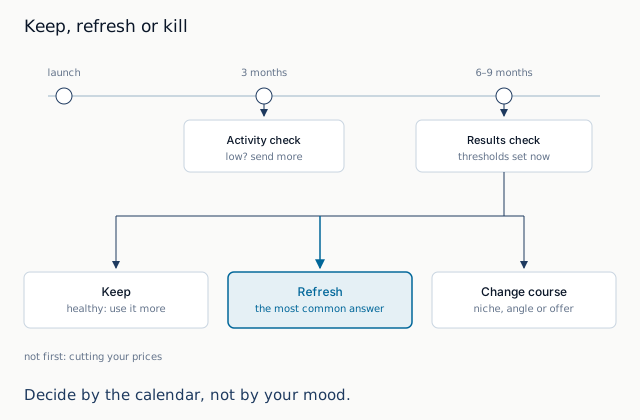
Set two review dates when you launch. The first, about three months in, is a check on activity: are you sending the book, are prospects reading it, are calls being booked? If activity is low, the problem is usually effort, not the book, and the fix is to send more. The second, about six to nine months in, is a check on results: has the book contributed to winning clients, measured honestly through the attribution habits described earlier?
At the second review, there are three possible decisions. Keep, if the book is clearly contributing and the numbers are healthy: carry on, refresh on schedule, and look for ways to use it more. Refresh, if the book is contributing somewhat but less than it could: identify the weakest parts, the entries that never come up in sales, the topics prospects ask about that the book does not cover, and produce a stronger edition. Kill, or more accurately change course, if the book is clearly not contributing despite genuine effort in using it.
Refresh is the most common right answer, and the payoff of this chapter. Few books are perfect at first edition. Most have strong parts and weak parts, entries that work in sales and entries that do not. A focused refresh, informed by six months of real use, usually produces a book that performs much better than the original. It is cheaper than starting again and builds on what already works.
Changing course is harder to accept but sometimes right. If the book has been sent widely and used well, and still no client mentions it, something fundamental may be wrong. The niche might not value written expertise. The angle might not resonate. The promise might not match what buyers want. In that case, the honest response is not to abandon the method but to change the niche, the angle or the offer, and write a different book, using everything you have learned.
Do not change the price of your services as the first response to a book that is not working. The book's job is to help buyers understand and trust your expertise. If it is not doing that, lowering your prices will not help; it will just make you cheaper and still unknown. Fix the book or the niche first.
This week, put two review dates in your calendar: three months and six to nine months after launch. Next to each, write the specific numbers you will look at and the threshold that would trigger a refresh or a change. Deciding the criteria now, while you are calm, protects you from deciding later on a bad day.
The Authority Book — How a 100-entry book wins clients
Ready when you are.
Tap below to open the full chapter in the book reader. Anchored books jump to this chapter automatically.
Doing It for Clients
The Authority Book — How a 100-entry book wins clients
Once you have produced your own authority book, you have something many of your clients and contacts would like: a method for turning their expertise into a book that wins them work. Offering that method as a service is a natural extension, particularly for agencies, marketing consultants and anyone who already helps experts communicate. The same process that produced your book can produce theirs.
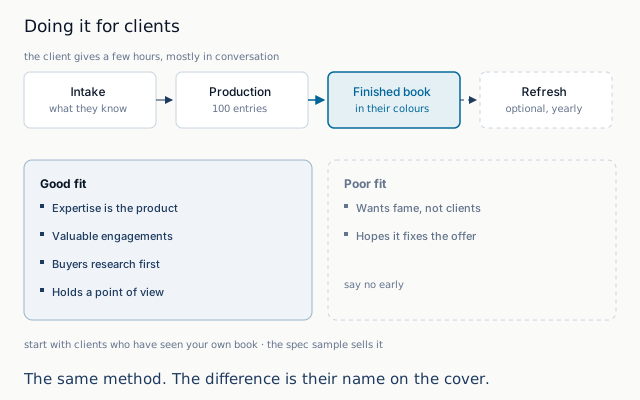
The service has a clear shape. An intake process that extracts the client's knowledge, voice and goals. Production that turns that material into a hundred edited entries, using the methods described in this guide. Editions: the PDF, web reader, app and print versions, branded in the client's colours. And an optional refresh, keeping the book current over time. Each stage is something you have already done for yourself, so you know what it involves and where the difficulties lie.
What clients are buying is not words. They are buying a finished asset that helps them win clients, produced with less of their time than they could ever manage alone. Most experts know they should write a book and never do, because they cannot find the months it seems to require. A service that asks for a few hours of their time, mostly in conversation, and delivers a finished book with multiple editions, solves a problem they have had for years.
The service suits certain clients better than others, and the earlier chapter on who the method is for applies here too. Clients whose product is their expertise, whose engagements are valuable, whose buyers research before deciding, and who are willing to hold a point of view. Clients who want fame rather than clients, or who expect the book to fix a weak offer, are less likely to be satisfied.
There are responsibilities that come with this. The book will carry the client's name, and its quality reflects on them. You must capture their voice, not yours. You must check facts in their field, which may be unfamiliar to you. You must handle their information confidentially. And you must be honest with them about how the book is produced, including the role of AI tools. The chapters that follow cover each of these.
Start with clients you know. Existing clients who have seen your own book and asked about it are the ideal first customers. They trust you, they understand the method because they have seen its results, and they will give you honest feedback as you refine the service. A handful of successful client books becomes your portfolio, and each one is a live example to show the next prospect.
The spec sample from the previous part is particularly powerful here. For a prospect considering a book service, nothing is more persuasive than seeing the first ten entries of their own book, in their voice and their colours, before they have committed to anything.
The Authority Book — How a 100-entry book wins clients
Ready when you are.
Tap below to open the full chapter in the book reader. Anchored books jump to this chapter automatically.
The Intake Interview
The Authority Book — How a 100-entry book wins clients
The most important step in producing a book for someone else is the intake interview: a structured conversation, usually around ninety minutes, that extracts the expert's knowledge, opinions, stories and voice. Done well, it supplies most of the raw material for the book. Done badly, it leaves you guessing, and the book will read like a guess.
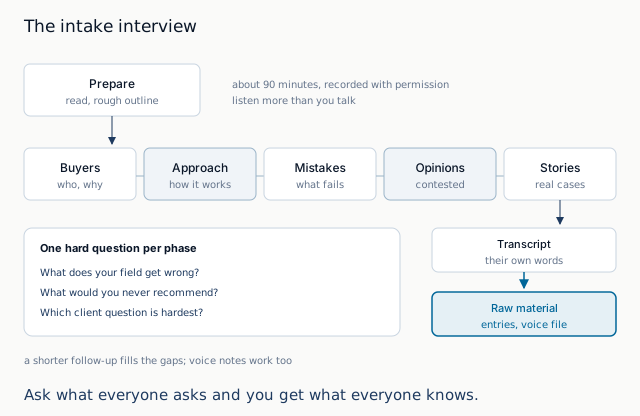
Prepare thoroughly. Before the interview, read everything the expert has already published: their website, posts, articles, talks, proposals they are willing to share. Note recurring themes, phrases they use, opinions they hold. Draft a rough outline of what their book might cover, so you can test it during the conversation. Send them a short list of topics in advance, so they can think, but not a script, which would make the conversation stiff.
Structure the interview in phases. Start with their buyers: who they are, what problems bring them in, what they misunderstand. Move to the expert's approach: how they diagnose, what they do, why it works. Then mistakes: what goes wrong, for clients and in the field generally. Then opinions: what they believe that others in their field would dispute. And finally stories: specific cases, suitably anonymised, that illustrate their thinking.
The most valuable moments come from hard questions. What do most people in your field get wrong? What would you never recommend, even though it's popular? What is the question clients ask that you find hardest to answer? These questions push the expert past their prepared material into the knowledge they rarely articulate. Their answers, spoken spontaneously, are often the best entries in the book.
Record the interview, with permission, and have it transcribed. The transcript is raw material in the expert's own words, which is exactly what you need for capturing their voice. You will draw on it throughout production: for entry content, for phrasing, for examples, and for the voice file that guides drafting.
Listen more than you talk. The interview is not a consultation; you are not there to give advice or demonstrate your own expertise. Your job is to ask, follow up, and draw out. When the expert says something interesting, ask for an example. When they generalise, ask for the specific case. When they hedge, ask what they would actually recommend.
One interview is often not enough for a hundred entries. Plan for a shorter follow-up conversation after you have drafted the outline, to fill gaps and test the structure. Some experts prefer to send voice notes or written answers to specific questions between sessions, which can work well for filling particular gaps.
The Authority Book — How a 100-entry book wins clients
Ready when you are.
Tap below to open the full chapter in the book reader. Anchored books jump to this chapter automatically.
Fixed Scope, Fixed Calendar
The Authority Book — How a 100-entry book wins clients
Custom work is hard to sell and harder to deliver profitably. Every project is different, scoping takes time, clients add requests, timelines stretch. A book service avoids most of these problems by being productised: a fixed scope, a fixed calendar, and a clear set of deliverables that are the same for every client. Clients know exactly what they are buying, and you know exactly what you are delivering.
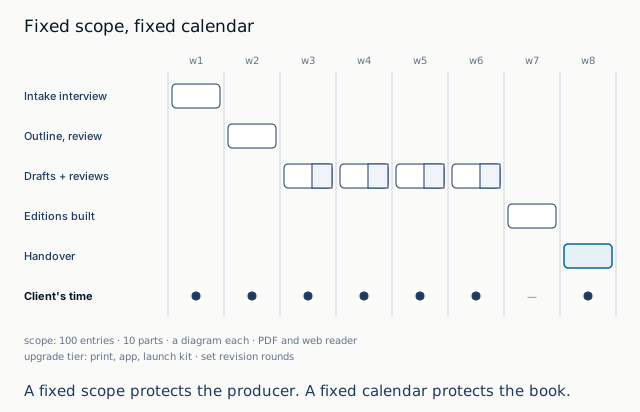
Fix the scope first. A hundred entries in ten parts. One diagram per entry. A defined set of editions: perhaps PDF and web reader as standard, with print and app as an optional upgrade. A defined number of revision rounds. A defined amount of the client's time: the intake interview, an outline review, a review of each batch of drafts. Anything outside this scope is a separate conversation.
Then fix the calendar. A sequence of stages with dates attached, agreed at the start. Intake interview in the first week. Outline delivered for review a few days later. Drafts delivered in batches, each with a short review window. Final editions delivered on a set date. The handover at the end, when the client receives the finished book and everything needed to use it, is the payoff, and it should be scheduled from the outset.
A fixed calendar helps clients as much as it helps you. Experts are busy, and an open-ended book project easily slips down their priorities. Fixed review windows, with clear dates, keep them engaged. They know when they need to give time and how much. And the end date gives them something to plan around: a launch, a conference, a sales push.
The production methods in this guide make a fixed calendar realistic. Once intake is done and the outline approved, drafting and editing a part is a predictable amount of work. Diagrams and editions are generated from data by templates you have already built. The variable is mostly the client's review time, which is why the calendar should allow reasonable windows for each review and be clear about what happens if they are missed.
Offer a small number of tiers rather than infinite customisation. A standard book with core editions, and a fuller package that adds print, the app, and perhaps a launch kit with social posts and email course. Two tiers are easy to explain and easy for clients to choose between. More than three tends to cause hesitation.
Write it all down in a simple one-page description of the service: what is included, what is not, the stages and their timing, what is required from the client, and what they receive at handover. Send it with every proposal. It answers most questions before they are asked, in the same way the book itself does for your own sales.
The Authority Book — How a 100-entry book wins clients
Ready when you are.
Tap below to open the full chapter in the book reader. Anchored books jump to this chapter automatically.
The Client's Voice, Not Yours
The Authority Book — How a 100-entry book wins clients
When you produce an authority book for a client, the hardest thing to get right is voice. Not your voice, theirs. After writing your own book, you will have developed a voice file, habits and preferences that serve you well. They will quietly creep into every client book if you let them, and the result will be books that sound like you with different names on the covers.
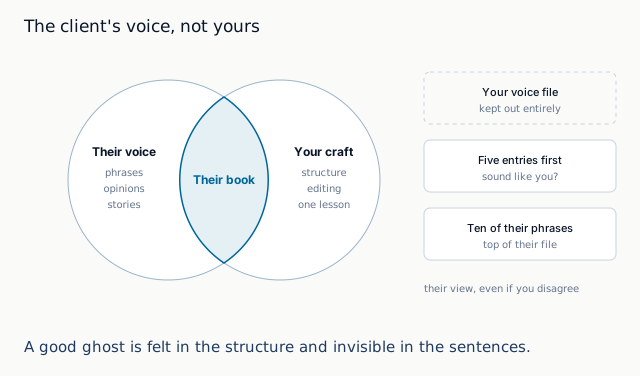
The client's book must sound like the client. Their buyers will meet them, on calls and in meetings, and the person they meet should match the person they read. If the book is crisp and dry and the client is warm and expansive, the mismatch will be noticed. If the book uses phrases the client never uses, the client will feel uncomfortable promoting it. A book that does not sound like its author undermines the authority it was meant to build.
Build a separate voice file for every client. Use the intake interview transcript as the main source: their phrases, their rhythms, their analogies, the way they explain things when talking naturally. Add samples of their writing, if they write well. Note their opinions and the words they use to express them. Note words and phrases they dislike. Have the client review the voice file before drafting starts, and adjust it based on their reaction.
The overlap is where good ghostwriting lives. Their words and knowledge, shaped by your craft: structure, editing, clarity, the discipline of one lesson per entry and a landing at the end of each. You bring the method. They bring the substance and the voice. Neither alone makes a good book.
Be careful with AI drafting. An agent given your house style alongside the client's voice file will often blend them, producing prose that sounds like a mix of both. Keep your own voice file out of client projects entirely. Use only the client's voice file, their transcripts and their source material. Then edit specifically for voice: does this sentence sound like them? Would they say this?
Test early. Draft the first five entries and send them to the client before going further, with a specific question: does this sound like you? Not do you like it , which invites general approval, but a question about voice. Their answer will tell you whether the voice file is working. Adjust before drafting the rest; correcting voice across a hundred entries is far more work than correcting it across five.
Respect their opinions, even when you disagree. The book is theirs. If the client holds a view you think is wrong, you can raise it in conversation, but the book should express their view, not yours. Your job is to make their thinking as clear and persuasive as possible, not to improve it into agreement with you.
The Authority Book — How a 100-entry book wins clients
Ready when you are.
Tap below to open the full chapter in the book reader. Anchored books jump to this chapter automatically.
Partners and White Label
The Authority Book — How a 100-entry book wins clients
Some of the best customers for a book service are not experts themselves but businesses that serve experts: marketing agencies, coaching networks, consultancies with many associates, professional associations. They have clients or members who would benefit from authority books, but they lack the production method. You have the method. A partnership, in which they sell books to their clients and you produce them, can suit both sides.
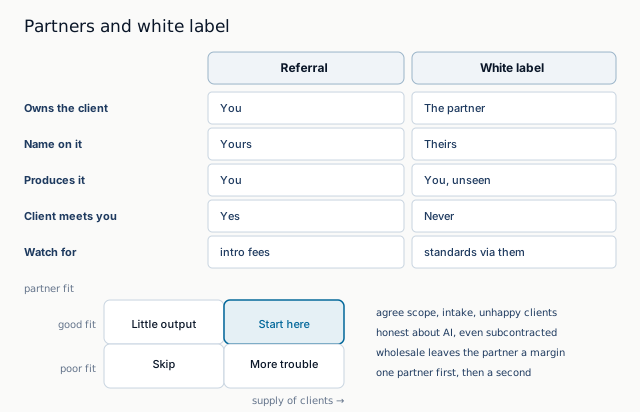
There are two common arrangements. In a referral partnership, the partner introduces clients to you, and you deliver the book under your own name, perhaps with an introduction fee or reciprocal arrangement. In a white-label partnership, the partner sells the book service under their own brand, and you produce it behind the scenes. The partner owns the client relationship; you own the production. Both work. White label tends to suit agencies who want to offer a complete service to their clients without building the capability themselves.
The best partners have two things. A good supply of suitable clients: experts whose work would benefit from a book. And a good fit with your production method: they understand what the book is for, they value quality, and they will not promise clients things your process cannot deliver. Partners with many clients but poor fit can create more trouble than revenue. Partners with good fit but few clients produce little.
White label requires particular care. The client never meets you, so every quality standard must be communicated through the partner. Agree clearly on scope, timelines, what the partner handles and what you handle. Agree on how the intake interview will be done: by you, by the partner, or jointly. Agree on what happens when a client is unhappy. And make sure the partner is honest with their clients about how the book is produced, including the use of AI tools, since the ethical obligations do not disappear because the work is subcontracted.
Price wholesale work to leave room for the partner's margin while covering your costs and time properly. Partners need to be able to resell profitably; if they cannot, the partnership will not last. But do not discount so far that each book becomes a burden. A partnership that leaves you resenting every order is worse than no partnership.
Start with one partner. Learn how the arrangement works in practice: how communication flows, where delays happen, what clients ask for that you did not expect. Refine the process before adding a second. Several partners, each with a steady flow of clients and a well-understood process, can become a significant part of a book service business.
This week, list five businesses that serve experts and might want to offer authority books. For each, note how many suitable clients they might have and how well they would fit your method. Approach the one that scores highest on both. Offer to produce a spec sample for one of their clients as a demonstration.
The Authority Book — How a 100-entry book wins clients
Ready when you are.
Tap below to open the full chapter in the book reader. Anchored books jump to this chapter automatically.
The Refresh Habit
The Authority Book — How a 100-entry book wins clients
A book delivered is not a book finished. Whether it is your own or a client's, an authority book starts dating on the day it launches, and its value depends on staying current. The refresh habit, a regular update on a fixed schedule, keeps the asset working and, for a book service, provides a natural ongoing relationship with clients.
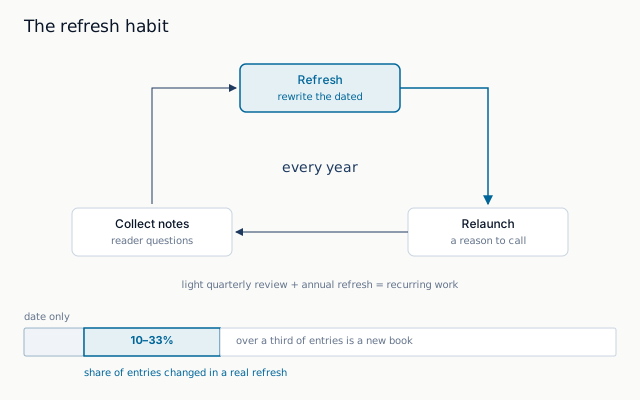
The cycle has three stages. Collect notes continuously: questions readers ask, entries that prompt disagreement, new examples from client work, changes in the field, entries that have never come up in a sales conversation. Refresh the book periodically: rewrite dated entries, replace weak ones with stronger material, update examples, check facts, and change the edition date. Relaunch the refreshed edition: tell readers what has changed, send it to new contacts, and use it as a reason to get back in touch with old ones.
The refresh itself is the payoff, because it is where accumulated learning turns into a better asset. A book refreshed annually for three years, each time informed by real use, will be dramatically better than its first edition. It will be more specific to the market, more aligned with what buyers actually ask, and more persuasive in sales. That improvement only happens if the refresh actually happens.
For your own book, schedule the refresh in your calendar and treat it as a fixed commitment. For client books, offer it as an ongoing service. A light quarterly review, perhaps updating a handful of entries and producing new social content from them, combined with a fuller annual refresh, gives clients a book that stays current without them having to think about it. It gives you recurring work with a client you already know, using a book you already understand.
The refresh is also a relaunch opportunity. A new edition is news. It gives you, or your client, a reason to contact everyone who received the previous edition, to post about what has changed, and to send the book to new prospects. Many experts find that the second and third editions generate more conversations than the first, because the audience has grown and the book has improved.
Keep the refresh proportionate. Most refreshes should change between a tenth and a third of entries. A refresh that rewrites everything is really a new book. A refresh that changes nothing but the date is not a refresh. Focus on the entries that matter most commercially and the ones that have most obviously aged.
If you built the book as a single source with templates, the technical side of a refresh is trivial: edit the source, run the QA script, rebuild every edition. The work is entirely in the content, which is where it should be.
The Authority Book — How a 100-entry book wins clients
Ready when you are.
Tap below to open the full chapter in the book reader. Anchored books jump to this chapter automatically.
Many Books Without Chaos
The Authority Book — How a 100-entry book wins clients
Producing one book is a project. Producing several, for different clients at different stages, is an operation, and operations fail in different ways from projects. Files get mixed up. A client's voice file gets used for another client's drafts. A review deadline is missed because nobody noticed it. Revisions from one client end up in another's book. Chaos is not inevitable, but it arrives quickly if the system is not designed for many books.
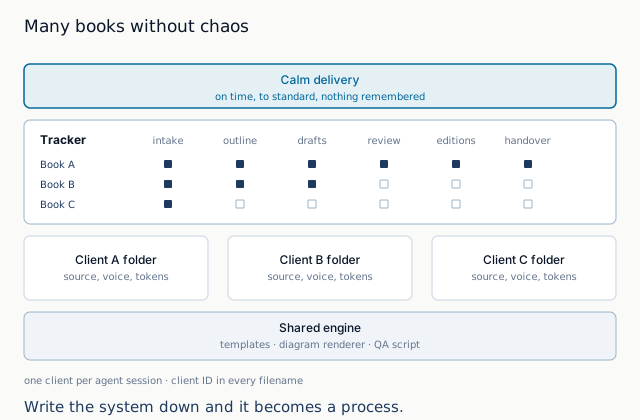
Build in layers. At the bottom, a shared engine: the templates, diagram renderer and QA script that every book uses. This should be identical across clients, so improvements benefit every book and bugs are fixed once. Above it, one folder per book, containing that client's source file, voice file, brand tokens, transcripts and notes. Nothing from one client's folder should ever be needed for another's. Above that, a tracker for every stage of every book: where each one is, what is waiting, and who is waiting for what. At the top, the payoff: calm delivery, where every client gets their book on time and to standard, and nobody has to remember anything.
The tracker is the piece most often missing. A simple table with one row per book and columns for each stage is enough: intake done, outline sent, outline approved, each part drafted, each part reviewed, editions built, handover complete. Add dates. Review it every morning. Any row where a date has passed without the next stage starting needs attention that day.
Separation is the other discipline. When working on a client's book with an AI agent, load only that client's materials. Never work on two clients' books in the same session. Name files clearly, with the client's identifier in every filename. These habits seem fussy until the day they prevent a client's confidential material from appearing in someone else's book, which would be a serious breach of trust.
Standardise everything you can. The intake interview guide, the outline template, the review request emails, the handover checklist. Each standardised piece reduces the number of decisions you make per book and the number of things that can go wrong. Leave room for each book's particularity in the content, not in the process.
Watch capacity honestly. Each book requires a certain amount of your attention, especially for intake and editing, which cannot be fully delegated. There is a limit to how many books you can have in production at once while maintaining quality. Find it, and do not exceed it, however tempting the next client is. A delayed or weakened book damages your reputation more than a waitlist does.
This week, set up the tracker, even if you only have one book in progress. Add the stages, the dates and the next action for each. Look at it every morning for a week. If it feels unnecessary with one book, it will feel essential with three, and it is much easier to start the habit now.
The Authority Book — How a 100-entry book wins clients
Ready when you are.
Tap below to open the full chapter in the book reader. Anchored books jump to this chapter automatically.
Honest About the Machine
The Authority Book — How a 100-entry book wins clients
AI agents are now part of how many books are produced, including the ones this guide describes. That raises a question every author and every book service must answer: how open should you be about it? The answer this guide recommends is simple. Be honest. Say plainly that AI tools assisted with drafting, that the knowledge and judgement are the author's, and that every entry was edited and approved by a person who stands behind it.
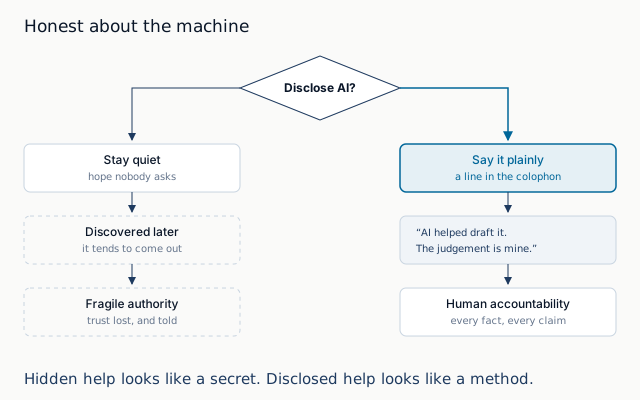
There are practical reasons. Some publishing platforms require disclosure of AI-generated content, and their rules are tightening rather than loosening. Readers increasingly assume AI involvement in published material and are more troubled by concealment than by the use itself. A client who discovers, after the fact, that their book service used AI tools without telling them is likely to feel misled, even if the book is excellent.
There are also principled reasons. An authority book is a statement of trust: the author is telling the reader that this is what they know and believe. That statement is compatible with assistance in drafting, in the same way it has always been compatible with editors, researchers and ghostwriters. It is not compatible with pretending the process was something it was not. Authority built on a concealment is fragile, and the concealment tends to come out.
Honesty here does not require a lengthy confession. A sentence in the colophon or introduction is enough: This book was produced with the help of AI drafting tools; its content, judgement and final text are the author's own. For client books, be clear in your service description and contract about how the book is produced, and recommend that clients include a similar note. Most clients appreciate the clarity.
Keep human accountability central. The point of disclosure is not merely to inform but to make clear who is responsible. The author is responsible for every fact, every opinion and every recommendation in the book. If an entry is wrong, the author is accountable, not the tool. That accountability is what makes the book trustworthy, and it is why the editing and fact-checking stages described earlier matter so much.
Be honest with clients about the speed, too. If AI-assisted production lets you deliver a book faster than they expected, tell them, and explain where the saved time goes: into better interviews, more careful editing, more revisions, richer editions. Clients are paying for the finished asset and your expertise in producing it, not for hours of typing. Clear explanations of value hold up far better than mystique.
There will be people who disapprove of any AI involvement in writing. Some of them will be in your market. Being honest means accepting that a few prospects may decide against you on those grounds. That is a fair outcome. Concealment would merely postpone their discovery, and cost you their trust and that of everyone they tell.
The Authority Book — How a 100-entry book wins clients
Ready when you are.
Tap below to open the full chapter in the book reader. Anchored books jump to this chapter automatically.
What the Book Cannot Do
The Authority Book — How a 100-entry book wins clients
After ninety-eight chapters on what an authority book can do, it is worth being clear about what it cannot. Overestimating the book leads to disappointment, and disappointment leads to abandoning a useful asset because it failed to do something it was never designed to do.
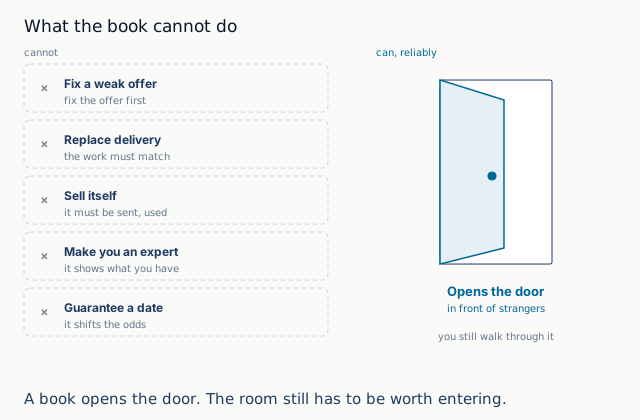
A book cannot fix a weak offer. If your services are poorly defined, overpriced for what they deliver, or aimed at buyers who do not need them, a book will not change that. It may even expose the weakness, by attracting readers who then discover a mismatch between the book's promise and your actual services. Fix the offer first, or at least alongside the book.
A book cannot replace delivery. It wins trust, and trust gets you hired, but the client then experiences your actual work. If the work does not match the book, the trust evaporates and often turns into resentment. The book raises expectations; delivery must meet them. This is one more reason the book should reflect what you genuinely do, not an idealised version.
A book cannot sell itself. It needs to be sent, mentioned, linked, serialised and used in conversations. A book that sits on a website waiting to be discovered will be discovered slowly, if at all. Most of its value comes from active use in the sales process, which is why so much of this guide concerns distribution and sales rather than writing.
A book cannot make you an expert. It makes visible the expertise you have. If that expertise is thin, the book will be thin, and readers will notice. The method in this guide can help you organise, express and publish what you know, but it cannot supply the knowledge. That comes only from experience.
And a book cannot guarantee a particular result in a particular time. It shifts the odds. It makes prospects warmer, calls shorter, decisions faster, and your expertise more visible. Over months and years, those shifts add up to more clients and better ones. But no book produces a guaranteed number of clients by a guaranteed date, and anyone who promises otherwise is selling something other than books.
What the book can do, reliably, is open the door: put your thinking in front of people who would otherwise never encounter it, in a form they can assess, keep and share. That is a modest-sounding claim and a very valuable one. Most experts have no door at all, only the hope that someone will knock.
The Authority Book — How a 100-entry book wins clients
Ready when you are.
Tap below to open the full chapter in the book reader. Anchored books jump to this chapter automatically.
The Book Is the Handshake
The Authority Book — How a 100-entry book wins clients
Here is the whole book in one sentence: the book is the handshake before the meeting. Everything else, the niche and the promise, the hundred entries and their structure, the agents and the voice files, the diagrams and the editions, the launch and the sales conversations, is machinery for making that handshake happen with the right people, in your voice, before you are in the room.
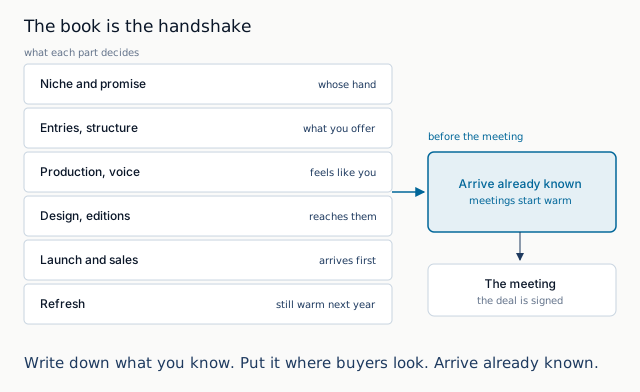
Buyers decide before they call. That was true before anyone wrote an authority book and it will remain true long after the current tools have been replaced. They form a view of you from whatever they can find, and they bring that view to the first meeting. If they can find nothing, the meeting starts cold and you spend it introducing yourself. If they can find a hundred useful, specific, generous entries that describe their problem better than they could and show how you think about it, the meeting starts warm. They already know you. They have already shaken your hand.
That is what the book is for. Not fame, not royalties, not the satisfaction of being an author, although some of those may follow. It is for being known by the people who need you, at the moment they need you, without you having to be there. It is for turning expertise that lives in your head, your inbox and your calls into something strangers can find, test and trust.
The parts of this guide fall along that line. Choosing the niche, the promise and the angle decides whose hand you are reaching for. Finding and structuring the entries decides what you offer them. Producing the book with care, in your own voice, decides whether the handshake feels like you. Design and editions decide whether it reaches them in a form they can use. Launch, distribution and sales decide whether it arrives before the meeting rather than after. And the refresh decides whether the handshake is still warm next year.
None of this replaces the meeting. The meeting is still where the deal is made, the details are settled, and the relationship begins. But the meeting is the most expensive place to start a relationship, and the least efficient place to demonstrate expertise. The book moves that work earlier, to a place where it costs you nothing each time it happens and can happen a thousand times at once.
So start this week. Write the promise line. List the questions clients ask you. Write one entry, properly, in your own voice. Send it to one person who would find it useful, with a note saying why you thought of them. Then do it again. A hundred entries is a book. A book in the right hands is a handshake. And a handshake before the meeting is the quietest, most reliable advantage an expert can have. The meeting is where the deal is signed. The book is where it is decided.
The Authority Book — How a 100-entry book wins clients
Ready when you are.
Tap below to open the full chapter in the book reader. Anchored books jump to this chapter automatically.