The Unbothered Machine cover
New book · A5 PDF + EPUB + Machine Kit

The Unbothered Machine

How one person runs a hundred apps with AI agents (and stays calm about it)

The operating manual for a company of one, staffed by AI agents. Written by someone running it: a skills canon, accountable agents, a control plane and an app factory, all run by one person who refuses to be rushed. Not a list of tools. A system.

  • 100 chapters in 10 parts, each with its own diagram
  • By Part 4: a goal, a scoreboard, a memory and your first three skills
  • By the end: a machine that tells you each morning what it did
  • The Machine Kit: 10 ready-to-use templates, from one-goal sheet to scale/hold/kill

Start free with chapters 1–5. The full book is one payment of £9, instant download, no account needed. By Mat Siems.

What's inside

  1. Part 1
    The Ground Floor

    Why one person needs a machine

  2. Part 2
    One Goal

    The 1G and the revenue ladder

  3. Part 3
    Context Is Capital

    Memory, vault and the private record

  4. Part 4
    Skills Are Recipes

    Writing procedures agents can follow

  5. Part 5
    Agents With Job Titles

    Accountability, contracts, machines

  6. Part 6
    The Control Plane

    Seeing the whole machine

  7. Part 7
    The App Factory

    Idea to deployed micro-app

  8. Part 8
    Money and Distribution

    Getting paid by strangers

  9. Part 9
    The Operating Rhythm

    Daily loops and decisive pruning

  10. Part 10
    The Frontier

    From machine to ecosystem

Three chapters to read online

Chapter 1. You Are the Bottleneck
You Are the Bottleneck

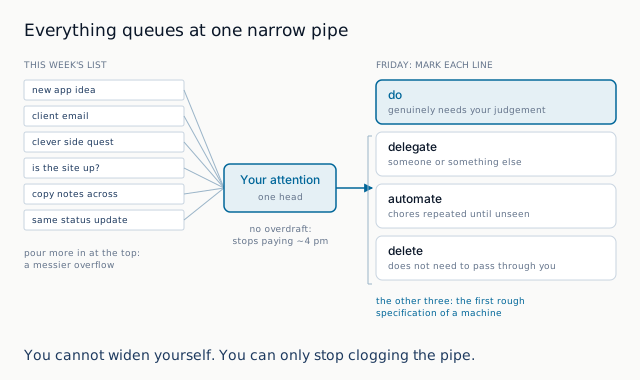
Everyday demands queue through one narrow pipe of attention, then get sorted: do, delegate, automate, delete.

Ideas are not your problem. You have a notes app full of them, a voice memo from the shower, three domain names bought at midnight and a half-built prototype that was going to change everything in March. Ideas arrive like weather. Nobody has ever run short.

What you run short of is attention. Not time, exactly; you could find another hour if you stopped refreshing things. Attention is the scarcer stuff: the capacity to hold one problem in your head long enough to finish it. A solo builder has one head. Every project, every client email, every clever side quest draws on that single account, and the account does not do overdrafts. It simply stops paying out, usually around four in the afternoon, and you call it tiredness.

This is the real constraint, and it is worth stating plainly because most advice gets it backwards. Productivity culture tells you to generate more: more ideas, more output, more content. But if attention is the narrow pipe, pouring more in at the top only makes the overflow messier. The useful question is not "what else could I do?" but "what must pass through me, and what could pass through something else?"

The bottleneck is not a flaw in the system. It is the system's most expensive component, and you are it.

So treat yourself like an expensive component. This week, keep a plain list of everything that required your attention, each item a line, nothing clever. On Friday, read it back and mark each line with one of four words: do, delegate, automate, delete. The do pile is what genuinely needs your judgement. The rest is the first rough specification of a machine. You will find, as I did, that a startling share of the list is chores you have repeated so often you stopped seeing them: checking whether a site is up, copying notes from one place to another, writing the same status update in slightly different words.

That list is where ABC, the system this book describes, began. Not with a grand architecture, but with a mild irritation at being the only thing in the building that could do anything. Every later part of the machine — the agents, the skills, the dashboard — exists to protect one narrow pipe from things that do not need to go through it. You cannot widen yourself. You can only stop clogging the pipe.
Chapter 42. The Contract Is the Agent

The Contract Is the Agent

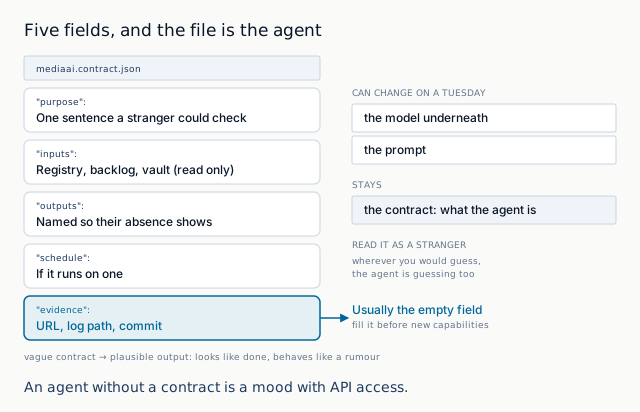
The five-field agent contract, with evidence as the field most often left empty.

People imagine an agent as a personality: a helpful voice that knows things and does them. In practice the useful part of an agent is much less charming. It is a contract. A small JSON file that says what this thing is for, what it takes in, what it hands back, and what proof it leaves behind when it claims to have finished.

Mine look roughly the same across the fleet. A purpose, written as one sentence a stranger could check. Inputs, listed by where they live: a registry file, a backlog, a folder in the vault it may read but not touch. Outputs, named precisely enough that their absence is noticeable. A schedule, if it runs on one. And evidence: a URL, a log path, a commit, something a sceptical person could open. The model underneath can change. The prompt can be rewritten on a Tuesday. The contract is what stays, and so the contract is what the agent actually is.

This is liberating in a slightly austere way. You no longer argue with a vibe. If MediaAI produced something odd, you do not ask it how it feels about that. You open the contract and ask which line it broke. Usually the answer is that the contract was vague, and the agent, being obliging, filled the vagueness with something plausible. Plausible is the most expensive word in automation. It looks like done and behaves like a rumour.

So here is the exercise. Pick the agent, script, or scheduled prompt you already lean on most, the one you would miss first if it stopped. Write its contract. Five fields, no more: purpose, inputs, outputs, schedule, evidence. Put it in a file next to the code, not in your head and not in a chat thread that will scroll away by Thursday. Then read it as if you were the agent and had never met you. Wherever you would have to guess, the agent is guessing too.

You will find at least one field you cannot fill. Commonly it is evidence, because most automation was built to do the thing and never to prove it did. That gap is the most valuable thing you will discover this week. Fill it before you add a single new capability.

An agent without a contract is a mood with API access. Write the contract, and the mood becomes staff.

Chapter 82. Do, Delegate, Automate, Delete

Do, Delegate, Automate, Delete

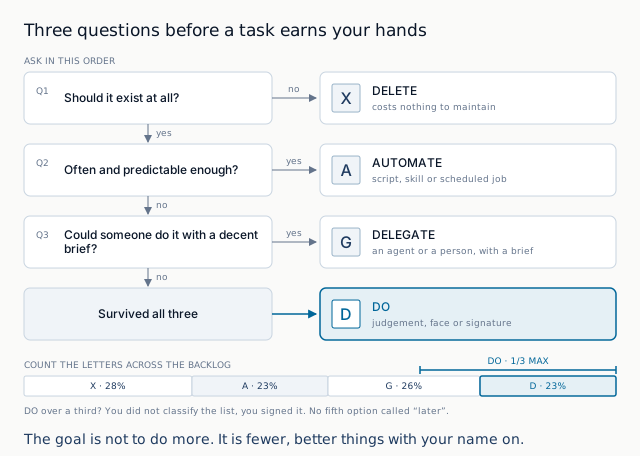
Three questions in order sort each task into Delete, Automate, Delegate or Do, with a one-third cap on Do.

There are four things you can do with a task, and only one of them involves you doing it. This is the most useful arithmetic in the book, and it is not even difficult arithmetic. It is just arithmetic people refuse to perform because the answer is rude.

Every item in my backlog gets one of four labels. DO means it needs my judgement, my face or my signature, and nobody else can supply those. DELEGATE means a capable agent or person could do it with a decent brief. AUTOMATE means it happens often enough and predictably enough that it should become a script, a skill or a scheduled job. DELETE means it should not exist. The labels are not tags for decoration. They decide where the item goes next, and who is allowed to touch it.

Most people run on a default of DO. A task appears, so they do it. This is how you end up at forty-three, extremely competent at renaming files. The default should run the other way. Ask first whether the thing should be deleted, because a task that does not exist costs nothing to maintain. Then ask whether it can be automated, because a job that runs itself at half seven every morning is better than any employee. Then ask whether it can be delegated. Only what survives all three questions earns your hands.

DELETE is the label that hurts, which is why it works. The weekly report nobody reads. The integration you built for a tool you stopped using. The newsletter you subscribed to out of guilt. Each of these has a small, steady cost in attention, and attention is the only currency the solo builder is truly short of. Deleting is not laziness. It is capital allocation with a bin. AUTOMATE has its own trap: automating something that should have been deleted. A beautifully orchestrated pipeline that produces nothing anyone wants is still a waste, only now it is a waste with uptime. Run the questions in order. Delete before you automate, automate before you delegate, delegate before you do.

The practice is simple. Go through your backlog this week, every item, and give each one a single letter: D, G, A or X. Do not allow yourself a fifth option called "later". Count the result. If more than a third of your list is marked DO, you have not classified it; you have just signed it. Go round again and be less flattering to yourself. You will find, in the end, that the work you actually do gets smaller and better. Smaller because you have stopped doing everything. Better because the things left are the ones only you can do, and you are no longer too tired to do them well.

The goal is not to do more. The goal is to be the person whose name is on fewer, better things.

Want the rest?

On sale Friday 9 October · £9

Questions

Can I try it first?
Yes. Download the first five chapters as a free PDF, no email needed. If you like them, the full book is one payment on Gumroad.
What formats do I get?
A print-ready A5 PDF (225 pages), an EPUB for Kindle, Apple Books and Kobo, and the Machine Kit: ten Markdown and JSON templates. All download straight after checkout.
Do I need to be technical?
It helps to be comfortable with a terminal and GitHub, but the ideas work at any level. If you already use ChatGPT or Claude daily, you are the reader it was written for.
What if it isn't for me?
Email within 30 days for a full refund, no questions asked.
How was it written?
With the machine it describes. Mat set the goal, the outline and the rules; agents drafted, illustrated and laid it out with the Book-a-Day skill from Chapter 35.
Roll the dice